Blog

  • Tunisia in April: Weather, Sea & What to Expect

    Tunisia in April: Weather, Sea & What to Expect

    By the Tunisia Tourism Guide team · Last updated 2 July 2026 · We don’t sell tours or take hotel commissions — this is independent advice.

    If we had to pick a single month to send a first-time visitor to Tunisia — someone who wants to see the Roman ruins, spend a night in the Sahara and still enjoy some sun without frying — April would be near the top of the list. Yet people hesitate over it, usually worrying it’ll be too cold, or that the sea won’t be swimmable, or that the Easter school holidays will make it a scrum. So let’s settle it.

    Here’s the honest verdict. Tunisia in April is one of the best months of the year to visit, with warm, largely dry spring days averaging around 22°C, long sunshine hours, wildflowers and near-perfect touring conditions for the Roman sites and the Sahara. The one catch is the sea: at roughly 17–18°C it’s warming but still brisk for a proper swim.

    In other words, if your holiday is about sightseeing, exploring and getting good value before the summer heat and prices arrive, April is close to ideal. If it’s strictly about long days swimming in a warm sea, you’ll want to wait a little longer. Below we’ll walk through exactly what to expect — early versus late April, day and night temperatures, how realistic swimming is, rain and daylight, crowds and the Easter effect, the best regions, and what to pack. If you’re comparing months, our full best time to visit Tunisia guide sets April against the rest of the calendar.

    Tunisia in April at a glance

    A quick snapshot before the detail. These are coastal averages for the Hammamet–Sousse belt where most UK visitors stay; spring can still vary year to year, so check the forecast closer to your dates.

    What to expect April on the coast
    Average daytime high Around 22–24°C
    Average overnight low Around 12–15°C
    Sea temperature Around 17–18°C — warming, but brisk for a full swim
    Rainfall Low; often only a day or two of rain all month
    Daylight Around 13 hours; sun setting near 7pm by late April
    Crowds & prices Quiet, apart from an Easter-week bump; still good value

    The short version: pack for pleasantly warm days and mild evenings, with barely any need to worry about rain, and you’ll have the country’s best sights in comfortable weather and light crowds.

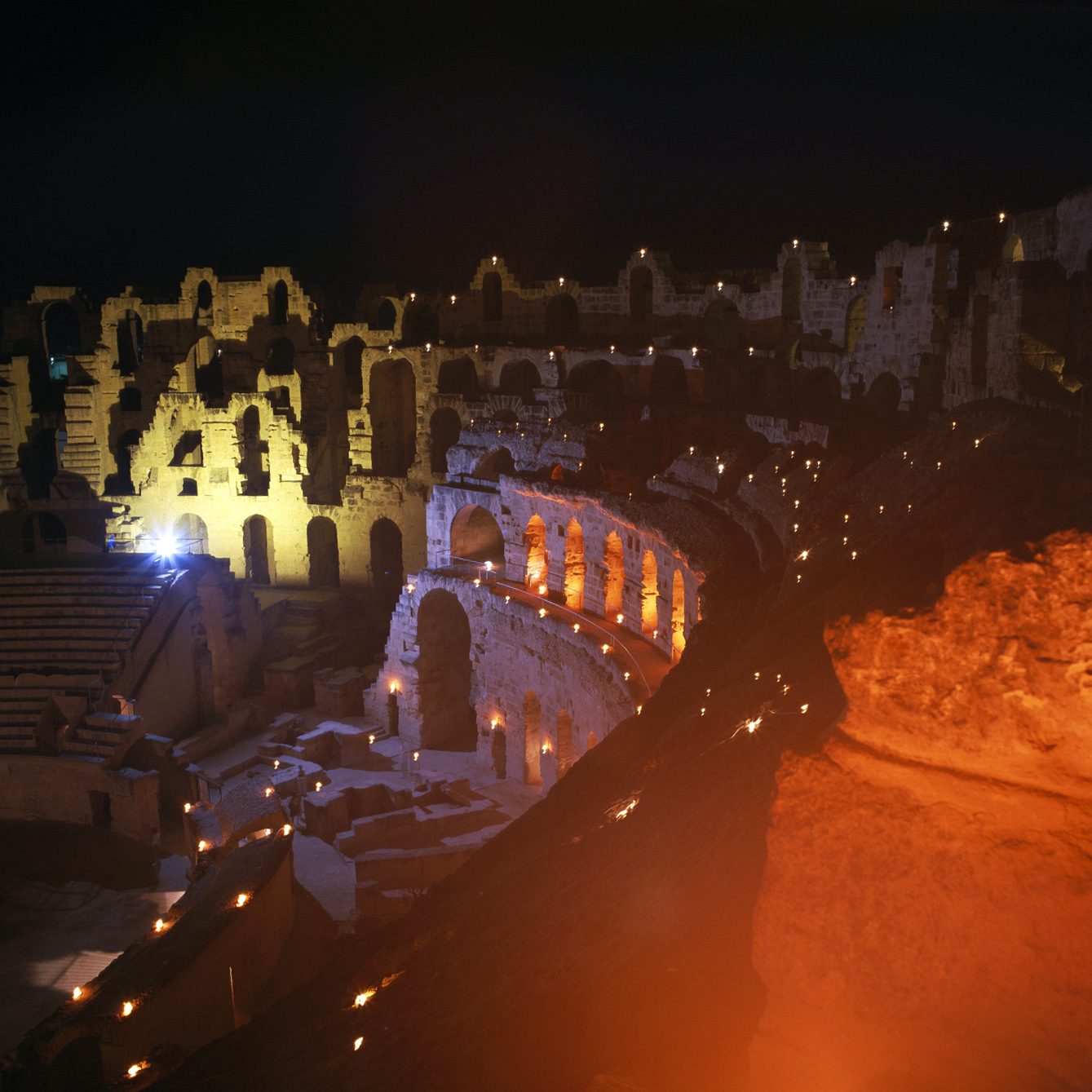
    The Roman amphitheatre at El Djem, Tunisia — the vast preserved arena and arches under bright spring sunshine

    Is Tunisia warm in April?

    Yes — comfortably so, and that’s exactly what makes it such a good touring month. Coastal daytime highs average around 22°C, sometimes nudging 24°C, with the kind of long, bright, dry days that make being outdoors a pleasure rather than an endurance test. It’s the first month where the summer’s warmth starts to show its hand, but without the fierce heat of July and August that turns a walk round a Roman site into hard work.

    Evenings are mild rather than balmy. Once the sun goes down the temperature eases to around 12–15°C — pleasant enough to sit out with a light layer, cooler than a Mediterranean summer night but a world away from the chill of early spring. You’ll want a jumper or light jacket for the evenings and, if you’re heading inland or into the desert, something warmer still.

    There’s a noticeable difference between the start and end of the month, which the averages smooth over — and it’s worth knowing when you’re choosing your week.

    Early April versus late April

    Early April still carries a little of March’s freshness. Days are warm and mostly dry, but the odd cooler, breezier spell can appear, and evenings have more of a nip. It’s lovely for sightseeing, just not quite shorts-all-evening weather.

    By late April the season has properly turned. Days are reliably warm, the light stretches out towards a 7pm sunset, and the whole country feels summery-in-waiting — greener, brighter and buzzier. The sea is at its warmest for the month by then, too, though still on the cool side. If you have a choice and want the warmest, longest days, the back half of April is the sweet spot. And if you’re weighing April against the month before, our guide to Tunisia in March lays out how the two compare.

    Can you swim in Tunisia in April?

    You can — but you’ll feel it. This is the honest caveat on an otherwise near-perfect month. The Mediterranean warms up slowly, lagging well behind the air, so even as afternoons hit the low 20s the sea is only around 17–18°C in April. That’s brisk: cool enough to make you gasp on the way in, and too cold for most adults to want a long, relaxed swim.

    That said, it’s a different story from March’s genuinely cold water. Plenty of people — especially children, who seem impervious to it, and anyone used to British seas — will happily splash about, and once you’re in and moving on a sunny day it’s perfectly bearable for a quick dip. Hotel pools, many of them heated, pick up the slack for proper swimming. So April is swimmable in the sense that a hardy family can enjoy the beach and the shallows; it’s not swimmable in the sense of long, warm-water lounging. If a genuinely warm sea is the whole point of your trip, you’ll want later in the season — our Tunisia beaches guide explains when the water really warms up.

    The upside of April’s cooler sea is everything else: the beaches are clean, uncrowded and lovely for walking, the light is beautiful, and you can happily combine a coastal base with the sightseeing that April does so well.

    Rain, daylight and sunshine in April

    April is one of the driest and sunniest months of the Tunisian spring. Rainfall drops right back — many years bring only a day or two of rain across the whole month — so the chance of a washed-out day is low, and you can plan excursions with real confidence. It’s a marked improvement on the showery edges of March.

    Daylight is generous, too. By April you’re looking at around 13 hours of it, with the sun not setting until close to 7pm by the end of the month and plenty of bright sunshine hours in between. That combination — long days, dry weather, comfortable warmth — is exactly why April is such a productive sightseeing month: you can fit a lot into a week without ever feeling rushed or overheated. Add the wildflowers that carpet the countryside and even the desert fringes after the winter rains, and the landscapes are at their most photogenic.

    Crowds, prices and the Easter effect

    For most of April, Tunisia is still enjoyably quiet and good value — you’ll find the big sights uncrowded and prices well below the summer peak. There’s one exception to plan around: Easter.

    Easter falls in spring, but its exact date moves each year — sometimes late March, sometimes well into April — so it doesn’t land in the same week annually. When it does fall in April, it brings a noticeable bump in demand: UK and European school holidays send more families abroad, and Tunisia’s resorts and flights get busier and dearer for that stretch. It’s nothing like the summer crush, but if your dates coincide with the Easter break, expect to book earlier and pay a little more, and the resorts to feel livelier. (Check exactly when Easter falls for your year of travel and decide for yourself: ride the buzz or dodge it.)

    Outside that Easter window, April keeps the best of the shoulder season: calm sites, available restaurant tables, less vendor hassle and keen prices. The great Roman monuments — El Djem, Carthage, Dougga — reward an April visit precisely because you can wander them in warm, dry weather without the coach parties, which in high summer is a rare luxury. Our guide to the Roman ruins in Tunisia picks out the ones most worth your time.

    Sidi Bou Said near Tunis, bright and blooming in April

    April region by region

    April flatters just about every part of Tunisia, but each region has its own case to make. Here’s how to choose your base.

    Hammamet and Sousse — the all-rounder base

    The familiar UK resort belt around Hammamet and Sousse is the natural pick for a first April trip. You get warm, dry days for lounging and beach walks, a sea that the brave (and the kids) can dip into, and — crucially — the best transport links for day trips. El Djem is an easy excursion, Sousse’s walled medina is on the doorstep, and the capital is within reach. Many hotels here have heated pools and spas to make up for the cool sea, so it’s an easy, comfortable base that keeps every option open.

    Djerba — warm, bright and relaxed

    The southern island of Djerba tends to run a touch warmer, drier and brighter than the northern coast, which makes it a lovely April choice for reliable sunshine and a slower pace. The sea is still brisk, but the island’s flat lanes are made for cycling between whitewashed villages, and the light is glorious. It’s the pick if you want the warmest, sunniest weather April can offer and are happy to fly into Djerba directly.

    Tunis and Carthage — culture in perfect weather

    April is arguably the finest month for the capital. Tunis in spring is warm but never oppressive, ideal for exploring the medina, the mosaic-filled Bardo Museum, and the sea-fringed ruins of Carthage just outside the city. The blue-and-white cliff-top village of Sidi Bou Said is at its prettiest in April’s light and warmth, before the summer crowds descend. Pair a couple of days here with a coastal base and you’ve got the best of both.

    The Sahara at Tozeur and Douz — near-perfect timing

    If you want to see the desert, April is close to the ideal moment. The Sahara around Tozeur and Douz is in the last, comfortable stretch of its touring season — which runs roughly October to April, because summer out there is dangerously hot, often 40°C and beyond. In April the desert days are warm and sunny but not yet brutal, perfect for camel treks, 4×4 runs across the vast Chott el Jerid salt flats and visits to the mountain oases and film sets. Nights are milder than in deep winter but can still be cool, so bring a layer for a desert camp. After the spring rains you may even catch wildflowers blooming among the dunes. It’s one of Tunisia’s great experiences — our Tunisia Sahara desert guide covers how to do it, and film fans should see our Star Wars filming locations guide, since several sets sit out this way. If you leave a desert trip much later than April, the rising heat starts to close the season.

    The Roman city of Dougga (Thugga), Tunisia — the Capitol and colonnades on the green hillside, showing spring wildflowers and greenery

    What to do in Tunisia in April

    April’s warm, dry, long days open up practically the whole country. A shortlist of what works best this month:

    • Tour the Roman ruins. El Djem, Carthage, Dougga and Bulla Regia in comfortable spring warmth, still refreshingly uncrowded outside Easter week.
    • Spend a night in the Sahara. This is the tail end of the desert season and a superb time for a camel trek and a night under the stars at Douz or Ksar Ghilane.
    • Explore Tunis and Carthage. The Bardo mosaics, the medina, Sidi Bou Said and the Carthage ruins make a rich two- or three-day cultural run in perfect weather.
    • Enjoy the beach — as scenery. Warm, dry days for sunbathing and long walks; a dip for the hardy, with heated pools for proper swims.
    • Wander the medinas. Sousse and Kairouan’s old quarters are a pleasure to explore before the summer heat and crowds.
    • Chase the wildflowers. Spring blooms across the countryside and desert fringes make April a photographer’s month.
    • Eat well. Warm-but-not-hot weather is made for long lunches — our Tunisian food guide points you at the best of it.

    For the full range of options, browse our things to do in Tunisia guide, and if you’d like a ready-made route that strings the highlights together, the Tunisia itinerary guide does the planning for you. April’s mild weather and long days make it an especially good month to combine a beach base with two or three excursions.

    What to pack for Tunisia in April

    Pack for warm days and mild evenings, with a nod to the odd cooler spell and the cold desert nights. The essentials:

    • Light, warm-weather clothes. T-shirts, shorts and summer dresses for the daytime.
    • A jumper or light jacket. For mild evenings, which still cool off after dark.
    • Sun protection. The spring UV is stronger than it feels — bring sun cream, sunglasses and a hat.
    • Comfortable walking shoes. You’ll cover ground at ruins, medinas and in the desert.
    • A swimsuit. For the beach (if you’re hardy), and for the hotel’s heated pool and spa.
    • Warm layers for the desert. A fleece, hat and closed shoes if you’re overnighting in the Sahara.
    • A light rain layer. Rare in April, but a packable jacket covers the occasional shower.
    • Modest options. Handy for visiting mosques and religious sites; see our Tunisia travel tips for the etiquette.

    Who April suits — and who it doesn’t

    April is one of the most broadly appealing months, but it still pays to match it to the traveller.

    April is great for… April is less ideal for…
    Sightseers wanting warm, dry weather and long days Anyone set on long swims in a genuinely warm sea
    History lovers touring the Roman ruins Sun-worshippers wanting to bask in peak-summer heat
    Sahara-curious travellers (near the end of desert season) Party-goers after a full-on summer resort scene
    Families happy with a brisk sea and heated pools Those needing warm-sea beach days above all else
    Value-hunters (outside the Easter-week bump) Travellers wanting to avoid busy Easter school-holiday crowds
    Walkers and photographers loving green, flowering landscapes

    Is Tunisia safe to visit in April? Yes — as in any month. The resorts and tourist sights sit well away from the border and mountain zones the Foreign Office flags, and April’s easy weather makes for a relaxed, straightforward trip. For the full, date-stamped picture, see our guide to whether Tunisia is safe.

    April compared to March and May

    April sits at the heart of Tunisia’s spring, and seeing how it compares either side helps you pin down your dates.

    Versus March: April is the warmer, drier, sunnier upgrade. March is lovely for touring too, and it’s cheaper and greener, but it’s cooler, has a colder sea, more showers and — in 2027 — an overlap with Ramadan. April carries all of March’s strengths (empty ruins, prime late-desert season, low-ish crowds) and adds more warmth, longer light and a slightly less-cold sea. If you can travel a few weeks later than March, April usually rewards you for it.

    Versus May: May pushes things on again — warmer still, with a sea that’s finally edging towards genuinely swimmable, and it’s often cited alongside June as the pick for beach-and-sun trips. If a warm sea is your priority, May has the edge over April. What April holds over May is that it’s typically a touch quieter and cheaper (Easter week aside), the touring temperatures are arguably even more comfortable than late-spring warmth, and the wildflowers are at their peak. For sightseeing and value, April is hard to beat; for swimming, later spring wins.

    Tunisia in April: your questions answered

    Is Tunisia warm in April?

    Yes — pleasantly so. Coastal daytime highs average around 22°C, sometimes nudging 24°C, with long, mostly dry, sunny days that are ideal for sightseeing. Evenings are milder, dropping to around 12–15°C, so you’ll want a light layer after dark. It’s warm without the fierce heat of high summer, which makes April one of the best touring months.

    Can you swim in the sea in Tunisia in April?

    You can, but it’s brisk. The sea sits at roughly 17–18°C in April — warming, but still cool enough to make most adults gasp on the way in and think twice about a long swim. Children and hardy swimmers will happily splash about on a sunny day. For proper warm-water swimming, wait for later spring, or rely on heated hotel pools.

    Is April a good time to visit Tunisia?

    It’s one of the best. April brings warm, largely dry days, long daylight hours, wildflowers and near-perfect conditions for the Roman ruins and the Sahara, with crowds still light outside Easter week and good value. The only real caveat is a sea that’s warming but still brisk. For sightseeing, exploring and value before the summer heat, April is hard to beat.

    Does it rain much in Tunisia in April?

    Very little. April is one of the driest spring months, often bringing only a day or two of rain across the whole month, so the risk of a washed-out day is low and excursions are easy to plan. A packable rain layer covers the occasional shower. The dry, sunny weather is a big part of what makes April such a strong touring month.

    What is the sea temperature in Tunisia in April?

    Around 17–18°C along the main coast at Hammamet, Sousse and Djerba. That’s warmer than March but still brisk — the Mediterranean warms slowly, lagging behind the air. It’s fine for a quick dip on a sunny day, especially for children, but too cool for most adults to enjoy a long, relaxed swim. The water keeps warming into late spring.

    Is Tunisia busy at Easter?

    Busier than the rest of April, yes. Easter’s date moves each year and doesn’t always fall in April, but when it does, UK and European school holidays bring more families and push resort and flight prices up for that week. It’s far from the summer crush, but if your dates coincide, book earlier, expect livelier resorts, and pay a little more.

    What should I pack for Tunisia in April?

    Pack for warm days and mild evenings: light summer clothes, plus a jumper or light jacket for after dark. Add sun protection, comfortable walking shoes, and a swimsuit for the beach or heated pools. If you’re doing a desert night, bring warm layers for cool Sahara nights, and a packable rain layer for the rare shower.

    Can you do a desert tour in Tunisia in April?

    Yes — April is near-ideal, at the comfortable tail end of the desert season. The Sahara around Tozeur and Douz is warm and sunny by day, perfect for camel treks and 4×4 salt-flat excursions, before the summer heat makes tours unbearable. Nights are milder than in winter but can still be cool, so pack a warm layer for overnight camps. You may even catch desert wildflowers.

    Is April warmer than March in Tunisia?

    Yes, noticeably. April’s coastal highs average around 22°C against March’s 18–20°C, with drier weather, longer daylight and a slightly warmer (though still brisk) sea. Evenings are milder too. Both are excellent touring months, but April is the warmer, sunnier, drier of the two — and, unlike March 2027, it falls clear of Ramadan.

    Is April good for the Roman ruins in Tunisia?

    Excellent. Warm, dry spring weather makes walking sites like El Djem, Dougga and Carthage a genuine pleasure, and outside Easter week you’ll often have them refreshingly uncrowded. It’s far more comfortable than the summer heat and less showery than early spring — arguably the finest all-round month to explore Tunisia’s Roman heritage.

    Is the weather better in April or May in Tunisia?

    It depends what you want. May is warmer, with a sea edging towards genuinely swimmable, so it wins for beach-and-sun trips. April is a touch cooler and often quieter and cheaper (Easter aside), with peak wildflowers and arguably more comfortable touring temperatures. For sightseeing and value, April; for a warmer sea and beach days, May has the edge.

    Is Tunisia cheaper in April?

    Mostly, yes. For most of April, shoulder-season prices keep flights and hotels well below the summer peak, and Tunisia’s low cost of living keeps meals, taxis and excursions cheap on the ground. The exception is Easter week, when demand and prices rise. Travel outside that window and April combines fine weather with strong value.


    Written by the Tunisia Tourism Guide team — an independent UK-focused guide to travelling in Tunisia. We don’t sell tours or take hotel commissions. Weather figures are climate averages and dates such as Easter and Ramadan shift each year; always check current forecasts and confirm dates before you book.

    Photo credits

    All images via Wikimedia Commons, used with thanks: The Roman amphitheatre at El Djem © Agnieszka Wolska (CC BY-SA 3.0); Sidi Bou Said near Tunis © Rene Cortin (CC BY-SA 4.0); The Roman city of Dougga (Thugga) © IssamBarhoumi (CC BY-SA 4.0).

  • Tunisia in March: Weather, Sea & What to Expect

    Tunisia in March: Weather, Sea & What to Expect

    By the Tunisia Tourism Guide team · Last updated 2 July 2026 · We don’t sell tours or take hotel commissions — this is independent advice.

    Every spring we get the same run of emails. Someone’s spotted a cheap late-winter deal, or they fancy escaping the tail end of a grey British March, and they want to know one thing: what’s Tunisia actually like at that time of year? Will it be warm? Can you swim? Is it worth going before the summer crowds turn up? The honest answer is that March is one of the most rewarding — and most misunderstood — months to visit, and it pays to know exactly what you’re booking.

    So here’s the straight version. Tunisia in March is a lovely time for sightseeing, with comfortable spring days averaging around 18–20°C on the coast and green, wildflower-strewn landscapes. But it isn’t a beach holiday: the sea sits at roughly 15–16°C, too cold for swimming, and nights are cool. Come for the ruins, the Sahara and the value.

    That’s the trade-off in a sentence. Below we’ll unpack it properly — early March versus late March, day and night temperatures, how realistic swimming is, rain and daylight, how busy it is, the best regions to base yourself, and one thing that genuinely shapes a March 2027 trip: Ramadan. If you’re still weighing up which month suits you, our full best time to visit Tunisia guide sets March in context against the rest of the year.

    Tunisia in March at a glance

    If you only skim one thing, make it this. These are coastal averages for the Hammamet–Sousse belt, where most UK visitors stay — always worth checking the current forecast a week or two out, because spring can swing.

    What to expect March on the coast
    Average daytime high Around 18–20°C
    Average overnight low Around 10–11°C
    Sea temperature Around 15–16°C — too cold for most swimmers
    Rainfall Low-to-moderate; a handful of showery days
    Daylight Roughly 11–12 hours, lengthening through the month
    Crowds & prices Quiet and cheap — well below summer rates

    In plain terms: pack for a mild British spring rather than a Mediterranean summer. You’ll want a jumper for the evenings and something waterproof, but you’ll also get plenty of bright, warm afternoons that are perfect for being out and about.

    The Roman amphitheatre at El Djem, Tunisia — the great honey-coloured arena and tiered arches, ideally in clear spring light

    Is Tunisia hot in March?

    No — and it’s better for it, if sightseeing is your plan. “Hot” isn’t the word for Tunisia in March. “Pleasant” is. Coastal highs hover around 18–20°C, which is roughly the temperature of a good English June day, and there’s a lot of sunshine to go with it. That’s close to ideal for walking Roman sites, wandering souks or riding a camel into the dunes without wilting in the heat — the kind of touring that becomes genuinely uncomfortable in July and August.

    The catch is the gap between day and night. Once the sun drops, the temperature falls away quickly to around 10–11°C, and it can feel colder still with a breeze off the sea. This is a place where you’ll be in shirtsleeves at lunchtime and reaching for a fleece by nine. It’s not cold — it’s just not the balmy evening you might be picturing.

    There’s also a real difference between the start and the end of the month, which the monthly averages hide.

    Early March versus late March

    Early March still has one foot in winter. The first week or two can throw up cooler, greyer, breezier days — highs closer to 16–17°C, the odd band of rain, and a sea that’s about as cold as it gets all year. It’s perfectly fine for touring under a jacket, but you wouldn’t call it a sun holiday.

    By late March the mood shifts. Days lengthen noticeably, the light softens, afternoons more reliably nudge 19–20°C, and the whole country feels like it’s exhaling into spring. If you have a choice of dates and warmth matters to you, aim for the back half of the month — it’s the difference between “pleasant with layers” and “genuinely lovely.” And if late March suits you, our guide to Tunisia in April is worth a look too, since the seasons blur at the edges and April simply builds on everything March starts.

    Can you swim in Tunisia in March?

    Honestly? Not comfortably, and not for long. The Mediterranean holds onto winter’s chill well after the air warms up, and in March the sea off Hammamet, Sousse and Djerba sits at roughly 15–16°C. That’s cold — bracing enough to knock the breath out of you and far too cold for a relaxed swim or a lazy afternoon in the shallows. Hardy souls and cold-water swimmers will manage a quick dip, especially when the sun’s out and the water feels a touch warmer than it is, but for most people it’s a paddle at best.

    This is the single most important thing to grasp about a March trip. If your holiday is really about lying on a beach and swimming in a warm sea, March will disappoint you, and you’d be better off looking at late spring or our rundown of when the water actually warms up in the Tunisia beaches guide. But if you think of the coast as a scenic backdrop — long empty sands to walk, sea air, a hotel with a heated indoor pool and a spa — then March delivers something quieter and, in its own way, more relaxing than the peak-season scrum.

    Plenty of the bigger resorts run thalassotherapy centres and heated pools precisely because the shoulder seasons are their bread and butter. A March trip built around a spa hotel, day excursions and long walks is a genuinely good holiday. A March trip built around sunbathing is a gamble you’ll usually lose.

    Rain, daylight and what the sky actually does

    March is a drying-out month. It’s not one of the wettest — those are December through February — but you should still expect a few showery days spread across the month, often short and sharp rather than all-day washouts. The upside of all that late-winter rain is what it does to the landscape: after the wet season, inland Tunisia turns green, hillsides flush with grass and the first wildflowers appear, especially down towards the south. It’s one of the prettiest times to see the country, and a world away from the parched gold of high summer.

    Daylight stretches out through the month too. You’ll get somewhere around 11–12 hours of it, climbing steadily, with the clocks and the lengthening evenings gradually giving you more usable time for excursions. Combined with the mild temperatures, that makes March a strong month for packing a lot of sightseeing into a week without ever feeling rushed or roasted.

    How busy is Tunisia in March? Crowds and prices

    This is where March quietly shines. It sits firmly in the low season, which means two very good things: you’ll have the big sights close to yourself, and you’ll pay some of the lowest prices of the year.

    The great Roman monuments — the amphitheatre at El Djem, the ruins of Carthage above the capital, the hilltop town of Dougga — are properly quiet in March. You can stand on the arena floor at El Djem with barely another soul in sight, which in peak season is unthinkable. Souks feel calmer, restaurants have tables, and the general hassle from vendors eases off simply because there are fewer tourists to work. Our guide to the Roman ruins in Tunisia maps out the sites that reward an uncrowded visit most.

    On price, March is one of the cheapest windows to book. All-inclusive weeks and flights are well below their summer peaks, and on the ground everything stays inexpensive. If value is high on your list, a shoulder-season trip like this is where Tunisia’s low cost of living really tells. Just go in knowing you’re trading warm-sea beach days for uncrowded sightseeing and a smaller bill — for a lot of travellers, that’s a trade well worth making.

    The blue-and-white village of Sidi Bou Said near Tunis in spring

    Ramadan in March 2027 — what it means for your trip

    This is the big one for anyone planning a March 2027 holiday, and it’s not a warning so much as a heads-up that helps you enjoy the trip more. In 2027, Ramadan — the Muslim holy month of fasting — is expected to run from roughly 8 February to around 8 March. That means most of early March 2027 falls within Ramadan, and even once it ends, the rhythm takes a few days to return to normal. (Islamic dates shift each year and depend on the moon, so treat these as close estimates and confirm nearer the time.)

    Here’s what it actually looks like on the ground. During Ramadan, most Tunisians fast from dawn to sunset, so many local cafés and restaurants outside the tourist zones close or run reduced hours during the day, and the pace of daytime life slows right down. Some shops open later. It’s a gentler, more inward month.

    Crucially, none of this leaves you stranded. Tourist hotels and resort restaurants carry on serving meals and drinks as normal throughout Ramadan — this is well understood and catered for. You won’t go hungry, and you won’t be expected to fast. If anything, you’ll experience something special: after sunset, towns come alive for iftar, the meal that breaks the fast, and the evening atmosphere — families out together, cafés buzzing, a warm communal energy — is genuinely lovely to witness. It’s one of the more memorable times to see everyday Tunisian culture up close, and our Tunisia culture guide gives more of the background.

    A few small courtesies go a long way: it’s polite not to eat, drink or smoke conspicuously in the street during daylight hours, and to be patient if service outside your hotel is slower than usual. Do that, and travelling during Ramadan is not a hardship at all — for many it’s a highlight. If you’d rather sidestep it entirely, aim for the very end of March or, better still, travel in April, which falls clear of Ramadan in 2027.

    March region by region

    Where you base yourself matters more in March than in the height of summer, because the point of the trip shifts from beach to sightseeing. Here’s how the main areas stack up.

    Hammamet and Sousse — the touring base

    The classic UK resort belt around Hammamet and Sousse makes the most sense for a first March trip. Not because you’ll be swimming — you won’t — but because these towns are the best-connected launchpads for day trips, packed with hotels that stay open and comfortable in the shoulder season, many with heated pools and spas. From here El Djem is an easy run, Sousse’s own walled medina is a highlight, and you’re well placed for the capital. Think of the coast as your comfortable, cheap base camp rather than the main event.

    Djerba — the mild-winter island

    The southern island of Djerba runs a degree or two warmer and drier than the northern coast, which makes it a slightly softer choice in early spring. The sea is still too cold for swimming, but you’ll generally find more reliable sunshine, gentle days for cycling flat lanes between whitewashed villages, and a relaxed pace. It’s the pick if you want the mildest, brightest weather March can offer and you’re happy to fly into Djerba directly.

    Tunis and Carthage — the culture capital

    March is an excellent month for the capital. Tunis in spring is comfortable for walking — the medina, the Bardo Museum’s mosaics, and the ruins of Carthage strung along the coast just outside town — without the summer heat that makes city sightseeing a slog. The pretty blue-and-white village of Sidi Bou Said, perched above the sea, is at its best in soft spring light and pleasantly quiet. A couple of days here pairs perfectly with a coastal base.

    The Sahara at Tozeur and Douz — prime touring season

    Here’s the happy surprise: March is a fine time for the desert. The Sahara around Tozeur and Douz is bang in the middle of its touring season, which runs roughly October to April precisely because the summer is dangerously hot. In March you get warm, sunny desert days — comfortable for camel treks, 4×4 runs across the Chott el Jerid salt flats, and visits to the mountain oases — with cold, sometimes near-freezing nights, so pack proper layers if you’re overnighting in a desert camp. After the winter rains, you may even catch a scatter of desert wildflowers. It’s one of the country’s great experiences, and our Tunisia Sahara desert guide covers how to do it. Fans of a certain film franchise will also want our Star Wars filming locations guide, since several sets sit out this way.

    The Roman ruins of Dougga (Thugga), Tunisia — the Capitol temple and columns on the green hillside, showing spring greenery

    What to do in Tunisia in March

    Play to the month’s strengths — cool-enough weather, empty sites, green landscapes — and March opens up almost everything except the beach. A shortlist of what works best:

    • Roman ruins, crowd-free. El Djem, Carthage, Dougga and Bulla Regia are all far more pleasant in mild March air than under a summer sun, and you’ll often have them nearly to yourself.
    • A Sahara overnight. Camel trek into the dunes at Douz, a night under the stars, sunrise over the sand — this is peak season for it, so build in a couple of days.
    • City sightseeing in Tunis. The Bardo mosaics, the medina, Sidi Bou Said and Carthage make a rich two- or three-day cultural stretch.
    • Medinas and souks. Sousse and Kairouan’s old quarters are calmer and more enjoyable to explore off-season.
    • Spa and thalassotherapy. With the sea too cold, this is the shoulder-season speciality — heated pools, hammams and seawater treatments in the big resort hotels.
    • Food and markets. Cool weather is perfect for long lunches; dig into our Tunisian food guide and eat your way round.
    • Independence Day. If you’re there on 20 March, you’ll catch the national holiday (see below).

    For the full menu of options across the country, our things to do in Tunisia guide is the place to browse, and if you want a ready-made route, the Tunisia itinerary guide strings the highlights together.

    Independence Day, 20 March

    Tunisia marks Independence Day on 20 March, commemorating independence from France in 1956. It’s a public holiday, with flag-raising, parades and civic ceremonies, and streets decked in the national red and white. It’s not a major tourist spectacle in the way of a big festival, but it’s a nice slice of national pride to witness if your dates line up. Do bear in mind that as a public holiday, some government offices and services may close for the day.

    What to pack for Tunisia in March

    Pack for a mild but changeable spring, layered so you can shed and add through the day. The essentials:

    • Layers, layers, layers. T-shirts and light tops for warm afternoons, plus a jumper or fleece and a light jacket for cool evenings.
    • A waterproof. A packable rain jacket or small umbrella for the odd shower.
    • Comfortable walking shoes. You’ll be on your feet at ruins and in medinas far more than on a beach.
    • Warm kit for the desert. If you’re doing a Sahara night, bring a proper warm layer, hat and closed shoes — desert nights get genuinely cold.
    • Sun protection. The spring sun is stronger than it feels; sunglasses, sun cream and a hat still earn their place.
    • A swimsuit, just in case. Mainly for the hotel’s heated pool or spa rather than the sea.
    • Modest options. Handy for visiting mosques and respectful during Ramadan; more in our Tunisia travel tips.

    Who March suits — and who it doesn’t

    March isn’t for everyone, and matching the month to the traveller is what makes or breaks the trip.

    March is great for… March is wrong for…
    History lovers who want empty Roman sites Anyone whose holiday is all about swimming and sunbathing
    Sahara-curious travellers (prime desert season) Sun-worshippers chasing a beach tan
    Value-hunters wanting low-season prices Party-goers after a lively summer resort scene
    Couples and culture buffs on a city-and-ruins trip Families set on splashing in a warm sea all day
    Walkers and photographers loving green, quiet landscapes Those who want long, balmy evenings outdoors

    Is Tunisia safe to visit in March? Yes — the same as any other month. The tourist areas are well away from the border and mountain zones the Foreign Office flags, and spring’s quieter atmosphere makes for an easy, low-stress trip. For the full, date-stamped picture, see our guide to whether Tunisia is safe.

    March compared to February and April

    March sits neatly between two very different neighbours, and seeing the trend helps you pick your week.

    Versus February: March is a clear step up. February is colder, wetter and darker, with the coldest sea of the year — beautiful for almond blossom and rock-bottom prices, but more of a winter trip. March keeps the low prices and quiet sites while adding warmth, light and greenery. If you’re choosing between the two for sightseeing, March usually wins.

    Versus April: April is warmer, drier and sunnier still, with the sea beginning (slowly) to warm — it’s one of the best all-round touring months of the year, and in 2027 it falls clear of Ramadan. If you can push your trip a few weeks later, April gives you more of everything March does well. March’s edge is that it’s cheaper and quieter, and the landscapes are at their greenest. Between them, these two months are the sweet spot for anyone who cares more about ruins and desert than about beaches.

    Tunisia in March: your questions answered

    Is Tunisia warm in March?

    It’s mild rather than warm — pleasant, not hot. Coastal daytime highs average around 18–20°C with plenty of sunshine, ideal for sightseeing, while nights drop to around 10–11°C. Bring layers for cool evenings. It feels much like a good English spring day: comfortable for being out and about, but not beach-and-sunbathing weather.

    Can you swim in the sea in Tunisia in March?

    Not comfortably. The sea sits at roughly 15–16°C in March — cold enough that only hardy swimmers will brave more than a quick dip. It’s too cold for a relaxed swim or lazy afternoon in the shallows. If swimming is central to your holiday, look at later spring; for March, treat the coast as scenery and rely on heated hotel pools.

    Is March a good time to visit Tunisia?

    Yes, if you want sightseeing rather than a beach holiday. March offers comfortable touring weather, uncrowded Roman ruins, prime Sahara-tour conditions, green landscapes and some of the year’s lowest prices. The trade-offs are a cold sea, cool evenings and, in 2027, an overlap with Ramadan. For history, desert and value, it’s one of the best months.

    Does it rain a lot in Tunisia in March?

    Not heavily. March is drier than the winter months, though you should still expect a few showery days spread across the month, usually short rather than all-day rain. The upside is lush, green scenery and desert wildflowers after the wet season. Pack a light waterproof and you’ll rarely have a day spoiled by it.

    What is the sea temperature in Tunisia in March?

    Around 15–16°C along the main coast at Hammamet, Sousse and Djerba — close to its coldest of the year, since the Mediterranean warms up slowly after winter. That’s fine for a bracing paddle on a sunny day but too cold for most people to swim properly. The water lags well behind the warming air right through spring.

    Is Tunisia affected by Ramadan in March 2027?

    Yes — most of early March 2027 falls within Ramadan, which is expected to run roughly 8 February to around 8 March (dates depend on the moon, so confirm nearer the time). Expect many local cafés and restaurants to close or reduce daytime hours and a gentler daytime pace, but tourist hotels serve normally throughout, and the evening atmosphere is a genuine highlight.

    What should I pack for Tunisia in March?

    Layers for a changeable spring: light tops for warm afternoons, a jumper and jacket for cool evenings, and a packable waterproof for showers. Add comfortable walking shoes, sun protection, and — if you’re doing a desert night — warm kit for cold Sahara nights. A swimsuit is worth bringing mainly for heated hotel pools and spas.

    Can you do a desert tour in Tunisia in March?

    Absolutely — March is prime desert-touring season. The Sahara around Tozeur and Douz is comfortably warm by day, ideal for camel treks and 4×4 salt-flat excursions, because summer heat there is dangerous. Nights get cold, sometimes near freezing, so pack proper warm layers for overnight desert camps. You may even catch desert wildflowers after the winter rains.

    How busy is Tunisia in March?

    Pleasantly quiet. March is firmly low season, so major sights like El Djem and Carthage are near-empty, restaurants have tables, and vendor hassle eases with fewer tourists about. That also means some of the lowest prices of the year on flights and hotels. If you value uncrowded sightseeing and good value over lively resorts, the quiet is a real plus.

    Is March better than April for visiting Tunisia?

    They’re close, and both are excellent for touring. April is warmer, drier, sunnier and clear of Ramadan in 2027, with the sea slowly warming — arguably the better all-rounder. March is cheaper, quieter, and greener. Choose March for value and empty sites, April for warmth and slightly better beach potential. Neither is really a swimming month.

    Are the Roman ruins good to visit in March?

    Excellent. Mild spring temperatures make walking sites like El Djem, Dougga and Carthage far more comfortable than under the summer sun, and low-season crowds mean you’ll often have them almost to yourself. It’s one of the best months of the year to explore Tunisia’s Roman heritage without heat, queues or coach parties getting in the way.

    Is Tunisia cheaper in March?

    Yes — noticeably. As a low-season month, March brings some of the lowest prices of the year on all-inclusive packages and flights, and Tunisia’s already low cost of living keeps meals, taxis and excursions cheap on the ground. For value-focused travellers happy to trade a warm sea for uncrowded sightseeing, March is one of the best-value windows to visit.


    Written by the Tunisia Tourism Guide team — an independent UK-focused guide to travelling in Tunisia. We don’t sell tours or take hotel commissions. Weather figures are climate averages and dates such as Ramadan and Easter shift each year; always check current forecasts and confirm dates before you book.

    Photo credits

    All images via Wikimedia Commons, used with thanks: The Roman amphitheatre at El Djem © Agnieszka Wolska (CC BY-SA 3.0); The blue-and-white village of Sidi Bou Said near Tunis in spring © Rene Cortin (CC BY-SA 4.0); The Roman ruins of Dougga (Thugga) (public domain).

  • Tunisia in February: Weather, Sea & What to Expect

    Tunisia in February: Weather, Sea & What to Expect

    By the Tunisia Tourism Guide team · Last updated 2 July 2026 · We don’t sell tours or take hotel commissions — this is independent advice.

    February is the half-term question. Every year, around the start of the month, UK parents start hunting for somewhere sunny to escape the grey week off school without a long-haul flight or a long-haul price tag — and Tunisia’s cheap February deals catch the eye. So the honest question is whether a Tunisian February half-term is a clever move or a false economy, and the answer, as ever, depends entirely on what you want from the week.

    Tunisia in February is mild and quiet — the coast averages around 17°C by day, the sea is at its coldest of the year (about 15°C), and it’s one of the wetter months — so it works for a sun-and-culture or desert half-term but not for a beach one. Treat it as a short-haul winter escape built around history, the Sahara, the cities and gentle warmth down south on Djerba, and February is good value with almond blossom as a seasonal bonus. Expect a beach holiday and you’ll be let down. If you’re still choosing your month, our guide to the best time to visit Tunisia puts February in context with the rest of the year.

    One important flag before we go further: in 2027, Ramadan begins on 8 February, which changes the daytime rhythm of Tunisian towns for anyone travelling in the second half of the month. We’ll cover exactly what that means for a half-term trip below. First, the weather.

    Tunisia weather in February at a glance

    These are coastal climate averages for the Hammamet–Sousse belt, where most package flights arrive. They’re long-run normals, not a forecast, so check the current outlook before you pack.

    February (coast) Typical
    Air temperature (daytime high) Averages around 17°C — check current
    Air temperature (night low) Around 8°C
    Sea temperature Around 15°C — the coldest of the year
    Rainfall One of the wetter months — roughly 55–60mm across about 10 days at Tunis
    Daylight / sunshine About 10.5 hours of daylight; roughly 6–7 hours of sun on a clear day

    February brings the faintest hint that winter is loosening its grip — daylight is stretching out and the very end of the month can feel a touch springlike — but on the numbers it’s still firmly a cool, damp winter month. The sea, at around 15°C, is at its coldest of the whole year, colder even than midwinter, because water lags behind the air. When the sun’s out it’s pleasant, jacket-and-jumper weather; when it isn’t, it’s grey and breezy. Pack accordingly.

    The blue-and-white lanes of Sidi Bou Said near Tunis in late winter

    Is Tunisia warm in February? The honest answer

    Set against a British February, yes — 15–17°C and real sunshine is a genuine escape from the damp and the dark. Set against any dream of a beach half-term, no. This is a cool month with the coldest sea of the year, and it’s best pictured as a fine early-spring day rather than a warm one.

    On a good February day you’ll happily explore a medina or a ruin in a light jacket, sit in the sun outside a café and feel the winter lift off you. On a poor day it’ll be cloudy, breezy and around 13°C, and you’ll want a coat. Both turn up in February, sometimes in the same week, so the answer — as with any Tunisian winter month — is to plan a trip that works rain or shine. Between the ruins, the museums, the cities and the desert, Tunisia is well equipped for precisely that.

    Early February versus late February

    There’s a subtle warming trend across the month. Early February is still deep winter — cool, damp, the sea at its lowest. By late February the days are noticeably longer, the light feels softer, and in a good year you’ll catch the first almond blossom inland and the earliest sense of spring. If you have a choice and you’re chasing the gentlest weather, the tail end of the month tends to be marginally kinder. The larger caveat for late February 2027, though, isn’t the weather — it’s Ramadan, which we come to shortly.

    Day and night — the temperature swing

    As in any Tunisian winter month, the drop from day to night is significant. A pleasant 17°C afternoon on the coast becomes an 8°C evening once the sun’s down, and inland the swing is much larger. Hotels and restaurants cope with heaters and blankets, but pack layers to add as evenings cool — and treat the desert as a category of its own, where cold nights are the defining feature.

    Region by region: where February works

    In winter, the gulf between Tunisia’s regions is the whole story. Choose your base to match the season and a February trip comes good; choose badly and you’ll wish you’d gone elsewhere.

    The mainland coast: Hammamet and Sousse

    The classic resorts of Hammamet and Sousse are quiet and cheap in February, which is the appeal and the catch in equal measure. Rates are low and the beaches and promenades are peaceful, but this is the belt that catches the winter rain, the sea is at its coldest, and much of the seasonal machinery — beach bars, watersports, some restaurants — is shut for the off-season. What’s left is an inexpensive, low-key base for sightseeing, with calm medinas and long empty beaches good for a bracing walk.

    Choose a mainland resort in February for a cheap sightseeing base with day trips on the side — but check your hotel’s pool is heated (many aren’t in winter) and don’t expect a lively resort scene. Hammamet’s thalassotherapy centres are one of the month’s real pleasures: warm seawater pools, hammams and massages are the perfect antidote to a cool, damp week. Our where-to-stay guide helps you compare bases.

    Djerba and the south: the winter-sun pick

    For the best chance of warmth and sunshine over February half-term, go south. The island of Djerba runs a couple of degrees warmer than the mainland and drier too, escaping much of the northern rain. February highs on Djerba often sit around 17–18°C, and the island soaks up more winter sun than almost anywhere else in Tunisia, which is why it works as a winter-sun destination when the mainland resorts are dozing.

    Stay honest, mind: the sea is around 15°C, so swimming is off the table, and Djerba gets cloudy days too. What you’re buying is the best odds of gentle, jacket-optional afternoons — flat, family-friendly cycling, quiet beaches to walk, the whitewashed streets of Houmt Souk, the El Ghriba synagogue and lovely soft light. For families weighing up the south with children in tow, our is Djerba safe guide sets out plainly why the island and its coast sit well inside the reassuring zone.

    Whitewashed lanes of Houmt Souk on the island of Djerba, Tunisia

    Tunis and the north: cities and ruins

    February is a rewarding time to visit Tunis, because the capital doesn’t depend on beach weather. A bright winter’s day is ideal for the medina, the Bardo Museum’s Roman mosaics, the ruins of Carthage above the sea, and the blue-and-white lanes of Sidi Bou Said. You’ll want a coat and one eye on the forecast, since the north catches the rain, but a great city in the crisp February air — with cafés and hammams to duck into — is a fine half-term day out for families and couples alike. The country’s Roman ruins, from El Djem’s mighty amphitheatre to hilltop Dougga, are more comfortable to explore in cool weather than under summer sun, and in February you’ll have them nearly to yourself.

    The Sahara: still prime touring season

    February sits neatly within the desert-touring window, and it’s a superb time for the Tunisian Sahara. The season runs October to April — before the dangerous summer heat — and February days at the gateways of Tozeur and Douz are typically dry and sunny, often around 18–20°C, with clean air and beautiful light for dune drives, camel rides and the oasis towns. For a half-term with older children or teenagers, a desert overnight is the sort of thing they’ll actually remember.

    The nights remain the thing to plan for. Desert temperatures in February still fall sharply after dark, sometimes towards freezing, so an overnight camp needs serious warm layers — thermals, hat, gloves, a proper coat. Reputable camps provide heavy blankets, but the swing from a 19°C afternoon to a near-freezing dawn catches families out every year. Prepare for it and a February night under the desert stars is magical; underpack and someone will be cold and miserable.

    February half-term: is Tunisia a good idea?

    Let’s answer the question that brought most readers here. For a UK February half-term, Tunisia is a good idea if — and only if — you frame it correctly. It is not a beach half-term; the sea is at its coldest and much of the coast is off-season. But as a cheap, short-haul (roughly three hours from the UK) winter escape built around sunshine, culture and the desert, it works well, and it’s far better value than the usual half-term sun spots.

    It suits families who’ll happily swap sunbathing for a mix of pool time at a good hotel, a desert overnight, a day among Roman ruins, and gentle warmth on Djerba. It suits couples and older travellers after a quiet, inexpensive week of history and sun-on-the-face. It suits anyone glad to escape the British damp without the cost or jet lag of going further afield. The almond blossom in bloom inland is a lovely seasonal extra. What it won’t deliver is a fortnight-in-August beach experience squeezed into a February week — so if splashing in the sea is the whole point, look at a shoulder or summer month instead. Our things to do in Tunisia guide is a good place to see what a February trip could actually contain.

    Ramadan 2027: an important note for February travellers

    This one genuinely matters for planning, so read it before you book a late-February 2027 trip. In 2027, Ramadan begins on Monday 8 February and runs until around 8 March. That means the bulk of February 2027 falls within the Islamic holy month, and it changes the daily rhythm of the country.

    During Ramadan, many Tunisians fast from dawn to dusk, and in towns and cities a good number of daytime cafés and restaurants close or run reduced hours, the pace of the day slows, and the atmosphere is quieter until sunset — after which streets and eateries come alive for the evening meal. Crucially for visitors, tourist hotels and resorts carry on serving food and drink as normal throughout the day, so if you’re on an all-inclusive you’ll barely notice the difference within the hotel walls.

    What it means in practice for a February half-term 2027: expect fewer daytime dining options in towns and at some sights, plan lunches around your hotel or ask locally what’s open, and be respectful — avoid eating, drinking or smoking conspicuously in the street during fasting hours. Far from a reason to cancel, Ramadan can be a fascinating time to visit, with a special evening buzz once the fast breaks. But it’s absolutely something to know in advance rather than discover on arrival. If your half-term falls in the first week of February 2027, before the 8th, you’ll miss Ramadan entirely; if it’s later in the month, you’ll be travelling during it. Our Tunisia culture guide has more on what Ramadan means and how to travel respectfully during it.

    What to do in Tunisia in February

    With the beach ruled out, here’s what makes a genuinely good February week.

    • Tour the Sahara. Still prime desert season — dune drives, camel rides, oasis towns, salt flats and the Star Wars sets near Tozeur, under clear skies and lovely light. Warm days, cold nights.
    • Explore the ruins in comfort. El Djem, Carthage, Dougga and the Bardo mosaics are more pleasant in cool weather and beautifully quiet in February.
    • See the almond blossom. Late February brings the first almond blossom inland around Tozeur and Kairouan — a pretty, fleeting sign of the turning season.
    • City-break in Tunis. Medina, museums, Sidi Bou Said and Carthage make a great cool-weather couple of days.
    • Book a spa day. Hammamet’s thalassotherapy centres — warm seawater pools, hammams, massages — are ideal for a cool, damp February.
    • Do Djerba on foot or by bike. Flat, mild and quiet, with the Houmt Souk market and gentle beaches — good, easy family territory.
    • Eat well and cheaply. Cool weather suits hearty couscous, lablabi (chickpea soup) and grilled fish; our Tunisian food guide points you to the best of it. (In Ramadan 2027, aim for hotel meals or evening dining.)
    The great Roman amphitheatre at El Djem, Tunisia, under a clear winter sky

    What to pack for Tunisia in February

    February packing goes wrong when “North Africa” persuades people to leave the warm clothes at home. Pack for a cool, changeable early-spring trip with cold desert nights and you’ll be comfortable. The checklist we’d use.

    What to pack Why
    Layers — jumpers, long sleeves, a fleece Days are cool-mild; evenings turn cold quickly, especially inland
    A warm, water-resistant jacket February is one of the wetter months and can be breezy; you’ll want it most days
    Comfortable closed walking shoes Sightseeing, medinas and ruins — a walking month, not a sandals one
    A packable waterproof or small umbrella Showers are common; the northern coast and Tunis catch the rain
    Cold-weather kit for the desert Thermals, hat, gloves and a warm coat if you’re camping in the Sahara — nights near freezing
    Sunglasses and a little sun cream The winter sun is still bright, especially in the clear desert air
    Swimwear (optional) Only for a heated hotel pool or a spa — the sea is around 15°C, its coldest of the year
    Modest layers for towns and sites Covered shoulders and knees for mosques and respectful visits — doubly worth it during Ramadan 2027

    A money note that catches winter visitors out: the Tunisian dinar is a closed currency, so you can’t buy it before you fly or take it home. Change money on arrival, keep some for taxis and tips, and convert leftovers back before departure. Reckon on roughly £1 to 3.8–3.9 dinars in mid-2026, but check the current rate. More of this practical detail is in our Tunisia travel tips.

    Who February suits — and who should pick another month

    February is a good choice if you want a cheap, short-haul half-term escape from the British winter, you’re happy to trade beach days for history, culture, cities and the desert, you fancy the Sahara in its clear touring season, or you’d enjoy catching the first almond blossom and a quieter, gentler Tunisia. Families willing to build the week around a hotel pool plus day trips get real value here.

    It’s the wrong month if a beach holiday with sunbathing and swimming is the aim — February simply can’t provide it, with the coldest sea of the year. It’s also less suitable if changeable, cool weather would spoil things, or if you want a lively resort scene, which the off-season coast won’t offer. And for 2027 specifically, if you’d rather not travel during Ramadan, either go in the first week of February (before the 8th) or choose a different month — our month-by-month guide (linked near the top) weighs up all the options.

    How February compares to January and March

    February sits at the tail of the Tunisian winter, and it’s worth seeing beside its neighbours. January is the coolest, quietest month, marginally drier than February and with slightly warmer sea; the two feel very alike, though January lacks the almond blossom and (in 2027) the Ramadan overlap. February’s own signatures are the coldest sea of the year, the first blossom inland, and the start of Ramadan on 8 February 2027.

    March is where spring genuinely begins: milder days, longer light, better touring weather, though the sea stays cold well into the month. Note that most of Ramadan 2027 (8 February to around 8 March) actually spills into March too, so March 2027 travellers should expect reduced daytime services for the first week or so. On the coast, the jump in warmth from February to March is real but gradual — March is the better bet if you want the season clearly turning, while February holds the edge for the lowest prices and the quietest atmosphere. Whichever you pick, the winning move stays the same: treat the coast as a base, not a beach, and let the desert and the cities carry the week.

    Tunisia in February: your questions answered

    Is Tunisia warm in February?

    Mild rather than warm. The coast averages around 17°C by day and 8°C at night — pleasant in the sun, cool otherwise — with the sea at its coldest of the year (about 15°C). Djerba and the south run a little warmer. It’s a welcome escape from a British February, but it isn’t hot and it isn’t beach weather.

    Is Tunisia good for February half-term?

    Yes, if you treat it as a sun-and-culture or desert escape rather than a beach holiday. It’s a cheap, short-haul option — around three hours from the UK — that works well for pool time, Roman ruins, a desert overnight and gentle warmth on Djerba. It won’t deliver a beach-and-swim week, as the sea is at its coldest.

    Can you swim in the sea in Tunisia in February?

    Not comfortably. February has the coldest sea of the year, around 15°C, which is too cold for all but the hardiest swimmers. For swimming you’ll want a heated hotel pool or a thalassotherapy centre — always confirming the pool is genuinely heated, as many are not in winter.

    Where is the warmest place in Tunisia in February?

    The south. Djerba is the winter-sun pick, running warmer and drier than the mainland with highs often around 17–18°C. The inland desert around Tozeur and Douz also gets warm, sunny days of about 18–20°C — though with cold nights that can approach freezing.

    Does it rain a lot in Tunisia in February?

    February is one of the wetter months, with around 55–60mm of rain across roughly 10 days at Tunis. Expect showers and grey, breezy spells alongside clear, sunny days rather than constant rain. The south, especially Djerba, is markedly drier than the northern coast and the capital.

    When is Ramadan in 2027 and does it affect travel?

    In 2027, Ramadan begins on Monday 8 February and runs until around 8 March, so most of February 2027 falls within it. Many daytime cafés and restaurants in towns close or reduce hours and the pace slows, but tourist hotels serve as normal. Plan lunches around your hotel and be respectful in public during fasting hours.

    Is February a good time for the Tunisian Sahara?

    Yes — it’s well within the October-to-April touring season. February days at Tozeur and Douz are typically dry and sunny, often around 18–20°C, with clear light for dune drives and camel rides. The nights are the catch, dropping near freezing, so pack serious warm kit for any overnight desert camp.

    Can you see almond blossom in Tunisia in February?

    Yes — late February brings the first almond blossom inland, around Tozeur and Kairouan, a pretty and fleeting sign of the turning season. Exact timing varies year to year with the weather, so treat it as a lovely bonus rather than something to build a trip around.

    Is Tunisia quiet in February?

    Yes, it’s one of the quietest months, with calm, cheap coastal resorts, relaxed medinas and near-empty ruins. In 2027, the Ramadan overlap makes towns quieter still during daytime and livelier in the evenings after the fast breaks — a different, atmospheric kind of quiet.

    What should I pack for Tunisia in February?

    Pack for a cool, changeable early-spring trip: layers, a warm water-resistant jacket, closed walking shoes and a packable waterproof. Add cold-weather kit — thermals, hat, gloves, a warm coat — for any desert camp, where nights near freezing. Bring sunglasses for the bright winter sun and only token swimwear for a heated pool.

    Is February or March better for visiting Tunisia?

    March is milder with longer days and better touring weather as spring begins, though the sea stays cold. February is cheaper and quieter, with the first almond blossom. Note that most of Ramadan 2027 spans both months (8 February to around 8 March), so both years’ March and February travellers in 2027 may see reduced daytime services.

    How does February compare to January in Tunisia?

    They feel very similar — cool, damp winter months with the year’s coldest sea and little between them on temperature. January is fractionally drier with slightly warmer sea and is the quietest month overall. February adds the coldest sea, the first almond blossom, and, in 2027, the start of Ramadan on the 8th.


    Written by the Tunisia Tourism Guide team — an independent, UK-focused guide to travelling in Tunisia. We don’t sell tours or take hotel commissions. Weather figures are long-run averages and the 2027 Ramadan dates were correct at publication; always check the current forecast and dates before you book.

    Photo credits

    All images via Wikimedia Commons, used with thanks: The blue-and-white lanes of Sidi Bou Said near Tunis in late winter © Rene Cortin (CC BY-SA 4.0); Whitewashed lanes of Houmt Souk on the island of Djerba © Henning Leweke from Kiel, Germany (CC BY-SA 2.0); The great Roman amphitheatre at El Djem © Agnieszka Wolska (CC BY-SA 3.0).

  • Tunisia in January: Weather, Sea & What to Expect

    Tunisia in January: Weather, Sea & What to Expect

    By the Tunisia Tourism Guide team · Last updated 2 July 2026 · We don’t sell tours or take hotel commissions — this is independent advice.

    January is the month people book on a whim. The Christmas cards are down, the credit-card bill is looming, everything’s grey — and then a Tunisia deal pops up for the price of a big weekend away. Before you press “book”, though, it’s worth knowing exactly what a Tunisian January delivers, because it’s the coolest, quietest month of the year and it rewards the right kind of traveller while quietly disappointing the wrong one.

    Tunisia in January is the country at its coolest and calmest: the coast averages around 16–17°C by day with the sea at its chilliest (about 16°C), so it’s firmly a culture-and-desert month rather than a beach one. But it’s brilliant for the Sahara — the clearest skies and the best light of the year — for near-empty Roman ruins, and for a warmer, drier winter-sun break down on Djerba. Go for the desert, the history and the peace, and January is a bargain. Go expecting to sunbathe and you’ll be sorry. If you’re still weighing up which month to pick, our guide to the best time to visit Tunisia sets January against the rest of the year.

    Below we get into what the weather really does in January — coast versus desert, day versus night, early versus late month — plus what’s open, what’s shut, one national-holiday date to keep an eye on, and how to build a January trip that plays to the season.

    Tunisia weather in January at a glance

    These are the coastal climate averages for the Hammamet–Sousse belt, where most flights land. They’re long-run normals rather than a forecast, so always check the current outlook before you travel.

    January (coast) Typical
    Air temperature (daytime high) Averages around 16–17°C — check current
    Air temperature (night low) Around 8–9°C
    Sea temperature Around 16°C — the coldest of the year
    Rainfall Roughly 9 rainy days; damp but a touch less than December
    Daylight / sunshine About 10 hours of daylight; roughly 6–7 hours of sun on a clear day

    January is the coolest month on the Tunisian calendar, but “coolest” here still means a comfortable British-spring sort of day when the sun’s out. The sea, at around 16°C, is at its lowest of the year — properly cold — and while January isn’t quite as wet as December, it’s still a damp month with fierce winds possible. The upside written into that table is the light: on the many clear, crisp days, the low winter sun is glorious, and inland the skies are about as clean as they get all year.

    The vast Chott el Djerid salt lake in the south, at its best in cool, clear January

    Is Tunisia warm in January? The honest answer

    Against a British January, absolutely — landing into 15–17°C and actual sunshine when you left frost behind is a real lift. Against any notion of a beach holiday, no. This is the coolest month of the year, and it’s best framed as a fine-spring-day escape rather than a warm one.

    On a good January day you’ll wander a medina or an archaeological site in a light jacket, sit in the sun with a mint tea and feel thoroughly restored. On a poor day it’ll be grey, breezy and around 12–13°C, and you’ll want a proper coat. Both are normal in January, so the winning strategy is a trip built to work whatever the sky does — and Tunisia, with its ruins, museums, cities and desert, is unusually well suited to exactly that.

    Early January versus late January

    There isn’t a dramatic shift across the month — January is consistently the cool low point of the year — but the first half tends to be the damper, more unsettled stretch, carrying December’s wet weather into the New Year. Later January can bring longer settled spells of clear, crisp, sunny days, the kind that make winter travel a joy. Temperatures barely move across the month; it’s the run of clear versus cloudy days that varies, and that’s impossible to predict far ahead, so watch the forecast in the fortnight before you fly.

    Day and night — the temperature swing

    The day-to-night drop is a defining feature of a Tunisian January. A pleasant 16–17°C afternoon on the coast becomes an 8–9°C evening once the sun goes down, and inland the swing is far bigger. Hotels and restaurants expect it — heaters, blankets, warm interiors — but pack layers you can pile on as the evening cools. In the desert this swing becomes the single most important thing to plan for, as we’ll come to.

    Region by region: where January works

    In winter, the differences between Tunisia’s regions matter more than any single number on a chart. Choose your base to suit the season and January is a genuine pleasure.

    The mainland coast: Hammamet and Sousse

    The big package resorts of Hammamet and Sousse are at their absolute quietest in January, and prices reflect it — this is bargain season. The flip side is that a fair amount of the seasonal machinery is closed: beach bars, watersports and some restaurants shut for winter, and the sea is far too cold to swim. What remains is a peaceful, inexpensive base for sightseeing, with calm, hassle-free medinas and long empty beaches lovely for a bracing walk.

    Pick a mainland resort in January if you want a cheap, low-key place to lay your head between day trips and spa visits — but confirm your hotel’s pool is heated (many aren’t in winter) and don’t expect the resort to be buzzing. Hammamet’s thalassotherapy centres are a real January highlight: warm seawater pools, hammams and massages are exactly what a cool, damp week calls for. Our where-to-stay guide helps you compare the options.

    Djerba and the south: the winter-sun pick

    For the best odds of warmth and sunshine in January, head south. The island of Djerba runs a couple of degrees warmer than the mainland and, importantly, drier, dodging much of the rain that dampens the north. January highs on Djerba often sit around 17–18°C, and the island collects more winter sun than almost anywhere else in Tunisia, which is why it stays open as a winter-sun destination when the mainland resorts go quiet.

    Keep it realistic, though: the sea is around 16°C, so it’s not swimming weather, and Djerba gets cloudy days too. What you’re paying for is the best chance of gentle, jacket-optional afternoons — flat, easy cycling, quiet beaches to walk, the whitewashed lanes of Houmt Souk, the old El Ghriba synagogue and that soft winter light. If the south’s safety is a worry, we’ve set it out plainly in is Djerba safe: the island and its coast sit comfortably inside the reassuring zone.

    The courtyard and minaret of the Great Mosque of Kairouan in winter light

    Tunis and the north: cities and ruins

    January is a fine time to explore Tunis. The capital doesn’t need beach weather, so a clear, crisp winter’s day is close to perfect for the medina, the Bardo Museum’s astonishing Roman mosaics, the ruins of Carthage on their hill above the sea, and the blue-and-white streets of Sidi Bou Said. You’ll want a coat and an eye on the forecast — the north catches the rain — but a great city in the sharp January air, punctuated by cafés and hammams, is a proper winter treat. And the Roman ruins scattered across the country — El Djem’s vast amphitheatre, hilltop Dougga — are far more comfortable to explore in cool weather than under summer sun, and you’ll often have them entirely to yourself.

    The Sahara: the clearest desert days of the year

    This is January’s trump card. The Tunisian Sahara is impossible in the summer heat, but the touring season runs October to April, and January delivers some of the clearest, most beautiful desert days of the whole year. At the desert gateways of Tozeur and Douz, days are typically dry and sunny — often around 18–20°C — with astonishingly clean air and long, low light that makes the dunes glow gold. For photographers and for anyone booking that camel ride into the sand, it’s about as good as Tunisia gets.

    The price of that clarity is genuinely cold nights. Desert temperatures in January can plunge towards freezing after dark — some nights the far south dips to around 2°C — so an overnight desert camp demands serious warm kit: thermals, hat, gloves, a proper coat. Good camps supply heavy blankets, but the swing from a 19°C afternoon to a near-freezing dawn floors the unprepared every winter. Plan for it and a January night under the desert stars, with the sky as clear as it ever gets, is unforgettable.

    National holiday: 14 January

    One date to have on your radar. The 14th of January is Revolution and Youth Day, a Tunisian public holiday marking the events of 2011. Most of the time it passes as any public holiday would — some offices and businesses closed, a quieter feel — and it needn’t affect a beach-base-and-day-trips sort of trip at all.

    The one sensible precaution: on national dates like this, demonstrations and gatherings can cluster in central Tunis, particularly around Avenue Habib Bourguiba. These are usually peaceful, but the standard advice — ours and the Foreign Office’s — is to give any protest or large crowd a wide berth. If you’re in the capital around the 14th, simply plan your sightseeing away from the central avenue that day, keep an eye on local news, and you’ll be fine. Our broader is Tunisia safe guide covers this kind of practical caution in more depth.

    What to do in Tunisia in January

    With the beach out of the picture, here’s what genuinely fills a rewarding January week.

    • Tour the Sahara. January offers the clearest skies and finest light of the year for dune drives, camel rides, oasis towns, salt flats and the Star Wars sets near Tozeur. Warm days, very cold nights.
    • Have the ruins to yourself. El Djem, Carthage, Dougga and the Bardo mosaics are more comfortable in cool weather and blissfully empty in January — arguably the best month for Tunisia’s Roman history.
    • City-break in Tunis. Medina, museums, Sidi Bou Said and Carthage make a great cool-weather two- or three-day itinerary.
    • Book a spa day. Hammamet’s thalassotherapy centres — warm seawater pools, hammams, massages — are made for a cool, damp January.
    • Walk and cycle Djerba. Flat, mild and quiet: the villages, the Houmt Souk market and the beaches are lovely on foot or by bike in winter.
    • Eat hearty winter food. Cool weather suits steaming couscous, lablabi (chickpea soup) and fresh grilled fish. Our Tunisian food guide lists what to seek out.
    • Bag the year’s lowest prices. January is deep off-season on the coast, so flights, hotels and excursions are among the cheapest you’ll find all year.

    If organising a desert trip or a ruins day in winter feels like hassle, a well-run tour takes the strain; our Tunisia itinerary guide suggests how to slot the highlights together.

    Whitewashed houses and blue doorways of Sidi Bou Said above the sea near Tunis

    What to pack for Tunisia in January

    January is the month people most underpack for, because “North Africa” tricks them into leaving the warm clothes at home. Pack for a cool, changeable spring trip with genuinely cold desert nights and you’ll be right. Here’s the checklist.

    What to pack Why
    Layers — jumpers, long sleeves, a fleece Days are cool-mild; evenings turn cold quickly, especially inland
    A warm, water-resistant jacket January is damp and can be windy; you’ll want it most days
    Comfortable closed walking shoes Sightseeing, medinas and ruins — this is a walking month, not a sandals one
    A packable waterproof or small umbrella Showers come and go; the northern coast and Tunis catch the rain
    Proper cold-weather kit for the desert Thermals, hat, gloves and a warm coat if you’re camping in the Sahara — nights near freezing
    Sunglasses and a little sun cream The clear winter sun is bright, particularly in the crisp desert air
    Swimwear (optional) Only for a heated hotel pool or a spa — the sea is around 16°C
    Modest layers for towns and sites Covered shoulders and knees for mosques and respectful medina visits

    A money note that trips up winter visitors: the Tunisian dinar is a closed currency, so you can’t buy it before you fly or bring it home. Change cash on arrival, keep some for taxis and tips, and convert leftovers back before you leave. Reckon on roughly £1 to 3.8–3.9 dinars in mid-2026, but check the current rate. More of this practical detail sits in our Tunisia travel tips.

    Who January suits — and who should pick another month

    January is a strong choice if you want the cheapest possible escape from the depths of the British winter, you’re drawn to history, culture, cities and the desert far more than to beaches, you want the Sahara at its clear, photogenic best, or you simply crave peace and quiet — this is Tunisia at its calmest.

    It’s the wrong month if you’re after a beach holiday with sunbathing and swimming, which January flatly cannot provide. It’s also a poor fit if changeable, cool weather would spoil the trip for you, or if you’re travelling with very young children who need to be warm and outdoors all day. If you want warmth and value but not midwinter, the shoulder months either side of summer are the sensible target — the month-by-month guide linked at the top of this page lays out the compromises.

    How January compares to December and February

    January is the cool heart of the Tunisian winter, and it helps to see it beside its neighbours. December is fractionally milder early on and comes with the festive draw — Christmas and New Year galas in the resort hotels, plus the Douz Festival of the Sahara at the month’s end. January strips the events away and gives you the quietest, cheapest, clearest version of a Tunisian winter, with the coldest sea of all.

    February is much of a muchness on temperature — still cool, still damp, sea at its lowest — but it adds two things: the first almond blossom appearing inland around Tozeur and Kairouan, and, in 2027 specifically, the start of Ramadan on 8 February, which changes the daytime rhythm of towns. On raw numbers, December, January and February feel very alike on the coast, so the real choice between them is about events, blossom and Ramadan rather than degrees. January’s particular gift is emptiness and desert clarity — and, as ever in a Tunisian winter, the smart play is to treat the coast as a base and let the Sahara and the cities carry the trip.

    Tunisia in January: your questions answered

    Is Tunisia warm in January?

    It’s the coolest month, so mild rather than warm. The coast averages around 16–17°C by day and 8–9°C at night — pleasant in the sun, cool otherwise. Djerba and the south run a little warmer. It’s a welcome break from a British January, but it isn’t hot and it isn’t beach weather.

    Can you swim in the sea in Tunisia in January?

    Realistically no. The sea is at its coldest in January, around 16°C, which is too cold for all but the hardiest swimmers. For swimming you’ll need a heated hotel pool or a thalassotherapy centre — and always check the pool is actually heated, as many close or cool down for winter.

    Is January a good time to visit Tunisia?

    Yes, for the right trip. January is superb for the Sahara, Roman ruins, city breaks and spas, it’s the quietest and cheapest month, and Djerba offers gentle winter sun. It’s a poor choice for a beach-and-swim holiday. Go for culture and desert over sunbathing and it’s excellent value.

    Where is the warmest place in Tunisia in January?

    The south. Djerba is the winter-sun pick, running warmer and drier than the mainland with highs often around 17–18°C. The inland desert around Tozeur and Douz also enjoys warm, sunny days of about 18–20°C — though with very cold nights that can approach freezing.

    Is January a good time for the Tunisian Sahara?

    It’s one of the best. The desert-touring season runs October to April, and January brings the clearest skies and finest light of the year — ideal for camel rides and photography, with warm days around 18–20°C. The nights are the catch, dipping near freezing, so pack serious warm kit for any overnight desert camp.

    Does it rain a lot in Tunisia in January?

    January is damp, with around 9 rainy days on the coast, though slightly less wet than December. Expect showers and some grey, breezy spells rather than constant rain, interspersed with clear, crisp, sunny days. The south, especially Djerba, is noticeably drier than the northern coast and Tunis.

    Is Tunisia quiet in January?

    Very — it’s the quietest month of the year, which is a big part of its appeal. Coastal resorts are calm and cheap, medinas are relaxed and hassle-free, and the Roman ruins are almost deserted. If you value peace and low prices over buzz, January delivers both in abundance.

    What is 14 January in Tunisia?

    The 14th of January is Revolution and Youth Day, a public holiday marking the 2011 revolution. Some businesses close and the mood is quieter. On national dates like this, demonstrations can gather in central Tunis, so the sensible move is to keep away from any protest or large crowd, especially around Avenue Habib Bourguiba.

    What should I pack for Tunisia in January?

    Pack for a cool, changeable spring trip: layers, a warm water-resistant jacket, closed walking shoes and a packable waterproof. Add proper cold-weather kit — thermals, hat, gloves, a warm coat — for any desert camp, where nights near freezing. Bring sunglasses for the bright winter sun and only token swimwear for a heated pool.

    How cold does the Tunisian desert get at night in January?

    Cold — that’s the trade-off for January’s beautiful clear days. Nights in the far south around Tozeur and Douz can drop towards 2–5°C, sometimes near freezing. Reputable desert camps provide heavy blankets, but bring thermals, a hat and a warm coat so the near-freezing dawn doesn’t ruin an otherwise magical night.

    Is Djerba good for winter sun in January?

    It’s the best winter-sun option in Tunisia, with milder, drier, sunnier days than the mainland — highs often around 17–18°C. It’s warm enough for pleasant walking, cycling and sightseeing in a light jacket, but not for beach days or swimming. Think restorative winter sun rather than a tan.

    How does January compare to December and February in Tunisia?

    All three are cool, damp winter months with the year’s coldest sea and little between them on temperature. December adds festive hotel programming and the Douz festival; February brings almond blossom and, in 2027, the start of Ramadan. January’s distinct appeal is its emptiness, its low prices and the clearest desert skies of the year.


    Written by the Tunisia Tourism Guide team — an independent, UK-focused guide to travelling in Tunisia. We don’t sell tours or take hotel commissions. Weather figures are long-run averages; always check the current forecast and any local advice before you travel.

    Photo credits

    All images via Wikimedia Commons, used with thanks: The vast Chott el Djerid salt lake in the south © Angeline A. van Achterberg (CC BY-SA 4.0); The courtyard and minaret of the Great Mosque of Kairouan in winter light © Keith Roper (CC BY 2.0); Whitewashed houses and blue doorways of Sidi Bou Said above the sea near Tu © Rene Cortin (CC BY-SA 4.0).

  • Tunisia in December: Weather, Sea & What to Expect

    Tunisia in December: Weather, Sea & What to Expect

    By the Tunisia Tourism Guide team · Last updated 2 July 2026 · We don’t sell tours or take hotel commissions — this is independent advice.

    December is the month readers second-guess the most. Someone’s spotted a cheap week over Christmas, or they fancy escaping the British damp, and they want to know the honest truth: will they actually feel any sun on their face, or will they land to grey skies and a sea nobody in their right mind would swim in? We get the question in our inbox every winter, so here’s the straight version, with the numbers to back it up.

    Tunisia in December is mild rather than hot: the coast averages around 17°C by day and December is the wettest month of the year, so this is emphatically not a beach holiday. But it’s a genuine winter-sun option if you head south to Djerba (a couple of degrees warmer and drier), and a superb time for the Sahara, Roman ruins and the cities. Set your expectations to “crisp, quiet, cultural” rather than “sunlounger”, and December can be a lovely, cheap trip. Where December sits against the rest of the calendar is laid out in our guide to the best time to visit Tunisia — worth a look if you’re still choosing a month.

    This guide walks through what the weather actually does in December — early month versus late, day versus night, coast versus desert — plus what’s open, what’s closed, and how to build a trip that plays to the season’s strengths rather than fighting them.

    Tunisia weather in December at a glance

    Here are the coastal averages for the Hammamet–Sousse belt, where most package holidays land. Treat them as long-run climate normals, not a forecast — always check the current outlook before you pack.

    December (coast) Typical
    Air temperature (daytime high) Averages around 17°C — check current
    Air temperature (night low) Around 10°C
    Sea temperature Around 18°C
    Rainfall The wettest month — roughly 80mm across about 8 rainy days
    Daylight / sunshine About 9.5 hours of daylight; roughly 6–7 hours of sun on a clear day

    The headline is that word “wettest”. December brings Tunisia its heaviest rainfall of the year, and while that rarely means all-day downpours, it does mean you should pack for showers and the odd grey stretch. When the sun is out it feels pleasant — jumper-and-jacket weather, comfortable for walking — but the sea, at around 18°C, is cold enough that only the hardiest Brits will do more than paddle.

    A calm, near-empty sandy beach on Djerba under soft winter sunshine

    Is Tunisia warm in December? The honest answer

    “Warm” is relative, and this is where a lot of disappointment comes from. If your reference point is a British December — frost on the car, dark by four — then yes, Tunisia will feel positively balmy, and stepping off the plane into 15–17°C sunshine is a genuine tonic. If your reference point is a summer beach holiday, it won’t measure up, and no amount of optimistic brochure copy changes that.

    Think of December in Tunisia the way you’d think of a fine spring day back home. On a good day you’ll happily wander a medina in a light jacket, sit outside a café in the sun, and feel thoroughly cheered up. On a poor day it’ll be breezy, cloudy and around 12–13°C, and you’ll be glad of a proper coat. Both happen in December, sometimes in the same week, so the trick is to plan a trip that works rain or shine — which, happily, Tunisia does very well.

    Early December versus late December

    There’s a gentle downward drift across the month. Early December still carries a whisper of autumn: daytime highs can nudge 18–19°C, the sea holds onto some warmth from the summer, and you might get long settled spells. By the back half of the month, and especially into the Christmas–New Year window, it’s cooler and the weather is more changeable, with a higher chance of those wet, blustery days. Nights get chillier too, dropping towards 8–9°C on the coast. None of it is dramatic, but if you have a choice, the first ten days of December tend to be the kinder ones on the coast.

    Day and night — the temperature swing

    The gap between day and night matters more in winter than people expect. A pleasant 17°C afternoon can become a 9°C evening once the low winter sun drops, and that swing is even bigger inland. Restaurants and cafés are geared up for it — you’ll see outdoor heaters and blankets — but pack layers you can add as the evening cools, and don’t assume “Mediterranean” means warm nights in December, because it doesn’t.

    Region by region: where December works

    Tunisia isn’t one climate, and in winter the differences between regions are the whole game. Pick the right base and December is a pleasure; pick the wrong one and you’ll spend the week wishing you’d gone somewhere else.

    The mainland coast: Hammamet and Sousse

    The classic package resorts — Hammamet and Sousse — are at their quietest and cheapest in December, which is both the appeal and the catch. Room rates are low, the beaches and promenades are gloriously uncrowded, and the medinas are calmer and easier to enjoy without the summer crush of vendors. But this is the belt that catches December’s rain, the sea is firmly in paddle-only territory, and a chunk of the seasonal tourist machinery — beach bars, watersports, some restaurants — shuts down for winter.

    Choose a mainland resort in December if you want a cheap, low-key base for sightseeing, with a hotel pool (heated ones exist, but confirm before booking) and easy day trips. Don’t choose it expecting beach days. Hammamet in particular has a strong thalassotherapy and spa scene that comes into its own in the cooler months — a day being steamed, scrubbed and soaked in warm seawater is a very December sort of pleasure. Our where-to-stay guide can help you weigh up the resorts.

    Djerba and the south: the winter-sun pick

    If you want the best shot at warmth and sunshine in December, go south. The island of Djerba sits far enough down the coast that it runs a couple of degrees warmer than the mainland resorts and, crucially, drier — it dodges a good deal of the rain that soaks the north. Daytime highs on Djerba often sit around 18–19°C in December, and the island gets more winter sunshine than almost anywhere else in the country. It’s the reason Djerba is Tunisia’s genuine winter-sun destination and why a chunk of European visitors still come in the depths of winter.

    Even here, though, keep it honest: the sea is around 18°C, so it’s still not swimming weather for most, and Djerba gets its share of cloudy days too. What you’re buying is the best odds of pleasant, jacket-optional afternoons — flat cycling lanes, quiet beaches to walk, whitewashed villages, the old synagogue at El Ghriba, and that lovely low winter light. If safety is on your mind for the south, we’ve addressed it plainly in is Djerba safe — the short version is that the island and its coast sit well inside the reassuring zone.

    Camels crossing golden Saharan dunes near Douz in southern Tunisia

    Tunis and the north: city breaks and ruins

    December is an underrated time to visit Tunis. The capital doesn’t rely on beach weather, so a cool, bright winter day is close to ideal for exploring the medina, the Bardo Museum’s mosaics, the ruins of Carthage on the hill above the sea, and the blue-and-white lanes of Sidi Bou Said. You’ll want a coat and an eye on the forecast — the north catches the rain — but wandering a great city in the crisp December air, then ducking into a café for a mint tea, is one of the season’s quiet joys. The nearby Roman ruins, El Djem’s colossal amphitheatre chief among them, are actually more comfortable to explore in cool weather than under the summer sun, and you’ll have them close to yourself.

    The Sahara: prime touring season

    Here’s the region that turns December from a compromise into a highlight. The Tunisian Sahara is dangerously hot in summer, but from October to April it comes into its own, and December sits right in the sweet spot for desert touring. Days at the desert gateways of Douz and Tozeur are typically warm and sunny — often around 18–20°C — with the clear, dry air that makes the dunes glow. It’s the best light of the year for photographs and for that camel ride into the sand everyone books.

    The catch is the nights. Desert nights in December are genuinely cold, sometimes dropping close to freezing, so if you’re doing an overnight camp you’ll need proper warm layers — thermals, a hat, a warm coat — not the token fleece people pack for a “hot country”. Reputable camps provide heavy blankets, but the temperature swing from a 19°C afternoon to a near-freezing dawn shocks first-timers every year. Plan for it and a December night under the desert stars is unforgettable; ignore it and you’ll shiver.

    Christmas and New Year in Tunisia

    Tunisia is a Muslim country, so Christmas isn’t a public holiday and you won’t find the wall-to-wall festive trappings of a European city break. What you will find, in the resort hotels that cater to European visitors, is a proper effort made for the season: Christmas trees in the lobby, special gala dinners on Christmas Eve and Christmas Day, and New Year’s Eve parties with music, entertainment and a countdown. Many all-inclusives lean into it, and for families or couples wanting a sunny, low-cost, no-cooking-no-washing-up Christmas, it can be a real treat.

    A few honest caveats. The festive programming is concentrated in the bigger tourist hotels — book one that advertises Christmas and New Year events if that’s what you’re after, because a quiet town-centre guesthouse won’t lay on the same. New Year’s Eve packages can carry a supplement and sell out, so book early. And step outside the hotel and daily life carries on as normal: shops open, no decorations, business as usual, which some travellers find refreshingly un-commercial and others find flat. Go in knowing it’s a sunny escape with a festive layer bolted on for tourists, rather than a Christmassy destination in its own right, and you’ll enjoy it for what it is.

    The Douz International Festival of the Sahara

    If you want one genuinely special event to time a December trip around, this is it. The Douz International Festival of the Sahara is one of Tunisia’s great cultural gatherings, celebrating the nomadic heritage of the south. The 57th edition is confirmed for 25–28 December 2026, held in and around the desert town of Douz, with associated programmes in nearby Kebili and Tozeur.

    It’s a spectacle rather than a polished tourist show. Expect camel races across the sand, horse fantasias with riders firing muskets at the gallop, traditional wrestling, folk music and poetry, sloughi (desert greyhound) displays and re-enactments of Bedouin marriage customs, all staged with the dunes as a backdrop. It draws people from across the region and a scattering of international visitors, and it slots neatly onto the end of a desert tour. Dates for festivals like this can shift, and the fine detail of the programme is often confirmed only weeks ahead, so verify the current schedule before you build a trip around it — but if it lands during your visit, it’s well worth the detour. Our overview of things to do in Tunisia puts it in context with the country’s other highlights.

    What to do in Tunisia in December

    Lean into the season and there’s plenty to fill a week. Here’s what actually works when the beach is off the table.

    • Tour the Sahara. December is prime desert-touring weather — dune drives, camel rides, oasis towns, salt flats and the Star Wars film sets around Tozeur. Warm days, cold nights, brilliant light.
    • Do the ruins properly. El Djem, Carthage, Dougga and the Bardo mosaics are more comfortable in cool weather and blissfully quiet. This is arguably the best time of year for Tunisia’s Roman history.
    • City-break in Tunis. Medina, museums, Sidi Bou Said and Carthage make a great two- or three-day cool-weather itinerary.
    • Book a spa day. Hammamet’s thalassotherapy centres are made for winter — warm seawater pools, hammams, massages. A very December indulgence.
    • Walk and cycle Djerba. Flat, mild and quiet: potter around the villages, the market at Houmt Souk, and the beaches on foot or by bike.
    • Eat well and cheaply. Cooler weather suits Tunisia’s hearty winter food — steaming couscous, lablabi (chickpea soup), fresh grilled fish. Our Tunisian food guide has the dishes to hunt down.
    • Enjoy the low prices. December is off-season on the coast, so flights, hotels and excursions are among the cheapest of the year — the trade-off for the cooler weather.

    If you’d rather someone else handle the logistics of a desert trip or a ruins day, a well-chosen tour takes the strain out of winter travel; a rough plan of what to slot in is in our Tunisia itinerary guide.

    The ochre-brick medina of Tozeur, gateway to the Tunisian Sahara

    What to pack for Tunisia in December

    December packing is where people slip up, because “North Africa” lulls them into leaving the warm clothes at home. Pack for a cool, changeable spring trip with cold desert nights and you’ll be comfortable. Here’s the checklist we’d use.

    What to pack Why
    Layers — jumpers, long sleeves, a fleece Days are mild but not warm; evenings turn cool quickly
    A warm, water-resistant jacket December is the wettest month; you’ll want it for showers and breezy days
    Comfortable closed walking shoes Sightseeing, medinas and ruins — sandals won’t cut it now
    A small umbrella or packable waterproof Showers come and go; the northern coast and Tunis catch the rain
    Serious warm kit for the desert Thermals, hat, gloves and a proper coat if you’re camping in the Sahara — nights near freezing
    Sunglasses and a little sun cream The winter sun is still bright, especially in the clear desert air
    Swimwear (optional) Only really for a heated hotel pool or a spa — the sea is around 18°C
    Modest layers for towns and sites Covered shoulders and knees for mosques and respectful medina wandering

    One practical money note that catches December visitors out: the Tunisian dinar is a closed currency, so you can’t buy it before you fly or take it home. Change money on arrival, keep some cash for taxis and tips, and convert leftovers back before departure. Reckon on roughly £1 to 3.8–3.9 dinars in mid-2026, but check the current rate. More of this practical groundwork is in our Tunisia travel tips.

    Who December suits — and who should pick another month

    December rewards a particular kind of traveller. It’s a strong pick if you want a cheap winter escape from the British gloom, you’re more interested in history, culture, cities and the desert than in beach days, you fancy a sunny-but-inexpensive Christmas or New Year in a resort, or you’re set on the Sahara and want the good touring season with dramatic light.

    It’s the wrong month if a beach holiday with reliable sunbathing and swimming is the whole point — that’s a summer trip, or a shoulder-season gamble at best. It’s also less ideal if you can’t abide changeable weather, or you’re travelling with very young children who need to be outdoors and warm all day. If beach warmth is non-negotiable but you still want value, look at the shoulder months either side of summer rather than midwinter — our month-by-month guide (linked at the top) spells out the trade-offs.

    How December compares to November and January

    December sits in the coldest, wettest stretch of the Tunisian year, and it helps to see it against its neighbours. November is a notch milder and a touch drier, with the sea still holding around 20°C early in the month — the tail end of the shoulder season, and a better bet if you want any chance of the coast feeling gentle. December then tips into proper winter: cooler, wetter, but with the festive hotel programming and the Douz festival as compensations.

    January is marginally cooler still and the quietest month of all, with the clearest desert days but the coldest sea. In truth, December, January and February feel broadly similar on the coast — mild days, cool nights, the odd wet spell — so the choice between them comes down to events and crowds more than degrees. December wins for Christmas, New Year and the Sahara festival; January wins for peace, price and desert clarity. Whichever you pick, the winning move is the same: treat the coast as a base, not a beach, and let the desert and the cities carry the trip.

    Tunisia in December: your questions answered

    Is Tunisia warm in December?

    Mild rather than warm. The coast averages around 17°C by day and 10°C at night, which feels pleasant when the sun’s out and cool when it isn’t. Djerba and the south run a couple of degrees warmer. It’s a lovely break from a British winter, but it isn’t hot and it isn’t beach weather.

    Can you swim in the sea in Tunisia in December?

    Only if you’re hardy. The sea sits around 18°C in December, cold enough that most visitors do no more than paddle. For swimming you’ll want a heated hotel pool or a thalassotherapy centre. Confirm the pool is heated before booking, as many are not.

    Does it rain a lot in Tunisia in December?

    December is the wettest month of the year, with roughly 80mm of rain across about 8 days on the coast. That rarely means constant downpours — expect showers and some grey, breezy spells rather than a washout — but pack a waterproof and check the forecast. The south, especially Djerba, is noticeably drier.

    Where is the warmest place in Tunisia in December?

    The far south. Djerba is Tunisia’s winter-sun pick, running a couple of degrees warmer and drier than the mainland resorts, with daytime highs often around 18–19°C. The inland desert around Tozeur and Douz also gets warm, sunny days — though very cold nights.

    Is December a good time to visit the Tunisian Sahara?

    Yes — it’s one of the best. The desert-touring season runs October to April, and December offers warm, sunny days (around 18–20°C) with superb clear light for photography and camel rides. The catch is the nights, which can drop near freezing, so pack serious warm layers for any overnight desert camp.

    Do hotels in Tunisia celebrate Christmas?

    The larger tourist hotels do, with trees, gala dinners on Christmas Eve and Day, and New Year’s Eve parties, all aimed at European guests. Christmas isn’t a public holiday in Tunisia, so outside these hotels daily life carries on as normal. Book a hotel that advertises festive events if that’s what you want.

    When is the Douz Festival of the Sahara in 2026?

    The 57th International Festival of the Sahara at Douz is confirmed for 25–28 December 2026, with camel races, horse fantasias, folk performances and desert traditions, plus associated programmes in Kebili and Tozeur. Festival dates and programmes can shift, so verify the current schedule before planning a trip around it.

    Is Tunisia busy in December?

    No — it’s one of the quietest months, which is part of the appeal. Coastal resorts are calm and cheap, medinas are far more relaxed than in summer, and the ruins are almost empty. The exceptions are the Christmas–New Year window in festive hotels and the Douz festival, which draw crowds to specific spots.

    What should I pack for Tunisia in December?

    Pack for a cool, changeable spring trip: layers, a warm water-resistant jacket, closed walking shoes and a compact waterproof. Add serious warm kit — thermals, hat, gloves, a proper coat — if you’re camping in the desert, where nights approach freezing. Bring sunglasses for the bright winter sun and only token swimwear for a heated pool or spa.

    Is it worth going to Tunisia in December?

    Yes, if you go for the right reasons. December is excellent value and ideal for the Sahara, Roman ruins, city breaks and spas, plus festive hotel escapes and the Douz festival. It’s poor for a beach-and-swim holiday. Match the trip to the season — culture and desert over sunbathing — and it’s a rewarding, inexpensive winter break.

    Is Djerba warm enough for a winter-sun holiday in December?

    It’s the best Tunisia offers in winter, with milder, drier, sunnier days than the mainland — highs often around 18–19°C. It’s warm enough for pleasant walking, cycling and sightseeing in a light jacket, but not for beach days or sea swimming. Think winter sun for the soul rather than a suntan.

    How does December compare to January and February in Tunisia?

    They’re broadly similar — mild days, cool nights, the coldest sea of the year and changeable weather. December edges it for events (Christmas, New Year, the Douz festival) and slightly milder early-month conditions. January and February are quieter and cheaper still, with February bringing almond blossom inland. On temperature alone there’s little between them.


    Written by the Tunisia Tourism Guide team — an independent, UK-focused guide to travelling in Tunisia. We don’t sell tours or take hotel commissions. Weather figures are long-run averages and the Douz festival dates were correct at publication; always check the current forecast and event schedule before you book.

    Photo credits

    All images via Wikimedia Commons, used with thanks: A calm © Michel Mougey (CC BY 3.0); Camels crossing golden Saharan dunes near Douz in southern Tunisia © Dennis G. Jarvis (CC BY-SA 2.0); The ochre-brick medina of Tozeur © Tsaag Valren (CC BY-SA 4.0).

  • Tunisia in November: Weather, Sea & What to Expect

    Tunisia in November: Weather, Sea & What to Expect

    By the Tunisia Tourism Guide team · Last updated 2 July 2026 · We don’t sell tours or take hotel commissions — this is independent advice.

    November is where we get most honest with readers. It’s the month the cheap deals tempt people and the weather stops playing along with the beach fantasy. Expect a sunbathing holiday and you may grumble; expect a mild, quiet shoulder trip built around touring, spas and the desert, and November can be quietly wonderful.

    Tunisia in November is a mild, quiet shoulder-season month, not a beach one. Expect days around 21°C on the coast, chilly nights near 13°C, and a sea cooling from about 20°C early on to too cool for most swimmers by the end. The landscape greens up, crowds thin and prices drop — ideal for touring, spas and the Sahara.

    That’s the frank verdict, part of our wider guide to the best time to visit Tunisia; here we give November the honest, detailed treatment it deserves. We’d rather you had the trade-offs up front than felt short-changed on arrival — because with the right expectations, this is a lovely, low-cost time to go.

    The Great Mosque of Kairouan, a fine dry-season sightseeing trip in November

    Tunisia in November: the weather at a glance

    Here are the coastal averages for the Hammamet–Sousse belt. November is a proper shoulder month, so treat these as long-term norms and expect real variation — you might strike a run of warm, bright days or a cool, breezy spell.

    November (coast) What to expect
    Air high Around 21°C — mild and pleasant, cooling as the month goes on
    Air low (night) Around 13°C — chilly evenings; you’ll want a proper jacket
    Sea temperature Around 20°C early November, dropping through the month — brisk to too cool for most
    Rainfall Wetter than autumn; roughly 35–50mm over around a week of rain days
    Sunshine Around 6–7 hours a day; daylight down to about ten hours
    Crowds & prices Very quiet; among the lowest prices of the year

    The honest summary: November is spring-in-reverse. It’s mild and green and cheap, with the beach largely off the table but the touring, the culture and the desert all at their comfortable best.

    Is Tunisia warm in November?

    Mild is the fairer word. Coastal days average around 21°C — pleasant for walking a medina, exploring ruins or wandering a souk, and often warmer than a grey November back home. On a good day the sun feels lovely; on a cool, breezy day it can feel decidedly autumnal. It is not, by any stretch, sunbathing weather for most people, and the sea has cooled past the point where many will want to swim.

    The bigger shift is the nights, which drop to around 13°C and can feel genuinely chilly — bring a proper jacket and a jumper, not just a light layer. Hotel pools will be cold unless heated, and evenings call for long sleeves. Down in the south and inland, the daytime warmth holds up better, which is exactly why November travellers should think beyond the beach resorts.

    Early November vs late November

    November cools noticeably from start to finish, and the two ends of the month feel different.

    • Early November (the 1st to the 15th) still carries a whiff of autumn warmth — days can reach the low twenties and the sea is around 20°C, so the hardiest swimmers might still take a dip. It’s the better half for anything remotely beachy.
    • Late November (the 16th to the 30th) tips towards winter — cooler days, colder nights, a sea that’s dropped below comfortable, and a higher chance of grey, wet spells. It’s firmly a touring-and-spa half of the month by then.

    If any part of you is hoping for beach weather, book the first fortnight and keep your expectations gentle. If you’re here to tour and unwind, the whole month works and the back end is even quieter and cheaper.

    Can you swim in the sea in Tunisia in November?

    Early in the month, just about — the Mediterranean holds around 20°C in the first week or so, which cold-water Brits and dedicated swimmers will manage, especially on a sunny day. By mid-to-late November it slips below that and most people will find it too cool to enjoy. This isn’t a swimming holiday, and we’d not book November on the promise of the sea.

    The exception, as ever, is the south: Djerba and the Gulf of Gabès run a couple of degrees warmer, so if a late-season dip matters to you, the island is your best shot. But honestly, November’s strengths lie elsewhere — the greener landscape, the empty ruins and the desert. Our guide to Tunisia’s beaches is worth a look for next time, but November is not the month to judge them by.

    The blue-and-white lanes of Sidi Bou Said near Tunis, quiet and mild for sightseeing in November

    November weather resort by resort

    Where you base yourself matters more in November than in high summer, because the regional gaps widen as the coast cools. Here’s the honest regional read.

    Hammamet and Nabeul

    Mild days around 20–21°C, chilly nights near 13°C and a sea cooling from 20°C early on. Hammamet is pleasant for walks along the bay and around the old town, and its thalassotherapy spas come into their own now — more on those below. It’s a comfortable, low-key base for a touring-and-relaxing trip; see our Hammamet guide.

    Sousse and Port El Kantaoui

    Similar to Hammamet — low-twenties days, cool evenings — with the draw of the medina, the ribat and the quiet off-season marina at Port El Kantaoui. Good for combining a little coastal time with day trips to Kairouan and El Djem. Our Sousse guide has the specifics.

    Djerba

    The southern island is Tunisia’s mildest coastal option in November, typically a couple of degrees warmer by day than the mainland and drier, with a sea that holds its warmth a little longer. If you want the gentlest November weather with the faint chance of a swim early in the month, Djerba is the pick.

    Tunis and Carthage

    The capital is at its most comfortable for sightseeing in November — mild, uncrowded and green, ideal for the Bardo Museum, the ruins of Carthage and the lanes of Sidi Bou Said without the summer heat or the summer coaches. Expect low-twenties days and cool evenings; pack for both. It’s a strong culture base — our Tunis guide maps it out.

    The Sahara — Tozeur and Douz

    This is where November genuinely shines. Inland around Tozeur and Douz, daytime desert temperatures settle into a very comfortable range — roughly 20–25°C — with clear skies and soft light, making November one of the finest months of the year for camel treks, dune walks and oasis visits. The catch is the nights, which fall towards single figures and can feel bitterly cold in the open, so a warm layer for a desert camp is non-negotiable. The date harvest is in full swing in the palmeries too. Start with our guide to the Tunisian Sahara.

    What to do in Tunisia in November

    Reframe November away from the beach and it opens up beautifully. This is a month for the interior, for culture and for the kind of slow, restorative break that summer crowds make impossible.

    • Tour the Sahara. With comfortable days and empty dunes, November is prime desert season — an overnight trip from Douz or Tozeur is at its best. See our Tunisia excursions overview.
    • Book a thalassotherapy spa. Tunisia is one of the world’s big thalasso destinations, and the cooler months are prime spa season — Hammamet and Sousse have some excellent seawater spas to hunker down in.
    • Play golf. November’s mild, dry-ish days suit the courses around Hammamet, Sousse and Djerba, well away from summer heat.
    • Do the Roman ruins in comfort. El Djem, Dougga and Carthage are a pleasure in 21°C and near-empty — our Roman ruins guide ranks them.
    • Follow the Star Wars trail. The desert film sets around Tozeur and Nefta are comfortable to visit now; here’s the Star Wars Tunisia route.
    • Catch the Carthage Film Festival. Tunisia’s landmark film festival (Journées Cinématographiques de Carthage) tends to fall late in the year, often around November or December — dates move, so check the current year’s programme if you want to build a trip around it.
    • Eat the autumn harvest. Olives, dates and citrus are all coming in; our Tunisian food guide points you to the good stuff.

    To thread the coast, the culture and the desert into one trip, our Tunisia itinerary is a sensible framework for a November visit.

    The Roman amphitheatre at El Djem, Tunisia, near-empty and comfortable to visit in November

    What to pack for Tunisia in November

    November packing is layered and season-straddling — mild by day, cold by night, wetter than you might expect, and cold in the desert. Here’s the honest checklist.

    Bring Why
    Layers for mild days Days around 21°C — think trousers, long sleeves, a T-shirt underneath
    A warm jacket and a jumper Nights drop near 13°C and can feel chilly; not a light-layer month
    A proper rain jacket November is wetter — expect a few rainy days across the trip
    A warm fleece and hat for the desert Sahara nights can approach freezing even after a mild day
    Comfortable walking shoes For ruins, medinas, oases and dunes
    Swimwear (optional, early month) Only if you’re a hardy swimmer or heading to a heated pool or spa
    Sun cream and sunglasses The midday sun is still bright, especially inland
    Modest layers for sites Shoulders and knees covered for mosques and holy places

    A practical must-know: the Tunisian dinar is a closed currency. You can’t buy it before you fly and can’t take it home, so change money on arrival, keep your receipts, and convert leftovers back before departure. Reckon on roughly £1 to 3.8–3.9 dinars in mid-2026, but check the current rate.

    Crowds, prices and daylight in November

    If value is your priority, November delivers it in spades. This is one of the quietest, cheapest months of the year — the summer crowds are a distant memory, resorts are calm and spacious, and hotel rates fall to among their lowest. You’ll rarely queue for anything, and the ruins and medinas can feel like they’re yours alone.

    The trade-off is daylight and, to a degree, atmosphere: some seasonal beach bars and water-sports outfits wind down for winter, and the pace slows. Days shorten to around ten hours of daylight with roughly 6–7 hours of sunshine, so plan excursions for the earlier part of the day and don’t expect long light evenings. It’s worth knowing this before you book: a November day is best used with an early start, a proper lunch and a relaxed afternoon, rather than the long, lazy beach hours of high summer. If a lively resort atmosphere matters to you, lean towards the bigger, year-round bases such as Sousse, Hammamet Yasmine or Djerba, where enough hotels stay open to keep bars and restaurants busy; smaller seasonal resorts can feel very quiet indeed by late November. Wherever you stay, our where-to-stay guide helps you pick a base that still feels lively in the off-season.

    Who is November in Tunisia good for?

    November is a specific month for specific travellers — here’s the honest sort.

    • Culture and history lovers — a top pick: mild days, empty ruins and comfortable sightseeing without the heat or crowds.
    • Desert travellers — one of the best months of the year for the Sahara, with comfortable days and clear skies.
    • Spa and wellness seekers — prime thalassotherapy season; ideal for a restorative, low-key break.
    • Golfers — mild, dry-ish days suit the courses far better than summer heat.
    • Budget travellers and couples wanting quiet — rock-bottom prices and peaceful resorts.
    • Beach holidaymakers and families after guaranteed sun — the wrong crowd for November; you’ll be happier in September, or hopping to Djerba in winter. Our Tunisia with kids guide has better-timed options.

    How November compares to October and December

    November is the pivot month between the last of the beach season and the start of winter, and the choice around it is really about how much beach you still want.

    • October is warmer and more beach-friendly — days around 25°C and a sea still swimmable at roughly 23–24°C — with the first showers only late in the month. If you want a genuine last shot at the beach alongside comfortable touring, step back to Tunisia in October.
    • December is cooler and wetter still — the coldest coastal weather begins and it’s the wettest month — but the south comes into its own as a winter-sun escape, and the Douz Festival of the Sahara lights up the desert around Christmas. For winter-sun on Djerba and desert festivities, see Tunisia in December.

    Put simply: October for the last of the beach, November for the quietest touring-and-spa shoulder, December for winter sun in the south and Saharan celebration. November is the country at its most peaceful and its best value — just not its sunniest.

    Is Tunisia safe to visit in November?

    November is no different from any other month on safety, and the places you’d actually visit — Hammamet, Sousse, Djerba, Tunis and the main Sahara circuit — all sit well away from the areas the UK Foreign Office advises against, chiefly the Chaambi Mountains and remote parts of the Algerian and Libyan borders. More than 11 million people visited Tunisia in a record 2025. We keep the exact FCDO wording, date-stamped, in our guide to whether Tunisia is safe — a sensible read before you book, particularly if you’re heading into the desert.

    Tunisia in November: your questions answered

    Is November a good time to visit Tunisia?

    It depends what you want. For touring, culture, the Sahara, spas and golf, November is excellent — mild days around 21°C, empty sites, greener landscapes and rock-bottom prices. For a beach or sunbathing holiday it’s the wrong month, as the sea has cooled and days are only mild. Match it to the right trip and it’s a quiet gem.

    Is Tunisia warm in November?

    Mild rather than warm. Coastal days average around 21°C — pleasant for sightseeing and often warmer than home — but nights drop to about 13°C and can feel chilly. It’s comfortable for touring in layers, not for sunbathing. The south and the desert interior stay a little warmer by day.

    Can you swim in the sea in Tunisia in November?

    Only just, and only for the hardy. The sea holds around 20°C in early November, which cold-water swimmers will manage on a sunny day, but it cools below comfortable by mid-to-late month. This isn’t a swimming holiday; Djerba in the south is your warmest bet for an early-month dip.

    Does it rain a lot in Tunisia in November?

    It’s noticeably wetter than the autumn months, with roughly 35–50mm of rain across about a week of rain days on the coast. You’ll likely see a few showers over a trip, though plenty of dry, bright spells too. Pack a proper rain jacket and plan indoor or flexible options.

    What is there to do in Tunisia in November?

    Plenty, once you look past the beach: Sahara camel treks in comfortable weather, thalassotherapy spas, golf, near-empty Roman ruins, the medinas of Tunis and Sousse, the Star Wars film sets, and the date and olive harvest. Tunisia’s Carthage Film Festival often falls around now too — check the current dates.

    Is November good for a Sahara desert trip in Tunisia?

    It’s one of the best months for it. Daytime desert temperatures around Tozeur and Douz are a comfortable 20–25°C with clear skies, ideal for camel treks and dune walks. Just pack a warm layer — desert nights in November can approach freezing even after a mild day.

    What’s the weather like in Hammamet in November?

    Hammamet in November averages mild days around 20–21°C, chilly nights near 13°C and a sea cooling from about 20°C early in the month. Expect a mix of bright, pleasant days and cooler, wetter spells. It’s a comfortable base for walks, day trips and the town’s thalassotherapy spas rather than the beach.

    How busy is Tunisia in November?

    Very quiet — one of the least crowded months of the year. The summer crowds are long gone, resorts are calm and hotel prices fall to among their lowest. You’ll rarely queue and the ruins and medinas can feel almost private, though some seasonal beach facilities wind down for winter.

    Is November cheaper than October in Tunisia?

    Generally yes. As the weather cools and the beach season closes, November prices drop below October’s, making it one of the best-value months to book. You trade warm-sea beach days for mild touring weather, empty sites and lower costs — a good deal if the beach isn’t your priority.

    What should I pack for Tunisia in November?

    Layers for mild days, a warm jacket and jumper for chilly nights near 13°C, and a proper rain jacket as it’s wetter now. Add a warm fleece and hat if you’re doing a desert night, comfortable walking shoes, sun cream and sunglasses, and modest cover-ups for mosques and holy sites.

    When is the Carthage Film Festival?

    The Journées Cinématographiques de Carthage, Tunisia’s flagship film festival, typically takes place late in the year — often around November or December, with recent editions running in December. The dates shift each year, so check the current programme if you want to plan a trip around it.

    Should I choose November or October for Tunisia?

    Choose October if you want a genuine last shot at the beach with a still-swimmable sea and warmer days, plus comfortable touring. Choose November for the quietest, cheapest, greenest shoulder trip built around the Sahara, culture and spas, accepting that the beach is largely off the table. October for the coast; November for the interior.


    Written by the Tunisia Tourism Guide team — an independent UK-focused guide to travelling in Tunisia. We don’t sell tours or take hotel commissions. Weather figures are long-term averages and prices were checked at publication; always confirm current forecasts and rates before you book.

    Photo credits

    All images via Wikimedia Commons, used with thanks: The Great Mosque of Kairouan © Dennis G. Jarvis (CC BY-SA 2.0); The blue-and-white lanes of Sidi Bou Said near Tunis © Rene Cortin (CC BY-SA 4.0); The Roman amphitheatre at El Djem © Agnieszka Wolska (CC BY-SA 3.0).

  • Tunisia in September: Weather, Sea & What to Expect

    Tunisia in September: Weather, Sea & What to Expect

    By the Tunisia Tourism Guide team · Last updated 2 July 2026 · We don’t sell tours or take hotel commissions — this is independent advice.

    September is the month we quietly recommend to friends who want a summer holiday but hate the summer crowds and prices. The heat has softened, the sea is at its warmest of the year, and the July–August rush has gone home. If you can travel outside the school holidays, it might be the smartest week you book all year.

    Tunisia in September is late summer at its best. Expect hot, sunny days averaging around 30°C on the coast, a Mediterranean sea at its yearly warmest — roughly 25–26°C — and very little rain. Crowds thin out sharply after the August peak and prices soften, making it a superb value beach-and-culture combination.

    That’s the headline, and it sits inside our wider guide to the best time to visit Tunisia, where we weigh up every month; here we look at September on its own, week by week. It’s a genuinely happy one to write, too — September has fewer honest downsides than most months we cover.

    Late-summer sun over the marina at Yasmine Hammamet in September

    Tunisia in September: the weather at a glance

    These are the coastal averages for the Hammamet–Sousse belt, where most UK visitors stay. As ever, treat them as long-term norms rather than a cast-iron forecast — but September is one of the more dependable months, so the gamble is small.

    September (coast) What to expect
    Air high Around 30°C — still properly warm, easing gently from August’s peak
    Air low (night) Around 19–20°C — warm, balmy evenings
    Sea temperature Around 25–26°C — the warmest of the whole year
    Rainfall Low; roughly 25–30mm across a couple of days, mostly late month
    Sunshine Around 9–10 hours a day
    Crowds & prices Thinning fast after August; better value, especially from mid-month

    In a sentence: September gives you high-summer sea and near-high-summer sun, with the crowds and the prices of the shoulder season. That’s a rare and rather brilliant combination.

    Is Tunisia hot in September?

    Yes — comfortably so, but the edge has come off. Where August can be draining, September’s coastal highs of around 30°C feel warm and pleasant rather than oppressive. The humidity eases, the light softens a touch, and long days on the beach are a joy rather than an endurance test. This is what people picture when they imagine a Mediterranean summer holiday: hot enough to want the sea, not so hot you’re hiding indoors at midday.

    The nights stay lovely too — around 19–20°C — so you can eat outdoors in shorts and a T-shirt and stroll the marina after dark without a second thought. It’s the last month of the year where the evenings feel truly summery; by October they start to cool. If you want the beach without the beating sun, September is the sweet spot.

    Early September vs late September

    September shifts gently across the month, and it’s worth knowing which end you’re booking.

    • Early September (the 1st to the 15th) is still unmistakably summer — hot days, hot sea, long evenings — but with the crowds already noticeably lighter than August once UK schools go back.
    • Late September (the 16th to the 30th) is a touch cooler and even quieter, with the best value of the month as resorts wind down. The sea is still gloriously warm and days remain reliably sunny; you simply trade a degree or two of heat for lower prices and more space on the sand.

    Because UK schools return at the start of September, families tied to term dates largely can’t take advantage — which is precisely why the resorts empty out and the deals appear. If you’re child-free or can travel in term time, this is your reward.

    Can you swim in the sea in Tunisia in September?

    This is September’s showpiece. The Mediterranean off Tunisia reaches its warmest of the entire year in September, holding around 25–26°C — bath-warm by British standards and blissful for swimming, snorkelling and long lazy floats. All that summer sun has poured heat into the water, and September is when you cash it in.

    It stays warm right across the month, barely cooling by the end, so there’s no early-or-late calculation to make on the sea front — every week delivers. Down in the south, Djerba can nudge even warmer. For where to find the loveliest stretches of sand to go with that warm water, our honest guide to Tunisia’s best beaches separates the gems from the let-downs.

    The blue-and-white clifftop village of Sidi Bou Said near Tunis, lovely in September's warm light

    September weather resort by resort

    Tunisia’s regions run to slightly different rhythms, and where you base yourself shapes your September. Here’s the honest breakdown.

    Hammamet and Nabeul

    The reliable UK favourite, and an excellent September choice. Expect daytime highs around 30°C, balmy nights near 20°C and a sea around 25–26°C. The big sandy bay is at its best, the old-town beach is lovely in the softer late-summer light, and the town has an easy, unhurried feel once August departs. Our Hammamet guide covers where to stay and what’s within reach.

    Sousse and Port El Kantaoui

    Near-identical weather to Hammamet — hot 30°C days, a warm 25–26°C sea — with the added draw of a lively medina, the ribat to climb and the marina at Port El Kantaoui for evening wanders. Sousse suits anyone who wants beach plus a bit of life and simple day trips; see our Sousse guide.

    Djerba

    The southern island runs a shade warmer than the mainland resorts, with highs sometimes edging past 30°C and a sea that can reach the top of that 25–27°C range. It’s a fine September base for pure beach warmth, and it stays comfortable well into the autumn. Explore it with our Djerba guide.

    Tunis and Carthage

    The capital is warm and sunny in September — great for the beach clubs at La Marsa, the ruins of Carthage and the blue-and-white lanes of Sidi Bou Said, though midday sightseeing at the exposed Roman sites still calls for a hat and water. Coastal temperatures mirror Hammamet, with warm evenings for dining out. Our Tunis guide has the detail.

    The Sahara — Tozeur and Douz

    Here’s September’s one honest caveat: the desert is still very hot. Inland around Tozeur and Douz, early September can push well above 35°C, which makes daytime camel rides and dune walks hard going. The Sahara tour season really gets comfortable from October onwards, once the heat breaks. If a desert night is high on your list, September travellers are better off doing it as a brief, well-shaded excursion — or timing the whole trip a few weeks later. Our guide to the Tunisian Sahara explains the seasons.

    Events and what’s on in September

    September isn’t Tunisia’s busiest month for festivals — the big summer cultural season peaks earlier — but there’s a pleasant late-summer rhythm to it, and a couple of things worth timing around.

    The headline for foodies is the grape harvest around Cap Bon, the fertile peninsula just north of Hammamet. Through September the vineyards come in and the markets fill with fresh produce; it’s a lovely time to eat well and cheaply, and to see a working side of the country away from the resorts. Down south, the date palms are ripening towards the autumn harvest, though the main Deglet Nour crop comes in later.

    Culturally, September is a quiet, settled stretch. The International Festival of Carthage — the summer’s big draw, staged in the ancient Roman theatre — usually wraps up in August, so September visitors typically miss it; if a festival is the reason for your trip, check the current year’s dates before you book, as programmes shift. What you gain instead is a calmer country: the domestic summer holidays are ending, local families head back to work and school, and the beaches and sights settle into an easy, unhurried pace.

    It’s also worth knowing that September sits firmly outside Ramadan for the next few years, so daytime cafés, restaurants and shops all run normally — no closures or reduced hours to plan around, unlike the late-winter and early-spring months.

    What to do in Tunisia in September

    September is a beach month first and foremost, but the warm, settled weather makes it a lovely time to mix in some culture — provided you dodge the midday heat inland.

    • Swim, all month. The sea is at its yearly warmest; make the most of it.
    • Sightsee in the mornings. Tackle the Roman ruins and medinas early, then retreat to the beach when the sun climbs — our Roman ruins guide ranks the best.
    • Wander Sidi Bou Said and Carthage. The capital’s headline sights are glorious in warm, clear September light.
    • Take a boat trip. The warm, calm sea makes September ideal for catamaran and pirate-ship excursions — see our Tunisia excursions overview.
    • Eat with the seasons. The Cap Bon grape harvest is around now and the markets are heaving with produce; dive into our Tunisian food guide.
    • Enjoy the evenings. September’s warm nights are made for late dinners and marina strolls; here’s our take on Tunisia’s nightlife.

    To weave the beach and the sights into one trip, our Tunisia itinerary is a good starting point.

    The vast Roman amphitheatre at El Djem, Tunisia, best explored in the cooler morning hours in September

    What to pack for Tunisia in September

    September packing is refreshingly simple — it’s a summer holiday, with just a nod to cooler evenings later in the month. Here’s the checklist.

    Bring Why
    Full summer wardrobe Days around 30°C — shorts, T-shirts, sundresses, sandals
    Plenty of swimwear The sea is at its warmest; you’ll be in it daily
    Strong sun cream and a hat The September sun is still fierce, especially at midday
    Sunglasses Bright, clear skies most days
    A light layer for evenings Nights are balmy but a thin cover-up is handy later in the month
    Comfortable walking shoes For early-morning ruins and medina wanders
    Modest layers for sites Shoulders and knees covered for mosques and holy places
    A refillable water bottle Stay hydrated in the heat — stick to sealed or bottled water to fill it

    A practical must-know: the Tunisian dinar is a closed currency, so you can’t buy it before you travel or take it home. Change money on arrival, keep your receipts, and convert leftovers back before you fly. Reckon on roughly £1 to 3.8–3.9 dinars in mid-2026, but check the current rate.

    Crowds, prices and daylight in September

    This is where September earns its reputation. Once UK and European schools go back at the start of the month, the peak-summer crowds evaporate and hotels drop their rates to fill the quieter weeks. You get near-peak weather at well below peak prices — the value sweet spot that makes September such a canny booking.

    The resorts feel calmer and more spacious, restaurants are easier to get into, and the beaches have room to breathe. Value keeps improving as the month goes on, so late September is often the best deal of all. Wherever you land, our where-to-stay guide helps you match the resort to your trip.

    Daylight is still generous — around twelve and a half hours early in the month, easing to about twelve by the end — so you get long, useful days for both beach and sightseeing, with warm evenings to round them off. It’s the last month before the clocks and the shorter autumn days start to bite.

    Who is September in Tunisia good for?

    It’s one of the most crowd-pleasing months, but here’s the specific picture.

    • Couples and honeymooners — arguably the best month: hot sea, warm evenings, thinner crowds and softer prices make for a romantic, relaxed trip.
    • Solo travellers — warm, easygoing and sociable without August’s crush; our solo female travel guide covers the practical side.
    • Child-free and term-time-flexible visitors — the standout winners, enjoying summer weather at shoulder prices.
    • Families with pre-school children — a lovely, less crowded alternative to August, with warm shallow sea; see our Tunisia with kids guide.
    • Beach lovers — no better month for the sea, which is at its yearly peak.
    • Desert-first travellers — the one group better served a little later, once the inland heat breaks in October.

    How September compares to August and October

    September sits at the graceful end of summer, and the choice around it is really about heat and crowds versus reliability and value.

    • August is hotter and far busier — peak temperatures, peak crowds and peak prices, with the school-holiday families in full force. September gives you almost the same warmth and the same warm sea with a fraction of the crush, which is why we so often steer people a few weeks later.
    • October cools things down — days around 25°C and a sea slipping to roughly 23–24°C — and brings the first autumn showers late in the month, but opens up the Sahara as inland heat drops. If you want the interior to be comfortable and don’t mind slightly cooler beach days, look at Tunisia in October. Heading the other way for the quietest, greenest shoulder trip? See Tunisia in November.

    Put simply: August for guaranteed peak heat (and peak crowds), September for the best balance of warm sea and value, October for the coolest touring weather and the opening of desert season. For most people chasing a late-summer beach holiday, September is the pick.

    Is Tunisia safe to visit in September?

    September is no different from any other month where safety is concerned, and every place you’d actually holiday — Hammamet, Sousse, Djerba, Tunis and the main Sahara circuit — sits well away from the areas the UK Foreign Office advises against, chiefly the Chaambi Mountains and remote parts of the Algerian and Libyan borders. Tunisia welcomed more than 11 million visitors in a record 2025. We set out the exact FCDO wording, date-stamped, in our guide to whether Tunisia is safe — a sensible read before booking.

    Tunisia in September: your questions answered

    Is September a good time to visit Tunisia?

    Yes — it’s one of the best. You get hot, sunny days around 30°C, the year’s warmest sea at roughly 25–26°C, very little rain, thinning crowds after August and softer prices. It’s a superb late-summer beach holiday with the option to mix in culture, especially if you can travel outside the school holidays.

    Is Tunisia hot in September?

    Yes, but pleasantly so. Coastal daytime highs average around 30°C — warm and enjoyable rather than August’s draining peak — with balmy nights near 19–20°C. The humidity eases and the light softens, making long beach days and outdoor evenings genuinely comfortable.

    How warm is the sea in Tunisia in September?

    It’s at its warmest of the entire year, holding around 25–26°C across the whole month and staying warm right to the end. That’s bath-warm by British standards and ideal for swimming and snorkelling. Djerba in the south can be a shade warmer still.

    Is September better than August for Tunisia?

    For most people, yes. September offers almost the same warmth and the same warm sea as August but with far thinner crowds and lower prices, since the school-holiday rush has ended. Choose August only if you’re tied to peak school-holiday dates or want the absolute hottest weather.

    Does it rain much in Tunisia in September?

    Very little. September is one of the drier months on the coast, with roughly 25–30mm of rain across just a couple of days, most likely late in the month. You’ll get mostly clear, sunny skies, though the odd short shower is possible towards the end.

    What’s the weather like in Hammamet in September?

    Hammamet in September averages daytime highs around 30°C, warm nights near 20°C and a sea around 25–26°C, with plenty of sunshine and very little rain. It’s classic late-summer beach weather — hot enough to want the sea, with lovely warm evenings for dining out.

    Is September good for a beach holiday in Tunisia?

    It’s arguably the best month for one. The sea is at its yearly warmest, days are hot and reliably sunny, and the beaches are far less crowded than in peak summer. Add softer prices and warm evenings and you have an outstanding beach holiday with room to breathe.

    How busy is Tunisia in September?

    Much quieter than July and August. Once UK and European schools return at the start of the month, the crowds thin quickly and the resorts feel calm and spacious. It gets quieter and better value as the month goes on, with late September often the best deal.

    Can you do a Sahara desert trip in September?

    You can, but it’s still very hot inland — early September can top 35°C around Tozeur and Douz, making midday camel rides hard going. The desert becomes far more comfortable from October. If a Sahara night is a priority, keep it brief and well-shaded in September, or time your trip a little later.

    What should I pack for Tunisia in September?

    A full summer wardrobe — shorts, T-shirts, sundresses and sandals — plenty of swimwear, strong sun cream, a hat and sunglasses. Add a light layer for cooler evenings later in the month, comfortable shoes for morning sightseeing and modest cover-ups for mosques and holy sites.

    How many hours of sunshine does Tunisia get in September?

    Around 9–10 hours of sunshine a day, with roughly twelve and a half hours of daylight early in the month easing to about twelve by the end. You get long, useful days for both beach and sightseeing, rounded off with warm, summery evenings.

    Should I choose September or October for Tunisia?

    Choose September for the warmest sea and the most reliable beach weather, with summer evenings still in play. Choose October for cooler, quieter touring weather and the opening of Sahara season, accepting slightly cooler beach days and the first late-month showers. September for the beach; October for the interior.


    Written by the Tunisia Tourism Guide team — an independent UK-focused guide to travelling in Tunisia. We don’t sell tours or take hotel commissions. Weather figures are long-term averages and prices were checked at publication; always confirm current forecasts and rates before you book.

    Photo credits

    All images via Wikimedia Commons, used with thanks: Late-summer sun over the marina at Yasmine Hammamet in September © R-E-AL (talk | contribs | Gallery)  (German Wikipedia) (CC BY-SA 3.0); The blue-and-white clifftop village of Sidi Bou Said near Tunis © Rene Cortin (CC BY-SA 4.0); The vast Roman amphitheatre at El Djem © Agnieszka Wolska (CC BY-SA 3.0).

  • Tunisia in October: Weather, Sea & What to Expect

    Tunisia in October: Weather, Sea & What to Expect

    By the Tunisia Tourism Guide team · Last updated 2 July 2026 · We don’t sell tours or take hotel commissions — this is independent advice.

    Of all the month-by-month questions we get from UK readers, October is far and away the busiest. It’s the half-term slot, the “can we still swim?” slot, and the month the cheap late-season deals appear. So let’s answer it properly, honestly, with the numbers in front of us.

    Tunisia in October is one of the best-value warm-weather breaks a UK traveller can book. Expect comfortable days averaging around 25°C on the coast, a sea still swimmable at roughly 23–24°C, and mostly dry, sunny weather until the first autumn showers arrive late in the month. It’s the tail end of beach season, and prices drop.

    That’s the short version, and it slots into our wider guide to the best time to visit Tunisia, where we rank every month; here we go deep on October alone. It matters, because October is a month of two halves in Tunisia, and the gap between the first week and the last is bigger than in almost any other month.

    The long sandy beach and turquoise sea at Hammamet, Tunisia, a popular October holiday resort

    Tunisia in October: the weather at a glance

    Here’s the coastal picture — the Hammamet–Sousse belt where most Brits stay. Treat every figure as a long-term average, not a promise: October is a shoulder month, and shoulder months wobble.

    October (coast) What to expect
    Air high Around 25°C (often warmer early in the month, cooling towards the end)
    Air low (night) Around 16–18°C — a light layer for the evenings
    Sea temperature Around 23–24°C — still very swimmable, warmest in the first fortnight
    Rainfall Roughly 60mm across a handful of days; October is the coast’s wettest autumn month, but rain tends to come late
    Sunshine Around 8–9 hours a day
    Crowds & prices Quieter than summer; a UK half-term bump late month; among the best-value weeks of the year

    The headline is that October gives you genuine summer-holiday warmth without July’s heat and without July’s prices. The catch is the weather gamble creeps in as the month goes on — so if swimming is the whole point, the earlier you go, the safer the bet.

    Is Tunisia hot in October?

    “Hot” is the wrong word, and that’s usually good news. October in Tunisia is warm rather than hot — think a lovely English July that actually turns up, day after day. Coastal highs sit around 25°C, which is comfortable for sightseeing, walking a medina, or lying on a beach without frying. Early in the month you’ll often see 27–28°C; by the final week it can dip closer to 22–23°C on the cooler days.

    What changes most is the evening. In summer the nights stay balmy; in October they cool off noticeably, dropping to around 16–18°C. That’s not cold — you’ll be fine in a T-shirt for dinner most nights — but pack a light jumper or a shirt to throw on, especially if you’re eating outdoors or walking back to the hotel after dark. The sea, having soaked up all that summer heat, is slower to cool than the air, which is exactly why October swimming still works.

    Early October vs late October — the split that matters

    If we could give you one piece of October advice, it’s this: the first two weeks and the last two weeks are almost different holidays.

    • Early October (roughly the 1st to the 15th) is, for our money, one of the sweetest weeks of the whole year. The sea is at its warmest for the month, days are reliably warm and dry, and the summer crowds have gone home. It feels like summer with the volume turned down.
    • Late October (the 16th to the 31st) is cooler, greener and more of a gamble. The first proper autumn showers usually arrive, days shorten, and you’re more likely to catch a grey, breezy spell. It’s still a lovely time to tour, but it’s less of a dead cert for the beach.

    Since UK October half-term (in England and Wales it falls around 26–30 October 2026; Scotland’s is earlier, around 12–16 October) lands in that second half, families booking for half-term should go in with beach-optional expectations — brilliant if the sun shines, but have a plan B of ruins, souks and a desert trip ready.

    Can you swim in the sea in Tunisia in October?

    Yes — and this is October’s headline act for beach lovers. The Mediterranean off Tunisia holds around 23–24°C for most of the month, which is warmer than the UK sea manages at the height of summer. It’s genuinely pleasant for swimming, snorkelling and messing about with the kids, particularly in the first fortnight.

    As the month wears on the sea slips down towards 22°C and the cooler days can make it feel brisker getting in, but it stays swimmable throughout. Hardy Brits will be perfectly happy; if you feel the cold, you’ll want the earlier weeks. Our honest roundup of Tunisia’s best beaches tells you which stretches are worth your towel this time of year — some resort beaches thin out beautifully once the summer rush leaves.

    The historic Ribat fortress in the medina of Sousse, Tunisia, pleasant to explore in October's cooler weather

    October weather resort by resort

    Tunisia isn’t one climate. Where you base yourself changes your October quite a bit, so here’s the honest regional picture.

    Hammamet and Nabeul

    The classic UK choice, and a strong October pick. Hammamet weather in October runs to daytime highs around 25–26°C, nights near 17°C and a sea around 23–24°C. The long sandy bay and the sheltered old-town beach are lovely in the softer autumn light, and the town stays comfortably busy rather than heaving. It’s an easy, low-stress base — see our full Hammamet guide for where to stay and what’s within reach.

    Sousse and Port El Kantaoui

    Very similar numbers to Hammamet — high 20s dropping to mid-20s later, sea around 23–24°C — with the bonus of a big medina, a proper ribat to climb and the marina at Port El Kantaoui for evening strolls. Sousse works well if you want beach plus a bit of city buzz and easy day trips. Our Sousse guide has the detail.

    Djerba

    The island in the south runs a touch warmer and drier than the mainland resorts, which makes it a smart October hedge. Daytime highs often nudge 27–28°C and the sea can still be around 25°C early in the month — a degree or two of extra warmth that’s very noticeable when you’re deciding whether to swim. If you want to stretch beach season as late as possible, Djerba is the coast’s best bet.

    Tunis and Carthage

    The capital in October is a joy for sightseeing — warm but not sweltering, ideal for the Bardo Museum, the ruins of Carthage and the blue-and-white lanes of Sidi Bou Said. Expect similar coastal temperatures to Hammamet, perhaps a shade cooler in the evenings. It’s a poor beach base but a wonderful culture one; our Tunis guide maps it out.

    The Sahara — Tozeur and Douz

    This is where October quietly comes into its own. Through the summer the desert around Tozeur and Douz is dangerously hot — 40°C and up — and tours effectively pause. By October the fierce heat has broken, daytime desert temperatures settle into a very pleasant range for camel rides and dune walks, and the tour season swings back open (it runs roughly October to April). Nights out there cool sharply, so a warm layer is essential for a desert camp. If a night under Saharan stars is on your list, October is one of the best months to do it — start with our guide to the Tunisian Sahara.

    What to do in Tunisia in October

    The beauty of October is that it opens up the whole country at once. The coast is still warm enough for the beach, and the interior is finally cool enough to explore properly — a combination summer can’t offer.

    • Swim and laze in the first fortnight. Bank the warm-sea days early; save the touring for later.
    • Ride into the Sahara. With the heat broken, an overnight desert trip from Douz or Tozeur is at its most comfortable. See our overview of the best Tunisia excursions.
    • Do the Roman circuit. El Djem’s colossal amphitheatre, Dougga and Carthage are far more enjoyable in 25°C than in August’s furnace — our Roman ruins guide ranks them.
    • Chase Star Wars. The desert film sets around Tozeur and Nefta are comfortable to visit again once the heat drops; here’s the Star Wars Tunisia trail.
    • Eat well and cheaply. October is olive-harvest season; the food markets are at their best. Read up in our Tunisian food guide.
    • Explore the medinas. Sousse, Tunis and Kairouan are a pleasure to wander when it isn’t 35°C.

    For a route that stitches the beach and the interior together, our Tunisia itinerary is built for exactly this kind of shoulder-season trip.

    Camels on the Sahara dunes near Douz, Tunisia, where desert tour season reopens in October

    What to pack for Tunisia in October

    October packing is all about layering — warm days, cooler evenings, and the small chance of a shower, especially late month. Here’s the honest checklist.

    Bring Why
    Summer daywear Days are warm — shorts, T-shirts, sundresses all earn their place
    A light jumper or two Evenings drop to around 16–18°C; you’ll want a layer after dark
    Swimwear The sea’s still swimmable — don’t leave it at home
    A light rain jacket or packable brolly The first autumn showers can appear late in the month
    A warm fleece for the desert Sahara nights get genuinely cold, even when days are warm
    Sun cream and a hat The October sun is gentler but still strong at midday
    Comfortable walking shoes For the ruins, medinas and dunes
    Modest layers for sites Shoulders and knees covered for mosques and holy sites

    One practical note that trips people up: the Tunisian dinar is a closed currency. You can’t buy it before you fly and can’t take it home, so change money on arrival and convert any leftovers back before departure. Reckon on roughly £1 to 3.8–3.9 dinars in mid-2026, but check the current rate.

    Crowds, prices and daylight in October

    Here’s where October really rewards you. The peak-summer crush is over, the school-holiday families of July and August have gone home, and hotels drop their rates accordingly — October is consistently one of the best-value months to book Tunisia. You get warm weather at low-season money, which is the whole appeal, and it’s the reason we point so many readers at it when they ask where their pounds will stretch furthest.

    The one exception is UK half-term in the last week of the month, when demand from British families ticks up and the better family resorts fill. If your dates are flexible, the first three weeks are quieter and often cheaper still. Wherever you stay, our where-to-stay guide helps you pick the right resort for the season.

    Daylight shortens through the month, from roughly eleven and a half hours at the start to under eleven by the end — noticeably less than high summer, so plan your excursions to make the most of the light and don’t expect long golden evenings on the beach. It’s a small trade for the warmth and the value, but worth building into your days.

    Who is October in Tunisia good for?

    It’s one of the most broadly appealing months, but let’s be specific.

    • Families — a strong pick, especially early month; warm sea, cheap all-inclusives, camel rides and waterparks (though some pools may be unheated by late October). Our Tunisia with kids guide has the family angle.
    • Couples — lovely. Warm days, soft light, quieter resorts and cheap dinners out; late-month romantics won’t mind swapping some beach time for touring.
    • Solo travellers — a comfortable, easygoing month with fewer crowds; see our solo female travel guide for the practical side.
    • Older visitors and culture lovers — arguably the best month of all: the heat has broken, the ruins are quiet, and the desert is comfortable.
    • Dedicated sun-worshippers — go early, and consider Djerba to squeeze the warmest, driest days out of the month.

    How October compares to September and November

    October sits between the last of summer and the honest shoulder season, and choosing between the three comes down to how much you’re willing to gamble on the weather.

    • September is warmer and more reliable — days around 30°C and a sea at its yearly warmest, roughly 25–26°C, with summer crowds already thinning. If guaranteed beach warmth matters more than rock-bottom prices, nudge earlier to Tunisia in September.
    • November is milder and greener — days around 21°C, a sea cooling to about 20°C early then dropping — and it’s really a touring-and-spa month rather than a beach one. If you want the quietest, cheapest shoulder trip and don’t mind trading the beach for the Sahara and the ruins, look at Tunisia in November.

    Put simply: September for the warmest sea, October for the best all-rounder and value, November for the quietest and greenest. October is the Goldilocks middle — which is exactly why it’s the month everyone asks about.

    Is Tunisia safe to visit in October?

    October is no different from any other month on the safety front, and the tourist areas — Hammamet, Sousse, Djerba, Tunis and the main Sahara circuit — are firmly away from the zones the UK Foreign Office advises against, which are the Chaambi Mountains and remote stretches of the Algerian and Libyan borders. 2025 was a record year for Tunisian tourism with more than 11 million visitors. We keep the full, date-stamped FCDO wording in our guide to whether Tunisia is safe — worth a read before you book so you travel with the right facts.

    Tunisia in October: your questions answered

    Is October a good time to visit Tunisia?

    Yes — it’s one of the best all-round months. You get warm days around 25°C, a sea still swimmable at roughly 23–24°C, mostly dry and sunny weather until late in the month, thin crowds and some of the best-value prices of the year. Go in the first fortnight for the warmest, most reliable conditions.

    Is Tunisia hot in October?

    Warm rather than hot. Coastal daytime highs average around 25°C, often warmer early in the month and a little cooler by the end. Evenings drop to about 16–18°C, so pack a light layer. It’s ideal sightseeing weather — comfortable for the beach without July’s heat.

    Can you still swim in the sea in Tunisia in October?

    Yes. The Mediterranean holds around 23–24°C for most of October — warmer than the UK sea ever gets in summer — and it’s genuinely pleasant for swimming. It’s warmest in the first two weeks and cools towards 22°C by month’s end. Djerba in the south stays a degree or two warmer.

    What’s Hammamet weather like in October?

    Hammamet in October averages daytime highs around 25–26°C, nights near 17°C and a sea around 23–24°C, with mostly dry, sunny days and the first showers possible late in the month. It’s a comfortable, good-value beach base with warm sea and easy day trips.

    Does it rain a lot in Tunisia in October?

    Not usually, though October is the coast’s wettest autumn month — expect roughly 60mm spread over a handful of days, most likely in the second half. Early October tends to be dry; late October carries a higher chance of showers. Pack a light rain jacket and you’ll rarely need it.

    Is October a good time for a Sahara desert trip in Tunisia?

    It’s one of the best. The dangerous summer heat has broken by October, daytime desert temperatures become comfortable for camel rides and dune walks, and the tour season reopens (roughly October to April). Nights get cold, so pack a warm layer for a desert camp.

    Is Tunisia good for October half-term?

    It’s a strong, affordable half-term choice, but go in with beach-optional expectations. UK half-term falls in the cooler, showerier last week of October, so pair any beach time with ruins, souks and a desert trip. Warm sea is likely but not guaranteed by then; the earlier your dates, the safer the bet.

    How busy is Tunisia in October?

    Pleasantly quiet for most of the month, as the summer crowds have gone. The exception is UK half-term in the final week, when British families push up demand at the better resorts. Book early for half-term; the first three weeks are quieter and often cheaper.

    What should I pack for Tunisia in October?

    Summer daywear plus a light jumper for cooler evenings, swimwear, a packable rain jacket for late-month showers, and a warm fleece if you’re doing a desert night. Add sun cream, a hat, comfortable walking shoes and modest layers for mosques and holy sites.

    How many hours of sunshine does Tunisia get in October?

    Around 8–9 hours of sunshine a day on average, with daylight shortening from roughly eleven and a half hours early in the month to under eleven by the end. It’s still plenty of light for full days out, but the long golden summer evenings are gone.

    Is the sea warmer in Djerba than Hammamet in October?

    Yes, usually by a degree or two. Djerba sits further south and stays warmer and drier into autumn, with a sea often around 25°C early in October versus roughly 23–24°C on the mainland coast. If stretching beach season as late as possible is the goal, Djerba is the better base.

    Should I choose September or October for Tunisia?

    Choose September if guaranteed beach warmth matters most — it’s warmer, with the year’s hottest sea and reliably summery days. Choose October for the best balance of warmth, quiet and value, with the interior finally cool enough to explore. September for the beach; October for the all-rounder.


    Written by the Tunisia Tourism Guide team — an independent UK-focused guide to travelling in Tunisia. We don’t sell tours or take hotel commissions. Weather figures are long-term averages and prices were checked at publication; always confirm current forecasts and rates before you book.

    Photo credits

    All images via Wikimedia Commons, used with thanks: The long sandy beach and turquoise sea at Hammamet © Birdseye95 (CC BY-SA 3.0); The historic Ribat fortress in the medina of Sousse © Sharon Hahn Darlin (CC BY 2.0); Camels on the Sahara dunes near Douz © Dennis G. Jarvis (CC BY-SA 2.0).

  • Tourist Scams in Tunisia (and the Bezness Problem)

    Tourist Scams in Tunisia (and the Bezness Problem)

    By the Tunisia Tourism Guide team · Last updated 2 July 2026 · FCDO advice last updated 23 February 2026, re-checked word for word 2 July 2026 (unchanged) · We don’t sell tours or take hotel commissions — this is independent advice.

    Almost every review that mentions a Tunisia “scam” is really describing the same handful of set pieces: the taxi meter that’s mysteriously broken, the mint tea that turns into a carpet you never wanted, the friendly stranger who “works at your hotel.” Learn the dozen routines and their tells and the whole thing stops being intimidating — it becomes a slightly repetitive game you already know the answers to. So here’s the honest field guide, with a “how it works / how to avoid” rhythm for each and a polite decline script you can actually use.

    Most Tunisia scams are wallet problems, not safety problems — overcharging and hard-sell pressure aimed at your holiday money, not your person. The usual suspects are broken-meter taxis, the carpet-shop tea routine, fake “I work at your hotel” guides, and the romance long game locals call bezness. A firm, smiling “la, shukran” defuses almost all of them.

    Before the details, one reassurance worth banking: this is petty commercial hassle, and it sits inside a country that’s genuinely safe for the places tourists go. We lay out the full, date-stamped picture in our guide to whether Tunisia is safe for tourists, and it’s the FCDO’s own crime section that frames it best — the majority of visits are unaffected by crime, and the commonest issue is simple theft. Keep that proportion in mind as you read: annoying, yes; dangerous, very rarely.

    The souk lanes of Sousse medina, where most Tunisia scams and hard-sell approaches happen

    The Tunisia scams cheat sheet

    If you read nothing else, photograph this table. It’s every common routine in one glance, with the counter-move.

    The scam How it works Your move
    Broken-meter taxi “Meter’s broken” → inflated flat fare, or a fast-running meter Insist on the compteur, or agree the fare before you get in
    Carpet-shop tea Free mint tea → high-pressure sell at 5–10x value Decline the tea, or set a firm budget and be ready to walk out
    “I work at your hotel” Fake familiarity → steers you to a commission shop “Which one? What’s my room number?” then “la, shukran”
    Self-appointed guide “Free” tour of the medina → ends in a shop, then a fee Decline firmly; use a licensed guide or your own map
    Free-then-pay photo/ride Camel, quad or a monkey/falcon photo “free” → charged after Agree the price out loud first, or don’t engage
    Henna & “gifts” Henna dab or trinket pressed on you → payment demanded Don’t accept anything placed in your hand; keep walking
    Short-change / rate trick Wrong change, or a dodgy “exchange rate” in a shop Count change; change money only at banks/official bureaux
    Bezness (romance) Whirlwind romance → requests for money, phone, visa, marriage Enjoy it if genuine; never send money once home

    Notice the shape of it: nearly every entry ends with money leaving your pocket by persuasion, not force. That’s the reassuring headline of this entire guide. Now, the routines in full.

    Taxi scams: the broken meter and its cousins

    The most common gripe by a distance, and the easiest to defeat once you know the moves. Tunisian city taxis are yellow and metered, and a fair fare is genuinely cheap — a hop across town is a few dinars. The problem is the tourist surcharge dressed up as a mishap.

    How it works

    You climb in, and the driver announces the meter’s “broken,” or simply doesn’t switch it on, then quotes a flat fare pitched at two, three, four times the real cost. Variations include a meter that gallops suspiciously fast, a scenic “detour,” a sudden night-rate applied at noon, or the classic airport pounce — drivers touting inside arrivals at Tunis–Carthage who’ll ask 30–50 dinars for a trip the meter would bring in around 10–15 (hedge that — check the current rate). Hotel-arranged taxis are a softer version of the same thing: convenient, but often double the street price.

    How to avoid it

    • Insist on the compteur. A pleasant “compteur, s’il vous plaît?” as you get in. If the driver refuses, get out and wave down the next one — there’s always another.
    • Or agree the fare first. If the meter genuinely isn’t happening, settle the number out loud before you move, not on arrival.
    • Use the app in Tunis. There’s no Uber, but Bolt works in greater Tunis and removes the negotiation entirely. It’s our default for the capital.
    • Skip the arrivals-hall touts. At the airport, walk to the official rank outside rather than taking the first insistent offer indoors.
    • Carry small notes. Handing over a big bill invites a “no change” shrug that quietly rounds the fare up.

    The script: “Compteur, please.” / “No thank you — how much before we go?” / and if it’s silly, a cheerful “la, shukran,” step out, next taxi. Shared intercity louages (minibuses) can also over-quote tourists; the fix is the same — know they run to a set fare and ask a fellow passenger or the station what it should be. Our full guide to getting around Tunisia has the transport detail, fares and app tips.

    A yellow metered taxi in Tunis; insist on the compteur to avoid taxi scams in Tunisia

    The carpet shop and the mint-tea routine

    A rite of passage in the souks, and worth understanding rather than fearing — because the tea is genuinely nice and the pressure is genuinely relentless, and knowing which is which lets you enjoy the first and sidestep the second.

    How it works

    A friendly shopkeeper (or a “guide” who’s steered you there — more on him next) invites you up to a rooftop or into a back room for a free glass of mint tea. It’s warm, it’s welcoming, and it’s the opening of a long, practised sale. Out come the carpets, unrolled one after another, with a story about each — a family heirloom, a rare Berber weave, made by his grandmother. Then the price: a rug worth a couple of hundred dinars pitched at a thousand or more, five to ten times a fair figure. The tea, the time spent, the flattery and the theatre are all engineered to make walking away feel rude, which is precisely the point.

    How to avoid it

    You don’t have to avoid the souks — they’re a highlight, and haggling is a genuine, enjoyable part of the culture, not a con in itself. You just enter with clear rules:

    • Decide before you sip. If you have zero intention of buying, a warm “la, shukran” to the tea keeps you free to browse and leave. Accepting the tea isn’t a contract, but it does raise the social pressure.
    • Set a hard budget and name it. If you might buy, decide your ceiling in advance and stick to it. Opening prices are theatre; a fair sale often lands at a third to a half of the first number, sometimes less.
    • Be ready to walk. The single most powerful move in any souk is a genuine walk toward the door. Prices fall fastest at the threshold.
    • Ignore the emotional story. Heirloom, grandmother, “special price just for you” — it’s sales patter, not fact. Buy the rug because you love it at a price you’re happy with, or don’t buy it.
    • Never feel guilty. Their time isn’t your debt. Leaving empty-handed is completely normal and they move straight to the next visitor.

    The same rhythm applies to pottery, “antique” trinkets, leather and spices. Enjoy the ritual, set your number, keep your feet ready. For more on the etiquette behind the bargaining, our Tunisian culture guide is a friendly primer.

    “Hello, remember me? I’m a waiter from your hotel”

    The fake-familiarity classic, and once you’ve heard it once you’ll spot it a mile off — it’s almost a Tunisian tradition at this point.

    How it works

    A friendly man intercepts you on the street near your hotel or in the medina: “Hello! Do you remember me? I work at your hotel — reception, the bar, the restaurant!” Warm, disarming, and designed to borrow the trust you’d give a member of staff. From there he’ll walk with you, chatting, and gently steer you toward “a shop my cousin owns” or “a craft cooperative, no pressure, just looking” — where he collects a commission of 20–30% on anything you buy. Sometimes it’s a supposed one-day-only “Berber market” or “festival” that only he can take you to.

    How to avoid it

    • Call the bluff gently. “Oh, which restaurant? What’s my room number?” The vagueness gives it away instantly, and the game usually ends there.
    • Don’t follow. Any “special shop,” “cousin’s place” or “cooperative” a street-met stranger wants to take you to is a commission run. Decline and carry on.
    • Hide the hotel wristband. That coloured band is a billboard for this exact approach. A sleeve over it in town removes the hook.
    • Keep the reply short. A smiling “la, shukran” and steady walking closes it. You don’t owe an explanation, and engaging just extends the pitch.

    None of this is menacing — it’s commercial, not criminal — but it can wear you down over a week if you let each one become a conversation. Treat it as background noise and it fades fast.

    Fake and self-appointed guides

    How it works

    At the gates of a medina or the entrance to a big site, a man offers to show you “the real old town,” “a local craft co-op” or “the parts tourists never see,” often insisting it’s free and he’s just being hospitable. He walks you through a genuinely interesting lane or two, then delivers you — inevitably — into a carpet or leather shop where he earns his cut, and/or turns round at the end and asks for a “tip” far larger than the tour was worth. At ticketed sites, self-styled “guides” may also imply you can’t enter without them, which is untrue.

    How to avoid it

    • Decline at the gate. A firm “la, shukran, I’m fine on my own” before you engage is far easier than shaking someone off halfway round.
    • Use an official guide if you want one. Book through your hotel, a reputable operator or the site’s own ticket office — a proper licensed guide is worth every dinar and there’s a clear price up front.
    • Know you can enter alone. You don’t need an escort to buy a ticket or walk a medina. Our excursions guide flags the trips genuinely worth taking with a real guide.
    • If one attaches anyway, agree a price out loud before he does anything, so there’s no “tip” ambush at the end — or simply peel off into a shop or café.

    “Free” photos, camel rides and quad bikes

    How it works

    The word “free” is doing a lot of dishonest work here. Someone plonks a falcon, a monkey or a snake on your shoulder for a “free” photo — then demands payment to remove it and hand your phone back. A camel or quad “just for a quick photo, no charge” becomes a fee once you’re aboard. A “free” sample, sprig of jasmine or festival trinket is followed by an outstretched palm. It’s the oldest structure in the book: give first, invoice second, bank on your not wanting a scene.

    How to avoid it

    • Nothing is free — assume a price. If you actually want the camel ride or the photo, that’s fine; just fix the number out loud, for the whole party, before anything starts.
    • Don’t let them load you up. Keep the animal, the henna cone and the “gift” at arm’s length. Once it’s on your shoulder or in your hand, you’ve lost the negotiating position.
    • Book activities properly. A camel trek or quad session arranged through your hotel or a real operator has a set price and actual insurance — worth checking your travel policy covers quads and camels, as they’re classic exclusions.
    • Walk on. A cheerful “la, shukran” and momentum solves the street version every time.
    Shops in a Tunisian medina souk, where haggling is normal and the carpet-shop tea routine begins

    Henna, “gifts” and short-change tricks

    How it works

    Two small-money classics that catch tired, distracted tourists. The first: a woman or a stall-holder grabs your wrist and starts a henna design before you’ve agreed to it, or presses a “gift” — a bracelet, a sprig of jasmine — into your hand, then wants paying, often theatrically, sometimes with a small crowd for pressure. The second is at the till: short-changing on the assumption you can’t do the dinar maths quickly, or a shop offering to “change” your euros or pounds at a rate that quietly fleeces you.

    How to avoid it

    • Keep your hands to yourself. Don’t offer a wrist, don’t accept anything placed in your palm. A smile and a headshake, and keep moving.
    • Count your change, every time. Do it openly and unhurried. Mistakes “in your favour” are vanishingly rare; the other kind isn’t.
    • Change money only at banks or official bureaux. Remember the dinar is a closed currency — you can’t buy it before you fly or take it home, so you change on arrival, keep the receipts, and convert leftovers back at the airport before departure. Never use a shop’s informal “exchange rate.”
    • Mind your cards and ATMs. Use machines attached to banks, shield the keypad, keep an eye out for anything odd on the slot, and prefer cash for small souk buys so your card stays in your pocket.

    For the wider money picture — how much to bring, tipping, budgeting beyond the all-inclusive — our Tunisia travel tips cover it. A couple of relaxed meals out and a mint tea barely dent a modest daily budget, and the food is a highlight in its own right; see our Tunisian food guide.

    Bezness: the romance long game

    The one “scam” that isn’t about your wallet on day one — it’s about your heart, and then, often, your wallet for months afterward. It’s common enough in the resorts to carry its own local name, and it deserves a clear, non-judgemental explanation.

    How it works

    A charming young local — frequently working in or around a resort — strikes up a fast, flattering romance with a visitor, often an older one. It feels intense and genuine, and sometimes it is. But in the bezness pattern the devotion is a means to an end. Canada’s official advisory names it directly, noting that some young Tunisians seek relationships with older visitors “either to enrich themselves or to come to” the visitor’s country. After you fly home the requests begin — a family emergency, a sick relative, a phone, a plane ticket, help with a visa, talk of marriage — and they can escalate with practised speed. Victims have lost thousands and, worse, taken a real emotional hit.

    How to avoid it

    • Enjoy romance, stay clear-eyed. Nobody’s telling you who to like on holiday. Just be sceptical of adoration that arrives at warp speed from someone you met three days ago.
    • The one hard rule: never send money after you’ve gone home. No exceptions, however heartfelt the emergency. This single line prevents almost all the real damage.
    • Keep documents and finances private. Don’t share bank details, don’t co-sign anything, don’t hand over your passport, and be wary of any relationship that turns quickly to visas or marriage paperwork.
    • Talk to someone impartial. If you’re being pulled into sending money, tell a friend or family member back home before you act — an outside eye spots the pattern fast.

    Because bezness disproportionately targets women travelling alone, we go into it further — along with harassment and the “la, shukran” toolkit — in our companion guide to solo female travel in Tunisia.

    The polite decline: your all-purpose script

    Almost everything above is defeated by the same short toolkit, delivered without the reflexive British over-apology. Here it is, ready to borrow:

    Situation Say this Then
    Any vendor or tout “La, shukran” (no, thank you) — smiling but final Keep walking; stop replying
    “I work at your hotel” “Oh, which one? My room number?” Walk on when he stalls
    Taxi, no meter “Compteur, s’il vous plaît” If refused, get out — next taxi
    Carpet-shop pressure “It’s beautiful, but no — thank you” Walk to the door; the price will follow
    “Free” photo/gift/henna “La, shukran” — hands to yourself Don’t accept anything offered
    Persistent messages after the trip Nothing — block and delete You owe no reply

    The common thread: a firm, friendly refusal, no lingering, no reaction to feed. It isn’t rude — Tunisians decline persistent sellers exactly this way — and it works far better than a flustered, over-explained “sorry, maybe later.” Say it once, mean it, move on.

    Keeping it all in proportion

    Step back and the picture is calm. These are commercial nuisances, overwhelmingly in a few predictable places — airport taxi ranks, tourist-strip medinas, the busiest souks — and they thin out the moment you leave the obvious tourist funnels. The FCDO’s own crime section leads with the reassurance that most visits to Tunisia are unaffected by crime and that theft is the commonest issue; violent crime against tourists is rare. Millions of Europeans, including hundreds of thousands of Brits, holiday here every year and come home with, at worst, a story about the carpet shop.

    A last word on geography, because it belongs in any honest safety piece: the FCDO does advise against travel to specific border strips and inland mountain areas — the Chaambi Mountains and remote Algerian and Libyan frontier zones, plus all-but-essential-travel warnings for parts of the interior including Kasserine Governorate and the town of Sbeitla. Every resort, Tunis, Djerba and the standard Sahara circuit sit far outside those zones, and we’d never present border areas as places to visit. Should a “guide” ever offer a bargain trip toward Sbeitla or a border region, that’s your cue to decline flatly. The full, date-stamped wording lives in our Tunisia safety guide. Handle the small stuff with a smile and a “la, shukran,” and Tunisia is one of the warmest, best-value trips in the Mediterranean — explore where to base yourself in Sousse, on the island of Djerba, or in the capital, Tunis.

    Tunisia scams: your questions answered

    What are the most common scams in Tunisia?

    The usual set: taxi drivers claiming a “broken meter” to charge inflated fares, the carpet-shop mint-tea routine that ends in a hard sell, a stranger claiming to “work at your hotel” who steers you to a commission shop, self-appointed guides, “free” photos or camel rides that aren’t, henna and “gift” pressure, short-changing, and the romance long game known as bezness. Nearly all are about money, not danger.

    How do I avoid taxi scams in Tunisia?

    Insist on the meter (the “compteur”) as you get in, or agree the fare out loud before you move. If a driver refuses the meter, get out and take the next one. In greater Tunis, use the Bolt app to skip the negotiation entirely. Avoid touts inside the airport arrivals hall, use the official rank outside, and carry small notes so “no change” can’t inflate the fare.

    What is bezness in Tunisia?

    Bezness is a local term for a romance-based con: a charming young local pursues a whirlwind relationship with a visitor, then — usually after you’ve flown home — asks for money, a phone, a plane ticket, visa help or marriage. Canada’s advisory notes some young Tunisians seek relationships with older visitors to “enrich themselves or to come to” the visitor’s country. Enjoy holiday romance if it’s real, but never send money once you’re home.

    Are the carpet shops in Tunisia a scam?

    Not exactly — they’re genuine shops using very high-pressure sales. The tactic is free mint tea and a flattering story, then opening prices five to ten times a fair value. Haggling is a real part of the culture, not a con. Set a firm budget before you sip, ignore the emotional back-story, be ready to walk to the door (prices fall fastest there), and never feel guilty leaving empty-handed.

    Is it safe to change money in Tunisia?

    Yes, at banks and official exchange bureaux — not at shops offering informal rates. The dinar is a closed currency: you can’t buy it before you travel or take it home, so change money on arrival, keep your receipts, and convert leftover dinars back before departing. Count your change, use bank ATMs, and shield the keypad. Reckon on roughly £1 to 3.8–3.9 dinars, but check the current rate.

    How do I politely say no to vendors in Tunisia?

    “La, shukran” — no, thank you — said in a friendly but final tone, then keep walking and stop responding. Don’t over-explain or apologise repeatedly; that just extends the pitch. Tunisians decline persistent sellers exactly this way, so it isn’t rude. For the “I work at your hotel” opener, a quick “which one? my room number?” ends it fast.

    What is the “I work at your hotel” scam?

    A friendly man greets you near your hotel claiming to be a waiter or receptionist there, borrowing the trust you’d give staff, then steers you to “a cousin’s shop” or a “special market” where he earns commission. Call it out gently — ask which restaurant or your room number — and decline to follow him anywhere. Tucking your hotel wristband out of sight removes the hook entirely.

    Are “free” camel rides and photos really free in Tunisia?

    No — “free” almost always means “pay after.” Someone puts an animal on your shoulder or waves you onto a camel “just for a photo,” then demands payment. If you genuinely want the ride or picture, agree the price out loud for everyone first; otherwise decline and don’t let anything be placed on you or in your hands. Book real camel treks and quad trips through your hotel or a proper operator with a set price.

    Do people get pickpocketed in Tunisia?

    Occasionally, in the usual crowded places — busy medinas, packed markets and public transport. The FCDO notes theft is the most common crime experienced, while stressing most visits pass without any trouble. A crossbody bag kept in front, a zipped pocket for your phone, nothing valuable left on a beach lounger, and passports in the hotel safe handle it. It’s the same discipline you’d use in any busy European city.

    Is bargaining expected in Tunisian markets?

    Yes, in the souks it’s normal and part of the fun — opening prices are deliberately high and a fair sale often lands at a third to a half of the first number. It’s a friendly ritual, not a con, so long as you set your ceiling in advance and stay relaxed. Fixed-price shops and supermarkets don’t haggle, so pay the marked price there.

    Are ATMs and card payments safe in Tunisia?

    Generally yes. Use ATMs attached to banks rather than standalone machines, shield your PIN, and check the card slot looks untampered. Card acceptance is patchy outside hotels and bigger shops, so carry cash for the souks and small cafés — which also keeps your card out of sight. Tell your bank you’re travelling so a Tunisian transaction doesn’t trigger a block.

    What should I do if I’m scammed in Tunisia?

    For overcharging, it’s usually a lesson rather than a police matter — note the taxi’s plate and move on. For theft, you’ll need a police report from the local station for any insurance claim, so get one before you fly home; the hotel front desk can help you reach the tourist police quickly. Keep the emergency numbers handy: Police 197, Ambulance 190, Fire 198, National Guard 193 in rural areas.


    Written by the Tunisia Tourism Guide team — an independent, UK-focused guide to travelling in Tunisia. We don’t sell tours or take hotel commissions, so we’ve no reason to sugar-coat the hassle or overstate it. Advice and prices were checked at publication; always confirm current details, and check the FCDO’s Tunisia page yourself before you book and again before you fly.

    Photo credits

    All images via Wikimedia Commons, used with thanks: The souk lanes of Sousse medina © Hamed Gamaoun (CC BY-SA 4.0); A yellow metered taxi in Tunis; insist on the compteur to avoid taxi scams © Rene Cortin (CC BY-SA 4.0); Shops in a Tunisian medina souk © Faiza affes (CC BY-SA 4.0).

  • Solo Female Travel in Tunisia: A Realistic Guide

    Solo Female Travel in Tunisia: A Realistic Guide

    By the Tunisia Tourism Guide team · Last updated 2 July 2026 · FCDO advice last updated 23 February 2026, re-checked word for word 2 July 2026 (unchanged) · We don’t sell tours or take hotel commissions — this is independent advice.

    The message lands in our inbox most weeks, always slightly nervous, usually late at night: “I’ve found a cheap week in Sousse and I really want to go on my own — but I’m a woman travelling alone, and my mum keeps sending me articles. Is it actually fine?” So let’s have the honest conversation, the one we’d have over a coffee rather than the one the fear-led blogs have. We’ll tell you what most solo women genuinely experience here, where it’s easiest, where a bit of steel helps, and the small habits that turn the volume right down on the one real annoyance.

    Tunisia solo female travel is, for most UK women, safer and warmer than the internet suggests. Thousands do it every year and come home glowing. Expect real, protective hospitality alongside some tiresome verbal attention in tourist zones — catcalls and persistent vendors more than anything sinister — all of it manageable with modest dress, firm refusals and standard street sense.

    Before we go further: this sits under our big, date-stamped guide to whether Tunisia is safe for tourists, which quotes the Foreign Office word for word and maps the restricted zones. Read it alongside this. The short version is that every place you’d actually holiday as a solo woman — the resorts, Djerba, Tunis, the classic Sahara loop — sits a long way from any zone the FCDO warns against, and we’ll come back to that.

    A woman walking a quiet blue-and-white street in Sidi Bou Said, an easy spot for solo female travel in Tunisia

    The honest verdict, at a glance

    If you skim one thing, skim this. It’s the summary we’d give a friend at the departure gate.

    The question Our straight answer
    Is Tunisia safe for solo female travellers? Broadly yes — among the easier North African countries for women alone. Verbal harassment is the honest caveat, not violence.
    Easiest places to start Resort zones (Hammamet, Sousse, Monastir, Mahdia) and the island of Djerba — gentle, used to solo visitors.
    Where to bring more confidence Central Tunis and busy medinas — a working capital, fine with business-like briskness.
    The one real nuisance Catcalling and persistent “guides”/vendors, worse in summer. Tedious, rarely threatening.
    Best single phrase “La, shukran” (no, thank you) — said flatly, without a smile, and kept walking.
    Dress Shoulders and knees covered in medinas and towns; bikinis entirely normal on hotel beaches.
    Transport at night Hotel-called cars or the back seat of a metered taxi. No Uber; Bolt works in greater Tunis.
    Non-negotiable Comprehensive travel insurance — your GHIC is not valid here.

    That’s the whole picture in miniature. Now the detail behind each line, because the detail is what actually lets you relax.

    What solo women really report

    Here’s the thing the scary articles miss: the single most common feedback we get from women who’ve travelled Tunisia alone isn’t about hassle at all. It’s about kindness. Shopkeepers who insist you sit down out of the sun. Families on the beach who fold you into their picnic. Taxi drivers who wait until you’re safely inside the door. Tunisia is a country where women are visibly everywhere in public life — driving, running shops, working as doctors, lawyers and police officers, filling the cafés — and that changes the texture of solo travel completely. You are not an oddity here. Nobody demands to know why you’re on your own.

    That’s the half of the story the horror stories skip. The other half is real too, and we won’t gloss it: in the tourist zones you will, at some point, get verbal attention. It ranges from a muttered comment to a vendor who treats your first “no” as an opening bid to a self-appointed “guide” who falls into step beside you. It is far more wearing than it is frightening — the overwhelming pattern is talk, not touch — and it evaporates the instant you stop feeding it a reaction. Women who travel here often describe it the same way: annoying background noise you learn to tune out within a day or two, not a threat that shadows the trip.

    What the official advice actually says

    We promised straight facts, so here they are. The FCDO notes that reports of sexual harassment and assault increase in the summer months, in busy public places at night and in quieter parks and beaches during the day. Canada’s advisory is blunter still about verbal abuse directed at foreign women. We quote these not to frighten you — the numbers involved are small against millions of untroubled visitors — but because a realistic guide names the risk instead of pretending it away. The practical translation is simple: be a bit more switched on after dark and in empty stretches, exactly as you would in any city at home.

    Where the restricted zones are — and why they’re nowhere near you

    Because “is it safe” and “where can’t I go” get tangled together, let’s separate them cleanly. The Foreign Office does advise against travel to specific parts of Tunisia, and it’s worth reading the words rather than a scary headline. It advises against all travel to the Chaambi Mountains National Park and the designated military operations zones of Mount Salloum, Mount Sammamma and Mount Mghila in the west, along the Algerian border; and in the south, to the militarised zone south of El Borma and Dhehiba, the area within 20km of the rest of the Tunisia–Libya border north of Dhehiba, and the town of Ben Guerdane. It advises against all but essential travel to a wider band of interior and border country, including Kasserine Governorate and the town of Sbeitla.

    Now look at where you’d actually be. Hammamet, Sousse, Monastir, Mahdia, Djerba, Tunis and the standard desert circuit of Tozeur and Douz all sit far outside every one of those lines — the nearest restricted area to the resorts is a long inland drive through territory no excursion goes near. The FCDO even carves Djerba’s governorate out by name as fine. In other words, the map of “don’t go” and the map of “where a solo woman holidays” don’t overlap at all. Just don’t let a taxi or a self-styled guide talk you into an off-piste trip toward Sbeitla or a border zone — there’s nothing there for a visitor, and we’d never list those places as destinations for exactly this reason. Our Tunisia travel advice hub keeps the full, current wording.

    Dressing as respect, not as a uniform

    This is the lever that quietly controls how much attention you get, so it’s worth getting right — and it’s far less restrictive than nervous packing lists imply. Tunisia is a Muslim country but a relatively relaxed one, and the honest rule of thumb is context.

    On your hotel beach and around the pool, ordinary swimwear is completely normal — bikinis included. Nobody blinks. Sundresses, shorts and vest tops are fine in the resort bubble. Step out into a medina, a working town, a mosque or a local neighbourhood, and the read changes: covering your shoulders and knees is simply good manners, and it pays for itself in noticeably less hassle. You don’t need a headscarf day to day, but keep a light scarf in your bag — it covers your hair for mosque visits, doubles as sun cover, and turns a strappy top respectable in a second. Think loose linen trousers, a maxi dress, a top with actual sleeves. You’ll also just feel more comfortable: you blend in a little, and blending in is the whole game.

    Where you are What works What draws attention
    Hotel beach / pool Bikini, swimsuit, sundress, shorts Genuinely nothing — anything goes
    Resort strip, evening Dress, trousers, top — relaxed Very short/tight after dark in quieter spots
    Medina & souks Shoulders & knees covered, loose fit Vest tops, short shorts, bare midriff
    Mosques & shrines Shoulders, knees, hair covered (scarf) Uncovered hair or shoulders (may be refused entry)
    Local towns & transport Modest, unremarkable, covered Beachwear worn into town

    None of this is about shrinking yourself. It’s the same instinct that stops you wearing a bikini into a European cathedral. Match the room, and Tunisia mostly leaves you alone to enjoy it. Our wider guide to Tunisian culture goes deeper on the etiquette if you’re curious.

    The “la, shukran” method — handling attention

    If we could teach you one skill for solo Tunisia, it’s this, and it’s almost embarrassingly effective. Most unwanted approaches — the vendor, the “remember me from the hotel?” opener, the man who appoints himself your guide — run on engagement. They need you to reply, to smile apologetically, to explain. Starve that and the whole thing collapses.

    So: “la, shukran” — no, thank you — said evenly, without the reflexive British smile, eyes forward, feet still moving. Not rude, not a scene, just closed. The smile is the bit that trips women up: back home a warm “no thanks” is politeness, but here it can read as an opening, so you deliberately switch it off for this one transaction. It feels unnatural for about a day, then it becomes second nature. Repeat once if you must, then simply stop responding altogether — silence is a complete sentence. Nine times out of ten they’ve already turned to someone else.

    A few field-tested extras from women who travel here a lot:

    • Tuck your hotel wristband out of sight. It’s a flag that says “package tourist, here for a week, commission opportunity.” Sleeve over it in the medina.
    • Don’t accept the “free” thing. Free mint tea, a free henna squiggle, a “gift” pressed into your hand — there’s usually a price attached at the end. A pleasant “la, shukran” up front saves the awkward scene later.
    • Walk with purpose. Looking lost invites “help.” Even when you’re wandering, look like you know exactly where you’re going; duck into a café to check your map rather than standing frozen over your phone.
    • The block button travels. Handed your number and now getting a stream of WhatsApp or Instagram messages from a hopeful suitor? Block, delete, done — it works exactly as well abroad as it does at home, and you owe no explanation.
    • Local women are your allies. If someone genuinely oversteps, the Tunisian women nearby will pile in on your behalf without a second’s hesitation — it’s practically a national sport. Standing near a group of women, or asking one for directions, resets a situation fast.

    The fake-wedding-ring trick — a cheap band and a vague “my husband’s joining me” — divides opinion. Some women swear it heads off romantic approaches; others find it makes no difference to the commercial hassle and feels like a faff. Try it if it gives you confidence; skip it if it doesn’t. It’s a comfort tool, not a safety essential.

    Getting around safely, especially after dark

    Transport is where a little planning buys a lot of calm. There is no Uber in Tunisia. In greater Tunis the Bolt app works and takes the negotiation (and the meter argument) out of the equation, which is why we lean on it for city evenings. Elsewhere you’ll use the yellow metered taxis, and the golden rules are the same ones in our guide to getting around Tunisia: insist on the meter (the “compteur”) or agree the fare before you set off, because tourists get quoted several times the going rate as a matter of routine, and hotel-arranged cars in particular can cost double the street price.

    For solo women specifically, a few extra habits:

    • Sit in the back. Always, especially at night. It’s normal here and it keeps a comfortable distance.
    • Let the hotel call the car after dark. It costs a bit more, but there’s a record of the driver and the trip, and that peace of mind is worth a few dinars.
    • Share your live location. Drop your journey to a friend or family member back home — the same thing you’d do on a night out in the UK.
    • Skip empty louages late on. The shared intercity minibuses are cheap, characterful and fine by day; alone and after dark, take the train or a proper taxi instead.
    • Trust the flinch. If a car, a driver or a situation feels off, you’re allowed to say no and wait for the next one. You never owe anyone the ride.
    Central Tunis by day, where solo travellers get around the capital by metered taxi and light rail

    Resort by resort: where’s easiest for a solo woman?

    Not everywhere in Tunisia feels the same when you’re on your own, so here’s the candid ranking. Broadly: the resorts and Djerba are the gentle end, Tunis rewards a bit more confidence, and everywhere is more relaxed than first-timers fear.

    Hammamet & Yasmine Hammamet

    The classic UK package base and a very soft landing for a first solo trip: gated hotels, a long promenade that’s busy and normal to walk in the evening, and a hassle level that peaks at an over-keen carpet salesman. The medina in Yasmine Hammamet is touristy and the sales patter comes with it, but it’s mild. If you want the reassurance in detail, we’ve a full is Hammamet safe guide, and a wider look at Hammamet itself.

    Sousse & Port El Kantaoui

    Sousse carries more history than most resorts and, consequently, the most visible security — patrols along Boujaafar beach, screening at hotel doors. As a solo woman you’ll find the resort strip and the marina at Port El Kantaoui easy and busy; the medina is a genuine working market, so it’s the one spot to keep your bag zipped and your wits about you in the crush, not because it’s menacing but because crowds are crowds. Our is Sousse safe and Sousse guides go further.

    Djerba

    Many women tell us Djerba is where they felt most at ease in the whole country. The island runs at a slower, softer rhythm; Houmt Souk’s market hassle is gentle by regional standards; and the FCDO names Djerba’s governorate specifically as outside its restricted zones. It’s our top pick for a nervous first solo trip. See is Djerba safe and the island Djerba guide.

    Tunis, Carthage & Sidi Bou Said

    The capital is a different register — a working city of two million, not a resort — and it rewards the same brisk, been-here-before confidence you’d use in any big city. Keep your phone and bag close in the medina crush and on the busy TGM train, use Bolt or a metered taxi after dark, and steer clear of any demonstration you happen across (they cluster around Avenue Habib Bourguiba on weekends). By daylight the leafy suburbs of Carthage and Sidi Bou Said are calm and easy. Just know that the old medina empties and shuts after dark, so it’s not the place for a late solo wander — not menacing, simply closed.

    The Sahara circuit

    Going into the desert alone worries people, but the standard Tozeur–Douz loop is one of the most supervised tourist routes in the country, run by drivers who do it weekly with established camps. Booking onto a small group tour is the easy, sociable way to do it solo — you get company for the overnight and none of the logistics. Our Tunisian Sahara guide has the detail, and the wider excursions roundup covers day trips worth joining.

    Where to stay, and eating alone

    A few accommodation habits make solo life smoother. A larger hotel with a staffed, gated entrance and a proper reception is the easy default for a first trip — there’s always someone to call you a car, flag a dodgy approach or point you right. Ask for a room that isn’t on the ground floor facing a public path. When you check in, jot down the front-desk number and the hotel’s exact name and address in Arabic or French to show a taxi driver. Our where to stay in Tunisia guide breaks the resorts down.

    Eating alone as a woman is completely fine, especially inside resorts and in tourist-facing restaurants where solo diners are routine. Out in local, male-heavy café culture you may feel a bit conspicuous — not unsafe, just noticed — so if that grates, pick busier, mixed places, sit where you can see the room, and lunch out rather than dining late. A book or your phone makes a fine dining companion, and plenty of women happily work their way through a plate of grilled fish and a mint tea with nobody bothering them at all. For what to order, our Tunisian food guide is a good primer.

    The bezness question — holiday romance and the long game

    We can’t write an honest solo-women guide without this, because it disproportionately targets women travelling alone. In some resorts, a charming young local strikes up what feels like a whirlwind romance — attentive, flattering, moving fast. Sometimes it’s genuine. Often it’s what Tunisians themselves call “bezness”: Canada’s official advisory puts it plainly, noting that young Tunisians may seek relationships with older visitors “either to enrich themselves or to come to” the visitor’s country. It can escalate from beach romance to requests for money, a phone, a visa or even marriage with practised speed.

    Nobody’s policing who you fall for on holiday, and plenty of real relationships have started on a Tunisian beach. Just go in clear-eyed: be sceptical of devotion that arrives at warp speed from a staff member or a beach acquaintance, keep your accommodation and plans to yourself early on, and — the one hard rule — never send money after you’ve flown home, no matter how convincing the emergency. We cover the full playbook, and the polite scripts that end it, in our companion guide to tourist scams in Tunisia.

    The sandy beach and warm sea at Hammamet, one of the gentlest resorts for solo female travellers in Tunisia

    Health, money and the practical scaffolding

    The unglamorous stuff that keeps a solo trip smooth. Travelling alone means there’s no one to fetch your medicine or argue with a clinic on your behalf, so the admin matters more, not less.

    • Insurance is non-negotiable. Your UK GHIC is not valid in Tunisia — there’s no reciprocal healthcare deal, and private clinics want payment up front. Take comprehensive cover with medical and repatriation, and check it includes anything adventurous you’ll do (quad bikes, camel rides and jet skis are classic exclusions). The FCDO also warns that travelling into its restricted zones can invalidate your policy entirely.
    • Health prep. Check the NHS-linked TravelHealthPro Tunisia page (Tunisia is country 226 at travelhealthpro.org.uk/country/226/tunisia) for jabs and food-and-water advice before you go. “Tunisia tummy” is the commonest ailment — stick to bottled or sealed water, be sensible at buffets, and pack rehydration sachets. Pharmacies are excellent and everywhere, and pharmacists usually speak French or some English.
    • The dinar is a closed currency. You can’t buy it before you fly or take it home — change money on arrival, keep your receipts, and convert leftover cash back before departure. Reckon on roughly £1 to 3.8–3.9 dinars, but check the current rate.
    • Split your cash and cards. Some in the hotel safe, some on you; a spare card kept separately. Photograph your passport, insurance certificate and policy details and email them to yourself, so losing the originals is an inconvenience, not a crisis.
    • Save the numbers now. Ambulance 190, Police 197, Fire 198, National Guard (rural areas) 193. Add your hotel’s front desk and the British Embassy in Tunis to your phone before you land.

    For the full pre-trip checklist, our Tunisia travel tips pull it all together, and if you’re still choosing your dates, the best time to visit Tunisia guide weighs weather against crowds — shoulder season is quieter and cooler-headed, which many solo travellers prefer.

    Solo female travel in Tunisia: your questions answered

    Is Tunisia safe for solo female travellers?

    For the most part, yes. Thousands of women travel Tunisia alone every year, and most report it warmer and easier than they feared, with verbal harassment — catcalls and persistent vendors — the honest caveat rather than any real threat of violence. It’s widely rated among the more comfortable North African countries for women alone. Firm refusals, modest dress in towns, and normal night-time caution handle nearly everything.

    Is Tunisia safe for women compared with Morocco or Egypt?

    Seasoned travellers consistently rate Tunisia gentler on harassment and hard-sell hassle than Morocco or Egypt. Women are highly visible in Tunisian public and professional life, which makes solo travel feel ordinary rather than exposed. All three deserve the same basic street sense, but many women find Tunisia the softest introduction to the region.

    What should a woman wear in Tunisia?

    On hotel beaches and around pools, ordinary swimwear including bikinis is completely normal. In medinas, towns, mosques and local areas, cover your shoulders and knees and keep a light scarf handy — it reads as respect and noticeably reduces unwanted attention. Loose linen trousers, maxi dresses and tops with sleeves are ideal. You don’t need to cover your hair except at religious sites.

    Is it safe to walk alone at night in Tunisia?

    In resort strips and busy, lit tourist areas, walking in the evening is normal and fine. Avoid empty, unlit stretches and quiet beaches after dark, and don’t wander the old medinas at night — they close up and empty out. For anything beyond a short, busy walk, take a hotel-called car or a metered taxi and sit in the back. It’s the same judgement you’d use in any city at home.

    How do I deal with catcalling and harassment in Tunisia?

    Starve it of a reaction. Say “la, shukran” (no, thank you) flatly, without smiling, eyes forward, and keep walking; then stop responding entirely. Don’t accept “free” tea, henna or gifts. Tuck your hotel wristband away, look purposeful rather than lost, and remember local Tunisian women will readily intervene if someone genuinely oversteps. It’s tiresome but almost always just talk.

    What is bezness in Tunisia?

    Bezness is a well-known local term for a romance long game: a charming young local pursues a fast-moving relationship with a foreign visitor, then steers it toward requests for money, gifts, a visa or marriage. Canada’s advisory notes some young Tunisians seek relationships with older visitors to “enrich themselves or to come to” the visitor’s country. Enjoy holiday romance if you like, but never send money once you’re home.

    Do I need a headscarf in Tunisia?

    Not for everyday sightseeing or the beach — Tunisia is relatively relaxed and most Tunisian women in tourist areas don’t cover their hair. You will need a scarf to cover your hair when entering mosques and some shrines, so keep a light one in your bag. It also doubles as sun cover and makes a strappy top respectable for a medina visit.

    Are taxis safe for women travelling alone in Tunisia?

    Physically yes; the main issue is overcharging, not safety. Sit in the back, insist on the meter (the “compteur”) or agree the fare first, and after dark let your hotel call the car so there’s a record of the driver. There’s no Uber, but Bolt works in greater Tunis and removes the haggling. Trust your instincts and wait for the next taxi if one feels off.

    Is Djerba or the mainland better for solo female travel?

    Djerba is our top pick for a first solo trip — the island runs at a gentler pace, market hassle is mild, and the FCDO names its governorate as outside all restricted zones. The mainland resorts of Hammamet, Sousse, Monastir and Mahdia are also easy and well set up for solo visitors. Tunis rewards a bit more city confidence.

    Will locals treat me differently for travelling alone?

    Mostly with curiosity and kindness rather than suspicion. Because Tunisian women are so visible in everyday public life, a woman travelling solo isn’t the novelty it can be elsewhere, and you’re unlikely to be constantly quizzed about it. Expect warm hospitality from shopkeepers, families and drivers — genuine helpfulness is the strongest thing most solo women take home.

    What emergency numbers should a solo traveller know in Tunisia?

    Ambulance 190, Police 197, Fire 198, and the National Guard on 193 in rural areas and villages. In a resort, your fastest first call is usually the hotel front desk, who can get tourist police moving quickly. Save these plus the British Embassy in Tunis and your hotel’s number to your phone before you travel.

    Is solo female travel in Tunisia worth it?

    For the right traveller, absolutely — you get Roman ruins, warm sea, a Sahara night and some of the best value in the Mediterranean, all on a short-haul flight and mostly free of drama. Go with modest-dress sense in towns, a firm “la, shukran” ready, and proper insurance, and the rewards far outweigh the manageable nuisance of the odd unwanted “hello”.


    Written by the Tunisia Tourism Guide team — an independent, UK-focused guide to travelling in Tunisia. We don’t sell tours or take hotel commissions, and we write for solo travellers the way we’d brief a friend. Advice and prices were checked at publication; always confirm current details, and check the FCDO’s Tunisia page yourself before you book and again before you fly.

    Photo credits

    All images via Wikimedia Commons, used with thanks: A woman walking a quiet blue-and-white street in Sidi Bou Said © Rene Cortin (CC BY-SA 4.0); Central Tunis by day © Silar (CC0); The sandy beach and warm sea at Hammamet © RAFFA Ranya (CC BY-SA 4.0).