By the Tunisia Tourism Guide team · Last updated 4 September 2026 · We don’t sell tours or take hotel commissions — this is independent advice, written to be useful.
Someone emailed us last spring with a question we’ve since heard a dozen times: “Everyone says Tunisia has the best Roman mosaics in the world. Is that actually true, or is it just what the brochures say — and where do I go to see them?”
Here’s the honest answer. Tunisian mosaics really are extraordinary, and the Bardo National Museum in Tunis is routinely described by archaeologists and museums as holding the world’s largest collection of Roman mosaics. The best trail runs Bardo, Bulla Regia, El Jem and Sousse — one museum, one site with floors still in place, and two in between.
This is part of our wider guide to the Roman ruins in Tunisia, and it’s the piece we’d hand to anyone who has already decided they like ancient sites and now wants to know which museums are worth a day. We’ve laid out the primer that makes the floors legible, the pieces we’d walk straight to, and three trails that work on real Tunisian travel times.
The mosaic trail at a glance
The short version, before the detail. Every price and hour below is a 2026 figure and should be treated as a starting point, not a promise — Tunisian museums adjust both, and one of them has spent years closed.
| Where | What you get | Time needed | Rough cost (2026) | Our verdict |
|---|---|---|---|---|
| Bardo National Museum, Tunis | The headline collection: Virgil, Neptune, Ulysses, Dominus Julius | 2.5–4 hours | Around 30 TND non-resident — check current | The reason to come. Confirm it’s open first |
| Bulla Regia, near Jendouba | Mosaics still on the floors of underground rooms | About 2 hours on site; a long day trip from Tunis | Site ticket, 8 TND for non-residents | The single most memorable stop |
| El Jem museum + villas | Museum plus a reconstructed villa and an on-site house quarter | Allow about 1.5 hours after the amphitheatre | Combined amphitheatre and museum ticket, 20 TND for non-residents | Easy to bolt onto the amphitheatre |
| Sousse Archaeological Museum | Second-biggest mosaic collection in the country | 1–2 hours | Around 10 TND, often cash only | Genuinely good, and badly under-visited |
| Carthage site + museum | Some in-situ floors; museum long closed for rebuilding | Half a day for the site | Multi-site Carthage ticket | Go for the setting; check museum status |
| Nabeul Museum | Neapolis mosaics, small and well-labelled | 1–1.5 hours | Around 8 TND | Worth it if you’re already on Cap Bon |
If you only have one day, make it the Bardo. If you have two, make the second Bulla Regia, and we’ll explain below why we’d choose a half-ruined house in the countryside over a second museum.
Are Tunisia’s mosaics really the best in the world?
We want to be careful here, because it’s the kind of claim that gets repeated until nobody checks it.
What the claim actually is
The specific, checkable version is about the Bardo: it is widely described — by the Smithsonian, by press coverage of its reopening, and by academic writing on Roman North Africa — as holding the largest collection of Roman mosaics anywhere. That’s a claim about quantity, and it’s well supported: mosaics take up more than half the museum’s display space, and the total area on show is usually quoted in the thousands of square metres.
“Finest” is a judgement, not a fact, and we’d rather attribute it than assert it. But the reason specialists reach for it is quality of a particular kind. Roman North Africa produced enormous, colourful, narrative floors full of recognisable people doing recognisable things, and Tunisia has more of them, in better condition, than anywhere else. As a documentary record of ordinary Roman life the material is close to unrivalled. Italy has the better sculpture; Tunisia has the floors.
Why the floors survived when everything else didn’t
This is the bit that makes the whole subject click, and almost nobody explains it.
Roman houses were decorated top to bottom: walls painted, ceilings plastered, floors paved. When a building was abandoned the roof went first, then the upper walls, and all that painted plaster came down in flakes and dissolved in the rain. What it fell onto was the floor — stone set in lime mortar, now buried under a protective metre of its own rubble.
So the survival rate is wildly lopsided. Wall painting from Roman Africa is rare and fragmentary; floor mosaic is everywhere. When you stand in the Bardo looking at a wall of glowing hunting scenes, you’re looking at the one part of the decorative scheme that was heavy enough and low enough to make it.
A five-minute primer that makes every mosaic better
Read this bit on the plane. It takes almost no time and it changes what you see.
What a mosaic is actually made of
The units are tesserae — small cubes, usually cut down from local stone. Tunisia’s mosaicists had an unusually good palette to hand: creamy limestone, ochres and reds and pinks from the local hills, grey and black from harder stone, marble for the brighter whites. For the colours stone couldn’t give them — deep blues, emerald greens, gold — they used glass, either coloured through or backed with gold leaf.
Glass tesserae are the giveaway on a good floor. Look for the sea in a marine scene, or the highlight in an eye: if a patch of an 1,800-year-old floor still catches the light like a jewel, that’s glass doing the work.
Opus tessellatum and opus vermiculatum
Two terms, and once you can see the difference you’ll see it in every room.
- Opus tessellatum is the standard field work. Roughly square cubes, larger than about 4 mm, laid in more or less straight rows to fill borders, backgrounds and geometric panels. It’s fast, it’s robust, and it’s how most of the surface area of any large floor was made.
- Opus vermiculatum is the fine work. Tesserae the size of a grain of rice or smaller, laid in curving lines that follow the shape of what’s being depicted — the Latin refers to worm tracks, which is exactly what the setting lines look like close up. It’s how you model a cheekbone or the fold of a toga in stone.
The very finest panels — the emblema at the centre of a floor — were often made in a workshop on a portable tray, then carried to the house and dropped into the surrounding field like a framed painting. That’s why the middle of some floors is dramatically more detailed than the border around it: two craftsmen, two price brackets, possibly two towns.
How a floor was laid
Roughly: dig out and level, lay a bed of rubble, then a thick coarse mortar layer, then a fine mortar bed. While that top layer was still wet the setter pressed in the tesserae, working from a design snapped out with a chalked cord. Then the whole thing was grouted, and often ground and polished flat so you could walk on it barefoot without noticing the joints. Several layers went down before a single tessera did, and a big figured floor was a serious investment that the owner absolutely wanted you to know about.
The African school: colour, and people
Here’s the distinctive thing. In Italy, especially in and around Rome, the fashion through the first and second centuries AD ran to black-and-white: silhouetted figures and elaborate geometric fields, restrained and graphic. North African workshops started out following that lead, then went the other way entirely.
What they developed was big, loud, full-colour figurative work, meant to be read like a picture rather than a pattern. And crucially, meant to be read from several sides at once, because you walked around a dining room rather than sitting in front of it. The recurring subjects tell you what mattered to the people who paid:
- Hunting. Mounted hunters, dogs, boar, gazelle, lions, nets and spears — the leisure sport of the landed class, and a stand-in for courage and control.
- The amphitheatre. Beast-fights, named animals, named performers, even named horses. El Jem’s houses are full of it, which makes sense two hundred metres from the arena.
- Farming and the estate. Olive harvests, ploughing, wine presses, the villa itself with its towers and baths — the economy of Roman Africa laid out on a dining-room floor.
- The sea. Fishing boats, nets, and a startling encyclopaedia of Mediterranean species, many still identifiable to the individual fish.
- Literature and myth. Virgil and the Muses, Ulysses and the Sirens, Dionysus arriving in triumph behind big cats. Cultured subjects for people who wanted to be seen as cultured.
So when a Tunisian floor feels warmer, busier and more human than the Roman mosaics you’ve seen in Europe, that isn’t your imagination. It’s a different school with different taste.
The Bardo National Museum: the centrepiece
The Bardo National Museum sits in Le Bardo, a few kilometres west of the middle of Tunis, inside a nineteenth-century beylical palace that opened as a museum in 1888. The building alone would be worth the ticket — painted ceilings, tiled courtyards, carved plaster — and then they hung outstanding Roman mosaic floors on the walls of it.
The first honest caveat: check it’s open
We’re putting this before the highlights because it matters more. The Bardo shares its site with Tunisia’s parliament building, and when parliament was suspended in July 2021 the museum closed too. It stayed shut for over two years, reopening on 14 September 2023 with some galleries reorganised. Before that it had closed temporarily after the 2015 attack. During the earlier refurbishment it stayed partly open, and the new layout was unveiled in May 2012.
Since it reopened on 14 September 2023 it has welcomed visitors again. But it has closed more than once in recent years, and that is a pattern, not bad luck. Don’t build a day around the Bardo without checking, that week, that it is open: the museum’s own site, a call through your hotel, or a very recent review will all do. We’d also avoid making it the last thing you do before a flight.
The pieces we’d walk straight to
The collection is big enough to be exhausting. These are the ones worth queuing behind a coach party for.
The Virgil mosaic. A third-century panel from a house at Hadrumetum — modern Sousse — showing a seated man in a white toga holding an open scroll, flanked by Clio, muse of history, reading, and Melpomene, muse of tragedy, holding a mask. The scroll is legible and carries a line from the opening of the Aeneid. It’s often presented as a portrait of Virgil, and it is one of the oldest known depictions of him; another ancient portrait survives in the Monnus mosaic at Trier. Be careful with the word “contemporary”, though: Virgil died in 19 BC and this floor is some 250 years later, so it can’t be a life portrait, and some scholars read the figure as the villa’s owner in the guise of the poet. Remarkable either way — just not quite what the caption boards imply.
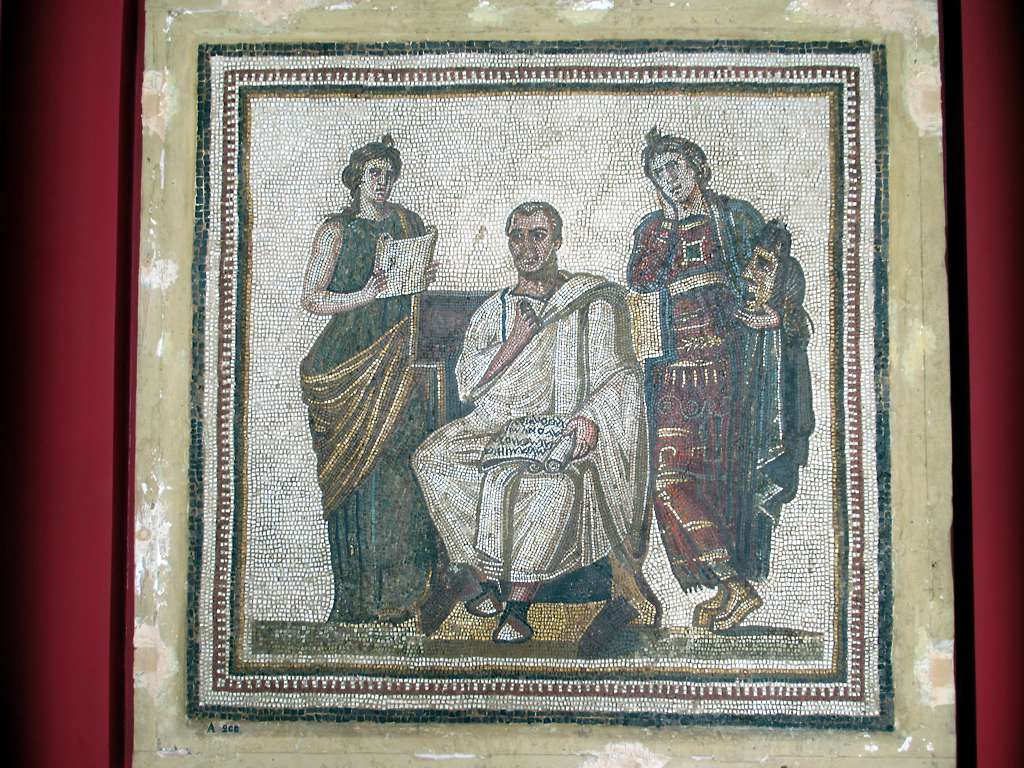
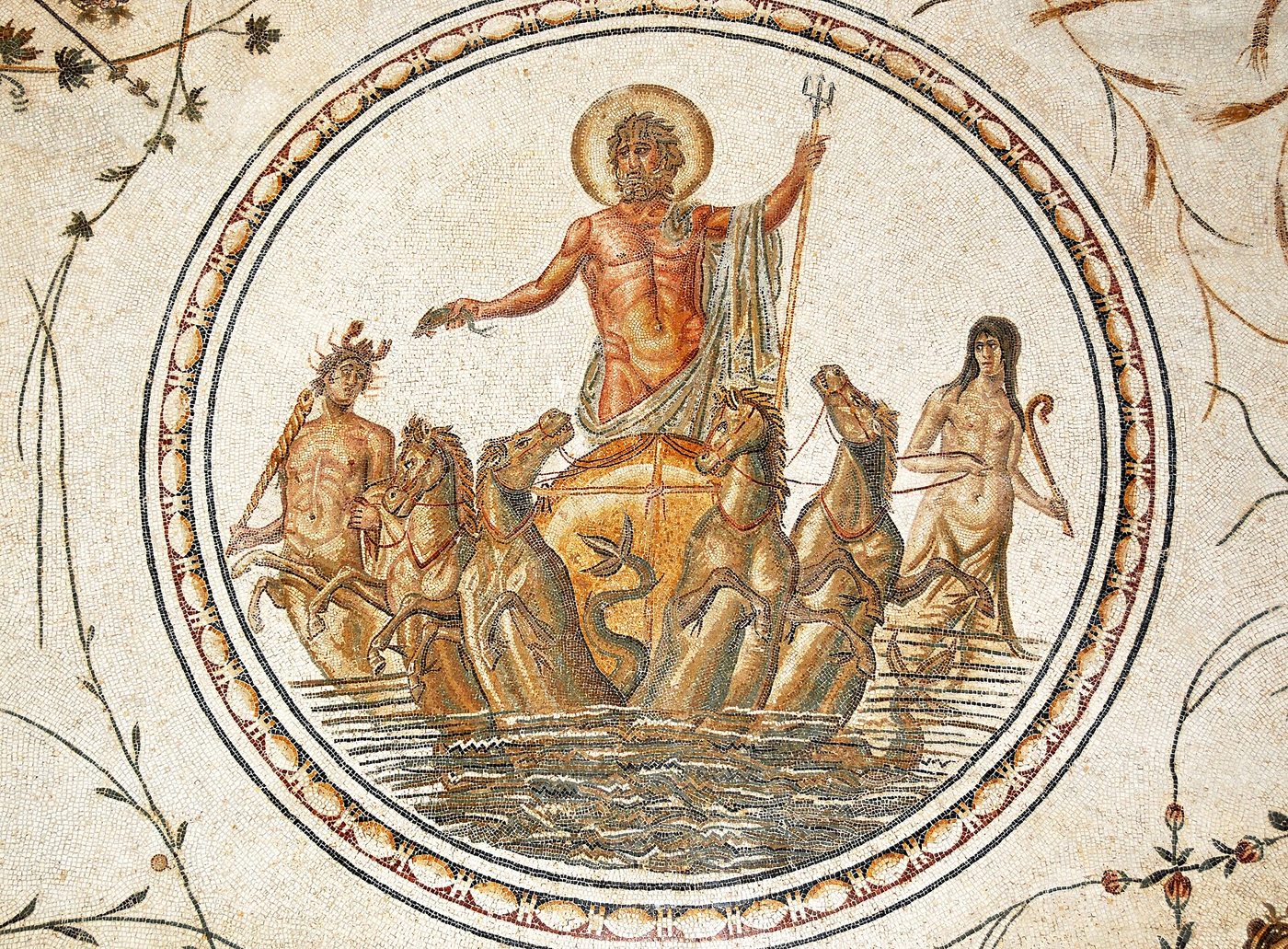
Neptune in triumph. The Bardo has more than one, which trips people up. There’s a celebrated Triumph of Neptune from Sousse, and a separate, spectacular roundel of Neptune driving sea-horses out of the waves, ringed by the Four Seasons, from La Chebba on the Sahel coast. Both are third-century, both are enormous, and both get called “the Neptune mosaic” in guidebooks. Ask which room you’re in rather than assuming.
Ulysses and the Sirens. From a house at Dougga, third century. Ulysses lashed to the mast of his ship, his crew rowing with their ears stopped, three sirens perched on the rocks. It’s small for a floor of this fame, and the artist had very few tesserae to work with, yet the anxiety on the faces comes through completely. Our favourite thing in the museum, and easy to walk past.
The Dominus Julius mosaic. Late fourth or early fifth century, from Carthage, and the single best picture of how a rich African family wanted to be seen. Three horizontal bands: the estate house in the middle with its arcaded front and domed bath-house; the master and mistress at either end, being brought fish, roses, grapes, a hare, a duck; servants working through the four seasons around them. One carries a note addressed “Iulio domino” — to Lord Julius — which is how the floor got its name. Spend ten minutes on this one; it rewards it more than anything else in the building.
The Mahdia shipwreck room. Not mosaics at all, and don’t skip it. In 1907 Greek sponge divers working off Mahdia found a wreck a few kilometres offshore; excavations up to 1913 brought up the cargo of a ship carrying Greek art from Piraeus to Italy when it went down in the first century BC. Sixty-odd marble columns, furniture fittings, and bronzes including a herm of Dionysus signed by its maker, Boëthos of Chalcedon, and a winged boy usually identified as Agon, the spirit of contest. The sea has eaten the surfaces into something strange and beautiful — the most atmospheric room in the building.
Practicalities at the Bardo
- Getting there: Métro léger line 4 to Le Bardo, or a metered taxi from central Tunis — usually around 10–15 dinars and twenty minutes, traffic permitting. Insist on the meter. Our guide to getting around Tunisia covers the taxi etiquette.
- Hours: Tuesday to Sunday, 09:00–17:00 in summer and 09:30–16:30 in winter, closed Mondays. Ramadan hours differ. Verify before you go.
- Ticket: the non-resident price quoted through 2026 is around 30 TND — call it under a tenner. Residents pay considerably less. Cash is safest.
- Time needed: two and a half hours to see it properly, four if you’re the kind of person who reads every label. An hour is not enough and you’ll resent having tried.
- Audio guide: there’s a digital guide in English, French and Arabic. Worth the small surcharge, because the printed labelling is patchy in places.
The rest of the trail, with honest verdicts
The Bardo is the anthology. The rest of the trail is where the mosaics still live near where they were made, and two of these stops are better experiences than the Bardo even though the objects are less famous.
Bulla Regia — the one that changes how you see all the others
Bulla Regia sits in the green farmland of the northwest, a few kilometres north of the town of Jendouba, roughly two and a half hours’ drive from Tunis. What it is famous for is that the wealthy here built downwards: houses with an underground residential storey, courtyards and mosaic floors that are still in place.
Which means you walk down a staircase into a cool, half-lit room — and the mosaic is on the floor, where it was laid, in the space it was designed for. The House of Amphitrite is the famous one: a marine goddess carried on the water between fish-tailed centaurs, cupids overhead, fish around the border, the whole thing still bedded in the ground it has occupied for eighteen centuries. The House of the Hunt, the House of the Peacock and several others have floors in place too.
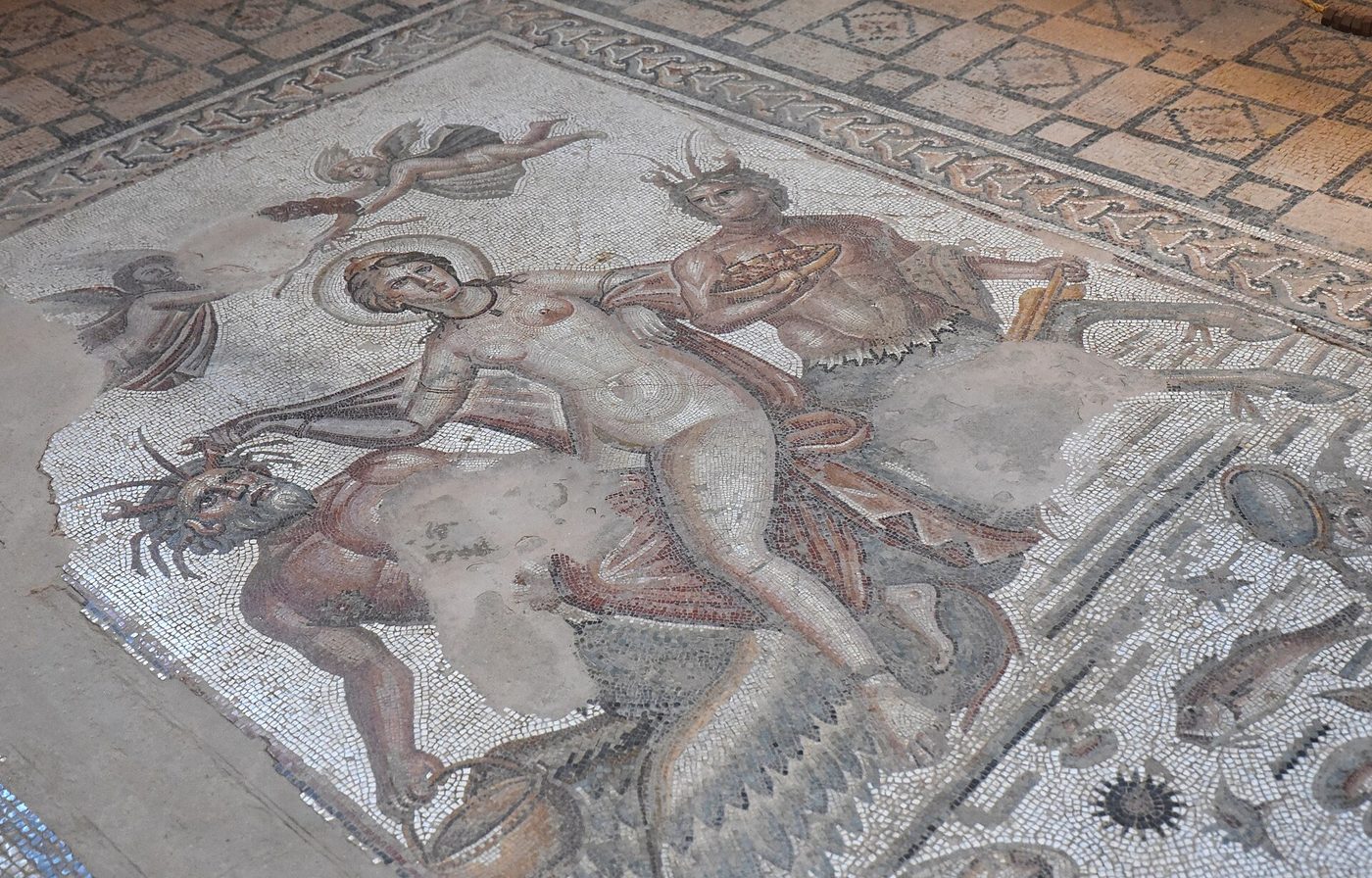
Verdict: our favourite mosaic experience in Tunisia, by a distance. Bring a torch for the darker rooms, go in the morning, and expect to have most of it to yourself. It pairs naturally with Dougga if you’re driving, and it’s a long but doable day from Tunis — see our day trips from Tunis for how to build it.
El Jem: museum plus the houses themselves
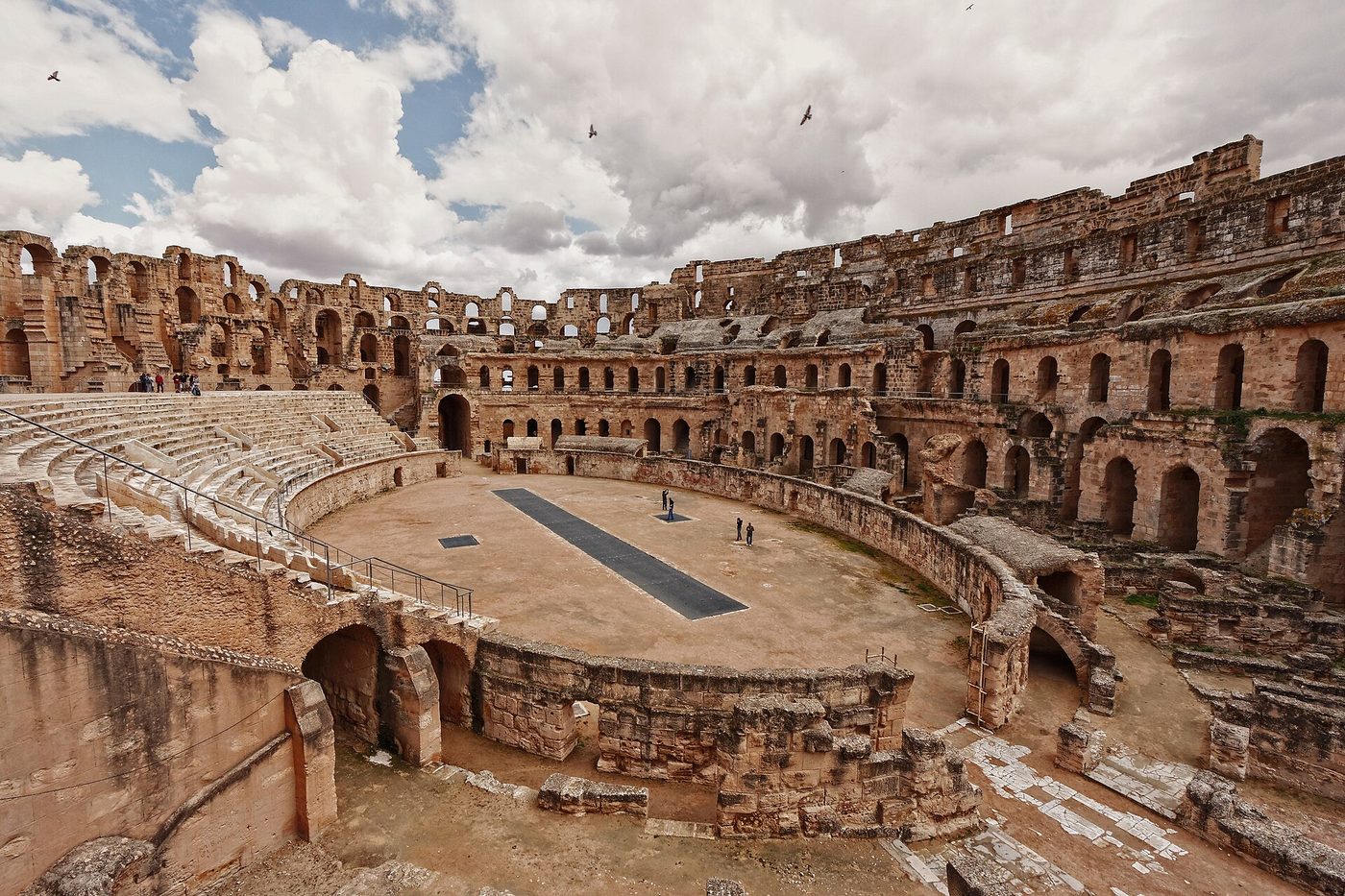
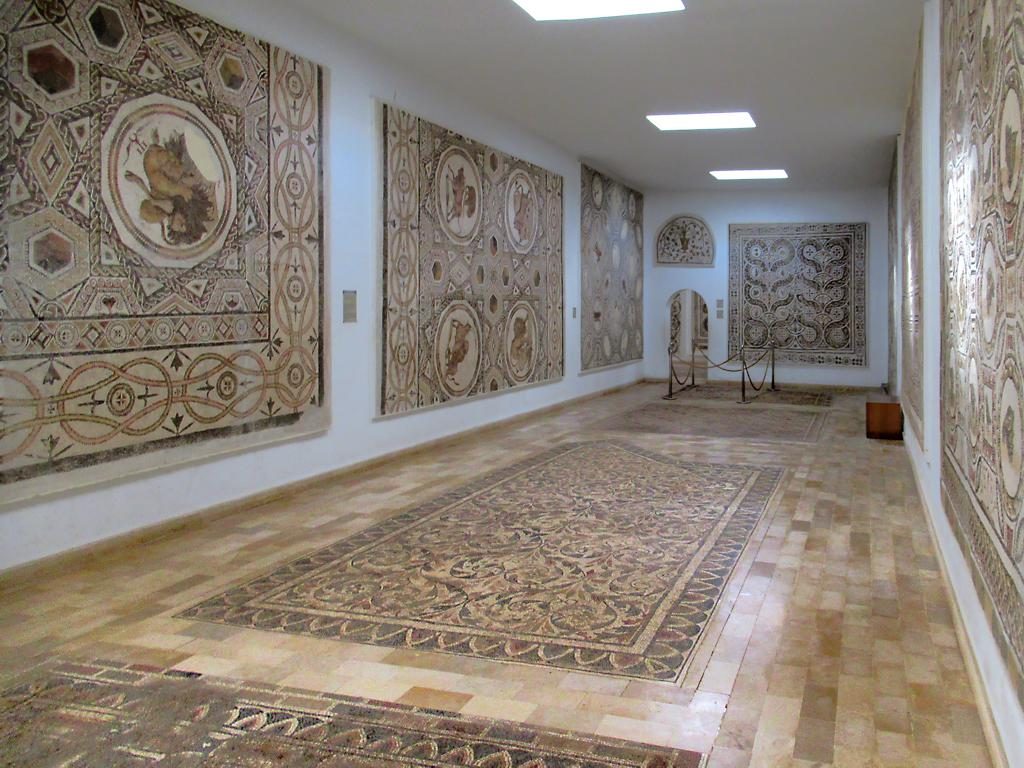
Most people come to El Jem for the amphitheatre and leave without walking the four hundred metres to the archaeological museum. That’s a mistake. The museum holds a serious collection of mosaics from ancient Thysdrus, animals among them, and the House of Africa is reconstructed here too: a villa dated to around AD 170, discovered in the 1990s and rebuilt using its principal rooms and original floors, including the personification of Africa that gives it its name.
Better still, the ticket usually gives you access to an adjacent archaeological park where the ruins of two houses, the Sollertiana Domus and the House of the Peacock, keep a good number of their mosaics in their original positions.
Verdict: the highest-value stop on the trail. You’re already in town, the combined ticket is small money, and it gives you the whole picture — arena, then the houses of the people who watched.
Sousse Archaeological Museum
Housed in the Kasbah at the top of the Sousse medina, this is generally reckoned the second-largest mosaic collection in Tunisia after the Bardo, and it was thoroughly reorganised before reopening in 2012. The headline pieces are usually cited as a Triumph of Bacchus, a fierce head of Medusa, an Ocean or marine ensemble, and a calendar mosaic of the months brought here from Thysdrus. Display is modern, the courtyards are shaded, and the views over the medina from the Kasbah walls are a bonus.
Verdict: genuinely good and shamefully quiet, given how many people are on beaches ten minutes away. Entry is usually around 10 dinars and often cash only; closed Mondays. Budget an hour, two if you like this stuff.
Carthage: great site, complicated museum
Ancient Carthage is a scatter of separate enclosures across a wealthy seaside suburb, reached on the TGM light rail from Tunis. There are mosaics in place in the Roman villas quarter, and more in the Antonine Baths area, all with the sea behind them — which is a very different pleasure from a gallery wall.
The complication is the museum on Byrsa Hill. It has been closed since 2018 and is the subject of an EU-funded rehabilitation. Do not assume it has reopened. Check the current position before you plan around it, and if it’s still shut, treat Carthage as a site visit — which it is worth doing anyway. Our guide to visiting Carthage today has the multi-site ticket detail, and Tunisia’s UNESCO sites puts it in context.
Nabeul, Utica and the smaller museums
The Nabeul museum opened in 1984 and shows mosaics from Neapolis and other Cap Bon sites, including material from the House of the Nymphs — one panel has two cockerels facing each other across an amphora filled with gold coins, which is exactly the sort of thing that makes these floors fun. Around 8 dinars, an hour or so, well labelled. Worth it if you’re already on the peninsula; not worth a special journey.
Utica, about forty-five minutes northwest of Tunis, has a small national museum and, more interestingly, floors still in place at the site, notably in the House of the Cascade. It is quiet to the point of sleepy and opening can be erratic; ask before you commit an afternoon.
Dougga is the source of some of the Bardo’s best pieces rather than a mosaic destination in its own right — most of its great floors were lifted decades ago. Go for the town, the most complete Roman townscape in North Africa, and enjoy knowing where the Ulysses panel came from.
Why one mosaic in place beats ten on a wall
A mosaic hung vertically in a gallery has been rotated ninety degrees out of the position it was made for. You look at it head-on, at eye level, evenly lit, like a painting. That is not how any Roman ever saw it. They looked down on it, from a shifting angle, in changing daylight, usually while doing something else.
That difference isn’t academic. Floors were composed for the way people moved. Borders run towards doorways to steer you. Figures face outwards from the middle of a dining room so that guests reclining on three sides all get a right-way-up view. Panels near a threshold are simpler because you cross them; the elaborate work sits where people stopped. Lift a floor and hang it, and every one of those decisions becomes invisible.
Underground at Bulla Regia, or in the house quarter at El Jem, all of it comes back. You stand where the dining couch stood, you see the design resolve as you turn, and you notice that the room is cool — which is the whole reason a family built down here to eat in August, looking at a picture of the sea. Go to the Bardo for the masterpieces. Go to Bulla Regia to understand them.
Three mosaic trails that actually work
Realistic routings, on realistic Tunisian travel times. Add contingency — nothing here runs to a Swiss timetable.
The Tunis version: two days, no car needed for day one
- Day 1 — Bardo, then Carthage. Métro léger to the Bardo at opening, three hours inside, lunch nearby, then the TGM out to Carthage for the villas quarter and the Antonine Baths in the afternoon light. Finish in Sidi Bou Said. Both legs are on public transport for a couple of dinars.
- Day 2 — Bulla Regia, with Dougga if you’re driving. Bulla Regia is about two and a half hours each way by car; a hired driver or a small-group tour makes this painless. Doing both Bulla Regia and Dougga in one day is possible but tight — leave at seven, and accept that you’ll be rushing one of them.
Base yourself centrally; our notes on where to stay in Tunis and the two-day Tunis itinerary slot these in around the medina.
The Sousse version: one long day, one short one
- Morning — the Sousse Archaeological Museum at the Kasbah, an hour or two, then down through the medina.
- Afternoon or a separate day — El Jem. Roughly an hour south by road or on the Tunis–Sfax train line; do the amphitheatre first while the light is good, then the museum, the House of Africa and the house quarter. Trains are cheap and slow; a taxi or a driver for the day gives you the flexibility to stay longer.
- Optional add-on — Mahdia, about an hour up the coast on the Métro du Sahel, more for the town and the sea than the mosaics.
See day trips from Sousse for how these fit around a beach week.
The full north-to-Sahel run: five or six days
| Day | Route | Driving | Mosaic payoff |
|---|---|---|---|
| 1 | Tunis — Bardo | None | The whole anthology in one building |
| 2 | Tunis — Carthage — Utica | Around 1 hour total | In-situ floors by the sea |
| 3 | Tunis — Bulla Regia — Dougga — overnight Téboursouk or back | 5–6 hours total | Underground rooms, floors in place |
| 4 | North to Sousse via Nabeul (Cap Bon) | Around 4 hours with the detour | Neapolis mosaics, then the Kasbah museum |
| 5 | Sousse — El Jem — Sfax or back | 1–2 hours | Amphitheatre, museum, House of Africa |
This is a driving itinerary and it needs a car or a hired driver. Our Tunisia itinerary guide has route notes, and if you’re pushing further south, Sfax and Kairouan both make sensible next stops.
Practicalities: tickets, permits, light and stamina
Tickets and photography
Tunisian sites and museums are cheap by European standards, though prices vary: in 2026 non-residents pay 30 TND at the Bardo, 20 TND at Carthage, El Jem and Kairouan’s monuments, and 8–10 TND at many other sites and museums. Bring cash. Card acceptance is improving but is not something to rely on, and several museums are cash only.
The old quirk of a separate photography charge has gone: since April 2026, personal, non-commercial photography is included in the ticket. Professional photography and filming need authorisation from the heritage agency (AMVPPC). Flash is generally not allowed anywhere near a mosaic, and tripods and anything that looks professional usually need separate written permission.
Opening hours and the Monday closure
Most Tunisian state museums close one day a week and that day is usually Monday. The Bardo, Sousse and several others follow this pattern. Sites can differ: Thuburbo Maius and Oudhna, for instance, are open all week, so check each site’s opening days.
Hours are also seasonal and vary by venue: the Bardo runs 09:00 to 17:00 in summer and 09:30 to 16:30 in winter, while the Sousse Archaeological Museum runs 09:00 to 18:00 in summer and 09:00 to 17:00 in winter, with different arrangements again during Ramadan, which next falls in February 2027. Two practical rules: never plan a museum day on a Monday, and always check the specific place rather than trusting a generic figure — including ours.
Photographing mosaics without ruining the shot
- Glare is the enemy in museums. Vertically mounted mosaics under downlights throw reflections straight back. Move off-axis by a few steps rather than shooting square on, and crouch — a lower angle usually kills the hotspot.
- Skip the flash entirely. It’s usually banned, and it flattens the surface texture that makes a mosaic look like a mosaic.
- Outdoors, avoid midday. Overhead sun blows out the pale limestone and destroys contrast. Early morning and late afternoon are dramatically better at Bulla Regia, El Jem and Carthage. A polarising filter helps if you carry a proper camera.
- Underground rooms are dark. Bulla Regia’s best floors sit in low light. A phone will manage; steady it on a wall, and bring a torch to see what you’re photographing.
- Shoot the detail, not just the whole. One face in opus vermiculatum at close range says more about the craft than a wide shot of a twenty-square-metre floor.
How long each stop really needs
Museum fatigue is real, and mosaic fatigue is worse — after two hours of magnificent floors they start to blur into one long hunting scene. Our honest timings: Bardo two and a half to four hours; Sousse one to two; El Jem museum plus the house quarter about ninety minutes on top of the amphitheatre; Nabeul an hour; Bulla Regia two hours on site. Don’t try to do the Bardo and Carthage properly in the same morning, and don’t stack two mosaic museums into one day if you can spread them.
Tunisia is an easy country for this kind of trip and a cheap one — see our broader guide to things to do in Tunisia and to Tunisian culture for what to fold in around the ancient sites.
Frequently asked questions
Where are the best mosaics in Tunisia?
The Bardo National Museum in Tunis is the natural first stop: it’s often described as the largest collection of Roman mosaics in the world, and it holds many of the best-known pieces. For mosaics still in the rooms they were made for, Bulla Regia in the northwest is the best place in the country, followed by the house quarter beside the El Jem museum.
Is the Bardo Museum open in 2026?
It reopened on 14 September 2023 after a closure of more than two years and has been operating normally since. That said, it has closed unexpectedly several times in the past fifteen years, so confirm the current position in the week you travel rather than relying on any guide, including this one.
How much does the Bardo Museum cost?
The non-resident ticket quoted through 2026 is around 30 Tunisian dinars, roughly £8, with much lower rates for residents and older Tunisians. Photography for personal use is included in the ticket; there may be a small extra charge for the audio guide. Bring cash, and treat the figure as indicative — prices change.
Are Tunisia’s museums closed on Mondays?
Most state museums close one day a week and Monday is the usual choice, including the Bardo and the Sousse Archaeological Museum. Some archaeological sites, such as Thuburbo Maius and Oudhna, are open all week. Hours shift between a longer summer schedule and a shorter winter one, and change again during Ramadan, so check the specific place.
Is the Virgil mosaic really the only portrait of Virgil?
It’s one of the oldest known depictions of him, which is why it’s famous. But it dates to around the third century AD, roughly 250 years after Virgil died, so it can’t be a life portrait — and some scholars read the seated figure as the villa’s owner posing as the poet. A wonderful object; just take the “contemporary portrait” line with caution.
What makes North African Roman mosaics different?
Colour and people. In the third and fourth centuries African workshops made increasing use of big polychrome figurative scenes, hunts and arena spectacles above all. The result is livelier and far more informative about daily life.
Can you take photographs of the mosaics?
Generally yes, for personal use and without flash, and since April 2026 there is no separate photography charge: personal photography is included in the ticket. Professional photography and filming need authorisation from the heritage agency, and tripods and professional kit usually need written permission. Rules vary, so ask when you buy your ticket rather than afterwards.
Can you visit Bulla Regia as a day trip from Tunis?
Yes. It’s roughly two and a half hours each way by road, so it’s a long day but a comfortable one with a hired driver or on a small-group tour. Combining it with Dougga in the same day is possible if you leave early, though you’ll be rushed at one of the two. Both reward a morning start.
Is the Carthage museum open?
The museum on Byrsa Hill has been closed since 2018 and is being rehabilitated with EU funding, so check the latest news before you plan around it. The archaeological site itself remains open on a multi-site ticket and has mosaics in place, so a Carthage visit is still worthwhile either way.
Is the Sousse Archaeological Museum worth visiting?
Yes, and it’s badly under-visited given how many people are on beaches nearby. It holds the second-biggest mosaic collection in Tunisia, was well modernised before reopening in 2012, and sits in the Kasbah at the top of the medina with good views thrown in. An hour or two, around 10 dinars, closed Mondays.
How many days do you need to see the main mosaic collections?
Two days covers the essentials from Tunis: the Bardo, plus Bulla Regia. Four to six days lets you add Carthage, Dougga, Nabeul, Sousse and El Jem at a civilised pace with a car or a driver. Trying to do it in one day means the Bardo only — a good day, but half the story.
Written by the Tunisia Tourism Guide team — an independent UK-focused guide to travelling in Tunisia. We don’t sell tours or take hotel commissions. Prices and advice were checked at publication; always confirm current details before you book.
Photo credits
All images via Wikimedia Commons, used with thanks: The Virgil mosaic in the Bardo National Museum © David Stanley from Nanaimo, Canada (CC BY 2.0); Roman mosaic of Neptune and the Four Seasons displayed at © Dennis G. Jarvis (CC BY-SA 2.0); The Amphitrite mosaic still in place on the floor of © Carole Raddato from FRANKFURT, Germany (CC BY-SA 2.0); Roman mosaics on display at the El Jem Archaeological Museum © David Stanley from Nanaimo, Canada (CC BY 2.0).