By the Tunisia Tourism Guide team · Last updated 16 October 2026 · We don’t sell tours or take hotel commissions — this is independent advice, written to be useful.
Most people who search for Kerkouane are weighing up the same thing: is a low wall of stone at the far end of Cap Bon really worth a long day out, when Carthage is a train ride from Tunis and El Jem’s amphitheatre is the postcard everyone recognises? It’s a fair question. The pictures don’t flatter it. Nothing here stands higher than your shoulder, and there are no columns marching against the sky.
Kerkouane is worth the trip if you care about how people actually lived in the ancient Mediterranean. UNESCO calls it the only example of a Phoenicio-Punic city to have survived: a whole town abandoned around 250 BC and never rebuilt by Rome, with its streets, houses and bathtubs still laid out by the sea.
That makes it a different kind of site from the Roman sites in our guide to Roman ruins in Tunisia, because the Romans never rebuilt the town. Below we cover why it matters, what you’ll see on the ground, the small museum and the necropolis, opening hours and the entry fee, how to get there, and how to fold it into a Cap Bon day so the drive pays for itself.
Kerkouane at a glance
| What | The short version |
|---|---|
| What it is | A Punic (Carthaginian-era) town and its necropolis on the clifftop coast near the tip of Cap Bon |
| UNESCO status | World Heritage Site since 1985, as the Punic Town of Kerkuane and its Necropolis |
| Age of what you see | Mostly late 4th to first half of the 3rd century BC; earliest traces from the 6th century BC |
| Why it’s special | Abandoned during the First Punic War and never rebuilt, so the Punic town plan survives without a Roman layer on top |
| Opening hours | Winter 09:00-16:00; summer 09:00-18:00; Ramadan 09:30-17:00 (the heritage agency’s published hours) |
| Museum | On site; closed on Mondays |
| Entry | 8 TND (about £2) for non-residents; 5 TND for residents (October 2026) |
| Time needed | 1.5-2 hours for the town and museum |
| Facilities | Toilets, a shop and a cafeteria |
| Best combined with | Kelibia’s fort and beaches, and the quarry caves at El Haouaria |
Why Kerkouane matters: the town Rome never rebuilt
To understand why archaeologists get misty-eyed about a site most holidaymakers have never heard of, you need to know what happened everywhere else. Carthage was the great Phoenician city of North Africa, and when Rome finally destroyed it in 146 BC, it later built a new Roman city over the top. Go to ancient Carthage today and what you mostly see is Roman: baths, villas, a theatre. The Punic layer survives in pockets, such as the Hannibal Quarter on Byrsa Hill and the circular military harbour, but it’s buried, fragmentary and cut through by later building.
The same story repeats along the coast. Punic towns became Roman towns, then Byzantine, then Arab, and each generation reused the stone. Kerkouane escaped. UNESCO’s description says the town was “probably abandoned during the First Punic War (c. 250 B.C.) and as a result was not rebuilt by the Romans”, and that its remains “constitute the only example of a Phoenicio-Punic city to have survived”. Its listing also describes it as the unique known Punic city in the Mediterranean.
So when you walk in, you’re seeing a town plan from the 4th and 3rd centuries BC without a Roman forum dropped on top of it. The streets are where the Punic residents laid them. The houses are their houses. The bathtubs are their bathtubs. That’s the whole point, and it’s why the site is worth a bit of imagination on your part.
A short history
According to UNESCO, the earliest traces of settlement go back to the 6th century BC, but almost everything visible dates from the late 4th century to the first half of the 3rd century BC. That was the town’s heyday, when Carthage controlled much of the western Mediterranean and Cap Bon, facing Sicily across the strait, was prime territory.
It ended with the First Punic War between Rome and Carthage. UNESCO links the town’s destruction to the Roman general Regulus, around 255 BC, when Rome carried the war to Africa. Whatever exactly happened, the people did not come back. The site was never reinhabited, the dunes and vegetation took over, and the town vanished from view for more than two thousand years.
It was found again in 1952, and the excavations were carried out by Tunisia’s national archaeology institute. UNESCO inscribed the town and its necropolis on the World Heritage List in 1985. It’s one of the Tunisian properties we cover in our guide to Tunisia’s UNESCO World Heritage Sites.
What “Punic” actually means
A quick primer, because the words get blurred. The Phoenicians were seafaring traders from the coast of what is now Lebanon. They founded colonies across the Mediterranean, Carthage being the most famous. “Punic” is the term historians use for the western, Carthage-centred branch of that civilisation from roughly the 6th century BC until Rome won the Punic Wars. Kerkouane was a Punic town: Carthaginian in its religion, language and trade networks, but with its own character and, almost certainly, a local North African population mixed in.
If you’ve seen the Punic stelae at Carthage’s Tophet, or the Libyco-Punic mausoleum at Dougga, Kerkouane is the missing piece: the ordinary town those people lived in.
What you’ll actually see at Kerkouane
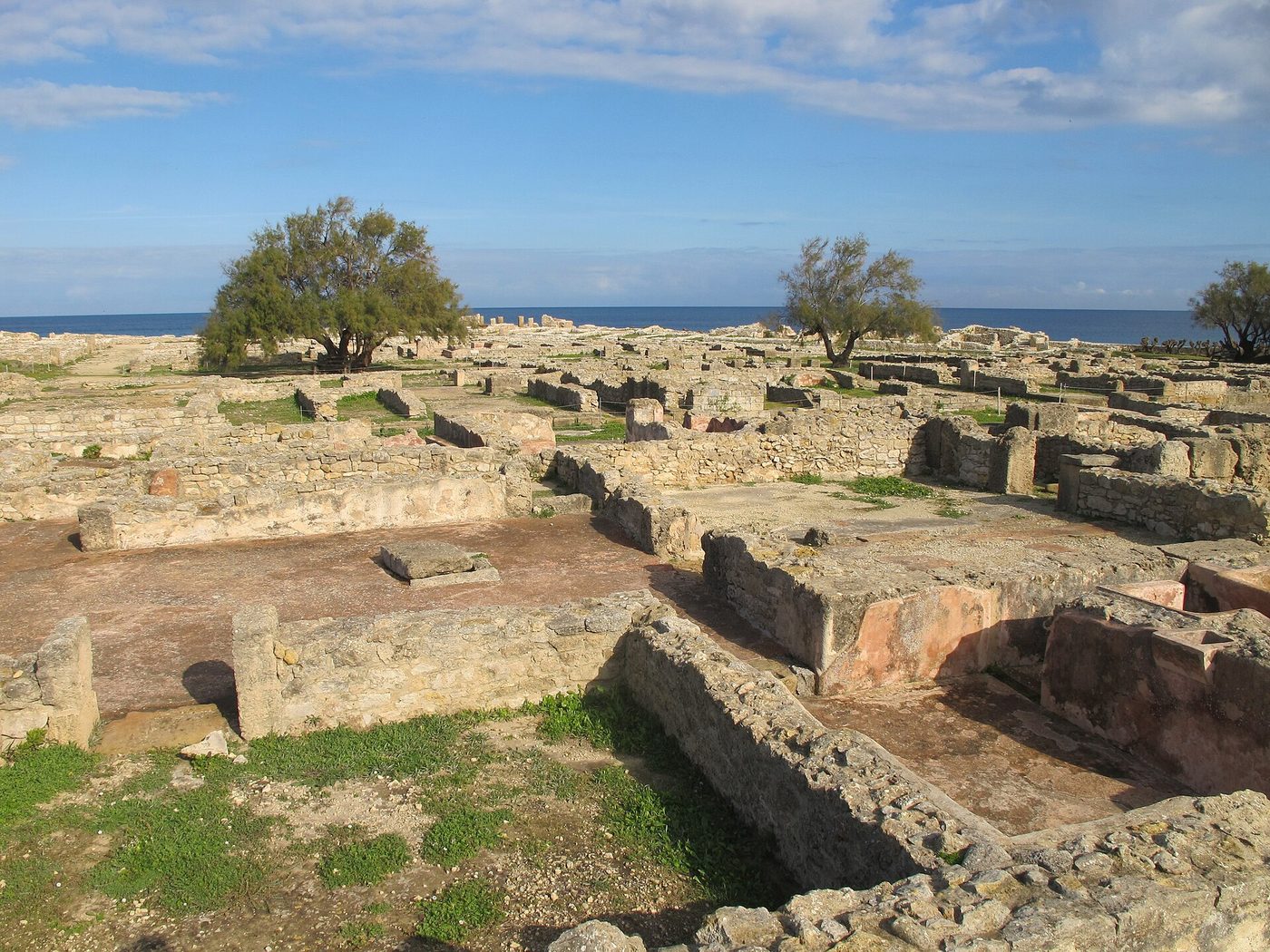
Let’s be honest about the scale. This is a site of foundations and low walls, mostly knee to chest height. If you arrive expecting the drama of El Jem or the hillside temples of Dougga, you’ll be underwhelmed for the first ten minutes. Then the details start to land, and they’re what makes the trip.
The town plan and the ramparts
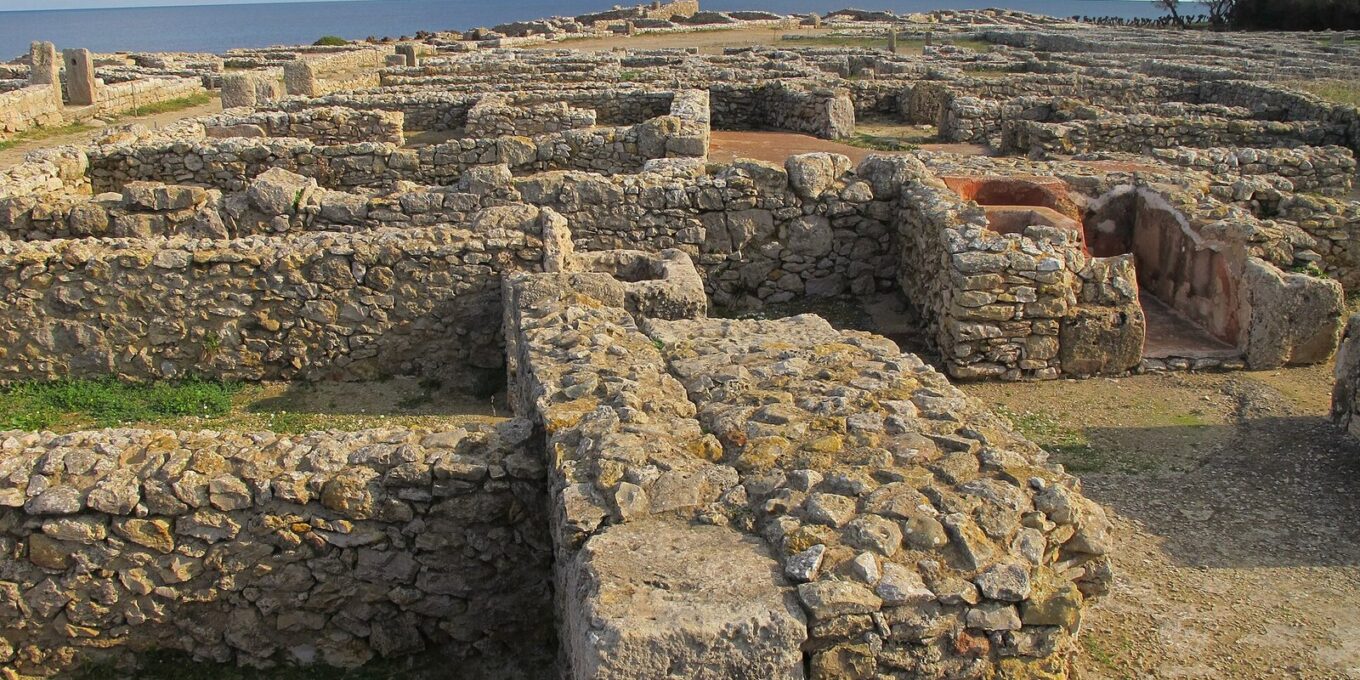
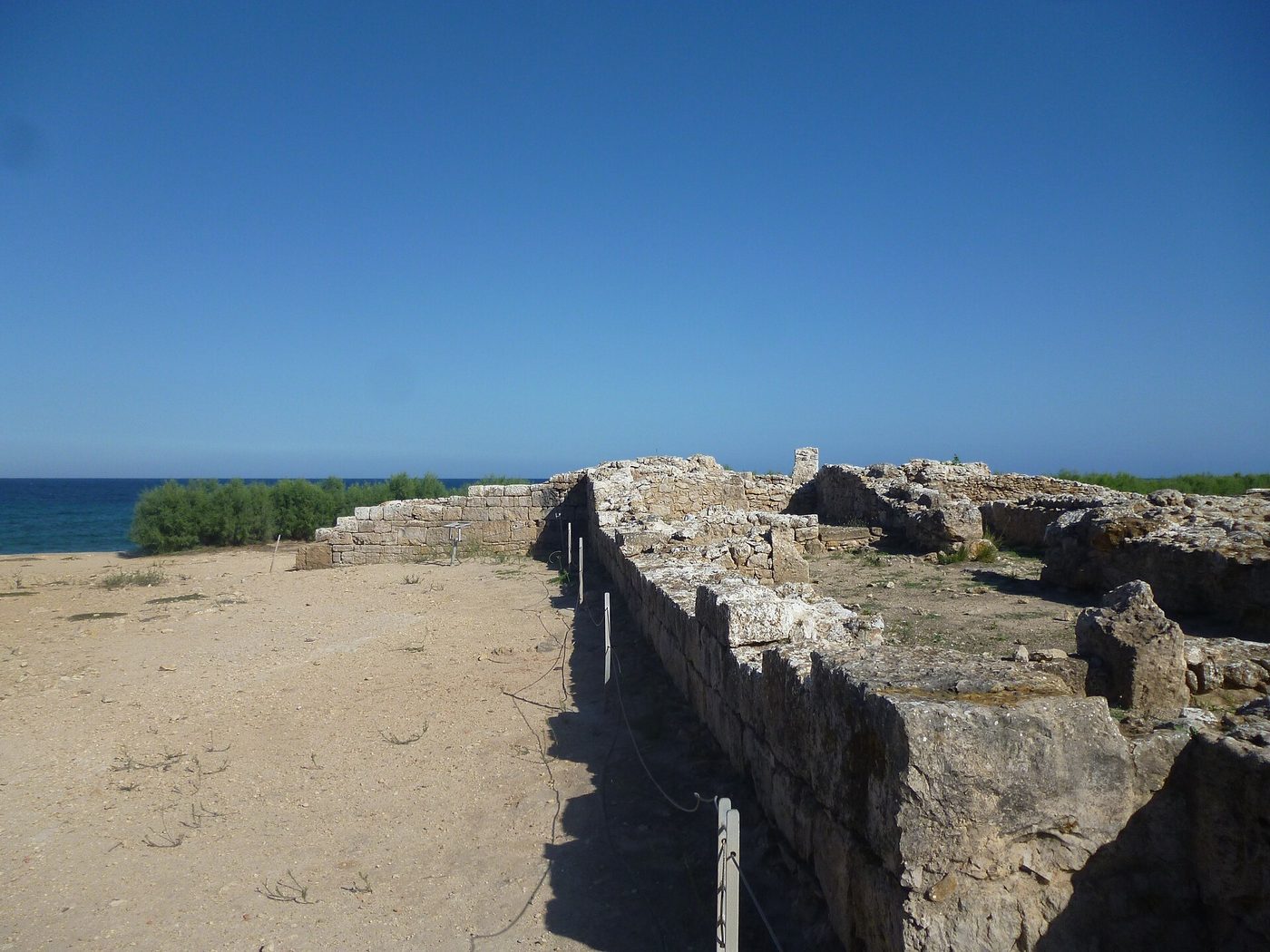
The town sits right on the coast, and the sea is part of every view. It was defended on the landward side by a double wall with towers, two monumental gates and four smaller posterns, according to the Agence de mise en valeur du patrimoine (AMVPPC), the state body that runs the site. You can still trace the line of the fortifications and walk the gap between them, which is one of the better ways to get a sense of the town’s shape before you dive into the house plots.
Inside, the streets are laid out in a fairly regular grid, with blocks of houses between them. It’s a readable town: you can stand at a crossroads and see how a street led to a door, the door to a courtyard and the courtyard to the rooms around it.
The houses and their bathrooms
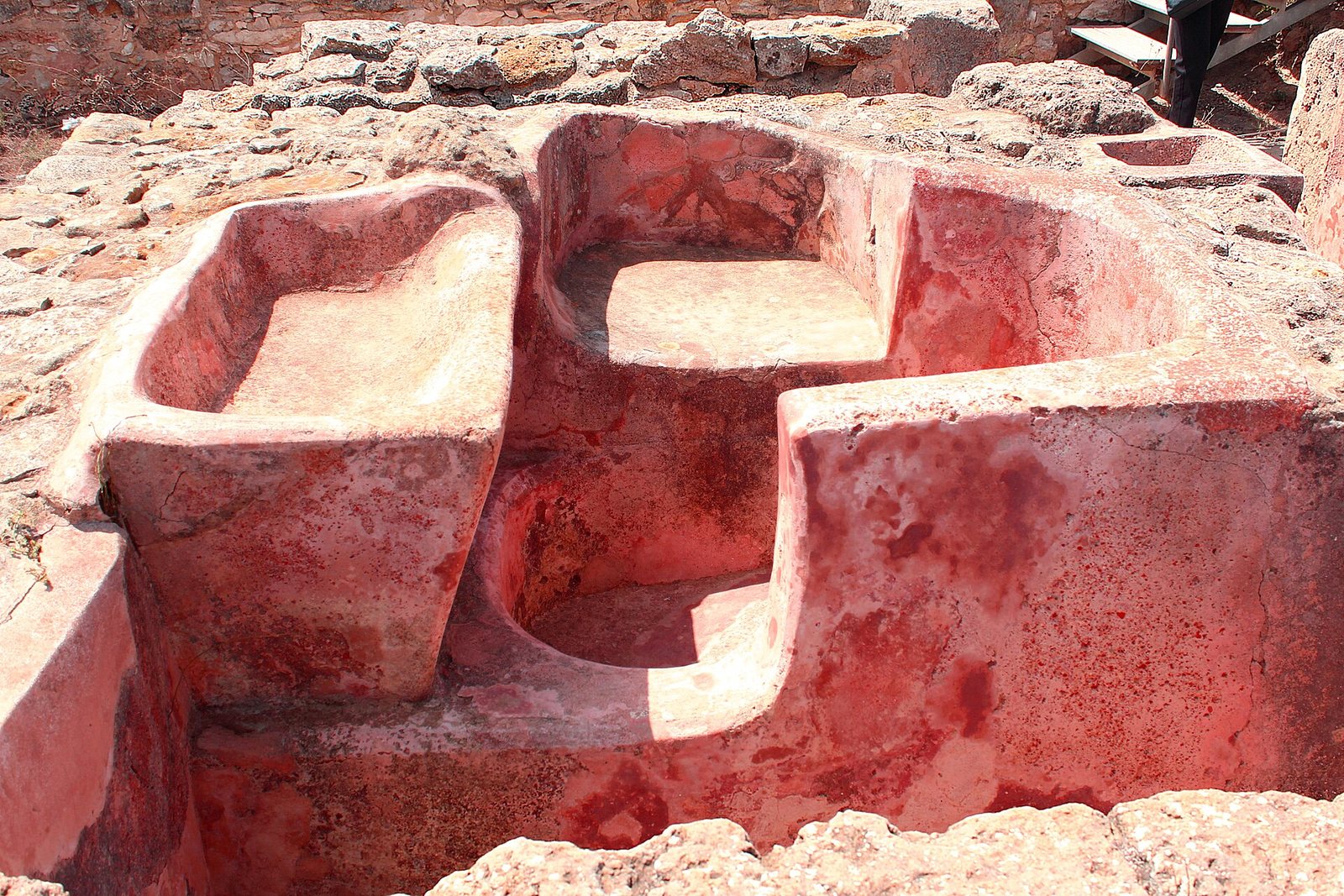
This is the star of the show. The AMVPPC says every house had its own bathroom, and once you know to look, you’ll see them everywhere: small washrooms with built-in sit-down tubs, finished in a reddish waterproof plaster that still glows pink in the sun. In a world where Romans later bathed communally in big public baths, the Punic residents of Kerkouane washed at home, in private.
Many houses follow a similar pattern: an entrance from the street, a central open courtyard, and rooms opening off it, with drains carrying water out towards the street. Reading a few of these plots properly is more rewarding than rushing round all of them.
The floors and the sign of Tanit
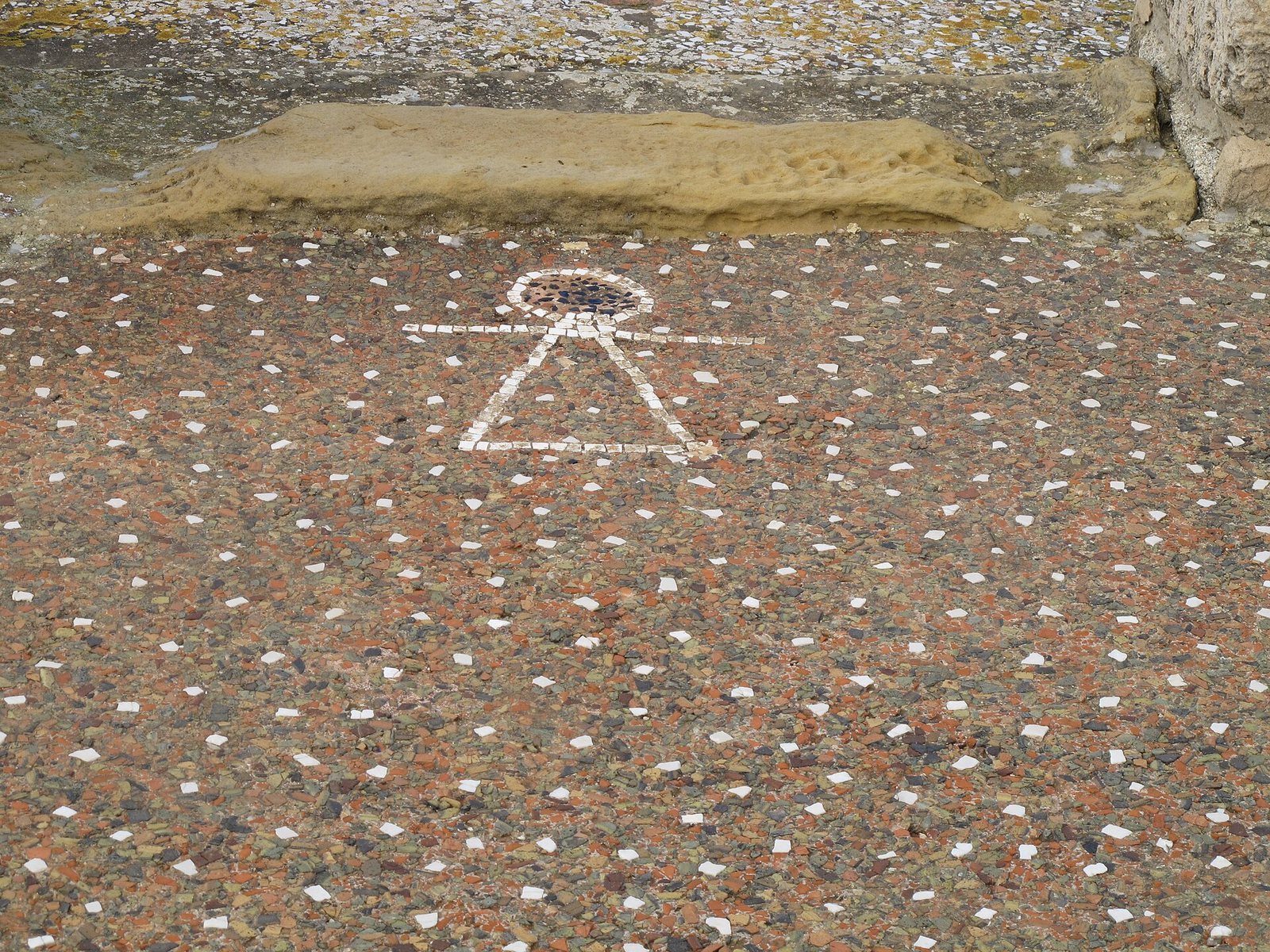
Look down as much as up. Many floors are made of a reddish mortar studded with small white stone chips, a technique archaeologists associate with Punic building. In a few places the white chips are arranged into motifs: the AMVPPC lists the sign of Tanit, fish and lotus among them.
The sign of Tanit is the one everyone photographs. It’s a simple figure, a triangle topped by a horizontal bar and a circle, a little like a stick person with raised arms. Tanit was the chief goddess of Carthage, and her sign turns up across the Punic world on stelae, pottery and jewellery. Seeing it set into the floor at the threshold of a house, where a family walked in and out every day, is the moment the place stops being a ruin and becomes somebody’s home.
If floor decoration is what draws you, compare it with the far more elaborate Roman work in our guide to Tunisia’s Roman mosaics. The contrast tells you a lot: Kerkouane’s floors are practical, waterproof and modest, with a single symbol where a Roman villa would have a whole hunting scene.
The sanctuary
Near the centre of town is a large religious complex, with courtyards, rooms and what are thought to be altars. The AMVPPC describes it as the great sanctuary and says it is claimed to be the largest Punic temple in the western Mediterranean. Treat that as the agency’s own claim; what you’ll see is a set of walls, column bases and a clear sense that this was a serious civic space rather than a household shrine.
Industry by the sea
Kerkouane wasn’t a grand city. The AMVPPC says it was mainly made up of craftsmen, merchants and fishermen. The AMVPPC describes a craftsmen’s quarter beside the public square, which probably served as a market. You don’t need to know any of that to enjoy the site, but it explains why a town of this size thrived on such an exposed stretch of coast.
A site on the edge
One thing worth knowing: the sea is slowly eating the site. UNESCO’s assessment notes that the town’s integrity is threatened by marine erosion of the cliff and that a supporting wall has been built. Some of what was once Kerkouane is already gone. It’s one more reason to go sooner rather than later, and to stick to the paths and keep off the walls.
The Kerkouane museum
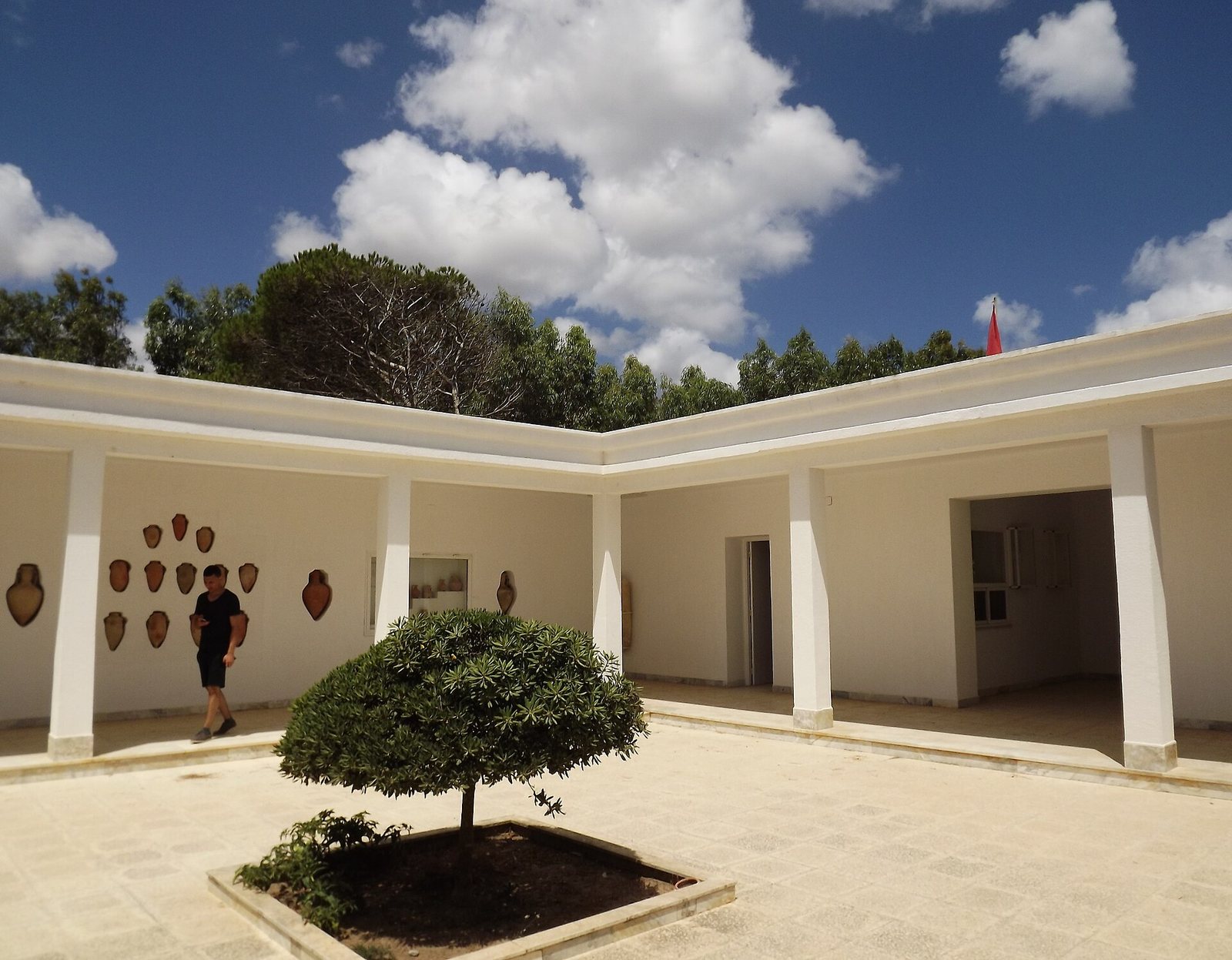
The small museum on site is easy to skip and shouldn’t be. The AMVPPC says it opened in 1987, and its rooms are organised around daily life, the gods, and women and jewellery. Fifteen or twenty minutes here before you walk the town makes everything outside more legible.
Its centrepiece is the Lady of Kerkouane: a wooden anthropoid sarcophagus lid, identified by the museum as depicting the goddess Ashtart (Astarte). There’s also a reproduction of the painted story from Tomb VIII at Mount Melezza, which saves you hunting for the original.
Expect a modest, quiet museum rather than a big modern gallery. The labels are basic, so this is where a little background reading pays off. Remember the museum is closed on Mondays.
The necropolis of Arg el Ghazouani
The “and its Necropolis” in the UNESCO title refers to the burial ground of Arg el Ghazouani, on a rocky hill less than a kilometre from the town. Its chamber tombs were cut into the rock, and it’s an important part of why the site was listed.
Don’t plan your day around it, though. UNESCO notes that the necropolis is enclosed and permanently guarded, and whether visitors can get in on a given day isn’t something we’d count on. If you’re keen, ask at the ticket office when you arrive. For most people, the museum’s displays and the Tomb VIII reproduction are the practical way to see what the tombs held.
Opening hours and tickets
Kerkouane is managed by the AMVPPC, which publishes the hours and prices on its official Kerkouane page. As of October 2026 that page gave:
| Season | Hours |
|---|---|
| Winter | 09:00-16:00 |
| Summer | 09:00-18:00 |
| Ramadan | 09:30-17:00 |
The changeover dates between the winter and summer timetables can shift, so if you’re visiting in spring or autumn, plan to arrive by early afternoon and you’ll be safe either way. The museum is closed on Mondays.
Entry was 8 TND for non-residents (about £2) and 5 TND for residents, paid at the gate. That’s at the Banque Centrale de Tunisie’s rate of 3.96 dinars to the pound on 13 October 2026. Bring cash in dinars: Tunisia has strict currency controls and you’re not allowed to take dinars out of the country, so change what you need once you land. A remote site like this is not the place to count on a card machine. Small notes and coins make life easier.
Ticket prices at Tunisian heritage sites do get revised, so check the AMVPPC page before you go. If you plan to use anything beyond a phone or ordinary camera, ask at the ticket office first. Leave the drone at home: the FCDO’s travel advice (last updated 24 July 2026, and still current on 15 October 2026) says it is illegal to bring one into Tunisia without authorisation, and any found are confiscated until you leave.
Getting to Kerkouane
Kerkouane sits on the east coast of Cap Bon, north of the town of Kelibia, near the tip of the peninsula. It’s the sort of place that’s easy with a car and fiddly without one.
| Option | How it works | Our verdict |
|---|---|---|
| Hire car | Drive round Cap Bon and combine Kerkouane with Kelibia and El Haouaria | The best way. Roads are fine, and you set the pace. |
| Taxi or driver for the day | Agree a full-day price before you set off from Hammamet, Nabeul or Kelibia | Good value if you’re two to four people. Agree the waiting time too. |
| Louage plus taxi | A shared louage (minibus taxi) to Kelibia, then a local taxi to the site | Cheapest, but slow, and you need to arrange the ride back. |
| Organised excursion | Cap Bon tours from the resorts sometimes include Kerkouane | Easy, but check how long you actually get at the site. |
From Hammamet or Nabeul, you drive up the east side of the peninsula through Kelibia; it’s a full day out once you add a lunch stop and another sight or two. From Tunis it’s longer again, and really only makes sense as part of a Cap Bon loop or an overnight in Kelibia. Our guides to day trips from Hammamet and day trips from Tunis lay out the options, and getting around Tunisia explains how louages, taxis and car hire work.
If you’re going by louage, ask at the louage station for Kelibia, then pick up a taxi in town for the last stretch. Agree the fare before you get in and arrange a pick-up time for the return, because you won’t find taxis waiting at the site.
Making a Cap Bon day of it
On its own, Kerkouane is a two-hour visit. The trick is to wrap it into a day on Cap Bon, the green, citrus-scented peninsula that juts out towards Sicily. Our Cap Bon guide covers the whole area; here’s how Kerkouane fits.
- Kelibia. The fishing town south of Kerkouane has a hilltop fortress above the harbour and beaches nearby. It’s the natural lunch stop. See our Kelibia guide for the fort and beaches.
- El Haouaria. At the very tip of Cap Bon, ancient quarry caves cut into the cliffs. It’s a dramatic, windswept spot and a good contrast to Kerkouane’s flat grid.
- Nabeul. On the way back towards Hammamet, Nabeul is known for its ceramics shops.
A sensible order from the Hammamet side: Kelibia in the morning, Kerkouane around midday or early afternoon, then on to El Haouaria if you have the energy, and back down the coast. In high summer, flip it and do Kerkouane first thing, because there’s very little shade on site.
A sample Cap Bon day from Hammamet
| Time | Plan |
|---|---|
| Morning | Drive north to Kelibia; walk up to the fort and look along the coast |
| Late morning | Kerkouane: museum first, then the town |
| Lunch | Fish in Kelibia, or a picnic by the sea |
| Afternoon | El Haouaria’s quarry caves, or a swim at a Kelibia beach |
| Evening | Back to Hammamet via Nabeul |
Planning a longer trip? Kerkouane also slots neatly into a self-drive route; our Tunisia road trip shows how Cap Bon connects to the rest of the country.
Kerkouane vs Tunisia’s other ancient sites
If you only have time for one or two ancient sites, here’s how Kerkouane compares with the big names. These are our judgements, not rankings from anyone official.
| Site | Era | What survives | Best for |
|---|---|---|---|
| Kerkouane | Punic | A complete low-lying town plan, houses, baths and floors | Everyday life before Rome; quiet visits |
| Carthage | Punic and Roman | Scattered sites: Roman baths, villas, the Punic ports and Tophet | The big story; easy from Tunis |
| Dougga | Numidian, Punic and Roman | A hillside Roman town with temples, theatre and streets | A Roman hillside town |
| El Jem | Roman | A huge amphitheatre | One jaw-dropping monument |
Our honest take: if you’re the kind of traveller who reads every label and likes to picture daily life, Kerkouane may be the site you remember longest. If you want spectacle, put Dougga and El Jem first and treat Kerkouane as a bonus on a Cap Bon day. And if you go to Carthage first, Kerkouane makes more sense: you’ll have seen the big Punic city’s fragments, and here’s what one of its smaller towns looked like intact.
It’s also worth pairing with the Bardo Museum in Tunis, where the national collection puts Punic and Roman finds side by side.
Is Kerkouane worth it? The honest verdict
You’ll love it if…
- You like ancient history and want to see something genuinely different from the Roman sites.
- You enjoy quiet sites where you can wander without a crowd.
- You’re already exploring Cap Bon, or staying in Hammamet or Nabeul with a car.
- You’re happy to read up beforehand and fill in the gaps with your imagination.
You might not, if…
- You want monumental ruins: there are no standing temples or arches here.
- You’re relying on a short coach excursion that gives you 45 minutes on site.
- You’re travelling with young children in summer heat; there’s little shade and not much to climb.
- You only have a few days in Tunisia and haven’t yet seen Carthage, El Jem or Dougga.
Practical tips for visiting
- Go to the museum first. It turns the ruins from rubble into rooms.
- Time it. Mornings are cooler and the light on the red plaster is lovely. Spring and autumn are the most comfortable seasons; see our guide to the best time to visit Tunisia.
- Bring water, a hat and sunscreen. The site is exposed and the sea breeze hides how strong the sun is.
- Wear proper shoes. The paths are uneven and sandy in places.
- Carry dinars. Small notes for the ticket and the cafeteria.
- Stay off the walls. They’re low and tempting to stand on for a photo, but the site is fragile and already losing ground to the sea.
- Avoid Mondays if the museum matters to you.
- Read up before. A good background on Carthage and the Punic Wars makes this visit twice as rewarding.
Kerkouane: frequently asked questions
What is Kerkouane known for?
Kerkouane is known as the only surviving Phoenicio-Punic city. UNESCO describes it as the only example of a Phoenicio-Punic city to have survived, because it was abandoned during the First Punic War and never rebuilt by the Romans. Its private bathrooms with red-plastered sit-baths and the sign of Tanit set into a floor are its best-known features.
Why is Kerkouane a UNESCO World Heritage Site?
UNESCO inscribed the Punic Town of Kerkuane and its Necropolis in 1985 because it is the only Phoenicio-Punic city known to survive without later Roman rebuilding. Its streets, houses and the necropolis of Arg el Ghazouani show what a Punic town of the 4th and 3rd centuries BC looked like, something Carthage itself can’t, since Rome built over it.
Is Kerkouane Roman or Punic?
It’s Punic. Kerkouane was a town of the Carthaginian world, abandoned around 250 BC during the First Punic War. Unlike Carthage and many other Punic towns, the Romans never rebuilt it, which is exactly why it matters. If you want Roman ruins, Dougga, El Jem and Carthage are the places to go.
How much does it cost to visit Kerkouane?
The heritage agency’s page gave entry as 8 TND for non-residents (about £2) and 5 TND for residents in October 2026. Bring cash in dinars, with small notes. Prices at Tunisian heritage sites are revised from time to time, so check the AMVPPC’s Kerkouane page before you go.
What are Kerkouane’s opening hours?
The published hours are 09:00-16:00 in winter, 09:00-18:00 in summer and 09:30-17:00 during Ramadan. The museum is closed on Mondays. In spring and autumn, when the switch between the winter and summer timetables can catch you out, aim to arrive by early afternoon.
How long do you need at Kerkouane?
Allow one and a half to two hours: around 20 minutes in the museum and the rest walking the town, the ramparts and the house plots. Keen history readers could spend longer. Most people combine it with Kelibia and El Haouaria for a full Cap Bon day.
How do I get to Kerkouane from Hammamet?
The easiest way is a hire car or a taxi booked for the day, driving up the east coast of Cap Bon through Kelibia. On public transport, take a louage to Kelibia and a taxi on from there, arranging your return in advance. Some resort excursions to Cap Bon include Kerkouane, but check how long you get on site.
Who destroyed Kerkouane?
UNESCO connects the town’s end to the First Punic War and the Roman general Regulus, around 255 BC. Whether it was sacked or simply abandoned, its people never returned, and the town was never reoccupied. It was rediscovered in 1952.
What is the sign of Tanit at Kerkouane?
Tanit was the chief goddess of Carthage, and her sign is a simple figure: a triangle with a horizontal bar and a circle on top. At Kerkouane it is picked out in white stones in a red mortar floor at the entrance to a house, and it’s the most photographed spot on the site.
Can you visit the Kerkouane necropolis?
The necropolis of Arg el Ghazouani is on a hill less than a kilometre from the town. UNESCO notes it is enclosed and permanently guarded, so don’t count on getting in. Ask at the ticket office on the day. The site museum displays finds from the tombs and a reproduction of the painted Tomb VIII.
Is Kerkouane suitable for children?
Older children who enjoy history will like the bathtubs and the idea of a lost town. Younger ones may find it flat and hot, with little shade and nothing to climb. Go early in the day, bring plenty of water, and pair it with a swim at Kelibia’s beaches to keep everyone happy.
Final thoughts
Kerkouane is the site that rewards the curious. It won’t give you a single dramatic photo the way El Jem does, but it gives you something rarer: a whole town where you can walk down a street, step through a doorway and look at the tub someone bathed in 2,300 years ago, with no Roman remodelling in the way. Go with the right expectations, do the museum first, and wrap it into a day on Cap Bon with Kelibia’s fort and a long lunch by the sea.
Plan the rest of your ancient sites with our guide to Tunisia’s Roman and Punic ruins, start with the big story at Carthage, the Punic capital, or see how Kerkouane fits with the others in Tunisia’s UNESCO sites.
Written by the Tunisia Tourism Guide team — an independent UK-focused guide to travelling in Tunisia. We don’t sell tours or take hotel commissions. Prices and advice were checked at publication; always confirm current details before you book.
Photo credits
All images via Wikimedia Commons, used with thanks: House plots at Kerkouane © Kritzolina (CC BY-SA 4.0); A Punic sit-bath at Kerkouane © Sami Mlouhi (CC BY-SA 4.0); The sign of Tanit floor at Kerkouane © Kritzolina (CC BY-SA 4.0); The seaward walls of Kerkouane © Christian Manhart (CC BY-SA 3.0 igo); The Kerkouane museum courtyard © Youssefbensaad (CC BY-SA 4.0); Punic houses at Kerkouane © Kritzolina (CC BY-SA 4.0).