Blog

  • Tunisian Culture, Shopping & Wellness: The 2026 Guide

    Tunisian Culture, Shopping & Wellness: The 2026 Guide

    The first time I tried to leave a carpet shop in Kairouan without buying anything, the owner had already poured three glasses of mint tea, shown me forty rugs and told me about his grandmother. I left two hours later with a small mergoum kilim I hadn’t planned on, a phone number “for when you come back”, and the distinct sense that I’d been on the losing side of a very pleasant negotiation. That is Tunisian culture in miniature: warm, theatrical, deeply hospitable, and far more layered than the all-inclusive buffet ever lets on.

    Tunisian culture is a layered Mediterranean blend — Amazigh (Berber) roots, an Arab-Islamic core, Ottoman and Andalusian influence and a French colonial overlay — and you can actually experience it on a package holiday: haggling in the souks, sweating through a hammam scrub, taking a thalassotherapy spa day, hearing malouf at a summer festival. This guide explains how to do all of it respectfully, what to buy, and what it costs.

    I’ve written it for the UK traveller flying into Enfidha, Monastir or Djerba who wants more than a sunlounger — whether that’s a single afternoon in a medina or a whole trip built around Tunisia’s wellness scene. Wherever money comes up I’ve used dinar (TND) with rough pound conversions at about 3.9 TND to the pound (June 2026), and I’ve flagged where prices are negotiable, seasonal or worth checking on the day.

    Last updated: June 2026. Safety and entry details reference UK Foreign, Commonwealth & Development Office (FCDO) advice; I’ve quoted and date-stamped it where it matters.

    Tunisian culture in a nutshell: who Tunisians are

    Tunisia packs an outsized history into a country smaller than England and Wales. The Phoenicians founded Carthage near modern Tunis around 814 BC; Rome flattened and then rebuilt it; Vandals and Byzantines passed through; Arab armies arrived in the 7th century and founded Kairouan in 670 AD, seeding Islam across North Africa. The Ottomans ruled from the 16th century, France imposed a protectorate in 1881, and independence came on 20 March 1956 under Habib Bourguiba, whose secular, education-first reforms still shape the country today.

    All of that has settled into a national character that feels, to me, distinctively Mediterranean: sociable, food-obsessed, family-centred, and more relaxed than first-time visitors expect. Tunisia’s 1956 Personal Status Code gave women rights — banning polygamy, setting a minimum marriage age, allowing divorce — that were radical for the region and remain among the most progressive in the Arab world. You’ll see that lived out in mixed cafés, women working every kind of job, and a generally easy-going attitude in the tourist coast.

    The deepest layer is Amazigh, or Berber — the indigenous people of North Africa, here long before Carthage. Most Tunisians today are of mixed Arab-Amazigh descent and identify as Arab, but the Amazigh substrate survives in village names, pottery motifs, the troglodyte homes of the south and a Tamazight language still spoken as a mother tongue by perhaps 1% of the population (heritage estimates run much higher). I’ve given the Amazigh their own section below, because it’s one of the most rewarding and least-understood parts of a Tunisian trip.

    Language: Modern Standard Arabic is official, but the street language is Derja (Tunisian Arabic), peppered with French, Italian and Amazigh words. French is widely spoken and appears on menus, shopfronts and road signs — a legacy of the protectorate that makes Tunisia easy to navigate. In the resorts and souks you’ll find plenty of English, German and Russian too; vendors are formidable linguists. A few words of Arabic go a long way: aslema (hello), shukran (thank you), barcha (a lot), la, shukran (no, thank you — useful in the souk).

    Religion: Around 99% of Tunisians are Sunni Muslim, mostly of the Maliki school, alongside the distinct Ibadi Muslim community on Djerba and a small, ancient Jewish community of roughly 1,500 people centred on Djerba and Tunis. Faith is woven through daily life — the call to prayer, Friday’s rhythm, Ramadan — but worn fairly lightly along the tourist coast. Understanding a little of it is the single best thing you can do to travel respectfully here, which is where the next section comes in.

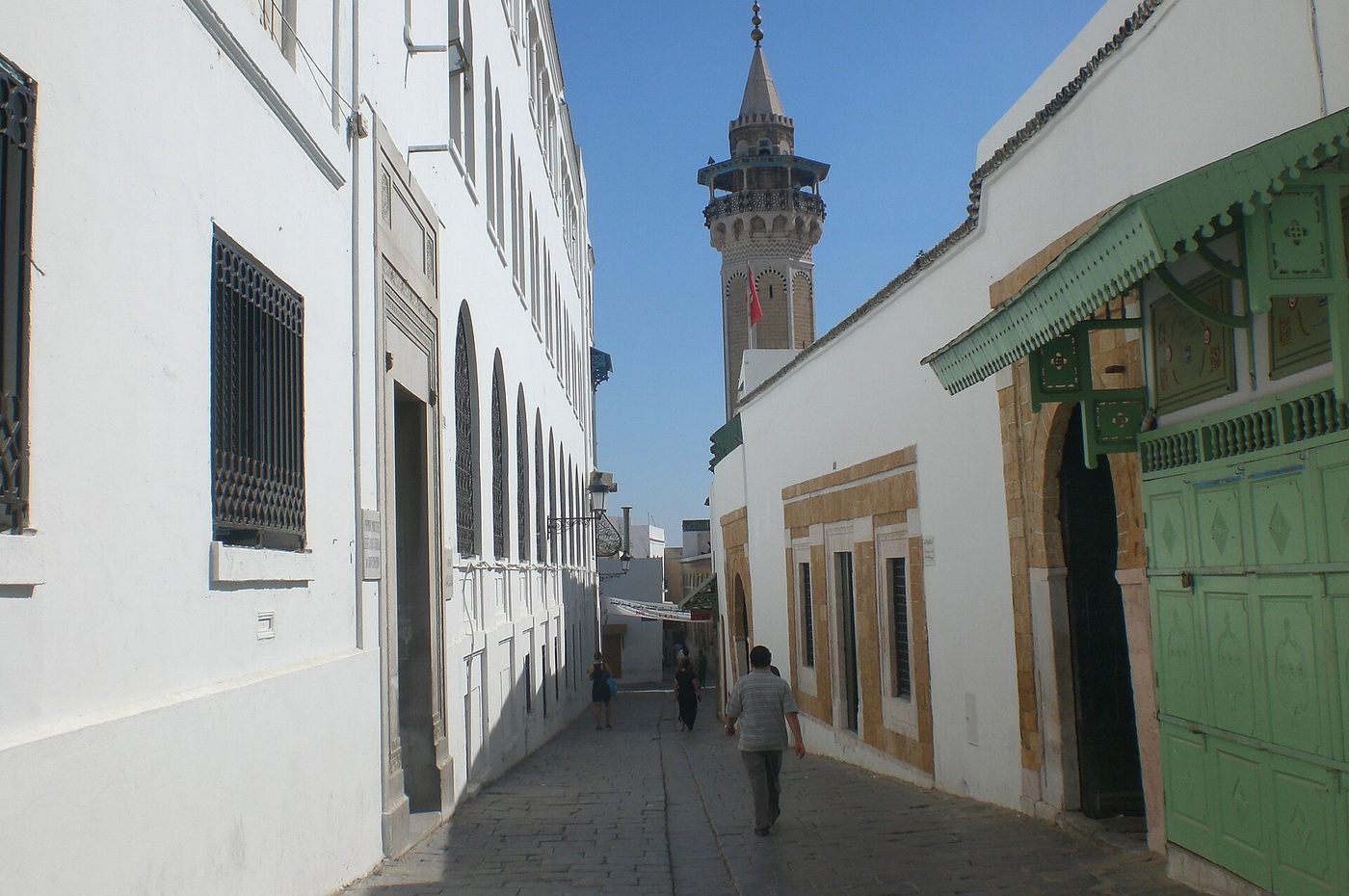
    An arched lane in the historic medina of Tunis

    Traditions, etiquette and how to be a respectful guest

    Tunisians are forgiving of visitors who get things slightly wrong — but a little effort is noticed and rewarded, often with an invitation to tea you’ll struggle to refuse. Here’s what actually matters on the ground.

    Greetings, hospitality and the right-hand rule

    Greetings are warm and unhurried. A handshake is standard (often followed by a brief touch of the hand to the heart, which I’ve always found a lovely gesture); good friends of the same sex kiss on the cheek. Between men and women, wait and follow their lead — some women, especially more religious ones, prefer not to shake hands, and a hand-to-heart nod covers it gracefully.

    Hospitality is close to a sacred duty. If you’re invited into a home, expect to be fed enormously and refused permission to help. Bring a small gift — pastries, or something from your own country — and remember the right-hand rule: eat, give and receive with your right hand, as the left is traditionally considered unclean. Take your shoes off at the door if your hosts have. And accept the tea; declining the first glass outright can read as a snub, though “just a little” is perfectly fine.

    What to wear (resort, medina and mosque)

    Tunisia is relaxed by regional standards, but context is everything. The FCDO puts it well, and it’s worth quoting directly (travel advice updated 23 February 2026): “Beach-appropriate clothing in holiday resorts is acceptable, however when visiting religious sites or remote areas of the country, local custom is to dress modestly.”

    In practice: bikinis and shorts are completely fine around the hotel pool and resort beaches. For a wander through a medina, a market town or any village away from the coast, I’d cover shoulders and knees — light trousers or a long skirt, a top with sleeves. It’s cooler in the sun anyway, draws far less attention, and is simply more courteous. For mosque courtyards (more on those below), women should carry a scarf for the hair and everyone should cover arms and legs; some sites lend cover-ups at the door. None of this requires a special wardrobe — just a bit of awareness about where you’re heading that day. Our Tunisia travel tips guide goes deeper on packing and practicalities.

    Ramadan and the religious calendar

    Islam follows a lunar calendar, so the big dates shift about 11 days earlier each year. Ramadan in 2026 ran from roughly 18 February to 19 March; in 2027 it begins in early February (around the 8th, subject to the moon sighting). During the holy month many Tunisians fast from dawn to dusk, cafés and some restaurants keep reduced daytime hours inland, and the whole country comes alive after the sunset iftar meal — the Tunis medina in particular hosts evening cultural events through Ramadan that are wonderful if you’re there.

    Crucially for package travellers, the FCDO confirms the resorts run as normal: alcohol and daytime dining rules “do not apply at holiday resorts.” If you venture out independently during Ramadan, the courteous move is simply not to eat, drink or smoke conspicuously in the street in daylight. The other movable feasts to know are Eid al-Fitr (end of Ramadan) and Eid al-Adha (around late May/early June 2026) — joyful family holidays when some shops and sites close. If you’re trying to time a visit, our month-by-month guide to the best time to visit Tunisia maps these against weather and crowds.

    A few honest dos and don’ts

    Alcohol is legal and easy to find in hotels, licensed restaurants and bars; the one quirk worth knowing is that the FCDO notes it’s “banned from sale in supermarkets on Fridays” — bars and hotels are unaffected. Ask before photographing people, especially women and older folk, and never photograph government buildings, police or military sites (the FCDO is explicit on this). Public displays of affection are best kept low-key away from resorts. And a factual note for LGBT+ travellers: same-sex sexual activity remains illegal under Article 230 of the Penal Code, carrying up to three years’ imprisonment, and the FCDO records that “members of the LGBT+ community have been targeted by criminals” — discretion is sensible. For the full safety picture, see our honest guide to whether Tunisia is safe to visit.

    Tunisia’s souks: a shopping and haggling guide

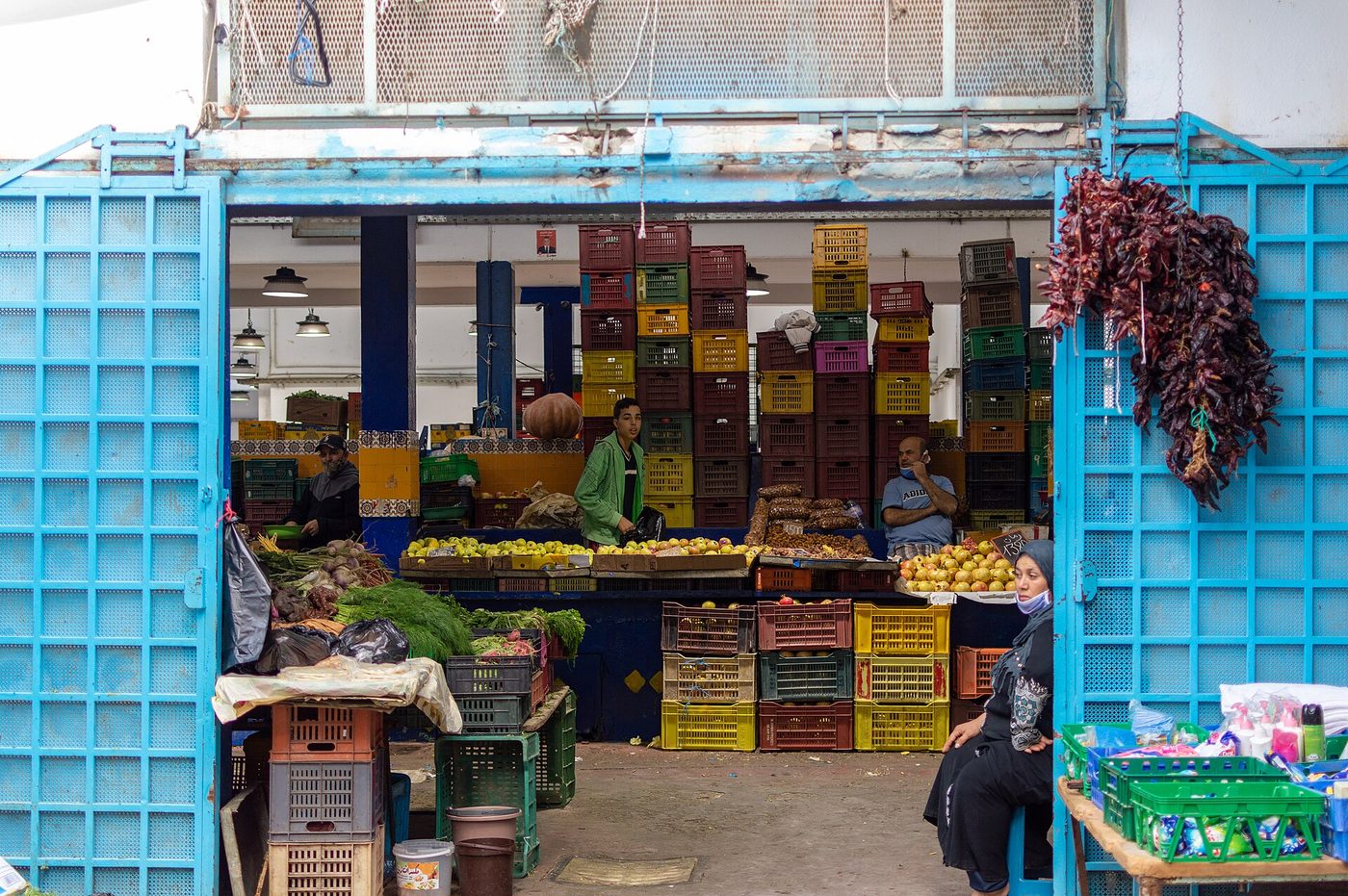
    The souk — the covered market at the heart of every old town — is where Tunisian culture is loudest, most fragrant and most fun. It’s also where nervous first-timers freeze up, convinced they’re about to be fleeced. You won’t be, if you understand how the game works. Shopping the souks is one of the best things to do in Tunisia, and it’s free to just wander.

    The great souks, and what each one sells

    The Tunis medina is the grandest, a UNESCO-listed warren of some 700 monuments where the lanes are still organised by trade, medieval-guild style. Souk El Attarine (the perfumers’, dating to the 13th century) is a wall of essences and rosewater; Souk des Chéchias — built by a Mouradite bey in 1691–92 for the city’s Andalusian hat-makers — is where the red felt caps are still blocked by hand; Souk El Berka, a former slave market, is now the gold and jewellery quarter; and Souk des Étoffes drips with fabric. Get lost on purpose; that’s the point.

    Beyond the capital, the Sousse medina has its own atmospheric, UNESCO-listed souk right by the resorts of the Sahel — the most convenient for package travellers. Kairouan is Tunisia’s carpet capital (more below). Nabeul, on Cap Bon near Hammamet, holds a big weekly market every Friday and is the pottery town. On Djerba, Houmt Souk — the name literally means “market quarter” — comes alive on Monday and Thursday mornings. And deep in the south, Douz hosts a Thursday-morning souk famous for its Saharan leather, wool burnous cloaks and a working livestock-and-camel market that is pure theatre.

    How to haggle without the stress

    Haggling here is expected, friendly and faintly performative — not the adversarial ordeal people fear. A few rules I’d pass on:

    • Greet first. An aslema and a smile resets the whole interaction. You’re a guest having a chat, not a mark.
    • Only start if you might actually buy. Naming a price you’re then unwilling to pay is the one genuine faux pas. Browsing is fine — “just looking, thank you” (nahawes barka, shukran) is a complete sentence.
    • The opening price is theatre. A common rule of thumb is to counter at roughly a third of the first quote and meet somewhere in the middle. It’s guidance, not gospel — quality and your own interest move the number.
    • Stay good-humoured and be willing to walk. The walk-away is the most powerful tool you have; half the time you’ll be called back. If you’re not, the price really was fair.
    • Carry small dinar in cash. Splitting a 50-dinar note for a 12-dinar trinket loses you leverage, and many stalls don’t take cards.

    Here’s the insider move nobody mentions: before you haggle for anything serious, visit a government-run fixed-price craft shop first. The national artisans’ body, ONAT (Office National de l’Artisanat Tunisien), and its retail arm SOCOPA run no-haggle stores in Tunis and the craft towns. Prices there are higher than a hard-won souk bargain but they anchor you: you’ll know what a genuine, decent-quality chechia or kilim actually costs before a charismatic vendor starts the music. Tour reps and our guide to Tunisian excursions can also steer you to reputable workshops.

    The closed dinar: money facts every shopper needs

    One genuinely important quirk: the Tunisian dinar is a “closed” currency. You legally cannot buy it before you fly, you change money on arrival (airports, banks, hotels, ATMs), and you’re not supposed to take dinar out of the country. Keep your exchange receipts — you’ll need them to convert leftover dinar back at the airport, and the FCDO notes that cash-machine receipts are not accepted for this. Budget your souk spending in cash, keep small notes handy, and change a bit more than you think for market days. Our Tunisia travel tips covers the currency rules and tipping in full.

    What to buy: traditional Tunisian crafts

    Tunisia’s craft heritage is the real souvenir story — not the mass-produced magnets, but ceramics, carpets and metalwork made the way they have been for generations. A buyer’s note up front: look for the ONAT quality stamp on genuine certified pieces, and be a little sceptical of anything suspiciously cheap and identical to the next stall’s — imported, machine-made goods (and even imported wool) do get sold as local handwork.

    Women weaving a kilim on a traditional loom, a living Tunisian craft

    Pottery and ceramics

    Two traditions, two looks. Nabeul (and historically Djerba’s Guellala) are the pottery heartlands. Guellala makes porous, unglazed earthenware — amphorae, water jars, earthy tones with Berber motifs — using techniques you can still watch in the village workshops on a Djerba day out. Nabeul, whose potters originally migrated from Guellala, went the other way: glazed, decorative ware and tiles in the famous blue-and-white floral and marine patterns that now tile half the country’s riads.

    The connoisseur’s buy, though, is Sejnane pottery from the Amazigh villages of the north-west. Hand-built by women without a wheel, open-fired on the ground and painted with red ochre and black geometric symbols, it was inscribed on UNESCO’s list of Intangible Cultural Heritage in 2018 — Tunisia’s very first such listing. The little modelled animals and figurines are utterly distinctive; if you see the real thing in a co-op or a good shop, buy it.

    A hand-painted Tunisian ceramic cup with traditional geometric decoration

    Carpets and kilims

    Kairouan is the name to know. The city’s textile prestige goes back to the medieval Aghlabid era, but the famous knotted Kairouan carpet is really a 19th-century tradition — local legend credits a governor’s daughter with introducing the Anatolian knot around 1830. Know your three types before you negotiate:

    • Zerbia — the premium knotted-pile rug, priced by knot density and size. A small one runs into the low hundreds of pounds; a good room-sized piece, well into the hundreds or beyond.
    • Mergoum — flat-woven, with bold diamond and lozenge patterns and brilliant colour. My personal favourite for the money.
    • Klim (kilim) — simpler flat-weave stripes, the most affordable; small ones start from around 60–120 TND (roughly £15–30) depending on size and how well you haggle.

    To sort handmade from machine-made: flip the rug over. A genuine hand-knotted carpet shows the pattern clearly on the back with slightly irregular knots; a perfectly uniform, rubbery or printed reverse is a factory job. Ask to see the knots, and don’t be rushed. Prices are very negotiable, so treat any single figure as a starting point.

    Knotted carpets hanging in a traditional carpet showroom in Kairouan

    The chechia, copperware, leather and the little things

    The chechia — the soft red felt cap that is Tunisia’s national headwear — is a craft on the brink. Made in that 17th-century Tunis souk by a dwindling band of artisans (a few dozen masters remain, down from thousands), a good one is a meaningful, packable buy at roughly 20–40 TND (£5–10). Tunisia’s metal engraving on gold, silver and copper earned its own UNESCO Intangible Heritage listing in 2023, and the hammered copper trays, lanterns and the engraved brass of the medinas are genuinely beautiful — just be realistic about getting a metre-wide tray home.

    Then there are the small, joyful things: the white birdcages of Sidi Bou Saïd, hand-built in the blue-and-white village above Tunis; olive-wood bowls and boards from the central groves; soft leather babouche slippers and bags; the protective khomsa (Hand of Fatima) charm against the evil eye, in silver or enamel; and, in summer, a machmoum — a tiny posy of jasmine, Tunisia’s emblematic flower, sold on street corners for small change and traditionally tucked behind a man’s ear. None of it will break the budget, and all of it beats a fridge magnet.

    What to buy Where it’s best Rough price (negotiable) Watch out for
    Knotted carpet (zerbia) Kairouan From low hundreds of £ Machine-made “silk”; check the back
    Kilim / mergoum flat-weave Kairouan, Gafsa, the south ~60–250+ TND (£15–65+) Imported, printed patterns
    Blue-and-white pottery Nabeul A few dinar upwards Fragile — pack well
    Sejnane pottery (UNESCO) Sejnane co-ops, good shops Tens of TND upwards Crude imitations
    Chechia (felt cap) Souk des Chéchias, Tunis ~20–40 TND (£5–10) Imported wool; buy from a maker
    Engraved copper / brass Tunis, Kairouan, Sousse Varies by size Getting it home; thin plate
    Olive wood, leather, khomsa Everywhere Small change to ~tens of TND Over-paying on the first stall

    The hammam: Tunisia’s bathhouse ritual, for first-timers

    If you do one cultural thing in Tunisia beyond the souk, make it a hammam. The steam bathhouse is a centuries-old fixture of every town — part wash-house, part social club, part budget spa — and a proper scrub leaves you feeling, frankly, reborn. It’s also the experience UK visitors are most nervous about, mostly because nobody explains what actually happens. So here it is.

    What actually happens, step by step

    1. Undress and wrap up. You leave your clothes in a changing area and keep your underwear on, wrapped in a fouta (a thin cotton sarong). You do not go fully naked — more on that below.
    2. Warm up in the steam. You move through warm rooms into the hot, humid steam room (the harara), sit, and let the heat open your pores. Pour warm water over yourself from the buckets or basins.
    3. Soap and soften. You slather on saboun beldi — a dark, soft olive-oil “black soap” — and let it sit while the steam does its work.
    4. The scrub (the main event). Using a coarse kessa mitt, you (or an attendant) exfoliate hard. Watching the grey rolls of dead skin come off is equal parts horrifying and satisfying; this is the gommage everyone raves about.
    5. Rinse. Bucket after bucket of warm water to sluice it all away.
    6. Optional massage, then rest. Many places offer a massage afterwards. Then you wrap up, cool down, and rehydrate — mint tea is traditional and very welcome.

    Hammam etiquette and the awkward questions, answered

    Do I get naked? No. Keep your underwear on; women usually keep knickers on (and sometimes nothing on top among locals, but a swimsuit bottom or briefs is normal for visitors), men wear shorts or underwear. Full nudity is not the custom.

    Is it mixed? Never, in a traditional hammam. Bathhouses are strictly single-sex — either separate premises, or, more often, separate time slots (commonly women in the daytime/afternoon, men early morning and evening). Hours vary by bathhouse and aren’t always posted, so ask locally or have your hotel check. The only “mixed” hammams are private couples’ treatments in some hotel spas, which are a different thing entirely.

    What do I bring? A kessa mitt, saboun beldi, a fouta, flip-flops, a towel and a change of underwear. You can buy the mitt and soap cheaply at the door or in any souk if you’d rather not pack them. Leave valuables at the hotel.

    Do I tip? Yes — if an attendant scrubs or massages you, a few dinar tip is customary and appreciated.

    A gentle word on the benefits: people have used hammams for relaxation, circulation and glowing skin for centuries, and I always sleep brilliantly afterwards — but treat the deep-“detox” claims as folklore rather than medicine, and skip the very hot rooms if you’re pregnant or have heart or blood-pressure issues.

    Neighbourhood hammam vs hotel hammam (and what it costs)

    There are two very different experiences here. A neighbourhood hammam is the real, local, no-frills version: you bring your own kit, do it yourself, and entry is just a few dinar — roughly 5–10 TND (£1.30–£2.60), with a small extra fee if you want an attendant to scrub you. In the Tunis medina, the long-running Hammam el Kachachine is a well-known working example, at around 10 TND entry plus a little more for the gommage. It’s authentic, occasionally chaotic, and not remotely aimed at tourists — which is the appeal.

    A hotel or spa hammam packages the ritual with guided steam, a full scrub, a massage and sometimes a wrap, in calmer, more polished surroundings. Expect roughly 80–165 TND (£20–42) at a mid-range spa — I paid 165 TND in Sousse for a hammam, scrub and massage that was worth every dinar — rising to the equivalent of $100-plus at five-star resorts. If you’re shy, start with a hotel hammam to learn the ropes, then try a local one. Either way, it’s the best-value pampering in the Mediterranean.

    Thalassotherapy and spa: why Tunisia is a wellness powerhouse

    Here’s the part of Tunisian culture that the guidebooks skip and that might genuinely change how you book your holiday. Tunisia is one of the world’s great wellness destinations — and for spa lovers flying from the UK, it’s spectacular value.

    What thalassotherapy actually is

    Thalassotherapy (from the Greek thalassa, “sea”) is the use of warmed seawater and marine products — algae and seaweed wraps, marine mud, mineral-rich ghassoul clay, hydro-massage pools, sea-water jets — for relaxation and recovery. The term was coined in France in the 1860s, and the science-y idea is that warm seawater and its minerals soothe muscles and skin. I’d frame the benefits honestly as deeply relaxing and restorative rather than medically curative, but as a way to spend a holiday afternoon it is sublime, and Tunisia happens to do it better and cheaper than almost anywhere.

    The world’s number two — and the value

    According to reporting by AFP in early 2025, Tunisia is the world’s second-largest thalassotherapy destination after France, drawing around 1.2 million wellness visitors a year (roughly 70% of them European), across some 60 dedicated thalasso centres and around 390 spas. Djerba was even named a “Mediterranean thalassotherapy capital” by an international hydrotherapy federation back in 2014. Treat the exact rankings as industry claims, but the scale is real — and so is the price gap. An all-inclusive thalasso week (hotel, treatments and meals) starts from around €1,000, roughly £850, against something nearer €3,000 for the equivalent in France. A single treatment or a half-day “discovery” pass typically runs about 80–200 TND (£20–50). For a UK spa-break budget, that’s transformative.

    Where to go, and what a day involves

    The wellness coast is easy to reach on a normal package. Hammamet and Yasmine Hammamet are the spa heartland; Sousse and Port El Kantaoui, Monastir, Gammarth on the Tunis north shore, and Djerba all have major centres, many built right into the big resorts so you can pad down in a robe after breakfast. Djerba’s Hasdrubal Prestige is often described as Tunisia’s largest thalasso centre; The Residence at Gammarth is the byword for luxury. If you want a spa-led trip, our guide to where to stay in Tunisia flags the resorts with the best on-site thalasso.

    A typical half-day might open with a warm sea-water pool and jet massage, move through an algae or mud wrap, a hammam scrub and a massage, and finish in a relaxation room with herbal tea. Book a day or two ahead in peak season, bring or buy flip-flops, and go easy on the sun afterwards.

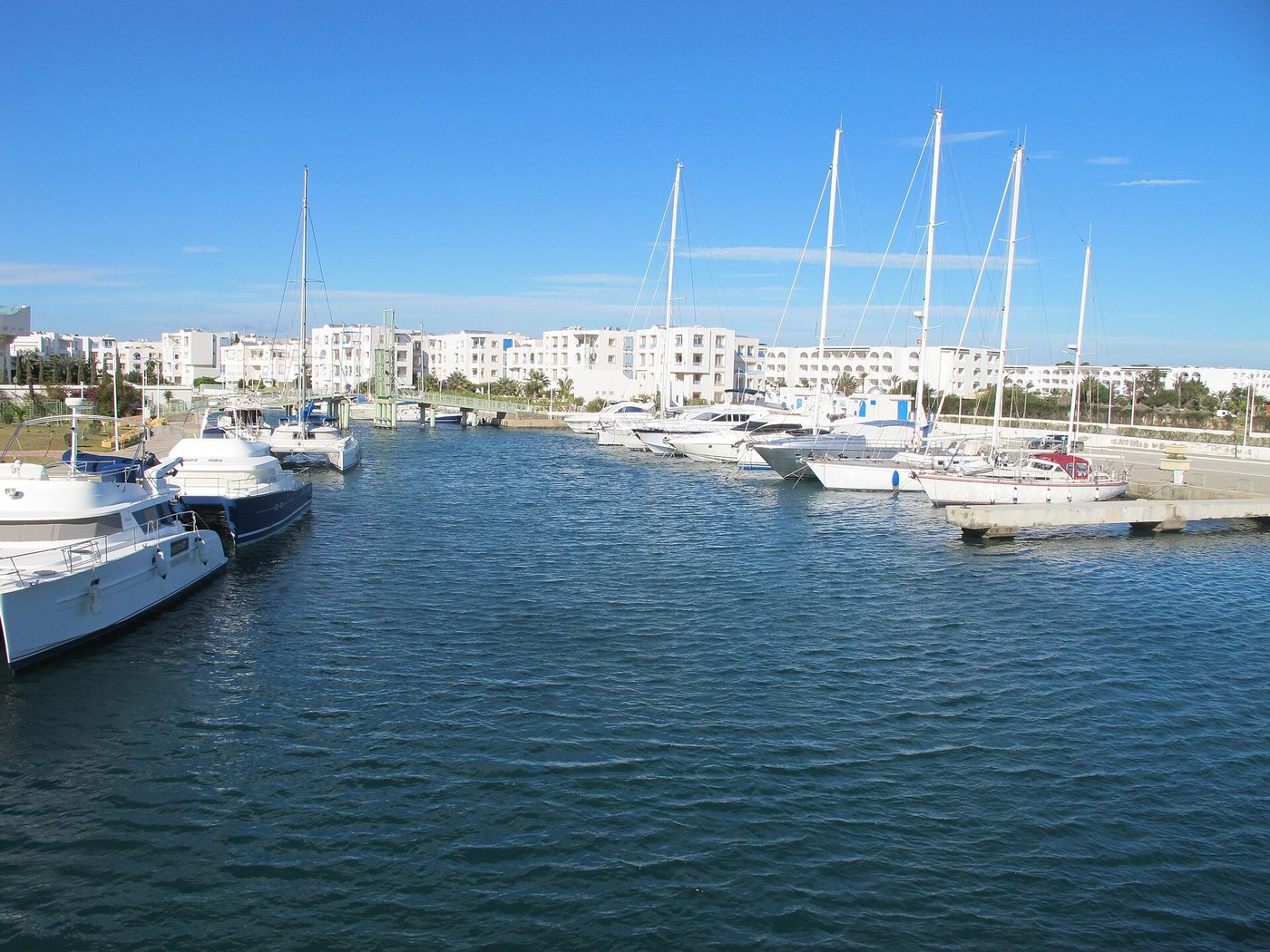
    The resort coast at Yasmine Hammamet, heart of Tunisia's thalassotherapy scene

    Korbous: bathing where hot springs meet the sea

    For something wilder and far older, head to Korbous, a tiny thermal-spring village wedged into the cliffs of Cap Bon, about 56 km from Tunis. People have taken the waters here since Roman times. Several hot springs feed the village’s spa hotels, but the magic spot is Aïn Atrous, a couple of kilometres outside, where scalding spring water — somewhere around 50°C (sources vary, roughly 45–60°C) — pours straight out of the rock and down to the shore. Bathers scoop out little pools where the hot water meets the cool Mediterranean and soak with the sea crashing in. The in-village springs sit inside paying hotels; Aïn Atrous is free and public. It’s a brilliant, slightly ramshackle half-day from the Cap Bon coast — bring water shoes and a sense of humour.

    Amazigh (Berber) heritage and the villages you can visit

    Long before Carthage, North Africa belonged to the Amazigh — the indigenous people often called Berbers, though “Amazigh” (plural Imazighen, meaning roughly “free people”) is the term they prefer; “Berber” descends from the same root as “barbarian”. Most Tunisians carry Amazigh ancestry, but the living language and customs survive mainly in pockets of the south and a few northern villages. Tamazight is spoken as a first language by only a small minority now — perhaps around 1% of the population, though heritage runs far wider — which makes visiting these communities feel like touching the country’s bedrock.

    Who the Amazigh are

    You’ll meet the Amazigh legacy everywhere once you know to look: in the geometric symbols on Sejnane pottery and kilims, the khomsa hand, the fortified granaries (ksour) of the south, and the ingenious underground homes built to beat the desert heat. It’s a culture of resilience and craft, and Tunisians are increasingly proud of it. A note on respect — these are lived-in villages, not open-air museums, so ask before photographing people and buy a tea or a craft to put something back into the community.

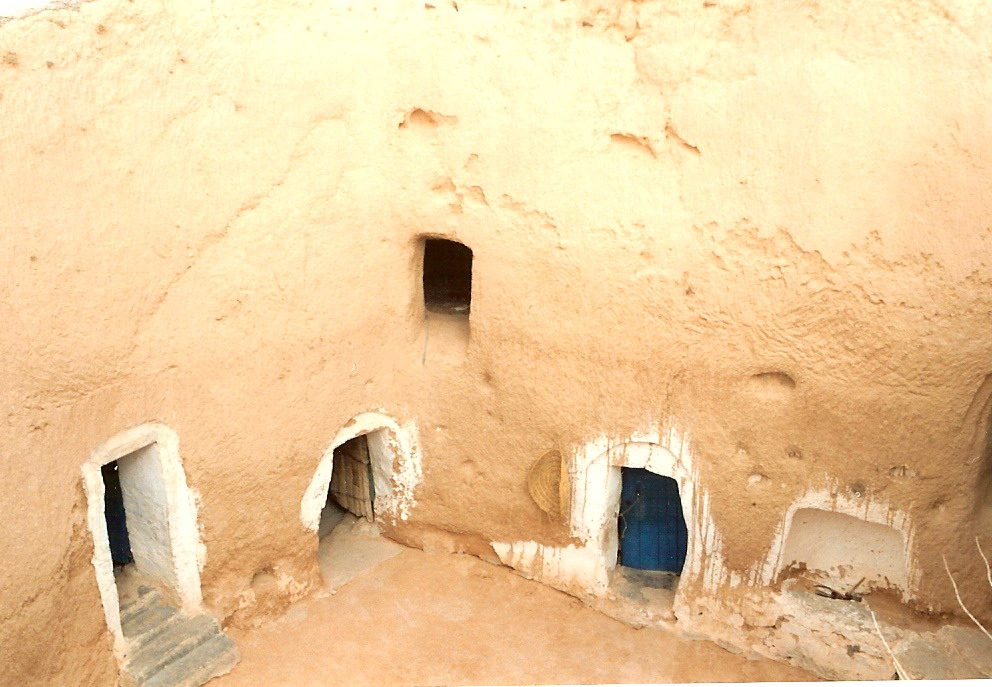
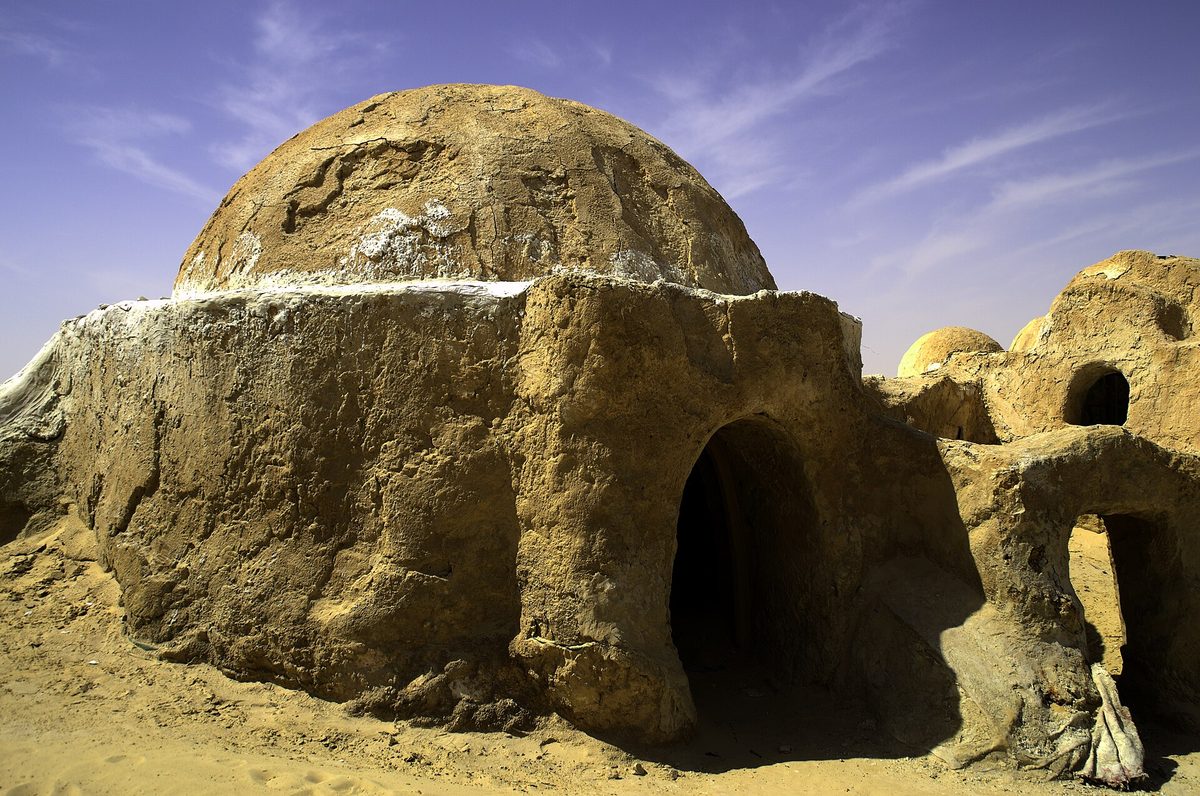
    A troglodyte Berber home dug into the ground at Matmata, southern Tunisia

    Berber villages worth the trip

    All of the following sit comfortably within the normal tourist map. (One caution per the FCDO: the deep south near the Libyan and Algerian borders includes areas the FCDO advises against travelling to, so stick to the established villages below and check current advice before any far-south desert excursion — our is Tunisia safe guide has the exact zones.)

    • Matmata — the most famous, and an easy add-on to a southern tour: a lunar landscape of troglodyte pit-homes dug into the ground around sunken courtyards. The Hotel Sidi Driss here played the Lars family homestead in Star Wars and you can still eat lunch in the filmed courtyard — see our Star Wars filming locations guide.
    • Chenini and Douiret — dramatic hilltop ksar villages near Tataouine town, with cave dwellings, whitewashed mosques and Tamazight still spoken. Achingly photogenic in late afternoon light.
    • Tamezret and Toujane — quieter Berber hill villages near Matmata, good for a slower, less touristy feel and a glass of almond tea.
    • Takrouna and Zriba — clifftop Amazigh hamlets in the north near Zaghouan, an easy detour from Hammamet or Sousse.
    • Guellala, Djerba — the island’s Ibadi-Amazigh potters’ village, where the unglazed-pottery tradition lives on.

    Most travellers reach the southern villages on an organised tour from the coast or from a Sahara trip; the northern ones are doable by hire car. Either way, see our guide to getting around Tunisia for the logistics.

    The Amazigh hilltop village of Chenini in southern Tunisia

    Music, festivals and the cultural calendar

    The sound of Tunisia

    Three traditions dominate. Malouf is Tunisia’s Arab-Andalusian classical music, carried here by Muslims and Jews expelled from Spain between the 15th and 17th centuries and nurtured in towns like Testour and Soliman; the Rashidiyya Institute, founded in Tunis in 1934, codified and saved it, and President Bourguiba later promoted it as national heritage. Mezoued — named after the goatskin bagpipe that drives it — is the raucous, danceable folk-pop of the working class, long looked down on by the establishment and now utterly mainstream at weddings. And stambeli is the haunting, trance-like spirit music brought by the descendants of enslaved West Africans, used in healing ceremonies and built on the iron shqashiq clappers and the gumbri lute. Listen for the oud, the double-reed zukra and the bendir frame drum threaded through all of it.

    Festivals month by month

    Tunisia’s festival season peaks in summer, when Roman theatres and amphitheatres become some of the most atmospheric concert venues on earth. Dates shift year to year, so I’ve given the usual window rather than invent specifics; check the official festival pages closer to the time, and note that the religious holidays move with the lunar calendar.

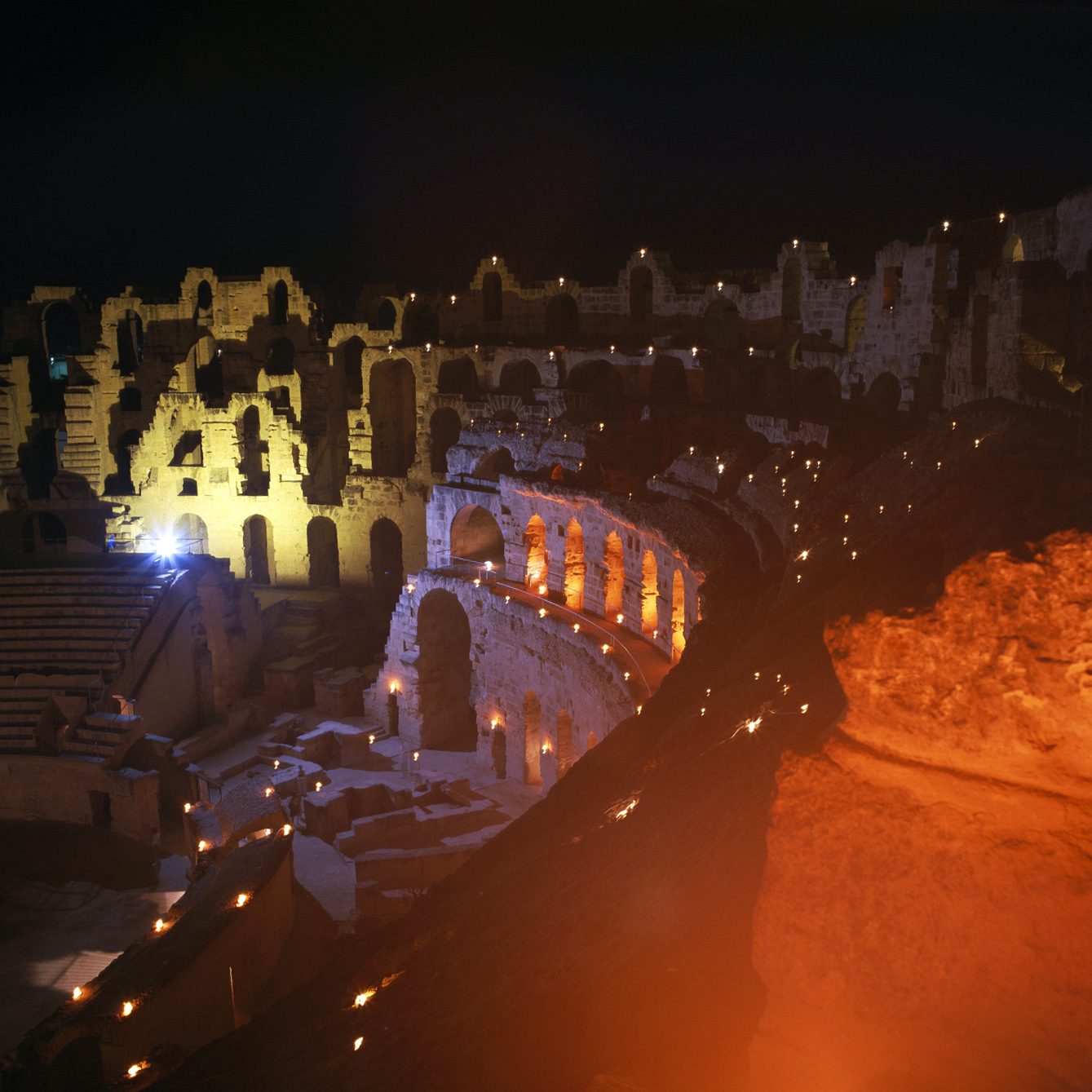
    The Roman amphitheatre at El Jem, summer venue for the symphonic music festival
    When Festival Where What it is
    During Ramadan (Feb 2026 / early Feb 2027) Medina Festival Tunis Evening concerts and cultural events after iftar
    Spring Orange Blossom Festival Nabeul / Menzel Bou Zelfa Cap Bon’s citrus harvest celebration
    Usually June Testour Malouf Festival Testour Tunisia’s flagship Andalusian-music gathering
    Usually June Falconry (Sparrowhawk) Festival El Haouaria, Cap Bon Cap Bon’s ancient bird-of-prey tradition
    July–August International Festival of Carthage Ancient theatre, Carthage The big one — music, theatre and dance, 60th edition in 2026
    July–August International Festival of Hammamet Open-air theatre, Hammamet Long-running arts festival by the sea
    July–August Symphonic Music Festival El Jem amphitheatre Orchestras under the stars in a Roman arena
    Summer Dougga Festival Roman site of Dougga Performances among the ruins
    Late December International Sahara Festival Douz Camel races and Bedouin culture on the desert’s edge
    Autumn/winter Date & oasis festivals Kébili, Tozeur Harvest celebrations in the palm groves

    If a festival is your reason to travel, line it up against our best time to visit guide and the venue write-ups in our Roman ruins guide — watching an orchestra in the El Jem amphitheatre is a bucket-list evening. The Sahara Festival at Douz is the great winter alternative.

    Food, mint tea and the culture of the table

    You can’t separate Tunisian culture from its food, and the kitchen is where the country’s heritage is most deliciously alive. Couscous — the national dish, and a UNESCO Intangible Heritage element since 2020 — is the Friday ritual; fiery harissa earned its own UNESCO listing in 2022; and the crisp, egg-filled brik is the snack you’ll crave for years. Meals end, always, with sweet mint tea, often with pine nuts floating on top, and honey-soaked makroud from Kairouan. Sharing a tagine of ojja or a plate of grilled fish with Tunisians is the warmest cultural exchange there is — our guide to Tunisian food tells you exactly what to order and how to eat it.

    Frequently asked questions

    What is Tunisia known for culturally?

    Tunisia is known for its layered Mediterranean culture: Carthaginian and Roman ruins, Arab-Islamic medinas and souks, the indigenous Amazigh (Berber) heritage of the south, a famous craft tradition (Kairouan carpets, Nabeul and Sejnane pottery, the red chechia hat), the steam-bath hammam ritual, and being one of the world’s leading thalassotherapy spa destinations.

    Is Tunisia a Muslim country, and can I visit mosques?

    Yes — around 99% of Tunisians are Sunni Muslim, with a small Jewish community and Djerba’s distinct Ibadi Muslims. Most working mosques are closed to non-Muslims, but you can usually visit the courtyards of a few historic ones, such as the Great Mosque of Kairouan and the Zitouna in Tunis. Dress modestly and respect prayer times.

    What should I wear in Tunisia as a tourist?

    Around resorts and pools, normal beachwear is fine. Away from the coast — in medinas, markets and villages — cover shoulders and knees out of courtesy and to draw less attention; women may want a scarf for mosque courtyards. The FCDO advises that beach clothing suits resorts, but “local custom is to dress modestly” at religious sites and in remote areas.

    What happens in a Tunisian hammam, and do you get naked?

    No, you keep your underwear on, wrapped in a thin cotton fouta. You warm up in steam, lather with olive-oil “black soap”, then exfoliate hard with a coarse kessa mitt — the famous scrub — before rinsing and, often, a massage. Hammams are always single-sex, usually split by time slot. Bring flip-flops, a towel and a few dinar to tip.

    How much does a hammam or spa cost in Tunisia?

    A local neighbourhood hammam costs just a few dinar — roughly 5–10 TND (£1.30–£2.60) — for self-service entry. A hotel or spa hammam with a full scrub and massage runs about 80–165 TND (£20–42), rising at five-star resorts. A thalassotherapy day pass is typically 80–200 TND (£20–50). Prices are approximate; check on the day.

    Why is Tunisia famous for thalassotherapy?

    Reporting in 2025 ranked Tunisia as the world’s second-biggest seawater-therapy destination after France, with around 60 thalasso centres and some 390 spas drawing about 1.2 million wellness visitors a year. The draw is quality at a fraction of European prices — an all-inclusive thalasso week starts from around €1,000 (about £850), versus roughly €3,000 in France.

    How do you haggle in a Tunisian souk?

    Greet the seller first, only start bargaining if you genuinely might buy, and treat the opening price as theatre — a common rule of thumb is to counter at about a third and meet in the middle. Stay friendly, carry small dinar in cash, and be ready to walk away (it often brings the price down). Visiting a fixed-price ONAT craft shop first helps you gauge fair value.

    What are the best souvenirs to buy in Tunisia?

    The standouts are a Kairouan carpet or kilim, Nabeul’s blue-and-white pottery or UNESCO-listed Sejnane terracotta, a handmade chechia felt hat, engraved copper and brass, olive-wood kitchenware, a Sidi Bou Saïd birdcage, and silver khomsa charms. Look for the ONAT quality stamp on certified crafts, and be wary of cheap imported lookalikes sold as local handwork.

    Who are the Amazigh, and which Berber villages can I visit?

    The Amazigh are North Africa’s indigenous people, here before Carthage. The most visitable villages are Matmata (troglodyte homes and a Star Wars set), Chenini and Douiret near Tataouine, Tamezret and Toujane near Matmata, and Takrouna and Zriba in the north. Most southern villages are reached on a tour; check FCDO advice before any deep-south desert trip near the borders.

    What are the main festivals in Tunisia?

    The summer headliners are the International Festival of Carthage (in the ancient Roman theatre), the Hammamet festival, and the symphonic music festival in the El Jem amphitheatre, all roughly July–August. Winter brings the Sahara Festival at Douz in late December. Dates shift each year, so check official sources before booking around one.

    Final thoughts

    The thing I want UK visitors to take away is that Tunisian culture isn’t a side excursion from the beach holiday — it is the holiday, if you let it be. An afternoon haggling for a kilim, a morning being scrubbed pink in a hammam, a thalasso day that costs less than a posh dinner at home, an evening of malouf under Roman arches: this is some of the best value, most welcoming cultural travel anywhere on the Mediterranean. Be a gracious guest, learn three words of Arabic, accept the tea, and Tunisia will open right up. For the bigger picture, start with our master list of things to do in Tunisia and build your trip with our Tunisia itinerary guide.


    About the author: Written by the Tunisia Tourism Guide editorial team — UK-based travel writers who have spent years exploring Tunisia’s coast, medinas and desert, from Tunis to Tataouine. We write practical, honest guides for British travellers and update them regularly. Last updated June 2026.

    Sources & further reading: UK FCDO Tunisia travel advice (updated 23 February 2026); UNESCO Intangible Cultural Heritage lists (Sejnane pottery 2018, couscous 2020, harissa 2022, metal engraving 2023); AFP/France 24 reporting on Tunisia’s thalassotherapy sector (2025). Prices and dates are indicative for June 2026 and should be confirmed locally before you travel.

    Photo credits

    • Hand-painted blue doors and crafts in Sidi Bou Said, an icon of Tunisian culture — Photo: Mstyslav Chernov / CC BY-SA 3.0 via Wikimedia Commons (source).
    • An arched lane in the historic medina of Tunis — Photo: Rais67 (CC0) via Wikimedia Commons (source).
    • Women weaving a kilim on a traditional loom, a living Tunisian craft — Photo: Dennis G. Jarvis / CC BY-SA 2.0 via Wikimedia Commons (source).
    • A hand-painted Tunisian ceramic cup with traditional geometric decoration — Photo: Nicholas Johnson from Brookline, MA, USA (CC0) via Wikimedia Commons (source).
    • Knotted carpets hanging in a traditional carpet showroom in Kairouan — Photo: Максим Улитин / CC BY 3.0 via Wikimedia Commons (source).
    • The resort coast at Yasmine Hammamet, heart of Tunisia’s thalassotherapy scene — Photo: Marc Ryckaert (MJJR) / CC BY 3.0 via Wikimedia Commons (source).
    • A troglodyte Berber home dug into the ground at Matmata, southern Tunisia — Photo: Bernard Gagnon / CC BY-SA 3.0 via Wikimedia Commons (source).
    • The Amazigh hilltop village of Chenini in southern Tunisia — Photo: Simunaire / CC BY-SA 4.0 via Wikimedia Commons (source).
    • The Roman amphitheatre at El Jem, summer venue for the symphonic music festival — Photo: Agnieszka Wolska / CC BY-SA 3.0 via Wikimedia Commons (source).
  • Star Wars Filming Locations in Tunisia: The Complete Guide

    Star Wars Filming Locations in Tunisia: The Complete Guide

    Tunisia is the real Tatooine. George Lucas filmed here for four Star Wars films — A New Hope and the entire prequel trilogy — and, remarkably, most of the sets still stand in the open desert. The Star Wars filming locations in Tunisia fall into two clusters: the purpose-built desert sets around Tozeur in the west, and the ancient towns, cave-houses and hilltop ksour of the south and the island of Djerba. This is every location worth your time, with exact coordinates, the real scene filmed at each, the honest state of each set in 2026, and how to reach them from wherever you’re staying.

    I’ve made this trip from both ends — out of Tozeur in a battered Land Cruiser at dawn, and out of a Djerba package hotel in a hire car with a paper map and a lot of optimism. The thing nobody tells you is that the locations are split across the country: you cannot see them all in a day, or even comfortably in a weekend. So before the site-by-site guide, let me show you how the pieces fit together, because getting that wrong is the single biggest mistake first-timers make.

    Star Wars filming locations in Tunisia at a glance

    Here’s the shortlist, roughly west to east, with my honest verdict on whether each is worth the detour. “Base” is the town or island you’d realistically set out from.

    Location What was filmed Film(s) Nearest base Worth it?
    Mos Espa set Anakin’s home spaceport; podrace town Episode I, II Tozeur Essential
    Lars Homestead dome (Chott el Djerid) The igloo farmhouse; Luke’s twin-suns sunset Episodes IV, II, III Tozeur Essential
    Sidi Bouhlel (“Star Wars Canyon”) Jawas capture R2-D2; Tusken attack; “Hello there” Tozeur High
    Ong Jemal & the Grande Dune Darth Maul’s lookout; C-3PO in the dune sea Tozeur High
    Sidi Driss Hotel, Matmata Interior of the Lars homestead (Aunt Beru’s kitchen) Djerba / Matmata Essential
    Ajim, Djerba Mos Eisley spaceport; the cantina exterior Djerba Medium
    Amghar Mosque, Djerba Obi-Wan Kenobi’s house exterior Djerba Medium
    Ksar Hadada Mos Espa slave-quarters streets Tataouine / Djerba Medium
    Ksar Ouled Soltane Disputed — scouted, probably not filmed Tataouine Go for the ksar, not the film
    Chenini & Douiret Not filmed — the scenery that inspired Tatooine Tataouine Worth it on its own terms

    If you only remember one thing from this guide, make it this: the desert sets (Tozeur) and the cave-and-ksour sites (Djerba and the south) are 300–400 km apart. Pick your half based on where your flight lands, or give yourself the two or three days it takes to do both properly. More on that below.

    Which Star Wars films were shot in Tunisia?

    Four of them, and they bookend the saga. Here’s the timeline that actually matters, because the shoot years and the release years are very different — and getting this right is half the fun of standing on the sites.

    • A New Hope (Episode IV) — the very first Star Wars footage ever shot was filmed on the Chott el Djerid salt flat in late March 1976, released 1977. This is where it all began: Luke’s homestead, the Jawas, the Tuskens, the droids stumbling through the dune sea, Mos Eisley.
    • The Phantom Menace (Episode I) — shot in Tunisia in July–August 1997, released 1999. This is the prequel that built the big sets: the whole town of Mos Espa, the podrace arena, Darth Maul’s arrival at Ong Jemal.
    • Attack of the Clones (Episode II) — a shorter shoot in September 2000, released 2002. Anakin returns home to find his mother; several Episode IV and I sites were reused.
    • Revenge of the Sith (Episode III) — released 2005, but here’s the twist fans love: there was no separate 2005 Tunisia shoot. The film’s only Tatooine moment — Obi-Wan handing the infant Luke to Owen and Beru at the homestead — was actually filmed on Chott el Djerid back in September 2000, during the Attack of the Clones production, then finished with digital effects. So the saga’s first and last Tatooine images were shot at the same spot, four years and one trilogy apart.

    What about the rest? The Empire Strikes Back and Return of the Jedi never came to Tunisia (Jedi’s Tatooine scenes were shot in Yuma, Arizona), and the sequel trilogy used Abu Dhabi and Jordan for its desert planets. So when you stand at these sites, you’re standing in the original — and the prequels — but not the Jabba’s-palace stuff. Disney later bought a slice of independently shot Tunisian footage for The Mandalorian, but no Lucasfilm crew has filmed here since 2000.

    The two clusters: how to plan your Tatooine pilgrimage

    This is the part the existing guides bury, so I’ll put it up front. Tunisia’s Star Wars sites are not one tidy circuit. They’re two distinct clusters at opposite ends of the country, plus a scatter of ksour in the deep south.

    Cluster 1 — the desert sets, around Tozeur (the west)

    This is the iconic stuff: Mos Espa, the Lars Homestead dome on the salt flats, the Star Wars Canyon at Sidi Bouhlel, and Ong Jemal with its dune sea. Everything here is open desert, reached by 4×4 from the oasis town of Tozeur. It’s a half-day or full-day trip. You’ll see the exterior of the Lars homestead here — the white igloo dome.

    Cluster 2 — the towns and cave-houses (Djerba and the south)

    This is where you find Matmata, where the underground Sidi Driss Hotel served as the interior of the Lars homestead; the island of Djerba, where the town of Ajim became Mos Eisley and a coastal mosque became Obi-Wan’s house; and the fortified granaries — ksour — near Tataouine that the prequels used for the slave quarters. Most package travellers reach these from Djerba.

    The “one homestead, two deserts” trick: the Lars farm you remember from the films is two separate places 300 km apart. The domed exterior (with the twin-suns sunset) is on Chott el Djerid near Tozeur. The interior — Aunt Beru’s kitchen, the dining alcove, the corridor where Leia’s hologram plays — is the Sidi Driss Hotel in Matmata. A Tozeur trip shows you the outside of the house; a Djerba/Matmata trip shows you the inside. To see both, you need to cross the country.

    The white igloo dome of the Lars Homestead exterior on Chott el Djerid

    Which cluster should you choose? It comes down to where you land. Most UK package holidays fly into Djerba (TUI and easyJet both serve it in season) or into Enfidha/Monastir for the beach resorts — putting Cluster 2 within reach. The desert sets near Tozeur are harder: there are no direct UK flights to Tozeur’s little airport, so you either fly via Tunis, take a long internal drive, or build a two- to three-day desert tour. I’ll give you exact routes, times and prices from each base further down. For the bigger picture of fitting this into a wider trip, our Tunisia itinerary guide maps out how the desert slots into 5, 7, 10 and 14-day plans, and the Tunisian Sahara guide covers the wider desert region the sets sit inside.

    The desert sets: Tozeur cluster, site by site

    Mos Espa — the spaceport that’s still standing

    Films: The Phantom Menace (Episode I), reused for Attack of the Clones (Episode II).
    Coordinates: approximately 33.9943° N, 7.8427° E, in the Eriguet dunes north of Nefta.
    How to visit: 4×4 day trip from Tozeur; free to walk around; the last few kilometres are soft sand.

    Of all the sites, this is the one that makes you gasp. Mos Espa is a whole town — around two dozen domed plaster-and-timber buildings — built from scratch for The Phantom Menace in 1997 and never taken down. You walk straight into the marketplace where young Anakin haggles, past the curved facade of Watto’s junk shop, under archways that framed the podrace crowds. It was only ever meant to last a few weeks of filming. It’s lasted nearly three decades.

    Two honest warnings. First, the scale is smaller than the films suggest — the towering cityscape was extended with digital matte paintings, so the real Mos Espa is a film-set village, not a metropolis. Second, you will not have it to yourself: souvenir sellers have colonised the buildings, draping scarves and “Tatooine” trinkets over the domes, and a camel or two will be parked photogenically out front, with a small fee expected. Go at sunrise if you can — the light is extraordinary, the heat bearable, and the sellers fewer.

    The state of the set in 2026: this is where the famous “Star Wars versus the dune” story is real. A crescent-shaped barchan dune has been creeping toward the set for years, and a smaller secondary Mos Espa set a few hundred metres away was swallowed by sand long ago. Geologists have warned the main set could be partially buried, and local authorities have at times bulldozed the advancing dune to hold it back. As of June 2026 the main town still stands, but the threat is genuine — this is a “go now” site, not a “someday” one. (Ignore the breathless headlines claiming it’s already buried; that’s the smaller set, or the dune threatening the main one.)

    My verdict: essential. Standing in that marketplace at first light is the single best Star Wars moment in Tunisia.

    The Lars Homestead dome — Chott el Djerid

    Films: A New Hope, Attack of the Clones, and Revenge of the Sith — the only Tunisian site that appears in three films.
    Coordinates: approximately 33.8428° N, 7.7790° E, on the salt flats between Tozeur and Kebili.
    How to visit: a short walk off the causeway that crosses the chott; usually bundled into a Tozeur 4×4 day; free.

    This is the white igloo dome — the exterior of the Lars moisture farm where Luke Skywalker grew up, and the spot where he watches the twin suns set in A New Hope, the franchise’s most quietly iconic shot. It sits alone on the blinding white crust of Chott el Djerid, Tunisia’s vast salt lake, with nothing around it but shimmering horizon. The very first frame of Star Wars ever committed to film was shot a stone’s throw from here in March 1976.

    What I love about this site is the goosebumps-to-effort ratio: it’s an easy walk from the road, it’s free, and the emotional payoff — standing where Luke stared at two setting suns and dreamed of leaving — is immense for any fan. Bring water and sunglasses; the salt glare is brutal even in winter.

    The state of the set in 2026: the dome is standing and in decent repair, and that’s thanks to fans. When the structure began crumbling, a volunteer project called “Save the Lars Homestead”, led by Belgian fan Mark Dermul, raised around US$10,000 and restored it over four days in May 2012, working in 43°C heat with forty-odd litres of white paint. It has since been patched up again — a second fan effort in 2018 and a German-government-funded restoration in 2022 reshaped the craters. So if the dome looks improbably crisp for a 1976 prop, that’s why.

    My verdict: essential, and weirdly moving. Time it for late afternoon and you can watch your own (single-sun) version of the binary sunset.

    The Chott el Djerid salt flat near Tozeur, Tunisia

    Sidi Bouhlel — the “Star Wars Canyon”

    Films: A New Hope (with a podrace sniper’s-eye moment in Episode I).
    Coordinates: approximately 34.0362° N, 8.2803° E, in the Jebel Sidi Bouhlel range east of Tozeur.
    How to visit: 4×4 and a guide — the gorge is unmarked and easy to miss.

    If Mos Espa is the showpiece, Sidi Bouhlel is the connoisseur’s site, and my personal favourite. This narrow desert gorge — fans call it the “Star Wars Canyon”, though its real name is Sidi Bouhlel or the Maguer Gorge — hosted more A New Hope scenes than anywhere else in Tunisia. Walk it and you tick off a string of moments: the Jawas zapping and bundling R2-D2 into their sandcrawler; the Tusken Raiders ambushing Luke; Obi-Wan Kenobi appearing in his cloak to scare them off with that mournful cry (“Hello there,” near enough); the spot where C-3PO is recovered. It’s the only Tunisian Star Wars location that was also filmed from the air.

    It’s a genuine thrill even if you’ve never seen the films, because the canyon is beautiful in its own right, and it pulls double duty in cinema history: Steven Spielberg shot scenes of Raiders of the Lost Ark here in 1980, and The English Patient used it too. You’ll want a guide who knows exactly which bend matches which shot — without one it’s just a (lovely) gorge.

    My verdict: high. The most rewarding site for anyone who likes matching the real landscape to the frame.

    Ong Jemal and the Grande Dune — the dune sea

    Films: The Phantom Menace (Ong Jemal); A New Hope (the Grande Dune near Nefta).
    How to visit: same Tozeur 4×4 circuit as Mos Espa; they’re close together.

    Ong Jemal — “the camel’s neck”, named for a rock outcrop that does look like one — is the dramatic mesa right beside Mos Espa where Darth Maul lands his Sith Infiltrator and surveys the desert in The Phantom Menace. Climb it for the view that the prequels used as the podrace backdrop. Nearby, the rolling Grande Dune near Nefta is the “dune sea” where, in A New Hope, C-3PO trudges over the crest complaining “How did we get into this mess?”, and where the droids pass the bleached skeleton of a krayt dragon. Most Tozeur desert tours roll Mos Espa, Ong Jemal, the Grande Dune and the Lars dome into one loop — which is exactly why Tozeur is the desert base.

    A camel caravan crossing the dune sea of the Tunisian Sahara

    My verdict: high, and effortlessly bundled with Mos Espa. The dune sea at sunrise is pure Tatooine.

    The towns and cave-houses: Matmata, Djerba and the ksour

    Sidi Driss Hotel, Matmata — sleep inside the Lars homestead

    Films: A New Hope and Attack of the Clones.
    Where: Matmata old town, Gabès Governorate (roughly 33.544° N, 9.969° E).
    How to visit: a working hotel — you can stay, or stop for lunch with a tour; a few dinars to look around if you’re not eating.

    This is the one that gives you the best photo in Tunisia, because you can stand inside the film. The Sidi Driss (also spelled Sidi Idriss) is a troglodyte hotel — rooms and courtyards dug down into the earth, as the Berber people of Matmata have built for centuries — and its sunken courtyards played the interior of the Lars homestead. The dining alcove where Uncle Owen lectures Luke over blue milk, the curved corridor, Aunt Beru’s kitchen: all here, and the production left enough set dressing that it’s instantly recognisable. The hotel leans into it, with a small Star Wars display and themed rooms.

    Can you stay there? Yes — and it’s a proper Tatooine sleepover, if a rustic one. It has eight cave rooms; expect somewhere around 250–300 TND (roughly £65–£90) for a basic double with shared facilities, as of mid-2026. Be clear-eyed: reviews are mixed, the rooms are spartan and a bit dilapidated, and there’s some hassling from sellers outside. But waking up in the Lars homestead is a story you’ll dine out on for years. If you’re just passing through on a tour, lunch (usually couscous) is typically included, or you can pay a few dinars — about 4 TND (£1) — to walk the courtyards.

    A troglodyte cave dwelling in Matmata, used as the Lars homestead interior

    My verdict: essential, and the easiest “stand inside the movie” moment of the lot. Manage your expectations on the rooms and you’ll love it. If you’d rather a comfortable base nearby, our where to stay in Tunisia guide covers the desert and coastal options. Matmata pairs naturally with the ksour further south and is reachable on a long day from Djerba — see the logistics section.

    Ajim, Djerba — Mos Eisley spaceport

    Films: A New Hope.
    Coordinates: approximately 33.7240° N, 10.7500° E, the ferry town on the south-west of Djerba.
    How to visit: a 30-minute drive from Djerba’s resorts; no tickets, but little signage — bring this guide.

    “You will never find a more wretched hive of scum and villainy.” Ajim is the working port town on Djerba that doubled for the exterior of Mos Eisley, the spaceport where Luke and Obi-Wan hire the Millennium Falcon. The famous cantina exterior — Chalmun’s Cantina, where the band plays and Han shoots first — is a real former bakery on the edge of town. (The cantina interior, with all the aliens, was a set built back in England, so don’t expect to walk inside.) Other corners of Ajim stood in for Docking Bay 94 and the stormtrooper checkpoint.

    I’ll be honest: this is the most “you have to use your imagination” site. The bakery-cantina is derelict and unmarked, and Ajim has redeveloped around it, so without knowing what you’re looking at you’d drive straight past. What it has going for it is access — if you’re on a Djerba beach holiday, this is a cheap half-day by taxi or hire car, on a flat, fully paved island where a 2WD is all you need. In 2019 the French street artist Invader added a pixel-art stormtrooper mosaic to the bakery, which at least marks the spot.

    My verdict: medium. A satisfying quick pilgrimage if you’re already on Djerba; not worth a special long journey. Our Djerba travel guide covers the island’s beaches, Houmt Souk and the rest of what to do around your cantina stop.

    Obi-Wan’s house — the Amghar Mosque, and a cautionary tale

    Films: A New Hope (exterior, filmed as a background plate in April 1976).
    Coordinates: approximately 33.7408° N, 10.7350° E, on the coast just outside Ajim.

    A short way from Ajim, a whitewashed old Ibadi mosque on the shoreline — the Amghar Mosque — is the building used for the exterior of Obi-Wan “Ben” Kenobi’s house. It’s a beautiful, lonely spot, and it’s the genuine article, confirmed from the production records. One important clarification, because the internet muddles this constantly: a different Djerba mosque, Sidi Jmour, is often mislabelled as Obi-Wan’s house — but Sidi Jmour was actually used for the Anchorhead and Tosche Station scenes, most of which were cut from the final film. The Kenobi hermitage is the Amghar Mosque. Don’t let a guide take you to the wrong white mosque.

    A word of warning that doubles as a plea: in November 2024, two British tourists daubed the historic Amghar Mosque with red clay paint in a misguided “restoration”, covering the ancient stone and the Invader mosaic and damaging what is now a UNESCO-listed site. It caused real upset locally. These places survive on goodwill — photograph them, don’t touch them, and certainly don’t “improve” them. Treat every set as someone else’s heritage, because it is.

    My verdict: medium, and best paired with Ajim into a single Djerba half-day.

    Ksar Hadada — the slave quarters

    Films: The Phantom Menace.
    Coordinates: approximately 33.1005° N, 10.3137° E, near Ghomrassen in the Tataouine area.
    How to visit: deep south; reached on a long day or overnight from Djerba, or from Tataouine town.

    Ksar Hadada is a ksar — a fortified Amazigh granary of stacked vaulted storage cells called ghorfas, honey-coloured and otherworldly. For The Phantom Menace, its lanes and porches became the slave-quarters of Mos Espa, where Qui-Gon Jinn talks with Anakin’s mother Shmi on the doorstep. (A nice bit of trivia: the production liked the ksar so much that the courtyard design was copied to build the now-buried “small” Mos Espa set out in the dunes.) The ksar has been partly converted into a simple hotel, and a film-set corner was tidied up in 2020.

    My verdict: medium — wonderful architecture, but it’s a long way south. Best for travellers doing a proper southern loop rather than a quick resort day-trip.

    Ksar Ouled Soltane — spectacular, but mind the Star Wars billing

    Coordinates: approximately 32.7885° N, 10.5150° E, about 23 km south-east of Tataouine.

    You’ll see Ksar Ouled Soltane on nearly every “Star Wars Tunisia” list, usually billed as a Phantom Menace slave-quarters location. Here’s the careful truth: the attribution is disputed. Specialist filming-location researchers — the people who work from call sheets and dated production photos — classify Ouled Soltane as a site that was scouted but not actually filmed, with the real slave-quarters footage shot at Ksar Hadada. Mainstream guidebooks still credit it, so you’ll find both stories. I’d treat its Star Wars credentials as “probably not, but visited by the location scouts” rather than gospel.

    Does it matter? Not really — because Ksar Ouled Soltane is the most jaw-dropping ksar in Tunisia regardless, a four-storey courtyard of ghorfas that genuinely looks like another world. Go for the place, not the (shaky) film claim. One practical note: of all the sites in this guide, this is the closest to the restricted border zone in the deep south — still currently outside it, but see the safety section, and check the latest advice before you set off.

    The stacked ghorfas of Ksar Ouled Soltane near Tataouine

    Chenini and Douiret — the scenery that named a galaxy

    Let me clear up another common myth: Chenini and Douiret were not Star Wars filming locations. These spectacular Berber hill-villages near Tataouine — cave dwellings clinging to ridgelines beneath ruined granaries — are pure Tatooine in feel, and Chenini was scouted, but no scene was shot in either. They’re on the tours because they look the part, and they’re worth every minute on their own merits.

    The Berber hill village of Chenini near Tataouine, Tunisia

    What is true, and lovely, is the naming. George Lucas adapted the planet name “Tatooine” from the real southern town of Tataouine while he was scouting and writing — in earlier drafts the planet had other names entirely. Fans have long noted that several Tatooine-related names echo real villages in this corner of Tunisia. You are, quite literally, standing in the country that named the most famous fictional planet in cinema.

    How to visit the Star Wars locations from your resort

    This is the question the other guides dodge, because most of them are written by independent travellers who flew into Tunis. If you’re on a UK package holiday, your real question is: “I’m in Djerba / Hammamet / Sousse — what can I actually reach?” Here’s the honest matrix.

    From… Reachable in a day-trip Needs an overnight (2+ days) Out of reach
    Djerba Ajim, Amghar Mosque (on-island, easy) Matmata + Sidi Driss; the southern ksour Mos Espa / Lars dome / Tozeur (too far west)
    Tozeur / Nefta Mos Espa, Lars dome, Ong Jemal, Sidi Bouhlel Matmata & the ksour (a southern loop) Djerba/Ajim (the other end of the country)
    Hammamet / Sousse Nothing Star Wars in a day 2–3 day desert tour covers Tozeur + Matmata Everything as a day-trip — it’s 6–9 hours each way
    Tunis Nothing Star Wars in a day Fly/drive to Tozeur, or a multi-day tour

    The crucial takeaway: no single base lets you day-trip both halves. Djerba gets you the cave-houses and towns; Tozeur gets you the desert sets. To bag both, you need two to three days and a south-then-west (or west-then-south) route.

    From Djerba — the easiest package base

    Djerba is the sweet spot for most UK holidaymakers. Ajim and the Amghar Mosque are on the island itself — a cheap half-day by hire car (the island is flat and entirely paved, so a 2WD is fine) or a taxi for around 30–60 TND (£8–£15) including waiting time. For Matmata and the Sidi Driss homestead interior, it’s a big but doable day: cross on the Ajim ferry (free for foot passengers, a small charge for cars, frequent) and drive inland, or take an organised excursion. The southern ksour (Ksar Hadada, Ouled Soltane) are better as an overnight.

    From Tozeur — the desert-sets base

    Tozeur is the launchpad for the iconic cluster. The standard outing is a half-day or full-day 4×4 trip taking in Mos Espa, Ong Jemal, the Grande Dune and the Lars dome on Chott el Djerid. Reckon on roughly £45–£100 per person depending on group size and length, usually with lunch — a private 4×4 for three to five people often works out around £70–£100 each. You genuinely need the 4×4 and a driver-guide: the final approach to Mos Espa is soft sand, and Sidi Bouhlel canyon is unmarked. Getting to Tozeur itself is the catch — there are no direct UK flights to its airport, so you’d connect via Tunis (a short Tunisair Express hop), drive (it’s a long haul from the coast), or arrive on a multi-day tour.

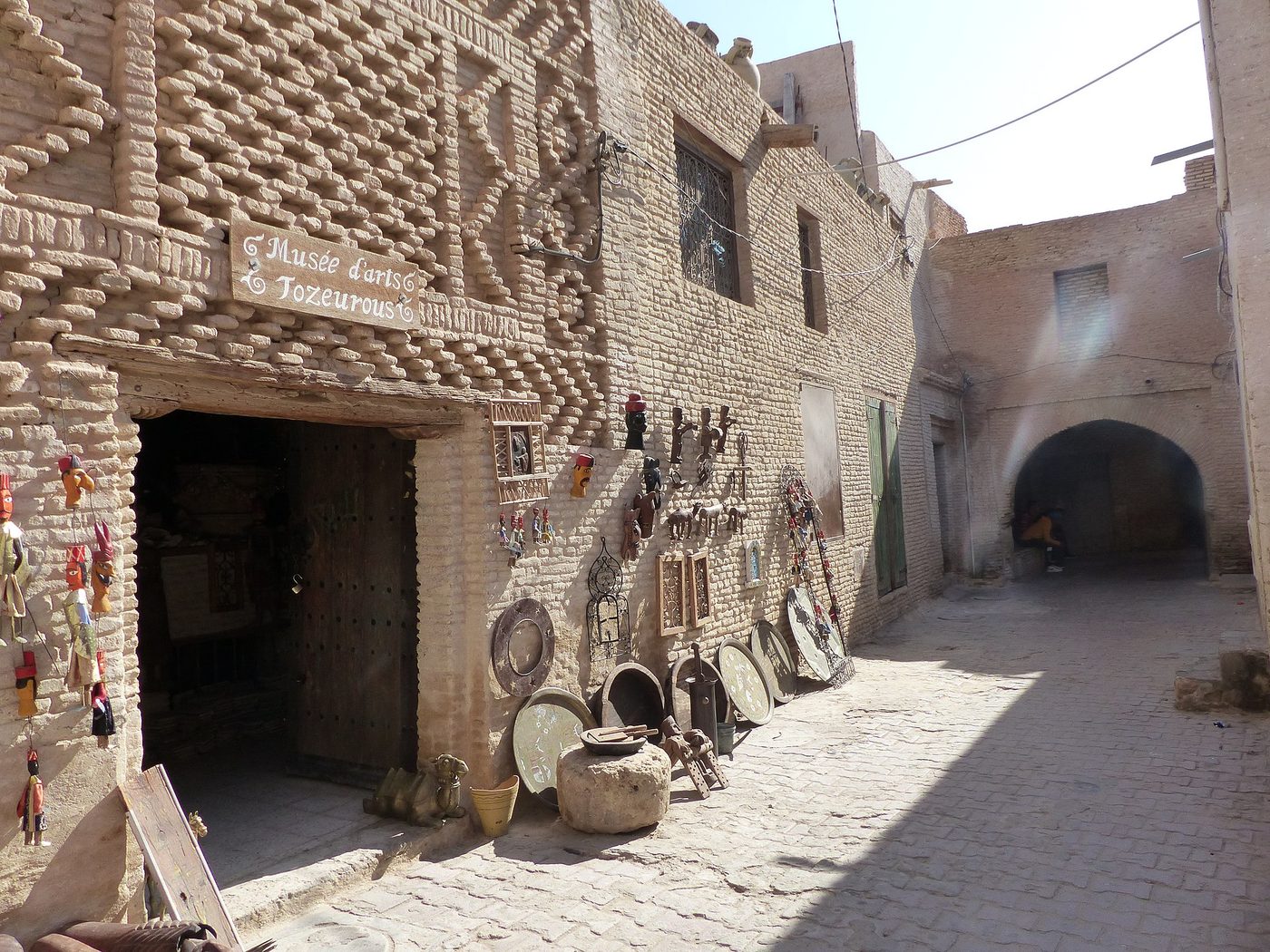
    Patterned brickwork in the medina of Tozeur, the desert gateway town

    From Hammamet, Sousse or Monastir — go for two days, not one

    I’ll say it plainly because the brochures won’t: you cannot day-trip the Star Wars sets from the beach resorts of Hammamet and Sousse. Tozeur is six hours or more each way. What works brilliantly instead is a two-day “Sahara and Star Wars” tour, which typically runs Tozeur (Mos Espa, the dune sea, the Lars dome), an overnight in or near Douz, and Matmata’s Sidi Driss on the way back, often with El Jem’s amphitheatre and Kairouan thrown in. Expect around £115–£150 per person for a two-day group tour including hotel and meals; three-day versions cost more and add Douz and Ksar Ghilane. For independent bookers, our Tunisia excursions guide explains how to book these well (and how to avoid the brutal single-day coach marathons), and the getting around Tunisia guide covers louages, trains, internal flights and car hire if you’d rather do it yourself.

    Self-drive or guided?

    On Djerba, self-drive is great — flat, paved, simple. For the Tozeur desert sets, take a guide: you need a 4×4 for the sand, and a good driver knows precisely which dune and which bend matches which shot, which is most of the magic. UK licence holders can drive in Tunisia for up to a year with a 1968 international driving permit (buy it at a UK Post Office before you travel, about £5.50) plus a green card from your insurer. Fuel is cheap and government-fixed. If you want the full rules on hire cars, tolls and that closed-currency dinar, the Tunisia travel tips guide has the lot.

    When to go: the desert heat is real

    The sets sit in genuine Sahara, and timing makes or breaks the trip. July and August are brutal — average highs around 39°C at Tozeur, with heatwaves pushing past 45°C. December to February gives mild days (16–19°C) but genuinely cold desert nights (down to 7–8°C, colder at a desert camp). The sweet spot is spring (March–April) and autumn (October–November), when daytime temperatures are pleasant and the light is gorgeous. Whatever the season, do the open-desert sites — Mos Espa, the dune sea, Chott el Djerid — at sunrise: it’s cooler, quieter, and the low sun turns the whole landscape Tatooine-gold. There’s a lovely irony that the very first 1976 shoot was hit by the region’s heaviest rain in seven years; rain here is rare, but pack for sun, wind and cold nights all the same. For a month-by-month breakdown across the whole country, see our best time to visit Tunisia guide.

    Is it safe to visit the Star Wars locations in Tunisia?

    Short answer: the mainstream Star Wars sites — Tozeur, Nefta, Matmata, Djerba, Tataouine town and the ksour around it — all sit outside the UK government’s “advise against travel” zones, and have done throughout the recent period. But this matters in the deep south, so let me quote the official advice exactly rather than wave it away as the casual blogs do.

    As of its update on 23 February 2026, the UK Foreign, Commonwealth & Development Office (FCDO) advises against all but essential travel to, among other areas in the south, “within 75km of the Tunisia-Libya border, including Remada and El Borma but excluding Zarzis, the C118 road and all areas in Medenine Governorate north of the road“, and against all travel to “the militarised zone south of the towns of El Borma and Dhehiba“, to “within 20km of the rest of the Tunisia-Libya border area north of Dhehiba“, and to “the town of Ben Guerdane and immediate surrounding area“. In the west it advises against all but essential travel to “Kasserine Governorate, including the town of Sbeitla“.

    What that means in practice for this trip: Tozeur and all the desert sets, Matmata, Djerba and Ajim are comfortably clear of any restriction. Tataouine town and the ksour of Ksar Hadada, Chenini and Douiret are also outside the zones — Tataouine town sits roughly 80 km north of Remada, which is itself the inner edge of the 75 km border belt. The one to watch is Ksar Ouled Soltane, which is the furthest south-east of the lot; it is currently outside the advisory zone on the FCDO’s wording, but it’s the closest of all these sites to the line, so check gov.uk/foreign-travel-advice/tunisia for the latest before you go. We never route readers toward Sbeitla, the Kasserine area or the border zones, and neither should any tour. For the full, current safety picture, our honest guide to whether Tunisia is safe keeps the FCDO wording up to date.

    What it costs

    Here’s the reassuring part: the sites themselves are mostly free or near-free. Your money goes on transport and a guide, not admission. Rough 2026 prices, with the dinar at about £1 = 3.9 TND (it’s a closed currency — you change money on arrival, and you can’t take dinar out):

    Item Typical price Notes
    Entry to Mos Espa, Lars dome, Sidi Bouhlel, Ong Jemal Free No ticket gates; tip the camel owner if you pose
    Sidi Driss Hotel — look around (non-guests) ~4 TND (£1) Lunch usually included on tours
    Sidi Driss Hotel — room for two ~250–300 TND (£65–£90) Rustic, shared facilities, themed rooms
    Ksour (Hadada, Ouled Soltane) entry A few dinars Sometimes just a custodian’s tip
    Tozeur half/full-day 4×4 Star Wars trip ~£45–£100 pp Group size dependent; usually with lunch
    2-day Sahara & Star Wars tour from the coast ~£115–£150 pp Hotel + meals included
    Djerba: taxi/half-day to Ajim + Amghar Mosque ~30–60 TND (£8–£15) Or self-drive — the island is flat and paved

    State of the sets: should you go now?

    Yes — and sooner rather than later for the desert sets. Here’s my honest 2026 read, site by site, because preservation varies enormously:

    • Mos Espa — standing, but with a dune literally creeping toward it and a sister set already buried. The most fragile of the big sites. Go now.
    • Lars dome (Chott el Djerid) — in good shape, repeatedly restored by fans and a German-funded project. The most reliably “still there” of the lot.
    • Sidi Driss, Matmata — thriving as a working hotel; the safest bet of all, since it’s maintained for business.
    • Sidi Bouhlel canyon — it’s a landscape, not a structure, so it isn’t going anywhere; it just needs a guide to find.
    • Ajim / Amghar Mosque, Djerba — fragmentary. The cantina-bakery is derelict; the mosque is fragile (and was vandalised in 2024). Manage expectations.

    These are plaster film sets in a harsh desert, kept alive by goodwill, the odd grant and a steady trickle of fans. They won’t last forever. If a Tatooine pilgrimage is on your list, this is a good decade to do it.

    Star Wars in Tunisia: frequently asked questions

    Can you actually visit the Star Wars sets in Tunisia?

    Yes. Most of the major sites are standing and freely accessible in the open desert or in working towns — Mos Espa, the Lars Homestead dome, the Sidi Bouhlel canyon, the Sidi Driss Hotel in Matmata, and the Ajim locations on Djerba. There are no ticket booths at the desert sets; you pay for transport and a guide, not entry.

    Is Mos Espa still standing in 2026?

    Yes — the main Mos Espa town still stands, with around two dozen buildings. But a migrating sand dune has been threatening it for years, and a smaller secondary set nearby is already buried. It’s the most at-risk of the big sites, so it’s a “go now” location.

    Which Star Wars films were filmed in Tunisia?

    A New Hope (shot 1976), The Phantom Menace (1997), Attack of the Clones (2000), and the single Tatooine scene that appears in Revenge of the Sith (also shot in 2000). The original and the prequels — but not Empire, Jedi or the sequels, which used other deserts.

    Can you stay at the Star Wars hotel?

    You can. The Sidi Driss (Sidi Idriss) Hotel in Matmata served as the interior of the Lars homestead, and it still rents its cave rooms — roughly £65–£90 for a basic double in 2026. It’s rustic and reviews are mixed, but sleeping inside Luke’s childhood home is hard to beat for a fan.

    Where was the Mos Eisley Cantina filmed?

    The exterior was a former bakery in the town of Ajim on Djerba; the alien-filled interior was a separate set built in England. So you can stand outside Chalmun’s Cantina, but there’s no bar to walk into.

    Where did Luke watch the twin suns set?

    At the Lars Homestead dome on the Chott el Djerid salt flat near Nefta and Tozeur — the franchise’s most iconic shot. Time your own visit for late afternoon and you can watch a (single-sun) sunset from the same spot.

    How many days do you need to see them all?

    Realistically two to three. The desert cluster (Tozeur) and the cave-and-town cluster (Matmata, Djerba, the ksour) are 300–400 km apart, so you can’t day-trip both from one base. A focused fan could do Djerba’s sites in a day and the Tozeur desert sets in another, with a transfer day between.

    Do you need a 4×4, or can you self-drive?

    For the Tozeur desert sets, take a 4×4 with a guide — the approach to Mos Espa is soft sand and Sidi Bouhlel is unmarked. On Djerba, the island is flat and fully paved, so a normal hire car (or a taxi) is fine for Ajim and the Amghar Mosque.

    How much does a Star Wars tour in Tunisia cost?

    A Tozeur half- or full-day 4×4 trip runs about £45–£100 per person; a two-day “Sahara and Star Wars” tour from the coastal resorts is roughly £115–£150 per person including hotel and meals. The sites are free — you’re paying for the vehicle, guide and logistics.

    Why is the planet Tatooine named after a real place?

    Because it is one. George Lucas borrowed the name from the southern Tunisian town of Tataouine while scouting and writing A New Hope; in earlier script drafts the planet was called something else entirely. You can visit Tataouine and the dramatic Berber villages of Chenini and Douiret nearby — they weren’t filming locations, but they’re the landscape that inspired the look.

    When is the best time to visit?

    Spring (March–April) or autumn (October–November), when the desert is warm but not punishing. Avoid July and August, when Tozeur regularly tops 39°C and heatwaves exceed 45°C. Whenever you go, do the open-desert sites at sunrise.

    Is it safe?

    The standard Star Wars sites are all outside the UK government’s advisory zones. The deep-south ksour near Tataouine are also outside, though Ksar Ouled Soltane is the closest to the restricted Libya-border belt — check the FCDO’s Tunisia advice before travelling. See our Tunisia safety guide for the current detail.

    The bottom line

    Tunisia is the most rewarding Star Wars pilgrimage on Earth, because so much of it is still here — not a museum exhibit but the actual desert, the actual cave-house, the actual cantina, baking under the same sun Lucas filmed in 1976. Plan around the two clusters, give it the days it deserves, go in spring or autumn, travel respectfully, and you’ll come home with the binary sunset burned into your memory. If you’re building a wider trip, start with our things to do in Tunisia guide and our itinerary planner — the desert is only one of the reasons this country is worth the flight. The Force, as they don’t quite say, is strong with this one.


    Sources & further reading: UK FCDO Tunisia travel advice (gov.uk, updated 23 February 2026); Wikipedia, “List of Star Wars filming locations” and “Tatooine”; Galaxy Tours Tunisia film-site database; the “Save the Lars Homestead” restoration project (markdermul.be); climate data from Climates to Travel. Filming-location attributions follow specialist production research where it differs from general guidebooks. Prices and conditions verified to June 2026 and will change — check before you travel.

    About this guide: Written by the Tunisia Tourism Guide UK travel desk. We write for British travellers, quote UK government safety advice verbatim and date-stamp it, price everything in pounds as well as dinar, and tell you honestly when a famous site is a quick photo rather than a half-day. We don’t sell tours. Last updated 11 June 2026.

    Photo credits

    All images are from Wikimedia Commons, used under their respective licences:

    • The Mos Espa set, one of the best-known Star Wars filming locations in Tunisia — photo by Habib M’henni, CC BY-SA 4.0, via Wikimedia Commons.
    • The white igloo dome of the Lars Homestead exterior on Chott el Djerid — photo by Stefan Krasowski, CC BY 2.0, via Wikimedia Commons.
    • The Chott el Djerid salt flat near Tozeur, Tunisia — photo by Gorik Francois, CC BY-SA 2.0, via Wikimedia Commons.
    • A camel caravan crossing the dune sea of the Tunisian Sahara — photo by Dennis G. Jarvis, CC BY-SA 2.0, via Wikimedia Commons.
    • A troglodyte cave dwelling in Matmata, used as the Lars homestead interior — photo by Bernard Gagnon, CC BY-SA 3.0, via Wikimedia Commons.
    • The stacked ghorfas of Ksar Ouled Soltane near Tataouine — photo by Andy Carvin, CC BY-SA 2.5, via Wikimedia Commons.
    • The Berber hill village of Chenini near Tataouine, Tunisia — photo by Simunaire, CC BY-SA 4.0, via Wikimedia Commons.
    • Patterned brickwork in the medina of Tozeur, the desert gateway town — photo by Tsaag Valren, CC BY-SA 4.0, via Wikimedia Commons.

    Off set, two more guides for the same trip: Tunisia’s souks, hammams and festivals, and what to eat between locations.

  • Tunisian Food: What to Eat & Drink in Tunisia

    Tunisian Food: What to Eat & Drink in Tunisia

    By the Tunisia Tourism Guide team · Last updated 11 June 2026

    Tunisian food is the spiciest and most underrated cooking in North Africa: a Mediterranean-meets-Berber kitchen built on couscous (the national dish), fiery harissa, tuna, eggs, olives and olive oil. Expect grilled-pepper salads, runny-egg brik pastries, slow stews and syrup-soaked pastries — far better than the resort buffet suggests.

    I’ll be honest with you: most British visitors come home from Tunisia having eaten the same beige all-inclusive buffet they’d find in any sunshine resort from Antalya to Cancún, and they never find out what they missed. That’s a genuine shame, because Tunisia has one of the most distinctive and delicious cuisines in the Mediterranean — punchy, sun-soaked, deeply spiced, and (by UK standards) almost comically cheap once you step outside the hotel gates.

    This is the full guide I wish I’d had on my first trip. Over the years I’ve eaten lablabi from a steamed-up hole in the wall in Tunis at 8am, burned my fingers on fresh brik in a Sousse souk, worked out the hard way which “salad” hides tuna, and learned to say sans piquant with feeling. Below you’ll find more than thirty dishes, sweets and drinks worth ordering, what each one actually is, roughly what it costs in dinars and pounds, and — the bit every other guide skips — exactly where on a package holiday you’ll find it. I’ve kept the prices honest and the hype to a minimum.

    Tunisian food at a glance

    The essentials What to know
    National dish Couscous — steamed semolina with meat or fish, vegetables and harissa (UNESCO-listed, 2020)
    Signature flavour Harissa, a fiery sun-dried chilli paste (UNESCO-listed in its own right, 2022)
    Five things on every table Tuna, eggs, olives, potato and harissa — they turn up in salads, pastries and sandwiches alike
    Spice level The hottest cooking in the Maghreb; say “sans piquant” (without chilli) if you’re sensitive
    Typical street snack 1–3 TND (roughly 25p–80p)
    Sit-down main in a local restaurant Around 10–25 TND (£2.50–£6.50)
    Halal? Yes, by default — meat in mainstream restaurants and hotels is halal
    Drink to try Mint tea with toasted pine nuts; and yes, alcohol is legal and available

    A quick note on prices throughout this guide: at the time of writing (June 2026) £1 buys roughly 3.9 Tunisian dinars. The dinar is a “closed” currency — you can’t get hold of it before you travel and you can’t legally take it out — so every figure here is in dinars first with an approximate pound conversion after. Tunisia has had a few years of stiff inflation, so treat all prices as a guide rather than gospel, and expect tourist-medina and resort prices to run several times higher than a neighbourhood café.

    A plate of Tunisian food: red couscous mhakek with peppers and chillies

    What makes Tunisian food different?

    Tunisian cooking is a layer cake of everyone who’s ever passed through. The base is Berber (Amazigh) — couscous, hand-rolled semolina, clay-oven bread and slow one-pot stews. On top of that you get Arab spicing, Ottoman-Turkish pastries and coffee, Andalusian fruit-and-nut influences brought by refugees after 1492, a heavy dose of Italian (especially Sicilian) tomato-and-pasta cooking just across the water, and the French colonial legacy you taste in every baguette and street-corner espresso.

    What ties it all together is heat. Tunisia is comfortably the spiciest of the three Maghreb cuisines — where a Moroccan tagine might be sweet with cinnamon and dried fruit, the Tunisian equivalent is sharp with chilli, tomato and garlic. Harissa is the engine room of the whole kitchen, and it’s on virtually every table, usually thinned with olive oil and a sprinkle of cumin as a dip for bread before the meal even starts.

    That olive oil matters, too. Tunisia is one of the world’s largest olive-oil producers and the biggest exporter outside the European Union, with ancient groves carpeting the centre of the country. Good local oil — grassy, peppery, generous — is the quiet hero behind most of these dishes. If you do one bit of edible souvenir shopping, make it a tin of Tunisian olive oil and a jar of harissa. For the wider picture of how the country fits together, our complete guide to things to do in Tunisia is a good companion to this one.

    The national dish: couscous

    Couscous (kosksi) is Tunisia’s national dish — and in 2020 it was added to UNESCO’s list of intangible cultural heritage in a rare joint nomination shared with Algeria, Morocco and Mauritania. But Tunisian couscous is its own thing: where neighbours go sweet, Tunisians go red and fiery, steaming the semolina over a bubbling broth of tomato, harissa, chickpeas and whatever protein is to hand.

    You’ll meet it in several guises. Inland and at celebrations it’s lamb or chicken; on the coast it’s fish couscous (kosksi bil hout), often a whole grouper or sea bream sitting on a mound of grain, which I’d argue is the single best thing you can order in a Tunisian seafood restaurant. Friday is the traditional couscous day, when families gather over an enormous shared bowl after midday prayers — if you’re self-catering or eating in a local restaurant on a Friday, that’s the day to order it.

    On a package holiday, couscous is the one Tunisian classic you’re guaranteed to meet: nearly every all-inclusive runs a “couscous night,” and it’s usually decent. But the version in a family-run restaurant, where the broth has simmered for hours, is a different and better animal. Expect to pay 25–45 TND (£6.50–£11.50) for a generous fish couscous in a mid-range coastal restaurant.

    Starters, salads and small plates (the kemia spread)

    Tunisians, like Italians and Spaniards, love a table covered in little dishes before the main event — a tradition called kemia, the local answer to mezze or tapas. This is where Tunisian food is at its most addictive, so order broadly and share. Bread arrives free and constant.

    Brik — the one you must try first

    If you order a single thing in Tunisia, make it brik à l’oeuf: a sheet of wafer-thin malsouka pastry folded around a whole raw egg, tuna, parsley and capers, then fried until crisp and golden while the yolk stays gloriously runny. The challenge — and the fun — is eating it: pick it up, bite a corner, and slurp before the yolk escapes down your wrist. A squeeze of lemon, a smear of harissa, and you’re away. You’ll find brik everywhere from street stalls (1.5–3 TND, under £1) to white-tablecloth restaurants, and it’s a buffet regular too.

    Salade mechouia

    My desert-island Tunisian dish. Slata mechouia (“grilled salad”) is roasted peppers, tomatoes, onion and garlic, charred until smoky, then chopped or pounded to a rough paste, dressed with olive oil and usually topped with flaked tuna and boiled egg. Scoop it up with bread. It’s smoky, sweet, a little spicy, and utterly more-ish. Every region tweaks it; nobody does it badly.

    Peppers, tomatoes and onion grilling to make Tunisian salade mechouia

    Slata tounsia (Tunisian salad)

    Not a lettuce in sight. Tunisian salad is finely diced raw tomato, cucumber, onion and green pepper, dressed simply, and — you’re spotting a theme — often crowned with tuna, olives and egg. Crisp, fresh and the perfect foil to anything fried or fiery.

    Omek houria

    A silky carrot salad — boiled carrots mashed with garlic, caraway, coriander and harissa, finished with olive oil and sometimes capers or olives. The name translates, charmingly, as something like “your mother’s freedom.” Warm, garlicky and gently spiced.

    Lablabi

    This is the one I send everyone to find. Lablabi is a steaming bowl of chickpeas in a thin, garlicky, cumin-laced broth, ladled over torn day-old bread that you tear in yourself, then loaded to taste with harissa, olive oil, a soft egg, capers, olives, and sometimes tuna. It’s working-class Tunis comfort food — cheap (2–5 TND, well under £1.50), filling, and gloriously messy. You won’t find it on a resort buffet; you have to go and look for it in a town, which is rather the point. The medina backstreets of the capital, Tunis, are lablabi’s spiritual home.

    Chorba

    Chorba is a hearty soup, classically with lamb, tomato, vegetables and frik (roasted cracked green wheat, like freekeh). It’s a winter warmer and an absolute fixture of the Ramadan table, eaten to break the fast. Even in summer you’ll see it on menus.

    Kafteji

    A glorious fried-vegetable hash: potato, peppers, courgette, pumpkin and tomato, all fried separately then chopped together with egg and a hit of harissa, served with bread. It’s the kind of cheap, satisfying plate students and workers live on, and a quietly brilliant vegetarian option (just check it’s cooked without the optional liver).

    Tunisian brik, a crisp fried pastry filled with egg and tuna

    A word on harissa

    Harissa deserves its own paragraph because it’s everywhere and because Tunisians are rightly proud of it — so much so that in 2022 UNESCO inscribed “Harissa, knowledge, skills and culinary and social practices” on its intangible cultural heritage list, a listing Tunisia holds alone. At its simplest it’s sun-dried red chillies pounded with garlic, salt, caraway and coriander and loosened with olive oil; recipes are family heirlooms and vary from mild and smoky to genuinely fierce. It’s a condiment, a marinade and a cooking base all at once. The kicker for nervous eaters: you control the dose. Harissa is almost always served on the side, so a little goes on the bread and the rest stays put.

    Mains, stews and grills

    Beyond couscous, the heart of a Tunisian home kitchen is the marqa — a catch-all word for a slow-simmered stew, usually tomato-based, with meat or fish, vegetables and often chickpeas, mopped up with bread or spooned over couscous. Here are the mains worth seeking out.

    Ojja

    One of my favourite quick meals in Tunisia. Ojja is eggs poached in a thick, spicy tomato-and-pepper sauce shot through with garlic and harissa — close cousin to the dish the wider world now calls shakshuka. The classic version adds slices of merguez (see below); on the coast you’ll find a superb prawn or seafood ojja. Served bubbling in the pan with bread to dunk, it’s brilliant value at around 8–15 TND (£2–£4).

    Tunisian tajine — not what you think

    This trips up every first-time visitor, so read carefully: a Tunisian tajine is not the Moroccan conical-pot stew. It’s a baked egg dish — much closer to an Italian frittata or a crustless quiche — made from beaten eggs folded with cooked meat (often chicken or lamb), potato, parsley, herbs, spices and grated cheese, baked firm and golden, then cut into squares. It’s a fixture at gatherings, weddings and Ramadan tables, served warm or at room temperature. Order it expecting a stew and you’ll be confused; order it knowing what it is and you’ll love it.

    Merguez

    Merguez are slim, fresh lamb (or lamb-and-beef) sausages, stained red with harissa and paprika and intensely savoury. You’ll meet them grilled over coals, tucked into a sandwich, or simmered into ojja. The smell of merguez on a charcoal grill is the smell of a Tunisian street at dinner time.

    Mloukhia

    An acquired love, and worth acquiring. Mloukhia is a very slow-cooked stew built on finely powdered dried jute (mallow) leaves, olive oil, garlic and beef or lamb, simmered for hours until it turns a deep, glossy near-black. The flavour is earthy and herbal, unlike anything else on the table. It carries a whiff of ceremony, too — it’s a dish for Eid, homecomings and new beginnings, eaten for good luck.

    Kammounia

    Named for kamoun (cumin), kammounia is a deeply spiced, cumin-heavy stew, traditionally of beef and liver. If offal isn’t your thing this one isn’t for you, but it’s a beloved soul-food classic and a window into how Tunisians actually eat at home.

    Koucha and mechoui

    For special occasions, Tunisians turn to the oven and the fire. Koucha is slow-roasted lamb — often shoulder with potatoes, tabil spice and garlic — cooked low until it falls apart. Mechoui is whole spit- or pit-roasted lamb, the centrepiece of Eid and big celebrations. Some restaurants in the south, and a few clay-pot specialists, cook lamb sealed inside a gargoulette clay jar that’s cracked open at the table — theatrical and delicious.

    Fish and seafood

    With a coastline this long, seafood is a Tunisian strength and often the smart order. Beyond fish couscous, look for grilled dorade (sea bream) and loup de mer (sea bass) sold by weight, spicy kabkabou (fish braised with tomato, preserved lemon, capers and olives), octopus, calamari and prawns. The seafood is freshest and best value in the coastal towns and on the island of Djerba, in Sousse and along the Sahel coast, and — if you make it that far — in Sfax, the country’s undisputed seafood capital. If a beach lunch is more your speed, our guide to the best beaches in Tunisia points you to the coastal spots worth basing yourself near.

    Tunisian harissa, a fiery red sun-dried chilli paste, ringed by dried chillies

    Street food and sandwiches

    Tunisia’s cassecroute (snack/sandwich) culture is fast, cheap and excellent, and it’s where you’ll eat best on a tight budget. The unwritten rule of every Tunisian sandwich is that it gets the full treatment — tuna, harissa, egg, olives, potato, salad — unless you say otherwise. Point, watch it being assembled, and pay a couple of dinars.

    Fricassé

    Don’t be fooled by the French name: a fricassé is not a stew but a small, slightly sweet fried bread roll, split and stuffed with tuna, harissa, boiled egg, olives, capers and potato. It’s a Tunis institution with Jewish roots in the old port district of La Goulette, and it’s my go-to bakery snack — about 1–2 TND (under 50p) and dangerously easy to eat three of.

    The tuna-harissa baguette

    The everyday hero. A crusty half-baguette (French legacy, this) packed with tuna, harissa, hard-boiled egg, olives and salad — sometimes thon complet with chips crammed in too. Two or three dinars and you’re sorted for lunch on the beach.

    Chapati, mlawi and makloub

    Three flatbread sandwiches worth knowing. Chapati tunisien is a soft, pillowy fried bread (nothing like the Indian kind) split and loaded with meat, cheese, salad and harissa. Mlawi is a flaky, layered, pan-fried square — lovely plain with cheese, or stuffed. Makloub is a folded, grilled wrap, like a Tunisian panini. All cost a handful of dinars and make a perfect quick lunch between sightseeing.

    Babbouche (snails)

    For the adventurous: babbouche are snails simmered in a fragrant, cumin-and-herb broth, sold by the bowl from street carts and markets. You winkle them out with a pin and then drink the spiced broth. They’re a cheap-protein tradition that surges in popularity whenever meat prices climb. Not for everyone, but a real taste of local life.

    Sacks of spices for sale in a Tunisian souk

    Bread: tabouna and the baguette

    Two breads define the Tunisian table. Khobz tabouna is the traditional round loaf baked against the wall of a clay tabouna oven, with a chewy crust and a heritage stretching back to Carthaginian times — seek it out warm from a village bakery and eat it with olive oil. Alongside it, the French-introduced baguette is a daily staple, the backbone of every sandwich and the free basket on every restaurant table. Bread is sacred here; you’ll rarely see it wasted.

    Tunisian desserts and sweets

    Tunisian sweets lean Ottoman and Andalusian: lots of semolina, almonds, sesame, dates, honey and orange-blossom or geranium water, usually fried or syrup-soaked and cut into neat diamonds. They’re sold by weight from glittering pâtisseries — point at a selection and buy a mixed box. A few you should hunt down:

    • Makroudh — a syrup-soaked semolina diamond stuffed with date paste, fried or baked. The most famous come from the holy city of Kairouan, where they’re practically an art form.
    • Baklawa — the Tunisian take on layered filo and syrup, here filled with almonds and cut into lozenges; richer and less pistachio-heavy than the Turkish version.
    • Zlabia — bright orange, deep-fried batter spirals drenched in syrup, sold year-round but absolutely synonymous with Ramadan evenings.
    • Bambalouni — a hot, sugar-dusted ring doughnut, fried to order. The stall in Sidi Bou Saïd, the blue-and-white village above Tunis, is a rite of passage; eat it on the spot, painfully hot, looking out to sea.
    • Yoyo — orange-scented doughnut rings dipped in honey syrup and sesame.
    • Samsa and kaak warka — almond-paste pastries; samsa are crisp triangles, kaak warka a delicate icing-dusted ring served at weddings.
    • Ghraiba — a melt-in-the-mouth shortbread of semolina, chickpea flour or almond, scented with sesame.
    • Debla — thin pastry ribbons rolled into roses, fried and dipped in orange-blossom syrup; also charmingly nicknamed “judge’s ears.”
    • Assida zgougou — a dark, creamy pudding made from ground Aleppo-pine seeds topped with cream and nuts, made above all for Mouled (the Prophet’s birthday). Tunisia is just about the only country that harvests these little pine seeds for the kitchen.
    • Mhalbiya — a fragrant rice-and-milk pudding perfumed with geranium or rosewater and scattered with pistachios.

    Dates: the queen of the oasis

    Save room for dates. Tunisia’s prized Deglet Nour — the translucent, honey-sweet “queen of dates” — grows in the southern oases around Tozeur and Nefta, and Tunisia is one of the world’s leading date exporters. Buy them still on the branch from a market in the south; they’re a world away from the dusty supermarket box back home. If you’re heading into the dunes, our guide to the Tunisian Sahara covers the oasis towns where they grow.

    Makroudh, syrup-soaked semolina-and-date Tunisian pastries

    What to drink in Tunisia

    A glass of sweet Tunisian mint tea served with pine nuts

    Mint tea, coffee and soft drinks

    The national ritual is mint tea (thé à la menthe) — strong green tea brewed with fresh mint and a frankly heroic amount of sugar, often served with a layer of toasted pine nuts or almonds floating on top (thé aux pignons). Being handed a glass is a gesture of welcome; accept it. Tunisia is also, unusually for the region, a serious coffee culture: cafés are the social heartbeat of every town, and you can order anything from a tiny Turkish-style qahwa (sometimes scented with orange-blossom water) to a French espresso (“express”), a cappucin or a milky café direct.

    For something cold, look for fresh-squeezed citronnade (lemonade), seasonal fruit juices, and the local sodas — chief among them Boga, a fizzy institution since the 1940s. Don’t be fooled by its apple colour: the original Boga Cidre is actually flavoured with carob, giving it a distinctive taste that’s nothing like cider. There’s a sharp lemon-lime version too. Tap water is best avoided (see the food-safety section below), so bottled water — still (plate) or sparkling (gazeuse) — is your everyday drink.

    Alcohol: yes, you can drink in Tunisia

    Tunisia is a majority-Muslim country, but alcohol is legal and reasonably easy to find in hotels, licensed bars and restaurants, and in dedicated supermarket sections. It’s worth understanding the rules before you travel, because a couple of them catch people out. The UK Foreign, Commonwealth & Development Office (FCDO) sets them out plainly. As its Tunisia travel advice states (Updated 23 February 2026; still current at the time of writing):

    “The sale of alcohol is permitted in Tunisia but is banned from sale in supermarkets on Fridays. You can still order and drink alcohol in hotels and bars. During Ramadan, sale of alcohol is banned and the consumption of alcohol is restricted to fewer restaurants and bars. These rules do not apply at holiday resorts.”

    In other words: in an all-inclusive resort, you’ll barely notice any restriction. Venture out, and you may find the supermarket booze aisle roped off on a Friday or during the holy month. Alcohol is also relatively pricey compared with the very cheap food — a beer in a bar can cost more than a street lunch. For the bigger picture on rules, customs and staying safe, see our honest guide to whether Tunisia is safe.

    What to order

    • Celtia — the national lager, a crisp, easy-drinking pale beer that’s been the default since 1951 and pours everywhere from beach bars to corner shops.
    • Tunisian wine — a genuine surprise, with a winemaking history going back to the Carthaginians and Romans. The vineyards cluster on the Cap Bon peninsula and the Mornag plain near Tunis. Look for the reds and rosés of Magon and Vieux Magon, Château Mornag, the wicker-wrapped bottle of Sidi Saâd, the popular dry Gris de Tunisie rosé, and — my pick — the fragrant Muscat de Kelibia, a coastal white that’s perfect with seafood.
    • Boukha — a clear spirit distilled from figs, with deep roots in Tunisia’s Jewish community. Served chilled, neat or over ice; an acquired but authentic taste.
    • Thibarine — a sweet, amber date-and-herb liqueur from the village of Thibar in the north-west, originally made by monks. A nice after-dinner sip.
    • Legmi — date-palm sap, drunk fresh and sweet straight from the tree in the southern oases and on Djerba. Left a few hours it ferments into a mildly alcoholic “palm wine.” Strictly a rural, seasonal curiosity, but a memorable one.

    Eating on a package holiday: the buffet versus the real thing

    Here’s the section no one else writes, and the most useful one if you’re booked into an all-inclusive in Hammamet, Sousse, Port El Kantaoui, Monastir or Djerba. The honest truth is that the resort buffet and the real Tunisian kitchen overlap only partly — and knowing the gap is the difference between a good food holiday and a forgettable one.

    What you’ll genuinely get on a good all-inclusive buffet: couscous (especially on the weekly “Tunisian night”), grilled fish and meat, brik, salade mechouia, Tunisian salad, merguez, an omelette or tajine station, harissa on the side, fresh fruit, dates, and a pâtisserie counter with baklawa and the like. Bigger hotels often run a themed Tunisian buffet once a week that’s well worth timing your week around.

    What the buffet flattens or skips: the spice (it’s dialled right down for international palates), and the dishes that only make sense made-to-order or in a busy local spot — lablabi, a freshly fried fricassé, a proper slow marqa, real street brik, bambalouni from the stall. For those, you have to step outside the gates.

    My advice: treat the resort as breakfast-and-late-night convenience, but eat at least a few lunches and one or two dinners out. A short taxi into the nearest town centre or medina, a points-and-smiles order at a packed local restaurant, and a bill that barely dents your holiday money — that’s where Tunisia’s food actually lives. If you’d rather not wing it, many resorts and operators run guided food walks and cookery sessions; our guide to Tunisia excursions and day trips covers what’s bookable and what’s worth it, and the where-to-stay guide explains which resort areas put you closest to a real town.

    Regional specialities: where to eat what

    Tunisia is small, but its food shifts noticeably as you travel. If you’re touring rather than staying put — and our Tunisia itineraries show how to string the regions together — these are the dishes to chase in each.

    Region Eat this here
    Tunis & the north Lablabi in the medina, kammounia, fricassé in La Goulette, and bambalouni up in Sidi Bou Saïd
    Cap Bon & Hammamet The harissa heartland (chillies grown around Nabeul), citrus, and the Mornag/Cap Bon wine country; Muscat de Kelibia on the coast
    Sousse & the Sahel Grilled seafood, fish couscous and easy access to the olive-oil plains and Kairouan’s makroudh inland
    Sfax Tunisia’s seafood capital, and home of charmoula sfaxienne — a sweet, dark onion-and-raisin sauce served with fish (not the green Moroccan chermoula)
    Djerba Octopus, sea bream and fish couscous, plus the island’s rich Tunisian-Jewish food heritage, including the spring stew msoki
    The south & oases Deglet Nour dates around Tozeur and Nefta, fresh legmi palm sap, and hearty desert lamb
    Tabarka & the Coral Coast North-western seafood — mussels, oysters and octopus — with an Italian-Mediterranean accent
    Date palms in a desert oasis at dusk

    What food costs in Tunisia

    This is where Tunisia delights British visitors. Even after recent inflation, eating like a local costs a fraction of what you’d pay at home. The figures below are typical 2026 prices in dinars with rough pound conversions — treat them as a guide, and remember that tourist medinas (Sidi Bou Saïd is the classic offender) and resorts charge several times more than an ordinary neighbourhood café. For more on money, tipping and the closed-currency rules, see our Tunisia travel tips.

    Item Typical price (TND) ≈ £
    Fricassé or brik from a stall 1–3 TND 25p–80p
    Tuna-harissa baguette 2.5–5 TND 65p–£1.30
    Bowl of lablabi 2–5 TND 50p–£1.30
    Espresso in a local café 1–2 TND 25p–50p
    Mint tea 1.5–3 TND (more in tourist cafés) 40p–80p
    Sit-down main, local restaurant 10–25 TND £2.50–£6.50
    Fish couscous, mid-range restaurant 25–45 TND £6.50–£11.50
    33cl Celtia in a shop / in a bar ~2 TND / 6–8 TND 50p / £1.50–£2
    Bottle of local wine (shop) 12–25+ TND £3–£6.50+
    Box of mixed pastries (by weight) varies; pieces ~1–4 TND each 25p–£1 each

    A tip of around 10% in restaurants is appreciated rather than expected, and is best left in cash, in dinars. Rounding up a taxi fare or leaving a dinar or two for a café waiter is normal and goes a long way.

    Vegetarians, vegans and special diets

    Tunisia is more vegetarian-friendly than you’d guess — and also more booby-trapped. On the plus side, the cuisine is full of naturally meat-free plates: vegetable couscous, ojja (ask for it without merguez), brik (the tuna can be left out), kafteji, lablabi, salade mechouia, omek houria, plenty of salads, and bread with olive oil and harissa. On the minus side, tuna and egg hide everywhere — in salads you’d assume were plain, and even on pizza by default. Learn the phrase sans thon (without tuna) and sans œuf (without egg), and ask before you assume.

    Vegans will need to be more vigilant still (butter, eggs and cheese are common in cooked dishes and pastries), but markets overflow with superb fruit, vegetables, olives, nuts and dates. Coeliacs should note that couscous, bread and most pastries are wheat-based, so naturally gluten-free options are limited beyond grilled fish or meat and salads. And a heads-up for nut allergies: almonds, sesame and pine nuts run right through the sweets — and pine nuts often float in the mint tea — so flag it clearly.

    One more: meat in mainstream Tunisian restaurants and hotels is halal by default. Pork is rare and mostly confined to a few international hotel menus; if it matters to you either way, it’s easy to ask.

    Is it safe to eat? Food and water in Tunisia

    With a few sensible habits, eating in Tunisia is a pleasure, not a worry. The main thing: don’t drink the tap water. Stick to sealed bottled water (it’s cheap and everywhere), and that includes being a little careful with ice and salads washed in tap water at lower-end places. The UK’s TravelHealthPro and the US CDC both advise bottled or treated water and the classic rule of thumb — “cook it, peel it, or leave it.”

    Travellers’ tummy upsets are the most common holiday ailment in the region, so it’s worth packing rehydration sachets just in case. Counter-intuitively, busy street stalls are often a safer bet than a quiet one: high turnover means food is fresh and cooked to order in front of you. Favour things that are hot, freshly fried or grilled; be a little warier of buffet dishes that have sat out, and of pre-dressed salads in budget spots. Peel your own fruit. None of this should put you off — it’s the same common sense you’d use anywhere warm. For broader health and pre-trip prep, check current advice on TravelHealthPro and the NHS before you go, and see our travel-tips guide for the practical essentials.

    Eating during Ramadan (and the Friday quirk)

    If your trip lands during Ramadan — roughly mid-February to mid-March in 2026, and shifting to early February in 2027 — daytime dining changes outside the resorts. Many local restaurants and cafés close or run reduced hours during fasting daylight, then burst into life after sunset for iftar, which is a wonderful time to eat: tables groaning with chorba, brik, dates and sweets like zlabia. The FCDO notes that eating, drinking or smoking in public during daylight hours can cause offence, so be discreet if you’re out and about.

    Crucially, all of this is suspended inside holiday resorts — the FCDO is explicit that the Ramadan rules “do not apply at holiday resorts,” so all-inclusive guests carry on as normal (hotels may simply screen the dining area out of courtesy to fasting guests). The other thing to remember any time of year is the Friday alcohol quirk: supermarkets can’t sell alcohol on Fridays, though bars and hotels still serve it. If you want wine with a self-catered Friday dinner, buy it on Thursday. Timing your trip around the seasons and festivals is covered in our best time to visit Tunisia guide.

    Etiquette and ordering tips

    A few small things make eating in Tunisia smoother and more enjoyable:

    • Say “sans piquant” if you’re spice-shy. It means “without chilli/heat,” and it’s the single most useful phrase at the table. Conversely, ask for extra harissa on the side if you like it hot.
    • Eat with your right hand when sharing bread or eating communally; the left is considered unclean. In tourist restaurants cutlery is standard, so this matters most in family or rural settings.
    • Accept the tea. Hospitality is central; being offered mint tea or coffee is a kindness, and a polite refusal is fine but accepting is warmer.
    • Hospitality can be insistent. A host may press more food on you; a gentle “it was delicious, I’m full” (a hand on the heart helps) is understood.
    • Decode the menu. An escalope is a thin breaded chicken cutlet, not seafood; brik à l’oeuf comes with a runny egg; complet means “with everything”; gazeuse is sparkling, plate still. Menus are often in French and Arabic.
    • Beat the tourist markup. The same plate of mechouia can be a few dinars in a back-street café and four times that at a viewpoint restaurant. Eat where locals eat and you’ll pay local prices.

    Tunisian food: frequently asked questions

    What is the national dish of Tunisia?

    Couscous. Steamed semolina served with meat or fish, vegetables, chickpeas and a tomato-and-harissa broth, it’s the centrepiece of Friday family lunches and celebrations. Couscous was added to UNESCO’s intangible cultural heritage list in 2020, shared with Algeria, Morocco and Mauritania.

    What food is Tunisia most famous for?

    Harissa above all — the fiery chilli paste that flavours almost everything and has its own UNESCO listing (2022). After that: couscous, brik (the fried egg-and-tuna pastry), lablabi (chickpea soup), salade mechouia (smoky grilled-pepper salad) and a long line of honey-soaked pastries and dates.

    Is Tunisian food very spicy?

    It’s the spiciest of the three North African cuisines, thanks to harissa. But the heat is almost always controllable: harissa is usually served on the side, and resort kitchens tone it right down. Say “sans piquant” to order a dish without chilli, or ask for harissa on the side to add it yourself.

    Is Tunisian food halal?

    Yes, by default. Tunisia is a majority-Muslim country and meat served in mainstream restaurants and hotels is halal. Pork is uncommon and mostly limited to a few international hotel menus. Alcohol is a separate matter — it’s legal and served in licensed venues and resorts.

    What do Tunisians eat for breakfast?

    Often something simple — bread with olive oil, honey or jam, eggs, olives, dates and mint tea or coffee. Heartier traditional options include lablabi (chickpea soup) and warm porridges like droô (sorghum), while a fried fricassé or a pastry from the bakery is the grab-and-go choice.

    What’s the difference between a Tunisian and a Moroccan tagine?

    Completely different dishes that share a name. A Moroccan tagine is a slow stew cooked in a conical clay pot. A Tunisian tajine is a baked egg dish — like an Italian frittata or crustless quiche — made with eggs, meat, potato, herbs and cheese, baked firm and cut into squares.

    Can you drink alcohol in Tunisia?

    Yes. Alcohol is legal and available in hotels, licensed bars and restaurants, and in some supermarket sections. The local lager Celtia is everywhere, and Tunisian wines are genuinely good. Two rules to know: supermarkets can’t sell alcohol on Fridays, and during Ramadan sales are restricted — but neither applies inside holiday resorts.

    Is Tunisia good for vegetarians?

    Reasonably, with care. Vegetable couscous, kafteji, lablabi, brik, ojja, salade mechouia and abundant salads and fruit make it doable. The catch is that tuna and egg are added to many “plain” salads and even pizzas by default, so learn to ask for dishes sans thon (without tuna).

    Is it cheap to eat in Tunisia?

    Very, by UK standards — once you leave the resort. A street snack is under a pound, a filling local meal a few pounds, and only tourist-trap medinas and resort restaurants charge anything like European prices. A short hop into the nearest town is the single best value move you can make; our guide to getting around Tunisia covers taxis, louages and trains.

    What should I eat first in Tunisia?

    A brik à l’oeuf, hands down — it’s quick, cheap, found everywhere and instantly tells you what Tunisian food is about. Follow it with salade mechouia and, if you can find a local spot, a bowl of lablabi.

    Can you drink the tap water in Tunisia?

    Best not to. Stick to sealed bottled water (cheap and everywhere) for drinking and brushing teeth, and be a little cautious with ice in budget venues. It’s standard advice from TravelHealthPro and the CDC for the region, and it spares most travellers any tummy trouble.

    What do Tunisians drink?

    Sweet mint tea (often with toasted pine nuts) and coffee are the social staples, alongside fresh juices, citronnade and local sodas like Boga. For alcohol, it’s Celtia beer, Tunisian wine (try Muscat de Kelibia), and curiosities like the fig spirit boukha and date liqueur thibarine.

    The bottom line

    Tunisian food rewards the curious. Stay glued to the buffet and you’ll eat well enough; step out for a fried brik, a smoky mechouia, a bowl of lablabi and a glass of mint tea, and you’ll eat brilliantly — for the price of a coffee back home. Learn three words (sans piquant, sans thon, and shukran — thank you), bring an appetite, and let harissa do the rest.


    Fed and watered, you might fancy something stranger for dessert: Tunisia’s Star Wars filming locations are the country’s most surreal day out.

    Photo credits

    All images via Wikimedia Commons: red couscous mhakek © Wajih Khalfallah (CC BY-SA 4.0); salade mechouia © Habib M’henni (CC BY-SA 4.0); brik © Wajih Khalfallah (CC BY-SA 4.0); harissa © Miansari66 (CC0); spice souk © matthew Hunt (CC BY 2.0); makroudh © Mourad Ben Abdallah (public domain); date palms © Meshari Alawfi (CC BY 4.0); mint tea with pine nuts © sky#walker (CC BY-SA 2.0).

  • Getting Around Tunisia: The Complete Transport Guide

    Getting Around Tunisia: The Complete Transport Guide

    Getting around Tunisia is easier and far cheaper than most first-time visitors expect. Shared “louage” minibuses and a north–south train line connect the main towns for a few dinars; yellow taxis are cheap if you insist on the meter; and a hire car opens up the south. There is no Uber, and Bolt left in May 2025, so apps matter less than knowing how the local system works.

    By the Tunisia Tourism Guide team — written from the road, last updated 11 June 2026. Prices are in Tunisian dinar (TND) with rough pound conversions at roughly £1 ≈ 3.9 TND. The dinar is a closed currency you can only get in-country, so treat every conversion as a guide, not a guarantee.

    I have arrived into all four of Tunisia’s tourist airports, queued for a louage at Tunis’s Moncef Bey at seven in the morning, taken the train down the coast with a cabin full of commuters and their shopping, and white-knuckled a hire car through a roundabout in Sousse where right of way is clearly a matter of opinion. This is the guide I wish I had been handed at arrivals: how to get to Tunisia from the UK, and then how to actually get around it once you land, with honest prices, the things nobody tells you, and the few traps worth dodging.

    Here is the reassuring headline. Tunisia is small — roughly the size of England and Wales — and the bits you will want to see are mostly strung along the eastern coast, an easy run apart. Public transport is genuinely useful, costs almost nothing, and is used by everyone. You do not need to hire a car to have a good holiday here, though for the desert and the deep south it helps. Let’s get into it.

    How getting around Tunisia actually works

    Three things shape every journey you will take, so it is worth understanding them before you book anything.

    It is a coastal country with an interior. The tourist heartland — Tunis, Hammamet, Sousse, Monastir, Mahdia, Sfax — runs down the east coast and is linked by a motorway, a railway and a constant stream of louages. Travel along that spine is quick and frequent. Strike inland or south (Kairouan, Tozeur, the Sahara, the Roman ruins, Djerba) and journeys get longer, the public transport thins out, and a hire car or an organised tour starts to make sense. Our Tunisia itinerary guide shows how these routes actually string together over five, seven or ten days.

    It runs on cash, and the cash is local. Louages, taxis, train tickets, ferry fares, motorway tolls and most car-hire deposits all expect Tunisian dinar in hand. The dinar cannot legally be taken out of the country and is not sold abroad, so you get it from an ATM or exchange desk once you land. Keep a pocket of small notes and coins — drivers rarely have change for a 50, and “I have no change” is a time-honoured way to round a fare up. There is more on the closed-currency rules and how much cash to carry in our Tunisia travel tips.

    It is slower than the map suggests. Distances look tiny to anyone used to driving in Britain, but single-track railways, towns that swallow the main road, livestock, speed bumps and the general unhurriedness of things mean you should add a generous margin. A line on the map that looks like an hour can be two. Plan for it and you will never feel rushed; ignore it and you will miss a train.

    Getting to Tunisia from the UK

    Almost every British visitor flies, and the flight is short — about three hours from London, a little more from the north. The single most useful thing to sort out before you book is which airport you are flying into, because it quietly decides your whole transfer.

    Which airport will you land at?

    Tunisia has four airports that matter to UK travellers, and they serve completely different trips:

    • Enfidha–Hammamet (NBE) — the big charter and budget gateway, purpose-built between Hammamet and Sousse. If you have booked a package to the Hammamet or Sousse coast, you are almost certainly landing here. It feels enormous and half-empty, which it is.
    • Djerba–Zarzis (DJE) — the island’s own airport, the second main package gateway, handy for the southern beach resorts and a springboard for the desert.
    • Monastir Habib Bourguiba (MIR) — the original Sahel holiday airport, right on the coast near Sousse and Monastir. Once the busiest UK charter airport, now quieter, but still used by tour operators and brilliantly connected to the Sahel Metro.
    • Tunis–Carthage (TUN) — the national hub and the one for scheduled airlines, city breaks, and anyone heading to the capital, Carthage or the north.

    Inland airports at Tozeur–Nefta (TOE), Sfax, Gafsa and Tabarka exist but have no UK flights — you reach them on a domestic hop from Tunis (more on that below). If you are still deciding where to base yourself, our guide to where to stay in Tunisia pairs each resort area with its nearest airport.

    Flights from the UK

    easyJet is the workhorse for independent travellers, flying to Enfidha from a long list of UK airports — among them Gatwick, Luton, Manchester, Bristol, Liverpool, Newcastle, Birmingham, Edinburgh, Glasgow and Belfast. Note the destination: easyJet serves Enfidha, not Tunis, so it suits a coast holiday rather than a city break. easyJet has also been adding Djerba from Luton and Manchester for the 2026 season, but treat those as seasonal additions and check dates rather than assuming year-round service.

    TUI is the main UK holiday operator, with flights and packages into both Enfidha and Djerba from airports across Britain. If you are booking a hotel-plus-flights deal to the beach, it is most likely on a TUI plane with a coach transfer included.

    For the capital, Tunisair (the national carrier) and Nouvelair fly direct to Tunis–Carthage from London. Between them there are several flights a week from Gatwick and a couple a week from Heathrow; the hop is about two hours forty-five. These are the flights to look at for a Tunis city break or a north-of-the-country trip.

    One myth worth killing because it still circulates: Jet2 does not fly to Tunisia. It pulled out years ago and both Enfidha and Monastir sit on its “terminated” list, so do not plan around a Jet2 route that no longer exists. If you have flown Jet2 to the Canaries and assumed Tunisia is on the same map, it is not.

    Arriving by ferry

    You can reach Tunisia by sea, though for most UK travellers it only makes sense if you are bringing a car or simply love a long crossing. Car ferries run to La Goulette, the port of Tunis, from Marseille (with CTN, the Tunisian state line, and Corsica Linea) and from the Italian ports of Genoa, Civitavecchia, Palermo and Salerno (GNV and Grimaldi Lines). Crossings from France and northern Italy run around 22 to 24 hours; sailings from Sicily are shorter. It is a two-leg journey from Britain and rarely cheaper than flying, but if you want your own vehicle for a Cap Bon or northern road trip, this is how it is done.

    From the airport to your resort

    This is the part the big guidebooks skip, and it is exactly where a first-timer can lose half an hour and a fistful of dinar. If you are on a package, a coach transfer is usually included — find your rep, find the right coach, and accept that it may tour two or three other hotels before yours. If you are independent, or your transfer times do not suit, here is what each airport actually involves.

    Two rules apply everywhere. Airport taxi drivers will often not use the meter and will quote a flat price instead, so agree the fare before you get in. And a small, legitimate airport pick-up surcharge (around 4.5 TND at Enfidha) plus a dinar or so per large bag is normal — that is not a scam, it is the tariff.

    Enfidha (NBE)

    The airport sits roughly 40 km from Hammamet and about 50 km from Sousse, both around 45 minutes away on a good road. A private taxi to Hammamet or Yasmine Hammamet runs roughly 40–65 TND (about £10–17); to Sousse, budget around 70 TND (about £18), sometimes more for a pre-booked private car. Pre-booked transfer companies wait in arrivals with name boards if you would rather fix the price online in advance. Our Hammamet travel guide and Sousse guide cover where you will actually be staying at the other end.

    Monastir (MIR)

    Monastir’s airport has a real trick up its sleeve: the Sahel Metro (a coastal commuter train, covered below) calls right at the airport, so for a few dinars you can ride into Monastir or up to Sousse without a taxi at all. If you prefer a cab, Sousse is about 20 km / 30 minutes for roughly 30–50 TND (about £8–13), and central Monastir is a short hop.

    Djerba (DJE)

    Djerba’s airport is close to everything on the island — about 8 km from Houmt Souk, the main town. A taxi into Houmt Souk is roughly 15–30 TND including the airport surcharge; the eastern resort strip around Midoun is a little further, perhaps 15–25 TND by day and more after dark, when the night tariff applies. One thing to know in advance: the Yassir ride app does not operate on Djerba, so it is taxis or your hotel transfer here. Plan the rest of your island time with our Djerba travel guide.

    Tunis–Carthage (TUN)

    The capital’s airport is unusually close to the city — about 8 km out. A metered taxi into central Tunis should be 15–30 TND, depending on traffic and time of day, with the standard +50% night surcharge after about 9pm. Insist on the meter (“compteur, s’il vous plaît“); if a driver refuses, the next one will agree. There is no rail link from the airport itself, but once you are in the city the light-rail and the TGM take over — see the Tunis section below, and our full Tunis travel guide.

    White shared louage minibuses at a station, the backbone of getting around Tunisia

    The louage: Tunisia’s real transport network

    If you learn one thing from this guide, make it the louage. These white shared taxis — usually eight- or nine-seat minibuses — are how Tunisians actually move between towns, and once you understand them they become the most useful tool in your kit: cheap, frequent, and going almost everywhere the train and bus do not.

    White louage shared taxis waiting at a station in Tunisia
    White louage shared taxis waiting at a station in Tunisia. Photo: Wael Ghabara / CC BY-SA 3.0 via Wikimedia Commons

    How louages work

    Every town has a station de louage, a yard where vehicles line up by destination. You find the one going your way (someone will point you to it the moment you look lost), take a seat, and wait until it fills. There is no timetable: the louage leaves when the last seat is sold, which on a busy route like Tunis–Sousse means a few minutes, and on a quiet rural run might mean the better part of an hour. Fares are fixed and posted — you are not haggling, you pay the same flat rate as the grandmother beside you — and it is cash only, ideally in small notes.

    A few hard-won tips. Travel in the morning, when departures are most frequent and you are not left waiting for a half-empty vehicle in the afternoon heat. Keep your bag with you or watch it go into the boot. And do not expect seatbelts in the back or a leisurely pace up front — louage drivers are professionals in a hurry. It is an experience as much as a transfer, and a genuinely good way to feel the country rather than glide over it.

    The colour-stripe code, explained

    Here is the detail half the internet gets wrong. Louages wear a coloured stripe down the side, and the colour tells you how far the vehicle is allowed to roam:

    • Red stripe — long-distance. These run between governorates (Tunisia’s regions), the workhorses for inter-city trips like Tunis to Sousse or Kairouan to Sfax. This is the stripe you will use most.
    • Blue stripe — regional. Shorter hops within a region or between neighbouring towns.
    • Yellow stripe — rural and local. Short runs out to villages within a single governorate.

    You do not need to memorise this — you will be directed to the right vehicle — but it explains why the yard is organised the way it is, and why a “louage to Sousse” and a “louage to the next village” sit in different rows. Ignore the older guides that tell you the colours mean compass directions; they mean administrative range.

    Tunis’s louage stations

    The capital has the wrinkle of three main louage stations, each pointing a different way, and turning up at the wrong one costs you a cross-city taxi. As a rule of thumb:

    • Bab Saadoun (Gare routière du Nord) — the north and northwest: Bizerte, Béja, Jendouba, Tabarka and Téboursouk (for the Roman ruins at Dougga).
    • Moncef Bey — the Sahel and the south: Sousse, Monastir, Kairouan, El Jem, Sfax, Gabès and onward.
    • Bab Alioua — the Cap Bon peninsula: Hammamet, Nabeul, Kelibia and Zaghouan.

    Station assignments shift over time and locals sometimes use them loosely, so if in doubt, tell a taxi driver your destination rather than a station name and let them drop you at the right yard. For reaching the ancient sites specifically, our guide to Roman ruins in Tunisia notes which are a straightforward louage ride and which really need a car or tour.

    Are louages safe?

    This is the question I get asked most, usually because someone has read an alarming line lifted from a foreign government website. The honest answer: louages are used by millions of ordinary Tunisians, including women travelling alone, every single day, and the overwhelming experience is uneventful. The real risks are mundane — a fast driver, no rear seatbelt, a cramped couple of hours — rather than sinister. The British Foreign Office (FCDO) does not warn against using them.

    If you are a solo traveller or a woman travelling alone and want to feel more comfortable, a couple of small moves help: sit where you like rather than being squeezed into a middle seat (you can wait for the next vehicle), keep valuables on your person, and travel in daylight. For the bigger safety picture — areas to avoid, the current FCDO advice, scams — see our honest, date-stamped guide to whether Tunisia is safe.

    An SNCFT train on Tunisia's coastal railway line

    Trains in Tunisia (SNCFT)

    Tunisia’s railways, run by SNCFT, are a lovely, slightly creaky way to travel the coast — comfortable, scenic in patches, and so cheap it feels like a mistake. They will not get you everywhere, but on the routes they serve they are my preferred way to move.

    SNCFT passenger train at a station in Tunisia
    SNCFT passenger train at a station in Tunisia. Photo: Sermal (CC0) via Wikimedia Commons

    The network is essentially one north–south spine: from Tunis down through Bir Bou Rekba (the junction for Hammamet and Nabeul), Sousse, El Jem (yes, the train drops you near that colossal amphitheatre), Sfax and on to Gabès. A separate branch from Sousse runs to Monastir and Mahdia — that is the Sahel Metro, covered below — and another line heads north from Tunis to Bizerte. Worth knowing: there is no train to Kairouan, so for the holy city you take a louage or bus.

    Trains come in first and second class (the old “confort” carriages are now simply sold as first). Second class is perfectly fine for a short hop and puts you among everyday life; first class buys you a bit more space and calm on a longer run, for not much more money. Here is a rough guide to the main journeys, in second class unless noted — bear in mind SNCFT no longer publishes fares online, so treat these as approximate:

    Route Approx. fare (2nd class) Journey time Frequency
    Tunis → Sousse around 8 TND (~£2) ~2h10–2h30 ~6–7 a day
    Tunis → El Jem around 10–11 TND (~£3) ~3h30 several a day
    Tunis → Sfax around 12 TND (~£3) ~4h15 ~6 a day
    Tunis → Gabès around 18 TND (~£4.50) ~7h limited
    Tunis → Bizerte a few dinar ~2h50 ~1–2 a day

    Buy tickets at the station ticket window — bookings open only a few days ahead and there is no proper online sales system, though a couple of third-party agencies sell the main inter-city pairs. Just turn up, queue, and ask; it is rarely a problem outside the holiday rush. Return tickets shave a little off two singles and children travel cheaply.

    Two caveats from experience. Much of the network is single-track, so delays happen — never plan a tight connection to a flight on a train. And the FCDO’s measured line is worth repeating: “Rail travel is generally safe, although safety standards tend to be lower than in the UK. There is a risk of petty crime on trains.” (FCDO travel advice, updated 23 February 2026.) In practice that means keep an eye on your bag, as you would anywhere.

    Tunisia also has a celebrated tourist train, the Lézard Rouge (“Red Lizard”), a restored bey-era carriage set that winds through the Selja Gorge from Metlaoui in the southwest. It relaunched in May 2025 after years of stop-start operation, which is exactly why I would not build a trip around it: confirm directly with SNCFT that it is running before you make the journey out there, rather than turning up on faith.

    Intercity buses (SNTRI and regional lines)

    For longer hauls and the routes louages serve thinly, the national coach company SNTRI is your friend. Its air-conditioned “grandes lignes” coaches link Tunis with towns all over the country, including overnight services down to Douz and Tozeur that save you a hotel night on the way to the desert — useful planning fuel for our Tunisian Sahara guide. Fares are low (often a touch cheaper than a louage on a long route), and you buy at the bus station; schedules and routes are on the SNTRI website.

    Each governorate also has its own regional bus company (an SRT) running shorter local routes, and there is a tangle of private minibuses in some areas. For a visitor, the simple hierarchy is: louage for speed and frequency, train for comfort on the coast, SNTRI coach for the long overnight hauls. Buses leave from stations on the edge of town, so factor a short taxi to reach them.

    A yellow metered city taxi in Tunisia

    Taxis and ride-hailing

    Within and around towns, taxis are cheap, plentiful and — with one habit on your part — easy. The habit is the meter.

    Yellow metered taxis

    Tunisia’s city taxis are yellow, metered and inexpensive. The flagfall is small (around half a dinar) and the running rate is roughly half a dinar to a dinar per kilometre, which means most hops across a town cost only a few dinar — genuinely a couple of pounds. The golden rule: make sure the meter (“compteur”) is running. The most common way visitors overpay is a driver who “forgets” to switch it on and then names a tourist price at the end. A polite “compteur, s’il vous plaît” as you get in solves it; if the driver refuses, wave them off and take the next one.

    After dark a +50% night tariff is legitimate, running roughly from 9pm to 5 or 6am — the meter switches to “Tarif 2” and that is correct, not a con. Small extras for luggage are normal too. From airports, where meters are routinely “broken”, agree the fare first instead. For city sightseeing, hiring a taxi by the hour or half-day is cheap and saves the repeated negotiation.

    Ride-hailing in 2026: what actually works

    This is where most guides are out of date, so let me be precise as of June 2026. There is no Uber in Tunisia, and there never really has been. Bolt, which many older articles still recommend, withdrew from the country in May 2025 and no longer operates. Forget both.

    What does work is a smaller set of local apps, and only in certain places:

    • Yassir — the most useful, an Algerian app strong in Greater Tunis and parts of Sousse. It gives you an upfront price and spares you the meter dance. Crucially, it does not cover Djerba or most resort areas, so do not count on it outside the big cities.
    • inDrive — works in Tunis, Sousse and Hammamet on a negotiate-the-fare model; cash only. Handy as a backup where Yassir is thin.
    • Heetch — present in the capital, another fallback.

    The practical takeaway: in Tunis, an app like Yassir is great. Everywhere else, assume you are using a yellow metered taxi and behave accordingly. Do not arrive on Djerba or in Hammamet expecting to tap a phone for a ride.

    Grands taxis vs louages

    One point of confusion for anyone who has travelled in Morocco: Tunisia’s long-distance shared vehicle is the louage, not the “grand taxi”. You will occasionally see inter-city shared cars described as grands taxis, and you can sometimes charter a taxi for a longer trip if you negotiate, but for getting between towns the louage is the system. Inside a town, it is the yellow metered petit taxi. Keep those two straight and you have the whole picture.

    Tram tracks and overhead lines of the Tunis metro leger light-rail in a city street

    Getting around the cities

    Three city networks are worth a visitor’s attention, all cheap and all easy once you know what they are.

    Tunis: the métro léger and city buses

    Despite the name, the Métro léger de Tunis is a surface tram, not an underground — a six-line, sixty-odd-station network run by TRANSTU that trundles across the capital for well under a dinar a ride. For visitors its most useful job is reaching the Bardo Museum (Line 4), home to the world-class Roman mosaics, without a taxi. City buses fill the gaps but are harder to fathom as a short-stay visitor; honestly, between the tram, the TGM and cheap taxis you rarely need them. Everything you would actually ride the tram to see is in our Tunis travel guide.

    The TGM: Tunis, Carthage, Sidi Bou Saïd and La Marsa

    The TGM — the Tunis–Goulette–Marsa light railway — is the single best-value sightseeing ride in the country. For the price of a coffee (under 1.5 TND) it runs from Tunis Marine station out along the lagoon to La Goulette, then up the coast through the ruins of Carthage and the blue-and-white village of Sidi Bou Saïd to La Marsa. It goes roughly every ten to twenty minutes from early morning until past midnight, and it is how locals and savvy visitors alike do a Carthage-and-Sidi-Bou-Saïd day. Full service resumed in February 2026 after engineering works; short closures occasionally recur with a replacement bus (the 347) shadowing the route, so just check it is running on the day. It is a highlight of any list of things to do in Tunisia.

    The Sahel Metro: Sousse, Monastir and Mahdia

    Down on the Sahel coast, the Metro du Sahel is a proper gift for resort holidaymakers and one almost no guidebook explains. It is a coastal commuter train linking Sousse (from the Bab Jedid station) through Monastir — calling at Monastir airport — and on to Mahdia. Trains run roughly every 40 minutes from around 5am to 10pm and cost only two or three dinar, which makes day-tripping between the Sahel towns absurdly easy and cheap. It resumed full service in May 2026 after works, so it is up and running. If you are basing yourself anywhere along this coast, read it alongside our Sousse and the Sahel guide — the metro turns three separate towns into one easy holiday patch.

    Driving on a Tunisian road, one way of getting around Tunisia

    Hiring a car and driving yourself

    You do not need a hire car for a coast holiday — the louage, train and taxi cover it comfortably — but for the Cap Bon peninsula, the northwest, and above all the south and the desert, your own wheels transform what is possible. I have driven here several times; it is rewarding and occasionally hair-raising in equal measure. Here is what to know.

    Licence and paperwork

    The official position is unambiguous, and I will quote it because the rules are quoted wrongly all over the web. The FCDO states: “You can drive in Tunisia for up to one year with a 1968 international driving permit (IDP) and your UK driving licence. You cannot buy an IDP outside the UK, so get one before you travel. You also need to carry a green card to prove you have the minimum insurance cover.” (FCDO travel advice, updated 23 February 2026.)

    In plain terms: bring your UK photocard licence and a 1968 IDP, which you buy over the counter at a UK Post Office for a few pounds before you fly — you cannot get one once you have left. Make sure the hire company’s green card insurance document is in the car. You will also need a credit card for the deposit and to be over the minimum age (usually 21, with a young-driver surcharge under 25). All the major firms — Europcar, Hertz, Avis and local outfits — operate at the airports, with economy cars from roughly 85–140 TND a day (about £22–36), more in peak season.

    Rules of the road, fuel and tolls

    Tunisians drive on the right. Speed limits are broadly 50 km/h in towns, 90 on the open road and 110 on the motorway, and the drink-drive limit is stricter than in England. Petrol costs around 2.5 TND a litre and diesel around 2.2 TND (roughly 60–65p) — government-fixed and cheap by UK standards. The A1 motorway runs down the coast from Tunis past Sousse towards Sfax and is the fast, easy spine for self-drivers; tolls are modest, just a few dinar per section, and cash only, so keep coins in the door pocket.

    The honest part. Driving standards take adjusting to, and again the FCDO puts it well: “Driving standards can be low. Vehicles entering roundabouts or junctions do not always follow the established right of way. Lane discipline can be poor… Pedestrians tend to walk on the roads and they have the right of way.” It also warns that “Driving at night can be hazardous outside towns, due to unlit roads, vehicles without lights and livestock on the road” and to “be careful when approaching sand drifts on roads” in the south. My own rules of thumb: do not drive at night outside towns, treat roundabouts as a negotiation, expect the unannounced speed bump, and approach the occasional police or military checkpoint slowly with your documents ready, as the FCDO advises.

    When a car is worth it (and when it isn’t)

    Hire a car for the south — Djerba, Tozeur, Matmata and the ksour country reward the freedom, though for the soft-sand tracks out to Ksar Ghilane or the dunes you want a 4×4 or, better, a guided tour. Hire one for Cap Bon or the northwest, where public transport is thin and the scenery is the point. Skip it in the cities, where parking is a headache and taxis are cheaper than the aggravation, and skip it for a simple beach week, where you will barely move the car. If the idea of Tunisian roundabouts fills you with dread, an organised excursion or private driver gets you to the same places with someone else at the wheel.

    A Tunisair aircraft, used for domestic flights within Tunisia

    Domestic flights

    For one or two long journeys, flying internally is a sanity-saver. Tunisair Express runs the domestic network from Tunis, and the route that earns its keep for visitors is Tunis–Djerba: about 55 minutes in the air versus a five-hour-plus drive or louage chain down the coast. There are several a day. Tunis–Tozeur (about an hour) is the other one to know if you are heading to the desert and short on time, though it runs only a few times a week, so book ahead. Tunisair Express also links Sfax, Gabès, Gafsa and Tabarka.

    Fares vary with season and how far ahead you book, but a domestic hop typically lands somewhere around 80–180 TND (roughly £20–45) one way. It is worth it specifically for Djerba and Tozeur, where the alternative is most of a day on the road; for the short coastal distances (Tunis to Sousse, say) the train or louage wins on both time and cost once you factor in getting to and from airports. If the desert is your goal, weigh this up against the overnight coach in our Sahara guide.

    Ferries within Tunisia

    Two short domestic ferries are worth a visitor’s notice. The first connects the mainland to Djerba: the Jorf–Ajim ferry, a roll-on roll-off boat that crosses in about 15–20 minutes and runs frequently through the day. It is free for foot passengers and costs only a token fee for cars — confirm the exact car fare locally, as published figures are unreliable, and brace for a queue of up to an hour in peak summer. (Most package travellers fly straight into Djerba’s airport and never need it, but it is the scenic back door if you are driving down from the Sahel.)

    The second runs from Sfax to the Kerkennah Islands, a low-key archipelago that sees few foreign visitors. The SONOTRAK ferry takes about an hour, sails several times a day (roughly hourly in summer), and costs around a dinar for foot passengers and several dinar for a car — check current times on the SONOTRAK website, and book a car place ahead in summer. Beyond these two, Tunisia’s islands and coast are reached by road, not boat.

    What it all costs: a quick reference in £

    Rough, real-world prices to set your expectations, converted at roughly £1 ≈ 3.9 TND (June 2026). Local fares move around and the dinar is closed-currency, so treat these as a guide for budgeting rather than a quote.

    Journey / mode Typical price In £
    City taxi hop (metered) 2–6 TND ~£0.50–1.50
    Train, Tunis → Sousse (2nd class) ~8 TND ~£2
    Louage, Tunis → Sousse 12–13 TND ~£3
    TGM, Tunis → Sidi Bou Saïd under 1.5 TND ~£0.35
    Sahel Metro, Sousse → Monastir 2–3 TND ~£0.60
    Enfidha airport → Hammamet (taxi) 40–65 TND ~£10–17
    Enfidha airport → Sousse (taxi) ~70 TND ~£18
    Hire car (economy, per day) 85–140 TND ~£22–36
    Petrol (per litre) ~2.5 TND ~£0.64
    Domestic flight, Tunis → Djerba 80–180 TND ~£20–45

    Distances and drive times between the main hubs

    Road distances are reliable; drive times are realistic estimates that assume daylight and no major hold-ups — pad them if you are setting off late or heading into a town at rush hour.

    Route Distance Approx. drive time
    Tunis → Hammamet ~65 km ~1h
    Tunis → Sousse (A1) ~140 km ~1h45–2h
    Tunis → Kairouan ~160 km ~2h
    Hammamet → Sousse ~80 km ~1h
    Sousse → Sfax (A1) ~130 km ~1h30
    Tunis → Tabarka ~175 km ~2h30
    Sousse → Tozeur ~320 km ~4h–4h30
    Sousse → Djerba ~350 km ~4h30–5h (+ ferry)
    Djerba → Tozeur ~310 km ~4h
    Enfidha airport → Hammamet ~40 km ~45 min

    The two things this table teaches: the coastal hops are short and easy, and anything involving the deep south (Tozeur, Djerba) is a half-day commitment by road — which is exactly when a domestic flight or an overnight coach starts to look clever.

    Which option should you choose?

    Pulling it all together, here is how I would pick, depending on the trip you are on:

    • Resort-based beach holiday (Hammamet, Sousse, Monastir, Djerba). You barely need to plan transport at all. Your package coach handles the airport; taxis, the Sahel Metro and the odd organised excursion handle the rest. Don’t bother with a hire car.
    • Independent coastal trip (Tunis down to Sfax, with stops). Live on the train and louages. They are cheap, frequent and link every town you will want — Tunis, Hammamet, Sousse, El Jem, Sfax. Add the TGM in the capital and you have a complete, almost free, transport system.
    • The south and the desert (Tozeur, Matmata, Ksar Ghilane, the dunes). Fly or take the overnight coach to cut the distance, then a hire car or a guided 4×4 tour on the ground. This is the one trip where wheels really matter.
    • City break in Tunis and the north. Fly into Tunis–Carthage, use the TGM and métro léger plus cheap taxis and the Yassir app, and take a louage or tour out to Dougga or Cap Bon.
    • Solo or budget traveller. The louage network is your best friend — sociable, dirt cheap, and the fastest way to feel you are actually in Tunisia rather than passing through it.

    For the bigger picture of where these journeys lead and how many days to give each, our Tunisia itinerary plans and our overview of the best time to visit are the natural next reads.

    Getting around Tunisia: frequently asked questions

    Is it easy to get around Tunisia?

    Yes, easier than most first-timers expect. The coastal towns are linked by cheap, frequent louages, a train line and a motorway, and taxis are inexpensive everywhere. The interior and the south take more planning, but for a coast holiday you can get around comfortably without ever hiring a car.

    Does Tunisia have Uber or Bolt?

    No. Uber has never operated in Tunisia, and Bolt withdrew in May 2025. The working ride-hailing apps in 2026 are Yassir (mainly Greater Tunis and parts of Sousse), inDrive (Tunis, Sousse and Hammamet, cash only) and Heetch. Outside the big cities, use a yellow metered taxi instead — and note none of these apps cover Djerba.

    How much is a taxi in Tunisia?

    Very little by UK standards. City taxis are metered, with a small flagfall and a rate of roughly half a dinar to a dinar per kilometre, so most hops cost only a couple of pounds. A +50% night tariff applies from about 9pm to 5–6am. Always make sure the meter is running, or agree the fare first at airports.

    Is there a train in Tunisia?

    Yes. SNCFT runs a north–south line from Tunis through Sousse, El Jem and Sfax to Gabès, plus a northern line to Bizerte and the Sahel Metro between Sousse, Monastir and Mahdia. Trains are cheap and comfortable but can be delayed on single-track sections, and there is no train to Kairouan.

    Can you drive in Tunisia on a UK licence?

    You can drive for up to a year with your UK photocard licence plus a 1968 International Driving Permit, which you must buy at a UK Post Office before you travel. You also need the hire car’s green-card insurance document. Tunisians drive on the right; avoid driving at night outside towns.

    What’s the cheapest way to travel around Tunisia?

    The louage (shared minibus) is usually the cheapest and most frequent option between towns, closely matched by second-class trains on the coast and SNTRI coaches on long routes. All three cost only a few dinar for journeys that would be many pounds at home.

    How do you get from Tunis airport to the city centre?

    By taxi — it is only about 8 km. Insist on the meter; expect roughly 15–30 TND depending on traffic, with a +50% surcharge after about 9pm. There is no direct rail link from the airport, but once in the city the TGM and the light-rail tram take over.

    How long is the flight to Tunisia from the UK?

    About three hours from London to the coastal airports (Enfidha, Djerba), and around two hours forty-five direct to Tunis. Flights from northern UK airports are a little longer. easyJet, TUI, Tunisair and Nouvelair all serve Tunisia; Jet2 does not.

    A final word

    Getting around Tunisia is part of the holiday, not an obstacle to it. The louage yard at dawn, the rattle of the coastal train, the TGM gliding past Carthage, the cheap yellow taxi that takes you home for the price of a sandwich — these are the small, ordinary scenes that make a place feel real. Travel the way Tunisians do, keep a pocket of small dinar, insist on the meter, and you will move around this country cheaply, safely and with a grin. Wherever you are headed next, our guide to the best things to do in Tunisia and our essential travel tips will see you right.

    Photo credits

    All images are used under their respective Creative Commons or public-domain licences via Wikimedia Commons. Credits are listed in each image caption and below. We are grateful to the photographers who share their work freely.

    Now that you can get anywhere, some destinations for the ticket: the beaches, the souks and hammams, the Star Wars sets, and everything worth eating along the way.

  • Tunisia Excursions: The Best Tours & Day Trips for 2026

    Tunisia Excursions: The Best Tours & Day Trips for 2026

    By the Tunisia Tourism Guide team · Last updated 19 June 2026 · All prices checked at publication

    The best Tunisia excursions take you from a Roman amphitheatre that rivals the Colosseum to a night under canvas in the Sahara, with blue-and-white villages, holy cities, salt lakes and Star Wars film sets in between. Most cost between £30 for a half-day and £150 for a two-day desert overnight, and almost all can be booked from your resort in Hammamet, Sousse, Monastir or Djerba.

    I’ll be honest with you from the start: the excursion desk in your hotel lobby is not your friend, or at least not your cheapest one. After several trips spent doing these tours — some brilliant, one or two I’d happily have skipped — I’ve learned that the difference between a great day out and a long, hot coach disappointment usually comes down to three things: picking the right trip for the way you like to travel, booking it through the right channel, and knowing what the day is actually going to feel like before you hand over your dinars.

    This guide is built for the way most British visitors actually do Tunisia: flying into Enfidha, Monastir or Djerba on a TUI or easyJet package, based in a beach resort, wanting a few good days out without renting a car or learning Arabic. I’ve organised it so you can read it two ways — by the excursions themselves (ranked, with honest verdicts and real prices), and by where you’re staying, because the trip that’s a comfortable morning from Sousse can be an unrealistic slog from Djerba. There’s a section on booking without the rep markup, one on the excursions I think you should approach with your eyes open, and the safety facts quoted exactly from the Foreign Office. If you’re still deciding what to see at all, start with our overview of the best things to do in Tunisia; this page is about the organised tours and day trips specifically.

    Tunisia excursions at a glance

    The essentials The short version
    Typical price range £25–40 for a half-day; £45–90 for a full day with lunch; £90–150 for a two-day Sahara overnight
    How to book cheapest Online platforms (GetYourGuide, Viator, TUI Musement) or a reputable local agency in resort — usually 10–30% under the hotel rep desk
    Pay in Tunisian dinar, cash, for street and local bookings; card online before you fly. The dinar is a closed currency, so you can’t buy it at home
    The big one The two-day Sahara & Star Wars overnight — long days, very early starts, but the trip people remember most
    Best months April–June and September–October for sightseeing and the desert; July–August is punishing inland
    One honest warning Skip the dolphin show — Friguia Park’s dolphinarium closed in 2016. More on the trips to think twice about below

    A quick word on prices before we go further. Every figure in this guide is in pounds, converted at roughly 3.9 dinars to £1 (the rate in June 2026), and checked against the main booking platforms at the time of writing. Excursion prices move with the season, the size of your group and how hard you haggle, so treat them as a realistic guide rather than a quote. Where a price is genuinely hard to pin down, I’ve said so rather than inventing one.

    Tunisia excursion prices: what you should actually pay

    Here is the single table I wish someone had handed me on my first trip. These are typical per-adult prices booked through the major online platforms in June 2026; a good local agency in resort will often come in a little under the lower end, and a hotel rep desk will usually sit at or above the top.

    Excursion Length Price guide (per adult) Sold from
    Half-day medina, market or local town tour 3–4 hrs £25–40 All resorts
    Pirate or catamaran boat trip 3–4 hrs £30–50 Hammamet, Sousse, Djerba
    Quad bike or buggy safari 1–2 hrs £25–45 Hammamet, Djerba, Sousse
    El Jem amphitheatre (half or full day) 5–6 hrs £40–55 Sousse, Monastir, Mahdia
    Carthage, Sidi Bou Said & Bardo with lunch Full day £45–75 Hammamet, Sousse, Tunis
    Kairouan & El Jem with lunch Full day £40–75 Sousse, Hammamet
    Cap Bon & Kerkouane Full day £45–90 Hammamet, Tunis
    Dougga (and Bulla Regia) Full day £80–120 Tunis
    Djerba 4×4 island day or jeep safari Full day £45–90 Djerba
    Two-day Sahara & Star Wars overnight 2 days £90–150 Sousse, Hammamet, Port El Kantaoui
    Camel ride (add-on at desert stops) 1 hr About £8 (30 TND) Douz, Sahara tours

    Two things to notice. First, the boat trips and quad safaris are cheap, cheerful and close to your resort — they’re the easy wins. Second, almost everything cultural that’s worth doing is a full-day commitment, because Tunisia’s headline sights are spread out and the coach has to get there. Entry fees to the ancient sites are almost always included in an organised tour, which removes one of the few genuine hassles of doing it yourself: at the flagship monuments — the Bardo, Carthage, El Jem and Kairouan — admission now runs up to around 30 dinars (about £8) following a national price rise in April 2026, with smaller Roman sites such as Dougga still nearer 8 dinars. When you book a tour, you don’t have to think about any of that.

    The best Tunisia excursions, ranked

    I’ve put these in the rough order I’d recommend them to a first-time visitor with a week on the coast, weighing how special the day is against how much of it you spend on a coach. Your priorities may differ — a family with young children will rank the boat trip far higher than I have — so each entry tells you who it’s really for and who should skip it.

    1. The two-day Sahara & Star Wars overnight

    This is the big one, the trip people are still talking about at the airport on the way home. Over two days you cross the country from the green coast to the edge of the Sahara, sleep somewhere out near the dunes, and come back having seen more of the real Tunisia than a fortnight on a sunbed would ever show you. If you do one excursion, do this one.

    The standard circuit, sold from Sousse, Port El Kantaoui and Hammamet for roughly £90–150 per person including a night’s half-board, runs something like this. Day one: a dawn departure, the Roman amphitheatre at El Jem, then inland to the troglodyte houses of Matmata — cave homes dug into the hills, one of which played Luke Skywalker’s boyhood home — before an overnight stop around Douz, the “gateway to the Sahara.” Day two: an early run across the Chott el Djerid salt lake as the sun comes up, a 4×4 dash out to the Star Wars sets near Nefta, and the long road home with a photo stop, often at Kairouan. You can read the full breakdown of routes, camps and costs in our dedicated guide to the Tunisian Sahara.

    Crossing the Chott el Djerid salt lake on a two-day Sahara excursion

    Here’s the honest part. The days are long and the starts are brutal — pickups from Hammamet can be around 6am, and the salt-lake sunrise on day two means a 5.30am alarm. You spend real hours on the coach. The overnight stop is usually a comfortable but unremarkable hotel rather than a romantic dune camp, unless you pay more for a desert-camp upgrade. None of that should put you off; it’s simply worth knowing so you pack snacks, a neck pillow and some patience. Who it’s for: anyone curious about Tunisia beyond the beach, couples, older teenagers, Star Wars fans. Who should skip it: families with very young children (the coach time is genuinely hard on toddlers) and anyone visiting in July or August, when the deep south is ferociously hot.

    2. Carthage, Sidi Bou Said and the Bardo Museum

    The classic culture day, and the one I’d book second. In a single full day from Hammamet, Tunis or the Sousse resorts (about £45–75 with lunch) you get the ancient and the impossibly pretty side by side: the ruins of Carthage, the mosaic treasure-house of the Bardo, and an afternoon wandering the cobbled, jasmine-scented lanes of Sidi Bou Said.

    Antonine Baths ruins at Carthage near Tunis

    Carthage itself surprises people. It isn’t one tidy site but a scatter of Roman and Punic remains across a wealthy seaside suburb of Tunis — the Antonine Baths down by the water, the theatre, the hilltop of Byrsa, the eerie Tophet. A single ticket covers the lot. Be aware that the National Museum on Byrsa hill has been closed for a long-running restoration and may or may not have reopened by the time you visit, so don’t build your day around it. The Bardo, back in Tunis, holds one of the world’s great collections of Roman mosaics in a former palace; it’s closed on Mondays, so a good tour will route around that. There’s far more detail on every site in our guide to Roman ruins in Tunisia and our Tunis travel guide.

    Blue studded door in the village of Sidi Bou Said

    Sidi Bou Said is the reward at the end — a clifftop village of whitewashed walls, cobalt-blue doors and studded shutters above the Gulf of Tunis, with a famous old mat-floored teahouse, the Café des Nattes, at the top of the steps. It’s touristy, it’s gorgeous, and a mint tea on a rooftop here is one of those small perfect travel moments. Who it’s for: first-timers, history lovers, photographers, anyone who wants the “greatest hits” of the north in a day. Who should skip it: if you’re staying in Djerba, this is an unrealistic distance — do it as part of a longer trip or save it for a stay nearer the capital.

    3. Kairouan and El Jem

    If the Carthage day is about breadth, this one is about two genuinely jaw-dropping single sights, usually sold together from Sousse and Hammamet for around £40–75 with lunch. Kairouan is the spiritual heart of Tunisia, widely described as the fourth holiest city in Islam, and its Great Mosque is a vast, austerely beautiful courtyard of recycled Roman columns. Non-Muslim visitors are welcome in the courtyard and can look into the prayer hall from the threshold; cover your shoulders and knees, and women should cover their heads — wraps are usually lent at the entrance if you arrive without one.

    Inside the columned prayer hall of the Great Mosque of Kairouan

    Then there’s El Jem, and there is no gentle way to prepare you for it: a third-century Roman amphitheatre, the third largest the empire ever built, standing almost intact in the middle of an ordinary Tunisian town. You can climb the tiers, walk out into the arena and go down into the underground passages where gladiators and animals once waited. After Rome’s Colosseum it’s the most complete amphitheatre I’ve stood in, and you can often have whole sections of it to yourself. The ticket usually covers the nearby archaeological museum with its mosaics, too. Who it’s for: everyone — this is the most universally loved culture trip on the coast. Who should skip it: nobody, though in high summer go for the morning departure and take water and a hat; there’s little shade in the arena.

    The Roman amphitheatre at El Jem, a top Tunisia excursion

    4. The pirate boat trip

    Every resort coast has one: a galleon-styled boat, a crew hamming it up, music, a swimming stop in a bay, lunch or snacks on board. From Hammamet’s Yasmine marina, Port El Kantaoui in Sousse, or Djerba, expect to pay around £30–50 for three or four hours, transfers usually included, with life jackets for children. It is unapologetically a tourist trip and all the better for it — if you’ve got kids, this is very often their favourite day of the holiday, and the swim stop in clear water is lovely. Book the morning sailing if you can; the sea is calmer and the decks less of a sun-trap.

    Boats off Yasmine Hammamet, departure point for pirate boat trips

    Who it’s for: families, groups, anyone who wants a fun half-day without a coach. Who should skip it: serious sailors and anyone hoping for a tranquil nature cruise — this is a party boat, not a wildlife trip.

    5. Quad bike, buggy and 4×4 safaris

    Sold from Hammamet, Sousse and Djerba for roughly £25–45, these run an hour or two through scrubland, olive groves and dry riverbeds, usually with a tea stop at a Berber-style house. They’re a genuine laugh and a good adrenaline hit. One firm piece of advice, and it isn’t mine alone: the Foreign Office specifically warns that “safety standards can vary considerably” and to “always wear a crash helmet.” Insist on one, don’t let an operator wave you off without it, and don’t book a quad for young children to drive. Who it’s for: couples and groups after some fun off the beach. Who should skip it: anyone uneasy on two wheels — take the buggy or 4×4 version instead, where someone else drives.

    6. Cap Bon and Kerkouane

    The Cap Bon peninsula, an easy run from Hammamet, is the gentle, green, under-touristed alternative to the big-hitter days — vineyards, citrus groves, clifftop towns and, at Kerkouane, the only Phoenician-Punic town to survive anywhere in the world, complete with little pink-plastered bathtubs in the ruined houses. It’s a UNESCO site and almost nobody goes. Tours run from about £45–90 depending on whether you join a group or hire a car and guide. Who it’s for: repeat visitors, history buffs who’ve done the obvious sites, anyone wanting a quieter day. Who should skip it: first-timers who’ve only got time for one culture trip — do Carthage or El Jem first.

    7. Dougga (and Bulla Regia)

    Dougga is the best-preserved Roman small town in North Africa, in UNESCO’s own words — a whole hillside of temples, a theatre, baths and paved streets with the countryside rolling away on every side. It’s a serious site and a serious day out, realistically only from Tunis (around £80–120, often paired with the underground villas of Bulla Regia), because it’s a fair drive inland. If you’re basing yourself near the capital rather than on the southern resorts, it’s the ruin I’d prioritise after Carthage and El Jem.

    The Capitol temple at the Roman site of Dougga

    Who it’s for: committed ancient-history travellers. Who should skip it: anyone on the Sousse or Djerba coast on a short trip — the distance just doesn’t add up.

    8. Djerba island tours and the flamingo lagoon

    If you’re staying on Djerba, the island itself is your excursion. A full-day jeep or 4×4 tour (about £45–90) typically loops in the Djerbahood street-art village at Erriadh, the El Ghriba synagogue — one of the oldest in the world and a place of pilgrimage — the souks of Houmt Souk, and the crocodile farm at Djerba Explore. Boat trips out to the flamingo sandbank, often dressed up as “pink lagoon” or pirate-island days, are a Djerba staple, though the flamingos themselves are seasonal (winter, not high summer). Our full Djerba travel guide breaks down every one of these.

    Interior of the El Ghriba synagogue on Djerba

    Who it’s for: anyone on a Djerba package wanting to see past the hotel zone. Who should skip it: nobody — just don’t expect to combine Djerba with the mainland ruins in a day; they’re a long way apart.

    9. Friguia Park and the theme-park days

    This one comes with a clear-eyed warning rather than a recommendation. Friguia Park, between Sousse and Hammamet, is an animal park sold heavily as a family day out and as an evening “African” dinner-and-dance show. You should know two things before you book. Its dolphinarium closed in 2016, so despite what some older listings imply, there are no dolphin shows — today the animal displays centre on sea lions. And the park has drawn repeated criticism over animal welfare. I’m not going to tell you what to do, but I’d steer a family towards the boat trip or a desert day instead. The same goes for the manufactured attractions like Hammamet’s Carthage Land theme park — fine for a rainy afternoon with bored kids, but not why you came to Tunisia. Who it’s for: families who’ve exhausted the beach and want a low-effort day. Who should skip it: anyone with concerns about captive-animal attractions.

    10. Hammams, food tours and the soft half-days

    Not every excursion needs a coach. A traditional hammam (steam bath and scrub), a medina food walk, a pottery visit in Nabeul or a cookery afternoon are all easy, cheap, near-resort half-days that give you a feel for daily Tunisian life. They rarely top anyone’s highlight reel, but they’re a gentle, authentic counterweight to the big trips — and a good shout on a day when you can’t face another early start.

    Excursions by where you’re staying

    This is the section the booking platforms and the glossy listicles never give you. The same trip is a different proposition depending on which resort you’re in — what’s a comfortable morning from Sousse can be a dawn-to-dark marathon from Djerba. Here’s what realistically works from each of the main UK package bases, and what to leave for another trip.

    From Hammamet and Yasmine Hammamet

    Hammamet is arguably the best base for excursions in the whole country, because it’s within striking distance of both the capital and the Sahara circuit. The Carthage, Sidi Bou Said and Bardo day is very doable (the capital is about an hour up the motorway). Cap Bon and Kerkouane are practically on the doorstep. The two-day Sahara overnight picks up here. And for easy half-days you’ve got pirate boats from Yasmine marina, quad safaris in the hills, and the medina and Kasbah right in town. If I had a week in Hammamet I’d do Carthage, the Sahara overnight, and a boat trip, and feel I’d seen the country properly. Our Hammamet travel guide has the local detail.

    From Sousse and Port El Kantaoui

    Sousse is the engine room of the excursion business — more tours leave from here and the marina at Port El Kantaoui than anywhere else, which means more choice and keener prices. El Jem is close (a little over an hour), so the El Jem and Kairouan day is the local star turn. The two-day Sahara trip runs from here too, and the boat trips out of Port El Kantaoui are a reliable family half-day. Carthage and Tunis are a longer haul than from Hammamet but still a sensible full day. You’re genuinely spoiled for choice; see our Sousse and Sahel coast guide for more.

    Troglodyte cave house at Matmata, a Star Wars filming location

    From Monastir and Skanes

    Monastir and the Skanes hotel strip sit right next to the airport and share Sousse’s excursion catalogue — many tours simply add a Monastir pickup to the Sousse run. The Ribat fortress and Bourguiba Mausoleum in Monastir itself make a cheap, easy half-day on the doorstep (Monastir’s Ribat is a film veteran — both Monty Python’s Life of Brian and Jesus of Nazareth were shot there). El Jem is even closer from here than from Sousse. Treat Monastir as Sousse’s quieter twin for excursion purposes: the same trips, often with a slightly earlier pickup.

    From Djerba

    Djerba is a special case, and I want to be straight about it because the disappointment I see most often is a Djerba visitor who booked expecting to “pop” to Carthage or El Jem. You can’t, really — the island is down in the deep south, hundreds of kilometres from the Roman sites of the north, with its own airport precisely because it’s so far from everything else. What Djerba does brilliantly is the island itself (the jeep tour, Djerbahood, El Ghriba, Houmt Souk), boat trips to the flamingo sandbank, and shorter desert excursions onto the nearby mainland — Matmata, Tataouine and Ksar Ghilane are reachable from here in a way they aren’t from the northern resorts. Think of Djerba as the gateway to the south, not a base for the north.

    From Tunis and the northern coast

    If you’re staying in or near the capital — Gammarth, La Marsa, or a city hotel — you’re perfectly placed for the cultural heavyweights and poorly placed for the beach-resort fun. Carthage and Sidi Bou Said are local. The Bardo is in the city. Dougga and Bulla Regia become realistic day trips. Cap Bon is an easy run. What you lose is the casual pirate-boat-and-quad-bike circuit, which is built around the southern resorts. For most British package holidaymakers Tunis is a day trip rather than a base, but if you’re here independently it’s the best launch pad for serious Roman ruins.

    Your resort Easy wins Doable full days Leave for another trip
    Hammamet / Yasmine Boat trip, quad, medina, Cap Bon Carthage & Tunis, Sahara overnight Djerba, far south
    Sousse / Port El Kantaoui Boat trip, El Jem, Kairouan Carthage & Tunis, Sahara overnight Dougga, Djerba
    Monastir / Skanes Ribat & mausoleum, El Jem Kairouan, Sahara overnight Dougga, Djerba
    Djerba Island jeep tour, El Ghriba, boat trip Matmata, Tataouine, Ksar Ghilane Carthage, El Jem, Dougga
    Tunis / north coast Carthage, Sidi Bou Said, Bardo Dougga, Cap Bon, Kairouan Southern resort boat/quad days

    Wherever you’re based, it’s worth reading our guide to where to stay in Tunisia before you book the holiday itself — the resort you choose quietly decides which of these days are even on the menu. And if you’re trying to fit several together, our Tunisia itinerary plans show how the trips slot into a week or two without burning you out.

    How to book excursions in Tunisia (without the rep markup)

    This is where you save real money and avoid real headaches, so it’s worth five minutes. You have four ways to book, and they suit different people.

    The hotel rep or excursion desk

    The easiest and usually the priciest. At your welcome meeting, and from the desk in the lobby, a rep will sell you the standard menu of trips. The upside is total convenience and a clear point of contact if something goes wrong. The downsides are the markup — you’re paying for that convenience — and the gentle hard sell, where the welcome meeting can feel less like an orientation and more like a timeshare pitch. If you book this way, never feel obliged to decide on the spot, and know that the identical trip is almost always available cheaper elsewhere.

    Online platforms before you fly

    My default. GetYourGuide, Viator and TUI Musement list most of the mainstream excursions with photos, real customer reviews, prices in pounds and — crucially — free cancellation up to 24 hours before on many products. That last point matters more than the small saving: it lets you lock in the popular trips before they sell out, then change your mind if the weather turns or you’re simply too tired for a 6am start. Read the reviews properly; they’ll tell you about the carpet-shop “detour” or the rushed lunch that the listing won’t. Book the headline trips this way and you arrive with the hard part done.

    A local agency in resort

    Often the cheapest of all, and a perfectly good option if you’re relaxed about it. Reputable agencies cluster around every resort strip, selling the same coaches as everyone else. You can usually shave a little off the platform price and pay in cash. The trade-offs: you’re booking in person once you’re there (so a sold-out trip is a wasted morning), and your consumer protection is weaker than booking at home. Stick to established shops with a real premises, not the man with a clipboard on the beach, and you’ll be fine.

    A private driver or guide

    The most expensive per day but transformative if there are a few of you, because the cost splits across the car. You go at your own pace, skip the carpet shops, and can tailor the route. For a family or a group of friends wanting the Carthage day or a desert run on their own terms, a private guide can work out at a similar per-head price to a group coach with none of the cattle-class feeling.

    A word on paying, and on protection

    Two practical points trip people up. First, money: the Tunisian dinar is a closed currency, which means you cannot buy it before you fly and cannot take it out again at the end. So while you can pay online platforms by card at home, anything booked locally is paid in cash dinar drawn out after you arrive — budget for it, and keep your exchange receipts, because you’ll need them to change leftover dinar back at the airport. Our Tunisia travel tips page explains the currency rules and tipping in full. Second, protection: a trip bought as part of your TUI or easyJet package is covered by that operator’s ABTA/ATOL protection; a trip you buy on the ground from a local agency is not. For most day trips that’s a risk worth taking for the saving; for a big-ticket multi-day tour, the peace of mind of booking through a platform or your operator may be worth the few extra pounds. Whichever you choose, a modest tip for a good guide and driver — ten or twenty dinars between you for a full day — is customary and warmly received.

    Are excursions in Tunisia safe?

    The short answer is that the excursions in this guide all take place in areas the UK Foreign Office considers fine to visit, and millions of package holidaymakers do them every year without incident. But you deserve the exact picture rather than a breezy “don’t worry about it,” so here it is, quoted from the source.

    As of the Foreign, Commonwealth & Development Office (FCDO) advice updated 23 February 2026 and still current at 17 May 2026, the British government advises against travel only to specific border and mountain zones, none of which are on any mainstream excursion itinerary. It advises against all but essential travel to, among other areas, “Kasserine Governorate, including the town of Sbeitla,” to areas near the Algerian border, and to “within 75km of the Tunisia-Libya border, including Remada and El Borma but excluding Zarzis, the C118 road and all areas in Medenine Governorate north of the road.” It advises against all travel to the militarised zones right on the Libyan frontier and to “the Chaambi Mountains National Park” and the designated military operations zones in the west.

    What that means in plain English for an excursion-booker: the entire standard tourist map — Carthage, Tunis, the Bardo, Sidi Bou Said, El Jem, Kairouan, Sousse, Hammamet, Djerba, and the desert circuit through Douz, Tozeur, Nefta, Matmata and the town of Tataouine — sits comfortably outside the restricted zones. The one place I’d gently flag is that the Foreign Office’s lines run through the deep south, so a reputable desert operator keeps well north and east of the Libyan border; you should never be routed toward El Borma, Ben Guerdane or the frontier itself, and no legitimate tour will take you there. The ancient Roman city of Sbeitla, which you’ll see in some older guidebooks, falls inside the Kasserine advisory zone, which is exactly why you won’t find it on this site’s recommended list — there are a dozen better and safer Roman sites to see instead.

    Tunisia has had two attacks that British visitors will remember — the 2015 shootings at a beach resort near Sousse and at the Bardo Museum in Tunis, and a 2023 shooting near the El Ghriba synagogue on Djerba. I mention them not to alarm but because honesty is the whole point of this site: security at tourist sites, the Bardo included, was substantially tightened afterwards, and you’ll notice a visible police and National Guard presence at the major monuments and on the approaches to resorts. For the full, current safety picture — terrorism, road safety, the lot — read our dedicated, regularly updated guide on whether Tunisia is safe to visit, and always check the live FCDO advice yourself before you travel, because these things can change.

    The likelier risks on an excursion are mundane ones: heat, dodgy quad bikes and tired coach drivers on long days. Wear the crash helmet, carry more water than you think you need, and don’t book the most exhausting trip for your first morning.

    The best time of year for excursions

    Beach weather and excursion weather are not the same thing in Tunisia, and getting this right makes the difference between a magical desert dawn and a heat-stricken ordeal. The coast is glorious from June to September, but that’s exactly when the interior and the Sahara become punishing — Tozeur and the deep south routinely sit at 40°C and above in July and August, with little shade at the ruins or in the dunes.

    For the cultural and desert excursions, the sweet spots are spring (April to June) and autumn (September to October), when you can walk El Jem or stand on a dune at midday without wilting. If you’re travelling in high summer and based on the coast for the beach, you can still do everything in this guide — just book the early-morning departures, treat the air-conditioned coach as a feature rather than a chore, and save the desert overnight for a cooler month if you possibly can. Our month-by-month guide to the best time to visit Tunisia breaks the weather down in detail, and if you’re weighing beach days against trips, the guide to Tunisia’s beaches will help you balance the two.

    What to wear and pack for a day out

    A few small things make these days far more comfortable:

    • Cover up for the mosques. At Kairouan’s Great Mosque and other religious sites, shoulders and knees must be covered; women should bring a scarf for their head, though wraps are usually lent at the gate. A light long-sleeved layer in your day bag solves this and doubles as sun cover.
    • Sun protection, always. The Roman sites and the desert offer almost no shade. Hat, high-factor sun cream, sunglasses and more water than you expect to drink — the coach won’t always stop when you’re thirsty.
    • Real shoes. Ancient sites are uneven, dusty and often involve steps and slopes. Leave the flip-flops at the pool.
    • Layers for the desert. On the two-day trip, desert nights and dawn salt-lake stops can be genuinely chilly even after a scorching day. A fleece earns its place in the bag.
    • Cash in small notes. For tips, mint teas, toilet stops and the inevitable souvenir, carry small-denomination dinar; nobody at a roadside stop will change a big note.

    Travelling responsibly on your excursions

    A quick, non-preachy note, because it genuinely shapes which trips are worth your money. Camel rides are a staple of the desert tours, and the welfare of working animals in tourism varies enormously; choosing an established operator over a roadside hawker, and keeping rides short, is the kindest approach. Give the captive-animal attractions a hard look before you book — as covered above, Friguia Park’s dolphinarium closed years ago and the park has faced welfare criticism. And the simplest responsible choice of all is to spend your money with local guides, family-run agencies and the tea houses and craft stalls along the way, rather than only with the big resort desks. It’s usually cheaper, and it puts your holiday money where it does the most good.

    Tunisia excursions: frequently asked questions

    Are excursions in Tunisia worth it?

    For most visitors, yes — with one caveat. Tunisia’s best sights are spread across the country, so an organised excursion is often the only practical way to reach them from a beach resort without hiring a car. The cultural and desert trips genuinely justify the day they take. The boat trips and quad safaris are fun rather than essential. The only ones I’d question are the captive-animal parks.

    How much do excursions in Tunisia cost?

    Roughly £25–40 for a half-day trip like a boat ride or quad safari, £45–90 for a full day with lunch and entry fees, and £90–150 for the two-day Sahara overnight including a night’s half-board. Prices vary with the season, your group size and how you book; the online platforms and local agencies generally undercut the hotel rep desk.

    Are excursions cheaper if you book independently rather than through the hotel?

    Almost always. The hotel excursion desk is the most convenient and usually the most expensive option. Booking the same trips online before you fly (GetYourGuide, Viator, TUI Musement) or through a reputable local agency in resort typically saves 10–30%, and online bookings often add free cancellation. The trade-off is slightly weaker consumer protection on locally bought trips.

    What is the best excursion for a first-time visitor?

    If you can only do one, make it the two-day Sahara and Star Wars overnight — it shows you the real country. If you only have a day, the Carthage, Sidi Bou Said and Bardo trip, or the El Jem and Kairouan day, are the two unmissable cultural outings. Families with young children usually rate the pirate boat trip highest of all.

    Is the two-day Sahara desert trip worth it?

    It’s the trip people remember most, and for that reason I’d say yes. Be ready for long coach hours and very early starts — a pickup around 6am and a dawn salt-lake stop on day two — and avoid it in July and August when the south is dangerously hot. Pack layers for the surprisingly cold desert nights. For couples and older children it’s a highlight.

    Can you visit Star Wars filming locations in Tunisia?

    Yes, and it’s one of the country’s quirkier draws. The Mos Espa set near Nefta still stands in the dunes (though encroaching sand threatens it), the salt flats of Chott el Djerid hosted the Lars homestead exterior, and the underground Hotel Sidi Driss in Matmata — Luke’s boyhood home — is still a working hotel where you can eat in the filmed courtyard. The two-day desert tour takes in several of these.

    Is El Jem worth visiting, and is it bigger than the Colosseum?

    El Jem is absolutely worth it — for many people it’s the single best thing they see in Tunisia. It’s the third-largest Roman amphitheatre ever built, slightly smaller than Rome’s Colosseum but far better preserved in parts and gloriously uncrowded. You can walk the arena floor and explore the underground passages, which you can’t always do in Rome. A UNESCO World Heritage Site since 1979.

    Can you still swim with dolphins at Friguia Park?

    No. Friguia Park’s dolphinarium closed in 2016, so there are no dolphin shows, despite what some older listings still suggest; the animal displays today centre on sea lions. The park has also drawn repeated criticism over animal welfare. If you’re after a family day out, I’d point you towards a boat trip or a desert excursion instead.

    Do you need a guide for Carthage, or can you visit independently?

    You can visit independently — a single ticket covers all the scattered Carthage sites, and the TGM light railway from Tunis stops right among them. But the ruins are spread out and lightly labelled, so a guide adds a great deal of context. Most people see Carthage as part of a guided day that also takes in Sidi Bou Said and the Bardo, which is the most efficient way to do it.

    What should I wear to visit the Great Mosque in Kairouan?

    Cover your shoulders and knees; women should also cover their heads. Wraps are usually available to borrow at the entrance if you arrive without one. Non-Muslim visitors are welcome in the courtyard and can view the prayer hall from the doorway but not enter it. The same modest-dress principle applies at other religious sites and in more traditional inland towns.

    Can you pay for excursions in euros, or do you need dinar?

    Online bookings made before you travel are paid by card in pounds. Anything booked locally is paid in Tunisian dinar cash. The dinar is a closed currency — you can’t buy it before you fly or take it home — so withdraw or exchange what you need after you arrive, and keep the receipts to change leftover dinar back at the airport. Some operators will take euros informally, but expect a poor rate.

    Do you tip tour guides and drivers in Tunisia?

    It’s customary, not obligatory. For a full-day excursion, something like 10–20 dinars between a couple, split between the guide and driver, is a normal and appreciated thank-you for good service. Tip in dinar cash. It’s a low-wage industry and a decent guide makes the day, so if yours has been good, it’s worth doing.

    Final thoughts: which excursions to actually book

    If you take one thing from this guide, let it be that the excursions are what turn a Tunisia package from a fortnight by a pool into a proper encounter with one of the Mediterranean’s most layered, surprising countries. You don’t need to do all of them. Pick two or three that match the way you like to travel, book them through a channel that isn’t the lobby desk, go in with your eyes open about the early starts, and you’ll come home with the stories.

    My standing advice for a first week on the coast: the two-day Sahara overnight for the sheer scale of it, one of the great culture days — Carthage or El Jem and Kairouan — for the history, and a boat trip or quad safari to keep it light. That trio, from any of the main resorts, is hard to beat. Then leave Cap Bon, Dougga and the deep south for the trip you’ll inevitably want to make back here.

    Plan the rest of your Tunisia trip

    This excursions guide is one piece of a much bigger picture. If you’re still shaping the holiday, start with our overview of the best things to do in Tunisia, then use our itinerary plans to slot the trips into your week, and our guide to where to stay to make sure your resort actually puts the excursions you want within reach. For the deep dives, we’ve got full standalone guides to the Tunisian Sahara and the country’s Roman ruins. New guides — including a complete Star Wars trail and detailed cluster pages for every excursion here — are rolling out daily through 2026, so bookmark us and come back.

    If you’d rather do any of these independently, start with getting around Tunisia — then reward yourself with proper Tunisian food wherever you end up.

    Photo credits

    All images via Wikimedia Commons, used with thanks: Camel caravan near Douz © Dennis G. Jarvis (CC BY-SA 2.0); Chott el Djerid salt lake © Gorik Francois (CC BY-SA 2.0); Antonine Baths, Carthage © Tamerlan Dulaev (CC BY-SA 4.0); Sidi Bou Said © Mstyslav Chernov (CC BY-SA 3.0); Great Mosque of Kairouan © Dennis G. Jarvis (CC BY-SA 2.0); El Jem amphitheatre © Agnieszka Wolska (CC BY-SA 3.0); Yasmine Hammamet beach © Marc Ryckaert (MJJR) (CC BY 3.0); Dougga © Dennis G. Jarvis (CC BY-SA 2.0); El Ghriba synagogue, Djerba © Dr. Ondřej Havelka (CC BY 4.0); Matmata troglodyte house © Bernard Gagnon (CC BY-SA 3.0).

  • Tunisia Travel Tips: Essentials to Know Before You Go

    Tunisia Travel Tips: Essentials to Know Before You Go

    The most useful Tunisia travel tips are the unglamorous ones — the practical details you only ever discover the hard way at the airport. The first time I helped a friend pack for Tunisia, she asked whether she could buy “a few hundred dinars from the Post Office” before she flew. She couldn’t, and that small fact — the dinar is a closed currency you can only get once you land — sums up why this country rewards a bit of homework. Get the handful of practical things right and Tunisia is one of the easiest, friendliest, best-value winter-sun and culture trips a UK traveller can take. Get them wrong and you’re the person stuck at the airier end of arrivals wondering why your card won’t work.

    The essential Tunisia travel tips in one breath: British passport holders get 90 days visa-free; your passport only needs to be valid for the duration of your stay. The dinar is a closed currency, so change money on arrival and spend it before you leave. Tap water’s a no; bottled is pennies. Your GHIC is useless here, so travel insurance is non-negotiable. Resorts are relaxed; towns and mosques want modest dress. And yes, it’s safe in the places you’re actually going.

    I’ve written this as the guide I wish my friend had had — a complete, no-nonsense pre-trip brief aimed squarely at UK visitors, especially the millions who fly into Enfidha, Monastir and Djerba on a package or all-inclusive to Hammamet, Sousse, Port El Kantaoui and the island. Independent travellers will find everything they need here too. Every price is in Tunisian dinar (TND) with a pound conversion, every safety claim is quoted from the Foreign Office and date-stamped, and where the official sources don’t give a firm figure I tell you so rather than guess. Last updated 10 June 2026.

    Tunisia at a glance: quick facts for first-timers

    If you read nothing else, screenshot this. It’s the reference card I’d hand anyone going for the first time.

    Thing to know The short version
    Visa (UK) None needed for stays up to 90 days
    Passport Must be valid for the duration of your stay; don’t travel on a damaged one
    Currency Tunisian dinar (TND); ~3.9 TND to £1 (June 2026); closed — get it there, spend it there
    Languages Arabic (official), French everywhere, English in resorts and tourist areas
    Plugs European two-pin, types C and E, 230V — bring an adaptor
    Time zone CET, UTC+1, no daylight saving (same as the UK in summer, +1hr in winter)
    Flight time from UK Around 3 hours
    Driving On the right; UK visitors need a 1968 International Driving Permit
    Dialling code +216
    Emergency numbers Police 197 · Ambulance 190 · Fire/Civil Protection 198
    Tap water Stick to bottled (it’s cheap and everywhere)
    Tourist tax 4–12 TND per person per night, paid at your hotel (see below)

    Beyond the basics, the rhythm of a Tunisia trip is genuinely gentle: short flight, no jet lag, a currency that makes a pint and a plate of grilled fish feel like a steal, and a coastline built for doing very little. The friction is all front-loaded into the planning, which is exactly what this guide is for. If you want the inspiration side — the sights, the souks, the day trips — start with our roundup of the best things to do in Tunisia and come back here for the logistics.

    A narrow lane in the medina of Tunis

    Do UK visitors need a visa for Tunisia?

    No. If you hold a full British Citizen passport you can visit Tunisia without a visa for up to 90 days. There’s no form to fill in beforehand, no fee, and no e-visa to apply for — you simply turn up, hand over your passport at immigration, and get a stamp. The Foreign Office confirms the 90-day allowance; overstaying without a good reason means a fine you settle on the way out, so don’t drift past it.

    Passport validity and condition

    This is where a lot of older guides get it wrong, so let me be precise. For Tunisia, the UK government says your passport just needs to be valid for the duration of your stay — there’s no “six months beyond your return date” rule like some destinations impose, and any blog telling you otherwise is recycling a generic default. What does matter is the state of your passport: the FCDO specifically warns that a damaged or torn passport can cause you problems leaving the country, so if yours is held together with optimism, renew it before you book.

    Is there a Tunisia e-visa or visa on arrival?

    For British, Irish, US, Canadian and Australian tourists, none of that applies because you’re visa-exempt in the first place. There’s been talk for a couple of years of Tunisia launching an online visa platform, but as of June 2026 there is no general tourist e-visa system, so ignore any site trying to sell you a “3-day Tunisia e-visa”. If you hold a passport from a country that does need a visa, that’s arranged through a Tunisian embassy in advance — check your own government’s advice.

    What border officials can ask for

    Entry is usually a 60-second formality, but the rules give officers the right to ask for a few things, and a small number of travellers each year get pulled up for not having them. Be ready to show a return or onward ticket and proof of where you’re staying — a hotel booking confirmation on your phone is plenty. Names are checked against an immigration database, and occasionally a coincidental name match causes a delay or a bag search; it’s rare, it’s not personal, and patience is the only tool that helps. There’s no landing card to fill in.

    One thing you can’t bring in: drones

    If you were picturing sweeping aerial shots of the dunes, leave the drone at home. It is illegal to bring drones into Tunisia without authorisation, and in the Foreign Office’s blunt words, “any drones detected will be confiscated and stored until your departure.” People do get them taken at the airport. Not worth it.

    Getting to Tunisia (and which airport you want)

    Almost every UK holidaymaker arrives at one of four airports, and which one you fly into shapes your whole trip far more than people realise. Here’s how they break down.

    Airport Code Best for UK service
    Enfidha–Hammamet NBE Hammamet, Yasmine Hammamet, Sousse, Port El Kantaoui, Monastir TUI, easyJet (8 UK airports)
    Monastir Habib Bourguiba MIR Sousse, Skanès, Mahdia, the Sahel TUI (seasonal)
    Djerba–Zarzis DJE The island of Djerba and the south-east TUI; easyJet via Enfidha for most
    Tunis–Carthage TUN The capital, Sidi Bou Said, Carthage, the north Tunisair, Nouvelair (no easyJet from the UK)

    Which airlines fly from the UK

    TUI is the workhorse, running package and flight-only services from a long list of UK airports to Enfidha and Djerba. easyJet flies to Enfidha–Hammamet from eight UK airports (Gatwick, Southend, Bristol, Manchester, Liverpool, Newcastle, Glasgow and Belfast) — note that easyJet’s UK routes go to Enfidha, not Tunis, so if you specifically want the capital you’ll be looking at Tunisair or Nouvelair, or a connection. Flights take around three hours, there’s no time difference to speak of in summer, and the longest part of your journey is often the coach transfer from Enfidha down to your resort.

    One persistent myth worth killing: Jet2 does not fly to Tunisia. It pulled out after 2015 and its Enfidha and Monastir routes are both listed as terminated — so if a comparison site or an out-of-date article tells you to “grab a Jet2 deal to Tunisia”, it’s wrong for summer 2026. Book through TUI or easyJet instead. If you’re weighing up where to base yourself once you land, our guide to where to stay in Tunisia breaks down every resort area, and there are dedicated deep-dives on Hammamet, Sousse and Djerba.

    Money in Tunisia: the closed dinar, explained

    This is the single most important practical thing to understand, so I’ll spend a bit of time on it. The Tunisian dinar is a closed currency. That has three consequences that catch first-timers out every week.

    Tunisian dinar banknotes, the country's closed currency

    You can’t buy dinar before you go

    It’s actually illegal to import or export Tunisian dinar, which is why your UK bank, the Post Office and the airport bureau de change won’t sell it to you. Don’t waste an afternoon trying. You change money once you arrive — there are exchange desks and ATMs in the arrivals hall at every airport, and the rate there is fine for a first tranche. As a rough anchor, in June 2026 you’re getting around 3.9 dinars to the pound and about 2.9 to the US dollar, though it floats, so treat that as a guide rather than gospel.

    Bring some cash — and mind the declaration rules

    Plenty of people bring sterling or euros to change on arrival. Euros in particular are widely accepted to change and, in resort areas, sometimes accepted directly. Two official wrinkles: there’s a small stamp duty of 10 TND payable when you bring foreign currency in, and if you’re carrying a large amount of cash you may need to declare it. The published thresholds (declare at the equivalent of 25,000 TND, or 5,000 TND if you’re a non-resident who wants to re-export it) come from the airport customs authority, but the figures are a few years old, so if you’re travelling with serious cash, check the current rules before you fly. For a normal two-week holiday this never comes up.

    Keep your exchange receipts

    Here’s the tip that saves money at the end: keep the receipt every time you change money or withdraw dinar from a bank counter. To convert leftover dinar back into pounds or euros at the airport when you leave, you have to show that receipt — and the Foreign Office is explicit that cash-machine receipts are not accepted for this. The simpler move, honestly, is to spend down to a few coins before you reach the airport: a closed currency is worthless the moment you’re home, so blow the last of it on dates, olive oil or a final round of mint teas.

    Cash, cards and ATMs

    Tunisia is still very much a cash society. Big hotels, smarter restaurants and supermarkets take Visa and Mastercard, and ATMs are easy to find along the coast — but cafés, taxis, souk stalls, medina shops and anywhere off the tourist strip want dinar in hand. A few realities worth knowing: American Express is rarely accepted, contactless is still patchy outside international hotels, and ATMs thin out dramatically once you head into the south, so draw what you need before a desert trip. Tell your bank you’re travelling, carry a card and a backup, and keep a cash float for the small stuff.

    The Tunisian tourist tax, by hotel star rating

    Almost nobody mentions this and then everybody’s surprised by it at check-in. Since a reform that took effect on 1 November 2024, Tunisia charges a flat accommodation (tourist) tax per person, per night, scaled to your hotel’s star rating. It’s small, but it’s per person per night, so on a family fortnight it adds up.

    Hotel rating Tax per person, per night ≈ in £
    4 & 5-star 12 TND ~£3.10
    3-star 8 TND ~£2.05
    2-star 4 TND ~£1.05

    The details that matter: it’s only charged for the first 10 nights of any stay (nights 11 onward are free), children under 12 are exempt, and it’s collected at the hotel — usually at check-in, in cash, in dinar. It isn’t included in your package price and you can’t reclaim it if you leave early. The Foreign Office publishes the 8 and 12 TND figures; the 2-star rate and the under-12 exemption come from the Tunisian hotel industry’s own briefings on the 2024 reform. Budget a few dinars a head per night and you’ll never be caught out. Picking the right base for those nights is its own decision — our where to stay guide weighs up the resort areas and all-inclusives.

    Tipping in Tunisia: who, how much, in what

    Tipping here is customary rather than compulsory, and a little goes a long way. The golden rule: tip in dinar, in cash — handing over a foreign coin nobody can change isn’t a kindness. Here’s the cheat sheet I use.

    Who Customary tip
    Restaurants Round up or ~10% (check first — a service charge is sometimes added)
    Cafés / bars Leave the small change, a dinar or two
    Taxis Not expected; round up to the next dinar
    Hotel porter / housekeeping 1–2 TND a bag; a few dinars left at the end of the stay
    All-inclusive bar & restaurant staff A dinar or two for good service, or an envelope at the end
    Local guides / drivers Customary, scaled to the length and quality of the day
    Hammam attendant A small tip, ~5 TND, is the norm

    On an all-inclusive in particular, a few dinars slipped to the bartender on day one tends to be repaid in attentive service all week — and it’s appreciated in a country where tourism wages are modest. None of it is obligatory, so don’t feel strong-armed; tip for service you were happy with.

    Staying connected: SIM cards, eSIMs and Wi-Fi

    Wi-Fi is standard in hotels and cafés, but it’s patchy and slow often enough that I always sort mobile data. You have three good options.

    Tunisia has three networks — Ooredoo, Orange Tunisie and Tunisie Telecom — and all three have desks in the arrivals halls at the main airports. A local tourist SIM with a chunky data bundle is cheap, somewhere in the region of 10–30 TND (£2.50–£8) depending on how many gigabytes you want, though exact bundles shift, so treat that as ballpark. You’ll need to show your passport to buy one — that’s a legal requirement, not a shop being awkward. Ooredoo and Tunisie Telecom generally have the broadest coverage if you’re heading inland or south.

    If you’d rather land already connected, an eSIM is the modern answer: buy one before you fly (Orange’s travel eSIM or a third-party provider), install it, and it switches on when you arrive. It’s slightly dearer per gig than a local SIM but saves the airport queue. Whatever you do, don’t just roam on your UK plan without checking — Tunisia sits outside most UK networks’ inclusive zones, so standard roaming can be eye-watering. Check your tariff’s North Africa rates before you assume.

    Health, water and travel insurance

    None of this is scary, but it’s the area where cutting corners genuinely costs you, so read this bit properly.

    The ribat fortress in Sousse on the Sahel coast

    Your GHIC won’t help here — you need travel insurance

    Let me be unambiguous, because it’s the mistake that turns a stomach bug into a four-figure bill. The UK Global Health Insurance Card (GHIC), and the old EHIC, are not valid in Tunisia. Tunisia isn’t in the scheme. The Foreign Office puts it plainly: “there’s no provision for free medical attention for foreign nationals in Tunisia,” and in private clinics “all doctors’ fees, medication and treatment must be paid for on the spot.” So comprehensive travel insurance with medical cover and repatriation is essential — not a nice-to-have. Buy it when you book, make sure it covers any activities you’re planning (quad bikes and diving often need a bolt-on), and carry the policy number on your phone. Care in the resort towns is decent and pharmacies are excellent; it’s the bill that bites without cover.

    Vaccinations

    No vaccine is legally required to enter Tunisia from the UK, and there’s no yellow fever certificate requirement. For your own protection, the UK’s TravelHealthPro service advises that most travellers be up to date on hepatitis A and tetanus, with hepatitis B, typhoid, rabies and MMR recommended for some travellers depending on what you’ll be doing. Tunisia is malaria-free, so no antimalarials. Book a GP or travel-clinic appointment six to eight weeks before you go if you’re not current, and don’t bin your routine UK jabs in the process. (Note for any old guides you stumble on: FitForTravel has been retired — use NHS, TravelHealthPro or the CDC instead.)

    Don’t drink the tap water

    Stick to bottled water for drinking and brushing your teeth, especially outside the big cities and down south. It’s sold everywhere for small change, hotels hand it out, and it removes the most common cause of a ruined day or two. Be a little cautious with ice and unpeeled salads at the cheapest end, go easy on the harissa if your stomach’s sensitive, and pack rehydration sachets just in case. Showering and washing are completely fine.

    Medicines, pharmacies and the sun

    Bring any prescription medication in its original packaging with a copy of your prescription or a GP letter, and check anything unusual before you travel — controlled substances and some products (CBD and cannabis-derived items among them) are illegal to bring in and can land you in real trouble. Pharmacies (pharmacie) are widespread, well stocked and staffed by people who usually speak French and often English; there’s a rota for late-night opening. The bigger day-to-day health risk for most visitors is simply the sun — summer highs are fierce, the south can sit above 40°C, so high-factor cream, a hat and water are not optional.

    Is Tunisia safe? What the FCDO says in 2026

    Short version: the places UK package tourists actually go — Hammamet, Yasmine Hammamet, Sousse, Port El Kantaoui, Monastir, Mahdia, Djerba and the Tunis–Carthage–Sidi Bou Said corner — are not subject to any Foreign Office travel warning, and millions of Europeans holiday there every year without incident. But Tunisia does have border and mountain regions the FCDO advises against, and because that advice can affect your travel insurance, you should know exactly where the lines are. We keep a full, regularly updated breakdown in our honest guide to whether Tunisia is safe; here’s the essential version.

    The areas the Foreign Office advises against

    As of its latest update (the FCDO page is marked “Updated: 23 February 2026” and “Still current at: 17 May 2026”), the Foreign Office advises against all travel to: “the Chaambi Mountains National Park” and the designated military operations zones of “Mount Salloum, Mount Sammamma and Mount Mghila”; “the militarised zone south of the towns of El Borma and Dhehiba”; areas “within 20km of the rest of the Tunisia-Libya border north of Dhehiba”; and “the town of Ben Guerdane and immediate surrounding area.”

    It advises against all but essential travel to a wider band including: areas “north and west of the town of Ghardimaou in Jendouba Governorate, including El Feidja National Park”; within “20km of the Tunisia-Algeria border” in El Kef and Jendouba south of Jendouba; “Kasserine Governorate, including the town of Sbeitla”; within “10km of the rest of the Tunisia-Algeria border” south of Kasserine; “Mount Mghila” and “Mount Orbata”; and within “75km of the Tunisia-Libya border, including Remada and El Borma but excluding Zarzis, the C118 road and all areas in Medenine Governorate north of the road.”

    Read that list and you’ll notice what’s not on it: every mainstream resort and sightseeing area. Crucially for Djerba travellers, the island, Zarzis and the C118 road are explicitly excluded from the Libya-border zone. The practical takeaway is simple — book the coast and the classic cultural circuit and you’re well clear of anywhere the FCDO flags. One firm rule we follow on this site: we never present the off-limits inland areas (Sbeitla, the Kasserine and border zones) as holiday destinations, because the Foreign Office advises against going and your insurance “could be invalidated if you travel against advice from the FCDO.”

    Petty crime, scams and fake “guides”

    Violent crime against tourists is rare; the everyday stuff is low-level and easily handled. In the medinas and around the big sights you’ll meet friendly strangers who happen to be steering you toward a particular carpet shop, “free” gifts that aren’t, and the occasional taxi driver whose meter is mysteriously “broken.” None of it is dangerous — it’s commerce — but a polite, firm “la, shukran” (no, thank you) and walking on works wonders. Agree taxi fares or insist on the meter before you set off, don’t accept an unsolicited medina “guide” unless you want to pay for one, keep valuables in the hotel safe, and watch your bag in crowds exactly as you would in any European city. That’s the whole of it.

    Culture, customs and etiquette

    Tunisia is one of the more relaxed, secular countries in the region, and as a visitor you’ll be met with genuine warmth. A handful of cultural pointers will keep you on the right side of local custom without turning your holiday into a lesson.

    The Great Mosque of Kairouan, where modest dress is required

    What to wear: beach versus medina versus mosque

    The Foreign Office sums the dress code up well: “beach-appropriate clothing in holiday resorts is acceptable, however when visiting religious sites or remote areas of the country, local custom is to dress modestly.” In practice that means swimwear and shorts are completely normal around the pool and on resort beaches in Hammamet, Sousse and Djerba — nobody blinks. Step into a working medina, a market town, a village or anywhere inland, though, and you’ll feel more comfortable (and draw less attention) with shoulders and knees covered. For mosque visits where non-Muslims are admitted, cover arms and legs, and women should carry a scarf for their hair. It’s about reading the room, not a rigid rulebook, and it applies a touch more to women than men. Pack one light long-sleeved layer and a scarf and you’re set for anywhere.

    Alcohol: where, when and the Friday rule

    Alcohol is legal and easy to find for visitors — served in licensed hotels, bars and restaurants, and sold in the alcohol sections of larger supermarkets like Magasin Général and Carrefour. Two quirks to file away. First, the Foreign Office notes that alcohol “is banned from sale in supermarkets on Fridays” — bars and hotels still serve, but you can’t grab a bottle from the shop that day, so stock up on Thursday if you’re self-catering. Second, during Ramadan supermarket sales pause and choice narrows, though the FCDO confirms these restrictions “do not apply at holiday resorts,” where the bar carries on as normal. The drinking age is 18, and drinking in the street or public parks is not done and can get you fined — keep it to licensed venues and your hotel.

    Ramadan and how it affects your trip

    If your trip lands during Ramadan, the Islamic holy month, expect a different rhythm: many cafés and restaurants outside resorts close or run reduced hours during daylight, the pace slows, and it’s respectful not to eat, drink or smoke conspicuously in the street while locals are fasting. Resorts and tourist hotels run normally, so a package holiday is barely affected. Dates move each year with the lunar calendar — Ramadan in 2026 ran roughly 18 February to 19/20 March, and in 2027 it begins on or around 8 February. Because the exact start depends on a moon sighting, and because opening hours and festival dates shift around it, double-check anything time-sensitive close to your travel date.

    Photography, greetings and small courtesies

    Tunisians are hospitable and generally happy to chat, but a few etiquette notes smooth the way. Always ask before photographing people, particularly women and older people, and never photograph government buildings, police or military sites — the FCDO is explicit: “do not take photographs of or near government buildings or military sites.” A handshake and a “salaam” or French “bonjour” opens doors; accept the offer of mint tea if you have a minute, as refusing outright can seem cold. Eat and pass things with your right hand, dress and behave a little more conservatively away from the coast, and steer clear of lecturing on politics or religion. Common courtesy, basically — it just travels especially well here.

    An ornate studded blue door in Sidi Bou Said

    LGBT+ travellers

    This is a point to be honest about. Same-sex sexual activity is illegal in Tunisia under Article 230 of the penal code, which carries a prison sentence of up to three years, and the Foreign Office notes that “members of the LGBT+ community have been targeted by criminals.” Prosecutions and arrests do happen. Many LGBT+ travellers visit Tunisia without issue by being discreet in public, but you should go in with a clear-eyed understanding of the legal position and read the FCDO’s dedicated LGBT+ travel advice before you book. I’d rather tell you this straight than have you find out the hard way.

    Do they speak English?

    Arabic is the official language and Tunisian Arabic the language of the street, but French is the everyday second language — on signs, menus and in business — and a huge practical help if you have any school French at all. English is widely understood in resorts, hotels and tourist areas, less so once you go rural. A few words of Arabic (shukran for thank you, la for no) are warmly received. You will not struggle to be understood on the coast.

    Getting around once you’re there

    Most package travellers barely move beyond a pre-booked transfer and the odd excursion, but if you want to explore independently, here’s the lay of the land.

    Tunisia travel tips: the blue and white village of Sidi Bou Said

    Taxis

    Town taxis are cheap, metered and the easiest way around the resorts and cities — just make sure the meter is running rather than accepting a “special price.” A genuinely useful thing to know: the meter switches to a night tariff (roughly +50%) between about 9pm and 6am, so a fare that feels steep after dinner is often legitimate. One big 2025 change that out-of-date guides miss: Bolt has left Tunisia (operations ceased in May 2025), there’s no Uber, and the local app Yassir really only works in Greater Tunis. So in the resorts you’re back to metered street taxis and your hotel desk — no app to fall back on.

    Louages, trains and buses

    For getting between towns on a budget, louages — shared inter-city minibuses that leave when full from a dedicated station — are the local lifeblood: cheap, frequent on popular routes and a proper slice of Tunisian life. The national railway, SNCFT, links Tunis down the coast through Sousse and on toward Sfax, plus the handy Sahel metro around Sousse–Monastir; it’s inexpensive and fine, if a notch below UK standards and with the usual advice to keep an eye on your bag. Long-distance SNTRI coaches cover the bigger intercity hops. For most resort-based visitors, though, an organised excursion or a half-day taxi hire is the path of least resistance — and our roundup of things to do in Tunisia and the Tunisia itinerary plans show what’s realistically reachable from each base.

    Hiring a car and driving

    Car hire unlocks the country, but drive in with your eyes open. UK licence holders need a 1968 International Driving Permit (buy it for a few pounds at a UK Post Office before you fly — you can’t get one once you’re there) plus a Green Card to prove insurance. You drive on the right. Roads between major centres are good and the A1 motorway is fast, but watch for potholes on minor roads, livestock and unlit vehicles at night, and the occasional police or military checkpoint — slow down, be polite and have your documents ready. Drink-driving limits are strict and enforced. If a long touring route tempts you, the itinerary guide maps out sensible distances; for the deep south, factor in that fuel stations and ATMs get sparse.

    When is the best time to visit Tunisia?

    The sweet spots are spring (April–June) and autumn (September–October), when the coast is warm, the sea’s swimmable and the inland sights aren’t an endurance test. July and August are hot and busy — glorious by the pool, brutal at midday in the desert, where temperatures routinely top 40°C. Winter is mild and green on the coast and a lovely, cheap time for cities and culture, if too cool for sustained beach days. Sea temperatures peak in late summer (warmest around August–September) and Djerba runs a degree or two warmer than the mainland. For a proper month-by-month breakdown of weather, sea temperatures and crowds, see our best time to visit Tunisia guide, and for where the sand’s nicest, the best beaches in Tunisia.

    A camel caravan in the dunes near Douz in the Tunisian Sahara

    Timing also shapes what you do. A summer trip is for the beach and a single early-morning excursion; spring and autumn open up the Sahara and the deep south, the Roman sites and walking the medinas of Tunis without wilting. If you can be flexible, the shoulder seasons give you the best of everything.

    The Roman amphitheatre at El Jem, Tunisia

    What to pack for Tunisia

    Beyond the obvious swimwear-and-sandals, the things people forget: a European two-pin travel adaptor (types C/E), high-factor sun cream and a hat, a light long-sleeved layer and a scarf for medinas and mosques, insect repellent for summer evenings, any prescription medicines in their original packaging with a doctor’s note, a small cash float mindset (you’ll be using notes and coins constantly), rehydration sachets, and comfortable shoes for cobbled medinas and Roman sites. Leave the drone at home, as we covered. A reusable water bottle you can refill from the big bottled multipacks saves money and plastic.

    Tunisia travel tips: frequently asked questions

    Do UK citizens need a visa for Tunisia?

    No. British passport holders can visit Tunisia visa-free for up to 90 days. There’s nothing to apply for in advance and no fee; you simply get a stamp on arrival. Your passport needs to be valid for the duration of your stay and undamaged. If you plan to stay longer than 90 days you’ll need to arrange permission locally.

    Can you drink the tap water in Tunisia?

    It’s best not to. Stick to bottled water for drinking and brushing your teeth, particularly outside the main cities and in the south. Bottled water costs very little and is sold everywhere, and most hotels provide it. Washing and showering in tap water is perfectly fine — it’s drinking it that can upset an unaccustomed stomach.

    Is my GHIC or EHIC valid in Tunisia?

    No. Neither the UK Global Health Insurance Card (GHIC) nor the old EHIC is valid in Tunisia, because the country isn’t part of the scheme. There’s no free healthcare for visitors and private clinics expect payment on the spot, so comprehensive travel insurance with medical cover and repatriation is essential. Buy it when you book and check it covers your activities.

    How much is the tourist tax in Tunisia?

    It’s an accommodation tax of 12 TND per person per night at 4 and 5-star hotels, 8 TND at 3-star and 4 TND at 2-star (roughly £1–£3 a head). It’s charged for the first 10 nights only, under-12s are exempt, and you pay it at the hotel, usually in cash at check-in. It isn’t included in package prices, so budget a few dinars per person per night.

    Can you buy Tunisian dinar before you travel?

    No. The dinar is a closed currency that can’t legally be taken in or out of the country, so UK banks and bureaux won’t sell it. Change money on arrival at the airport or a bank, keep your receipts so you can convert leftover dinar back when you leave, and aim to spend down to small change before you fly home.

    Can you drink alcohol in Tunisia?

    Yes. Alcohol is legal and served in licensed hotels, bars and restaurants, and sold in larger supermarkets — except that supermarket sales are banned on Fridays. During Ramadan, shop sales pause and choice narrows, but resort bars and hotels carry on as normal. The drinking age is 18 and drinking in public streets or parks is best avoided.

    What should women wear in Tunisia?

    Around resort pools and beaches, ordinary swimwear and summer clothes are completely fine. In medinas, towns, villages and rural areas it’s more comfortable and respectful to cover shoulders and knees, and a scarf is handy for visiting mosques. Tunisia is relatively liberal, so this is about blending in rather than strict rules — a light layer and a scarf cover every situation.

    What plug adapter do I need for Tunisia?

    Tunisia uses the European two-pin plug, types C and E, running on 230V at 50Hz — the same setup as France and much of mainland Europe. UK travellers need a European travel adaptor (a standard “Europe” adaptor works). Most modern phone and laptop chargers handle 230V automatically, but check any older appliances are dual-voltage.

    Is Tunisia safe for tourists right now?

    The mainstream resort and sightseeing areas — Hammamet, Sousse, Port El Kantaoui, Monastir, Mahdia, Djerba and the Tunis area — carry no Foreign Office travel warning and host millions of visitors a year. The FCDO does advise against travel to certain mountain and border regions well away from the resorts. Check the latest official advice before you go, and see our dedicated guide to whether Tunisia is safe for the full picture.

    How do you get around Tunisia without a car?

    Metered town taxis are cheap and the easiest option in resorts and cities (note the +50% night tariff after 9pm). Between towns, shared louage minibuses and SNCFT trains are inexpensive, and SNTRI coaches cover longer routes. Note that Bolt left Tunisia in 2025 and there’s no Uber, so there’s no ride-hailing app in the resorts — use street taxis or your hotel desk.

    Final thoughts

    Come back to my friend at the start, the one trying to buy dinars from the Post Office. Once she understood the closed currency, packed a European adaptor, bought proper insurance instead of relying on her GHIC, and learned that her passport just needed to outlast the trip, the planning took an evening — and the holiday itself was the easy, sun-drunk, ridiculously good-value week Tunisia does so well. That’s the whole point of these Tunisia travel tips: front-load the small stuff so the trip can be effortless.

    None of it is complicated once you know it. Change money on arrival and spend it before you leave, drink bottled water, dress for the room you’re in, keep your safety information current and quoted from the source, and treat people with the warmth they’ll show you. Do that and you’re free to get on with the good bit. When you’re ready to plan the days themselves, our guides to the best things to do, where to stay and the ready-made itineraries pick up exactly where this one leaves off. Have a brilliant trip.

    Photo credits

    All images via Wikimedia Commons. Hammamet beach by Marc Ryckaert (MJJR) (CC BY 3.0); Tunis medina lane by Rais67 (public domain); Tunisian dinar by Timo Schmidt (copyrighted free use); Great Mosque of Kairouan by Dennis G. Jarvis (CC BY-SA 2.0); El Jem amphitheatre by Agnieszka Wolska (CC BY-SA 3.0); Ribat of Sousse by Sharon Hahn Darlin (CC BY 2.0); Douz camel caravan by Dennis G. Jarvis (CC BY-SA 2.0); Sidi Bou Said doorway by Mstyslav Chernov (CC BY-SA 3.0); Sidi Bou Said street by Rene Cortin (CC BY-SA 4.0).

    And once the practicalities are sorted, the fun: what to eat in Tunisia, and the Star Wars filming locations half the country doubles for.

  • Roman Ruins in Tunisia: The 12 Best Ancient Sites (2026 Guide)

    Roman Ruins in Tunisia: The 12 Best Ancient Sites (2026 Guide)

    Yes — Tunisia has some of the finest Roman ruins on Earth, and you can usually have them almost to yourself. El Jem’s amphitheatre rivals the Colosseum, Dougga is the best-preserved Roman town in North Africa, and Carthage sprawls right along the Tunis coast. This guide ranks the 12 best, with honest verdicts, current 2026 prices and how to reach each one from your resort.

    I’ve lost whole days to the Roman ruins in Tunisia — wandering an empty forum at Dougga with only the wind and a custodian’s cat for company, climbing the vertiginous top tier of the El Jem amphitheatre, and standing in an underground Roman dining room at Bulla Regia where the mosaics are still on the floor. This is, for my money, the single best of all the things to do in Tunisia, and it’s the thing UK holidaymakers most often miss while they’re sitting by the pool. So this is the guide I wish I’d had: every site worth your time, grouped by who it suits, with the logistics nobody else bothers to spell out.

    A quick word on what this guide does differently. Most “best Roman ruins” lists are written from Tunis and stop at inspiration. This one is written for the way people actually travel here — from a resort in Hammamet, Sousse or Djerba, or on a short touring trip — with real drive times, the new 2026 ticket prices in dinars, and an honest line on the handful of interior sites I won’t send you to. Last updated: June 2026.

    Why the Roman ruins in Tunisia are world-class

    For roughly six centuries this was one of the richest corners of the Roman world. After Rome finally destroyed Carthage in 146 BC at the end of the Third Punic War, the territory became the province of Africa, and within a couple of generations it was the empire’s breadbasket — the grain and olive oil that fed Rome came largely from these plains. That wealth built cities, and those cities built theatres, baths, triumphal arches, capitols and amphitheatres on a scale you’d expect in Italy, not on the edge of the Sahara.

    Two things make the ruins here special for a visitor. First, preservation: because many towns were simply abandoned rather than built over, sites like Dougga and Bulla Regia survive as near-complete street plans you can walk through, not a few columns marooned in a modern city. Second, space. At Italy’s big sites you shuffle behind a rope in a crowd; here you can often walk straight into the arena, down into a Roman cellar, or across a forum with barely another tourist in sight. Tunisia has nine UNESCO World Heritage Sites in all, and four of them — Carthage, El Jem, Dougga and Punic Kerkouane — are on this trail.

    Punic, Numidian, Roman or Byzantine? A quick guide to who built what

    You’ll see these words on every information board, and it helps to keep them straight, because Tunisia’s “Roman” ruins are usually layered.

    • Punic (or Phoenician-Punic) — the civilisation of Carthage itself, founded by Phoenician settlers from modern Lebanon around 814 BC. This is the world of Hannibal and his elephants. Genuine Punic remains are rare because Rome flattened Carthage; the great exception is Kerkouane on Cap Bon, the only Punic town that was never rebuilt.
    • Numidian — the indigenous Berber/Amazigh kingdoms that ruled the interior before and alongside Rome. Their masterpiece is the elegant Libyco-Punic Mausoleum at Dougga, which predates the Roman town around it.
    • Roman — the bulk of what you’ll see, mostly 1st–3rd century AD: forums, capitols, theatres, baths and El Jem’s amphitheatre.
    • Byzantine (Eastern Roman) — after the Vandals and then Justinian’s reconquest in the 6th century, the Byzantines fortified many towns. Those blunt, recycled-stone forts you see plonked on top of elegant Roman fora — at Dougga and elsewhere — are theirs.

    So “is Carthage Roman or Punic?” The honest answer is both: a Punic superpower that Rome destroyed and then rebuilt as its own provincial capital. That layering is half the fascination.

    Tunisia’s Roman ruins at a glance

    Here’s the whole trail in one table — what each site is, the nearest sensible base, roughly how long you need, and the 2026 entry price. I’ll explain the new pricing and the resort transfers further down; treat this as your shortlist.

    Site What it is Nearest base (drive) Time needed 2026 ticket My verdict
    El Jem Giant amphitheatre Sousse/Monastir (~1 hr) 1.5–2 hrs 20 TND Unmissable
    Dougga Best-preserved Roman town Tunis (~2 hrs) 2–3 hrs 8 TND Unmissable
    Carthage Punic & Roman capital Tunis (~30 min by train) Half day 20 TND Unmissable
    Bulla Regia Underground Roman villas Tunis (~2.5 hrs) 1.5–2 hrs ~8 TND A genuine one-off
    Bardo Museum World-class Roman mosaics Tunis (city) 2–3 hrs 30 TND Unmissable (indoor)
    Thuburbo Majus Hilltop Roman colony Tunis (~1 hr) 1–1.5 hrs ~8 TND Worth it if driving
    Uthina (Oudhna) Amphitheatre & cisterns Tunis (~40 min) 1.5 hrs 8 TND Underrated, quiet
    Utica Oldest Phoenician city Tunis/Bizerte (~1 hr) 1–1.5 hrs ~8 TND For enthusiasts
    Zaghouan Roman Temple of Waters Tunis (~1 hr) 1 hr Free/nominal Lovely detour
    Maktar High-plains Roman town Tunis (~2.5 hrs) 1.5 hrs ~8 TND Deep-cut
    Kerkouane Only surviving Punic town Hammamet (~1.5 hrs) 1.5 hrs ~8 TND Special, remote
    Kairouan Islamic holy city & monuments Sousse (~1 hr) Half day ~20 TND Unmissable (not Roman)

    Prices are the 2026 figures under Tunisia’s new national heritage tariff (more on that below). At roughly 3.9 dinars to the pound in June 2026, a 20 TND ticket is about £5 and an 8 TND ticket barely £2 — these are some of the cheapest world-class sights you’ll ever pay to enter.

    The big five: ruins you shouldn’t miss

    If you only have a day or two for history, these are the five. Three are an easy day out for the coastal resorts; all five are world-class.

    1. El Jem (Thysdrus): Africa’s colosseum

    The Roman amphitheatre at El Jem, one of the best Roman ruins in Tunisia

    Nothing prepares you for the moment you turn a corner in a dusty little market town and a honey-coloured Roman amphitheatre the size of a stadium rears up over the rooftops. El Jem — Roman Thysdrus, built around 238 AD — is the third-largest amphitheatre in the Roman world, after the Colosseum in Rome and the arena at Capua, and it once held something like 35,000 spectators. It’s been a UNESCO World Heritage Site since 1979, and it is the single most jaw-dropping ancient sight in the country.

    What makes it beat the Colosseum as an experience is access. There’s no crowd and no rope. You can climb to the top tiers for the view down the bowl, then descend into the hypogeum — the underground passages where gladiators and animals waited beneath the arena floor — and walk its full length. Bring a hat; the upper levels are pure sun.

    Inside the arena of the El Jem amphitheatre, Tunisia

    Tickets & hours: 20 TND (about £5) in 2026, and the ticket is generally valid the same day for the excellent El Jem Archaeological Museum about 600m away, which has some of the finest in-situ mosaics in the country. Open roughly 8am–7pm in summer, shorter in winter; confirm locally. Getting there: El Jem sits on the main railway line, so it’s an easy train hop — roughly an hour from Sousse or Monastir and about three hours from Tunis. Most Sousse and Mahdia resorts run half-day coach excursions. Verdict: unmissable. If you do one thing on this list, do this. In July and August the amphitheatre hosts the International Festival of Symphonic Music, with orchestras playing in the arena under the stars — a remarkable setting if your dates line up.

    2. Dougga (Thugga): the best-preserved Roman town in North Africa

    The Capitol temple at Dougga, the best-preserved Roman town in Tunisia

    If El Jem is the showstopper, Dougga is the one that gets under your skin. UNESCO calls it the best-preserved Roman small town in North Africa, and that’s exactly what it is — not a handful of monuments but an entire hillside town, with paved streets, a theatre, temples, baths, a brothel, communal latrines (sit down for the photo, everyone does) and the magnificent Capitol, its columns still holding up a pediment after 1,800 years. The views over the patchwork of the Téboursouk valley are sublime, especially in spring when the site is green and starred with wildflowers.

    Don’t miss the Libyco-Punic Mausoleum at the bottom of the site — a slender, three-tiered tower that predates the Romans and is one of the only significant pieces of Numidian royal architecture left standing. Dougga rewards slow wandering; give it two to three hours.

    Tickets & hours: 8 TND (about £2), open roughly 8am to late afternoon. Getting there: this is the one that needs planning. Dougga is in Béja governorate, about two hours west of Tunis and well outside any restricted area. The DIY route is a louage (shared taxi) from Tunis to the town of Téboursouk, then a short taxi the last 6km up to the site — agree a return fare and a wait, as there’s nothing at the top but the ruins. Honestly, for most visitors a hire car or a private driver for the day makes far more sense, and you can pair Dougga with Thuburbo Majus or Bulla Regia. Verdict: unmissable, and the highlight of any touring Tunisia itinerary.

    3. Carthage: from Punic superpower to Roman capital

    The Antonine Baths at the Roman ruins of Carthage, Tunisia

    Carthage is a state of mind as much as a site. This was the great Phoenician sea power that produced Hannibal and fought Rome to a standstill for over a century, until Rome erased it in 146 BC — then rebuilt it as the capital of Roman Africa, the empire’s second city in the west. Today it’s a leafy, upmarket suburb strung along the coast north of Tunis, and the ruins are scattered through it: the seaside Baths of Antoninus (the largest Roman baths in Africa, with that famous lone column against the blue Gulf of Tunis), the Roman theatre, the hilltop Byrsa with its Punic house foundations, the eerie Tophet sanctuary, the villas and the ancient ports.

    Manage your expectations: this is not a single dramatic ruin but a half-day archaeological treasure hunt across a living suburb. Go for the layered history and the sea views rather than for one knockout monument. One thing to know — the Carthage National Museum on Byrsa Hill has been closed for a major renovation since 2018, and I’d not count on it being open; check before you go. The separate Roman and Paleo-Christian Museum reopened in December 2025.

    Tickets & hours: a single same-day ticket, 20 TND (about £5) in 2026, covers every Carthage site — buy it at the first one you reach and keep it. Open roughly 8am–6pm in summer. Getting there: the easiest thing in Tunisian tourism. Hop on the TGM light railway from Tunis Marine station; it trundles out to the coast in about 30 minutes, with stops right by the main sites (Carthage Hannibal and Carthage Byrsa), and you can combine it with the blue-and-white village of Sidi Bou Said on the same line. It’s all covered in our Tunis travel guide. Verdict: unmissable for the history; pace yourself and wear good shoes.

    4. Bulla Regia: the underground Roman villas

    The Roman site of Bulla Regia in Tunisia with its underground villas

    This is the strangest and most wonderful site in Tunisia, and the one even keen travellers haven’t heard of. To beat the ferocious interior heat, the wealthy of Bulla Regia built their finest rooms underground — and because those subterranean villas were sealed and forgotten, you can today walk down a Roman staircase into a cool, intact dining room with the original mosaics still on the floor and the walls still standing to head height. The House of the Hunt and the House of Venus are the stars. Standing in a 1,700-year-old basement that still feels like a home is genuinely moving in a way no roped-off museum can match.

    Tickets & hours: around 8 TND (about £2), open roughly 8am to late afternoon. Getting there: Bulla Regia sits near the town of Jendouba, around two and a half hours from Tunis, and is best combined with Dougga on a touring day or a private-driver trip. A note on geography: the site lies north of Jendouba town and east of Ghardimaou, which places it outside the FCDO’s advisory zones (those cover areas to the west and south, nearer the Algerian border) — but because it’s in that general region, do check the current FCDO travel advice before you go, as I explain in the safety section below. Verdict: if you have a third day for ruins, spend it here. There’s nothing else like it.

    5. The Bardo National Museum: where the mosaics live

    A Roman mosaic from Tunisia on display at the Bardo Museum

    Strictly a museum rather than a ruin, but no Roman-Tunisia trail is complete without it, because this is where the mosaics went. The Bardo, housed in a former Ottoman palace on the edge of Tunis, holds one of the finest and largest collections of Roman mosaics in the world — room after room of astonishing floors lifted from El Jem, Dougga, Sousse and a hundred other sites: Virgil writing the Aeneid between two muses, Neptune riding the waves, Odysseus lashed to his mast as the Sirens sing. After a day clambering over the places these came from, seeing them whole and at eye level ties the whole story together.

    Tickets & hours: 30 TND (about £7.70) in 2026; closed on Mondays, otherwise open roughly 9am–5pm. A combined Bardo-plus-Carthage ticket is available for 45 TND if you’re doing both. The museum reopened in September 2023 after a long closure. You’ll see it referenced in the context of the March 2015 attack here; I cover that honestly in the safety section. Verdict: unmissable, and a perfect rainy-day or too-hot-to-be-outside option. Give it half a day.

    Six more sites worth the detour

    These won’t all fit a one-week resort holiday, but each is a reward for the keen, and several pair neatly with the big five if you’re driving or on a private tour.

    6. Thuburbo Majus

    The Capitol at the Roman ruins of Thuburbo Majus, Tunisia

    An easy hour southwest of Tunis near El Fahs, Thuburbo Majus was an Augustan colony settled by Roman army veterans, and it’s a satisfying, compact site: a fine Capitol with re-erected columns, a forum, temples to Mercury and Caelestis, and good mosaics (the best are now in the Bardo). It catches beautiful low light in the late afternoon and you’ll likely share it with nobody. Around 8 TND. It combines perfectly with Zaghouan, 30 minutes away, for a half-day loop from Tunis or even from Hammamet if you have a car.

    7. Uthina (Oudhna)

    The Roman amphitheatre at Uthina (Oudhna), Tunisia

    The closest serious ruin to Tunis — about 40 minutes south near Mornag — and weirdly overlooked. Uthina has a partly restored amphitheatre that once seated around 15,000, built into a low hill so you walk in through a dramatic vaulted tunnel, plus huge cisterns, a capitol and a small site museum. It’s quiet, photogenic and cheap at 8 TND. There’s no public transport to the gate, so you’ll need a hire car or a chartered taxi, but as a short, easy add-on to a Tunis trip it punches above its weight.

    8. Utica (Utique)

    Older than Carthage itself, Utica was the first Phoenician foothold in the region and later the first capital of Roman Africa, before Carthage was rebuilt. The sea has since retreated and left it stranded inland near Bizerte, but the House of the Cascade preserves lovely mosaics and there’s a small national museum (opened 1990) a couple of kilometres away. It’s around 8 TND. This one is for the genuinely keen — if you’re already heading north to Bizerte it’s an easy stop; otherwise it’s a long way for a subtle site. Confirm opening locally, as hours here are unreliable.

    9. Zaghouan: the Temple of Waters & the great aqueduct

    Arches of the Roman aqueduct that carried water from Zaghouan to Carthage

    At the foot of Mount Zaghouan, the Romans built an elegant semicircular nymphaeum — the Temple of Waters (Temple des Eaux) — around the spring that fed their capital. From here, water ran roughly 132km all the way to Carthage along one of the longest aqueducts in the Roman empire, and you can still see its great arches striding across the plain in places (the photo above shows a surviving stretch). The temple itself is usually free or a nominal fee, the mountain air is cool, and the drive up through Zaghouan town is pretty. A lovely, low-key detour, ideally twinned with Thuburbo Majus.

    10. Maktar (Mactaris)

    High on the cool central plains at around 900m, Maktar is a deep-cut for ruin enthusiasts: a Numidian town that became Roman, with a triumphal Arch of Trajan, large baths, a forum and the famous Schola Juvenum (a young men’s college, built in 88 AD). It’s about two and a half hours from Tunis in Siliana governorate — well outside any restricted zone — and you’ll have it to yourself. Around 8 TND. Realistically one for a touring trip rather than a resort day out.

    11. Kerkouane: the only surviving Punic town

    The Punic ruins of Kerkouane on Cap Bon, Tunisia

    Out on the tip of Cap Bon near Kelibia, Kerkouane is unique on Earth: the only Phoenician-Punic town to have survived more or less intact, because after the Romans destroyed it around 250 BC nobody ever built over it. There are no grand temples — the magic is in the domestic detail. You walk pink-plastered streets of Punic houses, many with their own bath tubs still in place, complete with a little seat, looking out over a turquoise sea. It’s a UNESCO World Heritage Site (inscribed 1985, extended 1986) and a beautiful, peaceful spot. Around 8 TND, with a small museum (closed Mondays). It’s a 90-minute drive from Hammamet via Nabeul and Kelibia, and pairs well with a Cap Bon beach day.

    Beyond the Romans: Kairouan and Tunisia’s ancient layers

    Tunisia’s “ancient sites” don’t stop with Rome, and the greatest of the rest is Kairouan — the holy city founded in 670 AD that became the cradle of Islam in North Africa, and a UNESCO World Heritage Site since 1988. Its Great Mosque of Uqba is one of the oldest and most important in the Muslim world; non-Muslims can’t enter the prayer hall but may admire it from the doorway and walk the vast marble courtyard. Add the 9th-century Aghlabid Basins — enormous open reservoirs that supplied the medieval city — and the warren of the old medina, and Kairouan is a genuine half-day highlight. A combined monuments ticket runs around 20 TND in 2026. It’s often described, particularly in North African tradition, as the fourth holiest city in Islam; dress modestly. Kairouan is an easy hour inland from Sousse and a classic pairing with El Jem on a single touring day.

    The sites I don’t send people to (and why): Sbeitla, Chemtou & Haïdra

    Here’s where this guide parts company with most of page one. Several “best Roman ruins in Tunisia” lists cheerfully include Sbeitla (ancient Sufetula), with its beautiful trio of forum temples, and a few mention Chemtou and Haïdra (Ammaedara). They are real and they are impressive. But they sit in, or right up against, areas the UK government advises against travelling to — and I’m not going to point you toward a possible problem just to pad a list.

    The UK Foreign, Commonwealth & Development Office (FCDO) is specific. As of its advice last updated 23 February 2026 (always check the live page before you travel), it states:

    “FCDO advises against all travel to: the Chaambi Mountains National Park; the designated military operations zones: Mount Salloum; Mount Sammamma; Mount Mghila.

    In addition, FCDO advises against all but essential travel to: areas north and west of the town of Ghardimaou in Jendouba Governorate, including El Feidja National Park; within 20km of the Tunisia-Algeria border in El Kef and Jendouba governorates, south of the town of Jendouba, including the archaeological site of Chemtou; Kasserine Governorate, including the town of Sbeitla; within 10km of the rest of the Tunisia-Algeria border south of Kasserine Governorate; within 10km of Mount Mghila; Mount Orbata.”

    Read that carefully and the picture is clear. Chemtou is named outright as inside the 20km border zone. Sbeitla is named outright, because the whole of Kasserine governorate is covered. Haïdra/Ammaedara sits in the same Kasserine border country. Travelling against FCDO advice can also invalidate your travel insurance, which is reason enough on its own. So I leave all three off the trail. None of this affects the coastal resorts or any of the 12 sites above — Tunisia’s tourist areas are explicitly outside these zones — and I cover the whole safety picture in our dedicated is Tunisia safe guide.

    See this instead: if it’s the great forum-temples of Sbeitla you’re after, Dougga and Thuburbo Majus give you that same Capitol-and-forum drama in safe, accessible country. If you want a remote, lump-in-the-throat ancient town, Bulla Regia or Kerkouane deliver it without the worry. You lose nothing essential.

    Tickets, prices and opening hours in 2026

    Tunisia overhauled its museum and heritage pricing on 1 April 2026, so any older guide quoting “El Jem, 12 dinars” is now out of date. A national decree set a five-band tariff for non-resident visitors. Here’s how it works and where the big sites fall.

    Band 2026 price (non-resident) Roughly (£) Example sites
    A 30 TND ~£7.70 Bardo National Museum
    B 20 TND ~£5.10 Carthage, El Jem, Kairouan
    C 10 TND ~£2.60 Mid-tier sites & museums
    D 8 TND ~£2.05 Dougga, Bulla Regia, Thuburbo Majus, Uthina, Utica, Kerkouane, Maktar
    E 5 TND ~£1.30 Smaller sites

    A few things worth knowing about the 2026 rules:

    • Children and students pay a flat 2 TND (about 50p) with a valid card — superb value for families.
    • Photography for personal use is now included in your ticket. You no longer buy a separate camera permit (professional or drone filming still needs a permit).
    • Entry is generally free on the first Sunday of each month and on certain public holidays.
    • A combined Bardo + Carthage ticket costs 45 TND (about £11.50) if you’re doing both in Tunis.
    • Heads-up for later trips: Carthage, El Jem and Kairouan are due to rise to 30 TND from 2027 and move up a band again in 2028, so 2026 is a good year to visit.

    Opening hours aren’t fixed by the decree and vary by site and season, but as a rule of thumb expect roughly 8am to 7pm in summer and 8am to 5pm in winter, with the outdoor sites opening earlier and the indoor museums (Bardo, El Jem museum) typically closed on Mondays. During Ramadan, hours are shorter and often end mid-afternoon. None of these times is guaranteed, so for a long drive to somewhere like Dougga or Maktar, it’s worth confirming on the day.

    Getting to the ruins from your resort

    This is the question no one answers, so here’s the honest version, resort by resort. The single most important thing to grasp is that Tunisia’s Roman sites cluster in two areas: the far north around Tunis (Carthage, Dougga, Bulla Regia, Thuburbo Majus, Uthina, Utica, Zaghouan) and the Sahel near Sousse (El Jem, Kairouan). Where you’re staying decides what’s realistic.

    From Tunis

    You’re in the best possible base. Carthage is 30 minutes away on the TGM train; Uthina, Thuburbo Majus and Zaghouan are under an hour by car; Dougga and Bulla Regia are long but very doable day trips. If ruins are your priority, stay a couple of nights in Tunis or Sidi Bou Said — our Tunis guide and our where-to-stay guide cover the options.

    From Hammamet & Yasmine Hammamet

    A good central base. El Jem is about two hours south; Carthage and the Bardo are 60–75 minutes north (very doable as a self-drive or private-driver day); Kerkouane and Cap Bon are around 90 minutes east; Thuburbo Majus and Zaghouan are within an hour. Dougga is a committed full-day push but possible with an early start. See our Hammamet guide for excursion desks and transport.

    From Sousse, Port El Kantaoui & Monastir

    The Sahel resorts are perfectly placed for the two Sahel giants: El Jem is about an hour by train or car, and Kairouan about an hour inland — you can do both in one big day, which is exactly the classic excursion every operator here sells. The northern sites (Carthage, Dougga) are 2.5–3 hours away, so they’re a long day or an overnight in Tunis rather than a casual outing. Full detail in our Sousse & Sahel guide.

    From Enfidha

    If you flew into Enfidha–Hammamet airport and are staying nearby, you’re roughly midway between the two clusters — El Jem and Kairouan to the south, Carthage and Zaghouan to the north — all within day-trip reach with a car or driver.

    From Djerba — the honest truth

    I’ll be straight with you: if you’re on a package in Djerba, the Roman trail is essentially out of reach as a day trip. El Jem is around four hours’ drive each way; Dougga is the far end of the country. Djerba’s brilliant for beaches, its own island culture and a Sahara excursion, but for Roman ruins you’d need to build a touring trip rather than expect a day out. Don’t book a Djerba beach week expecting to “pop to Carthage.”

    Tour, hire car or louage? How to actually get around

    There are three honest ways to reach these sites, and the right one depends on how much you value comfort versus adventure versus money.

    • Organised excursion (resort coach or private driver-guide). The path of least resistance. Resort excursion desks sell El Jem + Kairouan day trips and, from the north, Carthage + Sidi Bou Said + Bardo combinations. For the harder-to-reach interior — Dougga, Bulla Regia — a private driver-guide for the day is the sweet spot: expect somewhere in the region of £60–110 for the car and driver depending on distance and your bargaining, split between up to three or four of you. No checkpoints to navigate, no parking, and a guide who can read the site.
    • Hire car. The most freedom, and Tunisian roads to the main sites are fine — the A1 motorway runs down the Sahel, and the roads to Dougga and Bulla Regia are decent. Budget around £25–40 a day. Be ready for police checkpoints (routine, polite, have your papers and an International Driving Permit), assertive city driving in Tunis, and livestock on rural roads. Our itinerary guide maps out road-trip routes.
    • Louage + taxi (the DIY adventure). Tunisia’s shared long-distance taxis are cheap, frequent and a genuine slice of local life — a louage from Tunis to Téboursouk costs a few dinars. The catch is the last mile: sites like Dougga, Bulla Regia and Uthina sit kilometres from the nearest town, so you’ll finish the journey by negotiating a local taxi and a wait. Brilliant if you have time and patience; frustrating if you’re on a tight schedule.

    My rule of thumb: train to El Jem, TGM to Carthage, private driver for Dougga and Bulla Regia, hire car if you want to tour the lot.

    Sample itineraries for Roman Tunisia

    However much time you have, here’s how I’d spend it.

    Half a day (from a Sahel resort): the El Jem run. Train or coach to the amphitheatre, an hour and a half on site plus the museum, back for the afternoon by the pool. The most ruin-per-effort on this whole list.

    One full day (from Sousse/Hammamet): the classic double — El Jem + Kairouan. Amphitheatre in the morning, the holy city and Aghlabid Basins after lunch. Long but hugely rewarding, and the standard operator excursion.

    One full day (from Tunis): Carthage + Sidi Bou Said by TGM, finishing at the Bardo if your legs hold out. A perfect first-timer’s day that mixes ruins, a gorgeous clifftop village and the world’s best mosaics.

    Two to three days (touring): base in Tunis. Day one, Carthage and the Bardo. Day two, a private driver west to Dougga and Bulla Regia (the great pairing). Day three, south to Thuburbo Majus, Zaghouan and Uthina, or onward to El Jem and Kairouan. This is the heart of a proper Tunisia touring itinerary, and it’s the trip the country deserves.

    Follow the mosaics: Tunisia’s Roman mosaic trail

    One thread ties this whole story together, and it’s worth chasing on its own: mosaics. Roman Africa produced the richest mosaic art in the empire, and Tunisia has the lion’s share of what survives. If floors of tiny coloured stone are your thing, follow them like this:

    • The Bardo, Tunis — the mothership, where the masterpieces from every site ended up.
    • The El Jem Archaeological Museum — superb mosaics displayed in a reconstructed Roman villa, included with your amphitheatre ticket.
    • The Sousse Archaeological Museum — the second-finest mosaic collection in the country after the Bardo, including the famous Triumph of Bacchus, and easy to combine with a Sahel beach stay.
    • In situ at Bulla Regia — the only place you stand on the mosaics where the Romans laid them, in those underground rooms.

    Do all four and you’ve seen the best Roman mosaic art anywhere on the planet, full stop.

    When to go, what to wear and accessibility

    When to go. Spring (March–May) and autumn (September–November) are ideal: warm, clear and, at the inland sites, mercifully bearable. The interior ruins — Dougga, Maktar, Kairouan — sit on open plains with almost no shade, and routinely top 35–40°C in July and August. I’ve trudged round Dougga at midday in high summer and wouldn’t wish it on anyone. If you’re here in the heat, go at opening time, take more water than you think you need, and be off the site by late morning. Spring has the bonus of wildflowers carpeting the ruins. For the full picture, see our best time to visit Tunisia guide.

    What to wear. Proper shoes — these are uneven, ankle-turning sites of 2,000-year-old stone, not paved museums. A hat, high-factor sun cream and a refillable water bottle are non-negotiable outdoors. For Kairouan’s Great Mosque and other religious sites, dress modestly: shoulders and knees covered for everyone, and women may be asked to cover their hair at mosque entrances.

    Accessibility. Be realistic: most of these sites are challenging for anyone with limited mobility. Expect rough ground, loose stone, steep theatre steps and, at Bulla Regia, staircases down into the villas. El Jem has the most even main concourse but still involves steps to the upper tiers and down into the hypogeum. The Bardo, as an indoor modern museum, is by far the most accessible option and the one I’d point anyone with mobility needs toward first. There’s little in the way of ramps, lifts or accessible toilets at the open-air sites, so plan accordingly.

    Frequently asked questions

    Does Tunisia really have Roman ruins?

    It has some of the best in the world. For six centuries this was Roman Africa, the empire’s grain and oil powerhouse, and it’s left an extraordinary density of amphitheatres, temples, baths and whole towns — four of them UNESCO World Heritage Sites. Many are better preserved, and far less crowded, than comparable sites in Italy.

    What is the best-preserved Roman town in Tunisia?

    Dougga, without much argument — UNESCO itself calls it the best-preserved Roman small town in North Africa. You walk a near-complete hillside town with its streets, theatre, temples and Capitol largely intact. Bulla Regia runs it close for sheer uniqueness, thanks to those underground villas.

    Is El Jem bigger than the Colosseum?

    Not quite — El Jem is the third-largest amphitheatre the Romans built, after the Colosseum and the arena at Capua, holding around 35,000 people. But it’s far better preserved in places than people expect, and because there are no crowds and no ropes, it often feels like the more thrilling visit.

    Can you visit Carthage from Tunis?

    Yes, and it’s effortless. The TGM light railway from Tunis Marine reaches Carthage in about 30 minutes, with stops beside the main sites, and continues to the village of Sidi Bou Said. A single 20 TND ticket covers all the Carthage sites for the day.

    How much does it cost to see Tunisia’s Roman ruins?

    Very little. Under the 2026 national tariff, El Jem and Carthage are 20 TND each (about £5), the Bardo is 30 TND, and sites like Dougga, Bulla Regia and Kerkouane are around 8 TND (roughly £2). Children and students pay a flat 2 TND, and photography is included.

    Is it better to visit on a tour or self-drive?

    For the easy sites — El Jem by train, Carthage by TGM — go independently. For the harder interior sites like Dougga and Bulla Regia, a private driver for the day (around £60–110 for the car) is the best balance of comfort and freedom. Hire a car only if you’re happy with checkpoints and Tunisian city driving.

    When is the best time to visit the ruins?

    Spring (March–May) or autumn (September–November). The inland sites have no shade and can hit 40°C in midsummer, so if you visit in July or August, go at opening time and carry plenty of water.

    Is it safe to visit Tunisia’s archaeological sites?

    All 12 sites in this guide are in areas the UK FCDO considers fine to visit, and the coastal resorts are well clear of any restricted zone. The only Roman sites I’d avoid are Sbeitla, Chemtou and Haïdra, which sit in or beside the FCDO’s advisory zones near the Algerian border. Always check the current FCDO advice before you travel.

    Where can I see the famous Tunisian mosaics?

    Chiefly the Bardo National Museum in Tunis, which holds one of the world’s greatest collections, plus the El Jem and Sousse museums, and — uniquely — in situ on the floors at Bulla Regia.

    Photo credits

    All images are used under their respective licences. Thank you to the photographers who share their work:

    • El Jem amphitheatre — photo by Agnieszka Wolska, CC BY-SA 3.0, via Wikimedia Commons.
    • Inside the El Jem arena — photo by Diego Delso, CC BY-SA 4.0, via Wikimedia Commons.
    • The Capitol at Dougga — photo by Dennis G. Jarvis, CC BY-SA 2.0, via Wikimedia Commons.
    • The Antonine Baths, Carthage — photo by Tamerlan Dulaev, CC BY-SA 4.0, via Wikimedia Commons.
    • Bulla Regia — photo by Verity Cridland, CC BY 2.0, via Wikimedia Commons.
    • The Virgil mosaic (Bardo National Museum) — photo by David Stanley from Nanaimo, Canada, CC BY 2.0, via Wikimedia Commons.
    • Thuburbo Majus — photo by Skander zarrad, CC BY-SA 4.0, via Wikimedia Commons.
    • The amphitheatre at Uthina (Oudhna) — photo by M.Rais, CC BY-SA 3.0, via Wikimedia Commons.
    • A surviving stretch of the Zaghouan–Carthage aqueduct — photo by Maison Méditerranéenne Des Sciences de l’Homme Phonothèque, André Raymond, Licence Ouverte, via Wikimedia Commons.
    • Punic Kerkouane on Cap Bon — photo by Christian Manhart, CC BY-SA 3.0 igo, via Wikimedia Commons.

    About this guide. Written by the tunisiatourism.org editorial team, drawing on repeated visits to Tunisia’s ancient sites and cross-checked against UNESCO, Tunisia’s heritage authority and current UK FCDO travel advice. Prices reflect Tunisia’s national heritage tariff effective 1 April 2026; exchange rates and opening hours change, so treat figures as a guide and confirm locally. Last updated: June 2026.

    If the ruins are your reason for coming, round out the picture with Tunisia’s living culture — the souks and hammams the Romans would recognise — the food guide, the Star Wars sets (Tunisia’s other film-set history), and the travel tips for site-day logistics.

  • The Tunisian Sahara: Desert Trips & the Deep South (2026)

    The Tunisian Sahara: Desert Trips & the Deep South (2026)

    By the Tunisia Tourism Guide team · Last updated 16 June 2026 · Prices and tour details checked at publication

    The first time I stood on the big dune at Douz — my first real taste of the Sahara desert Tunisia keeps tucked 300-odd kilometres south of its beach resorts — I watched the sun drop behind a horizon made entirely of sand and understood why every coach in every resort car park on the Tunisian coast has “SAHARA” chalked on a board in the windscreen. Nothing else in Tunisia — not the medinas, not the Roman cities, not even the beaches — rearranges your sense of scale quite like the desert does. I have done this trip every way it can be done: crammed into a 52-seat excursion coach from the coast, rattling south in a shared louage, and at the wheel of a small hire car that had no business being as far south as I took it. This guide is everything I wish someone had told me before the first attempt.

    The Sahara desert in Tunisia begins roughly 450km south of the capital, around the oasis towns of Douz and Tozeur. You can reach it on a two-day coach excursion from Sousse or Hammamet (roughly £80–120), a 4×4 day trip from Djerba, or independently via Tozeur — with overnight desert camps, camel treks, salt lakes and Star Wars film sets along the way.

    This is the pillar guide to Tunisia’s deep south: where the desert actually is, the honest verdict on the one-, two- and three-day trips, what they cost in pounds, what the overnight camps are really like, and a town-by-town tour of Douz, Tozeur, Ksar Ghilane, Matmata, Tataouine and the mountain oases. If you are weighing up whether to leave the sunbed for it — yes. But read the heat-calendar section first, because the answer changes with the month.

    The Tunisian Sahara at a glance

    Place What it is Best for Nearest base
    Douz The classic “gateway to the Sahara” — real dunes start at the town’s edge Camel treks, overnight camps, the December festival Douz itself, or 2-day tours
    Ksar Ghilane A hot-spring oasis on the edge of the Grand Erg Oriental sand sea Day trips from Djerba, the swim of your life Djerba (by 4×4) or Douz
    Chott el Djerid A vast salt lake — mirages, pink pools and a causeway road across the middle The drive between Douz and Tozeur Crossed on every 2-day tour
    Tozeur Oasis city: brick medina, a million-palm oasis, the comfortable base Hotels, mountain-oasis day trips, Star Wars sets Tozeur
    Chebika, Tamerza & Midès Mountain oases and canyons near the Algerian border 4×4 half-day from Tozeur Tozeur
    Matmata Berber pit-dwellings — and Luke Skywalker’s house The route back north; troglodyte hotels On 2-day tour routes
    Tataouine & the ksour Hilltop Amazigh villages and fortified granaries Chenini, Ksar Ouled Soltane; Djerba day trips Djerba or Tataouine town

    Where is the Sahara in Tunisia, exactly?

    People picture Tunisia as a beach destination with a desert vaguely attached, but the proportions are the other way round: well over a third of the country is Saharan, and the transition is brutally quick. Drive south from the olive groves around Gabès and within an hour the land empties, the horizon flattens, and road signs start counting down to places with names out of a science-fiction film — which, as we’ll get to, is not a coincidence.

    Tunisia’s slice of the desert has two distinct characters. South of Douz begins the Grand Erg Oriental, the great eastern sand sea that rolls on into Algeria — this is the postcard Sahara, ridge after ridge of golden dunes. Around Tozeur and Nefta, by contrast, the desert is stonier and stranger: palm oases pressed against bare mountains, and the immense salt flats of the Chott el Djerid shimmering in between. The two zones are joined by one of the great drives of North Africa, the causeway road across the chott, and most multi-day trips loop through both.

    Dunes of the Grand Erg Oriental near Ksar Ghilane, southern Tunisia

    The practical upshot: the “Sahara” you are sold from a resort noticeboard is a long way from the coast. Douz is around 300km from Sousse and more like 450km from Hammamet; Tozeur is further still. There is no way to see real dunes from the coast in an afternoon, whatever a particularly optimistic tout might tell you. Anyone promising you the Sahara as a half-day trip from Hammamet is taking you to a beach with camels on it.

    Where to start from: Djerba, Sousse, Hammamet or Tozeur?

    This is the decision that actually shapes your desert trip, and it is the thing no other guide seems to spell out. Your options look completely different depending on where in Tunisia you are standing.

    Starting point Distance to real dunes The standard trip Hours on the road Typical price
    Djerba ~120km to Ksar Ghilane 4×4 day trip or 2-day loop via Tataouine and Matmata 4–6h (day trip) ~£45–90 day trip; £95–150 overnight
    Sousse / Port El Kantaoui / Monastir ~300km to Douz 2-day coach circuit (El Jem, Matmata, Douz, chott, Tozeur, Kairouan) ~10–12h over 2 days ~£80–110 per person
    Hammamet / Yasmine ~450km to Douz Same 2-day circuit with a longer first leg ~12–14h over 2 days ~£85–120 per person
    Tunis ~480km 2-day tours run; flying to Tozeur smarter 2-day tours from ~£80
    Fly to Tozeur You’re there Base yourself 2–3 nights, day-trip by 4×4 ~1h flight from Tunis Flights + ~£45–110/day for tours
    Self-drive The full southern loop at your own pace Your call Car hire + fuel (cheap) + hotels

    From Djerba: the shortest road to the sand

    Djerba is the best-kept secret in this whole equation. The island sits far enough south that a Djerba holiday puts you closer to the Grand Erg than anywhere else with a UK flight. The classic day trip crosses to the mainland and runs to the hot-spring oasis at Ksar Ghilane by 4×4 — you can be floating in warm spring water looking at dunes by late morning and back at your all-inclusive for dinner. Two-day versions add the hilltop villages around Tataouine and the pit-houses of Matmata. If your priority is maximum desert for minimum coach time, book your week in Djerba and the desert problem solves itself.

    From Sousse and Hammamet: the two-day pilgrimage

    From Sousse or Hammamet, the Sahara means the famous two-day excursion — the one sold in every hotel lobby. It is a genuinely long haul: the standard circuit covers around 1,000–1,200km in 48 hours, typically taking in the amphitheatre at El Jem, lunch at Matmata, the dunes at Douz, a dawn crossing of the salt lake, the Chebika–Tamerza mountain oases, and Kairouan on the way home. I have honest opinions about this trip — they are in the next section — but the short version is that it delivers an astonishing amount of Tunisia for the money, provided you go in with your eyes open about the coach hours.

    From Tunis: fly or join the loop

    Staying in the capital? Two-day tours run from Tunis too, but the smarter move if you can build it into your plans is the short hop to Tozeur — Tunisair Express flies from Tunis in about an hour, though only a few days a week, so book ahead. There are no direct UK flights to Tozeur-Nefta airport; the only international route currently is a seasonal Transavia service from Paris Orly.

    Self-drive: the best road trip in the country

    The whole southern circuit — Tozeur, the chott, Douz, Matmata, Tataouine — is on sealed roads, and I have covered every leg of it in an ordinary 2WD hire car, including the run to the oasis edge at Ksar Ghilane. You need your UK licence plus a 1968 international driving permit (buy it at the Post Office before you fly, £5.50) and a green card from your hire firm. Fuel is cheap and the driving is easy by day; the rules are different after dark, which I cover in the safety section. If a proper southern road trip appeals, our Tunisia itinerary guide has a full route with day-by-day timings.

    One day, two days or three? The honest verdicts

    The day trip (from Djerba only)

    Verdict: the best value desert hit in Tunisia — if you are already in Djerba. Ksar Ghilane by 4×4, a swim in the hot spring, lunch under palms, an hour in the dunes, home for dinner. From around £45–55 per person in a shared vehicle it is the cheapest way to put your feet on Grand Erg sand. From anywhere north of Djerba, “Sahara day trips” do not reach the Sahara; don’t book one from Hammamet and expect dunes.

    The two-day excursion (from Sousse, Hammamet or Tunis)

    Verdict: worth it once, with caveats. Around £80–120 per person buys transport, a night’s hotel (or camp), most meals and a guide, across two very long days. You will doze through a lot of olive country, and the schedule is relentless — this is not a trip to do with a toddler, and several stops get 45 minutes when they deserve half a day. But for the price of a decent London dinner you cross the salt lake at sunrise, watch the sun set from a dune, and tick off three or four of North Africa’s greatest sights in one swing. Most people come home calling it the highlight of their holiday. Book it through your rep or a reputable platform rather than the cheapest tout — the difference is usually the state of the vehicle and whether the “desert camp” is actually in the desert.

    Three days or more: the proper version

    Verdict: this is where the Sahara actually happens. With a private 4×4 and driver — typically €150–250 per vehicle per day, quotes on request from southern operators — or three days of your own road trip, the maths changes completely. You can sleep at a remote camp deep in the erg rather than a roadside one, take the mountain oases at walking pace, detour to the ksour around Tataouine, and stop the car when the light goes golden. Two travellers sharing a private vehicle for three days will spend roughly what a fortnight’s package costs — but it is the version of the desert people write books about.

    What desert tours cost in 2026 (in actual pounds)

    Tunisia’s tour prices are quoted in a confusing salad of dinars, euros and dollars depending on who you book with. Here is what the market actually looks like in June 2026, converted at roughly 3.9 dinars to the pound:

    Trip Booked online (GetYourGuide/Viator etc.) Booked in resort / locally
    Ksar Ghilane 4×4 day trip from Djerba ~£45–90 Similar; haggle for groups
    2-day Sahara coach tour from Sousse/Hammamet ~£80–120 ~£80–110 via hotel reps (TUI sells the same circuit)
    2-day private 4×4 versions ~£180–260+ per person Negotiable
    Overnight camel trek from Douz ~£60–110 Less, booked at the Zone Touristique
    Camel ride at Douz (1 hour) ~30 TND (about £8)
    Chebika–Tamerza–Midès half-day 4×4 from Tozeur ~£45–80 Shared seats cheaper
    Private 4×4 + driver, multi-day Typically €150–250 per vehicle per day

    Three money tips from hard experience. First, the dinar is a closed currency — you cannot buy it before you travel, so the camel man, the quad hirer and the salt-crystal stalls all need cash you withdrew in Tunisia. Second, check exactly what your tour includes: camel rides and quad sessions at Douz are usually extras paid in dinar on the spot, even on “all-inclusive” excursions. Third, if a price seems dramatically cheaper than everything else on offer, the corners being cut are usually the vehicle’s tyres or the camp’s distance from the actual desert.

    The overnight desert camp, honestly

    “Sleep under the Saharan stars” covers everything from a mattress in a communal nomad tent to en-suite glamping with air conditioning. Before you book, work out which one you are being sold:

    Standard tour camps — the ones on the big two-day circuits — sit at the edge of the dunes near Douz or Ksar Ghilane. Expect rows of solid tents or bungalow-tents, shared toilet blocks, a buffet of couscous and grilled chicken, and a campfire with drumming. Hot showers exist but are rationed by the boiler’s mood. It is closer to a festival campsite than to wilderness, and it is still magical at 2am when you step out and the Milky Way is doing things it never does over Britain.

    The comfortable oasis camps at Ksar Ghilane raise the bar: Campement Yadis has proper beds, air-conditioned tents and a pool (roughly £80–120 half board, depending on season), while Pansea at the oasis entrance is the luxury option with en-suite tents from around €150 a night. You fall asleep listening to the spring-fed stream.

    The remote camps are a different species. Camp Mars, two hours’ 4×4 transfer beyond Douz at Timbaine inside the Jebil national park, puts a handful of tents in genuine sand-sea emptiness — from around €90 a night plus the transfer, and worth every step of the logistics. Out there the silence has texture.

    Two warnings that apply to all of them. In summer, tents are ovens until midnight — most camps pause or adapt operations in the hottest weeks. And from November to February the desert swings the other way: nights can drop towards freezing in the open desert, and the blankets provided assume you brought layers. Pack as if for camping in a British October and you will be the smug one at breakfast.

    Douz: the gateway to the Sahara

    Camel caravan crossing the dunes of the Sahara desert, Tunisia, near Douz

    Douz is where the road runs out and the Grand Erg begins, a market town of half a million date palms with sand drifting against its southern edge. It wears the “gateway to the Sahara” label on every sign, and for once the marketing is accurate: walk past the last hotel of the Zone Touristique and the dunes simply start.

    The set-piece is the Great Dune, a couple of miles from the town centre — a genuinely big ridge of soft sand that serves as Douz’s stage for camel treks, quad bikes and sunset-watching. A one-hour camel ride costs around 30 TND (about £8) arranged on the spot; sunset and sunrise treks with an overnight in a nomad camp are the upgrade I would actually spend money on. Quads are hireable by the half-hour — wear the helmet, however casually it is offered; the FCDO’s advice on quad bikes in desert resorts is blunt: “Always wear a crash helmet.”

    Time your visit for a Thursday and you get Douz’s other spectacle: the weekly souk, where the tourist stalls up front conceal a proper livestock market round the back — goats, sheep and the occasional indignant camel changing hands as they have for centuries. And if you are in Tunisia in late December, the International Festival of the Sahara brings camel racing, poetry and Bedouin horsemanship to town; the 57th edition ran 25–28 December 2025, and the 2026 dates usually land in the same late-December window (unconfirmed as I write — check before building a trip around it).

    Ksar Ghilane: the hot spring in the sand sea

    Ksar Ghilane is the Sahara doing fan service: a palm oasis on the very edge of the Grand Erg Oriental where a warm spring feeds a bathing pool ringed by cafés, with serious dunes rising directly behind. Swimming in spring water while looking at a sand sea is one of Tunisia’s great surreal moments, and it costs nothing — bathing is free, though buying a coffee from the café whose loungers you borrow is basic manners.

    The oasis is reachable on tarmac (my poor 2WD made it to the edge of the palms), which is why it works as that day trip from Djerba. Getting beyond it — to the dunes proper and the Roman fortlet of Tisavar out in the sand — needs a 4×4, a camel or very determined legs. Stay the night at one of the camps and you get the oasis at dawn, after the day-trippers and before the heat, which is when it earns its reputation.

    Chott el Djerid: the salt lake

    Salt crust and shallow water on Chott el Djerid, the great salt lake of southern Tunisia

    Between Douz and Tozeur lies something I struggle to describe without sounding like I am inventing it: a salt lake bigger than some English counties — over 7,000 square kilometres by most estimates — that is bone dry most of the year, blinding white in places, rust-pink in others, and crossed dead-centre by a causeway road. The P16 between Kebili and Tozeur is entirely ordinary tarmac and entirely extraordinary everything else: heat mirages float islands above the horizon, salt crystallises in pink pools by the roadside, and stalls sell desert roses to the passing coaches.

    Every two-day tour crosses the chott, usually around sunrise on day two, which is the right call — the low light turns the whole pan into coloured glass. Self-drivers: resist the urge to drive out onto the crust. It is firm right up until it very much is not, and recovering a hire car from wet salt mud is an expensive anecdote.

    Tozeur: the comfortable base for the Djerid

    Traditional brickwork architecture in the old quarter of Tozeur, Tunisia

    Tozeur is the desert with a boutique hotel attached. The old quarter, Ouled el-Hadef, is built from pale handmade bricks laid in raised geometric patterns — a medina that looks knitted rather than built — and the town sits against a palmeraie of hundreds of thousands of date palms producing the deglet nour dates Tunisians treat as a food group. After the dust of Douz, Tozeur’s café terraces and calèche rides feel positively metropolitan.

    It is also the only place in the deep south with a proper spread of hotels, from simple dars in the old town to the Mora Sahara Tozeur (the former Anantara, rebranded in late 2025), whose pool terraces stare straight out at the desert from around £200 a night. Our where to stay in Tunisia guide covers the trade-offs region by region.

    Around town: Chak Wak, a gloriously eccentric theme park telling the history of the world (dinosaurs included) for around 12 TND; Eden Palm, a date-palm estate doing tours and tastings for a few dinars; and the Dar Cherait museum, a palace-style collection of costumes and interiors. The palmeraie itself is best by hired bicycle in the early morning, when the irrigation channels are running and the light comes through the fronds in bars.

    The mountain oases: Chebika, Tamerza and Midès

    Chebika mountain oasis in the Djerid, Tunisia

    An hour northwest of Tozeur, the Atlas mountains stagger to a halt against the desert in a line of canyons, and in their folds hide three villages that account for half the postcards sold in Tunisia. Chebika is the crowd-pleaser: a spring-fed palm gorge below an abandoned stone village, with a short walk to a waterfall pool. Tamerza has the grandest canyon and its own cascades. Midès, pressed against the Algerian border, has the most dramatic gorge of the lot — a slot canyon that featured in The English Patient — and the fewest coaches.

    Tamerza canyon and oasis in the mountains near Tozeur, Tunisia

    Be realistic about the waterfalls: they flow year-round but can be a trickle by late summer, and the busiest hours bring a conga line of tour groups through Chebika’s gorge. Go first thing on a half-day 4×4 from Tozeur (£45–80 booked online, less for shared seats) and you will have the canyons close to yourself. All three villages sit comfortably outside the FCDO’s restricted border zones — more on that below, because the geography matters down here.

    Star Wars in the Sahara: Tatooine is real

    Mos Espa Star Wars film set in the Tunisian Sahara near Tozeur

    George Lucas borrowed more than scenery from southern Tunisia — he borrowed the name. Tatooine is Tataouine with the vowels rearranged, and the deep south is scattered with surviving sets and locations that you can walk into for free, mostly because nobody has ever got around to fencing them.

    Mos Espa, the largest surviving set, stands in the desert near Ong Jemal about 30 minutes from Nefta: twenty-odd domed buildings from The Phantom Menace (reused for Attack of the Clones), complete with moisture-vaporator props and, these days, trinket sellers who materialise out of apparently empty desert. There is no ticket — you just drive up, the last stretch on hard-packed sand. The dunes are slowly advancing on the set, which adds a certain end-of-empire poignancy to the visit.

    Lars homestead igloo film set on the edge of Chott el Djerid, Tunisia

    Out on the crust of the Chott el Djerid stands the loneliest building in cinema: the Lars homestead igloo, Luke Skywalker’s childhood home from the original 1977 film, rebuilt for Attack of the Clones and rescued from collapse in 2012 by a crowdfunded fan restoration. It is still standing, weathered and improbable, a white dome on an infinite white plain. Hotel Sidi Driss in Matmata — the sunken courtyard that played the homestead’s interior — is covered in the next section, and the slave-quarters streetscapes of The Phantom Menace survive in the ksour near Tataouine, principally at Ksar Hadada and in the courtyards of Ksar Ouled Soltane.

    Tour-wise, the Tozeur-side sites (Mos Espa, Ong Jemal, the igloo) bundle naturally with the mountain-oases circuit, while the Tataouine-side ksour pair with day trips from Djerba. A dedicated pillar guide to every Tunisian filming location is coming to this site soon.

    Matmata: the underground town

    Troglodyte pit dwelling at Matmata, southern Tunisia

    Matmata solves the problem of desert heat by refusing to live on the surface. For centuries its Amazigh inhabitants have dug their homes straight down — a sunken courtyard open to the sky, with cave rooms tunnelled off it — and the hills around town are pocked with hundreds of these craters (around 1,200 by some counts). Several families open their homes to visitors for a small tip, and the experience is genuinely hospitable rather than human-zoo awkward, especially if you arrive before the coach wave around late morning.

    The famous one is Hotel Sidi Driss, where the Lars homestead interiors were filmed in 1976 and redressed in 2000 — still a functioning (basic) hotel, where you can eat couscous in the very courtyard where Luke moped about power converters. Ten kilometres west, the stone village of Tamezret climbs a hilltop with a café terrace looking back over the whole moonscape; it makes the perfect pause on the lovely sealed road that continues to Douz across the edge of the Dahar plateau. Watch for sand drifting across the carriageway out there — the FCDO specifically warns drivers to “be careful when approaching sand drifts on roads”, and they appear with no warning at all.

    Tataouine and the ksour: granaries like sandcastles

    Ghorfa courtyard of Ksar Ouled Soltane near Tataouine, Tunisia

    Tataouine town is a workaday market hub (souks on Monday and Thursday, famous for honey-soaked corne de gazelle pastries), but the country around it holds the most arresting architecture in Tunisia: the ksour, fortified communal granaries built of stacked barrel-vaulted cells called ghorfas, rising three and four storeys around courtyards like terracotta honeycomb.

    Ksar Ouled Soltane is the masterpiece — four storeys of ghorfas around two courtyards, still used for village festivals. There is no ticket office; a local custodian will usually appear, and 5–10 TND is a fair tip for the tour. Ksar Hadada, half an hour north, is the one whose lanes actually appear on film in The Phantom Menace. The hilltop villages complete the picture: Chenini, a crumbling crest of stone houses around a whitewashed mosque, still partly inhabited, and quieter Douiret across the valley. All of them sit well outside the FCDO’s restricted border areas — Tataouine town is roughly 100km from the Libyan frontier.

    The white mosque and hillside houses of Chenini village near Tataouine, Tunisia

    The Lézard Rouge: the desert by train

    One for the romantics: the Lézard Rouge, a beylical-era train of 1910s salon cars, returned to service in May 2025 after years of suspension and a full restoration. It runs from Metlaoui through the Selja Gorge — ochre cliffs, tunnels, a river of pink oleander — on a roughly 1h45 round trip, currently scheduled six days a week (no Saturdays), morning departures, for around 20–25 TND. The caveat earned by its history: this service has stopped and started more times than I can count, so confirm it is running with SNCFT before you build a day around Metlaoui. When it runs, it is the best £6 in Tunisia.

    When to go: the heat calendar nobody shows you

    Here is the awkward truth for British visitors: the Sahara is at its worst exactly when UK schools break up. These are Tozeur’s average daytime highs — and note that in July and August, days topping 40°C are routine, not exceptional:

    Month Avg high Desert verdict
    January 16°C Glorious days, cold nights — pack proper layers for camps
    February 19°C Excellent; almond blossom in the oases
    March 22°C Excellent, though spring brings the strongest sand-laden winds
    April 26°C The sweet spot: warm dunes, mild nights
    May 31°C Hot but workable with early starts
    June 36°C Marginal — dawn and dusk only
    July 39°C Brutal; tours run with adapted timings
    August 39°C Brutal; the camel is suffering politely and so are you
    September 34°C Easing; fine by month’s end
    October 28°C Excellent — my favourite month down south
    November 22°C Excellent; nights turning cold
    December 17°C Lovely days, near-freezing camp nights; festival season at Douz

    October to April is the desert season. If you are on a summer beach holiday, the two-day trips still run — operators shift the dune time to sunset and sunrise — and thousands do them every August without melting. But if you have any flexibility at all, an autumn or spring holiday transforms the desert from an endurance event into pure pleasure. Our month-by-month guide to visiting Tunisia weighs this against beach weather, which conveniently peaks at different times.

    What to pack for the desert

    Whatever the season: a scarf or shemagh (sun, wind and the occasional face-full of sand), real sunglasses, factor 50, lip balm, closed shoes for the dunes (sand at 45°C ends flip-flop ambitions instantly), a refillable bottle and a head torch for the camp toilets at 3am. Add for winter: a proper fleece, a warm hat and a pair of socks you would trust in Scotland — that near-freezing night air is not a rumour. Add for summer: electrolyte sachets and the humility to nap through the midday hours like everyone else. A power bank matters more than you think; camp electricity is generator-hours only. And carry small dinar notes — every camel, quad, tip and glass of palm-shade tea is a cash transaction out here.

    Is the Tunisian Sahara safe?

    The honest answer: the tourist south is fine, the borders are not, and the geography between the two is wider than the headlines suggest. The standard circuit — Douz, Tozeur, Nefta, the chott, Ksar Ghilane, Matmata, Tataouine town and the ksour, plus the mountain oases — sits outside every restricted zone, and the thousands of excursion coaches that loop through it weekly do so without incident.

    The restrictions that do exist are specific. As of the FCDO’s advice (updated 23 February 2026, still current as I write on 10 June 2026), the FCDO advises against all travel to “the militarised zone south of the towns of El Borma and Dhehiba”, “within 20km of the rest of the Tunisia-Libya border area north of Dhehiba” and “the town of Ben Guerdane and immediate surrounding area”; and against all but essential travel “to within 75km of the Tunisia-Libya border, including Remada and El Borma but excluding Zarzis, the C118 road and all areas in Medenine Governorate north of the road”. None of the places in this guide fall inside those lines. Reputable operators know exactly where the lines are, which is one more argument for booking with one; always check the FCDO’s Tunisia advice yourself before you travel, and see our full Tunisia safety guide for the country-wide picture.

    The risks that will actually concern you are environmental. Heat is the big one — follow the camp staff’s lead on shade hours, and treat headache-plus-no-sweat as the emergency it is (TravelHealthPro’s extreme-heat guidance is worth five minutes before you go). Scorpions are real but overwhelmingly a rural-local problem rather than a tourist one; the camp ritual of shaking out your shoes in the morning is genuinely all the precaution most visitors ever need. And if you are self-driving, do not drive the southern roads at night — in the FCDO’s words, “driving at night can be hazardous outside towns, due to unlit roads, vehicles without lights and livestock on the road” — and fill the tank at the last big towns (Douz, Kebili, Tozeur, Tataouine); as the FCDO drily advises, “check the availability of petrol stations with local drivers before travelling long distances in remote areas”. There is no pump at Ksar Ghilane.

    Frequently asked questions

    Is the Sahara desert Tunisia’s best experience?

    For most visitors, yes — it is the single most memorable thing they do in the country, and Tunisia is one of the cheapest and easiest places on earth to experience real Saharan dunes. Even the whistle-stop two-day coach version consistently tops people’s holiday highlights, and it costs less than a theme-park day out at home.

    How far is the Sahara from Hammamet, Sousse and Djerba?

    Real dunes are roughly 450km from Hammamet and 300km from Sousse — hence the two-day excursion format — while Djerba sits only about 120km from the sand sea at Ksar Ghilane, close enough for a 4×4 day trip. There is no genuine Sahara within day-trip range of the northern beach resorts.

    Is the 2-day Sahara trip from Sousse or Hammamet worth it?

    Yes, once, if you go in expecting 10–14 hours of total coach time across the two days. You trade comfort for an absurd density of sights: El Jem, Matmata, the Douz dunes, a sunrise salt-lake crossing and the mountain oases, for around £80–120 all-in. Skip it with very young children.

    Do you actually sleep in the desert? What are the camps like?

    On overnight tours, yes — typically at a fixed camp on the dune edge near Douz or Ksar Ghilane, with proper tents, shared bathrooms, dinner and a campfire. It is comfortable rather than wild; pay for a remote camp like Camp Mars if you want true sand-sea solitude.

    Is the desert cold at night?

    In winter, genuinely cold — desert nights from November to February can drop towards freezing, and underestimating this is the most common mistake British visitors make. Pack a fleece and warm layers for any camp stay outside high summer.

    When is it too hot for the Sahara?

    July and August are brutal, with Tozeur and Douz routinely topping 40°C; tours still run but compress activity into dawn and dusk. October to April is the proper desert season, with April and October the sweet spots.

    Can you visit the Star Wars film sets?

    Yes, and mostly for free: the Mos Espa set near Tozeur, the Lars homestead igloo on the salt lake, Hotel Sidi Driss in Matmata (the homestead interior) and the ksour around Tataouine are all open and unfenced. Tozeur-based tours bundle the western sites; Djerba trips reach the Tataouine side.

    Douz or Tozeur — which is better?

    Douz for dunes, camels and the rawer desert feel; Tozeur for comfort, the brick medina, the palmeraie and the mountain-oasis and Star Wars day trips. They are 125km apart across the salt lake, and the classic southern loop simply does both — as does every two-day tour.

    How much money should I bring for extras?

    On a standard two-day tour, 100–150 TND per person in cash (about £25–40) comfortably covers a camel ride, a quad session, photo stops, teas and tips. Remember the dinar can only be obtained inside Tunisia, and card machines do not exist where you are going.

    Final thoughts

    Tunisia gets filed under “beach holiday” so reflexively that the Sahara still feels like a secret hiding in plain sight — a genuine sand-sea desert, with hot springs and film sets and underground towns, two days and a hundred quid from your sunlounger. Plenty of things to do in Tunisia are lovely. The desert is the one that follows you home. Whether you give it 24 hours from Djerba or a week behind the wheel, give it something: standing on a dune at sunset, listening to nothing at all, is worth more than another day even on Tunisia’s best beaches — and I say that as someone who ranked all seventeen of them.

    Photo credits

    All images via Wikimedia Commons: Dennis G. Jarvis (CC BY-SA 2.0); Jérôme Prax (CC0); Gorik Francois (CC BY-SA 2.0); Habib M’henni (CC BY-SA 4.0); Stefan Krasowski (CC BY 2.0); Bernard Gagnon (CC BY-SA 3.0); Tsaag Valren (CC BY-SA 4.0); Jerzy Strzelecki (CC BY 3.0); Aymentahar1 (CC BY-SA 4.0); Andy Carvin (CC BY-SA 2.5); Simunaire (CC BY-SA 4.0).

    Before you head south, read getting around Tunisia for the louage-versus-hire-car question, and our travel tips for cash, coverage and desert-season packing.

  • Tunisia Itinerary: 5, 7, 10 & 14-Day Resort & Road Trip Plans

    Tunisia Itinerary: 5, 7, 10 & 14-Day Resort & Road Trip Plans

    I’ve planned trips to Tunisia three ways: parked at an all-inclusive in Hammamet doing day trips, in a hire car looping from Tunis to the Sahara and back, and the lazy hybrid where you fly into Djerba and barely move. They’re completely different holidays, and the “perfect” plan depends entirely on which one you’re after. So this guide isn’t one route — it’s a set of ready-made plans you can lift straight off the page.

    The short version: the right Tunisia itinerary depends on how you travel. With 5 days, pair the coast with a single desert overnight. Seven days adds Kairouan, El Jem and a proper southern loop. Ten to fourteen days lets you circle Tunis, the Sahara and Djerba without rushing. Base in one resort and day-trip out, or hire a car and tour — both work, and I’ve laid out each below.

    El Jem amphitheatre, a highlight on any Tunisia itinerary

    How many days do you need in Tunisia?

    Honestly? More than you think, and Tunisia is bigger than the map suggests — it’s around 750 km from Tabarka in the north to the Sahara camps in the deep south. The good news is the motorway spine (the A1) is fast and the highlights cluster sensibly. Here’s what each trip length realistically buys you.

    Trip length What you can realistically cover Best for
    3 days Tunis, Carthage, Sidi Bou Said and the medina — a city break, no more Cruise stopovers, a long weekend, first-timers testing the water
    5 days A coast base (Hammamet or Sousse) plus Kairouan and El Jem, or a quick taste of the desert Package holidaymakers who want one big day trip; short breaks
    7 days The all-rounder: north, coast, the holy city of Kairouan, El Jem and one or two desert nights Most first proper trips — the sweet spot
    10 days Everything in the 7-day plan plus the deep south — Tozeur’s oases, Douz, Matmata and Star Wars country Travellers who want the Sahara done properly
    14 days The full loop including Djerba, the southern ksour and a slower pace throughout Anyone treating Tunisia as the main event, not a side trip

    My honest take: seven days is the sweet spot for a first visit, and it’s the length I’d send most people away with. Five days works beautifully if you accept you’re choosing either the cultural coast or a desert taster, not both. Below ten days, trying to “see everything” just means seeing the inside of a car. For the full country — coast, Sahara and the island of Djerba — give it a fortnight.

    Two ways to do Tunisia (pick your style first)

    Before you pick a route, pick a style, because it changes everything. Tunisia splits neatly into two kinds of holiday, and most of the itinerary guides online only describe one of them — the touring road trip — while completely ignoring how most British visitors actually arrive.

    The resort-base way (day trips from your hotel)

    This is how the majority of UK visitors do Tunisia, and there’s no shame in it — it’s relaxing and excellent value. You book a week or two of all-inclusive in Hammamet, Sousse, Port El Kantaoui or Djerba, then dip out for day trips and one overnight desert excursion. You never pack and unpack more than once. The trade-off is that you see the country in spokes from a hub rather than as a continuous journey, and the far south is a long way from the coast. I’ll give you the best day-trip plans for each resort below.

    The road-trip way (a moving loop)

    Hire a car (or string together louages and trains) and travel as a continuous loop — north to the coast to the Sahara and back. You see far more, you go at your own pace, and you reach places no excursion bus bothers with. The trade-off is logistics, some long driving days, and Tunisian roads that demand your full attention. This is the better choice for second-time visitors and independent travellers. The classic touring itineraries by length are further down.

    Which airport you fly into changes the plan

    This matters more than any guidebook admits. Nearly every itinerary online routes from Tunis-Carthage (TUN), but most UK package flights land somewhere else entirely:

    • Enfidha–Hammamet (NBE) — the purpose-built charter airport between Hammamet and Sousse. Transfers run roughly 40–45 minutes to Hammamet and 45–60 minutes to Sousse. This is the gateway for a coast-base holiday.
    • Monastir (MIR) — closest to Sousse, Monastir and Mahdia; Sousse is only about 20–30 minutes away.
    • Djerba–Zarzis (DJE) — the island itself, with resorts 15–40 minutes from the terminal. easyJet flies here twice a week year-round from Luton and Manchester.
    • Tunis-Carthage (TUN) — the capital, best for a city break, a touring loop, or a domestic flight onward to Djerba or Tozeur.

    For exactly which UK airlines fly where and when, see our best time to visit Tunisia guide and the resort breakdowns in where to stay in Tunisia.

    Tunisia at a glance: the regions and what they’re for

    It helps to picture the country in four bands, because every itinerary below is really just a way of stitching these together.

    The north — Tunis, Carthage and the green hills

    The capital, Tunis, anchors the north: a UNESCO-listed medina, the world-class Bardo mosaic museum, the ruins of ancient Carthage spread along the bay, and the blue-and-white cliff village of Sidi Bou Said. Inland lie the Roman cities of Dougga and Bulla Regia, and the cork-oak hills around Tabarka. This is the cultural heavyweight of any trip.

    A blue door in the clifftop village of Sidi Bou Said

    The coast — Hammamet, Sousse, Monastir and El Jem

    The Sahel coast is where the beaches, the all-inclusives and the easy living are: Hammamet and Yasmine Hammamet on Cap Bon, then Sousse, Port El Kantaoui, Monastir and Mahdia running south. Slot in the colossal Roman amphitheatre at El Jem — one of the best-preserved on earth — and you’ve got the spine of a coast holiday. See our full guide to the best beaches in Tunisia for where the sand is actually good.

    The centre and the holy city

    Kairouan sits inland from Sousse — the spiritual heart of Tunisia, with the magnificent Great Mosque of Uqba and a labyrinthine medina of carpet workshops. It’s an easy half-day from the coast and belongs on almost every itinerary.

    The Sahara and the deep south

    This is the bit people remember forever: the date-palm oases of Tozeur and Nefta, the shimmering salt flat of Chott el Jerid, the dunes around Douz (“the gateway to the Sahara”), the troglodyte houses of Matmata, and the Star Wars sets scattered across the sand. It’s a long way from the coast — four to five hours’ drive minimum — which is exactly why so many people skip it and later regret it.

    Resort-based itineraries: the best day trips from your hotel

    If you’re booked into an all-inclusive, here’s how to turn a week of sunbathing into a week that also sees the real country. Each plan assumes a 7-night stay with a mix of beach days and excursions. Book the longer day trips through your hotel’s tour desk or a local operator the day before — and always agree the price first.

    From Hammamet / Yasmine Hammamet

    Hammamet is the most central base of all, which is its great advantage. A realistic week:

    • Day 1 — settle in. Beach, pool, and an evening stroll into Hammamet’s walled medina (the real one, not the Yasmine replica). It’s small, genuine and free to wander.
    • Day 2 — Tunis & Carthage day trip. About an hour up the A1. The Bardo Museum (closed Mondays), the ruins of Carthage and a coffee in Sidi Bou Said make a full, brilliant day. Our Tunis guide has the detail.
    • Day 3 — beach day, with a wander round Nabeul’s Friday market if the timing lands (it’s a proper working souk, not a staged one).
    • Day 4 — Cap Bon. The Roman site of Kerkouane and the clifftop fort at Kelibia, or the thermal springs at Korbous. A gentler, quieter day.
    • Day 5 — the big one: an overnight Sahara trip (see below) or a long day to Kairouan and El Jem.
    • Day 6 — recover by the pool.
    • Day 7 — Sidi Jdidi or a hammam and last-minute shopping in the medina.

    For everything Hammamet has on its doorstep, our Hammamet travel guide goes deep.

    From Sousse / Port El Kantaoui

    Sousse is the best base for culture vultures, because the heaviest hitters are all within about an hour.

    • Kairouan — under an hour inland, the holy city and Great Mosque. Half a day.
    • El Jem — about an hour south, the Roman amphitheatre and its mosaic museum. Pair it with Kairouan only if you start early.
    • Monastir — 20 minutes down the coast, with the photogenic Ribat fortress (you’ll recognise it from Life of Brian) and the Bourguiba mausoleum.
    • Sousse itself — the UNESCO medina, the Ribat and the kasbah’s archaeological museum, home to some of the finest mosaics outside the Bardo.

    Handy detail: the Metro du Sahel light-rail line links Sousse with Monastir and Mahdia for a couple of dinars, so you don’t even need a taxi for those two. (It’s normally running, but verify locally — the line had a service interruption that was restored in May 2026.) The full picture is in our Sousse and Sahel guide.

    The Ribat fortress in Sousse on the Tunisian coast

    From Monastir

    Monastir is quieter and more local than Sousse, and only minutes from its airport. Use the Metro du Sahel north to Sousse and south to Mahdia, day-trip to Kairouan and El Jem, and you’ve covered the Sahel’s greatest hits without ever hiring a car. Mahdia, at the southern end of the line, is an underrated half-day — a pretty fishing medina on a cape with far fewer tourists.

    From Djerba

    Djerba is the odd one out: it’s an island in the south, so the coast-and-Tunis day trips don’t apply, but the desert is much closer. From a Djerba base you can:

    • Explore the island itself — Houmt Souk’s market, the El Ghriba synagogue, the flamingos at Ras R’mal (November to March only — never believe a summer flamingo promise), and the beaches along the Sidi Mahres strip. Our Djerba guide covers it all.
    • Cross to the mainland for the ksour (fortified granaries) around Tataouine and the troglodyte villages of Chenini and Douiret.
    • Take a 2-day desert excursion to Ksar Ghilane’s hot spring and a night under canvas — Djerba is one of the easiest launch points for the Sahara.

    Adding an overnight Sahara trip to a beach holiday

    This is the single best thing you can do to upgrade a resort week, and it’s where the resort-base style really pays off. From Hammamet, Sousse or Djerba, operators run 2-day / 1-night 4×4 desert trips that typically cover Kairouan or El Jem on the way down, an oasis or the Chott el Jerid salt flat, a night in a desert camp near Douz or Ksar Ghilane, a camel ride at sunset, and the drive back. Expect a very long first day in the vehicle — this is a big country and the desert is genuinely far — but the payoff (silence, stars, dunes to the horizon) is worth every bumpy kilometre. Budget roughly 250–400 TND per person (£65–£105) depending on the operator and camp comfort; confirm exactly what’s included before you pay.

    The classic Tunisia road trip: touring itineraries by length

    Now the touring plans — continuous loops for travellers who’d rather move than sit still. I’ve written these around a hire car because it’s the most flexible option, but each one can be done car-free with louages, trains and the odd organised excursion (see the no-car section further down). Drive times assume an unhurried pace with photo stops.

    3-day Tunisia itinerary: Tunis & Carthage mini-break

    Perfect for a long weekend or a cruise call. You don’t need a car for this one — Tunis is walkable and the light-rail TGM line carries you out to the ruins.

    • Day 1: The Tunis medina — souks, the Zitouna Mosque courtyard, mint tea on a rooftop — then the Bardo Museum’s mosaics in the afternoon (closed Mondays, so plan around it).
    • Day 2: The TGM train to Carthage. Work through the Antonine Baths, the theatre and Byrsa Hill, then ride two more stops to Sidi Bou Said for sunset over the gulf.
    • Day 3: A morning day trip — either the Roman city of Dougga (about two hours each way; one of the finest ruins in North Africa) or the seaside town of La Marsa — before flying out.
    Roman ruins of ancient Carthage near Tunis

    5-day Tunisia itinerary: coast and culture

    Five days is tight, so this plan stays north and central and skips the long desert haul. Fly into Enfidha or Tunis.

    • Day 1 — Tunis. Medina and Bardo Museum; overnight in the capital or in Sidi Bou Said.
    • Day 2 — Carthage & Sidi Bou Said, then drive south to Sousse (about 1h45 on the A1). Overnight Sousse.
    • Day 3 — Kairouan (under an hour inland): the Great Mosque, the medina, the Aghlabid basins. Back to the coast for the evening.
    • Day 4 — El Jem amphitheatre in the morning (about an hour south of Sousse), Monastir’s Ribat in the afternoon.
    • Day 5 — slow morning, beach or Sousse medina, fly home from Enfidha or Monastir.

    Want the desert instead? Swap days 3–5 for a 2-night southern loop (Sousse → Tozeur → Douz → back) and accept that you’ll see less of the coast. You can’t sensibly do both the cultural coast and the Sahara in five days — that’s the honest trade-off.

    7-day Tunisia itinerary: the all-rounder (day by day)

    This is the one I recommend most. It balances the north, the coast, the holy city and a genuine two-night taste of the Sahara without any single day feeling like a forced march. Fly into Tunis, out of Tunis (or Enfidha).

    The Great Mosque of Kairouan, Tunisia's holy city
    Day Route Drive
    1 Tunis — medina, Bardo, overnight in the capital
    2 Carthage & Sidi Bou Said, then south to Kairouan ~2h
    3 Kairouan sights, then on to Tozeur via Gafsa ~4h
    4 Tozeur: oases, Chott el Jerid, Nefta and the Star Wars sets local 4×4
    5 Tozeur → Douz → Matmata (desert camp or troglodyte hotel) ~3h+
    6 Matmata → El Jem amphitheatre → Sousse ~3h30
    7 Sousse or Monastir, drive back to Tunis to fly out ~2h

    Day 1 — Tunis. Land, drop the bags, and dive into the medina. Lose an hour in the covered souks, see the Zitouna Mosque courtyard, then spend the afternoon at the Bardo, whose Roman mosaics are reason enough to visit Tunisia. Eat in the new town.

    Day 2 — Carthage, Sidi Bou Said, then Kairouan. Morning at the ruins of Carthage and a wander through Sidi Bou Said’s blue lanes, then pick up the car and drive south to Kairouan (about two hours). Arrive in time for the late-afternoon light on the Great Mosque.

    Day 3 — Kairouan to Tozeur. See the Great Mosque properly in the morning (courtyard access for non-Muslims; modest dress; it closes to visitors around midday on Fridays), then the long, beautiful drive southwest via Gafsa to the oasis town of Tozeur — about four hours of changing landscapes. Settle into a date-palm guesthouse.

    Day 4 — Tozeur’s oases and the salt flat. A full local day: a 4×4 run up to the mountain oases of Chebika, Tamerza and Mides, the vast white Chott el Jerid, the medina of Nefta, and the Mos Espa Star Wars set out in the dunes near Ong Jmel — go soon, the sand is slowly swallowing it. This is desert-tour country; the soft-sand sites need a 4×4 or a guide, not your hire saloon.

    Day 5 — Tozeur to Matmata via Douz. Cross to Douz, the “gateway to the Sahara”, for a camel ride or a night in a dune camp, then continue to the lunar landscape of Matmata, where the troglodyte houses are dug into the earth. You can even sleep at the Hôtel Sidi Driss — yes, the Lars family homestead from Star Wars, still open and still serving meals in the filmed courtyard.

    Day 6 — Matmata to Sousse via El Jem. Head back north, breaking the drive at the El Jem amphitheatre — climb the tiers, walk the underground passages, then carry on to Sousse for a night by the sea.

    Day 7 — coast and out. A relaxed morning in Sousse or Monastir, then the easy A1 run back to Tunis for your flight.

    10-day Tunisia itinerary: adding the deep south and Djerba

    Ten days lets the south breathe and brings the island of Djerba into play. Take the 7-day plan and unhurry it:

    • Days 1–2: Tunis, Carthage, Sidi Bou Said.
    • Day 3: Dougga or Bulla Regia on the way south, overnight Kairouan.
    • Day 4: Kairouan to Tozeur via Gafsa.
    • Day 5: Full Tozeur day — oases, Chott el Jerid, Star Wars sets.
    • Day 6: Tozeur → Douz → a night in a Ksar Ghilane desert camp.
    • Day 7: Ksar Ghilane → Matmata → Gabès, or straight on to Djerba.
    • Day 8: Djerba — Houmt Souk, El Ghriba, the beaches.
    • Day 9: Mainland ksour from Djerba (Tataouine, Chenini), or a slow island day.
    • Day 10: Fly home from Djerba, or drive the coast back north.

    The clever shortcut: fly one leg. Tunisair Express links Tunis with both Djerba (about 55 minutes) and Tozeur (about an hour), turning a brutal six- or seven-hour drive into a short hop. The Tozeur flights are thin — only a few a week — so book early; Djerba flights are frequent. Doing the south one-way by air and the coast by road is the smartest way to save a whole day.

    Troglodyte cave dwellings at Matmata in southern Tunisia

    14-day / 2-week Tunisia itinerary: the full loop

    With a fortnight you stop choosing. The two-week loop is simply the 10-day plan with the air let back into it — an extra night in Tozeur, a slow couple of days on Djerba, time for the Cap Bon peninsula or the northern Roman cities, and the odd do-nothing beach day so it still feels like a holiday. A sensible shape:

    • Days 1–3: Tunis, Carthage, Sidi Bou Said, plus a Dougga day trip.
    • Days 4–5: Cap Bon (Hammamet, Kelibia, Kerkouane) and down the coast to Sousse.
    • Day 6: Kairouan and El Jem.
    • Days 7–9: The southern oases — Tozeur, Nefta, Chott el Jerid, Douz.
    • Day 10: Ksar Ghilane desert camp.
    • Day 11: Matmata and the Tataouine ksour.
    • Days 12–13: Djerba — beaches, market, El Ghriba, properly unwinding.
    • Day 14: Fly home from Djerba.

    For inspiration on what to actually do at each stop, our master list of things to do in Tunisia pairs perfectly with any of these routes.

    Can you do Tunisia without a car?

    Mostly, yes — and plenty of people do. The coast and the cities are easy on public transport; only the deep desert genuinely needs wheels or a tour. Here’s the honest breakdown.

    The hire-car loop: costs and what to know

    A small car runs roughly £25–£40 a day booked ahead, with fuel cheap by UK standards (petrol around 2.5–3 TND a litre). The A1 motorway is fast and its tolls are tiny — a few dinars a segment, cash only, so keep coins handy. A normal 2WD handles every sealed road including the Chott el Jerid causeway; you only need a 4×4 (or an organised excursion) for the soft-sand sites like Ksar Ghilane’s camps, Mos Espa and the dune bivouacs.

    Three things UK drivers should know. First, the official advice: you can drive for up to a year on a UK licence plus a 1968 international driving permit (IDP), which you must buy in the UK before you travel (£5.50 at the Post Office) — you cannot get one abroad — and you should carry a green card for insurance. Second, driving standards are relaxed: lane discipline is loose, right of way at roundabouts is theoretical, and there are unmarked speed bumps and the occasional stray animal, so avoid driving at night outside towns. Third, you’ll pass police and military checkpoints — slow down, be ready to show your passport and licence, and don’t photograph them.

    The no-car plan: louages, trains and tours

    If you’d rather not drive, this is entirely doable for a coast-and-culture trip:

    • Louages (shared minibuses) are the backbone of Tunisian travel — they leave when full, cost a handful of dinars, and connect everywhere. Tunis to Sousse is around 12–13 TND and a couple of hours; Sousse to Kairouan about 5–7 TND. Cash only, small notes, and they go from dedicated stations (in Tunis, Moncef Bey for the south).
    • SNCFT trains run the coastal mainline from Tunis through Sousse, El Jem and Sfax down to Gabès several times a day — comfortable, scenic and from about 8 TND in second class for Tunis–Sousse. Single-track sections mean delays happen, so don’t build tight connections.
    • The Metro du Sahel links Sousse, Monastir and Mahdia for a couple of dinars (normally running; confirm locally).
    • Organised excursions fill the gap the desert leaves. The far south has essentially no scheduled public transport, so for Tozeur, Douz, Matmata and the Star Wars sites, a 4×4 tour from the coast or from Djerba is the realistic way in if you’re car-free.

    One reality check: rail to Hammamet and Nabeul is a fragile skeleton service — use a louage instead. And Kairouan has no railway at all; reach it by louage or SNTRI coach. For the full nuts and bolts, our transport guide is the place to go (publishing shortly as the cocoon fills in).

    Drive-time & distance matrix

    Realistic door-to-door driving times for the legs these itineraries use. “Motorway” means the fast A1; “road” means slower national routes where 90 km on the map can still eat 90 minutes.

    Leg Distance Realistic drive Road type
    Tunis – Hammamet ~65 km ~1h Motorway
    Tunis – Sousse ~140 km ~1h45–2h Motorway
    Tunis – Kairouan ~160 km ~2h Motorway + road
    Sousse – Kairouan ~57 km ~50min–1h Road
    Sousse – El Jem ~65 km ~1h Motorway + link
    Kairouan – Tozeur (via Gafsa) ~290 km ~4h–4h30 Road
    Sousse – Tozeur ~350 km ~4h30–5h Motorway + road
    Tozeur – Douz (via Kebili) ~120 km ~1h45–2h Road + Chott causeway
    Douz – Matmata ~150 km ~2h15–2h45 Road
    Matmata – El Jem ~210 km ~2h45 Road + motorway
    Gabès – Djerba (via causeway) ~110 km ~2h–2h30 Road + causeway
    Tunis – Dougga ~110 km ~1h45–2h Motorway + road

    The legs that need an overnight, not a day-return: anything coast-to-Tozeur (4h30–5h), Kairouan to Tozeur (4h+), and the desert loop generally. Don’t let anyone sell you a same-day round trip from Hammamet or Sousse to the Sahara and back — it exists, but it’s fourteen hours of misery for ninety minutes of dunes. Give the south two nights minimum.

    The Chott el Jerid salt flat near Tozeur in the Tunisian Sahara

    Family-friendly vs independent: how to pace it

    Travelling with children

    Tunisia is genuinely easy with kids, but pace matters. Keep drive days short, base yourself on the coast and day-trip out rather than packing up constantly, and lean on the crowd-pleasers: the camel rides and 4×4 fun of a Douz day, the gladiator drama of El Jem, the animal parks near the resorts, and simply the beach. A resort base with one or two big excursions beats a full touring loop for under-10s. If you do go south, the troglodyte houses and the salt flat are wonderfully strange in a way children love.

    Independent travellers

    If it’s just you (or two of you) and you’re happy on louages, you can move faster and dig deeper — overnight in the oases, linger in Kairouan, push out to the Tataouine ksour. The 7- and 10-day touring plans above are written for you. The one thing I’d protect even on a fast trip is desert time: rushing the Sahara is the classic mistake.

    What a Tunisia trip costs (a UK budget in pounds)

    Tunisia is one of the best-value destinations in the Mediterranean, which is much of the appeal. Rough per-person daily guides, excluding flights:

    Style Per person / day What it looks like
    Package + excursions £40–£70 All-inclusive resort already paid; spend on day trips, taxis, tips and shopping
    Independent, mid-range £55–£90 Guesthouses/3–4★, hire car shared, restaurant meals, site entries
    Independent, budget £25–£45 Simple hotels, louages, street food, the odd splurge

    Heritage sites are cheap but went up in April 2026 under a new national tariff: budget up to around 30 TND (£8) at the flagship sites — El Jem, the Bardo, Kairouan, Carthage — and a few dinars at smaller ones. A combined Bardo-plus-Carthage ticket saves money if you’re doing both. Meals run 10–25 TND in local places, more in resort restaurants. A 2-day desert excursion is 250–400 TND per person.

    The dinar: a closed currency

    Important and often missed: the Tunisian dinar is a closed currency. You can’t buy it in the UK before you fly and you’re not allowed to take it out of the country, so you change money on arrival (airport, banks, ATMs) and spend or reconvert what’s left before departure — keep your exchange receipts, as you can only change a limited share back. ATMs are reliable in cities and resorts, but the deep south, the louages, the site guardians and the rural cafés are all cash only, so carry small notes once you leave the coast.

    Best time to visit for a touring itinerary

    Timing changes which itinerary makes sense. Spring (April–May) and autumn (September–October) are ideal for a touring trip — warm but not punishing, which matters enormously once you’re inland and in the desert, where summer afternoons hit the mid-40s°C and turn sightseeing into survival. High summer (July–August) is for beach-base holidays, not Saharan road trips. Winter is mild on the coast and cold at night in the desert, but it’s the only season you’ll catch the flamingos on Djerba and the clearest desert skies. Time any trip around Ramadan too: many cafés and restaurants close in daylight hours, which reshapes a touring day. Our month-by-month best time to visit Tunisia guide has the full calendar, including festival and Ramadan dates.

    Is Tunisia safe? FCDO advice for itinerary planners

    The reassuring headline: every stop in the itineraries above lies outside the UK government’s “advise against travel” zones, which sit along the remote Algerian and Libyan borders, far from the tourist coast, the holy city, the oases and the islands. But because routes matter, here is the current Foreign, Commonwealth & Development Office (FCDO) guidance, quoted exactly. As of this update it was “Still current at: 17 May 2026” and last “Updated: 23 February 2026” — always re-check it before you travel, as it changes.

    “FCDO advises against all travel to: the Chaambi Mountains National Park; the designated military operations zones: Mount Salloum, Mount Sammamma, Mount Mghila.”

    “In addition, FCDO advises against all but essential travel to: areas north and west of the town of Ghardimaou in Jendouba Governorate, including El Feidja National Park; within 20km of the Tunisia-Algeria border in El Kef and Jendouba governorates, south of the town of Jendouba, including the archaeological site of Chemtou; Kasserine Governorate, including the town of Sbeitla; within 10km of the rest of the Tunisia-Algeria border south of Kasserine Governorate; within 10km of Mount Mghila; Mount Orbata.”

    “FCDO advises against all travel to: the militarised zone south of the towns of El Borma and Dhehiba; within 20km of the rest of the Tunisia-Libya border area north of Dhehiba; the town of Ben Guerdane and immediate surrounding area. In addition, FCDO advises against all but essential travel to within 75km of the Tunisia-Libya border, including Remada and El Borma but excluding Zarzis, the C118 road and all areas in Medenine Governorate north of the road.”

    What this means for your route, in plain English. Don’t build an itinerary through Kasserine or Sbeitla, or out to the Chemtou ruins near the Algerian border — they’re inside the restricted zones, so we never feature them, however tempting the Roman sites look on a map. Route Kairouan to the south via Gafsa instead. Reassuringly, the FCDO advisory explicitly excludes Zarzis, the C118 road and Djerba’s corner of Medenine governorate, so the island and its mainland day trips are fine, and the legitimate desert experience — Tozeur, Nefta, Douz, Ksar Ghilane — sits well north of the militarised south. Keep the Tataouine ksour to the Chenini and Ksar Ouled Soltane cluster and don’t push on toward the Libyan border. For the complete, regularly refreshed picture, read our dedicated is Tunisia safe guide.

    The El Ghriba synagogue on the island of Djerba

    Tunisia itinerary FAQs

    How many days do you need in Tunisia?

    Five days covers the cultural coast or a desert taster; seven days is the sweet spot that fits both with one or two Saharan nights; ten to fourteen days lets you add the deep south and Djerba at a civilised pace. For a city break, three days in Tunis is plenty.

    Is 7 days enough for Tunisia?

    Yes — seven days is the ideal length for a first trip. It’s enough to see Tunis and Carthage, the holy city of Kairouan, the El Jem amphitheatre and a genuine two-night taste of the Sahara without any day feeling rushed. You’ll skip Djerba and the far southern ksour, but little else essential.

    What is the best route through Tunisia?

    The classic loop runs Tunis → Kairouan → Tozeur → Douz → Matmata → El Jem → Sousse → back to Tunis. It threads the capital, the holy city, the oases, the dunes, the troglodyte houses and the great Roman amphitheatre into one continuous circle, mostly on good roads, returning you to your start point.

    Can you do Tunisia without a car?

    For the coast and cities, easily — louages (shared minibuses) and SNCFT trains connect Tunis, Sousse, Kairouan, El Jem and Monastir cheaply. The desert is the exception: with no scheduled transport to Tozeur’s sites, Douz or Ksar Ghilane, you’ll want an organised 4×4 excursion for the south if you’re not driving.

    Where should I base myself in Tunisia?

    For a resort holiday with day trips, Sousse or Port El Kantaoui give you the best access to Kairouan, El Jem and Monastir; Hammamet is most central for Tunis and Cap Bon; Djerba suits beach-and-desert. For touring, you don’t base — you move. Our where to stay guide compares every area.

    Can you combine the beach and the desert in Tunisia?

    Yes, and it’s the best of both worlds — but give it time. The Sahara is four to five hours from the coast, so add at least two nights for a desert leg rather than attempting a day return. The 7-day touring plan above does exactly this; resort-based visitors can bolt on a 2-day excursion.

    How far is the Sahara from the coast?

    Tozeur, the main desert gateway, is about 350 km and 4h30–5h by road from Sousse, or roughly an hour by air from Tunis on Tunisair Express. Douz and the dune camps are a little further south again. It’s a serious distance — which is why the desert deserves its own overnight, not a flying visit.

    Can you do a day trip to the Sahara from Hammamet or Sousse?

    You can book one, but I wouldn’t. A same-day return means 12–14 hours in a vehicle for a brief stop, and you miss the desert at its best — sunset and dawn. Far better is the 2-day / 1-night excursion every resort sells, which gives you a camp night under the stars.

    Is Djerba worth visiting?

    If you have ten days or more, or you’re flying in anyway, absolutely — the island has a gentle, distinct character, good beaches, the ancient El Ghriba synagogue, a lively market town and easy access to the mainland ksour. On a tight 5–7 day trip it’s a long detour south; save it for a longer visit. See our Djerba guide.

    Do you need a visa for Tunisia?

    UK, EU, US and many other passport holders don’t need a visa for tourist stays of up to 90 days — you get a free stamp on arrival. Your passport should be valid for the duration of your stay. Always confirm the latest entry rules for your nationality before booking, as requirements can change.

    What’s the best time of year for a Tunisia itinerary?

    Spring (April–May) and autumn (September–October) are ideal for touring — comfortable inland and in the desert. July and August suit a beach-base holiday but are brutally hot for the Sahara. Winter is mild on the coast, cold in the desert at night, and the only season for Djerba’s flamingos.

    Is Tunisia safe to visit in 2026?

    The main tourist areas — Tunis, the Sahel coast, Kairouan, the oasis towns, Djerba — sit well outside the FCDO’s restricted border zones and are visited safely by large numbers of holidaymakers. Take normal precautions, keep an eye on the current FCDO advice quoted above, and avoid the Algerian and Libyan border regions. Our safety guide goes into full detail.

    Final thoughts: which Tunisia itinerary is right for you?

    If you take one thing from all this, let it be the fork at the top: decide whether you want a holiday or a journey before you decide on a route. A week in a Sousse resort with a couple of cracking day trips and one night in the desert is a wonderful, low-stress trip — and for a lot of people it’s the right one. A seven-day loop from Tunis to the Sahara is a richer, more demanding adventure that shows you a whole country. Neither is better; they’re just different holidays.

    Whichever you choose, the ingredients are the same and they’re remarkable: Roman cities the equal of anything in Italy, a living desert, a coast made for doing nothing, and some of the warmest hospitality in the Mediterranean — all at a fraction of European prices. Pick your length, pick your style, and go. For more route ideas and the things worth building a day around, our guide to things to do in Tunisia is the natural next read.

    A street in the medina of Tunis

    Photo credits

    All images are used under their respective Creative Commons or public-domain licences via Wikimedia Commons. Specific author and licence details for each photograph are listed below.

    • El Jem amphitheatre — photo by Agnieszka Wolska, CC BY-SA 3.0, via Wikimedia Commons.
    • Sidi Bou Said — photo by Mstyslav Chernov, CC BY-SA 3.0, via Wikimedia Commons.
    • Carthage (Baths of Antoninus) — photo by Tamerlan Dulaev, CC BY-SA 4.0, via Wikimedia Commons.
    • Great Mosque of Kairouan — photo by Dennis G. Jarvis, CC BY-SA 2.0, via Wikimedia Commons.
    • Ribat of Sousse — photo by Sharon Hahn Darlin, CC BY 2.0, via Wikimedia Commons.
    • Matmata troglodyte house — photo by Bernard Gagnon, CC BY-SA 3.0, via Wikimedia Commons.
    • Chott el Jerid — photo by Angeline A. van Achterberg, CC BY-SA 4.0, via Wikimedia Commons.
    • El Ghriba synagogue, Djerba — photo by Dr. Ondřej Havelka (cestovatel), CC BY 4.0, via Wikimedia Commons.
    • Medina of Tunis — photo by Rais67, Public domain, via Wikimedia Commons.

    About this guide. Written and maintained by the Tunisia Tourism Guide editorial team — a UK-based team focused on practical, honest, up-to-date travel advice for Tunisia. We quote the FCDO and other official sources directly, date-stamp our safety information, and revisit prices, opening times and transport details regularly. Last updated 14 June 2026. Always verify time-sensitive details — opening hours, ticket prices, transport schedules and travel advisories — close to your departure.

    Two companion reads for this route: the Tunisian food guide for every stop along the way, and our travel tips for the practicalities in between.

  • The Best Beaches in Tunisia: 17 Honest Picks for 2026

    The Best Beaches in Tunisia: 17 Honest Picks for 2026

    Researched on the ground and updated 6 June 2026. Prices in Tunisian dinars (TND) with pound conversions at roughly £1 = 3.85 TND. FCDO travel advice quoted exactly as published (last updated 23 February 2026, checked 6 June 2026).

    The best beaches in Tunisia are Sidi Mahres on Djerba for classic white-sand resort holidays, La Mansoura at Kelibia for clear water, Mahdia for the mainland’s finest quiet sand, and Sidi Ali el Mekki for wild beauty an hour from Tunis. The Sahel strip — Sousse, Port El Kantaoui, Skanes — is where most UK package holidays land.

    I’ve been swimming my way around Tunisia’s coast for years — all 1,148 km of it, from the Algerian border to the Libyan one — and I’ll tell you something most beach listicles won’t: this is two different countries. There’s the Tunisia of the brochures, a chain of raked hotel sand from Hammamet to Djerba where your biggest decision is pool or sea. And there’s the other Tunisia — pine-backed coves in the north where you might share a kilometre of sand with three fishermen and a dog, and where the water goes a shade of glassy turquoise that genuinely embarrasses some Greek islands I could name.

    Most guides to Tunisian beaches are written by people who have clearly never stood on most of them. They call everything “white sand” (most of it is golden), they ignore the entire north coast, and they never mention the things you actually notice when you’re there: the seagrass, the jellyfish weeks, the sunbed men, the fact that every beach in the country is public by law no matter what a hotel tells you. So this is my attempt at the guide I wish existed — 17 beaches, ranked honestly, north to south, with the practical bits attached.

    The best beaches in Tunisia at a glance

    Beach Where Sand Best for
    1. Sidi Mahres Djerba (north-east coast) White, soft Classic resort holidays
    2. La Mansoura Kelibia, Cap Bon White, powder-fine Clearest water in Tunisia
    3. Mahdia Sahel coast Pale gold, fine Quiet luxury, families
    4. Sidi Ali el Mekki Near Ghar el Melh, north Golden spit Wild day trips from Tunis
    5. Hammamet Cap Bon south coast Golden First-timers, packages
    6. Seguia Djerba (south-east) Golden, shallow Small children
    7. Skanes Monastir Golden All-inclusive ease
    8. Raf Raf North coast Fine gold Scenery (Pilau island)
    9. Port El Kantaoui North of Sousse Golden Marina resort comfort
    10. Tabarka North-west, Coral Coast Dark gold, coarser Diving, green scenery

    Numbers 11 to 17 — Ras ed Drek, Boujaffar, Zarzis, Cap Serrat, Kerkennah, the Tunis city beaches and Ras R’mal — get their full write-ups below, because a ranking only tells you so much. A beach that’s perfect for a couple with a hire car is useless for a family of five on an all-inclusive, so I’ve organised everything by coast, the way you’d actually travel it.

    How I judge a Tunisian beach (and why “white sand” is usually a lie)

    Every beach in this guide I assess on the same five things: the sand itself, how the water shelves (toddler-flat or instant swim?), facilities and food, hassle level, and how it feels in high season versus the shoulder months. Where a beach has a flaw, I’ll tell you, because Tunisian beaches have a few recurring ones that the brochures airbrush out.

    First, the sand. Genuine white sand exists in Tunisia — on Djerba, at La Mansoura near Kelibia, at Mahdia — but the default along the package coast is a handsome pale gold. Competitor guides that promise “700 miles of pristine white sand” are quoting the length of the entire coastline, cliffs and ports included, which should tell you how carefully they’ve checked the rest.

    Second, the seagrass. In autumn and winter, many beaches — Djerba especially — develop brown banks of dried posidonia seagrass along the tideline. Hotels in the tourist zones rake it away daily in season; on wilder beaches it stays, and it’s deliberate. Those banquettes protect the sand from winter erosion, and the seagrass meadows offshore are why the water is so clear in the first place. It isn’t dirt and it isn’t neglect, but if you book a Djerba holiday in November expecting July’s catalogue beach, you’ll meet it.

    Third, the calendar matters more here than almost anywhere in the Med. Tunisian beach life runs roughly June to September; outside those months, beach bars shut, lifeguards vanish and whole resort strips go quiet. I’ve covered the month-by-month picture — sea temperatures included — further down, and in detail in my guide to the best time to visit Tunisia.

    Which Tunisian coast is for you?

    Tunisia’s beaches sort themselves into five coasts, and picking the right one matters more than picking the right hotel. Here’s the thirty-second version, including which airport serves each — useful, since easyJet and TUI between them connect a dozen UK airports to Enfidha (NBE) and Djerba (DJE) this summer, while Monastir (MIR) currently has no direct UK service and is reached via Enfidha, about 45 minutes up the road.

    Coast Character Headline beaches UK arrival airport
    The wild north Green hills, empty sand, no big hotels Sidi Ali el Mekki, Raf Raf, Cap Serrat, Tabarka Tunis (TUN), then drive
    Cap Bon Clear water, Tunisian summer culture La Mansoura, Ras ed Drek, Hammamet Enfidha (NBE)
    Gulf of Tunis City beaches, café society La Marsa, Gammarth Tunis (TUN)
    The Sahel Package-holiday heartland Boujaffar, Port El Kantaoui, Skanes, Mahdia Enfidha (NBE)
    Djerba & the south White sand, warmest sea Sidi Mahres, Seguia, Zarzis Djerba (DJE)

    If you’re still deciding where to base yourself — resort versus town, all-inclusive versus riad — I’ve written a full breakdown in where to stay in Tunisia. What follows is the coast-by-coast tour, starting in the green north-west and finishing at the Libyan-border end of the map.

    The wild north: Tunisia’s best-kept beach secret

    Nobody on a UK package sees this coast, and that’s precisely its charm. From Bizerte west to the Algerian border, northern Tunisia is green — properly green, cork oaks and pines down to the waterline — and the beaches are the emptiest genuinely beautiful sand I know anywhere on the Mediterranean’s southern shore. You need a hire car or a taxi negotiation to reach most of them, there are barely any facilities outside July and August, and I’d plan them as day trips or a touring loop from Tunis rather than a beach-resort week. That trade-off will either sell this coast to you instantly or rule it out. Both are correct answers.

    1. Sidi Ali el Mekki — the north’s showpiece

    About an hour and a quarter’s drive from Tunis, past the old corsair port of Ghar el Melh, the road runs out at a golden spit of sand between a turquoise sea and a flamingo-flecked lagoon, with a hermit’s shrine dug into the headland above. Seen from the cape, Sidi Ali el Mekki looks frankly tropical — a curl of pale sand and gin-clear shallows that you’d happily believe was the Caribbean until the call to prayer drifts over from the village.

    In July and August a strip of palm-frond huts and beach cafés appears (you can usually rent a simple hut for the day for a modest, negotiable sum) and Tunisian families arrive in force at weekends; come midweek, or in June or September, and it’s gloriously sparse. The lagoon system behind the beach is serious ecology, not scenery filler — Ghar el Melh lagoon has been a Ramsar-protected wetland since 2007, and in 2018 the town became the first in Africa and the Arab world to earn Ramsar “Wetland City” status. The shallow water warms early in the season, the shelving is gentle, and the only real downsides are weekend crowds in peak summer, patchy rubbish collection at the car-park end, and zero infrastructure off-season. Bring cash, water and shade.

    Verdict: the best wild beach within easy reach of Tunis, and the day trip I recommend to anyone staying in the capital. Pair it with lunch in Ghar el Melh village.

    2. Raf Raf — the postcard view

    Raf Raf beach with Pilau island offshore on Tunisia's north coast

    Twenty minutes east of Sidi Ali el Mekki, Raf Raf beach pulls off one of the great Mediterranean party tricks: a long ribbon of fine sand staring straight at Pilau, a conical rock island moored about a mile offshore like a miniature Gibraltar that wandered off. It’s the view that makes Raf Raf — local photographers never tire of it, and neither have I.

    The village above is famous for its muscat grapes, which appear at stalls along the beach road in late summer, and the whole place runs on Tunisian weekenders rather than foreign tourism: expect grilled-fish restaurants, casual café service, busy Sundays, and very little English. The sand shelves gently, though the bay is more exposed than Sidi Ali el Mekki, so on a windy day you’ll get proper waves. Out of season you’ll have it almost to yourself, minus the facilities.

    Verdict: the most photogenic beach in northern Tunisia. Come for a half-day with a camera and an appetite.

    3. Cap Serrat and Sidi Mechreg — beaches with Roman plumbing

    Halfway between Bizerte and Tabarka, a winding 10 km lane drops off the Sejnane road through cork forest to Cap Serrat, where long strands of sand run away on either side of a lighthouse-topped headland. There’s a seasonal café-camp or two, some summer tents, and otherwise nothing but forest, dunes and sea — this stretch is classed as a sensitive natural zone, and it feels like it. The neighbouring bay at Sidi Mechreg goes one better: the crumbling arches of a small Roman bath complex stand directly on the sand, which means you can swim off a beach the Romans built a spa on. I find that detail irrationally pleasing every single time.

    Be realistic with logistics. You want your own wheels, a full tank and supplies; the nearest proper towns are a long way back up the lane, and mobile signal dips in the valleys. Swim with care when the sea is up — these are open, unsupervised Mediterranean beaches with nobody to fish you out.

    Verdict: the wildest swimmable sand in the country. If “empty beach, Roman ruin, cork forest” sounds like your perfect afternoon, nowhere else in Tunisia comes close.

    4. Tabarka — the Coral Coast one-off

    The Aiguilles rock needles rising from the sea beside Tabarka harbour on Tunisia's Coral Coast

    Tucked under green mountains 20-odd kilometres from the Algerian border, Tabarka doesn’t feel like the rest of Tunisia. A Genoese fort — garrisoned by the Lomellini family from 1540 to 1742 — watches over a harbour where the shore erupts into Les Aiguilles, a row of weathered rock “needles” up to 20 metres tall that glow ochre at sunset. The town beach is a broad crescent of darker, coarser gold than the postcard south, backed by a low-key strip of hotels, and the sea here is the clearest cold-rinse blue on this coast.

    Tabarka’s real fame is underwater: this is the historic red-coral coast, with some of the best diving in Tunisia across 30-plus sites, at its clearest between May and October. Add the famous jazz festival in summer, mountain air from neighbouring Ain Draham, and an utterly different green landscape, and you have Tunisia’s best beach town for people who get bored on beaches.

    Now the question everyone asks: the border. Here is the FCDO’s current position, quoted exactly (advice last updated 23 February 2026, checked 6 June 2026). The FCDO advises against all but essential travel to “areas north and west of the town of Ghardimaou in Jendouba Governorate, including El Feidja National Park” and “within 20km of the Tunisia-Algeria border in El Kef and Jendouba governorates, south of the town of Jendouba, including the archaeological site of Chemtou”. Those zones sit inland and south of here — Tabarka town and its coast lie outside every advisory area, and the official FCDO map shows the town clearly in the unrestricted zone. Check the advice before you travel as a matter of habit; I cover the wider picture in my honest guide to safety in Tunisia.

    Verdict: worth the four-hour haul from Tunis for divers, festival-goers and anyone who wants their beach with scenery and a backstory. Sand connoisseurs should head south instead.

    Detour for the map-obsessed: 15 km west of Bizerte, the rocky headland of Cap Angela is the northernmost point of mainland Africa — officially confirmed in 2014, complete with an Africa-shaped monument and an arrow pointing 8,060 km to Cape Agulhas at the other end of the continent. It’s a windswept photo stop with wild coves around it rather than a swimming beach, but if you’re touring the north, the bragging rights cost you an hour.

    Cap Bon: clear water and Tunisian summer

    The Cap Bon peninsula points at Sicily like a finger, and its tip and eastern shore hide the clearest swimming water in the country. This is where Tunisian families summer — Kelibia and El Haouaria in August are a culture in themselves — and where you’ll eat the best grilled fish of your trip for the price of a UK meal deal.

    5. La Mansoura, Kelibia — the clearest water in Tunisia

    Clear water and pale sand at La Mansoura beach below Kelibia fort, Cap Bon

    I’ll say it plainly: on a calm June morning, the water at La Mansoura is the clearest I’ve swum in Tunisia, and it’s not an especially close contest. The sand is white and powder-fine, the shallows stay knee-deep for ages, and the whole scene is overseen by Kelibia’s enormous fortress on its 150-metre rock — Punic in origin (the city began as Aspis, founded by Agathocles of Syracuse at the end of the 4th century BC), though the walls you see today were raised by the Byzantines at the end of the 6th century AD. Sunset from those ramparts, with the beach below and Pantelleria sometimes visible on the horizon, is one of my favourite views in the country.

    August weekends get rammed with Tunisian holidaymakers and the foreshore sprouts cafés and pedalos; walk north past the Cap Bon Kelibia Beach Hotel and the crowds thin fast. Foreign tourists remain rare enough that you’ll be a minor curiosity. Facilities are local-summer standard: seasonal cafés, casual loungers, no British-resort polish.

    Verdict: the best beach in Tunisia that almost no British visitor has heard of. If clear water is your whole criterion, this is your number one.

    6. Ras ed Drek and El Haouaria — the tip of the finger

    Clear water and rocky coastline at El Haouaria on the tip of Cap Bon, Tunisia

    At Cap Bon’s very point, below the hill where banks of migrating raptors stream across to Sicily each spring, Ras ed Drek is a long white-sand local favourite with a scatter of summer cafés and a view across the strait that makes you squint for Europe. Clamber over the rocky rise to the north and you find a string of pebble-and-sand coves with water so clear the boats look airborne. The nearby Ghar el Kebir caves — sandstone quarries worked by Carthaginians and Romans for a thousand years — add the obligatory Tunisian layer of antiquity to your beach day.

    On the gulf side of the peninsula, the spa hamlet of Korbous pulls off a genuine oddity: at Aïn Atrous, a hot spring at around 50°C gushes down the rocks straight into the sea, and bathers wallow in the warm mixing zone where spring meets Mediterranean — most entertaining in the cooler months, when the contrast is greatest. It’s a curiosity dip rather than a beach day, but it’s free, faintly surreal, and very Tunisian.

    Verdict: combine Ras ed Drek, the caves and Kelibia into one Cap Bon road-trip day and you’ve had one of Tunisia’s great coastal days out for the cost of lunch and petrol.

    7. Hammamet and Yasmine Hammamet — the classics

    Golden sand and calm sea on the long resort beach at Yasmine Hammamet, Tunisia

    Hammamet is where Tunisian beach tourism began, and the fundamentals still hold: a vast, gently shelving arc of golden sand wrapping a whitewashed medina, with water warm enough for proper swimming from June into October. The town beach immediately south of the medina is the picturesque one — fishing boats, kasbah backdrop — while the sand improves and widens as you head south-west down the hotel strips.

    Crucially, “Hammamet” on a booking site means one of two different places. Hammamet proper is the original town with the medina and a beach used by real Tunisians as well as tourists; Yasmine Hammamet, 10 km south, is a purpose-built resort zone from the 1990s with a 700-plus-berth marina, a replica medina, and a broad, manicured beach lined end-to-end with big hotels. Yasmine’s sand is wide and well-groomed and its sea is flat and family-friendly; what it isn’t is Tunisia in any meaningful sense. I’ve unpacked the two (plus the quieter Hammamet Sud in between) in my full Hammamet guide.

    Expect high-season hassle from beach traders on the main strips — a polite, firm “la, shukran” works — and expect banana boats, parasailing and camel-photo men. That’s the deal at any big-name Mediterranean resort beach, and Hammamet wears it better than most.

    Verdict: still the best all-round package beach on the mainland. Town end for character, Yasmine for small kids and step-off-the-plane ease.

    The Gulf of Tunis: beaches with a metro stop

    8. La Marsa and Gammarth — the capital’s seaside

    Tunis is one of the few capitals anywhere with proper sandy beaches on its doorstep: ride the TGM suburban train to its terminus and you’re at La Marsa, the city’s smart seaside suburb, where a long golden city beach fronts a corniche of cafés and ice-cream parlours. Around the headland, Gammarth is the upmarket strip — hotel beach clubs, summer DJ bars, and wide sand that gets cleaner and quieter the further north you walk towards Raoued.

    Manage expectations: these are urban beaches, busiest on summer evenings and weekends, with the people-watching as much the point as the swimming. Water quality is generally fine on the open strands here, but the health ministry publishes an annual list of banned bathing spots that is almost entirely made up of urban corners of greater Tunis and Bizerte — local advice, or the absence of local swimmers, is your cue. For a dip-plus-culture day, swim at La Marsa, then take the TGM two stops back to Sidi Bou Said for sunset over the marina — the famous blue-and-white village has its own small beach and lido scene below the cliff, and the combination is pure Tunis. More in my Tunis guide.

    Verdict: not worth flying to Tunisia for on their own — but as the beach wing of a city break, the La Marsa–Sidi Bou Said combination is unbeatable.

    The Sahel: Tunisia’s package-holiday heartland

    From Hergla down to Mahdia, the Sahel (“coast” in Arabic, fittingly) is one near-continuous ribbon of golden sand, and it’s where the great majority of UK package holidays to mainland Tunisia actually happen. Fly into Enfidha, transfer 30–60 minutes, unpack once: the formula has worked for half a century. My full Sousse and Sahel coast guide covers the towns; here’s how the sand itself stacks up.

    9. Boujaffar, Sousse — the city beach with everything

    Sousse is a proper Tunisian city of half a million people that happens to have a holiday beach grafted onto its front — and Boujaffar is that beach, a wide band of pale sand running from the medina end north along an avenue of palms, cafés and hotels. The sand is better than a city deserves, the shallows are flat and supervised in season, and everything — ATMs, pharmacies, late-night brochetterie — is two minutes’ walk inland. The price is crowds, jet-ski buzz, evening promenade chaos and more attention from vendors than anywhere else on this list. I find it cheerful rather than oppressive, but if you want serenity, this isn’t where you book.

    Verdict: the best beach in Tunisia for people who hate being marooned in a resort bubble. Town, train station, real life — and sand — all in one place.

    10. Port El Kantaoui — the purpose-built crowd-pleaser

    Boats in the purpose-built marina at Port El Kantaoui, north of Sousse, Tunisia

    Ten kilometres north of Sousse, Port El Kantaoui was built from scratch in 1979 around a 340-berth marina done out in whitewashed Andalusian style, and it remains the Sahel’s prettiest piece of resort theatre: gulets and yachts in the harbour, golf behind, and a long, well-kept golden beach fronting the hotel gardens to the south. The sand shelves gently, watersports are everywhere, and the marina restaurants give you somewhere genuinely pleasant to stroll of an evening — which is more than most purpose-built zones manage.

    I won’t gloss the history: in June 2015, this beach was the site of the terrorist attack in which 38 tourists, 30 of them British, were murdered. Security across Tunisian resorts was transformed afterwards and the FCDO assesses the country in far better terms today — but I’d rather you hear the name from me with the context than stumble on it mid-holiday. The fuller picture, including exactly what the FCDO says now, is in my safety guide.

    Verdict: the most polished all-round resort beach on the mainland. If you want the Sahel formula executed at its best, it’s here.

    11. Skanes, Monastir — the all-inclusive mile

    The beach at Monastir with the ribat in the distance, Tunisia

    Between Monastir’s airport and its golden-stone ribat runs Skanes: a long, straight hotel beach of soft gold sand where the transfer coach takes ten minutes and the sea stays shallow for a comfortingly long way out. This is Tunisia’s all-inclusive heartland — the beach itself is largely parcelled into hotel frontages with loungers, bars and watersport stations — and as a place to park a family for a week with minimum friction, it does exactly what it promises. Monastir town, ten minutes away, supplies the culture: the 8th-century ribat (a film star, having played both Jerusalem in Jesus of Nazareth and, less reverently, the fortress in Monty Python’s Life of Brian), the Bourguiba mausoleum, and a marina-side city beach with a promenade if you fancy sand with civilians on it.

    Verdict: the easiest beach holiday in Tunisia, logistics-wise. Choose your hotel carefully and check the airport flight path on a map if you’re a light sleeper.

    12. Mahdia — the mainland’s finest sand

    Fine pale sand and clear shallow water on Mahdia beach, Tunisia's quiet Sahel gem

    Keep going past where most of the coaches stop and the Sahel saves its best for last. Mahdia’s zone touristique, north of the old town, is regularly described as the finest beach on the Tunisian mainland, and I won’t argue: pale, fine sand that genuinely approaches white, a clean and gently shelving sea, and a fraction of Sousse’s crowds or hassle. The hotel strip is small and low-rise by Tunisian standards, the sand south towards Rejiche gets quieter still, and the old town — out on the slender Cap Afrique peninsula, past the Ottoman Borj el Kebir fort and a sea-sprayed marine cemetery that is one of the most atmospheric spots in the country — is the prettiest on the coast.

    Verdict: the best beach on mainland Tunisia for sand quality and calm, and my pick for couples and families who want package convenience without the circus. The catch: fewer big-brand hotels and a longer transfer (roughly 1¾ hours from Enfidha).

    Further south, the low-key summer towns of Salakta and Chebba — the latter under the lighthouse cape of Ras Kaboudia, where the Byzantine army of Belisarius landed in AD 533 — carry on the quiet-sand theme for drivers in no hurry. Both flew the Blue Flag in years past; Tunisia has no current Blue Flag sites, so treat any such claim you read as historical.

    The islands and the deep south: white sand, warmest water

    13. Kerkennah — the anti-beach beach

    An hour off Sfax on the SONOTRAK ferry (sailings roughly every hour or two through the day, around a dinar for foot passengers — call it pocket change — and a few dinars for a car), the Kerkennah Islands are flat, palm-dotted and almost waveless, fringed by water that takes a hundred metres to reach your waist. Let me be honest in a way most guides aren’t: if your measure of a beach is sand quality and swimmability, Kerkennah will disappoint you. The shores are narrow, weedy in places, and the sea is a giant warm paddling pool.

    What Kerkennah offers instead is the Tunisia of forty years ago: palm-frond fish traps (charfia) staked across the shallows in autumn and winter, octopus pots stacked on jetties, grilled seafood that was swimming that morning, and sunsets over glassy water that I’d put against anywhere in the Med. Come for two slow nights, hire a bike, eat fish. Just don’t come for the swimming.

    Verdict: the best place on this list to do nothing beautifully; the worst place on this list to actually swim.

    14. Sidi Mahres, Djerba — Tunisia’s flagship beach

    Here it is: the long, soft, genuinely white strand along Djerba’s north-east coast that built the island’s tourist industry, with shallow turquoise water, palm shade and a sea that’s reliably the warmest in Tunisia — swimmable from May to November, a clear month longer than the mainland resorts. Practically every big hotel on the island fronts this sand (the zone touristique runs from near Houmt Souk down towards the Taguermess lighthouse), and at its best — June, September — Sidi Mahres is everything the brochure says.

    The honesty clause: in shoulder season the seagrass banquettes appear, hotel frontages are raked daily but public stretches aren’t, and a few half-finished or shuttered hotel blocks punctuate the strip — legacies of leaner tourism years. None of it has ever spoiled a holiday I’ve spent there, but you should arrive knowing the catalogue photo is a summer photo. One spelling note for your map app: you’ll see Sidi Mahres, Mahrez and Mahares; same beach.

    Verdict: the best resort beach in Tunisia, full stop. The whole island around it — Houmt Souk’s markets, Erriadh’s street art, the El Ghriba synagogue — is covered in my complete Djerba guide.

    15. Seguia and the south-east — Djerba for families

    Shallow turquoise water and sandbars at Ras R'mal (Flamingo Island) off Djerba, Tunisia

    Round the corner at Djerba’s south-eastern tip, between Aghir and the Lalla Hadria headland, Seguia is my pick for small children anywhere in the country: golden sand and water that stays shin-deep for what feels like half the distance to Libya, with a more local, less corporate feel than the main strip (one abandoned ex-Club Med site sits behind the beach — eyesore for some, atmosphere for others). The quieter sands at Sidi Yati carry the same easy shallowness on towards Zarzis.

    Off the north coast, the sandspit of Ras R’mal — “Flamingo Island” — is Djerba’s signature boat trip: pirate-ship outings from near Houmt Souk to a bar of white sand and shallow lagoons, lunch included. Two truths the ticket sellers skip: it’s the flamingos’ winter residence, roughly November to March, so summer visitors should expect sandbars and gulls rather than pink birds; and on August days the spit can host several boatloads at once. Go early-season or late, and it’s magic.

    Verdict: Seguia for toddlers, Ras R’mal for the photo, Sidi Mahres for the holiday.

    16. The kitesurf lagoon — Djerba’s flat-water playground

    Kitesurfers on the flat shallow water of Djerba's El Kantara lagoon, Tunisia

    Djerba hides one more world-class beach asset that most package guests never notice: the vast lagoon at El Kantara on the island’s south-east side, near the Roman causeway — roughly 40 square kilometres of butter-flat water mostly between knee and waist deep. For learning to kitesurf, conditions like these are about as forgiving as the sport gets, and a cluster of schools (around the lagoon and at Aghir) run lessons from roughly March to November, with the most reliable thermal winds in high summer. I’ve watched complete beginners riding within a long weekend here; try that on a choppy European sea.

    Verdict: the best place in Tunisia to learn a watersport — and a genuinely good reason to pick Djerba over the mainland if that’s on your list.

    17. Zarzis — the far south, without the crowds

    Palm-backed white sand at Zarzis in Tunisia's deep south

    Beyond Djerba on the mainland, Zarzis is Tunisia’s last beach town before the map runs out: kilometres of pale sand backed by real palm groves at Sangho and Oamarit, the warmest sea in the country, low-tide sandbars that turn the shallows into rippled white flats, and a fraction of the development an hour north. A small clutch of hotels serves mainly French and Tunisian visitors; British package tourism hasn’t really found it, which for some of you is the entire pitch.

    The geography question, answered exactly. The FCDO advises against all but essential travel “to within 75km of the Tunisia-Libya border, including Remada and El Borma but excluding Zarzis, the C118 road and all areas in Medenine Governorate north of the road” (advice last updated 23 February 2026, checked 6 June 2026). In plain English: Zarzis — like all of Djerba — is explicitly carved out of the border advisory by name. Read the advice yourself before booking, as ever.

    Verdict: for independent travellers who want southern warmth, empty sand and a working Tunisian town, Zarzis is the quiet find of this list. Package purists should stay on Djerba.

    Honourable mention for completists: Chaffar, south of Sfax, where the city’s families have summered in beach villas since the 1960s — a slice of local seaside life no tour bus visits.

    Sea temperature in Tunisia, month by month

    The single most-asked question about Tunisian beaches: how warm is the sea, really? Here are the long-run averages from satellite data, rounded to the nearest degree. My UK-calibrated commentary: anything from about 22°C reads as “pleasantly warm”, and the August sea off Djerba is bathwater by any standard you care to use.

    Month Hammamet Sousse Djerba
    May 19°C 19°C 21°C
    June 23°C 23°C 25°C
    July 26°C 26°C 28°C
    August 27°C 27°C 29°C
    September 27°C 27°C 28°C
    October 24°C 24°C 25°C

    Three takeaways. First, Djerba runs one to two degrees warmer than the mainland all season — it’s the only Tunisian destination where May swimming is comfortable rather than character-building. Second, September quietly beats June for sea warmth everywhere, which is why I rate it the smartest beach month of the year. Third, the north coast runs cooler and choppier than any of these. The full seasonal picture — weather, crowds, prices, Ramadan dates — is in my month-by-month guide to the best time to visit Tunisia.

    Jellyfish, seagrass and the other things nobody puts in the brochure

    Time for the section that makes this guide either useful or unpopular, depending on who you ask.

    Jellyfish are a real, intermittent feature of Tunisian summers. The main culprit is the mauve stinger (Pelagia noctiluca — locals say “horrika”, roughly “the burner”), small, purplish and properly unpleasant, which arrives in wind-blown blooms. The traditional season was late August; in recent warm years swarms have appeared as early as June, and the east-coast gulfs — the Sousse–Monastir–Mahdia stretch and around to Sfax — tend to see the worst of it, with Hammamet often luckier. Some summers barely register a sting; others bring a bad fortnight. If you’re stung: rinse with seawater (never fresh water), scrape off any tentacle fragments with a card edge, and a pharmacy gel sorts the rest. One newer arrival deserves its own line: Portuguese man o’ war — a blue-violet floating balloon, far more serious — was sighted off Tunisian coasts in late May 2026, including near Tabarka. Sightings were brief and isolated, but the rule is absolute: never touch one, even dead on the sand, and report it to the lifeguard.

    The brown stuff on the tideline is seagrass, and it’s meant to be there. Posidonia banquettes protect beaches from winter erosion and signal a healthy sea; resort zones rake them away daily in season, wild beaches don’t. November Djerba is not July Djerba. Now you know, which puts you ahead of half of TripAdvisor.

    Cleanliness varies — and it’s being worked on. Away from hotel-raked frontages, Tunisian beaches can carry litter, especially after busy weekends; it’s the country’s most honest beach flaw. The state runs an annual cleaning programme that this summer covers more than 150 beaches nationwide (launched 1 June 2026, expanded after January’s storms), and the difference on managed sands is visible. On wild beaches, carry your rubbish out — standards rise exactly as fast as visitors’ do.

    Flags and lifeguards run summer-only. Supervised beaches use a simple flag system (the FCDO’s advice: “Some beaches have a flag system. Make sure you understand the system and follow any warnings”) — red means stay out, and on unsupervised wild beaches you are your own lifeguard, with currents on the north coast deserving particular respect. Lifeguard posts generally operate from June to mid-September.

    Beach law, sunbeds and etiquette: how Tunisian beaches actually work

    Every beach in Tunisia is public. The shore is state maritime public domain, and the coastal agency APAL is explicit that its use is free, equal and open to all; licensed concessions (the sunbed-and-café operators) are legally capped — installations may take up at most half the beach’s width, and the rest must stay freely accessible. In practice: no hotel can lawfully fence you off the sand, “private beach” means “private loungers”, and you can lay your towel on the free half of any strip in the country. Hotels’ own loungers are typically free for their guests; on public stretches, expect to pay roughly 5–15 TND (£1.30–£3.90) for a bed-and-parasol set depending on the beach and the season — agree the price before you sit down, the one rule that prevents 90% of beach arguments. Beach car parks have official guidance capping fees at about 5 TND.

    What to wear: simpler than the internet thinks. Bikinis and swimsuits are completely normal on every resort and city beach in this guide — the FCDO’s own wording is that “beach-appropriate clothing in holiday resorts is acceptable”, with modest dress the custom at religious sites and in remote areas. My practical additions: topless sunbathing is not customary anywhere public (whatever you may glimpse at the odd hotel pool — public indecency is an actual offence in the penal code, so keep it for destinations that welcome it), local women often swim in more coverage and nobody will expect you to match them, and a cover-up for the walk from sand to café is basic good manners. On wild and rural beaches, dial the swimwear modesty up a notch; you’ll likely be sharing the sand with families. Finally, the FCDO notes that reports of harassment rise in summer, including at quieter beaches — solo women I know rate busy resort sands as entirely comfortable and recommend the usual big-city instincts on empty ones. More on all of this in the safety guide.

    Watersports pricing is negotiable theatre. Jet skis, parasailing, banana boats and pirate-ship trips line every resort beach from June to September; there are no fixed prices, so treat the first number as an opening bid, agree exactly what’s included, and pay at the end. For divers, Tabarka is the serious destination; for everyone else, the Djerba lagoon (beach 16, above) is the standout actual sport. Surfing, for the curious: Tunisia has a tiny scene around La Marsa and Bizerte that fires a handful of days a year — pack a kite, not a board.

    So which beach should you book?

    You are… Book this Why
    A family with young children Seguia (Djerba) or Yasmine Hammamet Shallowest, calmest water; easiest logistics
    A couple wanting quiet polish Mahdia Best mainland sand, least hassle
    A first-time package visitor Hammamet or Port El Kantaoui The formula, done properly
    A beach purist Sidi Mahres (Djerba) Tunisia’s best sand-sea-warmth package
    An independent explorer The wild north + Cap Bon by hire car Sidi Ali el Mekki, Raf Raf, La Mansoura
    A diver or scenery person Tabarka Coral Coast, mountains, character
    Allergic to other tourists Zarzis or Kerkennah Warmth and slowness, no coaches

    Whichever you choose, the beach is rarely the whole holiday here — Roman cities, Saharan day trips and some of the best food in North Africa sit within reach of every resort on this list, and I’ve ranked the lot in my guide to the best things to do in Tunisia.

    Tunisia beach FAQs

    Does Tunisia have nice beaches?

    Yes — genuinely excellent ones, and more varied than its package-holiday image suggests. Djerba and Mahdia offer soft white-to-pale-gold sand and warm shallow water; Kelibia’s La Mansoura has arguably the clearest sea in the country; and the wild north coast hides pine-backed strands most visitors never learn exist. The honest caveats are seasonal seagrass, occasional jellyfish weeks and variable cleanliness away from managed zones.

    Which part of Tunisia has the best beaches?

    For classic resort beaches, Djerba — Sidi Mahres is the country’s flagship sand and the sea is warmest there. For the mainland, Mahdia has the finest sand and Hammamet the best all-round resort package. For wild beauty, the north coast between Ghar el Melh and Tabarka wins, and Cap Bon has the clearest water.

    What is the most popular beach in Tunisia?

    By sheer visitor numbers, Hammamet’s bay (including Yasmine Hammamet) and Djerba’s Sidi Mahres strip host the most holidaymakers, with Sousse’s Boujaffar the busiest city beach. Among Tunisians themselves, summer favourites like Raf Raf, Kelibia and Sidi Ali el Mekki are the institutions.

    Is the sea warm in Tunisia?

    From June to October, yes. Expect about 23°C in June, 26–27°C in July and August on the mainland — Djerba runs warmer still, peaking around 29°C — and a pleasant 24–25°C hangover into October. May is brisk (19–21°C); proper swimming season starts in June and, around Djerba, stretches from May to November.

    Does Tunisia have white sand beaches?

    A few real ones: Djerba’s Sidi Mahres and Ras R’mal sandbars, La Mansoura at Kelibia, and Mahdia’s strip, which is as close as the mainland gets. Most of the package coast — Hammamet, Sousse, Monastir — is pale golden sand, whatever the brochures claim.

    Can you wear a bikini in Tunisia?

    Yes, everywhere tourists swim — resort beaches, hotel pools and city beaches alike, per the FCDO’s own advice. Topless sunbathing is not customary and is best avoided; pack a cover-up for cafés and the walk home, and dress more modestly on rural beaches and in town.

    Are there jellyfish on Tunisian beaches?

    Some summers, yes — wind-blown blooms of mauve stingers can arrive between June and early September, typically for days or a couple of weeks at a time, with the Sousse-to-Sfax gulfs most affected. Many seasons pass with barely an incident. Rinse stings with seawater, not fresh water, and ask the lifeguard about conditions.

    Which Tunisian beach is best for families?

    Seguia on Djerba for the shallowest, calmest water; Yasmine Hammamet and Skanes (Monastir) for all-inclusive convenience with gently shelving sand; Mahdia for families who prefer quiet to waterparks. All four combine easy transfers with supervised summer swimming.

    Photo credits

    All photographs via Wikimedia Commons, used with thanks: Sidi Ali el Mekki aerial © Citizen59 (CC BY-SA 3.0); Raf Raf and Pilau © Citizen59 (CC BY-SA 3.0); Les Aiguilles, Tabarka © Causseni Nour (CC BY-SA 4.0); La Mansoura, Kelibia © AmineKmira (CC BY-SA 4.0); Cap Bon coast at El Haouaria © Smailtn (CC0); Hammamet beach © Marc Ryckaert (CC BY 3.0); Port El Kantaoui marina © Jorge Franganillo (CC BY 3.0); Monastir beach © “Monastir” (CC0); Mahdia beach © Habib M’henni (CC BY-SA 4.0); Ras R’mal sandbar © Bilel Hawari (CC BY-SA 3.0); kitesurfing, Djerba © Henning Leweke (CC BY-SA 2.0); Zarzis sandbars © Smailtn (CC0).

    The beach is rarely the whole holiday. Around it: a route that strings the coast together, how to travel between resorts, Roman ruins an hour from most sun-loungers, hammams and souks for the wind-down days, the Sahara and its Star Wars sets if you’ll trade sand for dunes — plus what to eat and the tips that keep it all easy.