By the Tunisia Tourism Guide team · Last updated 24 July 2026 · We don’t sell tours or take hotel commissions — this is independent advice, written to be useful.
There’s no single “Carthage” to walk up to — that’s the thing nobody tells you. Rome’s great rival is now a leafy seaside suburb, its ruins scattered across it: a bath house here, a hilltop museum there, ancient harbours down by the water. Grasp that, and one of the most famous names in the ancient world becomes an easy half-day out.
Carthage Tunisia is not a single ruin but a UNESCO World Heritage site scattered across a seaside suburb 20 minutes from central Tunis. One combined ticket admits every part — the Antonine Baths, the Byrsa Hill museum, the Tophet, the Punic ports and the Roman theatre — and the cheap TGM light rail links them all.
This is part of our wider guide to things to do in Tunis, and it’s deliberately careful with the practicalities that English-language guides so often get wrong: how the single ticket works, which train stop serves which ruin, and a walking order that stops you doubling back in the heat. It’s the natural companion to a morning in the Tunis medina. Here’s everything you need.
Carthage at a glance
| Detail | What to know |
|---|---|
| What it is | The ruins of ancient Carthage, Punic and Roman, spread across a suburb of Tunis |
| Status | UNESCO World Heritage Site, listed 1979 |
| Where | About 20 km north-east of central Tunis, on the coast |
| Ticket | One combined ticket covers all the sites — around 12–30 TND (2026 — check current) |
| Getting there | TGM light rail from Tunis Marine, roughly 1 TND each way, about 25–30 minutes |
| Opening hours | Roughly 8.30am–5pm in winter, later in summer (confirm on the day) |
| Time needed | Half a day for the highlights; a full day with Sidi Bou Said |
| Don’t miss | The Antonine Baths, Byrsa Hill and the Punic ports |
Two numbers matter most here: one ticket, and about a dinar for the train. Nail those and the rest is just deciding what order to walk in. First, though, a little context — because Carthage means much more once you know whose city you’re standing in.
A quick history: Dido, Hannibal and Rome
Carthage was founded, so the legend goes, by the Phoenician queen Elissa — better known as Dido — around 814 BC, by settlers from Tyre in what is now Lebanon. It grew into the great trading power of the western Mediterranean, a maritime empire rich enough to take on Rome directly. This was Hannibal‘s city: the general who marched elephants over the Alps in the Punic Wars.
Rome won, in the end, and won brutally — Carthage was razed to the ground in 146 BC. But the location was too good to waste, so the Romans rebuilt it, and Roman Carthage became the second city of the western empire, second only to Rome itself. Almost everything you’ll see standing today dates from that Roman rebuild, laid over the older Punic foundations. Later came the Vandals, the Byzantines, and finally the Arab conquest, after which nearby Tunis inherited its role.
That layered history is exactly why the site feels scattered: you’re walking through the wreckage of several different cities stacked on the same headland. If you enjoy this sort of thing, Carthage is only the start — our guide to Roman ruins in Tunisia takes you on to El Djem and Dougga, which are, frankly, even better preserved. But for a first, easy hit of the ancient world, Carthage is hard to beat.
Getting there: the TGM light rail from Tunis
The easy, cheap and rather charming way to reach Carthage is the TGM — the old Tunis–Goulette–Marsa light rail line. It leaves from Tunis Marine station, at the sea end of Avenue Habib Bourguiba near the causeway, and trundles out along the lagoon towards the coast. Trains run frequently, roughly every 15–20 minutes from early morning until around 10pm, and the one-way fare is about 1 TND — buy a paper ticket at the window before you board.
The journey to the Carthage stops takes around 25–30 minutes. Crucially, Carthage isn’t one station but several in a row, and each drops you near different ruins. This is the bit English guides muddle, so here’s the plain version:
| TGM stop | What it serves |
|---|---|
| Carthage-Salammbô | The Tophet sanctuary and the Punic ports (down by the sea) |
| Carthage-Byrsa / Carthage-Dermech | Byrsa Hill — the National Museum and Acropolium — and, downhill, the Antonine Baths |
| Carthage-Hannibal | The Antonine Baths and the Roman theatre / villas |
| Carthage-Présidence | The theatre, villas and the presidential palace area |
Don’t overthink the stops — they’re only a few minutes apart on foot, and the whole ancient core is walkable, so a wrong choice costs you a short stroll, not your day. If trains aren’t your thing, a taxi from central Tunis takes 20–30 minutes and should cost roughly 15–25 TND one way on the meter; a driver for the full day, waiting between sites, runs higher. Our guide to getting around Tunisia covers meters, fair fares and the closed-currency dinar you’ll pay in.
The one ticket that covers everything
Here’s the single most useful thing to know: you do not buy a separate ticket at each ruin. Carthage is sold as one combined, multi-site ticket that admits you to all the fenced sites for the day — the Antonine Baths, the Byrsa museum, the Tophet, the Roman theatre, the Roman villas and Odeon, and the amphitheatre. There’s no grand central entrance; you simply buy the ticket at the first staffed site you reach (the Antonine Baths, the Tophet or the Byrsa museum are the usual points) and show it at the others.
On price, be a little wary of what you read online, because reports genuinely vary. For years the combined ticket sat at around 12 TND; some 2026 sources now quote a pass closer to 30 TND, with students paying roughly half on production of a valid card. We’d budget for around 12–30 TND per adult (2026 — check current) and simply confirm the figure at the ticket desk. Either way it’s a modest sum for a UNESCO site, and it usually comes with a basic site map. Bring cash: the dinar is a closed currency you can only get inside Tunisia, and card machines are not a given here.
Opening hours shift with the season. Reckon on roughly 8.30am to 5pm in winter (around October–April) and longer into the evening in summer (often to 6 or 7pm), with the sites open daily. Times do move, and can shorten during Ramadan, so treat these as a guide and check at the first gate. To pin down the best month for comfortable ruin-walking, our best time to visit Tunisia guide breaks it down.
The best walking order: Carthage site by site
Because the ruins run roughly north-to-south along the coast, the least sweaty plan is to work in one direction rather than criss-crossing. We like to start at the southern, seaward sites, climb the hill in the middle, and finish at the northern ruins — which also leaves you pointing towards Sidi Bou Said for lunch. Here’s the order, with what each place actually offers.
1. The Tophet (Sanctuary of Tanit)
A short walk from Carthage-Salammbô, the Tophet is the most haunting corner of the whole site: a sunken Punic sanctuary dedicated to the goddess Tanit and the god Baal Hammon, crowded with rows of carved stone stelae. Thousands of urns of cremated remains were buried here, many of them infants — which fuels antiquity’s most notorious debate about whether the Carthaginians practised child sacrifice. Archaeologists still argue about it; standing among the little stones, you feel the weight of the question either way. It’s small, and it’s sombre, but it’s unforgettable.
2. The Punic ports
Just north, two quiet lagoons are all that remain of the harbours that made Carthage rich and feared: a rectangular commercial port and, beyond it, a circular military harbour that once sheltered a fleet of warships behind hidden walls. Today they’re placid and residential, ringed by villas, and it takes a little imagination — but the round shape of the naval port is still unmistakable from the water’s edge. A tiny museum on the old admiralty island explains how it all worked.
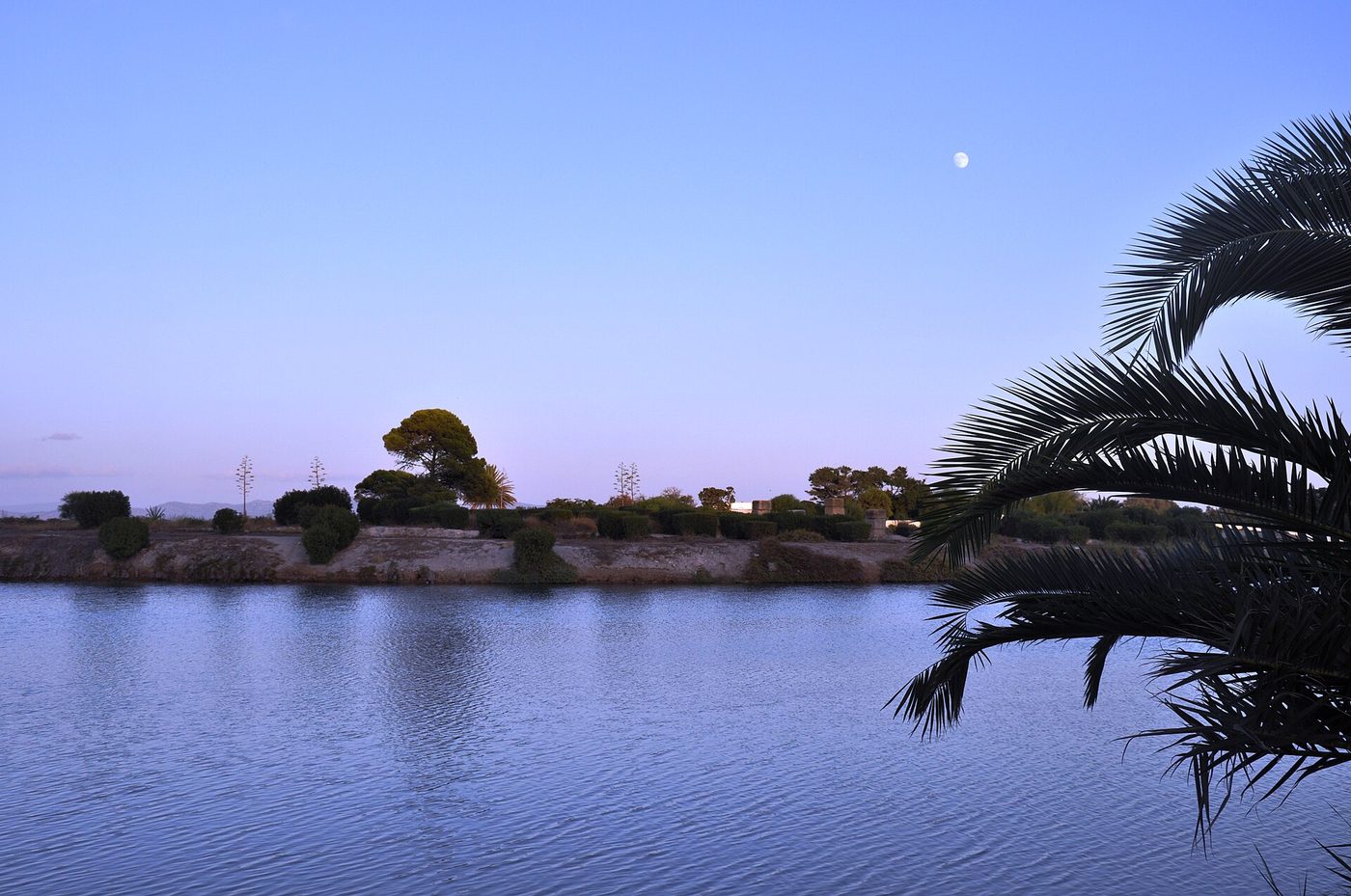
This is the most human-scaled part of Carthage, and a lovely place to walk the shoreline and look out over the Gulf of Tunis before you tackle the hill. There’s usually no crowd here at all.
3. Byrsa Hill: the museum, the Acropolium and the view
Byrsa is the high point of Carthage in every sense — the hill where the original Punic citadel stood, and where you get the grandest view over the ruins, the suburb and the sea. On top sit two things: the National Museum of Carthage, holding Punic masks, jewellery, stelae and Roman mosaics, and the Acropolium, the handsome former Cathedral of Saint Louis, no longer a church but now a concert and exhibition hall. Between them, excavations have uncovered a whole Punic residential quarter from the 2nd century BC.
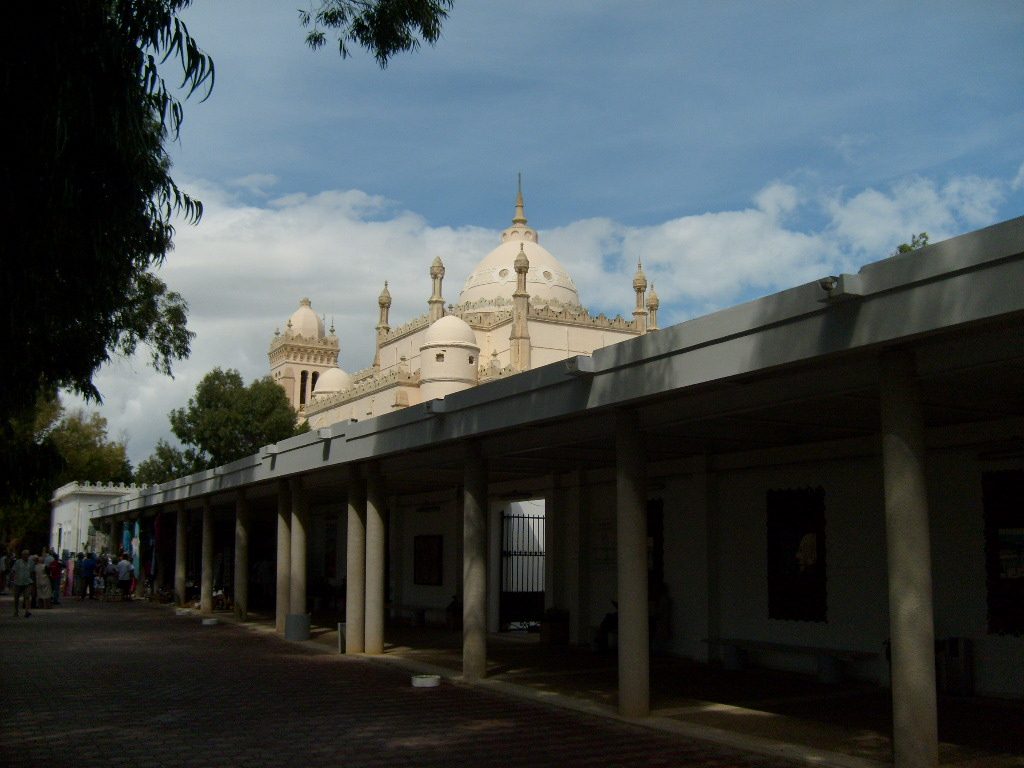
A quick honesty note: the National Museum has been through periods of partial closure and refurbishment, so if the collection matters to you, it’s worth checking it’s fully open before you make the climb. Even if it isn’t, the hilltop, the cathedral and the view justify the walk on their own. This is also the spot where a knowledgeable guide adds the most — see our note on hiring one below.
4. The Antonine Baths
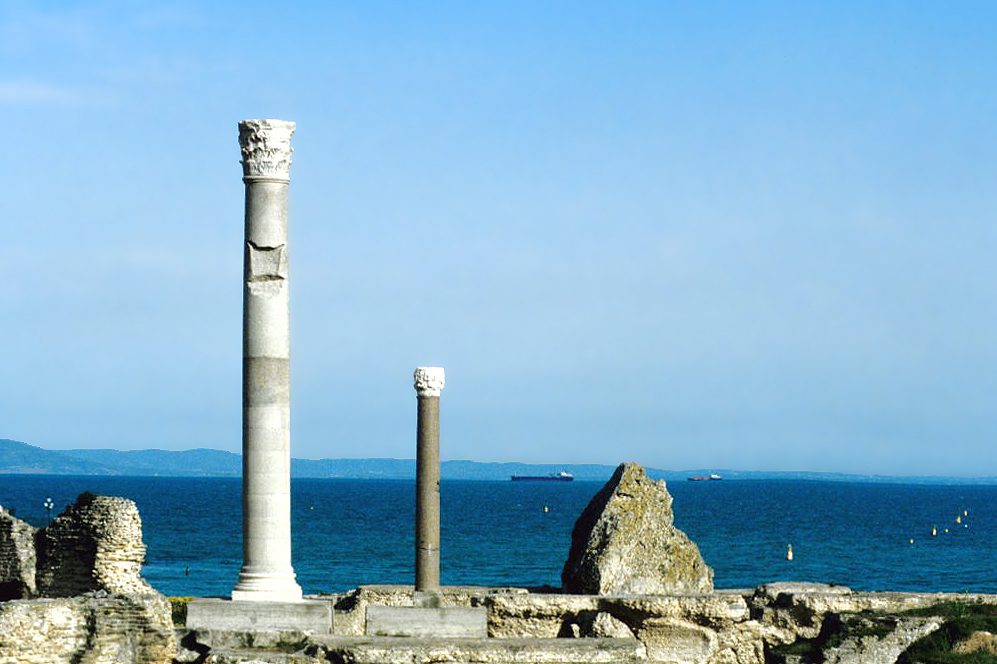
For most people this is the highlight, and rightly so. The Antonine Baths (or Baths of Antoninus) were the largest Roman baths in Africa and among the largest anywhere in the empire, begun under Hadrian and finished under Antoninus Pius in the mid-2nd century AD. What survives is the vast basement level — towering brick vaults and a single re-erected column that hints at the sheer height of the vanished halls above — set dramatically right on the seafront. Walk among them and the scale finally makes Roman Carthage feel real.
One important practicality: the baths sit immediately beside the presidential palace. Security is relaxed about visitors, but do not photograph towards the palace grounds — point your camera at the ruins and the sea, not the fence. There’s almost no shade down here, so this is a place to have water and a hat in summer.
5. The Roman theatre and villas
Uphill and north, the restored Roman theatre seats around 5,000 and still earns its keep: every summer it hosts the Carthage International Festival, so you may find it dressed with staging and lighting rigs. Purists grumble that the restoration is heavy-handed, but the setting is superb. Film fans, note: this theatre — not the amphitheatre at El Djem — was the real location for the crowd scene in Monty Python’s Life of Brian, a myth we untangle in our Roman ruins guide.
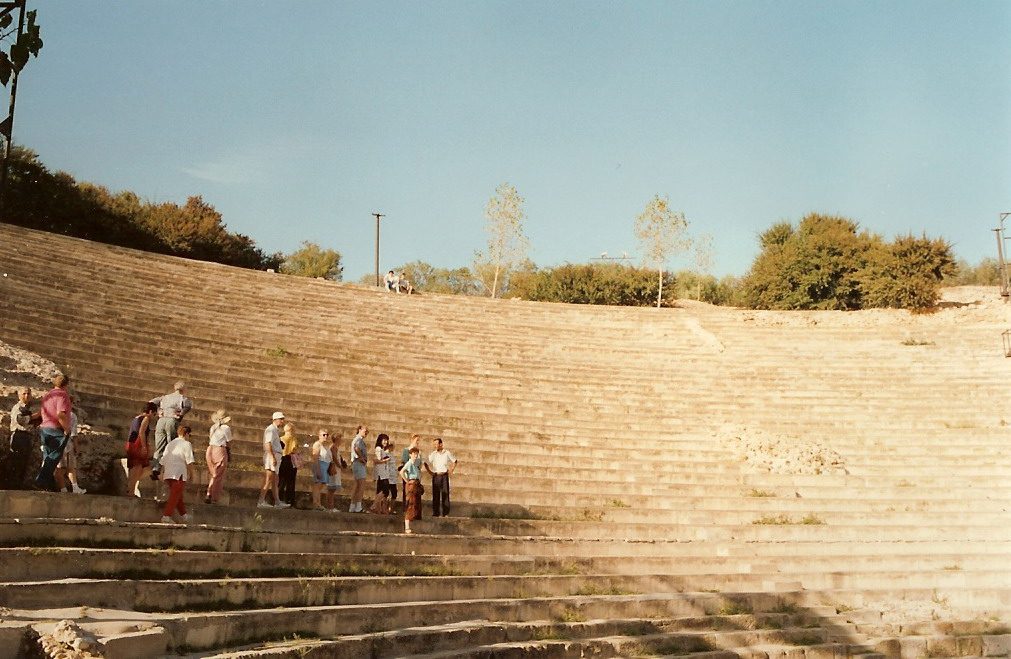
Next door, the Roman villas district preserves column-lined terraces, patches of mosaic floor and the small Odeon, all with sweeping views. It’s a peaceful, green corner to end on before you reboard the train north.
If you have time: amphitheatre, cisterns and St Cyprian
Three extras reward the curious. Inland stands the ruined amphitheatre, where early Christian martyrs were killed and which is now a tree-fringed oval; nearby, the enormous La Malga cisterns once stored water piped from distant Zaghouan. Down by the shore, the cliff-top ruins of the Basilica of St Cyprian — honouring the martyred bishop of Carthage — command one of the best sea views on the whole site, and it’s free to wander. None are essential, but each deepens the picture.
When to go and how long you need
Rushing the three big hitters — baths, Byrsa and the ports or Tophet — takes about three hours. To do the lot justice, including the museum, give it a full morning or afternoon of four to five hours. Because the ruins are open and exposed, spring and autumn are far kinder than high summer, when the midday heat on unshaded stone is punishing.
Whenever you come, go early. Arrive for opening at 8.30am and you’ll have the Antonine Baths almost to yourself before the tour coaches and the fierce light arrive around mid-morning. Carthage pairs so naturally with the blue-and-white village of Sidi Bou Said, one TGM stop further north, that we’d strongly suggest doing both in a day — ruins in the morning, a long lunch on a Sidi Bou Said terrace, home in the afternoon. Our day trips from Tunis guide maps out that classic loop, and the wider Tunisia excursions guide covers organised alternatives if you’d rather not do it yourself.
Visiting Carthage: know before you go
A handful of things that make the day run smoothly:
- Buy the ticket at your first site. There’s no central gate — pay at the Antonine Baths, the Tophet or the Byrsa museum, keep the ticket, and reuse it all day.
- Carry cash and small notes. Cards aren’t reliable here, and you’ll want change for the train and a guide. The dinar is a closed currency — change money once you land.
- Bring water, a hat and proper shoes. Shade is scarce, especially at the baths, and the paths are uneven stone and gravel. Trainers beat sandals.
- Don’t photograph the presidential palace. It adjoins the Antonine Baths. Shoot the ruins and the sea, not the guarded fence.
- Consider a licensed guide for Byrsa and the Tophet. Official guides wait at the main sites for a modest hourly fee and add real depth; agree the price and their credentials first, and treat unsolicited “helpers” with polite caution.
- Go at opening, or late. Mornings are cooler, clearer and quieter; weekends and French school holidays are busiest late morning.
- Wander the shoreline. Between the ticketed sites, the coastal lanes and the Punic ports are free, pretty and calm — some of the nicest walking in Carthage costs nothing.
Hungry afterwards? The suburb and neighbouring Sidi Bou Said have plenty of cafés and fish restaurants; our guide to where to eat in Tunis and our Tunisian food guide point you at the good stuff. To slot Carthage into a longer trip, see our Tunis itinerary, and for the mosaics that were lifted from these very ruins, don’t miss the Bardo Museum back in the city.
Carthage Tunisia: your questions answered
Is Carthage worth visiting?
Yes, with the right expectations. Carthage isn’t a single, intact monument like the Colosseum — it’s a scatter of Punic and Roman ruins across a modern suburb. But the seaside Antonine Baths, the hilltop museum and the ancient harbours, taken together with a UNESCO pedigree and a short, cheap train ride, make it one of the most rewarding half-days near Tunis.
How much does it cost to visit Carthage?
One combined ticket covers all the sites. Prices reported for 2026 range from around 12 TND to about 30 TND per adult, with students paying roughly half — so budget for the higher end and confirm at the ticket desk. Buy it at the first staffed site you reach, and bring cash, as card payment isn’t reliable.
How do I get from Tunis to Carthage?
Take the TGM light rail from Tunis Marine station near the causeway. Trains run every 15–20 minutes, cost about 1 TND each way, and reach the Carthage stops in 25–30 minutes. Get off at Carthage-Salammbô for the Tophet and ports, or Carthage-Byrsa/Dermech and Carthage-Hannibal for the museum and the Antonine Baths.
Which Carthage train stop should I use?
It depends on where you start. Carthage-Salammbô serves the Tophet and the Punic ports; Carthage-Byrsa or Carthage-Dermech serve Byrsa Hill and the Antonine Baths; Carthage-Hannibal is handy for the baths and theatre. The stops are only minutes apart on foot, so any of them puts you within easy walking of the ruins.
How long do you need at Carthage?
Allow about three hours for the main sites — the Antonine Baths, Byrsa Hill and the Tophet or ports — and a full four to five hours to include the museum and outlying ruins. Most visitors pair Carthage with Sidi Bou Said, one stop north, to make a comfortable full-day trip from Tunis.
What are the must-see sites at Carthage?
The Antonine Baths, for their seaside scale; Byrsa Hill, for the National Museum, the Acropolium cathedral and the view; and the Punic ports and the Tophet, for the older Carthaginian story. If you have time, add the Roman theatre and villas, the amphitheatre and the cliff-top Basilica of St Cyprian.
Can you photograph the Antonine Baths?
Yes — the baths themselves are fine to photograph, and they’re the most striking ruins at Carthage. The one rule is that they sit beside the presidential palace, so you must not take photos towards the palace grounds. Point your camera at the ruins and the sea instead, and security won’t trouble you.
What is the Tophet at Carthage?
The Tophet is a Punic sanctuary near Carthage-Salammbô where thousands of urns of cremated remains — many of infants — were buried beneath carved stelae. Ancient sources describe child sacrifice to the gods Tanit and Baal Hammon, though scholars still debate the interpretation. It’s a small, sombre but genuinely memorable part of the site.
Do you need a guide for Carthage?
Not to get around — the sites are easy to walk with this route and a map. But a licensed guide adds a lot at the museum and the Tophet, where the history isn’t obvious from the stones. Official guides wait at the main entrances for a modest fee; agree the price up front and be wary of unofficial “helpers”.
Can you visit Carthage and Sidi Bou Said in one day?
Easily, and most people do. Sidi Bou Said is just one TGM stop north of Carthage, so the standard plan is ruins in the morning, then lunch and a wander among the blue-and-white streets of the village, before heading back to Tunis. Together they make one of the best day trips in the country.
Is Carthage suitable for children?
Yes, though it’s open, uneven and short on shade, so bring water, hats and sturdy shoes. The dramatic vaults of the Antonine Baths and the harbour setting tend to hold younger imaginations better than the museum. Keep an eye on little ones near unfenced ruins and the water’s edge, and avoid the midday heat.
What’s the best time of day to visit Carthage?
Early morning, without question. Arriving at opening — around 8.30am — gives you cooler air, softer light for photos and the ruins largely to yourself before the tour groups arrive mid-morning. In summer especially, the unshaded Antonine Baths become uncomfortable by midday, so front-load the outdoor sites and save any indoor stops for later.
Written by the Tunisia Tourism Guide team — an independent UK-focused guide to travelling in Tunisia. We don’t sell tours or take hotel commissions. Prices and advice were checked at publication; always confirm current details before you book.
Photo credits
All images via Wikimedia Commons, used with thanks: The seaside Antonine Baths ruins at Carthage © LBM1948 (CC BY-SA 4.0); The circular Punic military port at Carthage © Noomen9 (CC BY-SA 4.0); Byrsa Hill at Carthage with the Acropolium cathedral and National © Credits to Mourad Ben Abdallah / Wikimedia Commons (Public domain); The restored Roman theatre at Carthage © Tico at Romanian Wikipedia (Public domain).

One response to “How to Visit Carthage: Sites, Tickets & Route”
[…] — it’s a serene base, if a slightly sleepy one, and it pairs naturally with our guides to Carthage and to the best day trips from […]