By the Tunisia Tourism Guide team · Last updated 2 September 2026 · We don’t sell tours or take hotel commissions — this is independent advice, written to be useful.
There are two Tunisias. One is the country the trains and the shared louage minibuses serve: Tunis, the Sahel coast, Sfax, Djerba, all of it cheap and sociable and perfectly doable without a car. The other is everything in between — the Cap Bon vineyards, the empty Roman hillsides of the northwest, the oasis roads of the Jerid where the landscape changes every twenty minutes. A hire car is the border between those two trips.
A Tunisia road trip is genuinely one of the best-value self-drive holidays in the Mediterranean: fuel at under 3 dinars a litre, motorway tolls of a few dinars a section, and a country small enough to loop in ten days. The trade-offs are assertive local driving, unlit rural roads after dark, routine police checkpoints, and hire-car insurance excesses that can run to thousands of dinars.
This guide covers the routes we’d actually drive, honest costs, the paperwork the Foreign Office requires, and the question most articles dodge — should you hire a car at all, or take a driver instead? It sits inside our wider Tunisia itinerary planning guide, which has the day-by-day versions of every route below.
Tunisia road trip at a glance
| Route | Days | Rough distance | Best for |
|---|---|---|---|
| The Cap Bon loop | 2–3 | Around 350 km | Short trips, first-time drivers, wine and quiet beaches |
| The northern culture loop (Tunis, Testour, Dougga, Bulla Regia, Tabarka, Bizerte) | 4–5 | Around 700 km | Roman ruins with nobody in them; green, hilly, cool |
| The coastal spine (Tunis, Hammamet, Sousse, El Djem, Sfax) | 3–4 | Around 300 km | Easy motorway driving, beaches, the amphitheatre |
| The southern desert circuit (Djerba, Matmata, Tataouine, Douz, Tozeur) | 5–6 | Around 900 km | Dunes, ksour, salt lake, film sets |
| The full anticlockwise loop | 12–14 | Around 1,800–2,000 km | Seeing the whole country properly, with rest days |
If you’ve only got a week, do the coastal spine plus the southern circuit and fly home from Djerba. If you’ve got a fortnight, the full loop is the trip — our two-week Tunisia loop has it staged with the long drives placed where you can absorb them.
The classic grand loop, leg by leg
This is the route almost every long Tunisia self-drive ends up as, running anticlockwise so you do the cool green north early and the desert once you’ve acclimatised. Times below are realistic rather than optimistic.
Tunis → Cap Bon (around 1 hour to Nabeul)
Don’t collect the car for the capital itself. Central Tunis is a place you escape driving in — parking is grim, the medina is pedestrian, and the TGM light railway gets you to Carthage and Sidi Bou Said for pocket change. Pick the car up on the morning you leave.
Cap Bon is the leg everyone skips and shouldn’t. An hour east of the capital you’re at Nabeul‘s pottery workshops; twenty minutes further and you’re at Kelibia, where an Ottoman-rebuilt fort sits on a rock above white sand. Kerkouane, on the same peninsula, is the only Punic city ever found intact — abandoned around 250 BC and never built over, so you walk through a Phoenician street plan with its bathrooms and pink-plastered floors still legible. UNESCO-listed since 1985, and often almost empty. Full detail in our Cap Bon guide.
Cap Bon → the Roman northwest (around 2h 30m in stages)
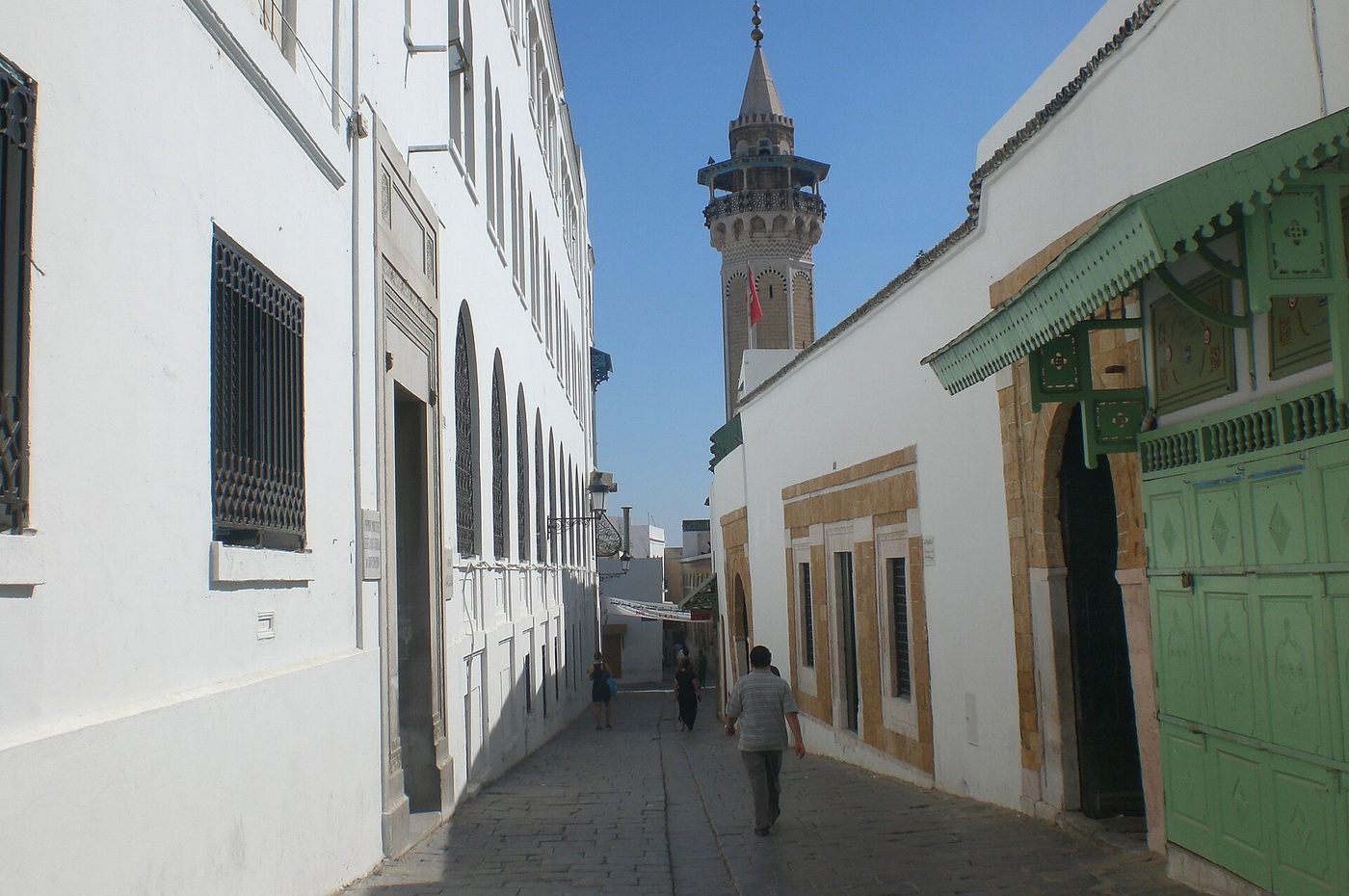
Head inland via Testour, an Andalusian town founded by Muslims expelled from Spain whose minaret clock runs anticlockwise, then on to Dougga — the best-preserved Roman town in North Africa, with a theatre cut into the hillside and the Capitol standing almost complete. Roads here are single-carriageway national routes: fine surfaces, slow average speeds, plenty of tractors.
Bulla Regia, near Jendouba, is the one that surprises people: the Romans built villas downwards here, with entire lower floors sunk below ground to escape the heat, and you walk down a staircase into a colonnaded room with its mosaic floor still in place. Then it’s roughly two and a half hours to Tabarka on the coral coast.
Routing note: this leg runs close to the Algerian frontier. Stick to the RN6, RN7 and RN17 and do not improvise onto forest roads west of Ghardimaou — see the safety section below for the exact FCDO wording.
Northwest → Kairouan → El Djem (around 4h then 1h)
Tabarka to Kairouan is the longest northern leg at around four hours cross-country. Take it via Béja and Medjez el Bab. Kairouan is the fourth holiest city in Islam and the oldest Muslim settlement in North Africa; a combined ticket bought at the tourist office covers the Great Mosque courtyard, the ninth-century Aghlabid basins and the Zaouia of Sidi Sahbi for somewhere around 10–12 TND (2026 — check current).
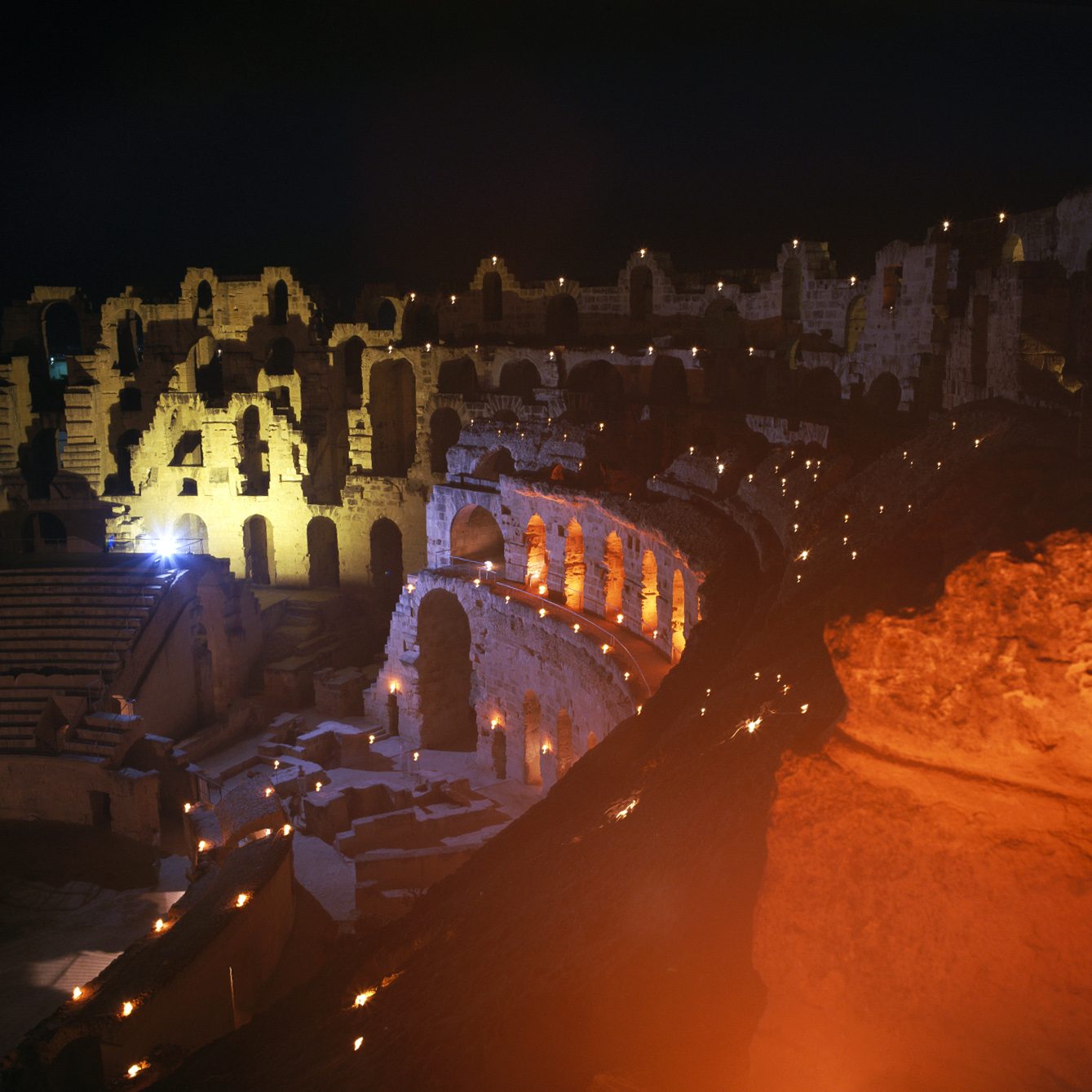
An hour south-east, the amphitheatre at El Djem rises out of a small market town like a mistake. You can walk the arena floor, climb the tiers and go down into the animal tunnels, usually without queueing. Two hours easily. Our Roman ruins guide ranks it against Dougga and Carthage.
The Sahel → the deep south (around 3h 30m to Matmata)
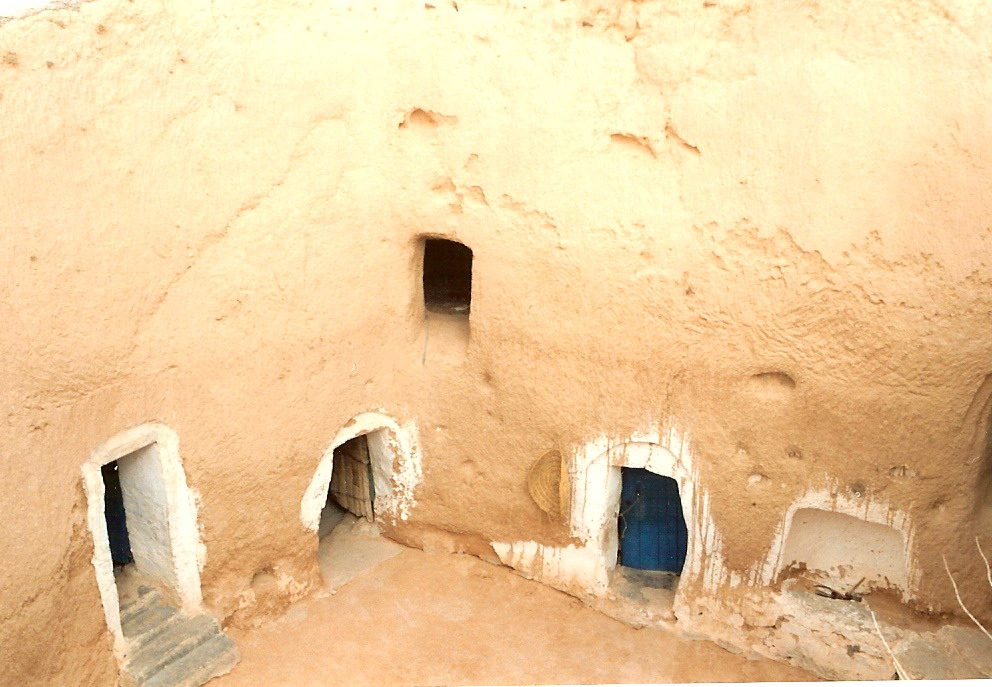
Down the A1 past Sfax — a working city with the most intact medina walls in Tunisia and almost no tourism infrastructure — then Gabès and up into the hills to Matmata, where houses are pits dug straight down into the crust with rooms tunnelled off a central courtyard. Some are still homes; one, the Hotel Sidi Driss, was the Lars homestead interior in A New Hope. Our Star Wars locations guide separates the surviving sets from the ones the sand has taken back.
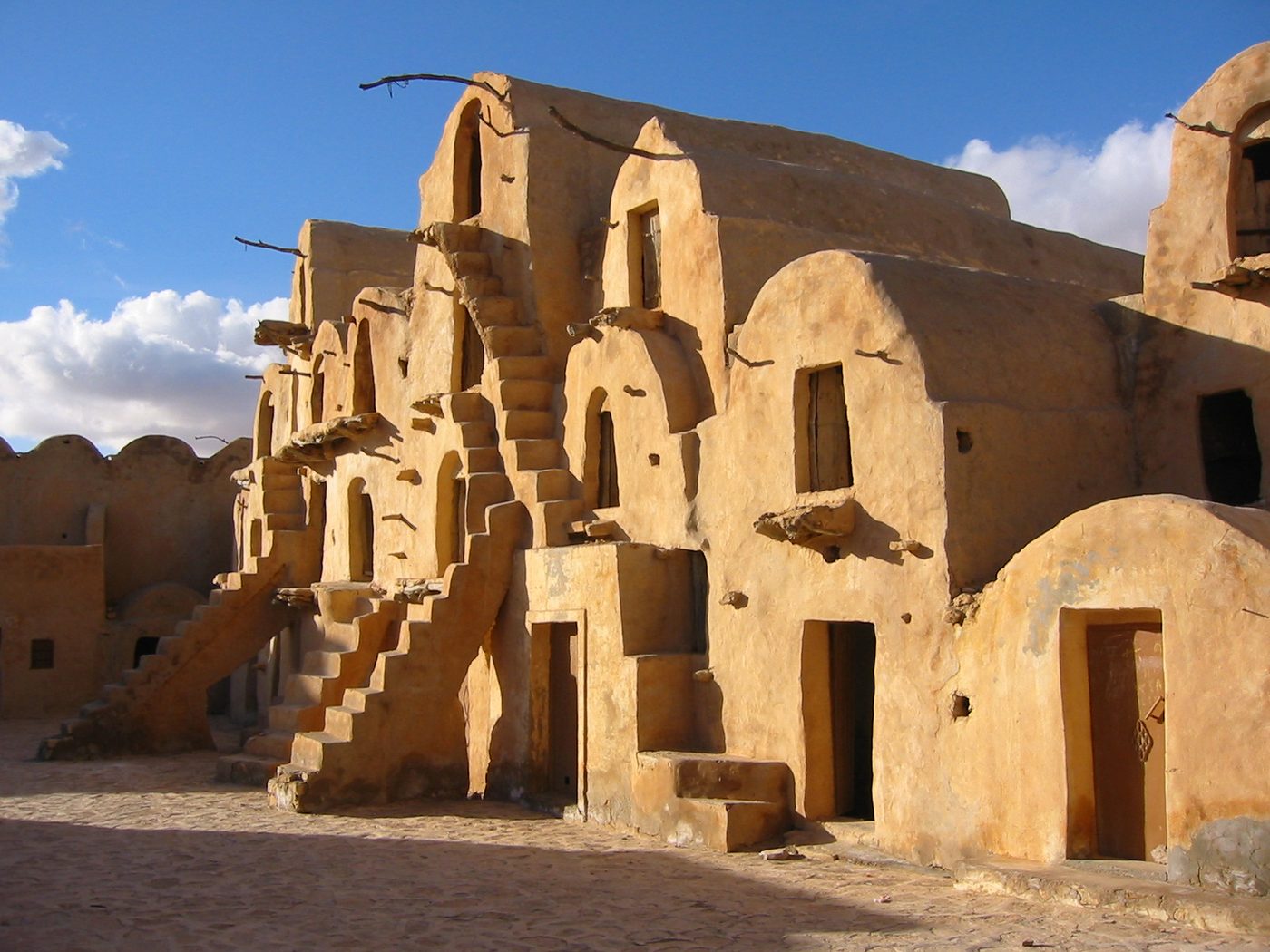
South of Matmata, Tataouine is the base for the ksour — fortified Amazigh granaries stacked three and four storeys high. Ksar Ouled Soltane, 22 km from town, is the spectacular one. All of these are on sealed road; you do not need a 4×4.
Douz → Tozeur → home (around 1h 30m across the chott)
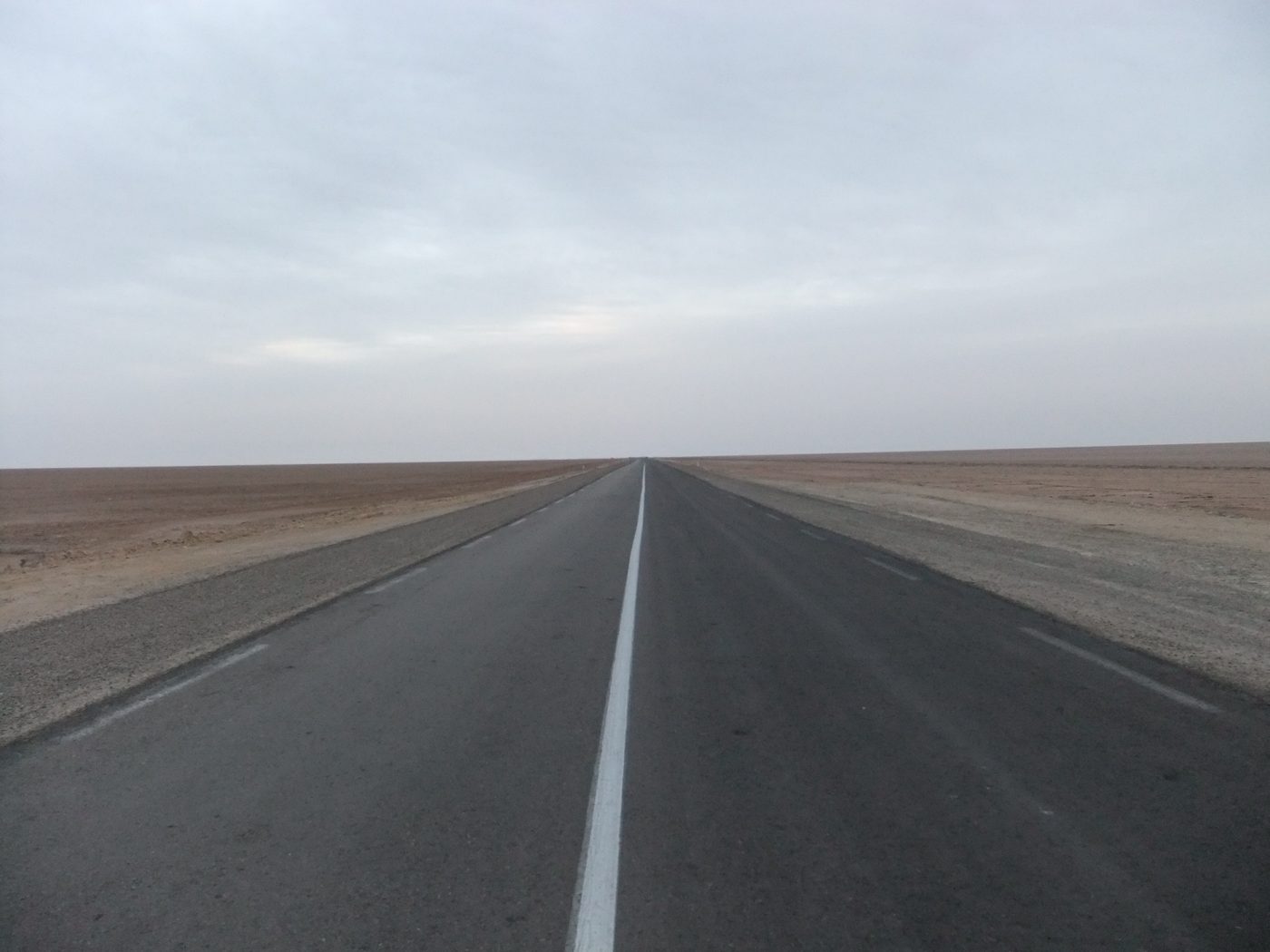
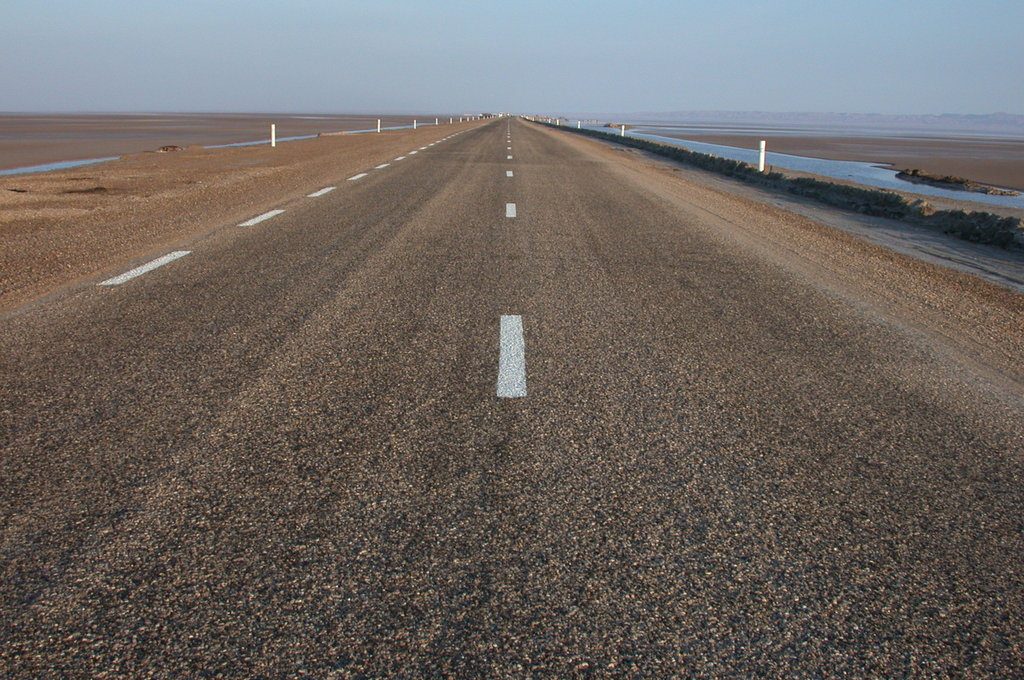
Douz is where the cultivated land stops and the sand starts, and it’s the usual jumping-off point for a night in a desert camp. From there the RN16 runs west to Tozeur across the causeway over Chott el Jerid, a salt pan the size of an English county that mirages into floating mountains in the middle distance. Everyone stops. You will too.
Then either loop north to Tunis (around five and a half hours) or run east to Djerba (around four and a half) and fly home from there. The Djerba finish is much the better trip, and easyJet’s direct Manchester service makes it practical for UK drivers.
What it costs to drive Tunisia
Everything below is indicative for 2026 — check current prices before you build a budget on it.
| Item | Rough cost | What to watch |
|---|---|---|
| Compact manual hire car | Around 800–1,300 TND a week with basic cover; roughly 80–120 TND a day off-season | August can run 60% above the yearly average. February is the cheapest month |
| Automatic | Typically 30–50% more, and scarce | Book weeks ahead or accept a manual — most fleets are Clios, Polos and Swifts |
| 4×4 | Roughly double a compact | Only needed if you’re leaving the asphalt. Every sealed road south, including the chott causeway, is fine in a small car |
| Deposit block | Around 500–1,500 TND, more for SUVs | Credit card in the driver’s name. Debit cards are widely refused |
| Insurance excess | Can run to several thousand dinars on the basic policy | The single biggest trap. See below |
| Fuel | Around 2.7–3.0 TND a litre for unleaded (2026) | Cash in most rural stations. Budget roughly 30 TND per 100 km |
| Motorway tolls | 2–8 TND a section; Tunis–Sfax totals around 12 TND | Cash in dinars only at the booths — keep coins and small notes |
| Parking | A dinar or so to the gardien in his fluorescent vest | Park outside the walls in medina towns, always |
The headline is that distance in Tunisia is nearly free. A 2,000 km loop costs somewhere around 600 TND in fuel and maybe 40 TND in tolls. It’s the car itself and the hotels that carry the cost.
The insurance trap, and how to avoid it
This is where Tunisian car hire goes wrong for British drivers, and it’s worth slowing down for.
The price you’re quoted almost always includes only basic cover with an excess — the franchise — that can run to several thousand dinars. That means a scraped bumper in a Sousse car park is your problem up to that amount, and the agency has your credit-card deposit to take it from. Four ways to handle it:
- Buy the excess-reduction at the desk. Simplest, dearest. Typical add-ons run around €11 a day to bring the excess down to a few per cent, or around €20 a day to reduce it further (2026 — check current).
- Use a credit card with rental cover. Only if the policy explicitly names Tunisia. Many UK cards exclude it. Ring and get it confirmed in writing before you fly.
- Buy standalone excess insurance in the UK. Usually the cheapest per day, but you pay the agency first and claim it back afterwards, which needs a card with headroom.
- Add full cover through the booking aggregator. Works, but read whether it reimburses you or pays the agency directly.
Whichever you pick, know your excess number before you sign. And do the walk-around properly: photograph and film every panel, the windscreen, the tyres, the fuel gauge, the spare, and the warning triangle and hi-vis vest (both legally required kit). Make sure every existing scratch is on the damage diagram before you drive off, and film it again at drop-off. That five-minute ritual dissolves most rental disputes before they start.
One more: age. Twenty-one is the usual floor, often with a year or two of licence history, and under-25s frequently pay a young-driver surcharge.
The paperwork: IDP, green card and ID
The Foreign Office is unambiguous here, so we’ll quote it. As at 2 September 2026 (FCDO advice last updated 24 July 2026): “You can drive in Tunisia for up to one year with a 1968 international driving permit (IDP) and your UK driving licence. You cannot buy an IDP outside the UK, so get one before you travel. You also need to carry a green card to prove you have the minimum insurance cover.”
In practice: the 1968 IDP costs a few pounds from a UK Post Office, takes minutes over the counter, and needs a passport photo. A rental desk may not ask for it. A gendarme at a checkpoint can. Get one — it’s the cheapest insurance on the whole trip.
The green card matters if you’re bringing your own vehicle over on the ferry from Italy or France; if you’re hiring locally, the agency’s insurance covers it, but check the paperwork is in the car. Separately, the FCDO notes that as a foreign national “you must carry ID, such as a copy of the photo page of your passport” — keep a photocopy in the glovebox and the original in the hotel safe.
Drink-driving is a serious offence and the FCDO points out the legal limit is stricter than in England and Wales, with fines and prison sentences available. Don’t have the one glass of Celtia with lunch.
Driving in Tunisia: the honest part
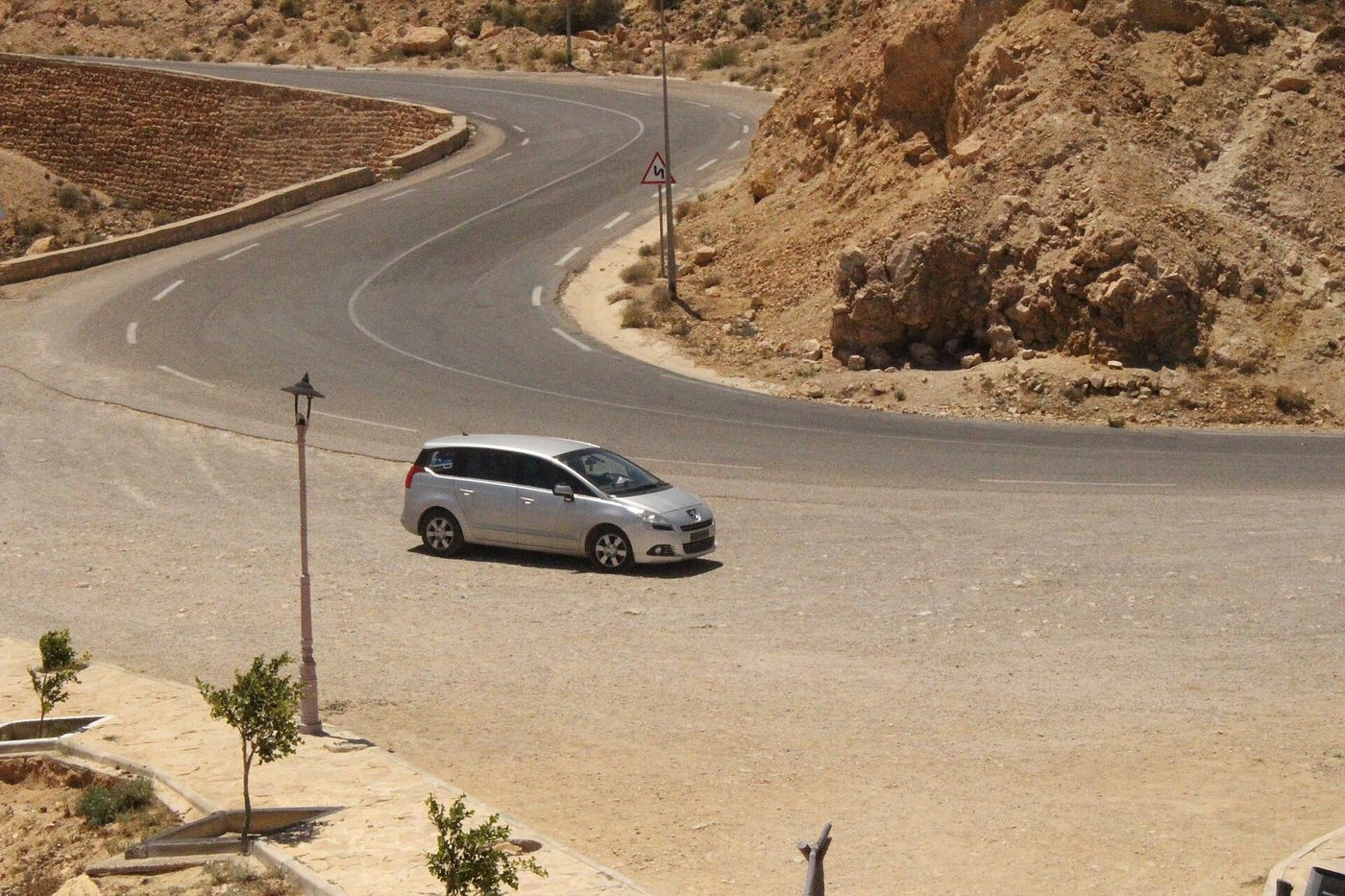
Tunisia drives on the right. Beyond that, the written rules are treated as a strong opening suggestion. Lane markings are advisory, overtaking is enthusiastic, mopeds appear from nowhere, and at quiet junctions the red light has only moderate authority. It isn’t aggression — it’s a different fluency, and most visitors acclimatise inside a day. Drive defensively, leave gaps, and don’t take anything personally.
The hazards the FCDO actually lists
These are worth reading before you collect the keys, because they’re specific and they’re accurate:
- Potholes and speed bumps. “Road surfaces are of a reasonable standard in Tunisia, although large potholes can appear after heavy rain. Many towns and villages have unannounced speed bumps.” The speed bumps are the real menace — unpainted, unsigned, and capable of removing a sump. Slow right down through every village.
- Sand drifts. “Be careful when approaching sand drifts on roads.” Common in the south after wind. Cross them slowly and straight; don’t brake hard mid-drift.
- Night driving. “Driving at night can be hazardous outside towns, due to unlit roads, vehicles without lights and livestock on the road.” This is the one rule every Tunisian will also give you. Plan every leg to finish by dusk.
- Fuel in remote areas. “Check the availability of petrol stations with local drivers before travelling long distances in remote areas.” Past Gabès, fill up whenever you pass a station rather than when the gauge tells you to.
- Driving standards. “Vehicles entering roundabouts or junctions do not always follow the established right of way. Lane discipline can be poor.” Also: “Pedestrians tend to walk on the roads and they have the right of way.”
Checkpoints
You will meet police and National Guard checkpoints, especially approaching cities and throughout the south. The FCDO’s line is the right one: “You may come across military or police security checkpoints. Approach slowly and do not cross without permission. Be prepared to present ID and driving licence if asked.”
In practice, for a hire car with foreign passengers, the overwhelming norm is a glance and a wave-through. Sometimes a friendly “welcome to Tunisia”. Occasionally they’ll want papers. Keep the passport photocopy, licence, IDP and rental contract within reach, slow down well before the barrier, take sunglasses off, and it’s thirty seconds of your day. Don’t photograph checkpoints, military sites or government buildings — that’s a separate FCDO warning and it’s taken seriously.
Speed limits, radar and fines
Fifty km/h in towns, 90 on national roads, 110 on the motorway. Radar is real, particularly on the A1, and speed cameras are common. Fines are issued on the spot and receipted; pay politely and keep the paper.
Roads, tolls and what the signs mean
- A — autoroute. Modern toll motorway, dual carriageway, 110 km/h, decent rest areas. The A1 runs Tunis–Hammamet–Sousse–Sfax and on toward Ben Guerdane; the A3 heads west toward Oued Zarga; the A4 goes north to Bizerte. Surfaces are genuinely good.
- RN — route nationale. Free, single carriageway, 90 km/h, quality from good to fair. This is most of your driving outside the coastal spine.
- GP — local road. Free, slow, often scenic. Fine in a normal car; expect goats.
Signs are in Arabic and French, which is the single most useful thing about driving here if your school French survives. Learn ralentir (slow down), travaux (roadworks), sortie (exit) and péage (toll) and you’ll cope.
Should you hire a car at all?
Here’s the triage we’d give a friend, because the happiest drivers are the ones who hire for the right days.
| Your trip | Car? | Why |
|---|---|---|
| Tunis, Carthage, Sidi Bou Said and the coast | No | The TGM, metered taxis and the SNCFT train line cover all of it. A car in central Tunis is a liability |
| A resort week in Hammamet or Sousse with two day trips | No | Excursions and taxis are cheaper than a week’s hire plus insurance |
| Mixed city-and-countryside trip | For the middle only | Do the urban days car-free, take a car for the Cap Bon or Dougga days, drop it before you go back to the capital |
| The deep south — Tozeur, Douz, the ksour, the chotts | Yes | Distances stretch and shared transport thins. Split between two or three people it beats everything else |
| Solo traveller on a budget | No | Louages and trains win on cost every time. See our getting around Tunisia guide |
The car-and-driver option nobody mentions
Hiring a car with a driver is common, cheap by European standards, and criminally under-discussed in English-language guides. You pay somewhere in the region of 250–400 TND a day for a car and driver depending on distance and season (2026 — check current), and in exchange you get somebody who knows the checkpoints, handles the parking, negotiates nothing because there’s nothing to negotiate, and does the night legs you shouldn’t.
For a couple doing a five-day southern circuit it costs more than self-drive. For a family of four, or for anyone nervous about Tunisian traffic, it’s often the better buy once you’ve added excess insurance, fuel and the stress. Ask your hotel rather than booking blind online, and agree the total in writing including the driver’s own accommodation and meals.
Where the road trip can’t go
Because a self-drive route gives you freedom the coach tours don’t, it’s worth knowing precisely where the lines fall. As at 2 September 2026 (FCDO advice last updated 24 July 2026), the Foreign Office “advises against all travel to” the “Chaambi Mountains National Park” and “the designated military operations zones: Mount Salloum, Mount Sammamma, Mount Mghila”. It “advises against all but essential travel to” “areas north and west of the town of Ghardimaou in Jendouba Governorate, including El Feidja National Park”, to “within 20km of the Tunisia-Algeria border in El Kef and Jendouba governorates, south of the town of Jendouba, including the archaeological site of Chemtou”, to “Kasserine Governorate, including the town of Sbeitla”, to “within 10km of the rest of the Tunisia-Algeria border south of Kasserine Governorate”, to “within 10km of Mount Mghila” and to “Mount Orbata”.
In the south it “advises against all travel to” “the militarised zone south of the towns of El Borma and Dhehiba”, “within 20km of the rest of the Tunisia-Libya border area north of Dhehiba” and “the town of Ben Guerdane and immediate surrounding area”, and against all but essential travel to “within 75km of the Tunisia-Libya border, including Remada and El Borma but excluding Zarzis, the C118 road and all areas in Medenine Governorate north of the road.”
Four practical consequences for a driver:
- Don’t link the northwest to the south via Kasserine. Several route planners online run Tozeur–Sbeitla–Kairouan because it’s the short way on a map. It crosses an “all but essential travel” governorate. Route via Gafsa and Kairouan or back down the coast instead.
- Tataouine town and the ksour immediately around it are outside the advisory. Do not continue south towards Remada or Dhehiba. Travellers who have tried report being turned back by police, which is the system working.
- Djerba and Zarzis are named exclusions from the Libya-border advice, so finishing your loop on the island is unaffected. That’s why we route it that way.
- Entering an area the FCDO advises against will void most UK travel insurance outright — which, on a self-drive trip with a hire-car excess hanging over you, is a much bigger deal than it sounds.
Check gov.uk/foreign-travel-advice/tunisia the week you travel, and read our date-stamped Tunisia safety guide for the full picture. On health: your UK GHIC is not valid in Tunisia, private clinics expect payment up front, and on a driving trip through remote country, insurance with medical cover and repatriation is not optional.
Nine things we’d tell a first-time driver
- Get the 1968 IDP before you fly. You cannot buy one abroad.
- Take a credit card, not a debit card. The deposit block needs it.
- Film the car at pickup and drop-off. Every panel, plus the spare and the safety kit.
- Carry cash in dinars. Tolls, rural fuel stations and parking gardiens are cash-only, and the dinar is a closed currency so you can only get it once you land. Reckon on roughly 3.8–3.9 TND to the pound in mid-2026 — check the rate.
- Fill up before the south. Past Gabès, top up at every station.
- Be parked by sunset. Every single time.
- Download offline maps. Coverage is decent but not universal, and signposting to archaeological sites is thin.
- Park outside medina walls. Then walk. There is no version of this where driving in works.
- Don’t plan more than four hours of driving in a day. Tunisia is small; the temptation to over-schedule is what ruins these trips. Our guide to how many days you need in Tunisia works through the pacing.
When to drive
April to early June and mid-September to early November. Summer makes the southern legs genuinely punishing — the interior routinely passes 40°C, and the FCDO notes that heatwaves can trigger temporary power cuts affecting air conditioning, mobile networks and even card payments and ATMs. Winter is fine for the coast and the ruins but the desert nights are cold and the daylight is short, which matters when you’re trying not to drive after dark. Our best time to visit guide goes month by month.
Tunisia road trip: your questions answered
Is it safe to drive in Tunisia as a tourist?
Yes, with sensible precautions. Motorway surfaces are good and the tourist regions are heavily travelled. The real risks are behavioural and environmental: assertive overtaking, unlit rural roads at night, unannounced speed bumps and livestock. Drive defensively, avoid driving after dark outside towns, and stay out of the FCDO advisory zones.
Do I need an international driving permit for Tunisia?
Yes. The FCDO states you can drive for up to a year on a 1968 international driving permit plus your UK licence, and you cannot buy an IDP outside the UK. Get one from a Post Office before you fly — it takes minutes and costs a few pounds.
How much does it cost to hire a car in Tunisia?
Roughly 800–1,300 TND a week for a compact manual with basic insurance in 2026, or about 80–120 TND a day off-season, climbing hard in August. Automatics cost 30–50% more and are scarce. Add excess insurance and a credit-card deposit of 500–1,500 TND.
Do I need a 4×4 in Tunisia?
Almost certainly not. Every sealed road on a normal itinerary — including the causeway across Chott el Jerid, the ksour circuit and the mountain oases — is fine in a small hire car. A 4×4 is only necessary for genuine off-piste desert, and for that you want a local driver rather than a rental.
Are Tunisian motorway tolls expensive?
No. Sections cost between 2 and 8 TND, and the full Tunis to Sfax run totals around 12 TND. Booths are staffed and take cash in dinars only, so keep coins and small notes in the door pocket.
Can I drive from Tunis to the Sahara in a day?
You can — Tunis to Tozeur is around 450 km and five and a half hours, Tunis to Douz a little more — but we wouldn’t. It’s a full day behind the wheel that arrives too late to enjoy anything. Break it at Kairouan or on the Sahel coast.
What happens at Tunisian police checkpoints?
Usually nothing. Slow right down, stop if signalled, and be ready with passport copy, licence, IDP and rental papers. For foreign visitors the norm is a look and a wave through. Don’t photograph the checkpoint and don’t try to hurry the officer.
Is fuel easy to find in southern Tunisia?
Less easy than in the north. Stations are frequent on motorways and in cities but thin out beyond Gabès and around Douz and Tataouine. The FCDO advises checking availability with local drivers before long remote runs; the practical rule is to fill up whenever you see a station in the south.
Can I take a hire car onto Djerba?
Yes. Either the Jorf–Ajim ferry, which crosses in around twenty minutes for a couple of dinars, or the free El Kantara causeway from the Zarzis side, which has no queue but adds thirty to sixty minutes. Take the causeway in July and August when the ferry queue can run over an hour.
Is a one-way rental possible in Tunisia?
Usually yes with the international chains and some larger local agencies — Tunis pickup and Djerba drop-off is the common combination — but it carries a fee and it isn’t always allowed. Confirm it in writing at the time of booking, not at the desk.
Should I hire from an international chain or a local agency?
Chains (Hertz, Avis, Europcar) sit in the arrivals halls with newer cars, reliable English and predictable terms, at a price. Local Tunisian agencies undercut them substantially and most are perfectly honest, with the trade-off of older cars and contracts that reward careful reading. Whichever you choose, check the review trail and photograph everything.
What’s the best short road trip if I only have four days?
The Cap Bon loop from Tunis: Nabeul, Kelibia, Kerkouane and the Korbous cliff road, around 350 km in total with no leg longer than 90 minutes. It’s easy driving, uncrowded, and it gives you a Punic city and a proper beach without going anywhere near the desert. On three days, don’t hire at all — see our long weekend in Tunisia guide instead.
Is a Tunisia road trip good for families?
It works if you keep the legs short and stay north. Long transfers south with young children are how these trips go wrong. A better shape is a resort base with a hire car for two or three day-trip days, then hand the keys back.
Written by the Tunisia Tourism Guide team — an independent UK-focused guide to travelling in Tunisia. We don’t sell tours or take hotel commissions. Prices and advice were checked at publication; always confirm current details before you book.
Photo credits
All images via Wikimedia Commons, used with thanks: An empty desert road in southern Tunisia on a self-drive © oatsy40 (CC BY 2.0); The road into Matmata — typical driving conditions on a © TOUKATOUKA (CC BY-SA 4.0); The causeway across Chott el Jerid © Francesco Piraneo G. (CC BY 3.0); Ksar Ouled Soltane near Tataouine © Ian Sewell (CC BY 2.5).