By the Tunisia Tourism Guide team · Last updated 4 September 2026 · We don’t sell tours or take hotel commissions — this is independent advice, written to be useful.
Almost everyone arrives at the same question: is it really worth giving up a beach day and travelling an hour or more inland to look at a ruin? We’ve had that conversation dozens of times, usually with someone who has already queued at the Colosseum in Rome and can’t quite believe a comparable building exists in a small Tunisian market town with nobody in it.
El Jem is a Roman amphitheatre in central Tunisia, built around 238 AD and big enough for a capacity usually given as 35,000. It is among the largest and best-preserved anywhere. You can walk the arena floor, descend into the underground passages and climb the tiers — usually almost alone.
It is the single most impressive thing we’ve stood inside in Tunisia, and the anchor of any tour of the Roman ruins in Tunisia. This guide covers what it actually costs, how to get there on the train rather than a coach, the museum most day trips skip, and the honest practicalities — the heat, the footing, the lack of shade.
El Jem at a glance
The quick version, before the detail.
| What you need to know | The answer |
|---|---|
| Where | El Jem (El Djem), Mahdia Governorate, central Tunisia — Roman Thysdrus |
| What it is | Roman amphitheatre, built around 238 AD; UNESCO World Heritage since 1979 |
| Size | Roughly 148m by 122m, about 36m tall; capacity usually given as 35,000 |
| Ticket | Around 12–20 TND for non-residents (2026 — check current prices); normally includes the museum |
| Hours | Roughly 08:00–19:00 in summer, closing around 17:00–17:30 in winter — confirm locally |
| Time needed | 60–90 minutes for the amphitheatre; 2–2.5 hours with the museum |
| Best time of day | First hour after opening, or the last two before closing |
| Getting there | Train from Sousse (~1h15) or Tunis (~3.5–4h); station is a few minutes’ walk away |
| What to skip | Nothing inside — but skip the coach tours that give you 45 minutes and no museum |
What makes El Jem extraordinary
Plenty of places call themselves the second Colosseum. This one has a genuine claim, and the reasons are worth understanding before you go, because they change what you look at when you’re there.
The numbers, honestly hedged
UNESCO gives the major axis as 148 metres and the minor axis as 122 metres, with a capacity “judged to be 35,000”. That word “judged” matters. Capacity figures for Roman buildings are calculated from seating dimensions, not from a ticket office ledger, and estimates for El Jem in other sources range from about 27,000 to 35,000. Treat 35,000 as the accepted headline number rather than a measured fact. The height — around 36 metres — is easier to trust, and it puts El Jem behind only the Colosseum in Rome and the amphitheatres at Capua and Carthage in the usual rankings.
Whatever the exact figure, the effect on the ground is the same. The town of El Jem today has a population smaller than the arena’s estimated capacity. You are looking at a building designed to hold more people than currently live around it.
It stands on flat ground, with no foundations
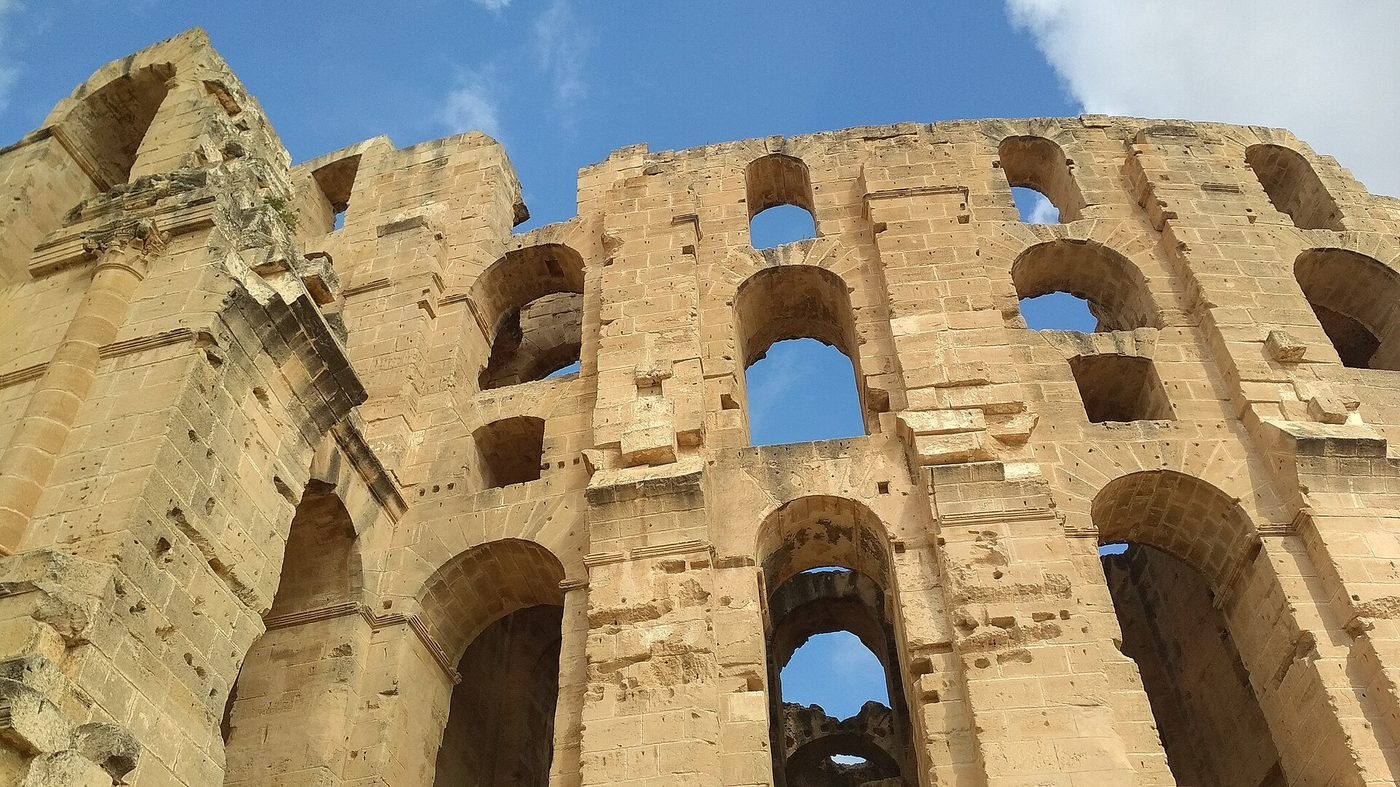
This is the detail we’d most want a first-time visitor to know. Most large Roman amphitheatres are cut into a hillside so the earth carries the load of the seating banks. El Jem is not. It sits on an open plain, built of dressed stone blocks laid dry, free-standing, held up entirely by its own system of arches and vaults. UNESCO singles this out as the reason it is “one of the rare monuments of its kind and unique in Africa”.
Stand back from the western facade and you’ll see three storeys of arcades — 64 of them, Corinthian and composite columns between — that read as a solid wall from a distance and resolve into individual stones close up. It should not still be standing. It is.
Gordian, and a building that was never finished
The construction is generally dated to around 238 AD and linked to the Gordian family. The usual telling credits the proconsul Gordian, later briefly emperor, but historians have picked holes in that: no proconsul could commission a building on this scale, and Gordian II’s reign lasted weeks. The more persuasive version is that Gordian III — probably born at Thysdrus on his grandfather’s estates — intended it as an embellishment of his home town. Either way, 238 was the year Thysdrus rose against Maximinus Thrax and proclaimed Gordian I emperor, and the town paid for it.
What almost nobody mentions on the coach tours: the amphitheatre was never completed. After Gordian III’s death his successors had no reason to finish it. Once you know that, the unfinished upper sections make sense rather than reading as damage.
It’s also the third amphitheatre built on the same spot. Thysdrus grew rich on olive oil, which is why a provincial town in the middle of nowhere could contemplate a building like this at all — the same wealth that produced the mosaics you’ll see in the museum.
A fortress, a saltpetre works, a row of shops
The amphitheatre’s afterlife is nearly as interesting as its Roman life. It sheltered the local population during the Vandal attacks of 430 and the Arab arrival in 647, and served as a fortress in the medieval period — local tradition puts the Berber queen Al Kahina inside it as a stronghold. In 1695, during the Revolutions of Tunis, Mohamed Bey El Mouradi breached one of the walls to flush out his brother’s supporters; around 1850 that breach was enlarged to roughly 30 metres. In between it is believed to have been used as a saltpetre factory, and in the later 19th century the arcades held shops, houses and grain stores.
The great gash in the wall you’ll photograph, in other words, is a cannon story and not an earthquake.
What you actually do inside
This is the bit that separates El Jem from every other Roman amphitheatre we’ve visited. There are almost no ropes.
Walk out onto the arena floor
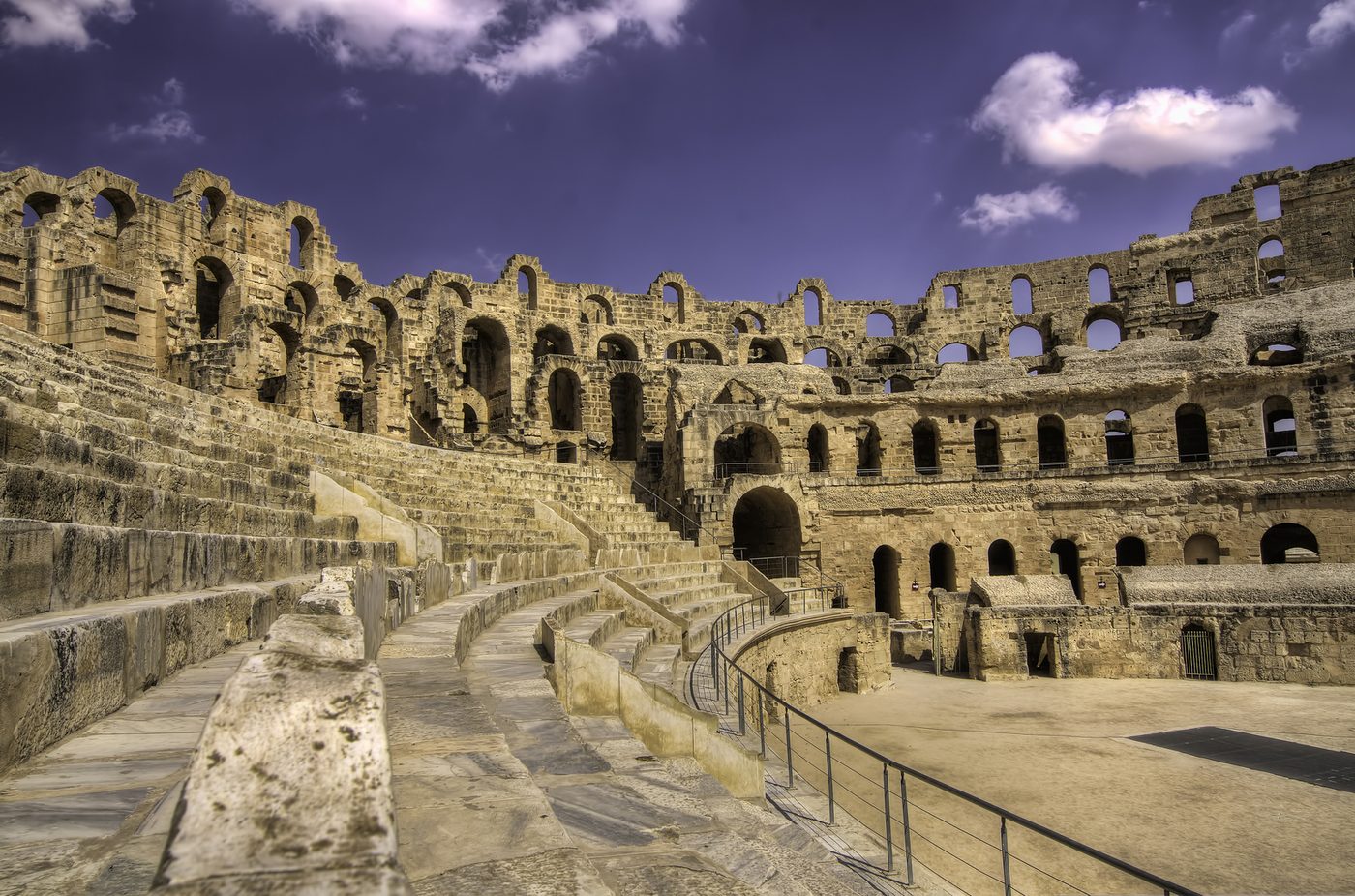
The arena is roughly 65 metres by 39 metres, and you can walk straight across it. In Rome you look down at a partial reconstruction from a walkway; here you stand in the middle, turn slowly, and watch three storeys of stone close over you. It takes about ninety seconds for the scale to land. If you do only one thing, do this, and do it before you climb — the perspective from the floor is what you’ll remember.
Note the long slot down the centre of the arena. That opening let air and light into the chambers beneath, and it’s the first hint of what’s underneath your feet.
Go down into the underground passages
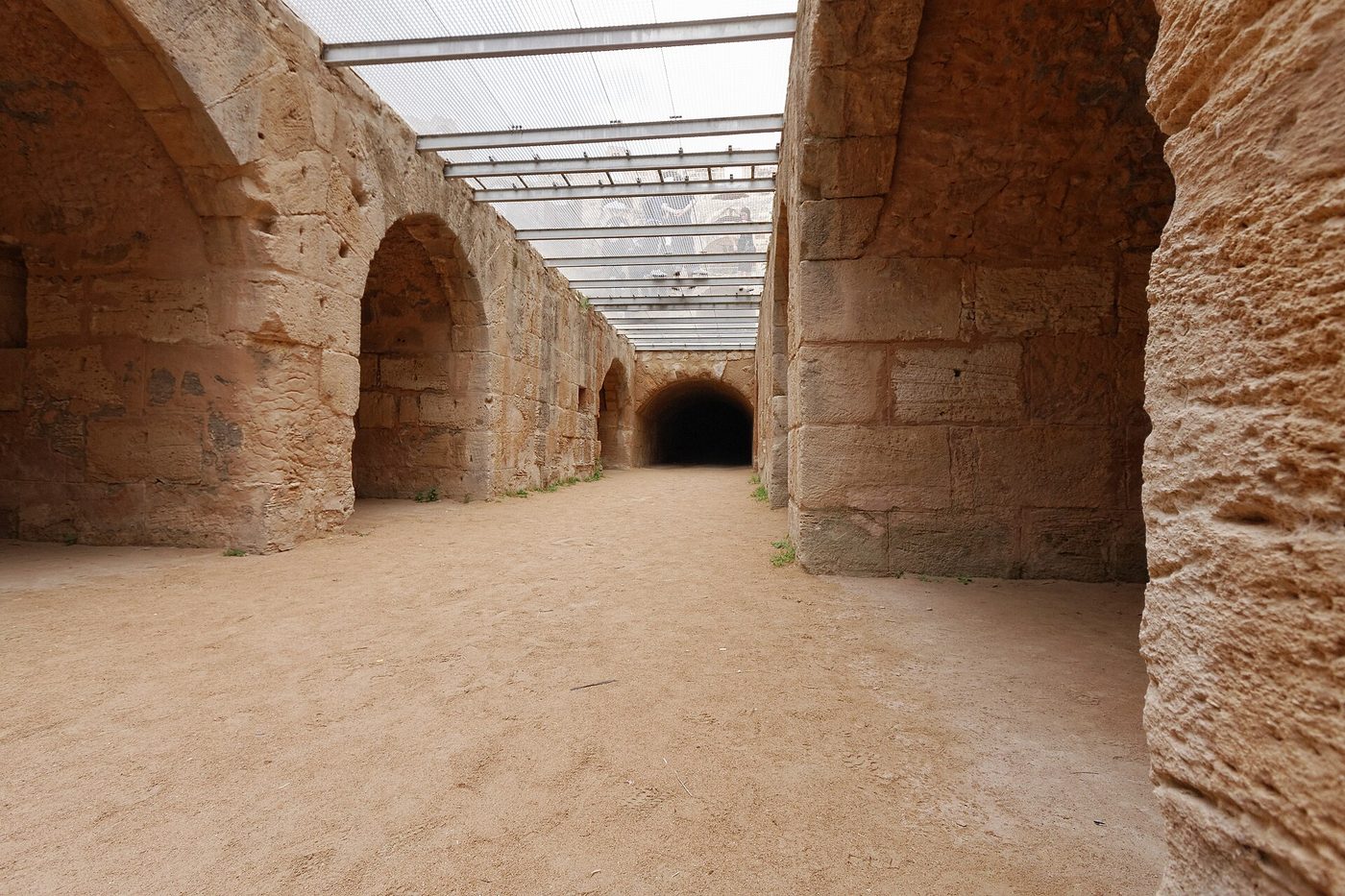
Stairs lead into two parallel underground galleries — the hypogeum — running beneath the arena floor. This is where animals, gladiators, scenery and equipment waited. Winches raised cages through trapdoors so that a leopard or a lion appeared in the arena as if from nowhere; there are ramps running in from outside, perpendicular to the main axes, that were used to bring animals in.
It is cool, dim and genuinely unsettling. Bring your phone torch: the far corners of the galleries are dark and the interesting stonework — the niches, the gate slots, the wear on the ramps — is easy to walk straight past. This section can close at short notice for works, so if it’s open when you arrive, do it first.
Climb the tiers
The staircases are Roman, steep, and in places uneven, but they are open and you can go a long way up. From the upper galleries the geometry of the building becomes obvious: the radial staircases, the vomitoria that emptied thousands of people out in minutes, and the strict seating hierarchy — the wealthy near the sand, everyone else stacked above them.
Look outward as well as down. The view is flat olive country in every direction, with the low white town pressed right up against the walls. That contrast — a monument this size sitting in an ordinary working town, with a school and a bakery across the road — is half the pleasure of the place.
Wander the corridors
The vaulted passageways behind the seating are the only reliable shade on site, and they’re worth ten minutes on their own. Arches frame views of the modern town; the stonework is precise enough that you can see the tool marks. We’ve had entire corridors to ourselves at nine in the morning in October.
Tickets, hours and the charge that catches people out
Here is where we have to be careful, because published figures for El Jem disagree with each other and Tunisian site prices have moved upwards since 2024.
What you’ll pay
Recent sources give the non-resident adult ticket as anywhere between about 10 TND and 20 TND (2026 — check current prices at the gate). Tunisian residents pay a lower rate, and students with valid ID usually get a substantial discount. Our advice: budget around 20 TND per adult and be pleasantly surprised if it’s less. At roughly 3.8–3.9 dinars to the pound in mid-2026, even the top of that range is about £5 — an absurd price for what you get.
Bring cash in small notes. Card acceptance at Tunisian archaeological sites is unreliable, and remember the dinar is a closed currency: you cannot buy it in the UK before you fly, so you’ll be changing money on arrival. Our Tunisia travel tips cover the money side properly.
The photography permit
Many Tunisian sites levy a separate, small charge for photography on top of the entrance ticket, and El Jem is one where reports conflict. Some 2026 accounts say phone and casual camera photography is free and only tripods or obviously professional kit attract a permit fee; others describe being asked for a token amount at the ticket window regardless. It is never expensive — historically the sort of charge that costs a dinar or two — but it is the classic way to get caught out with only a 50-dinar note in your pocket.
So: ask at the window, and carry a few coins and small notes. If you’re travelling with a proper camera or a tripod, assume you’ll pay something and factor it in.
Opening hours
Hours are seasonal and every source phrases them slightly differently. The pattern is broadly this (2026 — confirm before you travel):
- Summer (roughly April to September): opening between 07:30 and 08:00, closing between 18:30 and 19:00.
- Winter (roughly October to March): opening around 08:00–08:30, closing around 17:00–17:30.
- Ramadan: shortened, typically closing around 17:00. The next Ramadan begins in February 2027, so it won’t affect most 2026 trips.
- Closures: the site opens daily, including public holidays, but the museum and the underground galleries can close independently for works.
The last tickets usually go on sale some time before the stated closing time, so don’t turn up twenty minutes before the shutters come down and expect to get in.
How long to allow
Sixty to ninety minutes covers the amphitheatre thoroughly: ten minutes on the exterior, twenty on the arena and hypogeum, thirty climbing and wandering. Add another thirty to forty-five minutes for the museum. Two to two and a half hours total is a comfortable, unhurried visit. Coach excursions that allot forty-five minutes and skip the museum are selling you the postcard, not the place.
The El Jem Archaeological Museum — do not skip it
This is the part of El Jem that most visitors miss, and it is the reason we’d tell you to come independently rather than on a bus.
What’s in it
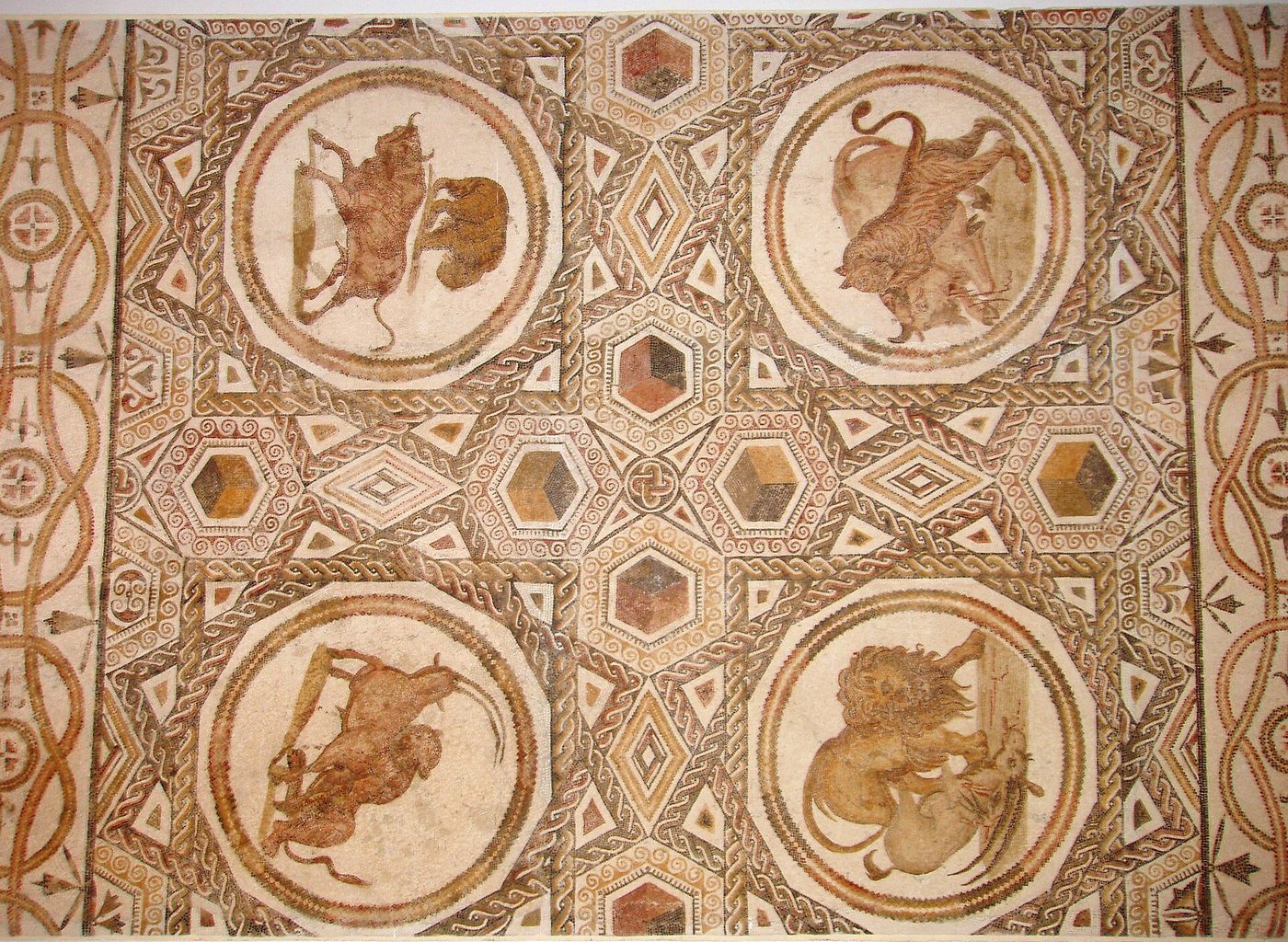
The museum sits a short walk — reckon on ten minutes, or a very short drive — south of the amphitheatre, and it is built on the site of a Roman villa. Inside are mosaic panels lifted from the houses of Thysdrus, alongside sculpture, ceramics and everyday Roman objects. The mosaics are the point: hunting scenes, mythological subjects, personifications of the seasons, all worked in stone the size of a fingernail and still holding their colour after eighteen centuries. If you have already seen the collection at the Bardo Museum in Tunis, this is the intimate, uncrowded version of the same story, and our guide to Tunisian mosaics explains what you’re looking at.
Outside, an archaeological park preserves the remains of several excavated villas — the House of the Peacock, the House of the Dolphins, the Sollertiana Domus among them — with some mosaics left in place where they were laid. The nearby House of Africa, uncovered in the 1990s, is a large complex whose pavements include a celebrated personification of the province of Africa. Seeing mosaics in situ, in the rooms they were made for, is a very different experience from seeing them hung on a museum wall.
Is it open, and is it a separate ticket?
Every current source we checked in 2026 describes the museum as open and included on the same combined ticket as the amphitheatre. We’d still ask at the amphitheatre ticket window, for two reasons: Tunisian museums close for refurbishment without much notice, and combined-ticket arrangements at INP sites do occasionally change. Ask “does this include the museum?” as you buy, keep the ticket stub — you may need to show it at the museum gate — and if the answer is no, pay the extra. It is worth it either way.
Getting to El Jem
El Jem sits inland in the Sahel, roughly 200km south of Tunis, about 65km from Sousse and Monastir, around 60km north of Sfax and 45km west of Mahdia. The good news is that it is on the main railway line, and the station is astonishingly close to the amphitheatre.
The train — our recommendation
SNCFT, the national railway, runs the Tunis–Sousse–El Jem–Sfax–Gabès line, and El Jem is a scheduled stop. Journey times run at roughly 1h15 from Sousse Ville and about 3.5 to 4 hours from Tunis. Fares are trivially cheap — a few dinars in second class, a little more in first — though SNCFT no longer publishes fares reliably, so treat any quoted figure as indicative.
The catch is frequency. There are only around three or four through trains a day in each direction, and the timings are not designed around day-trippers, so the whole trip lives or dies on the return departure. Check the current timetable at sncft.com.tn (there’s an English version and a real-time running page) and plan backwards from the train you intend to catch home. Booking opens only three days ahead and only at stations, so you buy at the counter — there’s no meaningful online option.
The reward: trains call at Gare El Jem, which is a few hundred metres from the amphitheatre. You can see the top of it from the platform. Get off the train, turn towards the enormous Roman building, walk for five minutes. No transfer, no taxi negotiation, no parking.
First class is worth the small supplement in summer for the air conditioning. Second class is perfectly fine. For the wider picture on trains, louages and taxis, see our guide to getting around Tunisia.
Louage (shared taxi)
Louages — shared long-distance minibuses that leave when full rather than to a timetable — run to El Jem from Sousse, Monastir, Mahdia and Sfax. Expect roughly one to two hours depending where you start, and a fare in single figures of dinars, cash only. Head for the town’s louage station, say “El Jem” and someone will point you at the right vehicle.
They’re cheap, frequent and a genuinely local way to travel. They’re also cramped, unairconditioned in older vehicles, and driven with commitment. We’d take the train if the timings work and a louage if they don’t.
Driving
El Jem is an easy drive: about 2.5 to 3 hours from Tunis on the A1 motorway, an hour to ninety minutes from Sousse or Monastir, and around an hour from Sfax. The roads are good, and there is parking near the amphitheatre and the museum. Car hire gives you the freedom to add the museum, the villa park and a second site in the same day.
Two things to know. You need a 1968-convention international driving permit alongside your UK licence, plus green-card insurance. And police and military checkpoints are routine on Tunisian roads — approach slowly, carry ID, and it’s a non-event. Avoid driving between towns after dark.
Organised excursions from the resorts
Every hotel desk in Sousse, Monastir and Hammamet sells an El Jem trip, usually bundled with Kairouan. They’re inexpensive and they solve the logistics, but the standard coach version gives you under an hour on site, no museum, and a compulsory carpet-shop stop. A private driver for the day costs more and is far better value in practice. Our roundups of Tunisia excursions, day trips from Sousse and day trips from Hammamet go through what’s worth booking.
Pairing El Jem with Kairouan
This is the classic Tunisian long day, and it works — but be realistic about it. Kairouan, the holy city with the Great Mosque and the Aghlabid basins, lies roughly 70km from El Jem, about an hour to an hour and a quarter by road. There is no railway station at Kairouan, so this pairing requires a car, a driver or a tour; you cannot do it on the train.
Done properly it’s a twelve-hour day from Sousse or Hammamet. Our order of preference: El Jem first thing, when the light is good and the stone is still cool, then Kairouan for the middle of the day, when the mosque courtyard and the covered souks give you somewhere to be out of the sun. Doing it the other way round means arriving at El Jem at two in the afternoon in an unshaded stone bowl, which is a mistake we’ve made once and won’t repeat.
If a full day feels like too much, El Jem pairs equally well with Mahdia — closer, quieter, and with a proper seafood lunch at the end of it — or with Sfax and its walled medina to the south.
When to go: light, heat and the shade problem
Say this plainly: there is almost no shade at El Jem. The arena floor and the seating tiers are entirely exposed. The vaulted corridors behind the seating are the only real refuge, and they are not where you want to spend your visit. Between June and early September, the middle of the day inside a stone amphitheatre on an inland plain is genuinely punishing, and the steps get hot enough to burn through thin soles.
Best time of day
Arrive within the first hour of opening. You get cooler stone, low raking light that picks out the arcades, and — this is the real prize — you may well have the arena to yourself before the first coaches pull in mid-morning. The last two hours before closing work almost as well, with warmer light and lengthening shadows in the corridors, though the underground galleries are gloomier late in the day.
For photography, morning light hits the western facade best and the interior is more evenly lit; late afternoon gives you the drama but heavier contrast.
Best time of year
April to early June and late September through October are the sweet spot — warm, workable, and the light is kind. November to March is comfortable for walking and climbing but can be windy and grey on the plain, and the shorter winter hours cut your day. July and August are only worth it at 08:00 or after 17:00. Our best time to visit Tunisia guide breaks the year down properly, and if you’re already committed to summer, October in Tunisia is the month we’d nudge people towards.
What to bring
- Water — more than you think. There’s a cafeteria and a shop on site, but nothing inside the seating tiers.
- A hat and sunscreen. Non-negotiable between May and September.
- Proper shoes. Trainers or walking shoes, not sandals. The steps are worn and the hypogeum floor is uneven.
- A phone torch for the underground galleries.
- Small notes and coins for the ticket, any photo permit, and the inevitable cold drink afterwards.
Accessibility, footing and visiting with children
We’d rather tell you this straight than have you find out on the day. El Jem is not an accessible site in the modern sense. The ground level and a good chunk of the arena floor are reachable with care, but the surfaces are ancient stone, uneven and loose in places. The tiers are reached by steep Roman staircases with no handrails, and the hypogeum involves stairs with worn treads and low light. Anyone with mobility limitations, vertigo or unsteady balance should plan to enjoy the ground level and the corridors, which is still a rewarding visit, and skip the climb.
For children, it is one of the best sites in the country. It’s a giant climbing frame with a gladiator story attached, and the freedom to actually walk on the arena floor makes it far more engaging than most museums. The flip side is that same freedom: there are unguarded drops from the upper tiers, gaps in the stonework and dark passages, so young children need real supervision rather than a glance every few minutes. Under-fives will be bored within twenty minutes; seven to fourteen is the age range that loves it. More on travelling as a family in our guide to Tunisia with kids.
The El Jem International Symphonic Music Festival
Every summer the amphitheatre hosts a classical music festival, staged in the arena with the tiers as seating. It runs across July and into August — the 2026 edition was scheduled roughly from mid-July to late August with around ten concerts — but the full programme is typically only confirmed in late June, so check festivaleljem.tn for the current line-up and dates before you build a trip around it.
Should you go? If your dates line up, yes. The acoustics of a Roman amphitheatre and a warm North African night are a combination worth rearranging an evening for, and it’s a rare chance to see the building lit after dark. Two practical notes: the seating is ancient stone, so take a cushion or a folded towel, and the concerts start late by British standards. Festival evenings can also affect daytime access while stages and rigging are installed, which is another reason to check ahead rather than turn up in the second half of July and hope.
El Jem on film: what’s true and what isn’t
This is where a lot of guides go wrong, so we’ve checked each claim rather than repeating them.
Gladiator was not filmed here. Ridley Scott’s 2000 film shot its Roman arena sequences at Fort Ricasoli in Malta, where a partial Colosseum was built, with the North African scenes filmed around Ouarzazate and Aït Benhaddou in Morocco and the opening battle in Bourne Wood in Surrey. El Jem gets credited constantly — by guides, by tour listings, by other travel sites — and as far as we can establish it is simply wrong. If your guide tells you Russell Crowe fought here, smile politely.
Monty Python’s Life of Brian is the claim with real support. The 1979 film was shot in Tunisia, largely around Monastir and Sousse, and El Jem is routinely listed among its locations, including on the amphitheatre’s own Wikipedia entry. We’d call this well attested rather than definitively sourced — the underlying citation is thin — so we state it as widely reported, not as gospel. Zeffirelli’s Jesus of Nazareth is also frequently cited, on similar footing.
The Nike advert is the best-documented of the lot. In 1996 Nike shot its “Good vs Evil” commercial here — a gladiatorial football match in which Eric Cantona, Ronaldo, Paolo Maldini, Luís Figo and Patrick Kluivert take on a team of demons, ending with Cantona’s “Au revoir” and a ball through the goalkeeper. If you were watching football in the mid-90s, you have already seen the inside of this building. The amphitheatre has also featured in the travel series Long Way Down and hosted the finish of an episode of The Amazing Race.
Where El Jem fits in a Tunisian trip
El Jem is the most spectacular Roman site in Tunisia but not the most complete one. If you want a whole Roman town rather than one enormous building, Dougga is the finest in North Africa — streets, a theatre, a capitol and a Punic mausoleum, spread across a hillside. Bulla Regia has its extraordinary underground villas with mosaics still in the floors. Ancient Carthage gives you the Punic and Roman layers together, above the sea outside the capital — worth reading alongside our guide to visiting Carthage today.
El Jem is one of Tunisia’s UNESCO World Heritage sites, inscribed in 1979 under criteria (iv) and (vi); the full list is in our guide to Tunisia’s UNESCO sites. For a broader plan, our Tunisia itinerary slots it into a coastal route, and our overview of things to do in Tunisia puts it in context with the Sahara and the beaches.
If you’re based on the Sahel coast, El Jem is the obvious excursion from Sousse, and a morning in the Sousse medina on the day before or after makes a satisfying pairing — two very different UNESCO sites within an hour of each other. Nearby Monastir’s ribat adds a third.
Honest downsides
Nowhere is perfect, and we’d rather you arrived with the right expectations.
- Interpretation is thin. There are few information panels and no audio guide worth speaking of. Read a little before you go, or hire one of the guides who wait at the entrance — the good ones are excellent and cheap, though quality varies and you should agree a price up front.
- The town is functional, not charming. El Jem is a working market town. There are a handful of decent cafés near the site and a couple of small hotels, but it isn’t a place to wander for an afternoon.
- Vendors at the entrance. Nothing aggressive, but expect to be offered souvenirs and “guide” services on the way in. A polite no works.
- Some areas close without warning. The hypogeum in particular can be shut for conservation work. Nobody will tell you in advance.
- It can get busy briefly. Mid-morning, when the coaches from Sousse and Hammamet coincide, the arena fills up for about an hour. Then it empties again.
On safety: El Jem sits in Mahdia Governorate on the central coast, far from any area the Foreign Office advises against travelling to. Our date-stamped guide to whether Tunisia is safe has the current wording if you want it.
Frequently asked questions
Is El Jem bigger than the Colosseum in Rome?
No. Rome’s Colosseum is larger on every measure — roughly 189m by 156m against El Jem’s 148m by 122m, and a much higher capacity. El Jem is usually ranked among the largest Roman amphitheatres in the world and the largest in North Africa. Where it genuinely beats Rome is access and atmosphere: you can walk the arena floor and climb the tiers with almost nobody there.
How much does it cost to visit El Jem?
Recent 2026 sources give the non-resident adult ticket as somewhere between about 10 and 20 TND, with residents and students paying less. Prices at Tunisian sites have risen since 2024, so budget around 20 TND per adult — roughly £5 — and check at the gate. A separate small photography permit may be charged; carry small notes and coins.
Is the museum included in the El Jem ticket?
Every current source we checked describes the amphitheatre and the El Jem Archaeological Museum as a combined ticket. We’d still confirm when you buy, because ticketing arrangements at Tunisian sites change without announcement. Keep your stub — you may be asked for it at the museum gate. The museum is about a ten-minute walk from the amphitheatre.
How long do you need at El Jem?
Sixty to ninety minutes covers the amphitheatre thoroughly, including the arena floor, the underground passages and a climb to the upper tiers. Add thirty to forty-five minutes for the museum and villa park. Two to two and a half hours is a relaxed visit. Allow four to six hours in total for a day trip from Sousse or Mahdia, including travel.
Can you go inside the underground passages at El Jem?
Yes, in normal conditions. Stairs lead down into two galleries beneath the arena where animals, gladiators and equipment were held before being winched up through trapdoors. It’s cool, dark and the most atmospheric part of the site. Bring a phone torch. The galleries occasionally close for conservation work with no advance notice.
How do you get from Sousse to El Jem?
The SNCFT train from Sousse Ville takes about an hour and a quarter and costs a few dinars, and El Jem station is a few minutes’ walk from the amphitheatre. There are only around three or four trains a day, so plan around the return. Louages take one to two hours; driving takes about an hour to ninety minutes.
Was Gladiator filmed at El Jem?
No, despite how often you’ll hear it. Ridley Scott’s 2000 film used a partial Colosseum built at Fort Ricasoli in Malta, plus locations around Ouarzazate and Aït Benhaddou in Morocco and Bourne Wood in Surrey. El Jem is widely reported as a location for Monty Python’s Life of Brian and for Zeffirelli’s Jesus of Nazareth, and it definitely hosted Nike’s 1996 “Good vs Evil” advert.
What is the best time of day to visit El Jem?
The first hour after opening. The stone is cool, the light is low and angled, and the tour coaches haven’t arrived. The last two hours before closing are the next best option. Avoid the middle of the day from June to September — there is almost no shade anywhere on site and the steps get uncomfortably hot.
Is El Jem suitable for wheelchair users or people with limited mobility?
Only partly. The ground level and much of the arena floor can be managed with help, but the surface is uneven ancient stone. The seating tiers are reached by steep, handrail-free Roman staircases and the underground galleries involve worn steps and poor light. It’s still worth visiting at ground level, but the climb isn’t realistically accessible.
Can you combine El Jem and Kairouan in one day?
Yes, and it’s the standard excursion, but it makes for a long day — around twelve hours from Sousse or Hammamet. Kairouan has no railway station, so you’ll need a car, a private driver or an organised tour. Do El Jem first thing and Kairouan over the middle of the day, when the mosque and souks offer shade.
When is the El Jem music festival?
The El Jem International Symphonic Music Festival takes place in the amphitheatre across July and into August, with around ten concerts. The 2026 season ran roughly from mid-July to late August. Programmes are usually only confirmed in late June, so check the festival’s official site rather than relying on last year’s dates before planning around it.
Is El Jem worth visiting if I’ve already seen Roman ruins in Europe?
Emphatically yes — arguably more so. What you get here that you don’t get in Italy is freedom of movement and near-solitude. Standing alone on the arena floor of a nearly intact 3rd-century amphitheatre, then walking down into the animal pens, is an experience Rome cannot offer at any price. It’s the highlight of most people’s Tunisia trip.
Written by the Tunisia Tourism Guide team — an independent UK-focused guide to travelling in Tunisia. We don’t sell tours or take hotel commissions. Prices and advice were checked at publication; always confirm current details before you book.
Photo credits
All images via Wikimedia Commons, used with thanks: The three-tiered stone facade of the Roman amphitheatre at El © AQVA121 (CC BY-SA 4.0); One of the underground galleries beneath the arena floor at © Agnieszka Wolska (CC BY-SA 3.0); Roman hunting-scene mosaic with lion and leopard roundels at the © damian entwistle (CC BY-SA 2.0); Interior view of the El Jem amphitheatre showing the arena © Yowalid (CC BY-SA 3.0).