By the Tunisia Tourism Guide team · Last updated 23 July 2026 · We don’t sell tours or take hotel commissions — this is independent advice.
All-inclusive is the way most Brits do Tunisia, and for good reason: it’s about the cheapest sunshine package you can book from the UK, and it takes the sums out of a foreign holiday. But “all-inclusive” is a slippery phrase, and in Tunisia specifically it comes with a few quirks — around drinks, à-la-carte restaurants and star ratings — that quietly catch people out. This is the plain-English rundown of how it actually works, so you book with your eyes open.
Tunisia all-inclusive holidays bundle your flights, transfers, hotel and (crucially) all your meals plus unlimited local drinks into one price — and it’s usually the cheapest all-inclusive in the Mediterranean. What “all” covers, though, has limits: it’s local beer, wine and spirits rather than premium brands, buffet dining rather than every à-la-carte restaurant, and star ratings that run a notch more generous than the UK. Understand those limits and it’s brilliant value; assume it means “everything, always” and you’ll feel short-changed.
This guide walks through exactly what’s included and what isn’t, the board levels you’ll see, how the UK package market works (and which operators actually sell Tunisia), what drives the price up and down, when to book, and the honest downsides. If you already know you want an all-inclusive and just need to pick the property, jump to our companion guide to the best all-inclusive hotels in Tunisia. And if you’re still choosing a resort, start with where to stay in Tunisia.
What all-inclusive actually includes in Tunisia — and what it doesn’t
Here’s the honest ledger. The exact list varies by hotel, and always check your own booking, but this is what “all-inclusive” typically buys you in Tunisia — and the things people wrongly assume are thrown in.
| Usually included | Usually NOT included (costs extra) |
|---|---|
| All meals — breakfast, lunch, dinner (buffet) | À-la-carte / speciality restaurants (often 1 free visit, then paid) |
| Local draught beer (Celtia), local wine, local spirits | Imported / branded spirits (Gordon’s, Bacardi, etc.) |
| Local-spirit cocktails and soft drinks | Bottled water off-site and some branded fizzy drinks |
| Daytime snacks at set hours | Snacks outside set hours; room service |
| Tea, coffee (often local/instant) | Barista / speciality coffees at some hotels |
| Pool, beach loungers, daytime activities, evening shows | Spa & thalasso treatments, motorised watersports |
| Kids’ club and entertainment (family hotels) | Excursions, taxis, tips, souvenirs |
The single biggest source of disappointment is drinks, so it’s worth being specific. On a standard Tunisian all-inclusive you’ll get the local lager (Celtia is everywhere), local wine, and cocktails and spirits made with local products — including local aniseed spirits and Tunisian liqueurs like Boukha (a fig brandy) and Thibarine (a date liqueur). What you generally won’t get for free is imported, branded spirits — those are charged as extras or reserved for a higher “ultra” package. Regular travellers also report that measures can be modest and drinks sometimes weak, so if a particular gin or whisky matters to you, either budget for it or bring some from duty-free. This isn’t a Tunisia-only trick — it’s common across cheaper Mediterranean all-inclusives — but it’s more pronounced here.
The second thing people miss is à-la-carte dining. Most all-inclusive hotels run a big main buffet plus one or more themed or à-la-carte restaurants (Italian, seafood, “gourmet”). Often you get one free à-la-carte visit per stay and pay a supplement after that, or need to book ahead for a limited number of tables. The buffet is the everyday reality of an all-inclusive here, and its quality is the thing to research most.
Board levels: what “all-inclusive” means next to the alternatives
When you’re comparing deals you’ll see a ladder of “board” options. All-inclusive is the top rung, but it isn’t always the right one — sometimes half-board plus a few meals out works out cheaper and lets you sample the local food. Here’s the ladder, plainly.
- Self-catering (SC): room only, you sort all your own food. Rare and rarely worth it in resort Tunisia unless you specifically want to eat out every night.
- Bed & breakfast (BB): breakfast included, everything else on you. Good if you want to explore and eat locally — and Tunisian food is cheap and excellent.
- Half-board (HB): breakfast and dinner. A sensible middle ground: you’re covered morning and evening but free to have lunch out or on an excursion.
- Full-board (FB): all three meals, but usually no free alcohol or all-day drinks. Less common than half-board or all-inclusive.
- All-inclusive (AI): all meals plus local drinks and snacks at set times. The default for a stay-put beach holiday.
- Ultra all-inclusive: a step up some hotels offer — more (sometimes imported) drinks, more à-la-carte access, longer service hours, extra snacks. Worth it only if you’ll genuinely use the extras; always check exactly what the “ultra” tier adds, because it varies hugely between hotels.
Our honest steer: if you plan to barely leave the hotel, all-inclusive usually wins on value and peace of mind. If you’re the type who wants to get out to the medina, eat grilled fish by the harbour and do a couple of excursions — and Tunisia genuinely rewards that — half-board can be better value and a lot more interesting. It’s worth reading up on how good and cheap the local food is before you default to AI.
How the UK package market works — and who flies to Tunisia
The beauty of a Tunisia all-inclusive from the UK is that it’s a classic package: one company sells you the flight, the transfer to the hotel and the board all in a single, ATOL-protected booking. If something goes wrong — a flight’s cancelled, the operator fails — you’re protected in a way that piecing it together yourself doesn’t match. For a destination where you probably don’t want to be arranging your own airport transfer, that’s a real plus.
As of mid-2026, the UK operators selling Tunisia are:
- TUI runs the widest Tunisia programme — flights into Enfidha, Djerba and Monastir, a big range of hotels including its own TUI BLUE and SUNEO brands, and all-inclusive as standard on much of the range. If you want the most choice and the most familiar UK-package experience, TUI is the default. Enfidha is the airport for the mainland resorts of Hammamet and Sousse.
- easyJet holidays sells flight-plus-hotel Tunisia packages (Hammamet, Sousse, Skanès, Djerba and more) with a low deposit, transfers and ATOL protection — a strong, often keenly priced alternative to TUI.
- Jet2holidays is the newcomer. It has announced Tunisia as a new destination for summer 2027, with flights starting 1 May 2027 from Birmingham, East Midlands, Leeds Bradford, Manchester and London Stansted, and packages already on sale. It isn’t flying to Tunisia in 2026, so for a trip this year you’re choosing between TUI and easyJet; from summer 2027 Jet2 adds a third option, with its usual bundled 22kg baggage and transfers.
A few practical notes on the package market. Routes and hotel ranges change season to season, so what flew last year from your nearest airport might not this year — always check current availability rather than assuming. Deposits are typically low (often around £60 per person) with the balance spread over monthly instalments, which is part of why these holidays feel so affordable. And because it’s a package, your board level, transfer and flight are locked in together — handy, but read the small print on baggage, transfer type (shared coach transfers can be long) and exactly which board you’re buying.
What drives the price up and down
Two people can pay wildly different amounts for what looks like the same week. Here’s what’s actually moving the price, so you know which levers to pull.
| What pushes price UP | What pushes price DOWN |
|---|---|
| School holidays (late July–August, half-terms) | Shoulder season (May–June, September–October) |
| Five-star and adults-only hotels | Well-reviewed four-stars |
| Sea-view / pool-access / family rooms | Standard garden-view rooms |
| Ultra all-inclusive board | Standard all-inclusive or half-board |
| Peak-day flights & weekend departures | Midweek departures, less popular airports |
| Booking at the last minute in peak summer | Booking early for summer, or late for shoulder deals |
The biggest single factor by far is when you go. Peak summer during the UK school holidays can cost two or three times a shoulder-season week at the very same hotel — which is why families tied to the holidays should book early and consider our family-resort picks, while couples free to travel off-peak often snap up the best deals (and the calmest hotels) in the adults-only range. If you’re tied to August, book early; if you’re flexible, May–June and September–October give you warm weather and much lower prices. Our best time to visit Tunisia guide breaks down the months. The second biggest is the hotel and room type — and because Tunisian star ratings are generous, a well-reviewed four-star can be both cheaper and better than a tired “five-star”, which is why we lean on recent reviews over star counts in our best hotels guide.
When to book a Tunisia all-inclusive
There’s no universal magic date, but there are patterns worth knowing. For peak-summer travel (the school holidays), booking early tends to win — the best-value family rooms sell first and prices generally climb as availability shrinks. For shoulder-season and winter travel, later deals often appear as operators discount unsold rooms, so patience can pay. Tunisia’s low prices also make it a strong last-minute destination in the quieter months.
Whenever you book, a low deposit (often around £60 per person) with monthly instalments is standard, so you rarely need the full cost up front. And keep an eye on which UK operator is flying your preferred route in your window — programmes shift, and a route that suits you from a nearby airport is worth locking in when you find it.
The honest downsides of all-inclusive in Tunisia
We’d be doing you no favours if we only sold the upside. All-inclusive in Tunisia is superb value, but it comes with real trade-offs. None are dealbreakers if you know them going in.
Star-rating inflation
The one to internalise. Tunisian hotel ratings run generous — a local “five-star” can feel like a UK four, a “four” like a three. This isn’t a scam, just a different scale, but it means the star count on a package listing tells you less than you’d think. Judge a hotel by its recent, dated guest reviews and real guest photos, not the stars.
Drinks: local, and sometimes weak
As covered above, “all-inclusive drinks” means local beer, wine and local-spirit cocktails, not premium imported brands, and travellers regularly report modest measures and weak-tasting drinks. If a proper gin and tonic is central to your holiday, budget for imports, bring duty-free, or consider an “ultra” package — and read the drinks section of reviews before booking.
Buffet fatigue and the dinner scrum
The everyday reality of an all-inclusive is the buffet, three times a day. In good hotels it’s plentiful and varied; in weaker ones it’s repetitive and, at peak dinner times, can turn into a bit of a scrum for tables and popular dishes. À-la-carte restaurants help but are often limited or chargeable. If eating well matters to you, make buffet quality your number-one review-reading priority — or pick half-board and eat out.
Tipping culture
Even on a “paid-for-everything” all-inclusive, there’s a tipping culture in many Tunisian resorts, and a little cash smooths the week — for the bar staff, the room team, the waiter who looks after you. Some travellers find it friendly; others find it a slightly relentless expectation. Either way, bring some small notes: it’s genuinely appreciated and, given local wages, makes a real difference.
The resort bubble and the upset-tummy risk
An all-inclusive can keep you inside a bubble, and it would be a shame to fly all the way to Tunisia and never see a medina, the Roman ruins or the Sahara — the things that make the country special. Get out for a couple of excursions. And on health: an upset stomach is Tunisia’s most-cited complaint, usually from buffets or tap water, so drink bottled or sealed water, be sensible at the buffet, and pack rehydration sachets. Note too that the UK GHIC is not valid in Tunisia, so comprehensive travel insurance with medical cover is essential — check the NHS’s TravelHealthPro Tunisia page (travelhealthpro.org.uk/country/226/tunisia) before you travel. More practicalities in our Tunisia travel tips.
Money, tips and the closed dinar
All-inclusive should mean minimal spending, but you’ll still need some cash, and Tunisia’s currency has a catch that surprises first-timers every year. The Tunisian dinar is a closed currency: you can’t buy it in the UK before you fly, and you can’t legally take it out of the country. So you change money on arrival (airport, hotel or bank), spend as you go, and convert any leftovers back before you leave — keep the exchange receipts, as you may need them to change money back.
How much spending money? Less than almost anywhere in the Med. On top of an all-inclusive, a modest daily budget comfortably covers tips, the odd taxi, a few souvenirs and a couple of excursions. Reckon on roughly £1 to 3.8–3.9 dinars in mid-2026, but check the current rate, and take some small notes for tipping. Budget in pounds, change money once you land, and don’t over-convert — you don’t want a fistful of dinars you can’t take home.
Is an all-inclusive in Tunisia safe — and right for you?
On safety: the resort areas where these holidays are based — Hammamet, Sousse, Port El Kantaoui, Djerba, Monastir, Mahdia — are well-policed, mass-market tourist zones visited by millions of Europeans a year. The UK Foreign Office advises against travel only to specific interior and border areas, all far from the resorts; that advice was still current at 19 June 2026 (last updated 23 February 2026) as we write, checked on 23 July 2026. The full, date-stamped picture is in our guide to whether Tunisia is safe.
And is all-inclusive right for you? If you want a cheap, low-effort, sit-still beach week with the sums done for you, it’s hard to beat, and Tunisia does it more cheaply than anywhere in the Med. If you’re a foodie or an explorer who’ll resent being tied to a buffet, consider half-board and get out into the country. Either way, choose the hotel on recent reviews, not stars, budget a little spending money in pounds, and go in knowing the local-drinks reality — do that, and a Tunisia all-inclusive delivers a genuinely brilliant holiday for the money. Ready to pick a property? Head to our best all-inclusive hotels in Tunisia guide.
Tunisia all-inclusive holidays: your questions answered
What does all-inclusive include in Tunisia?
Typically all meals (mostly buffet), local beer, wine and local-spirit cocktails, soft drinks, snacks at set times, pool and beach loungers, daytime activities and evening entertainment — plus kids’ clubs at family hotels. What’s usually extra: imported branded spirits, à-la-carte restaurants beyond one visit, spa treatments, motorised watersports, excursions and tips.
Is alcohol included in Tunisia all-inclusive?
Yes — local beer (Celtia), local wine and cocktails made with local spirits are normally included at no extra charge. Imported, branded spirits usually aren’t, and measures can be modest with drinks sometimes on the weak side. If a particular brand matters, budget for it, bring duty-free, or check whether an “ultra all-inclusive” package covers imports.
What is ultra all-inclusive in Tunisia?
Ultra all-inclusive is an upgraded tier some hotels offer — more drinks (sometimes including imported brands), more à-la-carte access, longer service hours and extra snacks. Exactly what it adds varies a lot between hotels, so check the specifics before paying the supplement. It’s only worth it if you’ll genuinely use the extras.
Does TUI do all-inclusive holidays to Tunisia?
Yes. TUI runs the widest UK programme to Tunisia, flying into Enfidha, Djerba and Monastir, with all-inclusive as standard on much of the range and its own TUI BLUE and SUNEO hotel brands. easyJet holidays also sells all-inclusive Tunisia packages, and Jet2holidays has Tunisia on sale for summer 2027, with its own flights starting 1 May 2027. Routes change seasonally, so check current availability from your local airport.
Is all-inclusive worth it in Tunisia?
For a stay-put beach holiday, usually yes — it’s the cheapest all-inclusive in the Mediterranean and takes the sums out of the trip. But if you want to explore, eat local food and do excursions, half-board can be better value and more interesting, because Tunisian food is cheap and excellent. It depends on how you like to holiday.
What’s the difference between all-inclusive and half-board?
Half-board covers breakfast and dinner but not lunch, all-day drinks or (usually) alcohol; all-inclusive adds lunch, snacks and unlimited local drinks. All-inclusive suits people who barely leave the hotel; half-board suits those who want to eat out, explore and only need the hotel morning and evening. In Tunisia, half-board plus cheap local meals can work out very well.
How much spending money do I need for an all-inclusive in Tunisia?
Less than almost anywhere in the Med. On top of the package, a modest daily budget covers tips, taxis, souvenirs and a couple of excursions. Remember the dinar is a closed currency — you can only get it on arrival — so budget in pounds, change money once you land, keep some small notes for tipping, and change leftovers back before you fly.
Are Tunisia all-inclusive holidays cheap?
Yes — Tunisia is consistently one of the cheapest all-inclusive package destinations from the UK, usually undercutting Spain, Greece and Turkey for a similar star rating. Low deposits (often around £60pp) and monthly instalments make them easy to book, too. The trade-off is generous star ratings and local-only drinks, so manage expectations on polish and brands.
Can you drink the tap water at Tunisia all-inclusive hotels?
Better not to. An upset stomach is the most commonly reported Tunisia complaint, often traced to tap water or buffets, so stick to bottled or sealed water (including for brushing teeth if you’re cautious), be sensible at the buffet and pack rehydration sachets. The GHIC isn’t valid in Tunisia, so proper travel insurance with medical cover is essential.
Do I need to tip at an all-inclusive in Tunisia?
It’s not compulsory, but there’s a tipping culture in many resorts and small tips are genuinely appreciated — for bar staff, housekeeping and waiters who look after you. Bring some small notes to hand out through the week. Given local wages it makes a real difference, and it tends to smooth the service, even on a fully paid-up all-inclusive.
When should I book a Tunisia all-inclusive holiday?
For peak-summer school-holiday travel, book early — the best family rooms sell first and prices climb as availability drops. For shoulder-season and winter trips, later deals often appear as operators discount unsold rooms, and Tunisia’s low prices make it a good last-minute option. Either way, a low deposit with monthly instalments means you rarely pay it all up front.
Is it safe to book a package holiday to Tunisia?
Yes. The resort areas are well-policed, heavily visited tourist zones, and booking as an ATOL-protected package adds financial protection. The Foreign Office advises against travel only to specific interior and border areas, all far from the resorts. See our date-stamped Tunisia safety guide for the exact current wording before you book.
Written by the Tunisia Tourism Guide team — an independent, UK-focused guide to travelling in Tunisia. We don’t sell tours or take hotel commissions. Inclusions, board levels, operator routes and prices vary and change; details were checked at publication, but always confirm the specifics of your own booking before you pay.
Photo credits
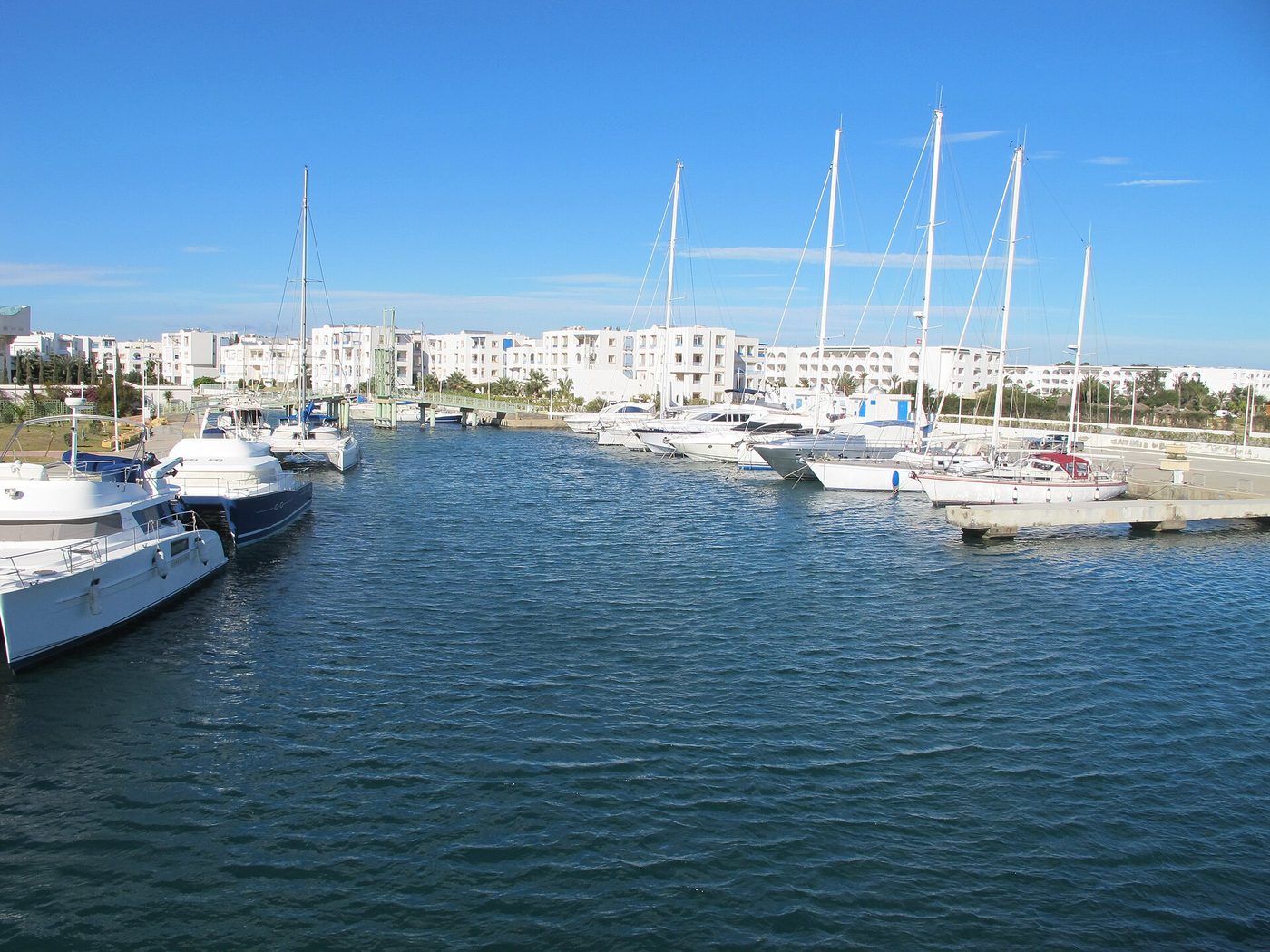
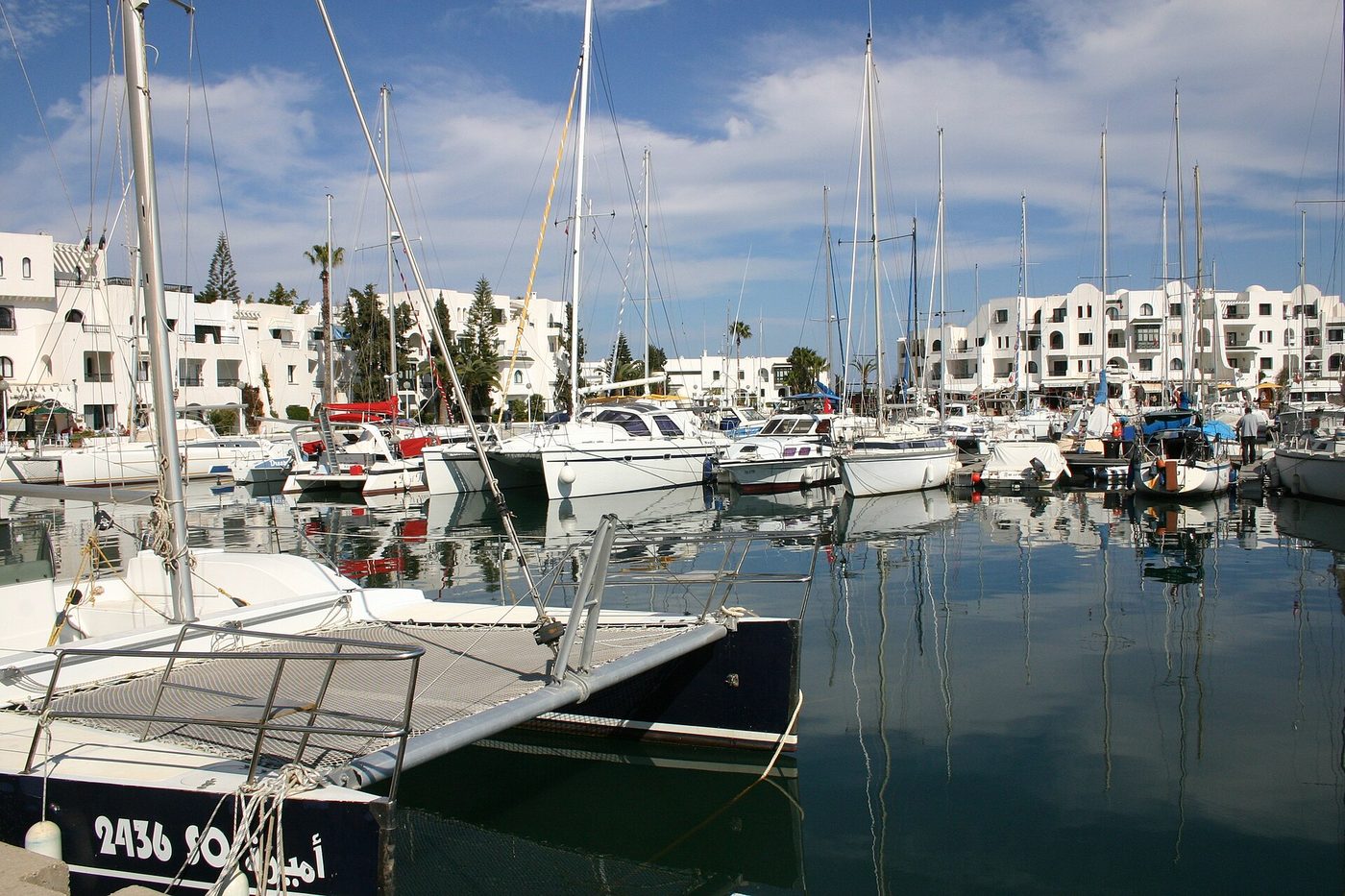
All images via Wikimedia Commons, used with thanks: Yasmine Hammamet marina © Kritzolina (CC BY-SA 4.0); Port El Kantaoui marina © Tony Hisgett (CC BY 2.0); Sousse seafront © Sermal (Public domain).