By the Tunisia Tourism Guide team · Last updated 16 June 2026 · Prices and tour details checked at publication
The first time I stood on the big dune at Douz — my first real taste of the Sahara desert Tunisia keeps tucked 300-odd kilometres south of its beach resorts — I watched the sun drop behind a horizon made entirely of sand and understood why every coach in every resort car park on the Tunisian coast has “SAHARA” chalked on a board in the windscreen. Nothing else in Tunisia — not the medinas, not the Roman cities, not even the beaches — rearranges your sense of scale quite like the desert does. I have done this trip every way it can be done: crammed into a 52-seat excursion coach from the coast, rattling south in a shared louage, and at the wheel of a small hire car that had no business being as far south as I took it. This guide is everything I wish someone had told me before the first attempt.
The Sahara desert in Tunisia begins roughly 450km south of the capital, around the oasis towns of Douz and Tozeur. You can reach it on a two-day coach excursion from Sousse or Hammamet (roughly £80–120), a 4×4 day trip from Djerba, or independently via Tozeur — with overnight desert camps, camel treks, salt lakes and Star Wars film sets along the way.
This is the pillar guide to Tunisia’s deep south: where the desert actually is, the honest verdict on the one-, two- and three-day trips, what they cost in pounds, what the overnight camps are really like, and a town-by-town tour of Douz, Tozeur, Ksar Ghilane, Matmata, Tataouine and the mountain oases. If you are weighing up whether to leave the sunbed for it — yes. But read the heat-calendar section first, because the answer changes with the month.
The Tunisian Sahara at a glance
| Place | What it is | Best for | Nearest base |
|---|---|---|---|
| Douz | The classic “gateway to the Sahara” — real dunes start at the town’s edge | Camel treks, overnight camps, the December festival | Douz itself, or 2-day tours |
| Ksar Ghilane | A hot-spring oasis on the edge of the Grand Erg Oriental sand sea | Day trips from Djerba, the swim of your life | Djerba (by 4×4) or Douz |
| Chott el Djerid | A vast salt lake — mirages, pink pools and a causeway road across the middle | The drive between Douz and Tozeur | Crossed on every 2-day tour |
| Tozeur | Oasis city: brick medina, a million-palm oasis, the comfortable base | Hotels, mountain-oasis day trips, Star Wars sets | Tozeur |
| Chebika, Tamerza & Midès | Mountain oases and canyons near the Algerian border | 4×4 half-day from Tozeur | Tozeur |
| Matmata | Berber pit-dwellings — and Luke Skywalker’s house | The route back north; troglodyte hotels | On 2-day tour routes |
| Tataouine & the ksour | Hilltop Amazigh villages and fortified granaries | Chenini, Ksar Ouled Soltane; Djerba day trips | Djerba or Tataouine town |
Where is the Sahara in Tunisia, exactly?
People picture Tunisia as a beach destination with a desert vaguely attached, but the proportions are the other way round: well over a third of the country is Saharan, and the transition is brutally quick. Drive south from the olive groves around Gabès and within an hour the land empties, the horizon flattens, and road signs start counting down to places with names out of a science-fiction film — which, as we’ll get to, is not a coincidence.
Tunisia’s slice of the desert has two distinct characters. South of Douz begins the Grand Erg Oriental, the great eastern sand sea that rolls on into Algeria — this is the postcard Sahara, ridge after ridge of golden dunes. Around Tozeur and Nefta, by contrast, the desert is stonier and stranger: palm oases pressed against bare mountains, and the immense salt flats of the Chott el Djerid shimmering in between. The two zones are joined by one of the great drives of North Africa, the causeway road across the chott, and most multi-day trips loop through both.

The practical upshot: the “Sahara” you are sold from a resort noticeboard is a long way from the coast. Douz is around 300km from Sousse and more like 450km from Hammamet; Tozeur is further still. There is no way to see real dunes from the coast in an afternoon, whatever a particularly optimistic tout might tell you. Anyone promising you the Sahara as a half-day trip from Hammamet is taking you to a beach with camels on it.
Where to start from: Djerba, Sousse, Hammamet or Tozeur?
This is the decision that actually shapes your desert trip, and it is the thing no other guide seems to spell out. Your options look completely different depending on where in Tunisia you are standing.
| Starting point | Distance to real dunes | The standard trip | Hours on the road | Typical price |
|---|---|---|---|---|
| Djerba | ~120km to Ksar Ghilane | 4×4 day trip or 2-day loop via Tataouine and Matmata | 4–6h (day trip) | ~£45–90 day trip; £95–150 overnight |
| Sousse / Port El Kantaoui / Monastir | ~300km to Douz | 2-day coach circuit (El Jem, Matmata, Douz, chott, Tozeur, Kairouan) | ~10–12h over 2 days | ~£80–110 per person |
| Hammamet / Yasmine | ~450km to Douz | Same 2-day circuit with a longer first leg | ~12–14h over 2 days | ~£85–120 per person |
| Tunis | ~480km | 2-day tours run; flying to Tozeur smarter | — | 2-day tours from ~£80 |
| Fly to Tozeur | You’re there | Base yourself 2–3 nights, day-trip by 4×4 | ~1h flight from Tunis | Flights + ~£45–110/day for tours |
| Self-drive | — | The full southern loop at your own pace | Your call | Car hire + fuel (cheap) + hotels |
From Djerba: the shortest road to the sand
Djerba is the best-kept secret in this whole equation. The island sits far enough south that a Djerba holiday puts you closer to the Grand Erg than anywhere else with a UK flight. The classic day trip crosses to the mainland and runs to the hot-spring oasis at Ksar Ghilane by 4×4 — you can be floating in warm spring water looking at dunes by late morning and back at your all-inclusive for dinner. Two-day versions add the hilltop villages around Tataouine and the pit-houses of Matmata. If your priority is maximum desert for minimum coach time, book your week in Djerba and the desert problem solves itself.
From Sousse and Hammamet: the two-day pilgrimage
From Sousse or Hammamet, the Sahara means the famous two-day excursion — the one sold in every hotel lobby. It is a genuinely long haul: the standard circuit covers around 1,000–1,200km in 48 hours, typically taking in the amphitheatre at El Jem, lunch at Matmata, the dunes at Douz, a dawn crossing of the salt lake, the Chebika–Tamerza mountain oases, and Kairouan on the way home. I have honest opinions about this trip — they are in the next section — but the short version is that it delivers an astonishing amount of Tunisia for the money, provided you go in with your eyes open about the coach hours.
From Tunis: fly or join the loop
Staying in the capital? Two-day tours run from Tunis too, but the smarter move if you can build it into your plans is the short hop to Tozeur — Tunisair Express flies from Tunis in about an hour, though only a few days a week, so book ahead. There are no direct UK flights to Tozeur-Nefta airport; the only international route currently is a seasonal Transavia service from Paris Orly.
Self-drive: the best road trip in the country
The whole southern circuit — Tozeur, the chott, Douz, Matmata, Tataouine — is on sealed roads, and I have covered every leg of it in an ordinary 2WD hire car, including the run to the oasis edge at Ksar Ghilane. You need your UK licence plus a 1968 international driving permit (buy it at the Post Office before you fly, £5.50) and a green card from your hire firm. Fuel is cheap and the driving is easy by day; the rules are different after dark, which I cover in the safety section. If a proper southern road trip appeals, our Tunisia itinerary guide has a full route with day-by-day timings.
One day, two days or three? The honest verdicts
The day trip (from Djerba only)
Verdict: the best value desert hit in Tunisia — if you are already in Djerba. Ksar Ghilane by 4×4, a swim in the hot spring, lunch under palms, an hour in the dunes, home for dinner. From around £45–55 per person in a shared vehicle it is the cheapest way to put your feet on Grand Erg sand. From anywhere north of Djerba, “Sahara day trips” do not reach the Sahara; don’t book one from Hammamet and expect dunes.
The two-day excursion (from Sousse, Hammamet or Tunis)
Verdict: worth it once, with caveats. Around £80–120 per person buys transport, a night’s hotel (or camp), most meals and a guide, across two very long days. You will doze through a lot of olive country, and the schedule is relentless — this is not a trip to do with a toddler, and several stops get 45 minutes when they deserve half a day. But for the price of a decent London dinner you cross the salt lake at sunrise, watch the sun set from a dune, and tick off three or four of North Africa’s greatest sights in one swing. Most people come home calling it the highlight of their holiday. Book it through your rep or a reputable platform rather than the cheapest tout — the difference is usually the state of the vehicle and whether the “desert camp” is actually in the desert.
Three days or more: the proper version
Verdict: this is where the Sahara actually happens. With a private 4×4 and driver — typically €150–250 per vehicle per day, quotes on request from southern operators — or three days of your own road trip, the maths changes completely. You can sleep at a remote camp deep in the erg rather than a roadside one, take the mountain oases at walking pace, detour to the ksour around Tataouine, and stop the car when the light goes golden. Two travellers sharing a private vehicle for three days will spend roughly what a fortnight’s package costs — but it is the version of the desert people write books about.
What desert tours cost in 2026 (in actual pounds)
Tunisia’s tour prices are quoted in a confusing salad of dinars, euros and dollars depending on who you book with. Here is what the market actually looks like in June 2026, converted at roughly 3.9 dinars to the pound:
| Trip | Booked online (GetYourGuide/Viator etc.) | Booked in resort / locally |
|---|---|---|
| Ksar Ghilane 4×4 day trip from Djerba | ~£45–90 | Similar; haggle for groups |
| 2-day Sahara coach tour from Sousse/Hammamet | ~£80–120 | ~£80–110 via hotel reps (TUI sells the same circuit) |
| 2-day private 4×4 versions | ~£180–260+ per person | Negotiable |
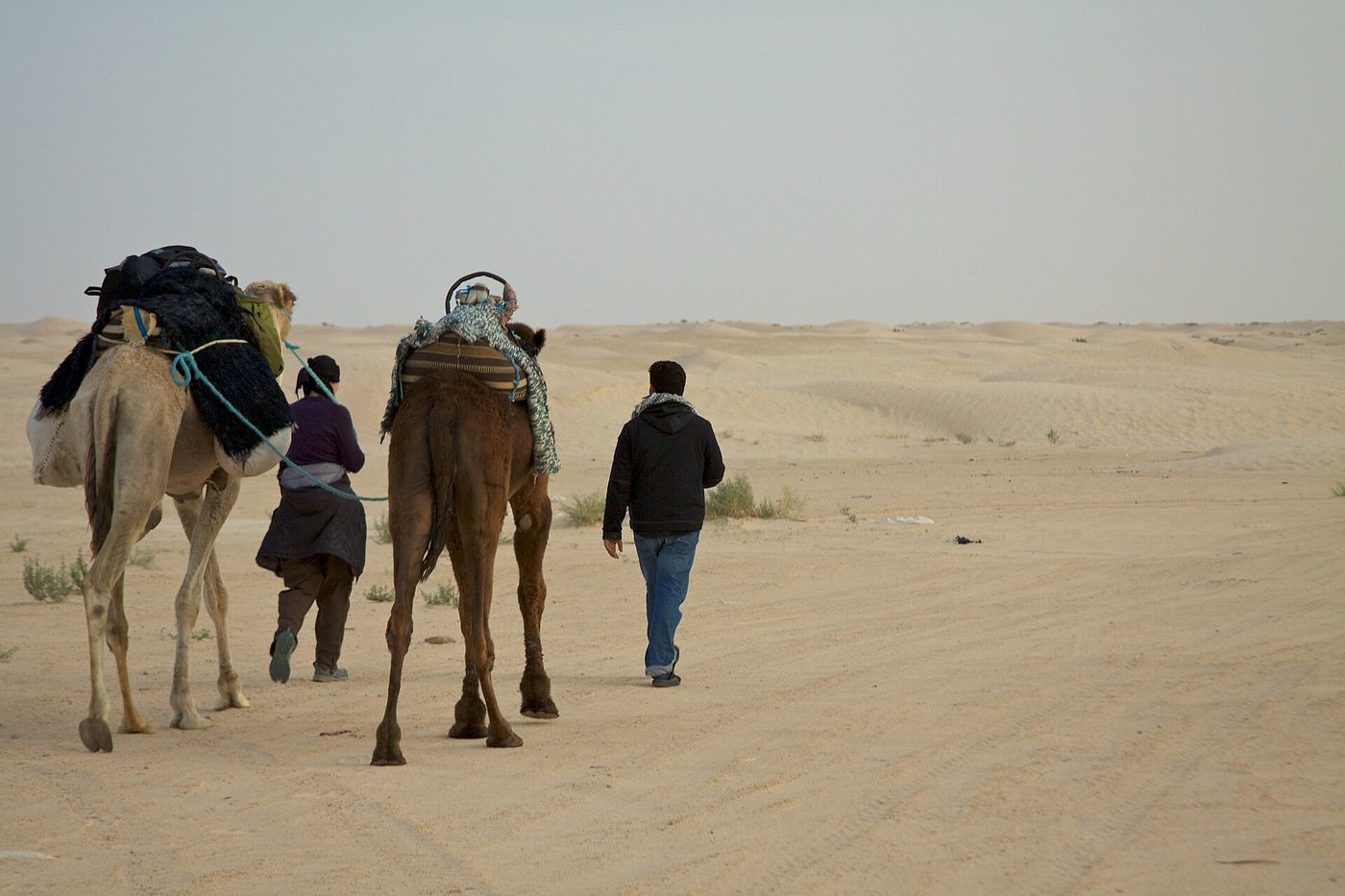
| Overnight camel trek from Douz | ~£60–110 | Less, booked at the Zone Touristique |
| Camel ride at Douz (1 hour) | — | ~30 TND (about £8) |
| Chebika–Tamerza–Midès half-day 4×4 from Tozeur | ~£45–80 | Shared seats cheaper |
| Private 4×4 + driver, multi-day | — | Typically €150–250 per vehicle per day |
Three money tips from hard experience. First, the dinar is a closed currency — you cannot buy it before you travel, so the camel man, the quad hirer and the salt-crystal stalls all need cash you withdrew in Tunisia. Second, check exactly what your tour includes: camel rides and quad sessions at Douz are usually extras paid in dinar on the spot, even on “all-inclusive” excursions. Third, if a price seems dramatically cheaper than everything else on offer, the corners being cut are usually the vehicle’s tyres or the camp’s distance from the actual desert.
The overnight desert camp, honestly
“Sleep under the Saharan stars” covers everything from a mattress in a communal nomad tent to en-suite glamping with air conditioning. Before you book, work out which one you are being sold:
Standard tour camps — the ones on the big two-day circuits — sit at the edge of the dunes near Douz or Ksar Ghilane. Expect rows of solid tents or bungalow-tents, shared toilet blocks, a buffet of couscous and grilled chicken, and a campfire with drumming. Hot showers exist but are rationed by the boiler’s mood. It is closer to a festival campsite than to wilderness, and it is still magical at 2am when you step out and the Milky Way is doing things it never does over Britain.
The comfortable oasis camps at Ksar Ghilane raise the bar: Campement Yadis has proper beds, air-conditioned tents and a pool (roughly £80–120 half board, depending on season), while Pansea at the oasis entrance is the luxury option with en-suite tents from around €150 a night. You fall asleep listening to the spring-fed stream.
The remote camps are a different species. Camp Mars, two hours’ 4×4 transfer beyond Douz at Timbaine inside the Jebil national park, puts a handful of tents in genuine sand-sea emptiness — from around €90 a night plus the transfer, and worth every step of the logistics. Out there the silence has texture.
Two warnings that apply to all of them. In summer, tents are ovens until midnight — most camps pause or adapt operations in the hottest weeks. And from November to February the desert swings the other way: nights can drop towards freezing in the open desert, and the blankets provided assume you brought layers. Pack as if for camping in a British October and you will be the smug one at breakfast.
Douz: the gateway to the Sahara

Douz is where the road runs out and the Grand Erg begins, a market town of half a million date palms with sand drifting against its southern edge. It wears the “gateway to the Sahara” label on every sign, and for once the marketing is accurate: walk past the last hotel of the Zone Touristique and the dunes simply start.
The set-piece is the Great Dune, a couple of miles from the town centre — a genuinely big ridge of soft sand that serves as Douz’s stage for camel treks, quad bikes and sunset-watching. A one-hour camel ride costs around 30 TND (about £8) arranged on the spot; sunset and sunrise treks with an overnight in a nomad camp are the upgrade I would actually spend money on. Quads are hireable by the half-hour — wear the helmet, however casually it is offered; the FCDO‘s advice on quad bikes in desert resorts is blunt: “Always wear a crash helmet.”
Time your visit for a Thursday and you get Douz’s other spectacle: the weekly souk, where the tourist stalls up front conceal a proper livestock market round the back — goats, sheep and the occasional indignant camel changing hands as they have for centuries. And if you are in Tunisia in late December, the International Festival of the Sahara brings camel racing, poetry and Bedouin horsemanship to town; the 57th edition ran 25–28 December 2025, and the 2026 dates usually land in the same late-December window (unconfirmed as I write — check before building a trip around it).
Ksar Ghilane: the hot spring in the sand sea
Ksar Ghilane is the Sahara doing fan service: a palm oasis on the very edge of the Grand Erg Oriental where a warm spring feeds a bathing pool ringed by cafés, with serious dunes rising directly behind. Swimming in spring water while looking at a sand sea is one of Tunisia’s great surreal moments, and it costs nothing — bathing is free, though buying a coffee from the café whose loungers you borrow is basic manners.
The oasis is reachable on tarmac (my poor 2WD made it to the edge of the palms), which is why it works as that day trip from Djerba. Getting beyond it — to the dunes proper and the Roman fortlet of Tisavar out in the sand — needs a 4×4, a camel or very determined legs. Stay the night at one of the camps and you get the oasis at dawn, after the day-trippers and before the heat, which is when it earns its reputation.
Chott el Djerid: the salt lake

Between Douz and Tozeur lies something I struggle to describe without sounding like I am inventing it: a salt lake bigger than some English counties — over 7,000 square kilometres by most estimates — that is bone dry most of the year, blinding white in places, rust-pink in others, and crossed dead-centre by a causeway road. The P16 between Kebili and Tozeur is entirely ordinary tarmac and entirely extraordinary everything else: heat mirages float islands above the horizon, salt crystallises in pink pools by the roadside, and stalls sell desert roses to the passing coaches.
Every two-day tour crosses the chott, usually around sunrise on day two, which is the right call — the low light turns the whole pan into coloured glass. Self-drivers: resist the urge to drive out onto the crust. It is firm right up until it very much is not, and recovering a hire car from wet salt mud is an expensive anecdote.
Tozeur: the comfortable base for the Djerid

Tozeur is the desert with a boutique hotel attached. The old quarter, Ouled el-Hadef, is built from pale handmade bricks laid in raised geometric patterns — a medina that looks knitted rather than built — and the town sits against a palmeraie of hundreds of thousands of date palms producing the deglet nour dates Tunisians treat as a food group. After the dust of Douz, Tozeur’s café terraces and calèche rides feel positively metropolitan.
It is also the only place in the deep south with a proper spread of hotels, from simple dars in the old town to the Mora Sahara Tozeur (the former Anantara, rebranded in late 2025), whose pool terraces stare straight out at the desert from around £200 a night. Our where to stay in Tunisia guide covers the trade-offs region by region.
Around town: Chak Wak, a gloriously eccentric theme park telling the history of the world (dinosaurs included) for around 12 TND; Eden Palm, a date-palm estate doing tours and tastings for a few dinars; and the Dar Cherait museum, a palace-style collection of costumes and interiors. The palmeraie itself is best by hired bicycle in the early morning, when the irrigation channels are running and the light comes through the fronds in bars.
The mountain oases: Chebika, Tamerza and Midès

An hour northwest of Tozeur, the Atlas mountains stagger to a halt against the desert in a line of canyons, and in their folds hide three villages that account for half the postcards sold in Tunisia. Chebika is the crowd-pleaser: a spring-fed palm gorge below an abandoned stone village, with a short walk to a waterfall pool. Tamerza has the grandest canyon and its own cascades. Midès, pressed against the Algerian border, has the most dramatic gorge of the lot — a slot canyon that featured in The English Patient — and the fewest coaches.

Be realistic about the waterfalls: they flow year-round but can be a trickle by late summer, and the busiest hours bring a conga line of tour groups through Chebika’s gorge. Go first thing on a half-day 4×4 from Tozeur (£45–80 booked online, less for shared seats) and you will have the canyons close to yourself. All three villages sit comfortably outside the FCDO’s restricted border zones — more on that below, because the geography matters down here.
Star Wars in the Sahara: Tatooine is real

George Lucas borrowed more than scenery from southern Tunisia — he borrowed the name. Tatooine is Tataouine with the vowels rearranged, and the deep south is scattered with surviving sets and locations that you can walk into for free, mostly because nobody has ever got around to fencing them.
Mos Espa, the largest surviving set, stands in the desert near Ong Jemal about 30 minutes from Nefta: twenty-odd domed buildings from The Phantom Menace (reused for Attack of the Clones), complete with moisture-vaporator props and, these days, trinket sellers who materialise out of apparently empty desert. There is no ticket — you just drive up, the last stretch on hard-packed sand. The dunes are slowly advancing on the set, which adds a certain end-of-empire poignancy to the visit.

Out on the crust of the Chott el Djerid stands the loneliest building in cinema: the Lars homestead igloo, Luke Skywalker’s childhood home from the original 1977 film, rebuilt for Attack of the Clones and rescued from collapse in 2012 by a crowdfunded fan restoration. It is still standing, weathered and improbable, a white dome on an infinite white plain. Hotel Sidi Driss in Matmata — the sunken courtyard that played the homestead’s interior — is covered in the next section, and the slave-quarters streetscapes of The Phantom Menace survive in the ksour near Tataouine, principally at Ksar Hadada and in the courtyards of Ksar Ouled Soltane.
Tour-wise, the Tozeur-side sites (Mos Espa, Ong Jemal, the igloo) bundle naturally with the mountain-oases circuit, while the Tataouine-side ksour pair with day trips from Djerba. A dedicated pillar guide to every Tunisian filming location is coming to this site soon.
Matmata: the underground town

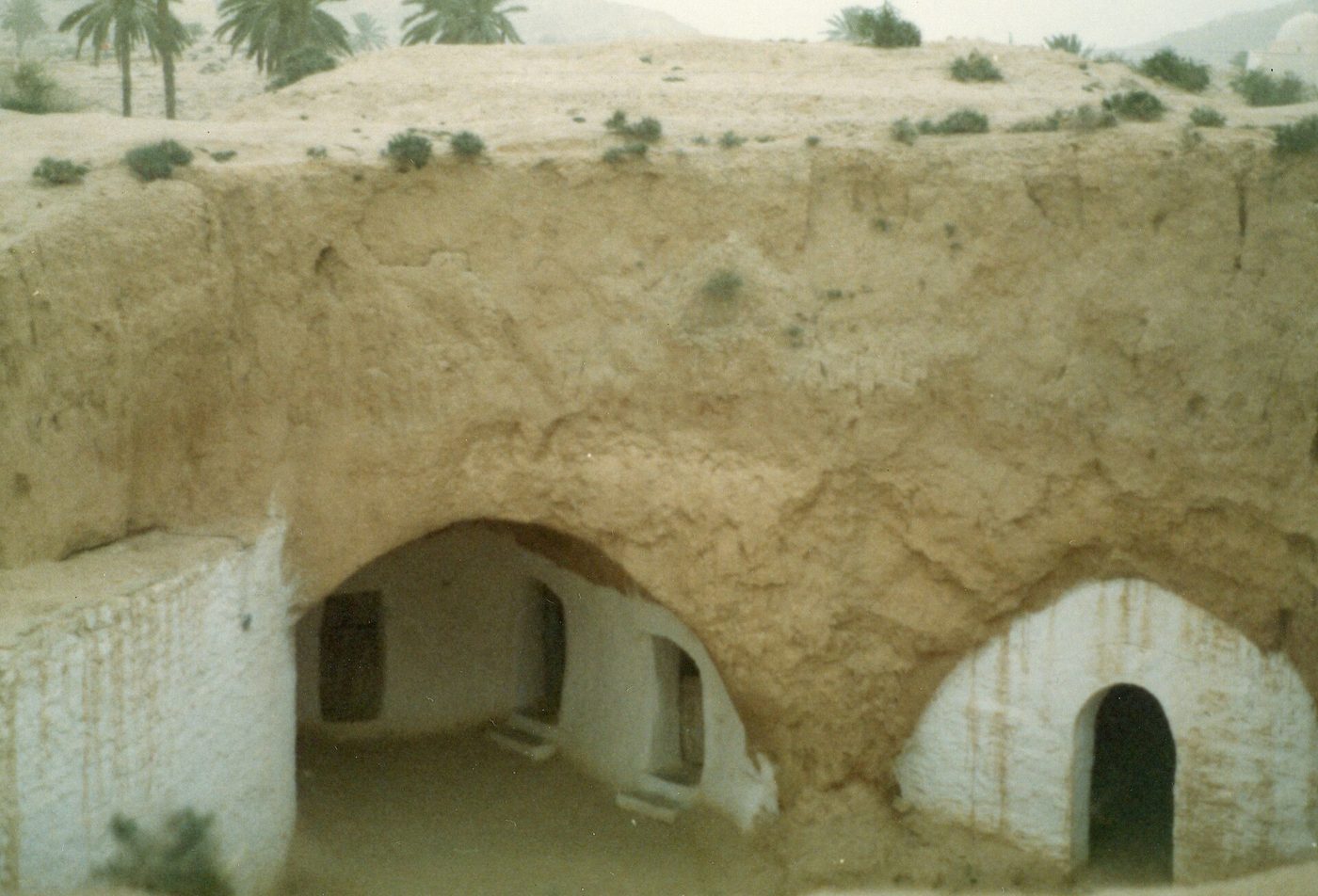
Matmata solves the problem of desert heat by refusing to live on the surface. For centuries its Amazigh inhabitants have dug their homes straight down — a sunken courtyard open to the sky, with cave rooms tunnelled off it — and the hills around town are pocked with hundreds of these craters (around 1,200 by some counts). Several families open their homes to visitors for a small tip, and the experience is genuinely hospitable rather than human-zoo awkward, especially if you arrive before the coach wave around late morning.
The famous one is Hotel Sidi Driss, where the Lars homestead interiors were filmed in 1976 and redressed in 2000 — still a functioning (basic) hotel, where you can eat couscous in the very courtyard where Luke moped about power converters. Ten kilometres west, the stone village of Tamezret climbs a hilltop with a café terrace looking back over the whole moonscape; it makes the perfect pause on the lovely sealed road that continues to Douz across the edge of the Dahar plateau. Watch for sand drifting across the carriageway out there — the FCDO specifically warns drivers to “be careful when approaching sand drifts on roads”, and they appear with no warning at all.
Tataouine and the ksour: granaries like sandcastles

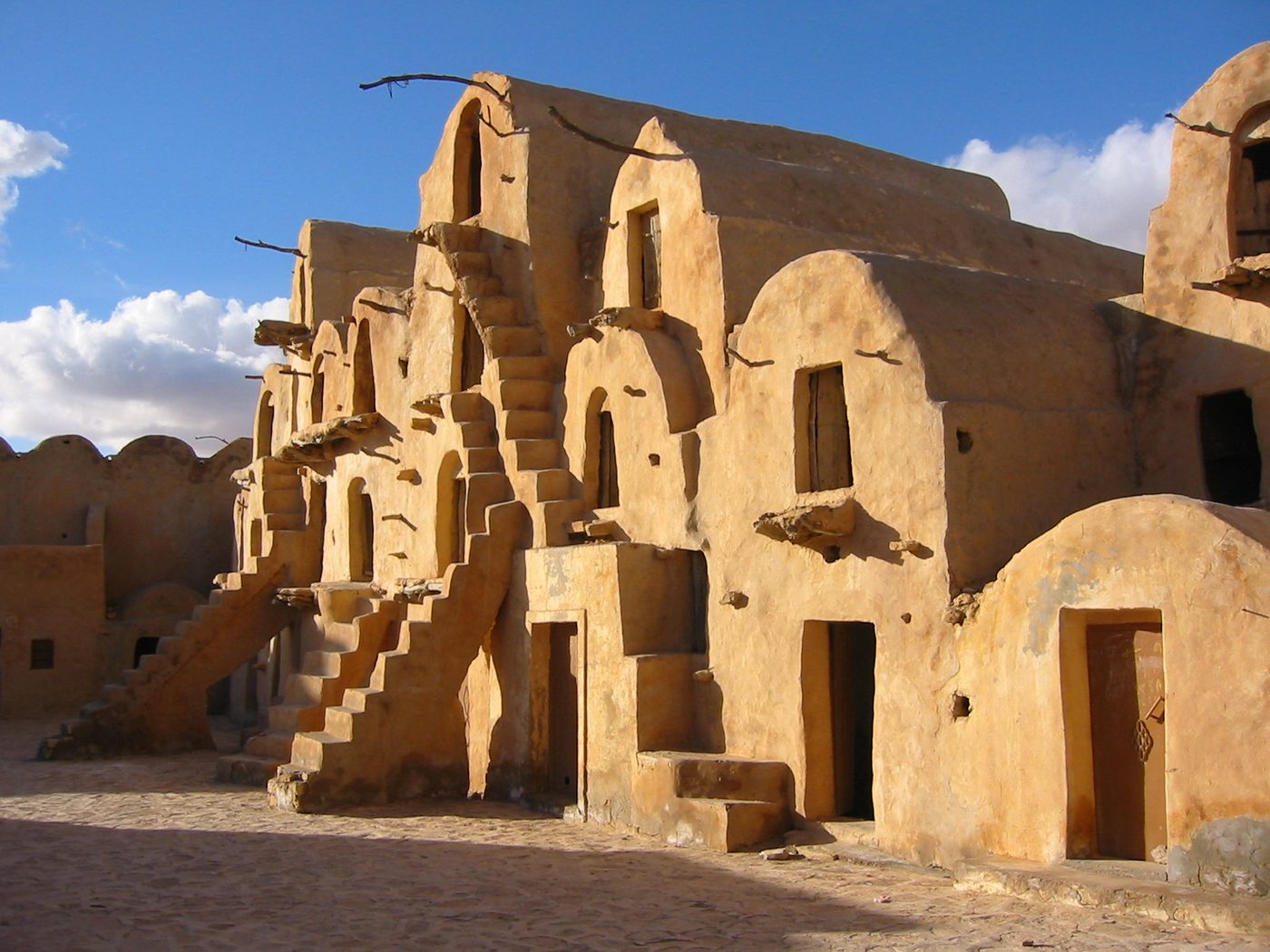
Tataouine town is a workaday market hub (souks on Monday and Thursday, famous for honey-soaked corne de gazelle pastries), but the country around it holds the most arresting architecture in Tunisia: the ksour, fortified communal granaries built of stacked barrel-vaulted cells called ghorfas, rising three and four storeys around courtyards like terracotta honeycomb.
Ksar Ouled Soltane is the masterpiece — four storeys of ghorfas around two courtyards, still used for village festivals. There is no ticket office; a local custodian will usually appear, and 5–10 TND is a fair tip for the tour. Ksar Hadada, half an hour north, is the one whose lanes actually appear on film in The Phantom Menace. The hilltop villages complete the picture: Chenini, a crumbling crest of stone houses around a whitewashed mosque, still partly inhabited, and quieter Douiret across the valley. All of them sit well outside the FCDO’s restricted border areas — Tataouine town is roughly 100km from the Libyan frontier.

The Lézard Rouge: the desert by train
One for the romantics: the Lézard Rouge, a beylical-era train of 1910s salon cars, returned to service in May 2025 after years of suspension and a full restoration. It runs from Metlaoui through the Selja Gorge — ochre cliffs, tunnels, a river of pink oleander — on a roughly 1h45 round trip, currently scheduled six days a week (no Saturdays), morning departures, for around 20–25 TND. The caveat earned by its history: this service has stopped and started more times than I can count, so confirm it is running with SNCFT before you build a day around Metlaoui. When it runs, it is the best £6 in Tunisia.
When to go: the heat calendar nobody shows you
Here is the awkward truth for British visitors: the Sahara is at its worst exactly when UK schools break up. These are Tozeur’s average daytime highs — and note that in July and August, days topping 40°C are routine, not exceptional:
| Month | Avg high | Desert verdict |
|---|---|---|
| January | 16°C | Glorious days, cold nights — pack proper layers for camps |
| February | 19°C | Excellent; almond blossom in the oases |
| March | 22°C | Excellent, though spring brings the strongest sand-laden winds |
| April | 26°C | The sweet spot: warm dunes, mild nights |
| May | 31°C | Hot but workable with early starts |
| June | 36°C | Marginal — dawn and dusk only |
| July | 39°C | Brutal; tours run with adapted timings |
| August | 39°C | Brutal; the camel is suffering politely and so are you |
| September | 34°C | Easing; fine by month’s end |
| October | 28°C | Excellent — my favourite month down south |
| November | 22°C | Excellent; nights turning cold |
| December | 17°C | Lovely days, near-freezing camp nights; festival season at Douz |
October to April is the desert season. If you are on a summer beach holiday, the two-day trips still run — operators shift the dune time to sunset and sunrise — and thousands do them every August without melting. But if you have any flexibility at all, an autumn or spring holiday transforms the desert from an endurance event into pure pleasure. Our month-by-month guide to visiting Tunisia weighs this against beach weather, which conveniently peaks at different times.
What to pack for the desert
Whatever the season: a scarf or shemagh (sun, wind and the occasional face-full of sand), real sunglasses, factor 50, lip balm, closed shoes for the dunes (sand at 45°C ends flip-flop ambitions instantly), a refillable bottle and a head torch for the camp toilets at 3am. Add for winter: a proper fleece, a warm hat and a pair of socks you would trust in Scotland — that near-freezing night air is not a rumour. Add for summer: electrolyte sachets and the humility to nap through the midday hours like everyone else. A power bank matters more than you think; camp electricity is generator-hours only. And carry small dinar notes — every camel, quad, tip and glass of palm-shade tea is a cash transaction out here.
Is the Tunisian Sahara safe?
The honest answer: the tourist south is fine, the borders are not, and the geography between the two is wider than the headlines suggest. The standard circuit — Douz, Tozeur, Nefta, the chott, Ksar Ghilane, Matmata, Tataouine town and the ksour, plus the mountain oases — sits outside every restricted zone, and the thousands of excursion coaches that loop through it weekly do so without incident.
The restrictions that do exist are specific. As of the FCDO’s advice (updated 23 February 2026, still current as I write on 10 June 2026), the FCDO advises against all travel to “the militarised zone south of the towns of El Borma and Dhehiba”, “within 20km of the rest of the Tunisia-Libya border area north of Dhehiba” and “the town of Ben Guerdane and immediate surrounding area”; and against all but essential travel “to within 75km of the Tunisia-Libya border, including Remada and El Borma but excluding Zarzis, the C118 road and all areas in Medenine Governorate north of the road”. None of the places in this guide fall inside those lines. Reputable operators know exactly where the lines are, which is one more argument for booking with one; always check the FCDO’s Tunisia advice yourself before you travel, and see our full Tunisia safety guide for the country-wide picture.
The risks that will actually concern you are environmental. Heat is the big one — follow the camp staff’s lead on shade hours, and treat headache-plus-no-sweat as the emergency it is (TravelHealthPro’s extreme-heat guidance is worth five minutes before you go). Scorpions are real but overwhelmingly a rural-local problem rather than a tourist one; the camp ritual of shaking out your shoes in the morning is genuinely all the precaution most visitors ever need. And if you are self-driving, do not drive the southern roads at night — in the FCDO’s words, “driving at night can be hazardous outside towns, due to unlit roads, vehicles without lights and livestock on the road” — and fill the tank at the last big towns (Douz, Kebili, Tozeur, Tataouine); as the FCDO drily advises, “check the availability of petrol stations with local drivers before travelling long distances in remote areas”. There is no pump at Ksar Ghilane.
Frequently asked questions
Is the Sahara desert Tunisia’s best experience?
For most visitors, yes — it is the single most memorable thing they do in the country, and Tunisia is one of the cheapest and easiest places on earth to experience real Saharan dunes. Even the whistle-stop two-day coach version consistently tops people’s holiday highlights, and it costs less than a theme-park day out at home.
How far is the Sahara from Hammamet, Sousse and Djerba?
Real dunes are roughly 450km from Hammamet and 300km from Sousse — hence the two-day excursion format — while Djerba sits only about 120km from the sand sea at Ksar Ghilane, close enough for a 4×4 day trip. There is no genuine Sahara within day-trip range of the northern beach resorts.
Is the 2-day Sahara trip from Sousse or Hammamet worth it?
Yes, once, if you go in expecting 10–14 hours of total coach time across the two days. You trade comfort for an absurd density of sights: El Jem, Matmata, the Douz dunes, a sunrise salt-lake crossing and the mountain oases, for around £80–120 all-in. Skip it with very young children.
Do you actually sleep in the desert? What are the camps like?
On overnight tours, yes — typically at a fixed camp on the dune edge near Douz or Ksar Ghilane, with proper tents, shared bathrooms, dinner and a campfire. It is comfortable rather than wild; pay for a remote camp like Camp Mars if you want true sand-sea solitude.
Is the desert cold at night?
In winter, genuinely cold — desert nights from November to February can drop towards freezing, and underestimating this is the most common mistake British visitors make. Pack a fleece and warm layers for any camp stay outside high summer.
When is it too hot for the Sahara?
July and August are brutal, with Tozeur and Douz routinely topping 40°C; tours still run but compress activity into dawn and dusk. October to April is the proper desert season, with April and October the sweet spots.
Can you visit the Star Wars film sets?
Yes, and mostly for free: the Mos Espa set near Tozeur, the Lars homestead igloo on the salt lake, Hotel Sidi Driss in Matmata (the homestead interior) and the ksour around Tataouine are all open and unfenced. Tozeur-based tours bundle the western sites; Djerba trips reach the Tataouine side.
Douz or Tozeur — which is better?
Douz for dunes, camels and the rawer desert feel; Tozeur for comfort, the brick medina, the palmeraie and the mountain-oasis and Star Wars day trips. They are 125km apart across the salt lake, and the classic southern loop simply does both — as does every two-day tour.
How much money should I bring for extras?
On a standard two-day tour, 100–150 TND per person in cash (about £25–40) comfortably covers a camel ride, a quad session, photo stops, teas and tips. Remember the dinar can only be obtained inside Tunisia, and card machines do not exist where you are going.
Final thoughts
Tunisia gets filed under “beach holiday” so reflexively that the Sahara still feels like a secret hiding in plain sight — a genuine sand-sea desert, with hot springs and film sets and underground towns, two days and a hundred quid from your sunlounger. Plenty of things to do in Tunisia are lovely. The desert is the one that follows you home. Whether you give it 24 hours from Djerba or a week behind the wheel, give it something: standing on a dune at sunset, listening to nothing at all, is worth more than another day even on Tunisia’s best beaches — and I say that as someone who ranked all seventeen of them.
The Sahara and the south: our detailed guides
- Sahara tours from Djerba: 1, 2 & 3-day options
- The 2-day Sahara trip from Sousse & Hammamet
- Douz: the gate of the Sahara
- Ksar Ghilane: the oasis at the edge of the erg
- Tozeur: things to do in the oasis city
- Chott el Jerid: crossing Tunisia’s great salt lake
- Chebika, Tamerza & Mides: the mountain oases
Deeper into the south: more guides
- Matmata: the underground houses, and how to visit well
- Tataouine & the ksour: Chenini, Douiret & the granaries
- Camel trekking & desert camps: a night in the Sahara
Photo credits
All images via Wikimedia Commons: Dennis G. Jarvis (CC BY-SA 2.0); Jérôme Prax (CC0); Gorik Francois (CC BY-SA 2.0); Habib M’henni (CC BY-SA 4.0); Stefan Krasowski (CC BY 2.0); Bernard Gagnon (CC BY-SA 3.0); Tsaag Valren (CC BY-SA 4.0); Jerzy Strzelecki (CC BY 3.0); Aymentahar1 (CC BY-SA 4.0); Andy Carvin (CC BY-SA 2.5); Simunaire (CC BY-SA 4.0).
Before you head south, read getting around Tunisia for the louage-versus-hire-car question, and our travel tips for cash, coverage and desert-season packing.