By the Tunisia Tourism Guide team · Advice checked 2 July 2026 · FCDO advice last updated 23 February 2026, re-checked word for word 2 July 2026 (unchanged) · We don’t sell tours or take hotel commissions, and we re-read this page whenever a government advisory changes.
Search “tunisia travel advice” and you get a wall of government pages, each written for one nationality, each split across half a dozen bureaucratic sub-pages, and none of them willing to tell you the one thing you actually want to know: what does this mean for my week in Sousse? So that’s the job here.
Here’s the short version of the Tunisia travel advice, as it stands on 2 July 2026. No Western government advises against travel to the tourist coast, Tunis, Djerba or the established desert circuit. The FCDO and the US State Department both flag Tunisia, but their restrictions apply to specific, remote border and mountain zones — every one of them a long drive from any hotel you’d book. The warnings are real; they are also geographically precise. Below, I quote the official wording exactly, date-stamp it, and translate it into what it means for your trip.
This is a companion to our full guide to whether Tunisia is safe, which walks through the country’s recent history, the resort-by-resort picture and the day-to-day risks in much more depth. This page does one thing and does it thoroughly: it decodes the official FCDO Tunisia advice and the US guidance, side by side, and tells you what to do with it. If you only ever read the government pages, you’ll come away either needlessly frightened or none the wiser. Read this first.
One promise before we start: I am not going to be dismissive of the official advice, the way some travel blogs are. The FCDO exists to give you the sober version, and on a safety topic that’s exactly what you want. What I will do is put its wording in plain English and tell you honestly how far the red zones sit from the green ones.

What the FCDO says about Tunisia (and when it was last updated)
Most articles paraphrase the Foreign, Commonwealth and Development Office until the meaning quietly disappears. I’m going to do the opposite and give you the real thing, straight from gov.uk’s Tunisia travel advice.
The critical detail on any safety page is the date, so here it is up front. As we checked it on 2 July 2026, the gov.uk Tunisia page read “Still current at: 2 July 2026” and “Updated: 23 February 2026”. The most recent change note was the “Removal of information about temporary safety measures following severe storm” — in other words, a weather clean-up, not a new security warning. That is genuinely reassuring: the substantive zone advice has not moved since February.
The headline banner on the page is one sentence: “FCDO (Foreign, Commonwealth and Development Office) advises against all travel to parts of Tunisia.” The operative words are parts of. It does not say Tunisia; it says parts of Tunisia, and it then defines those parts precisely. Two categories follow — “all travel” and “all but essential travel” — and I’ll quote each one in full, because the exact wording is the whole point of this page.
Areas where the FCDO advises against all travel
These are the strictest restrictions: remote border strips and designated military zones. Quoted verbatim from gov.uk (still current at 2 July 2026; last updated 23 February 2026):
Western Tunisia, including the Tunisia-Algeria border — FCDO advises against all travel to:
- the Chaambi Mountains National Park
- the designated military operations zones: Mount Salloum; Mount Sammamma; Mount Mghila
Southern Tunisia, including the Tunisia-Libya border — FCDO advises against all travel to:
- the militarised zone south of the towns of El Borma and Dhehiba
- within 20km of the rest of the Tunisia-Libya border area north of Dhehiba
- the town of Ben Guerdane and immediate surrounding area
The FCDO gives its reasons plainly: on the Algerian side, “cross-border terrorist activity and operations by the Tunisian security forces”; on the Libyan side, “cross-border terrorist activity and fighting in Libya.” Look at that list again and notice what it is: a national park high in the western mountains, three named peaks, a militarised strip in the deep south, and a single border town. There is not a beach resort, a Roman site on any normal itinerary, or a city on it anywhere.
Areas where the FCDO advises against all but essential travel
The second, slightly softer category adds a wider buffer around the same borders and mountains. Again, quoted verbatim from gov.uk (still current at 2 July 2026; last updated 23 February 2026):
In addition, FCDO advises against all but essential travel to:
- areas north and west of the town of Ghardimaou in Jendouba Governorate, including El Feidja National Park
- within 20km of the Tunisia-Algeria border in El Kef and Jendouba governorates, south of the town of Jendouba
- Kasserine Governorate, including the town of Sbeitla
- within 10km of the rest of the Tunisia-Algeria border south of Kasserine Governorate
- within 10km of Mount Mghila
- Mount Orbata
In addition, FCDO advises against all but essential travel to within 75km of the Tunisia-Libya border, including Remada and El Borma but excluding Zarzis, the C118 road and all areas in Medenine Governorate north of the road.
Two footnotes for accuracy. First, the FCDO’s separate Regional risks page (updated 29 April 2026) adds a little more detail to the El Kef and Jendouba line, noting the 20km strip includes “the archaeological site of Chemtou” and describing a “heightened Tunisian security presence at the border with Algeria.” Second, one line in that list deserves a full stop and your attention: Kasserine Governorate, including the town of Sbeitla. Sbeitla has a magnificent set of Roman ruins — and it sits inside the essential-travel-only zone. That is exactly why you will never find Sbeitla in our guide to the best Roman ruins in Tunisia, and why you should be wary of any tour that tries to sell you Sbeitla or a route through Kasserine. It is an area to avoid, not a destination. Treat it that way.
The Zarzis, C118 and Medenine carve-out — the bit most guides miss
Read that last quoted clause a second time, because it is the single most useful sentence in the whole advisory for anyone heading south, and almost nobody explains it: “within 75km of the Tunisia-Libya border… but excluding Zarzis, the C118 road and all areas in Medenine Governorate north of the road.”
In plain English: the FCDO has drawn a 75km buffer inland from the Libyan border, and then deliberately cut a hole in it. Zarzis, the C118 road, and everywhere in Medenine Governorate north of that road are explicitly carved out of the restriction. That is the FCDO formally confirming that the island of Djerba and its neighbouring stretch of coast are outside the zone it warns about. If you are booking a Djerba package or a Zarzis beach hotel, this clause is your green light in black and white — and it is worth screenshotting the gov.uk page the week you fly, so you have the current wording to hand.
What “advises against travel” actually means for you
The phrases “all travel” and “all but essential travel” are not just bureaucratic gradations. They have real consequences for your insurance and, if you’re on a package, your refund rights. Here is what each one actually does.
The difference between “all travel” and “all but essential travel”
“Advises against all travel” is the FCDO’s strongest warning short of telling British nationals to leave: don’t go there for any reason. “Advises against all but essential travel” is a notch down — it accepts that some people have a genuine, unavoidable need to be there (work, family emergencies), while making clear that a holiday is not an essential reason. For a tourist the practical effect is identical: both mean “this is not a place you visit on holiday.” The only reason the distinction matters to you is that it draws the map of where your travel insurance may stop working — which is the next, and most important, point.
How this affects your travel insurance
This is the line that actually costs people money, so here it is straight from gov.uk, verbatim: “Your travel insurance could be invalidated if you travel against advice from the Foreign, Commonwealth & Development Office (FCDO).”
Translate that into the real world. If you deliberately drive into one of the restricted zones above — the border strips, the Kasserine mountains, the deep desert south of Remada — a standard travel-insurance policy can treat your whole trip as travel against FCDO advice and decline to pay out, including for something unrelated like a broken ankle at the pool. The zones are not a polite suggestion; they are effectively a condition of your cover. The flip side is the reassuring part: because every mainstream resort, city and desert-circuit town sits outside those zones, a normal Tunisia holiday does not trip this wire at all. You are covered as usual for Hammamet, Sousse, Djerba, Tunis and Tozeur, precisely because the FCDO does not advise against travel to any of them. As a rule of thumb from the consumer comparison sites: if an “advises against” warning was already in place for your destination when you bought the policy, you’re not covered for it; if the FCDO changes its advice after you buy, you’re usually covered. Always confirm the specifics with your own insurer — policies differ, and this is general guidance, not a ruling on your particular cover.
Package holidays and your refund rights
If you booked a package — flights and hotel together through a UK operator — you have a separate and genuinely useful layer of protection that stands apart from your insurance. Under the Package Travel and Linked Travel Arrangements Regulations 2018, if the FCDO starts advising against travel to your destination (or its immediate vicinity) after you book and before you travel, you can postpone or cancel and get a full refund. In practice that means if, hypothetically, the advice for a resort area changed between your booking and your flight, you would not be stuck: an ATOL-protected package gives you the right to your money back rather than a fight with an insurer. This is why booking a package rather than piecing a trip together yourself carries a quiet safety benefit for a destination like this. As ever, confirm the detail with your operator and check the ABTA and ATOL small print — but know that the right exists, because most travel blogs never mention it.
Tunisia areas to avoid — mapped to where you’re actually going
Now let’s put the two maps side by side: the FCDO’s red zones, and the places you’d realistically book. The pattern is stark. Every restricted zone is a border strip or an inland mountain range. Every resort and city is on the coast or the established desert loop, a long way from any of them. Here is the honest distance picture, resort by resort.
| Where you’re going | Nearest FCDO restricted zone | The honest picture |
|---|---|---|
| The resort town of Hammamet & Yasmine Hammamet | Kasserine Governorate, roughly 200km / 3–4 hours inland | Well clear. The flagship UK package resort; nothing restricted is remotely near it. |
| Sousse and Port El Kantaoui | Kasserine Governorate, roughly 3 hours’ drive inland | Well clear. No excursion route goes anywhere near the restricted interior. |
| Monastir, Skanes & Mahdia | Kasserine Governorate, further still than Sousse | Well clear. Quiet, family-weighted coast with no restriction anywhere close. |
| Djerba & Zarzis | Explicitly excluded from the 75km Libya buffer by name | Formally carved out by the FCDO. As inside the green zone as it gets. |
| The capital, Tunis, Carthage & Sidi Bou Said | Algeria-border restrictions, well over 150km west | Well clear. About as close to the border zones as London is to Cardiff. |
| Kairouan | Kasserine Governorate to its west | Clear. The holy city sits outside every zone; standard routes don’t touch Kasserine. |
| Tozeur & Douz (the Sahara circuit) | Mount Orbata / the deep desert south of Remada | Clear on the established loop. The classic tour threads comfortably outside every line. |
The single most important row is the one that isn’t there: Sbeitla and Kasserine. They are areas to avoid, not places to visit. Do not route through Kasserine Governorate, and be sceptical of any operator offering Sbeitla’s ruins as a day trip — the ruins are real and impressive, but they sit inside the essential-travel-only zone, and going there can void your insurance for the entire holiday. Everywhere you’d genuinely want to be is on the coast or the supervised desert circuit, and every one of those places is outside the FCDO’s lines. For the fuller resort-by-resort breakdown, including the security you’ll actually see on the ground, see our Tunisia safety guide; and for Sousse specifically — the resort people ask about most because of 2015 — we’ve a dedicated answer to is Sousse safe to visit.

What the US State Department says (and why it’s different)
UK readers often stumble across the American advice and panic, because it uses different words and different distances. So let’s decode it. The US State Department places Tunisia at Level 2: Exercise Increased Caution, on a travel advisory dated 23 October 2024 (reissued to update its high-risk-area information). Worth knowing: Level 2 is the same tier the US assigns to France, Spain and Italy. It is the middle of a four-step scale, not a red alert.
The country summary reads: “Exercise increased caution in Tunisia due to terrorism. Some areas have increased risk.” Those “some areas” are the US Level 4 “Do Not Travel” sub-zones, and they map almost exactly onto the FCDO’s. Quoted from travel.state.gov, the US says do not travel to areas “within 16 km of the Algerian border due to terrorism, except for the cities of Tabarka and Ain Draham”; “within 16 km of the border with Libya”; “Mount Chaambi National Park, Mount Salloum, Mount Sammamma, and Mount Mghila in Kasserine governorate”; “the Mount Orbata area in the Gafsa governorate”; and “the desert south of Remada.”
Two differences are worth understanding. First, the thresholds: the US uses a flat 16km buffer along both borders, where the FCDO uses layered 10km, 20km and 75km zones depending on the stretch. That’s not one government being braver than the other — it’s just two different ways of drawing the same caution, each reflecting its own risk appetite. Second, the freshness: the live US page as we fetched it is dated October 2024, which makes it older than the FCDO’s February 2026 update. If you want the most current official read on Tunisia, the UK page is the fresher of the two — though some third-party trackers claim a later US reissue, so re-check the date on travel.state.gov yourself. The US Embassy in Tunis is on +216 71-107-000.
What other governments say — EU, Ireland, Australia and Canada
It’s worth a quick tour of the other major advisories, because they all agree on the geography while phrasing things their own way — and seeing them line up should settle any lingering worry that “one country knows something the others don’t.” Nobody advises against the resorts, the capital, Djerba or the classic Sahara loop.
| Government | Headline level | Border rule & named exceptions |
|---|---|---|
| UK (FCDO) | “Advises against all travel to parts of Tunisia” (the named zones only) | Layered 10 / 20 / 75km zones; carves out Zarzis, the C118 and Medenine north of the road |
| USA (State Dept) | Level 2: Exercise Increased Caution | Flat 16km border buffer; excepts Tabarka & Ain Draham |
| Canada | Exercise a high degree of caution (countrywide, due to terrorism) | Avoid within 20km of the Algerian border and Kasserine governorate; excepts named tourist towns |
| Australia (Smartraveller) | Exercise a high degree of caution (overall, due to terrorism) | “Do not travel” within 20km of the Algerian border except the P7 highway and Ain Draham, Tamerza, Mides, Chebika, Tabarka |
| Ireland (DFA) | Exercise a high degree of caution | Risk of further attacks remains; avoid the border areas |
Notice how Canada and Australia go out of their way to name safe towns — Tabarka, Ain Draham, Tamerza, Mides, Chebika — right next to the border restrictions. That’s a helpful signal in its own right: these are places close enough to the frontier to need a mention, and the official advice is that they’re fine to visit. There is no single EU-wide advisory; each member state publishes its own through its national foreign ministry, and they align broadly with the picture above. The takeaway is simple: five governments, five slightly different vocabularies, one shared conclusion — avoid the borders and the western mountains, and the rest of Tunisia is open for a normal holiday. If you’re still weighing the country up at all, our honest verdict on whether Tunisia is worth visiting tackles the value-versus-rough-edges question head on.
The terrorism threat, in honest context
You can’t responsibly write about Tunisia travel advice without addressing terrorism directly, so let’s do it soberly — neither glossing over it nor letting it define the country a decade on. The FCDO’s safety and security page (updated 23 February 2026) states it plainly: “Terrorists are likely to try to carry out attacks in Tunisia.” It lists the higher-risk locations as religious sites, tourist sites and festivals, government buildings, public transport, businesses with western interests, and areas where foreign nationals and tourists gather, or any crowded area. Worth knowing for perspective: the FCDO applies near-identical “likely to try to carry out attacks” wording to France and Spain.
The honest history behind that warning is 2015. In March that year, the FCDO records that “in March 2015, 21 tourists were killed, including a British national, in a terrorist attack at the Bardo Museum in the centre of Tunis”; and that June, “in June 2015, 38 foreign tourists were killed, including 30 British nationals, in a terrorist attack at Port El Kantaoui near Sousse.” That day near Sousse was the largest loss of British life to terrorism since the 2005 London bombings, and plenty of people googling Tunisia’s safety are really asking about it. It would be wrong to skate over that. The most recent incident the FCDO notes is the 2023 attack at the El Ghriba synagogue on Djerba, in which “3 security personnel and 2 civilians” were killed and 10 injured.
What changed after 2015 is the part that rarely gets told. The FCDO records that “a formal state of emergency has been in place since a terrorist attack against a police bus took place in 2015” — and behind that formal wording sits a decade of concrete change: armed tourist police deployed along the coast for the first time, hotel entrance screening and perimeter security as standard, scanners at airports and major sites, and armed patrols on the resort beaches. Since 2015 the targets have overwhelmingly been the security forces themselves rather than tourists, and the last attack to affect visitors was over three years ago — a period spanning tens of millions of visits. The threat is real enough that every Western government mentions it; it is also contextual enough that the same governments file Tunisia in their middle tiers alongside major European destinations. Both halves of that are true, and you deserve both. The fuller, soberly-told history — the timeline, the security rebuild, the resort-by-resort reality — is in our main Tunisia safety guide.
Everyday safety — crime, harassment, demonstrations and scams
Terrorism dominates the headlines, but it is statistically the least likely thing to affect your holiday. The FCDO’s crime section opens with a sentence worth keeping in mind: “The majority of visits to Tunisia are unaffected by crime. The most common crime experienced is theft.” Think phones lifted in medina crowds, bags off beach loungers, the occasional distraction trick in tourist zones. A crossbody bag, a zipped pocket and the hotel safe for your passport neutralise nearly all of it.
A few other realities the FCDO flags, quoted where the wording matters. On harassment: “Reports of sexual harassment and sexual assault statistically increase in the summer months.” On identity: “As a foreign national, you must carry ID, such as a copy of the photo page of your passport” — so keep a copy on you and the original in the safe. On LGBT+ travellers, the FCDO is blunt and it’s important to know before you book: “Same-sex sexual activity is illegal in Tunisia.” Demonstrations tend to cluster at weekends and around the national dates of 14 January and 17 December, mostly in central Tunis; there have also been anti-migrant tensions reported around Sfax and the coast. The rule with any demonstration is the same everywhere: don’t go looking, and if you come across one, leave the area.
The scam you’re most likely to meet isn’t dangerous, just annoying: the taxi with the “broken” meter, or the friendly stranger who steers you to a “special” shop where he earns commission. Insist on the meter (the compteur) or agree a price first, and a firm, smiling “no thank you” ends most approaches. We’ve gathered the lot — the meter trick, the fake “hotel waiter”, souk haggling, the emergency numbers — into our practical Tunisia travel tips, which is the companion piece to this one.
Entry requirements for UK travellers (2026)
The entry rules for Tunisia are refreshingly simple for British passport holders, but two myths float around online, so let’s bust them with the exact FCDO wording from the entry requirements page (updated 23 February 2026).
On visas: “You can visit Tunisia without a visa for up to 90 days.” No visa, no online form, no fee for a standard holiday — you get your passport stamped on arrival and that’s it. Overstaying without a valid reason means a fine on departure, so don’t linger past 90 days.
On passport validity, here is the myth-buster: “To enter Tunisia, your passport should be valid for the duration of your stay.” That’s it — the duration of your stay, not the “six months’ validity” rule that several other websites wrongly repeat for Tunisia. If your passport covers the dates you’re actually there, you meet the rule. (It never hurts to have a comfortable margin, but the official requirement is duration of stay.)
A few other entry practicalities, hedged where prices move:
- Carry photo-page ID at all times once you’re in the country — the FCDO requires it, so keep a copy on you.
- Proof of onward travel and accommodation can be requested at the border; a small number of travellers have been refused entry for lacking accommodation evidence, so have your hotel booking to hand.
- Hotel tax on arrival: the FCDO cites around 8 Tunisian Dinars per person per night for 3-star hotels and around 12 for 4- and 5-star, charged for a maximum of ten nights. Treat those as indicative — check the current figures, as they can change.
- The dinar is a closed currency. The FCDO states plainly: “You are not allowed to take Tunisian dinars out of the country.” You also can’t buy it before you fly. Change money on arrival, keep your withdrawal receipts, and convert leftover cash back before departure. There are strict currency controls, and bringing foreign currency in involves a small stamp-duty payment.
- Drones are banned without prior authorisation — leave them at home unless you’ve arranged permission.
Health and insurance essentials
Two health facts on this page could genuinely save your holiday, and the first surprises people every time. Your UK GHIC (or the old EHIC) is not valid in Tunisia. Tunisia sits outside the UK’s healthcare agreements, there’s no reciprocal cover, and public hospitals expect foreign nationals to pay — anything serious means a private clinic that wants a card or cash before it treats you, with repatriation running into five figures if it comes to that. This is why comprehensive travel insurance with medical and repatriation cover isn’t optional for Tunisia; it’s the price of entry. And remember the FCDO line from earlier: stray into a restricted zone and even that insurance can be voided.
For vaccinations and food-and-water advice, use the official NHS-linked service rather than a random blog: the TravelHealthPro Tunisia page (Tunisia is country 226) sets out the recommended jabs and the standard precautions. The short version travellers actually need: stick to bottled or sealed water, be sensible at buffets, and pack rehydration sachets, because an upset stomach is the most common Tunisia ailment by a distance and it’s almost always food-and-water hygiene, not anything sinister. Pharmacies, for what it’s worth, are excellent and everywhere.
Getting around safely
If you plan to drive, a couple of FCDO points matter. To drive in Tunisia you need a 1968 international driving permit (IDP) alongside your UK licence, and the FCDO notes “you also need to carry a green card” for insurance. Expect military and police checkpoints, especially the closer you get to the interior or the borders: approach them slowly and have your ID ready to present. The bigger everyday hazard, honestly, is the driving culture itself — lane discipline is loose and rural roads at night bring unlit vehicles and livestock — which is why many holidaymakers skip car hire entirely and use transfers, taxis and the train. For the full mechanics of louages, trains, taxi meters and whether to hire a car at all, see our guide to getting around Tunisia.
Your pre-departure checklist
Everything above distils into a short, boring routine — and boring is exactly what you want a safety checklist to be. Before you book, and again the week you fly:
- Check the gov.uk Tunisia page yourself the day before you travel, and note the “Updated” date — advice can change.
- Sign up for the FCDO’s free email alerts so any change lands in your inbox.
- Buy travel insurance the day you book, not the week you fly — and check it covers the activities you’ll actually do (quad bikes and camel rides are classic exclusions).
- Screenshot your passport photo page and insurance certificate, and email copies to yourself.
- Carry a copy of your passport photo page at all times, as the FCDO requires; leave the original in the hotel safe.
- Note the British Embassy in Tunis (+216 71 108 700) and the emergency numbers — ambulance 190, police 197 — before you need them.
- Carry some cash, remembering you can only get dinars on arrival and can’t take them home.
Tunisia travel advice: your questions answered
Is Tunisia safe to travel to right now?
Yes, for the places tourists actually go. As of 2 July 2026, no Western government advises against travel to the tourist coast, Tunis, Djerba or the established desert circuit. The FCDO restricts only specific border strips and western mountain zones, all far from the resorts, and there’s been no incident affecting tourists since May 2023. Check gov.uk yourself before you fly.
What areas of Tunisia does the FCDO say to avoid?
The FCDO advises against all travel to the Chaambi Mountains National Park, the Mount Salloum/Sammamma/Mghila military zones, the militarised strip south of El Borma and Dhehiba, within 20km of the Libya border north of Dhehiba, and Ben Guerdane. It advises against all but essential travel to Kasserine Governorate (including Sbeitla), wider Algeria-border buffers, Mount Orbata, and within 75km of the Libya border — but explicitly excludes Zarzis, the C118 road and Medenine north of that road. None are tourist areas.
Is Sousse safe to visit?
Yes. Sousse and Port El Kantaoui sit roughly three hours’ drive from the nearest restricted zone, and no FCDO warning applies to them. Because 2015 happened here, Sousse also has the most visible security rebuild in the country — armed beach patrols and hotel screening. Standard medina pickpocket-awareness is the residual issue. We cover it in full in our guide to whether Sousse is safe.
Is it safe to go to Djerba, Hammamet or Tunis?
Yes to all three. Djerba is explicitly carved out of the FCDO’s southern zone by name. Hammamet is the flagship UK package resort with nothing restricted anywhere near it. Tunis is a working capital roughly as far from the Algeria-border zones as London is from Cardiff, needing only ordinary big-city sense with your bag and phone. All three sit well outside every restricted area.
Does the FCDO advise against all travel to Tunisia?
No — and this is a common misconception. The FCDO advises against all travel to parts of Tunisia, namely the named border and mountain zones. It does not advise against travel to the country as a whole, nor to any resort area, city or the main desert circuit. Anyone telling you “the UK says don’t go to Tunisia” has misread the banner; the operative words are “parts of.”
Will my travel insurance be valid if I go to Tunisia?
For a normal resort or city holiday, yes — because the FCDO doesn’t advise against travel to those places. The only way to invalidate a standard policy is to travel into one of the restricted zones against FCDO advice, which no package tourist has any reason to do. The FCDO’s own wording is that travel against its advice “could be invalidated.” Always confirm the specifics with your own insurer.
Can I get a refund if the travel advice changes after I book?
If you booked a package through a UK operator, generally yes. Under the Package Travel Regulations 2018, if the FCDO starts advising against travel to your destination after you book and before you travel, you can cancel or postpone for a full refund. This is separate from your insurance and is a real advantage of booking an ATOL-protected package. Confirm the detail with your operator.
Do I need a visa to visit Tunisia from the UK?
No. The FCDO states you can visit Tunisia without a visa for up to 90 days. You simply get your passport stamped on arrival — no online form or fee for a standard holiday. Just don’t overstay the 90 days, or you’ll face a fine on departure.
How long does my passport need to be valid for Tunisia?
Just for the duration of your stay — not six months, despite what some sites claim. The FCDO’s exact wording is that your passport “should be valid for the duration of your stay.” If it covers the dates you’re actually in Tunisia, you meet the entry rule. A little extra margin never hurts, but it isn’t officially required.
Is there still a terrorism threat in Tunisia?
The FCDO says “terrorists are likely to try to carry out attacks in Tunisia” — wording it also applies to France and Spain. The threat is real, which is why resort security has run at heightened levels since 2015 and a state of emergency remains in force. In practice, the last attack affecting tourists was in May 2023, targets since 2015 have overwhelmingly been security forces, and mainstream travel continues normally for millions each year.
Is Tunisia safe for solo female and LGBT+ travellers?
Solo women mostly report warm, protective hospitality alongside verbal harassment that the FCDO notes increases in the summer months — manageable with firm refusals and standard precautions. For LGBT+ travellers, the FCDO is explicit that “same-sex sexual activity is illegal in Tunisia,” which means real discretion in public and caution on dating apps. Both groups travel in Tunisia every season; both deserve the honest legal and practical facts before booking.
What does the US State Department say about Tunisia?
The US places Tunisia at Level 2, “Exercise Increased Caution,” due to terrorism — the same level it gives France, Spain and Italy — on an advisory dated 23 October 2024. Its Level 4 “Do Not Travel” sub-zones are the border strips (a flat 16km buffer, excepting Tabarka and Ain Draham), the Kasserine mountains, Mount Orbata and the desert south of Remada. It broadly mirrors the FCDO, just with different distances.
Written by the Tunisia Tourism Guide team — an independent, UK-focused guide to travelling in Tunisia. We don’t sell tours or take hotel commissions. This page is a plain-English summary of official advice, not a substitute for it: the FCDO and US State Department wording is quoted as it stood on 2 July 2026, and advice can change at any time. Always check gov.uk yourself before you book and again before you travel.
Photo credits
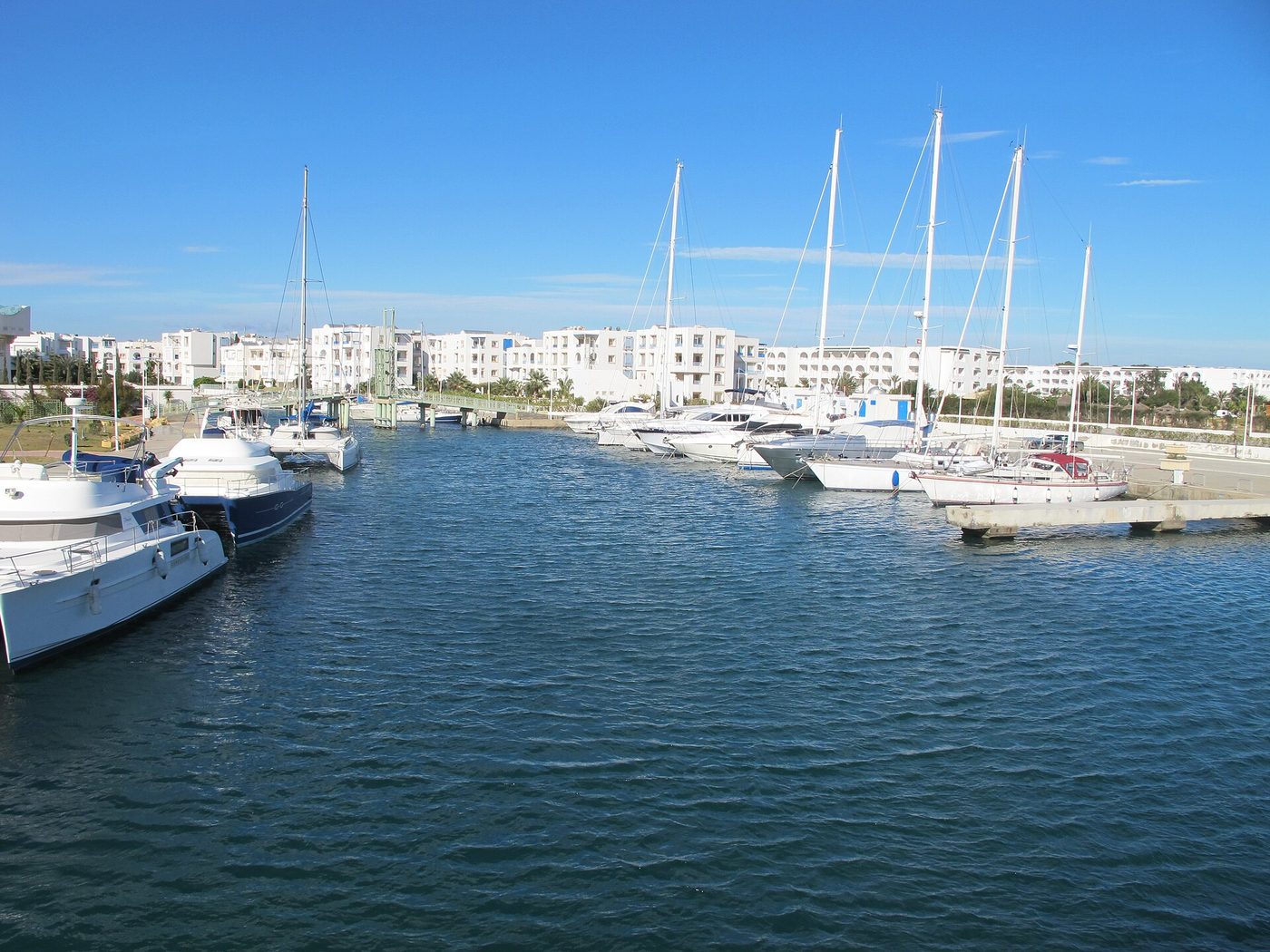
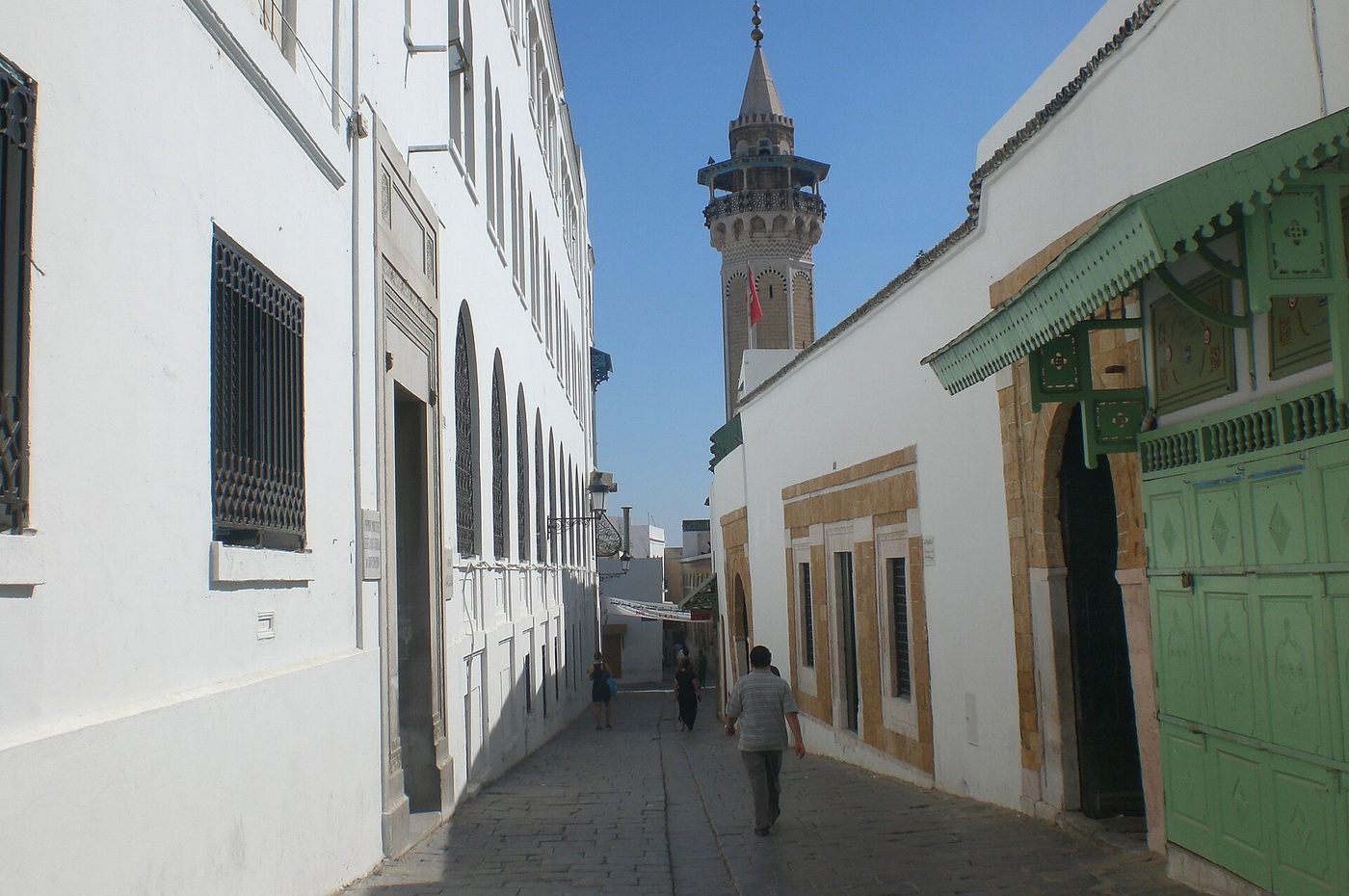
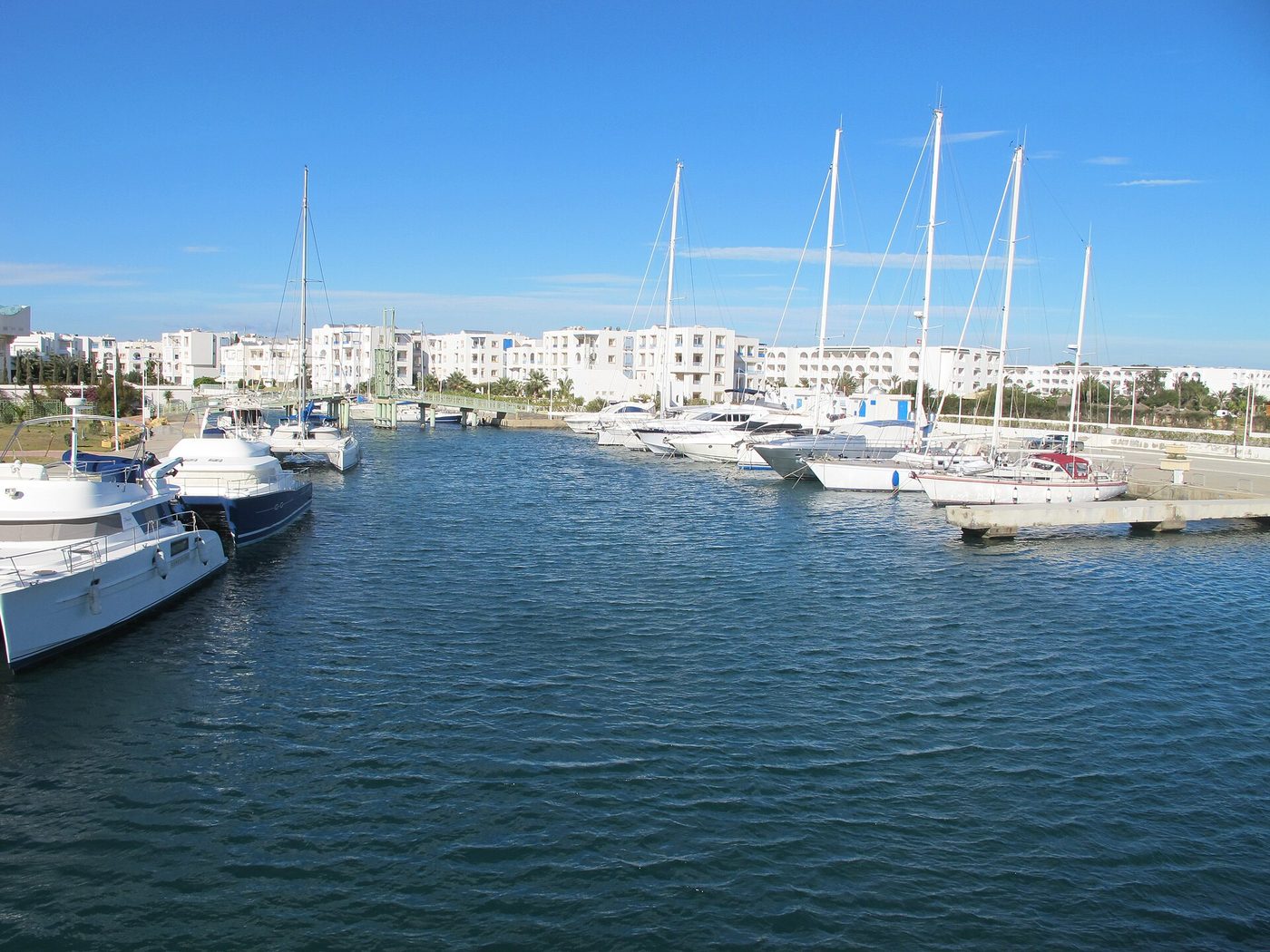
All images via Wikimedia Commons, used with thanks: the marina at Port El Kantaoui, Sousse © Amy Keus (CC BY-SA 2.0); a street in Sidi Bou Said © Rene Cortin (CC BY-SA 4.0); the marina at Yasmine Hammamet © Kritzolina (CC BY-SA 4.0).