By the Tunisia Tourism Guide team · Last updated 13 August 2026 · We don’t sell tours or take hotel commissions — this is independent advice, written to be useful.
Somewhere between a sun lounger and a working temple that predates Islam, most Djerba holidays run into the El Ghriba synagogue — and almost nobody arrives knowing quite what they are walking into. This is the page we wish we’d had.
The El Ghriba synagogue sits in the village of Erriadh, a short drive south of Houmt Souk on Djerba. Widely called the oldest synagogue in Africa, it is a working place of worship with a cool, blue-tiled interior, open daily except Shabbat. Entry is free with a small donation, dress is conservative, and the security around it is visibly heavy.
For the wider island — where this fits, and everything else worth your time — see our full guide to things to do in Djerba. Below, we stay focused on El Ghriba alone: its history, the legends, the annual Lag BaOmer pilgrimage and, honestly, the reason for the armed guards you will see. It is one of the few genuinely moving things you can do on a beach holiday in southern Tunisia, and it takes less than an hour.
El Ghriba synagogue at a glance
| Detail | The short version |
|---|---|
| Where | Erriadh (Hara Sghira), roughly 7 km south of Houmt Souk, central Djerba |
| What it is | Widely called the oldest synagogue in Africa; a working synagogue and pilgrimage site |
| Age | Current building is 19th-century; the site has been used for worship for well over 2,000 years by tradition |
| Getting there | About a 15-minute taxi or hire-car drive from Houmt Souk; well signed once you reach Erriadh |
| Opening | Daylight hours most days; closed Friday evening to Saturday (Shabbat) and on Jewish holidays |
| Entry | Free, with a donation box by the door; bring cash in dinars, no cards |
| Dress | Shoulders and knees covered; men are handed a head covering at the entrance |
| Security | Bag checks and armed guards; carry your passport |
| Pilgrimage | Lag BaOmer, usually in May (the 2026 gathering ran 30 April to 6 May) |
| Heritage status | Part of Djerba’s UNESCO World Heritage listing since September 2023 |
| Time needed | 45 minutes to an hour; pairs naturally with Djerbahood next door |
What is El Ghriba, and where exactly is it?
El Ghriba is a synagogue in Erriadh, a quiet inland village that older maps and locals still call Hara Sghira — “the small quarter”, one of Djerba’s two historic Jewish villages. It is central to the island rather than coastal, sitting a few kilometres inland from the harbour town of Houmt Souk, and from most of the beach resorts it is a 20 to 30-minute drive.
From outside, it announces almost nothing. You would pass a low, white-walled building on an ordinary residential street and never guess at its reputation. That reputation is considerable: El Ghriba is widely described as the oldest synagogue in Africa, and it is certainly the oldest in Tunisia. Some accounts go further and call it one of the oldest continuously used synagogues anywhere in the world. The building you actually walk into is much younger than the legend — it dates to the 19th century, with renovations in the 1920s and 30s — but the site beneath it has, by tradition, been a place of Jewish worship for the better part of 2,500 years.
A note on the name, because it matters. “El Ghriba” (الغريبة) is usually translated as “the miraculous” or “the wondrous”, though it can also mean “the isolated one” or “the stranger”. Both senses run through the stories the island tells about the place, and you will hear locals refer to it simply as El Ghriba Djerba, as if the island and the synagogue were one idea. In a sense they are.
The legends: a stone from Solomon’s Temple, and “the miraculous one”
Two very different origin stories sit side by side here, and Djerba has never felt the need to choose between them.
The first is grand and biblical. When the Babylonians destroyed Solomon’s Temple in Jerusalem in 586 BC, the story goes, a group of fleeing priests — the kohanim — carried a relic of the ruined Temple west across the Mediterranean. Some versions say a stone; the most repeated says a fragment of one of the Temple’s doors. They settled on Djerba and built a sanctuary around the relic, which is said to lie to this day in a grotto beneath the synagogue. It is this claim — an unbroken thread back to the First Temple — that gives El Ghriba its standing as one of the founding sites of Jewish life in North Africa, and helps explain why pilgrims speak of it in the same breath as Jerusalem.
The second legend is local, human and a little haunting. It tells of a young woman — the ghriba, the isolated one — who arrived alone on the island and lived apart from everyone in a small hut. When the hut burned down, her body was found untouched by the fire. The islanders, who had kept their distance while she lived, buried her with honour, and those who later visited her grave reported miracles of healing. A shrine grew over the grave, and the synagogue grew around the shrine. In Djerban tradition the ghriba is revered rather like a saint — a strand of folk devotion that echoes the veneration of holy figures in the island’s Muslim and Berber communities, with whom Djerba’s Jews have shared this ground for a very long time.
You do not need to believe either story to feel their weight inside the building. Both are physically present: the grotto is real, sits under the Torah ark, and remains the emotional centre of the whole place.
Inside the synagogue: what you actually see
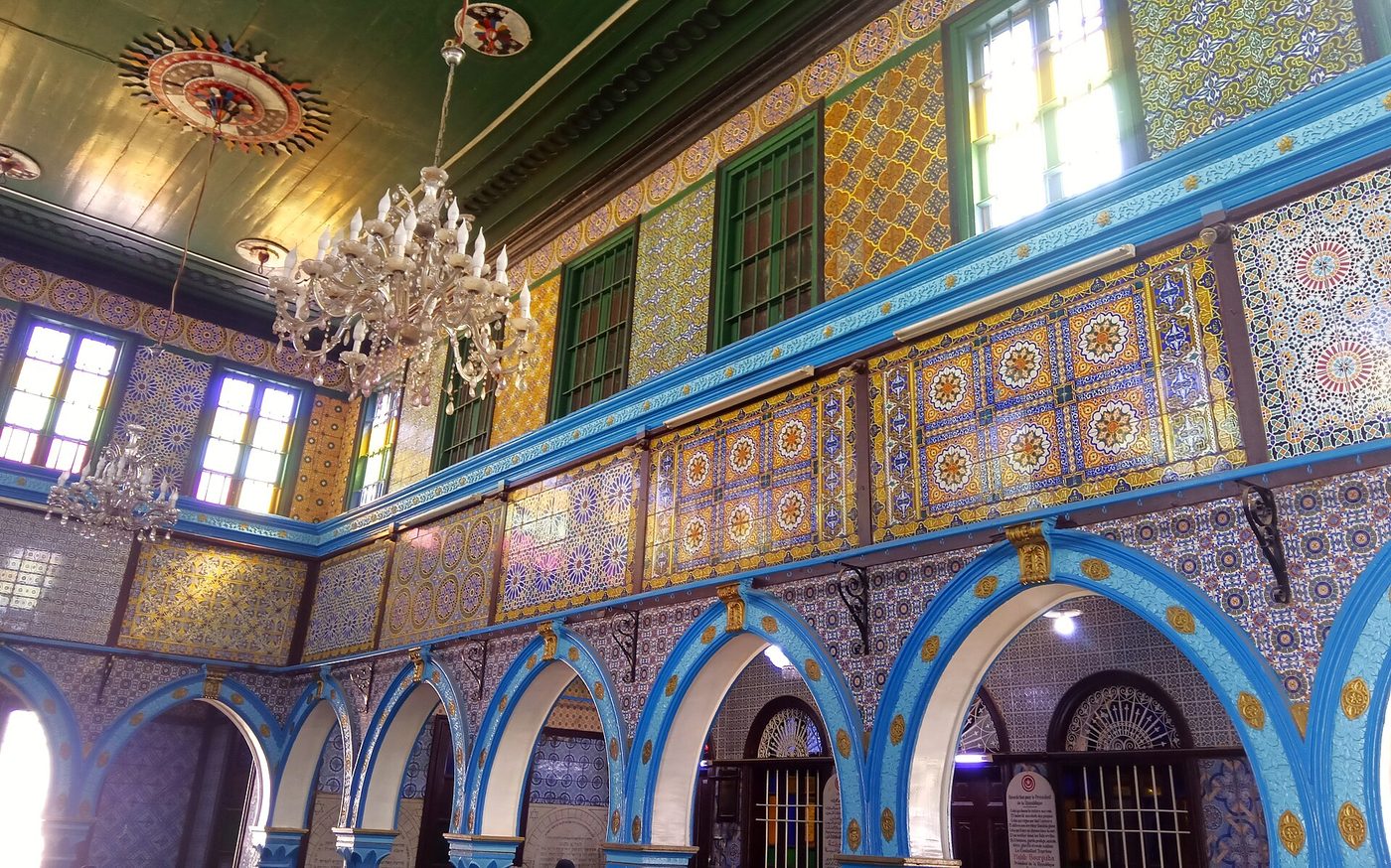
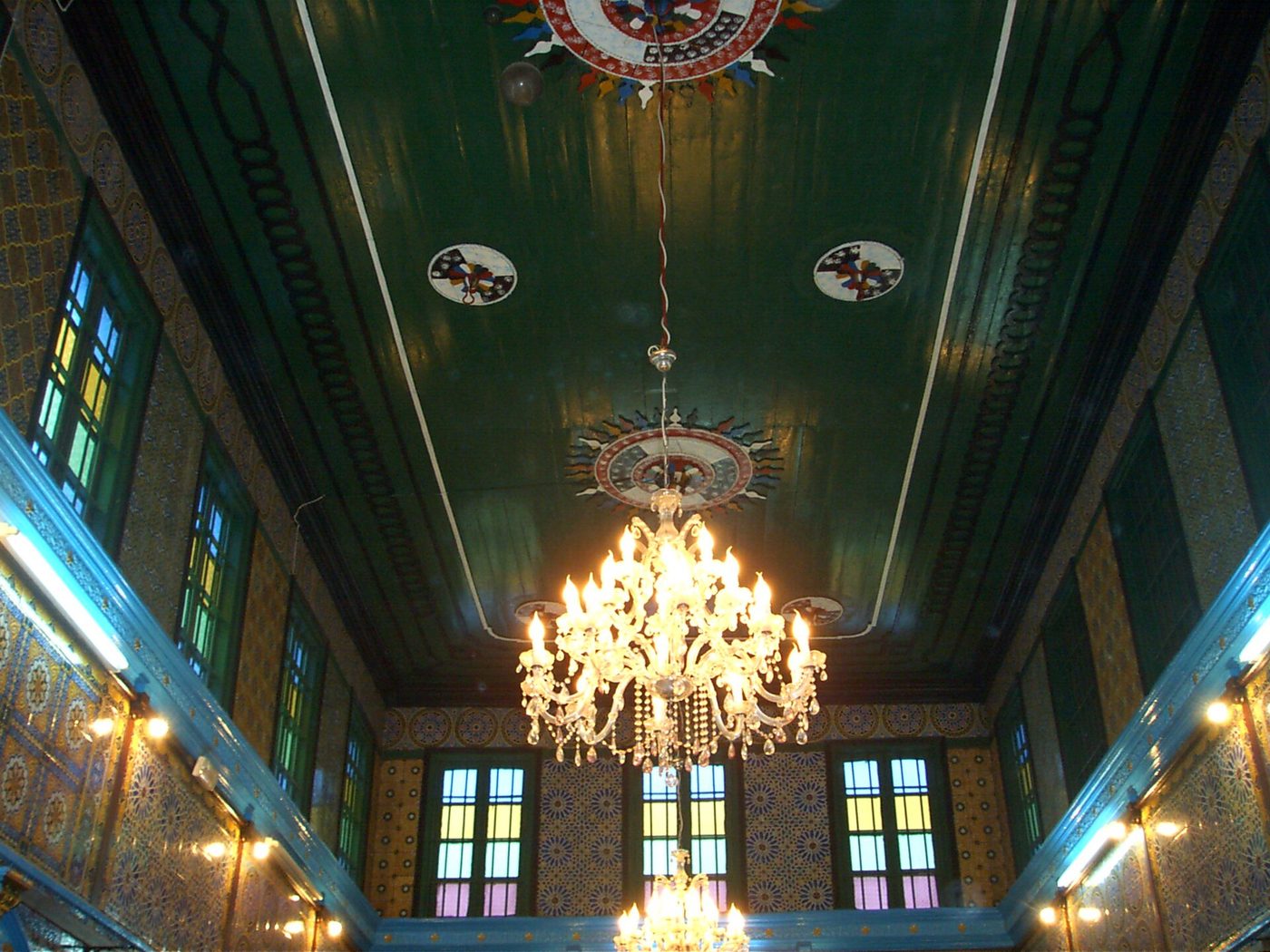
Step through the door and the modesty of the exterior flips into something else entirely. The interior is a slow flood of colour — walls sheathed in ceramic tiles in blue, white, green and ochre, in the old Tunisian qallaline style you also see in the grand houses and mosques of the mainland. It is cool, dim and quiet, and after the glare of a Djerban afternoon it feels like stepping into shade and centuries at once.
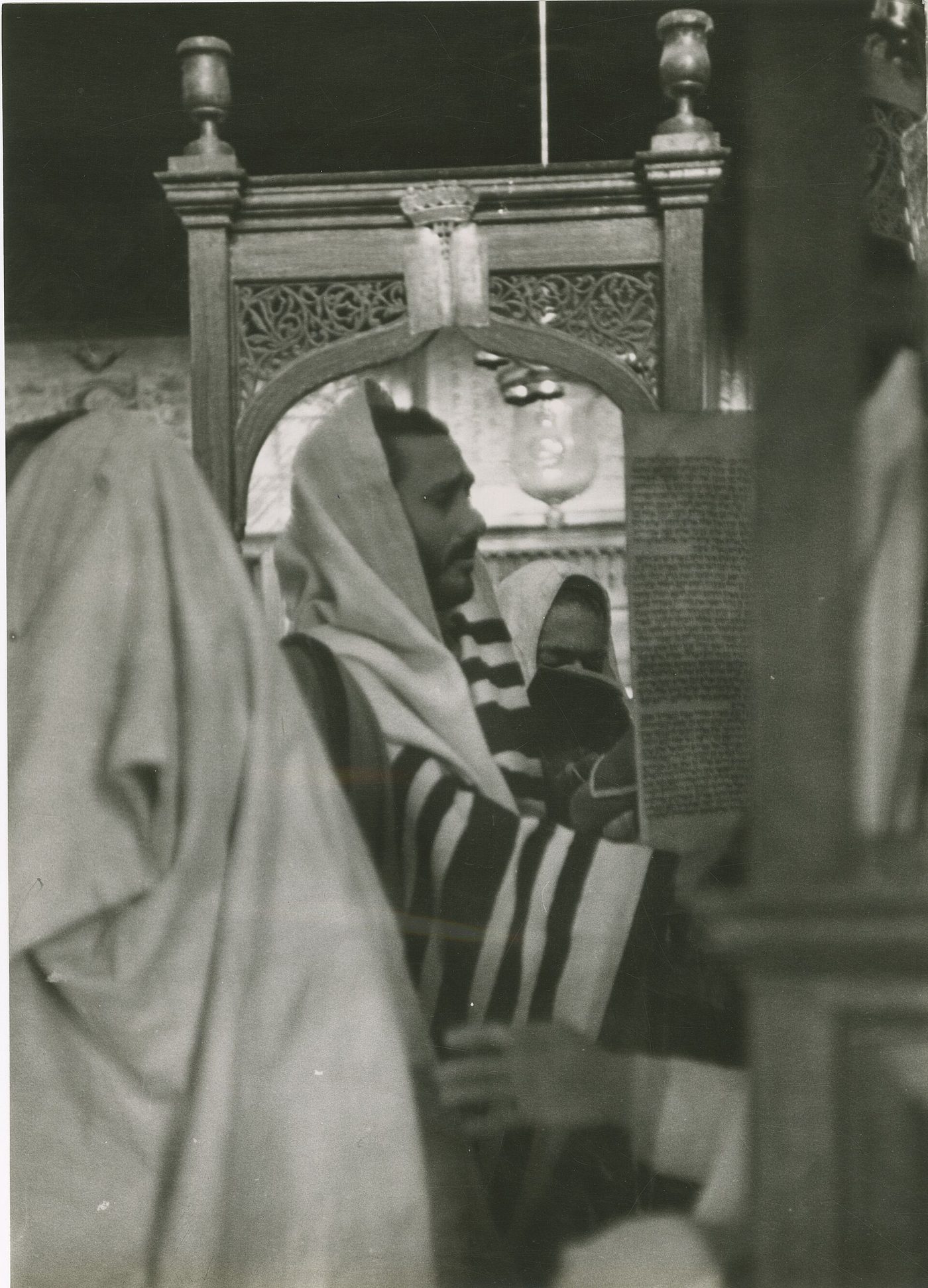
The building has two linked spaces. The first was originally an open courtyard — a common arrangement borrowed from mosque design, where worshippers gather before entering — later roofed over to shelter the crowds who come for the pilgrimage. Rows of blue-painted columns carry arches striped in blue and white, imitating the alternating light-and-dark stonework of the wider Islamic world. The second space is the sanctuary proper. At its heart stands a carved wooden bema, the reader’s platform from which the Torah is chanted, lit from above by a windowed lantern-tower.
The eastern end holds the heikhal, the Torah ark, a bank of cabinets said to house one of the oldest Torah scrolls still in use anywhere. Look at the base of the ark and you will find a small wooden door: this is the entrance to the grotto where the Temple relic and the ghriba’s remains are believed to rest. Around it, the details reward a slow look — engraved silver offerings behind glass, fish and hamsa (open-hand) motifs that ward off the evil eye, and, tucked into every crevice, small folded slips of paper carrying written wishes. If the gesture reminds you of the notes pushed into the Western Wall in Jerusalem, that is exactly the point. Pilgrims and visitors have left prayers, candles and requests here for generations, and the woodwork has quietly absorbed all of it.
One honest nuance worth knowing before you go, because it changes how you read the room: El Ghriba is no longer the synagogue where Djerba’s Jewish community holds its ordinary weekly prayers. The community worships in the working synagogues of its two villages. El Ghriba’s living role now is twofold — the great annual pilgrimage, and the rest of the year as a revered site that visitors come to see. That does not make it a museum. It makes it something rarer: a shrine that is still actively venerated, even when it is mostly quiet.
Djerba’s Jewish community — one of the oldest anywhere that still survives
El Ghriba only makes sense as the centre of a living community, and Djerba’s is one of the oldest surviving Jewish communities in the world. Tradition dates a Jewish presence on the island back over two thousand years — some accounts push it to the era of the Phoenicians and the founding of Carthage. Whatever the true start date, the continuity is the remarkable part: Jews have lived, prayed and worked on this small island through Roman, Arab, Ottoman, French and independent Tunisian rule, largely without a break.
The numbers tell a harder story too. Before Tunisia’s independence in 1956, the country was home to more than 100,000 Jews. Emigration to France, Israel and elsewhere has reduced that to somewhere around 1,500 today, and the large majority of them live on Djerba, in the two villages of Hara Sghira (Erriadh) and the larger Hara Kebira nearer Houmt Souk. It is often called the second-largest active Jewish community left in the Arab world. The community here still runs its own Hebrew schools, a kosher slaughterhouse and more than a dozen working synagogues, and the daily texture of that life — the bakeries, the silversmiths, the yeshiva students on bicycles — is one of the things that makes this corner of Djerba feel unlike anywhere else in Tunisia.
That coexistence is a large part of why Djerba earned its place on the UNESCO World Heritage List in September 2023. The listing — “Djerba: Testimony to a settlement pattern in an island territory” — is not for a single monument but for the whole way the island has been lived in: the scattered fortified farmsteads, the low mosques, and the centuries of Muslims, Jews and Christians settling side by side. El Ghriba and the Jewish quarters are part of that inscribed story. For the wider context of what makes the island tick, our guide to whether Djerba is worth visiting and our overview of Tunisian culture both go deeper.
The Lag BaOmer pilgrimage — the one time of year El Ghriba fills
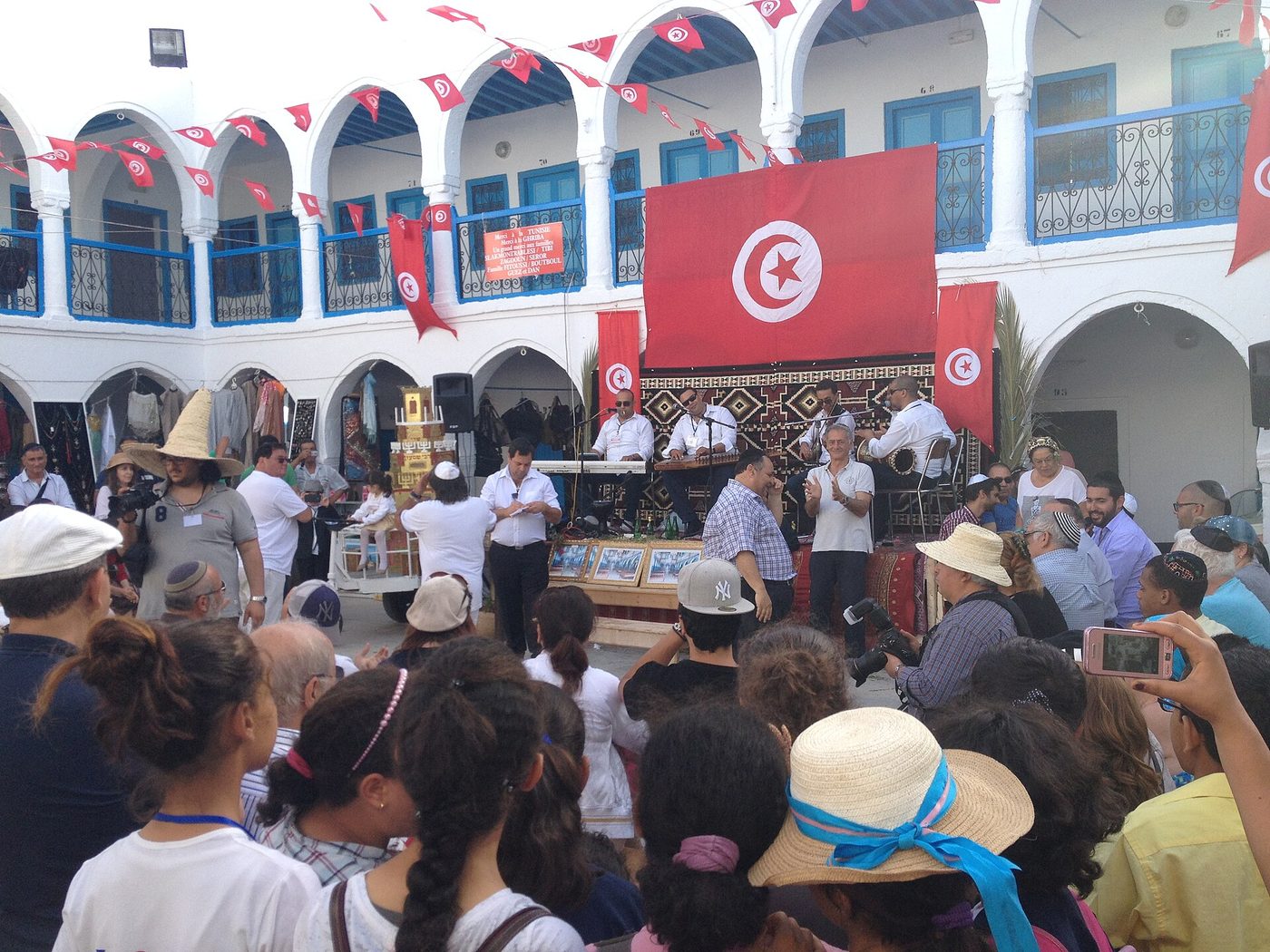
For most of the year El Ghriba is calm. For a few days each spring it becomes one of the most distinctive religious gatherings in the Mediterranean. The annual pilgrimage — the Hilula — is held around Lag BaOmer, the 33rd day of the Counting of the Omer, which falls between Passover and Shavuot and usually lands in May. The 2026 gathering ran from 30 April to 6 May; Lag BaOmer itself fell on 4–5 May. Dates move with the Hebrew calendar every year, so if you are aiming to be here for it, confirm the exact days for your year before you book anything.
The Lag BaOmer Djerba pilgrimage honours two revered 2nd-century rabbis, Shimon bar Yochai and Meir Baal HaNess, alongside the ghriba herself. Historically it has drawn Jewish families from Tunisia, France, Israel and across the diaspora, many of them staying in the oukala — the caravanserai of pilgrim rooms — opposite the synagogue. The rituals are unlike anything else on the island: the singing of piyutim in Hebrew and Judeo-Arabic, candles lit in the grotto, and a procession that carries the menara, a tall tiered candelabrum draped in silk scarves, through the streets between synagogues. The word for that centrepiece means “bride”, and the whole procession is understood as a symbolic wedding of the community with God, mirroring the way a Djerban bride was once carried to her groom.
There is a quieter ritual, too, that visitors often find the most affecting. In the grotto beneath the Torah ark, women leave eggs inscribed with their names and wishes; tradition holds that a woman who later eats her egg will see her hopes for love or a child answered within the year. It is a small, tender custom, and it says a great deal about how folk belief and formal religion have grown together on Djerba.
Should you try to visit during the pilgrimage? It is a genuine spectacle, but it is also a religious event with tight security and reduced access for casual tourists, and it is the one time the site is anything but peaceful. If your interest is the building, its history and a calm hour inside, come on a normal day. If your interest is the living tradition, come for the Hilula — but go with a good local operator, expect crowds and checkpoints, and be respectful that this is worship, not a show put on for you.
Why you’ll see armed guards — and why the island stays a mainstream destination
We are not going to skate past this, because you will notice the security the moment you arrive and it is better to understand it than to be unsettled by it. El Ghriba has been the target of attacks, and the protection around it now is a direct result.
The most recent was on 9 May 2023, during the pilgrimage, when a member of the Tunisian security forces opened fire near the synagogue; five people were killed, including two visitors and three Tunisian officers, before the attacker was stopped. A Tunisian court sentenced several people over the attack in February 2026. It was not the first such incident: a truck bombing at the synagogue in 2002 killed 21 people, most of them German tourists, and there was a shooting in 1985. We state these plainly, without dwelling on them, because an honest guide should — and because the response to them is the more important point for a visitor today.
That response is why the checkpoint outside feels more like an airport than a temple. Expect a bag search, a passport check and a visible presence of armed police and soldiers. The community and the Tunisian authorities took a deliberate decision to keep the synagogue and the pilgrimage open under heavy guard rather than close them, and visiting respectfully is widely understood on the island as part of supporting that choice. The pilgrimage went ahead again in 2024, 2025 and 2026.
For the practical safety picture — what the UK Foreign Office actually says, and why Djerba as a whole carries no travel restriction — read our date-stamped guides to whether Djerba is safe and the broader question of whether Tunisia is safe right now. The short version: the Foreign Office’s advisory zones all sit on the mainland, a long way from the island, and Djerba is explicitly outside them. Millions of package holidaymakers visit every year. The guards are there so that the pilgrimage can carry on, not because the island is dangerous to tourists.
How to visit El Ghriba: the practical bit
This is an easy, low-cost, high-reward stop. Here is how to do it without friction.
Getting there. El Ghriba is about a 15-minute drive from Houmt Souk and 20 to 30 minutes from the beach hotels along Sidi Mahres. A metered taxi is the simplest way; agree the fare or insist on the meter first, and consider asking the driver to wait, as taxis are thin on the ground out in Erriadh. If you have taken a hire car for a day of island sightseeing, the synagogue is well signposted once you are in the village. Plenty of organised half-day tours also bundle it with Djerbahood and the pottery village at Guellala.
Opening times. El Ghriba is generally open to visitors through daylight hours, but it closes for Shabbat — from Friday evening to Saturday evening — and on Jewish holidays, and access tightens sharply around the pilgrimage. Hours drift with the season and with security decisions, so have your hotel or a local guide confirm on the day rather than trusting a fixed timetable online.
Money. Entry has generally been free, with a donation box by the door — a few dinars is a normal and welcome gesture. Some visitors do report a small charge; either way, bring cash, because cards are not taken. Remember that the Tunisian dinar is a closed currency: you cannot buy it before you fly or take it home, so change money on arrival and carry small notes. As a rough guide in mid-2026, £1 is worth somewhere around 3.8 to 3.9 TND — check the current rate before you travel.
What to wear and how to behave. This is a place of worship, so dress and conduct matter. The essentials:
- Cover shoulders and knees — for both men and women. A light scarf or shawl over a strappy top does the job in the heat.
- Head covering for men — a kippah or paper skullcap is handed to you at the entrance; wear it inside.
- Shoes — you may be asked to remove them before stepping into the inner prayer hall, as pilgrims do. Follow the lead of the staff and worshippers.
- Photography — generally fine in the courtyard, but not always inside the sanctuary, and not during prayer. Always ask before photographing people. Confirm the rule on the day rather than assuming.
- Passport — carry it for the security check.
- Keep your voice down — even when it is quiet, treat it as the shrine it is.
Half an hour to an hour is plenty of time inside. The reward-to-effort ratio is high: for the price of a taxi and a donation, you stand in one of the oldest religious sites in Africa.
What to pair with El Ghriba
The clever move is not to make a special trip for El Ghriba alone but to build a half-day around Erriadh, because two of Djerba’s best experiences are within a short walk of each other.
Ten minutes on foot from the synagogue is Djerbahood, the open-air street-art project that turned Erriadh’s whitewashed lanes into a gallery of murals by artists from dozens of countries. Some of the older works have faded in the sun and salt, but new pieces keep appearing and the wander is free and genuinely good. The two sites pair so naturally that most visitors do them back to back, with a coffee in a village courtyard in between.
From there it is a short drive back to Houmt Souk for the fish market and the old souks, or on to the beaches if the afternoon is calling. If you are mapping the whole island, our rundown of the best day trips from Djerba shows how El Ghriba fits into a bigger loop, and the classic sail out to Flamingo Island makes an easy contrast the next day. Hungry afterwards? Djerba’s Jewish community shaped a distinctive local cooking, and our guide to Tunisian food points you at the dishes worth seeking out. For where to base yourself to reach all of this comfortably, see where to stay in Djerba, and to time it with the best weather, our guide to the best time to visit Tunisia has the month-by-month picture. El Ghriba also earns its spot on our national list of the best things to do in Tunisia.
El Ghriba synagogue: your questions answered
How old is the El Ghriba synagogue?
The building you visit today dates to the 19th century, with renovations in the 1920s and 30s. The site beneath it, however, has been a place of Jewish worship for far longer — by tradition around 2,500 years, since priests fleeing the destruction of Solomon’s Temple in 586 BC are said to have founded a sanctuary here. That combination of a relatively recent building on an ancient sacred site is exactly why accounts of its age vary so widely.
Is El Ghriba really the oldest synagogue in Africa?
It is very widely described as the oldest synagogue in Africa, and it is certainly the oldest in Tunisia. Some accounts go further and call it one of the oldest continuously used synagogues in the world. Because so much rests on tradition rather than documentary proof, we would treat “one of the oldest in Africa” as the safe, honest phrasing — but its standing is genuine and long-established.
Where is El Ghriba, and how do I get there from the resorts?
It is in the village of Erriadh (Hara Sghira) in central Djerba, roughly 7 km south of Houmt Souk. From the Houmt Souk area it is about a 15-minute drive; from the beach hotels along Sidi Mahres, 20 to 30 minutes. A metered taxi is easiest — ask the driver to wait, or arrive as part of a half-day tour that also takes in Djerbahood.
Can tourists visit, or is it only for the pilgrimage?
Tourists are welcome year-round, not just at pilgrimage time. In fact a normal weekday is the better visit if you want a calm, unhurried look at the interior. The site closes for Shabbat (Friday evening to Saturday evening) and Jewish holidays, and access is more restricted during the Lag BaOmer pilgrimage itself.
Is there an entry fee for El Ghriba?
Entry has generally been free, with a donation box by the door where a few dinars is welcome. Some visitors report a small charge. Either way, bring cash in Tunisian dinars, as cards are not accepted — and remember the dinar is a closed currency you can only obtain once you are in the country.
What should I wear to visit El Ghriba?
Dress modestly: shoulders and knees covered for both men and women. Men are given a head covering (a kippah or paper skullcap) at the entrance and should wear it inside. A light scarf over bare shoulders is enough in the heat. You may also be asked to remove your shoes before entering the inner prayer hall.
Can you take photographs inside El Ghriba?
Usually yes in the courtyard, but photography inside the main sanctuary can be restricted, and it is not allowed during prayer. Rules shift with the day and the staff on duty, so ask first, and always ask before photographing any worshipper or pilgrim.
When is the Lag BaOmer pilgrimage in Djerba?
It is held around Lag BaOmer, which falls between Passover and Shavuot and usually lands in May. The 2026 gathering ran from 30 April to 6 May. Because the date follows the Hebrew calendar it changes every year, so check the exact dates for your year of travel before making plans around it.
Is it safe to visit El Ghriba in 2026?
Djerba carries no UK Foreign Office travel restriction, and the island sits well outside the advisory zones, which are all on the mainland. El Ghriba specifically has heavy security — bag checks, armed guards, passport checks — put in place after past attacks, most recently in May 2023. The pilgrimage has gone ahead each year since. See our dedicated Djerba and Tunisia safety guides, linked earlier in this article, for the full, date-stamped picture before you book.
Do I need to cover my head or take my shoes off?
Men are given a head covering at the door and should wear it inside; women are not generally required to cover their hair, though a shawl over bare shoulders is expected. You may be asked to remove your shoes before entering the inner prayer hall, in keeping with how pilgrims worship. When in doubt, follow the lead of the staff and the people around you.
Is El Ghriba a UNESCO World Heritage Site?
Yes, as part of a wider listing. In September 2023, UNESCO inscribed “Djerba: Testimony to a settlement pattern in an island territory” — Tunisia’s ninth World Heritage Site. El Ghriba and the island’s historic Jewish quarters are components of that inscribed property, recognised alongside Djerba’s mosques and farmsteads for centuries of religious coexistence.
What else is near El Ghriba worth seeing?
Djerbahood, the street-art village, is a ten-minute walk away and pairs perfectly. Houmt Souk’s old town and fish market are a short drive north, and the pottery village of Guellala is an easy add-on to the south. Many people build a relaxed half-day around Erriadh and the synagogue, then head to the beach.
Written by the Tunisia Tourism Guide team — an independent UK-focused guide to travelling in Tunisia. We don’t sell tours or take hotel commissions. Prices and advice were checked at publication; always confirm current details before you book.
Photo credits
All images via Wikimedia Commons, used with thanks: The blue-tiled interior arcades of the El Ghriba synagogue at © Dr. Ondřej Havelka (cestovatel) (CC BY 4.0); Blue-tiled interior and striped arches inside the El Ghriba synagogue © Jalo (Public domain); Pilgrims and the decorated menara during the Lag BaOmer pilgrimage © Quatchenerlo (CC BY-SA 4.0); A rabbi reading from a Torah scroll inside the El © Touring Club Italiano (1952) (CC BY-SA 4.0).