By the Tunisia Tourism Guide team · Last updated 17 October 2026 · We don’t sell tours or take hotel commissions — this is independent advice, written to be useful.
Zaghouan comes up in two ways. Either you’ve seen a photo of a ruined Roman temple wrapped round a spring under a jagged grey mountain and wondered where on earth it is, or you’ve read that Carthage once drank water piped all the way from somewhere called Zaghouan and wondered whether there’s anything left to see. The short version is yes on both counts, though few visitors make the trip, and guides that mention it rarely tell you how to put a day together.
Zaghouan is a small mountain town south of Tunis where the Romans tapped the springs that supplied Carthage. Its Temple of the Waters, the arches of the 132km aqueduct and two Roman towns nearby, Uthina and Thuburbo Majus, make a rewarding day out from Tunis or Hammamet.
It’s one of the quieter stops in our guide to Roman ruins in Tunisia, and it works best as a “follow the water” day: start at the source, look at the arches that carried it, and take in the Roman towns along the way. Below we cover the story of the aqueduct, the Temple of the Waters, what’s in Zaghouan town, where to see the best arches, the Roman sites of Uthina (Oudhna) and Thuburbo Majus with their hours and prices, and how to get there without a car.
Zaghouan at a glance
| What | The short version |
|---|---|
| Where | Inland, south of Tunis, at the foot of Jebel Zaghouan |
| Why go | The Roman Temple of the Waters at the aqueduct’s source, the arches of the Carthage aqueduct, and two Roman towns nearby |
| The aqueduct | 132km long according to UNESCO’s tentative list; built in the early 2nd century AD to supply Carthage |
| Uthina (Oudhna) | Roman town with an amphitheatre; 8 TND for non-residents; open daily |
| Thuburbo Majus | Large Roman town with a capitol, forum and baths; 8 TND for non-residents; open daily |
| Temple of the Waters | Open-air site in a landscaped park at the edge of town; check access locally |
| Jebel Zaghouan | 1,295m; national park; visits were banned in the 1 May to 31 October 2026 fire-risk season |
| Best as | A full day trip by car or hired taxi from Tunis or Hammamet |
| Time needed | A full day for the temple, the arches and both Roman sites |
The story: how Zaghouan watered Carthage
Carthage had a water problem. Rebuilt by Rome as the capital of the province of Africa, it grew into one of the great cities of the Roman West, and big Roman cities ran on water: fountains, public baths, latrines, private houses. Local wells and rainwater cisterns weren’t going to keep up.
The answer was in the mountains to the south. Springs rose on the flanks of Jebel Zaghouan, and Roman engineers captured them and sent the water north to the coast. UNESCO, which has placed the whole system on Tunisia’s tentative list for World Heritage status since 2012, describes a hydraulic complex in three parts: the captured springs and the nymphaeum known as the Temple of the Waters at the source; a 132km aqueduct; and the great cisterns of La Malga at Carthage, with the city’s baths as the end of the line.
Most of the channel didn’t run on arches at all. UNESCO notes that it ran mostly at ground level or underground, following the contours so that gravity alone kept the water moving. Where it had to cross a valley or a plain, it rose onto arcades, some over 20 metres high. Those are the stretches you’ll still see striding across the countryside.
When was it built?
UNESCO dates the complex to the early 2nd century AD. Tradition links it to the emperor Hadrian, whose visit to Africa in 128 AD is said to have coincided with the end of a long drought, though the exact year of construction isn’t certain. The huge Antonine Baths on the seafront at Carthage, which the water helped feed, opened later in the same century; see our guide to ancient Carthage for what’s left of them.
A working life of nearly two thousand years
The aqueduct didn’t simply stop when Rome fell. It was damaged and repaired several times over the centuries that followed, through the Vandal conquest of Carthage in 439, the Byzantine reconquest and the Arab conquest at the end of the 7th century. In the 13th century, a Hafsid ruler of Tunis added a new branch to the system, running to La Manouba.
Later it decayed and became a handy quarry for building stone. Then, in the mid-19th century, the system was restored again and began supplying water to Tunis. UNESCO’s description notes that much of the channel still functions today. Few Roman engineering projects anywhere can claim that kind of afterlife, and it’s a big part of why the arches you see by the roadside matter.
The Temple of the Waters
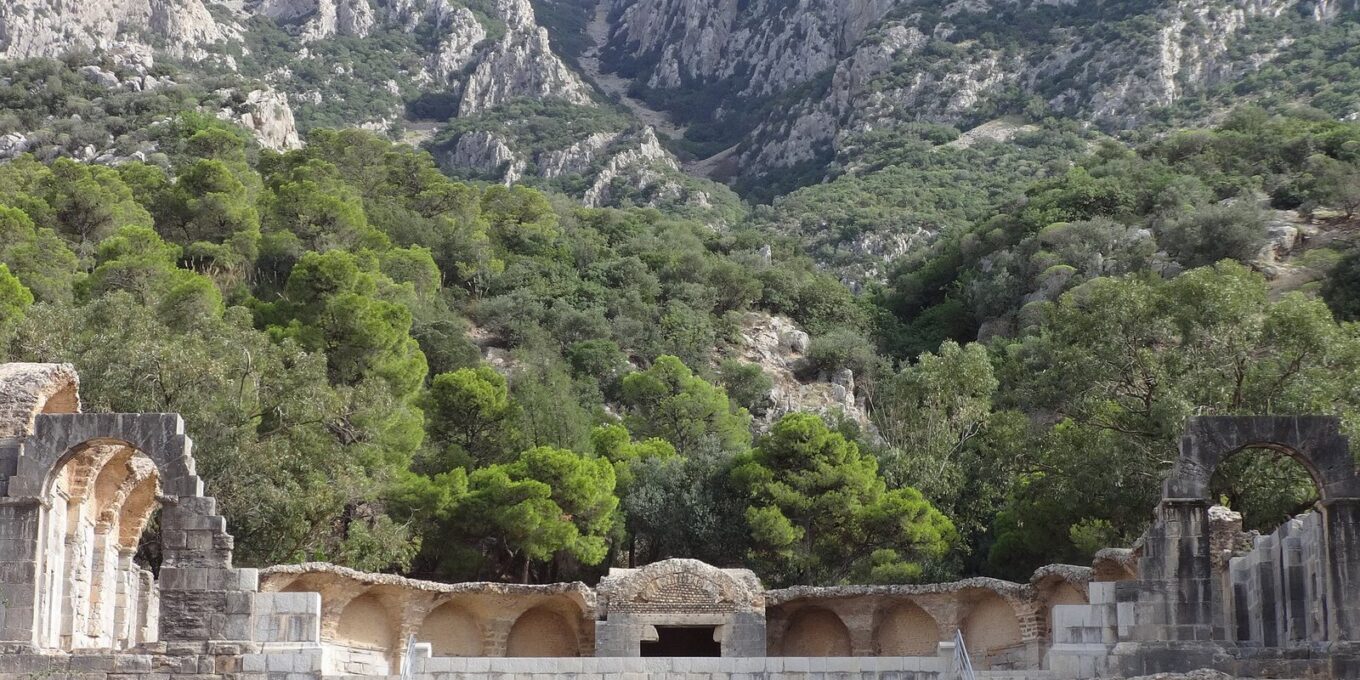
This is the photograph that sends people to Zaghouan. On the hillside at the edge of town, where the main spring rose, the Romans built a monumental nymphaeum: a shrine to the water nymphs and, in practical terms, the ceremonial head of the aqueduct.
What you see is a semicircular terrace backed by a curved wall lined with niches, which once held statues, framed at either end by a ruined arched pavilion. In front is a basin where the spring water collected before setting off on its long journey north, with a broad flight of steps leading up to it. Behind the whole thing, the bare grey ridges of Jebel Zaghouan fill the sky. It’s the setting as much as the stonework that makes the place: a Roman temple in a fold of green hillside with a proper mountain looming over it.
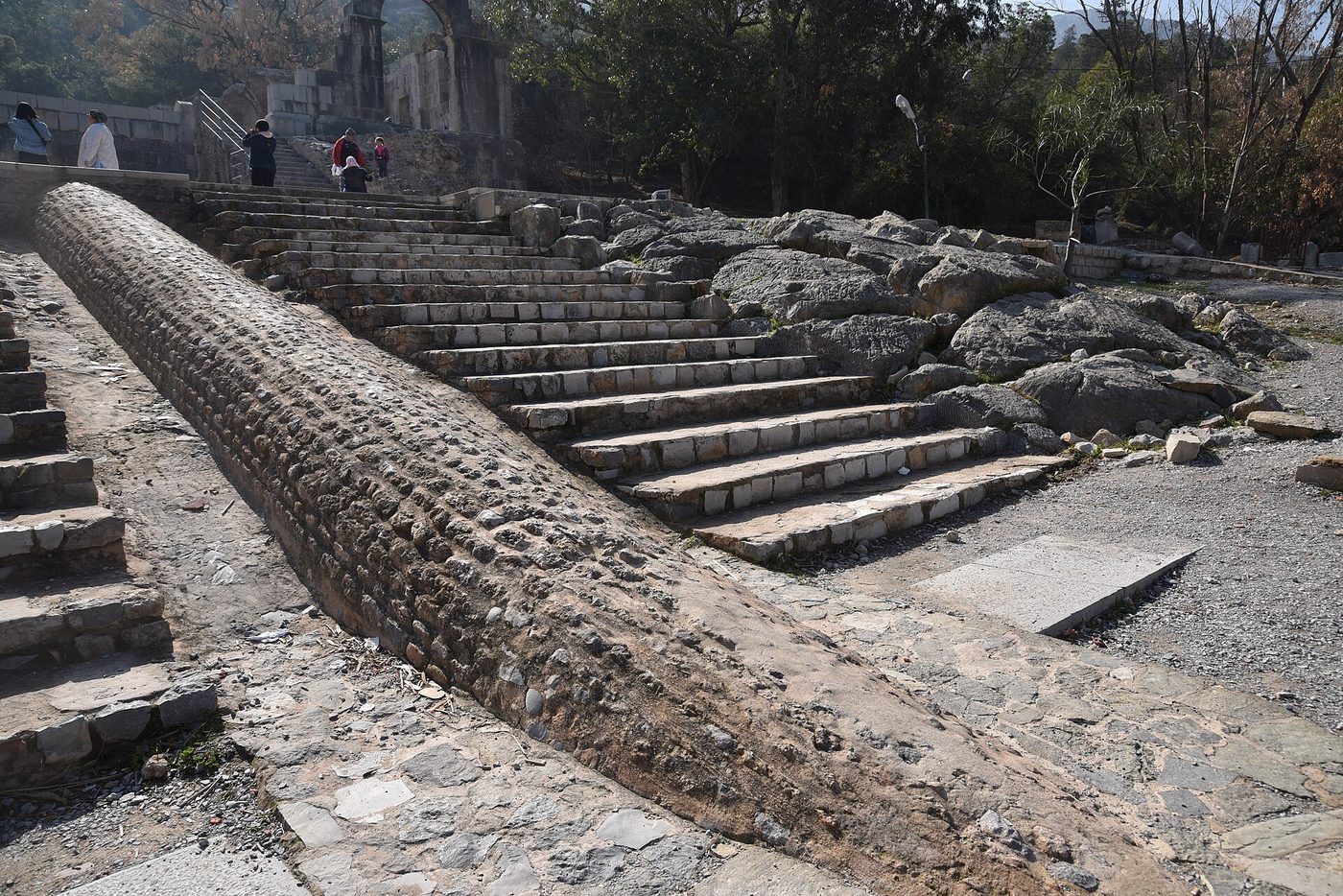
It’s not a huge site. Half an hour is enough to walk the terrace, read the niches and sit on the steps, longer if you’ve brought a picnic. Look for the fallen column lying across the stairs, a reminder of how much has come down since the 2nd century.
Visiting the temple
The temple sits inside a landscaped park with an arched entrance gate signed “Parc Temple des Eaux”.
Treat it as an open-air park, plan to visit in daylight and ask locally about opening times and any entry charge. Bring small change in dinars in case there’s a parking attendant or a charge at the gate.
Zaghouan town
Zaghouan is the capital of its governorate, but it feels like a market town: a modest old centre climbing the lower slopes of the mountain, white houses, a few cafés and a slower pace than the coast. It isn’t a destination in itself for most visitors, but it’s a pleasant place for a coffee and a wander between the temple and the Roman sites.
Roses and nesri
Zaghouan is known across Tunisia for roses and for nesri, a fragrant water distilled from eglantine (wild rose) flowers. The tradition is said to have arrived with Andalusian Muslims expelled from Spain in the 17th century. The town celebrates it each year with the Nesri (Eglantine) Festival: the 40th edition ran from 29 May to 7 June 2026, so if you’re in Tunisia in late spring, it’s worth checking the dates for 2027.
Rose water and nesri make good small gifts, and they’re widely used in Tunisian pastries. If cooking is your thing, our guide to Tunisian food explains where they turn up.
Jebel Zaghouan: check before you hike
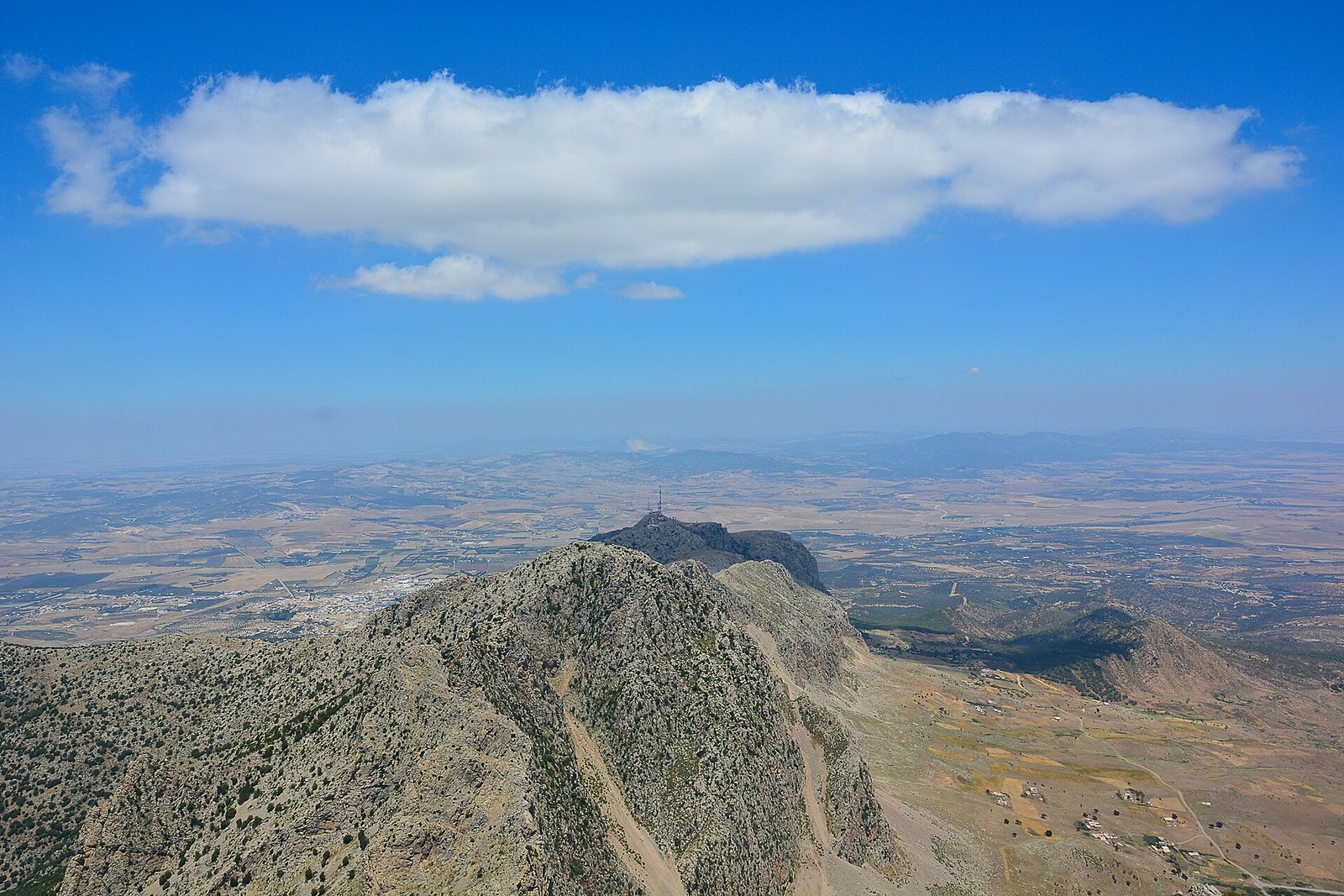
The mountain that gives the town its drama rises to 1,295m and is protected as a national park. In the cooler months it’s a good place to walk, with views across the plains towards Tunis and the sea.
But check before you plan a hike. The regional agriculture office banned visits and camping in the Jebel Zaghouan national park from 1 May to 31 October 2026, the fire-risk season, with no fires or camping allowed in the forest. If you’re visiting after that, ask the forestry office or your hotel which paths are open, and never light a fire.
Following the aqueduct: where to see the arches
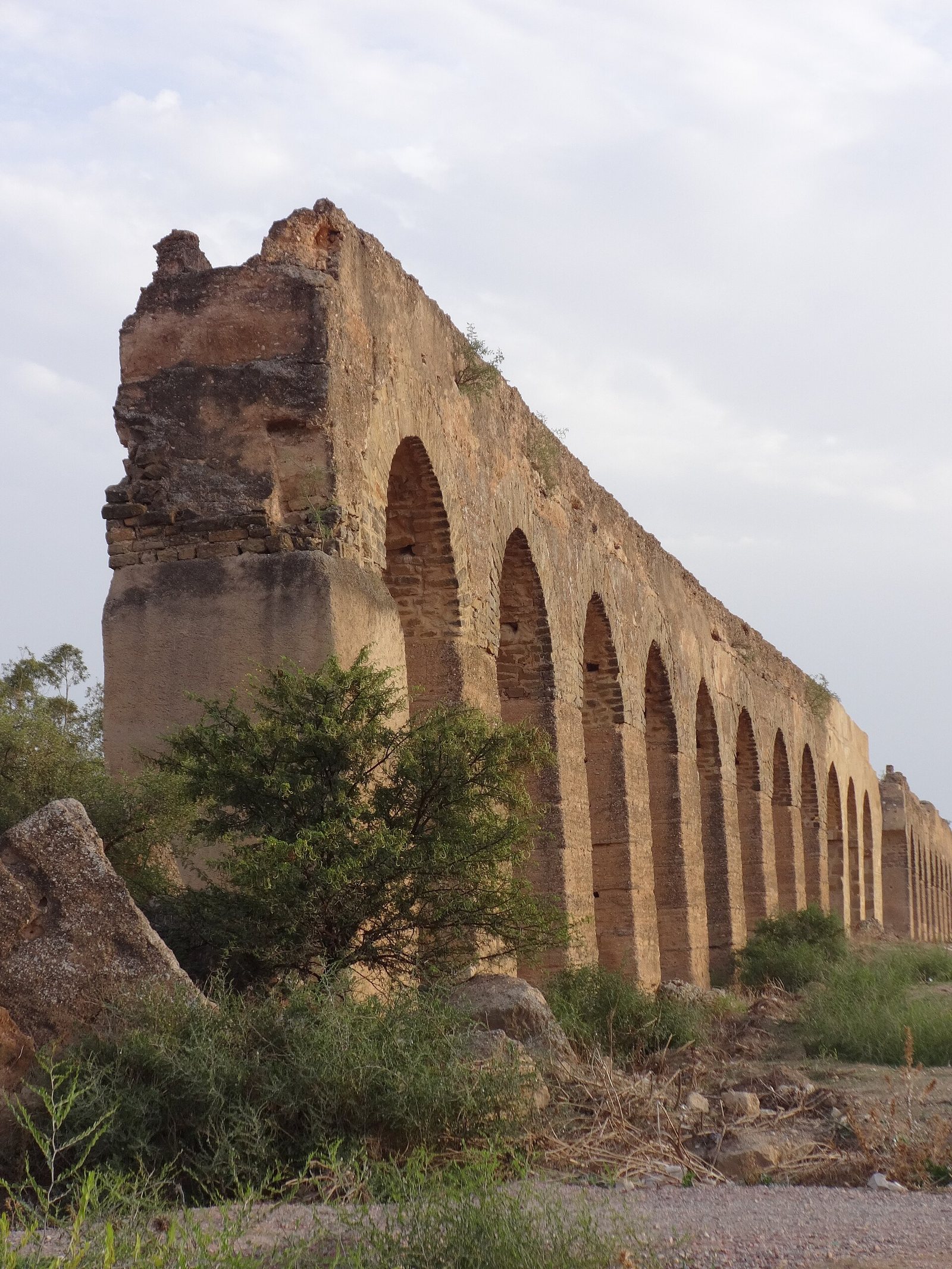
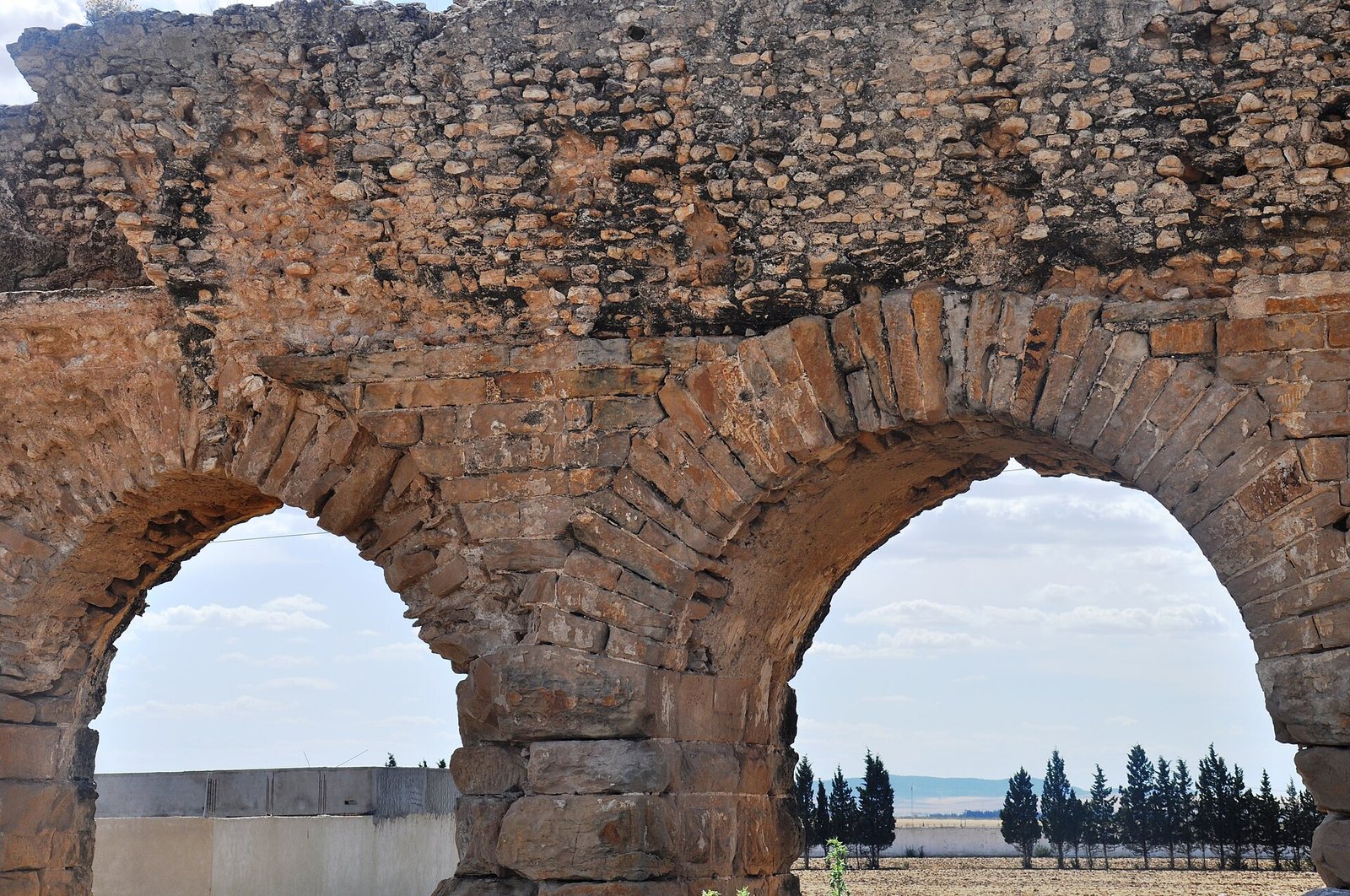
The single best thing about a Zaghouan day is that the aqueduct is your guide. For long stretches the road between Tunis and Zaghouan follows the same valleys the Roman engineers did, and every so often a line of arches appears in a field, sometimes broken, sometimes running for hundreds of metres.
- Along the Tunis to Zaghouan road. Sections of arcade stand close to the road; keep your eyes open as you drive and pull over somewhere safe when you see them.
- The Miliane valley near Oudhna. Here the aqueduct crossed the plain of the Oued Miliane on a long arcade, some over 20m high. This is the section most people picture.
- Towards Tunis. Closer to the capital, more arches survive across the plain of La Soukra and around the outskirts of the city, now hemmed in by modern buildings.
A tip on photography: the arches look best with low sun raking across the stone, so the late afternoon drive back towards Tunis is often better than the morning drive out. And respect the fields: many arches stand on farmland, so look from the roadside or a track rather than tramping through crops.
Uthina (Oudhna): the Roman town on the aqueduct’s route
Oudhna, the modern name for ancient Uthina, is the easiest stop to add and one of the most enjoyable. The heritage agency AMVPPC, which runs it, places it about 30km south-west of Tunis in the Oued Miliane valley, right on the road to Zaghouan.
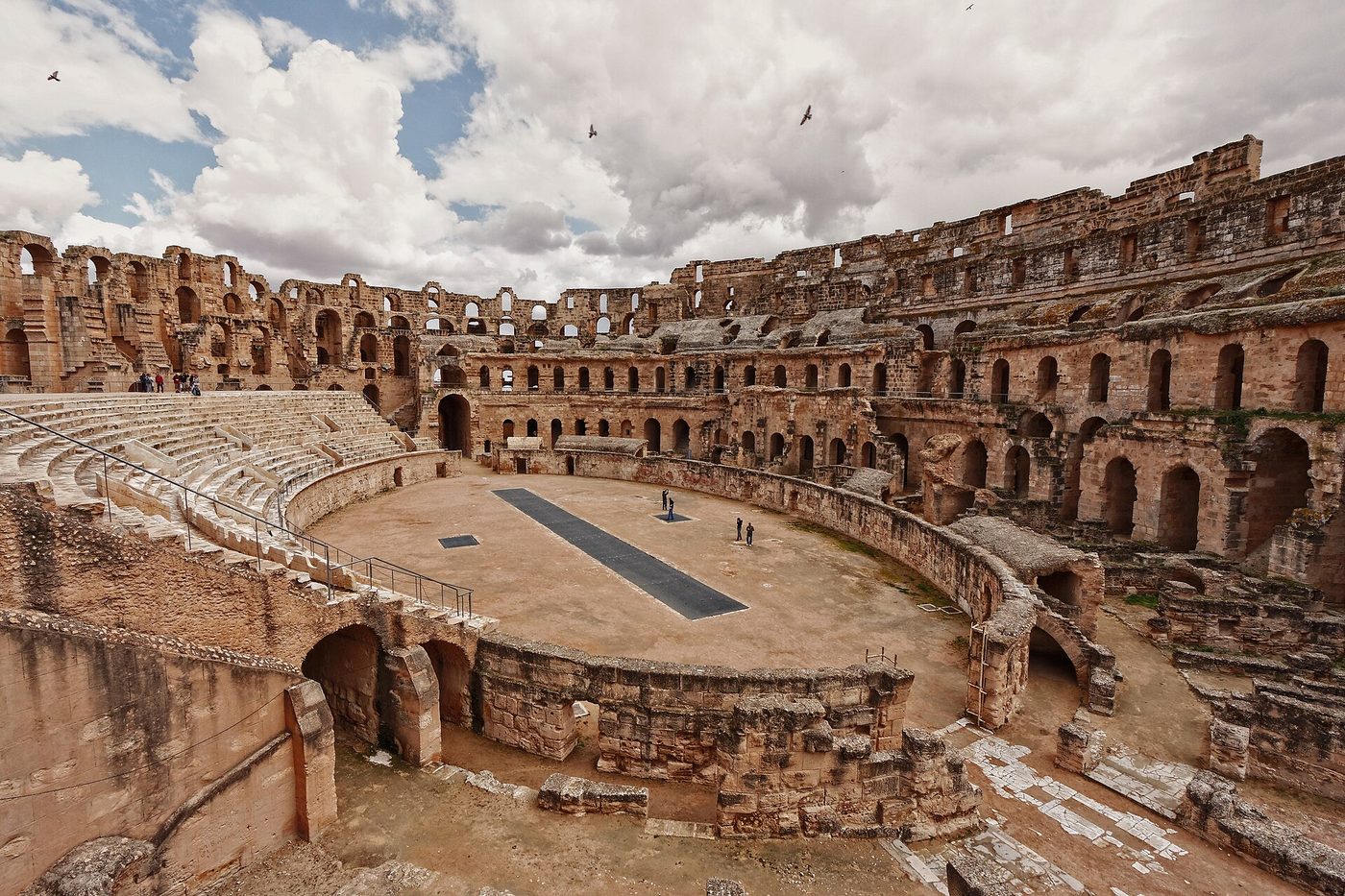
Uthina was a Roman colony founded at the end of the 1st century BC for veterans of the 13th legion, and it reached its peak in the 2nd century AD. The star is the amphitheatre: the AMVPPC ranks it third in Tunisia after El Jem and Carthage, with room for around 16,000 spectators. It has been substantially restored, and you can walk through the vaulted entrance onto the arena floor. If you’ve seen El Jem, think of this as its smaller, quieter cousin, and it is rarely busy.
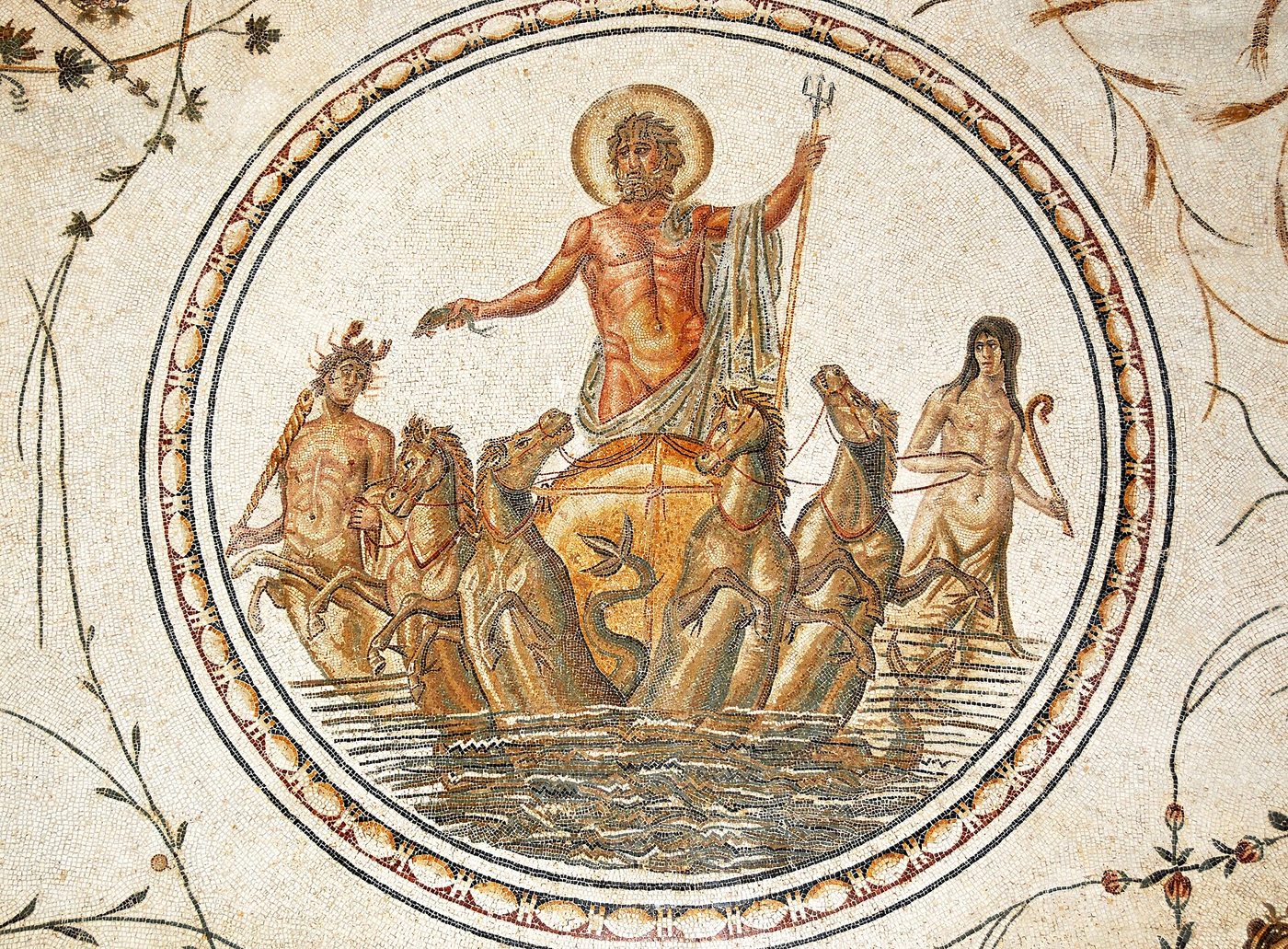
Elsewhere on the site you’ll find the capitol, dedicated to Jupiter, Juno and Minerva; large public baths covering around 10,000 square metres; and the House of Ikarios, a big villa with more than 30 rooms. The mosaic shown in the house today is a copy; for the real thing and many other floors from sites like this, the national collection is the place, and our guide to Tunisia’s Roman mosaics explains where to see the best of them.
| Uthina (Oudhna) | Details (AMVPPC) |
|---|---|
| Hours | 09:00-17:00 in winter and summer; 09:00-16:00 during Ramadan |
| Days | Open all week |
| Entry | 8 TND non-residents (about £2); 5 TND residents |
| Facilities | Shop and cafeteria |
| Time needed | About an hour |

Thuburbo Majus: the big one
If you only add one Roman site to a Zaghouan day, many history lovers would pick Thuburbo Majus. It’s a large, open site in farmland, and its capitol, with tall Corinthian columns standing on a high podium above the forum, is among the best-known Roman views in Tunisia, along with Dougga.
According to the AMVPPC, the site covers 120 hectares, about a third of it inside the visitor area, and around 16 temples have been identified. Thuburbo became a municipium under Hadrian and an honorary colony under Commodus. Look out for the forum and its surrounding buildings, the capitol (whose basement was later turned into an oil mill), the winter and summer baths, and the palaestra, the exercise yard, with its colonnade.
It’s a site that rewards wandering. Paved streets run between the house plots, and the views across the fields to the hills make it feel far more remote than it is. Bring a hat: there’s very little shade.
| Thuburbo Majus | Details (AMVPPC) |
|---|---|
| Winter hours | 08:30-17:30 |
| Summer hours | 08:00-17:00 |
| Ramadan hours | 08:00-17:00 |
| Days | Open all week |
| Entry | 8 TND non-residents (about £2); 5 TND residents |
| Facilities | Toilets, shop and cafeteria |
| Time needed | 1.5-2 hours |

Prices are in Tunisian dinars, with sterling at the Banque Centrale de Tunisie’s rate of 3.96 dinars to the pound on 13 October 2026. Seasonal changeover dates and prices can be revised, so check the AMVPPC’s Thuburbo Majus page and Oudhna page before you set off.
A “follow the water” day trip from Tunis
The sites sit close enough together to make a satisfying loop south of the capital. Here’s how we’d put the day together by car or hired taxi.
| Time | Stop | Notes |
|---|---|---|
| Early morning | Leave Tunis | Head south on the Zaghouan road |
| Morning | Uthina (Oudhna) | Amphitheatre, capitol and baths; about an hour |
| Late morning | Aqueduct arches | Stop at the arcades in the Miliane valley |
| Midday | Zaghouan | The Temple of the Waters, then lunch in town |
| Afternoon | Thuburbo Majus | Allow 1.5-2 hours; check the closing time |
| Evening | Back to Tunis | Watch for more arches in the late light |
You can reverse the order, or drop Thuburbo Majus for a shorter day. If you’re based in Tunis, our guides to Tunis and day trips from Tunis show how Zaghouan compares with Dougga, Bizerte and Cap Bon. Finish the story back on the coast at Carthage, where the water ended up; our guide to visiting Carthage covers the cisterns and baths.
From Hammamet or Sousse
Zaghouan is inland from the Gulf of Hammamet, so it also works from the resorts. From Hammamet it’s a manageable day out, especially if you just do the temple and Thuburbo Majus; see our round-up of day trips from Hammamet. From Sousse it’s a long day, so pick one Roman site and the temple rather than trying to do everything.
Getting to Zaghouan
| Option | How it works | Our verdict |
|---|---|---|
| Hire car | Self-drive from Tunis or Hammamet | The best way. The sites are spread out and you’ll want to stop for arches. |
| Taxi for the day | Agree a full-day price and the stops in advance | Good for two to four people; agree waiting times at each site. |
| Louage | Shared minibus taxis link Tunis with Zaghouan | Cheap and fine for the town and temple, but you’ll need local taxis for Uthina and Thuburbo Majus. |
| Organised tour | Some private tours from Tunis include Zaghouan | Easy, but rare; check which sites are actually included. |
Louage departure points in Tunis change from time to time, so ask your hotel or a taxi driver which station serves Zaghouan, and check the fare at the station before you board. Our guide to getting around Tunisia explains how louages work. Driving is straightforward on the main roads; the usual Tunisian advice applies about patience, roundabouts and the occasional police checkpoint, which is routine.
Is Zaghouan worth it? Our honest verdict
Zaghouan isn’t a headline sight, and it won’t stun you the way El Jem or Dougga can. What it offers is a story you can follow with your own eyes, from the spring to the arches to the towns that grew up along the way, in countryside away from the main tourist routes.
Go if…
- You’ve already seen Carthage, Dougga or El Jem and want something quieter.
- You love engineering stories as much as temples.
- You have a car, or are happy to hire a driver for the day.
- You’d like a green, inland day away from the coast.
Skip it if…
- You only have a few days and haven’t seen the big three.
- You’re relying entirely on public transport and don’t want to juggle louages and taxis.
- You want a mountain hike between May and October, when the national park can be closed to visits in the fire-risk season.
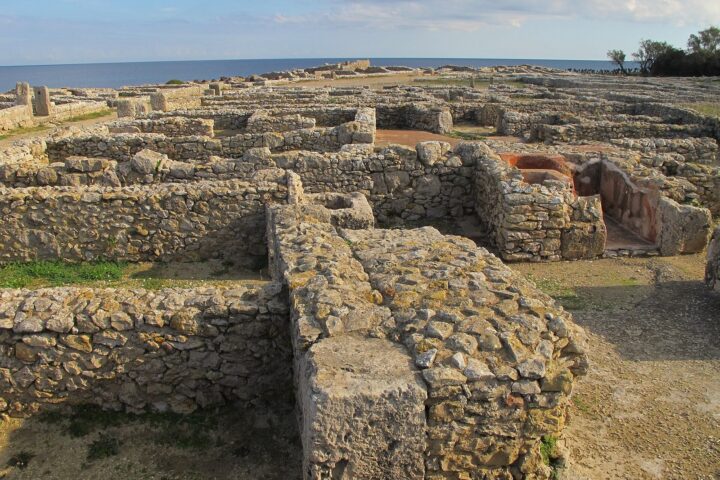
Our view: for anyone spending a week or more around Tunis, a Zaghouan loop is one of the best-value days you can have, especially paired with Thuburbo Majus. For a short city break, Carthage and the Bardo Museum come first. And if you’re collecting ancient sites, Zaghouan sits neatly alongside the Punic town of Kerkouane on Cap Bon as a pair of rewarding detours that many visitors skip.
Practical tips
- Carry cash in dinars. Each Roman site charges at the gate, and you’ll want change for parking and coffee.
- Start early. The sites close in the late afternoon, and Thuburbo Majus needs time.
- Bring water and a hat. Uthina and Thuburbo Majus are open fields with little shade.
- Pack a picnic. The temple park is a lovely place for one.
- Wear decent shoes. Paving is uneven and steps are worn.
- Visit in spring or autumn. Inland Tunisia gets hot in summer; our guide to the best time to visit Tunisia has the month-by-month picture.
- Respect the farmland. View roadside arches from the road or track.
Zaghouan: frequently asked questions
What is Zaghouan famous for?
Zaghouan is famous for the Roman Temple of the Waters and the aqueduct that carried spring water from here to Carthage, which UNESCO’s tentative list gives as 132km long. The town is also known across Tunisia for its roses and nesri, a fragrant water distilled from eglantine flowers, celebrated each late spring with the Nesri Festival.
What is the Temple of the Waters at Zaghouan?
It’s a Roman nymphaeum, a monumental shrine built over the main spring that fed the Carthage aqueduct in the early 2nd century AD. A curved wall lined with niches wraps round a terrace above a basin where the water collected. It sits in a landscaped park on the edge of Zaghouan town, beneath Jebel Zaghouan.
How long is the Zaghouan aqueduct?
UNESCO’s tentative-list entry gives the aqueduct as 132km long, running from the springs at Zaghouan to the La Malga cisterns at Carthage. Most of it ran at ground level or underground; it rose onto arcades, some over 20 metres high, only where it had to cross valleys and plains.
Is the Zaghouan aqueduct a UNESCO World Heritage Site?
It’s on the way there. The Zaghouan-Carthage hydraulic complex has been on Tunisia’s tentative list since 2012, which is the step before a country nominates a site. The entry covers the springs and Temple of the Waters, the aqueduct and the cisterns at Carthage. Carthage itself is already on the World Heritage List.
How far is Zaghouan from Tunis?
Zaghouan lies inland, south of Tunis, and makes a comfortable day trip from the capital by car. Uthina (Oudhna) is on the way, about 30km south-west of Tunis according to the heritage agency. Allow a full day if you want to add Thuburbo Majus and stop at the aqueduct arches.
Can you get to Zaghouan by public transport?
Yes: shared louages run between Tunis and Zaghouan. Ask your hotel which Tunis louage station serves Zaghouan, as departure points can change, and confirm the fare at the station. Getting to Uthina and Thuburbo Majus without a car means arranging local taxis, so a hired car or a taxi for the day is far easier.
How much does it cost to visit Thuburbo Majus?
The heritage agency lists entry as 8 TND for non-residents (about £2) and 5 TND for residents, with the site open all week. Hours are 08:30-17:30 in winter and 08:00-17:00 in summer. Check the AMVPPC page before you travel.
Is Uthina (Oudhna) worth visiting?
Yes, especially if you’re driving to Zaghouan anyway. Its restored amphitheatre is, according to the heritage agency, the third largest in Tunisia after El Jem and Carthage, and it is rarely busy. Add the capitol, the large baths and the House of Ikarios, and it’s an easy, rewarding hour.
Can you hike Jebel Zaghouan?
Usually, in the cooler months. But the regional agriculture office banned visits and camping in the Jebel Zaghouan national park from 1 May to 31 October 2026 because of fire risk. If you’re visiting after that, check with the forestry office or your hotel which paths are open, and never light fires.
When is the Zaghouan rose festival?
The Nesri (Eglantine) Festival takes place in late spring, when the flowers are harvested. The 40th edition ran from 29 May to 7 June 2026. For 2027, check Tunisian press listings or ask the regional tourist office closer to the time.
Final thoughts
Zaghouan is the kind of day that makes a Tunisia trip feel like your own. Expect a Roman temple at a mountain spring, a line of arches marching across the fields and two Roman towns that most visitors skip. Hire a car or a driver, start early, carry dinars, and let the aqueduct lead you home.
For more ancient sites, see our full guide to Tunisia’s Roman ruins, compare the country’s UNESCO World Heritage Sites, or plan a longer self-drive with our Tunisia road trip.
Written by the Tunisia Tourism Guide team — an independent UK-focused guide to travelling in Tunisia. We don’t sell tours or take hotel commissions. Prices and advice were checked at publication; always confirm current details before you book.
Photo credits
All images via Wikimedia Commons, used with thanks: Aqueduct arches on the Tunis to Zaghouan road © Rbsangelo (CC BY-SA 3.0); Steps below the Temple of the Waters © Carole Raddato (CC BY-SA 2.0); The view from Jebel Zaghouan © IssamBarhoumi (CC BY-SA 4.0); Arches of the Zaghouan aqueduct © Noomen9 (CC BY-SA 4.0); The amphitheatre at Uthina © M.Rais (CC BY-SA 3.0); The capitol at Thuburbo Majus © Skander zarrad (CC BY-SA 4.0); The Temple of the Waters at Zaghouan © Rbsangelo (CC BY-SA 3.0).