By the Tunisia Tourism Guide team · Last updated 24 July 2026 · We don’t sell tours or take hotel commissions — this is independent advice, written to be useful.
Tunis quietly earns its keep as a base. You can wake up in the medina, be standing among Roman columns by mid-morning, and be back for dinner having barely touched your dinars — the trick is knowing which trips work as a day out, and which need a car, a guide or an overnight stay.
The best day trips from Tunis are Carthage and Sidi Bou Said (20 minutes on the TGM light rail), Dougga’s peerless Roman ruins near Téboursouk, the Roman Temple of Water at Zaghouan, the northern port of Bizerte, and the pottery towns and beaches of Cap Bon. Most are doable by louage or train if you start early.
Our full Tunis travel guide covers the capital itself; this is its companion for days out — the trips worth the effort, honest journey times, and the real DIY logistics for each: which louage station, which train, and when a guided excursion simply makes more sense. Pair it with our advice on getting around Tunisia and you’re most of the way there.
Day trips from Tunis at a glance
Here’s the shortlist, sorted roughly by how easy each one is to pull off without a car. Times are one-way and approximate — Tunisian transport keeps its own counsel.
| Day trip | Rough time (one way) | Best DIY transport | Go for |
|---|---|---|---|
| Carthage & Sidi Bou Said | 20–40 min | TGM light rail from Tunis Marine | Roman ruins and the blue-and-white village |
| Hammamet | 1–1.5 hrs | Train or louage (southern station) | A walled medina and easy beaches |
| Zaghouan | 1–1.5 hrs | Louage from the southern station | The Roman Temple of Water and mountain air |
| Bizerte | 1.5 hrs | Train or louage from Bab Saadoun | An old fishing port and northern beaches |
| Cap Bon (Nabeul or Kelibia) | 1.5–2 hrs | Louage from Bab Alioua | Pottery, a clifftop fort, white-sand beaches |
| Dougga | 2–2.5 hrs | Louage to Téboursouk, then a taxi | The finest Roman town in North Africa |
| Kairouan | 2–2.5 hrs | Louage from Moncef Bey | Tunisia’s holiest city (a long day) |
A quick word on those louages before we go further. They’re the shared minibuses that link almost every Tunisian town, they leave when full rather than to a timetable, and they’re gloriously cheap. Tunis spreads its long-distance louages across a few stations, grouped loosely by direction — the northern station at Bab Saadoun for the north and west, and the southern stations (Bab Alioua and the larger Moncef Bey) for the Sahel, the south and Cap Bon. Stations do get reshuffled, so confirm which one serves your route before you set off.
The easy classics: Carthage and Sidi Bou Said
If you only manage one day out, make it this one — and it barely counts as a day trip, because both sit on the same suburban rail line as the city. The TGM (the Tunis–Goulette–Marsa light rail) leaves from Tunis Marine station at the sea end of Avenue Habib Bourguiba, and rattles out along the lakeside causeway to the coast for a fare of well under a dinar.
Get off at one of the Carthage stops — Carthage Hannibal is handiest for the main sites — to wander the ruins of the city Rome spent three wars trying to destroy: the Antonine Baths above the sea, the Punic ports, the theatre and the museum on Byrsa Hill. Then hop two stops further to Sidi Bou Said, the cliff-top village of blue shutters and white walls that everyone photographs and nobody regrets. We cover both properly in our guides to Carthage and Sidi Bou Said, so we won’t repeat the whole story here — just know the two pair into one very civilised half-day, and the TGM makes it effortless.
The other great sight of the capital, the Bardo Museum and its incomparable Roman mosaics, is technically in Tunis itself rather than a trip out — but if the weather turns, it’s the obvious wet-afternoon plan.
Dougga: the finest Roman town in North Africa
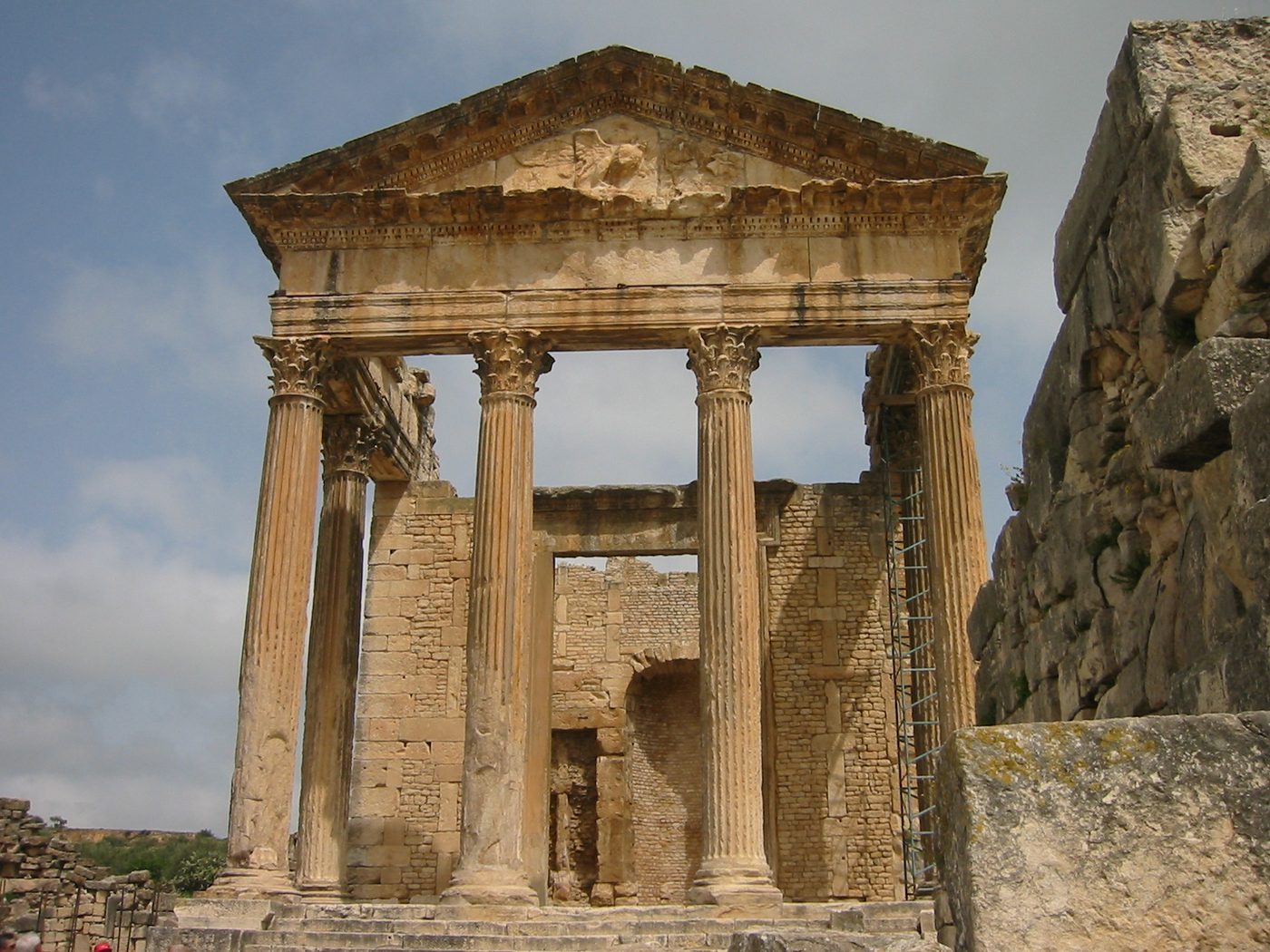
This is the big one — the day trip that history lovers build a whole visit around. Dougga (ancient Thugga) sprawls across a hillside of olive groves near Téboursouk, about 110 km west of Tunis, and it is, to our eyes, the most complete and atmospheric Roman town anywhere in North Africa. You wander actual streets: a Capitol with its columns still standing, a theatre cut into the slope, temples, baths, a market, even a preserved brothel and communal latrines. And you’ll often have long stretches of it entirely to yourself.
The honest part is the logistics. By public transport it’s a two-leg job: take a louage from Bab Saadoun (the northern station) to Téboursouk — reckon on an hour and a half or so, and somewhere around 7–8 TND (2026 — check current). Téboursouk is not Dougga, though; the ruins are a few kilometres further on, so you then negotiate a taxi (the white-with-a-red-stripe kind) for the short run up to the site and back, perhaps 20 TND for the return with a wait (agree the price first). Entry to the site is a modest fee, roughly 8–12 TND in 2026 — confirm on arrival.
The thing that trips people up is the return. The last louage back to Tunis can leave Téboursouk by mid-to-late afternoon, so this is not a lie-in kind of day: go early, keep an eye on the time, and have a fallback (there are buses too, from the stop across the road). Given all that, Dougga is the one trip where we think a guided excursion or a hired driver genuinely earns its fee — it removes the taxi haggling and the anxious clock-watching, and often folds in a second site nearby. Our Tunisia excursions guide weighs up the options, and Dougga tops our roundup of the country’s Roman ruins.
Zaghouan: the Temple of Water and the great aqueduct
Fewer visitors make it to Zaghouan, which is exactly why we like it. This small town sits beneath Jebel Zaghouan, a 1,295-metre wall of grey mountain about 60 km south of Tunis, and the air up here is noticeably cooler and cleaner than in the city. The draw is the Temple of Water — a Roman nymphaeum, a semicircle of niches built around the spring that the Romans tapped to supply Carthage.
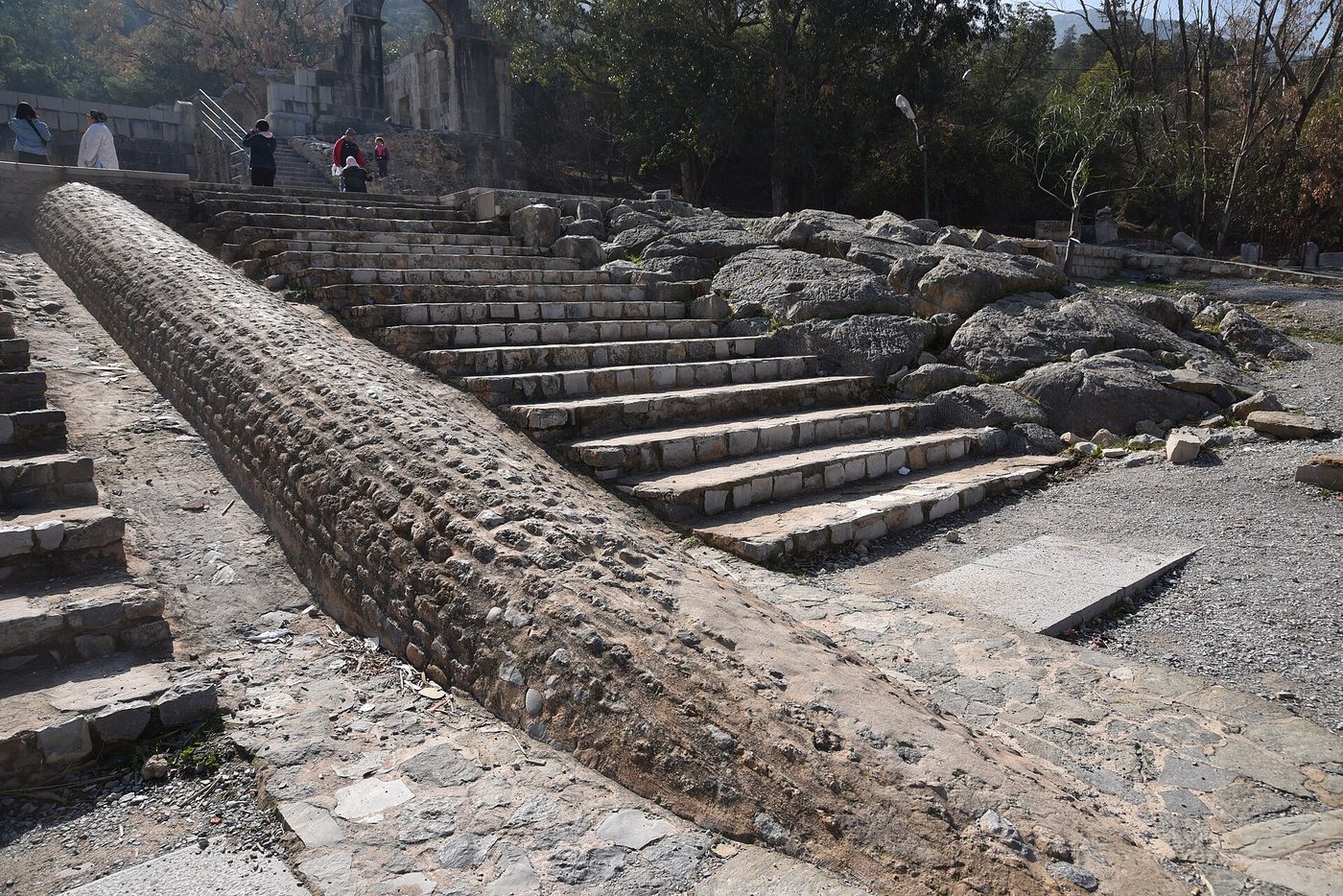
And what a supply line it was. From this spring, a 2nd-century aqueduct carried water more than 130 km north to Carthage — one of the longest in the entire Roman world. You can still see great stretches of its arches marching across the plains south of Tunis, most dramatically near Oudhna (Uthina) where the channel strides across a valley on tiers of stone. The temple itself is usually free or a token fee to enter, and the setting — mountain behind, ancient stone in front — is genuinely lovely.
By public transport, take a louage from the southern station towards Zaghouan; it’s roughly an hour and costs only a few dinars (hedge on both — check current). It’s a quiet, low-key half-day rather than a blockbuster, best paired with a general interest in Roman engineering. Combining it with the aqueduct arches and a nearby site like Oudhna really wants a car or a driver, since public transport between the smaller sites is thin.
Bizerte: the old port of the far north
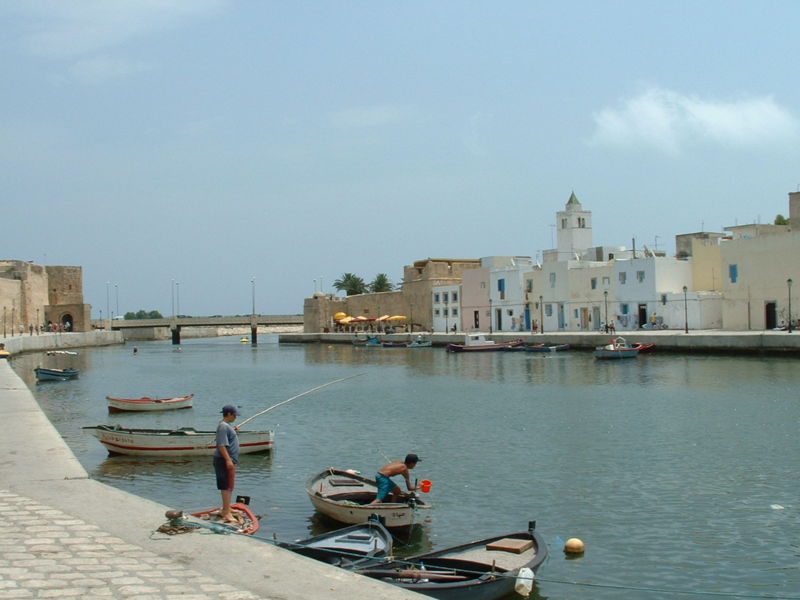
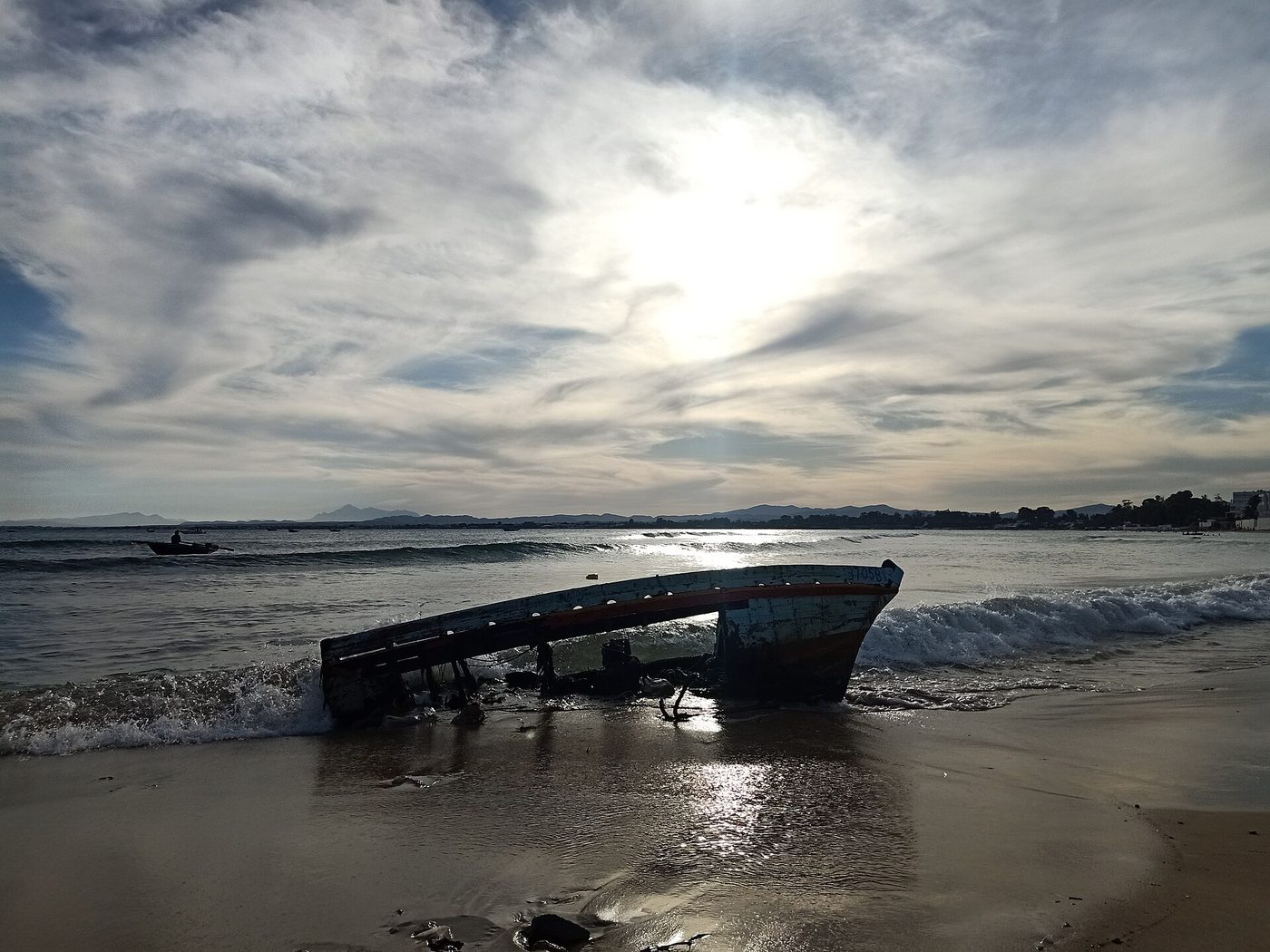
Head the other way — due north — and you reach Bizerte, the northernmost city in Africa and a proper working port with a soft spot for its own past. The star turn is the old harbour (the Vieux Port): a narrow channel lined with pastel houses and faded fishing boats, watched over by an old kasbah and a Spanish-built fort. Fishermen still mend nets on the quay, and you can eat the morning’s catch, grilled, at a simple table by the water.
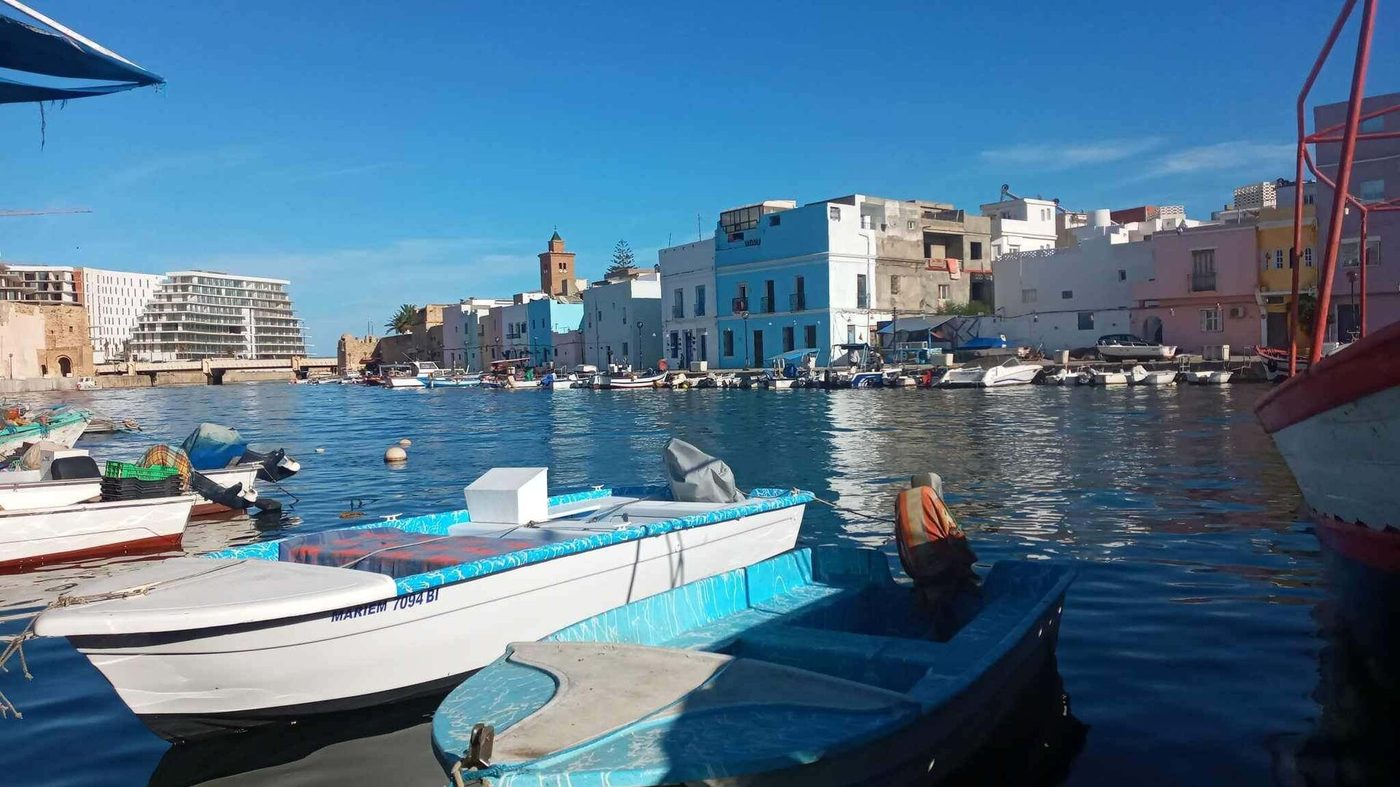
Getting there is refreshingly simple by Tunisian standards. Trains run from Tunis to Bizerte in around an hour and a half for a handful of dinars, though the timetable is sparse and some services don’t run at weekends, so check before you commit. Louages from Bab Saadoun cover the same route and are often quicker. Either way it’s an easy full day.
With your own wheels — or a driver — Bizerte opens up further. The Cap Blanc peninsula just north has long, empty sandy beaches, and the truly determined can push on to Cap Angela, the northernmost point of the whole African continent, for a photo beside the sign. Roughly half an hour inland lies Lake Ichkeul National Park, a UNESCO-listed wetland where flamingos and huge flocks of wintering birds gather; it’s a highlight for nature lovers but needs a taxi or car from Bizerte to reach properly. It’s one of the country’s quieter northern corners.
Cap Bon: pottery, a clifftop fort and hot springs
The Cap Bon peninsula juts north-east towards Sicily and is Tunisia’s market garden — all citrus groves, vineyards and long beaches. It’s really a two- or three-day loop if you want to do it justice, but as a day trip from Tunis you pick one anchor and enjoy it properly rather than racing round the lot.
The usual choices, from nearest to furthest:
- Nabeul — the peninsula’s capital and the pottery centre of Tunisia, best on a Friday when the big weekly market fills the streets. Good for ceramics, a laid-back seafront and an easy introduction to the area. Read up in our Nabeul guide.
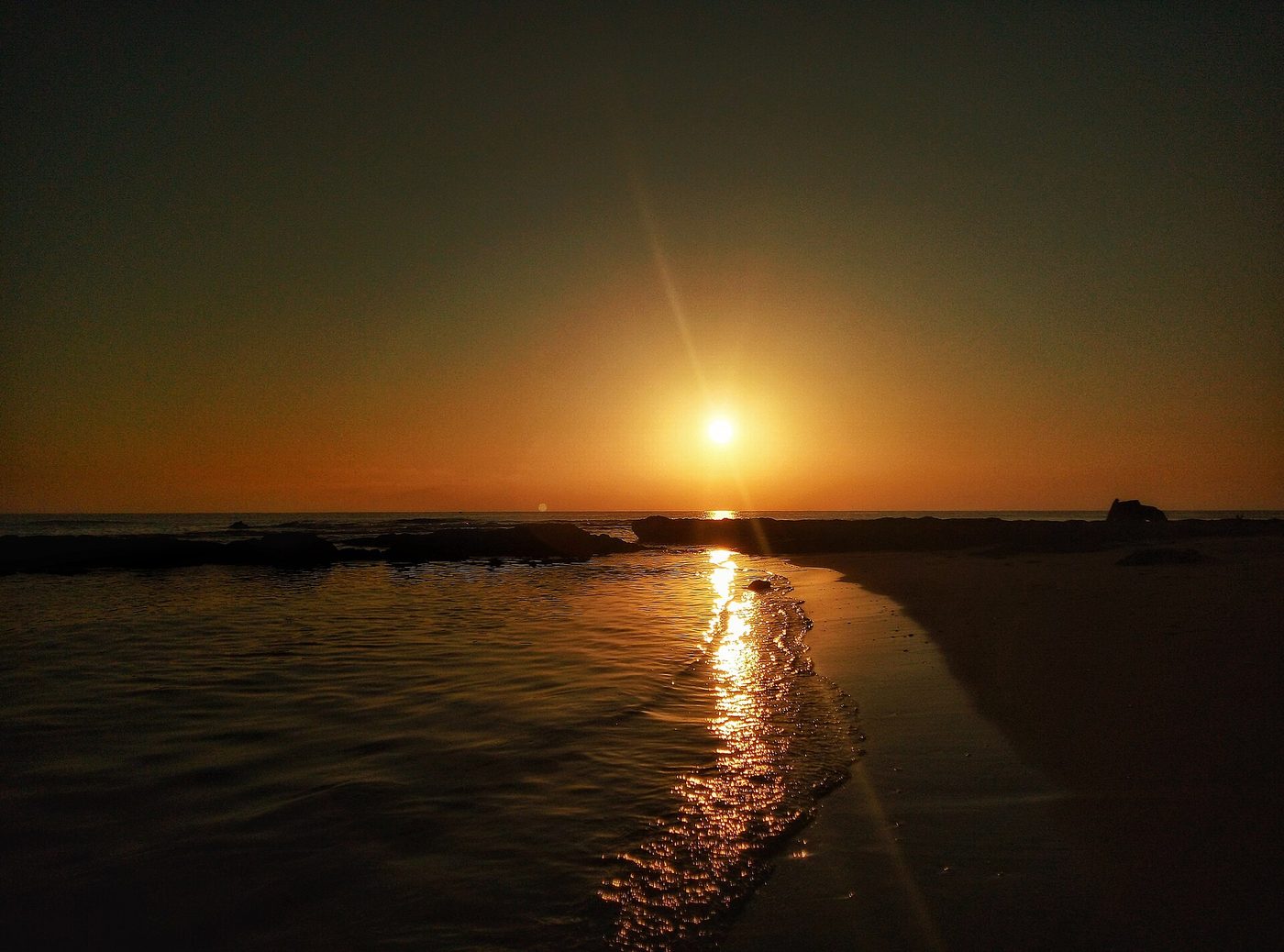
- Kelibia — further out and worth the extra time: a honey-coloured fort on a 150-metre crag above the sea, and one of the loveliest white-sand beaches in the country below it. Our Kelibia guide has the detail.
- Korbous — a cluster of natural hot springs that steam straight into the Mediterranean, a spa spot since Roman times. It’s magical in the cooler months but fiddly without a car (you generally change louages at Soliman), and a place we’d only chase if you’re set on the soak.
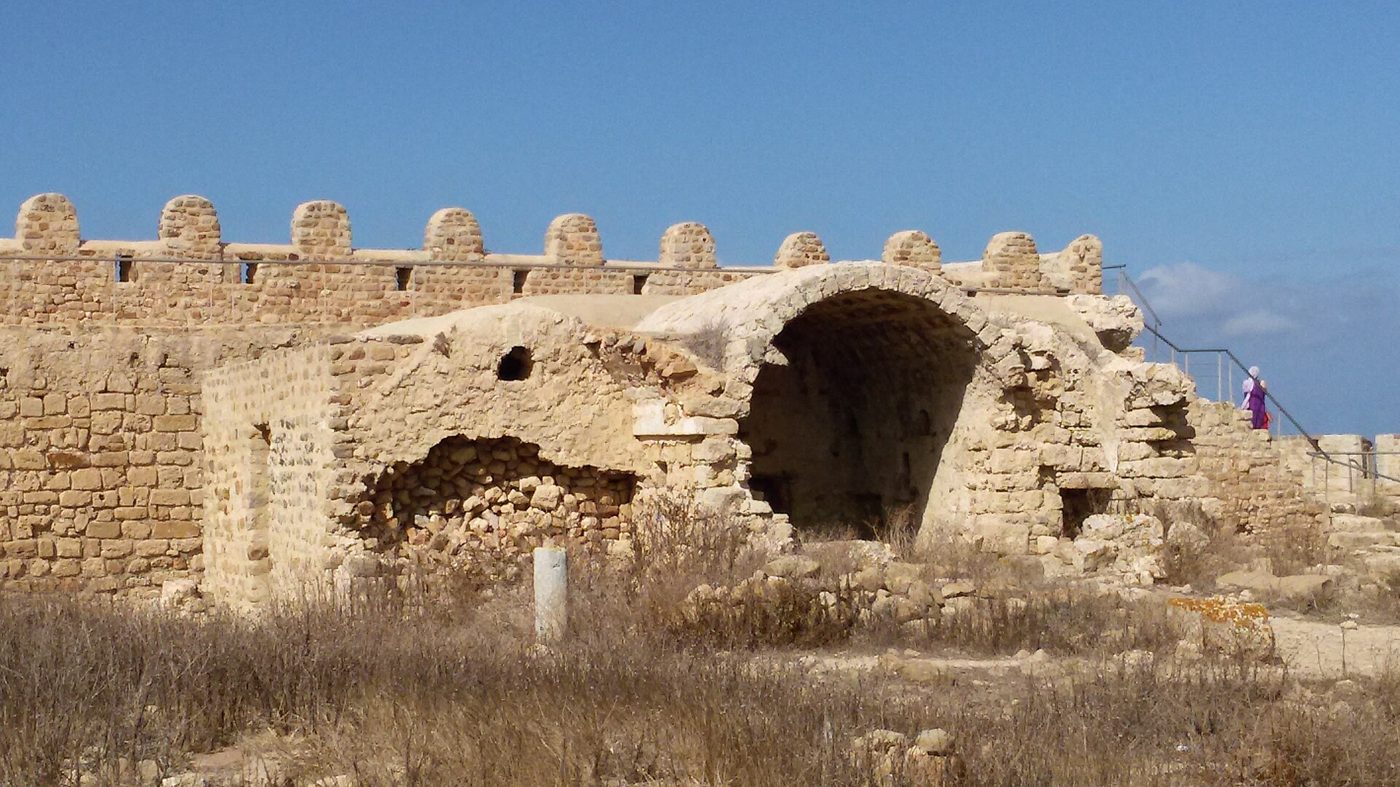
For DIY transport, louages to Nabeul and Kelibia leave from Bab Alioua (Cap Bon and the east are its patch), taking around an hour and a half to two hours and costing roughly 10–15 TND (2026 — check current). The whole peninsula is covered in our Cap Bon guide. Honestly, though, Cap Bon rewards a car more than almost anywhere near Tunis — the good bits are strung out along the coast, and public transport between them is slow going.
Hammamet: a medina and a beach by train or louage
If your idea of a day out involves sand rather than centuries, Hammamet is the pick. About 65 km south-east of Tunis, it’s the country’s original beach resort, and it wears the role well: a compact walled medina rising straight from the sand, a 15th-century kasbah to climb, and long beaches on either side of the old town.
It’s one of the more train-friendly trips. Direct services run from Tunis, though they’re limited — often just one convenient daytime departure — so check the current timetable, or fall back on a louage from Bab Alioua, which takes around an hour to an hour and a half. Once there, the medina and the nearest beach are an easy walk from the centre. We’ve got the full picture in our Hammamet guide, and a closer look at the sand in our guide to Hammamet beach. It also makes a natural stepping stone into Cap Bon if you fancy stringing a couple of days together.
For ruins fans: Thuburbo Majus, Utica and Andalusian Testour
Beyond Dougga, the plains around Tunis are quietly littered with Roman and Punic sites that almost nobody visits — catnip if you love having ancient stones to yourself.
Thuburbo Majus, near El Fahs about 60 km south, is a grand Roman town laid out on a neat grid, with a columned forum, temples and bath complexes. Unlike hillside Dougga it’s spread across open ground, and you’ll very likely wander it alone. Utica (Utique), north of Tunis on the way towards Bizerte, was an ancient Punic and Roman port — older than Carthage — with mosaics still in place and a small museum. And to the south, near Oudhna, the ruins of Uthina add an amphitheatre and that soaring stretch of aqueduct.
For something completely different, Testour is an Andalusian town founded in the 17th century by Muslims and Jews expelled from Spain, who rebuilt their old life on the Medjerda river. Its Great Mosque is unlike any other in Tunisia — Spanish-tiled, with a minaret that carries a clock whose numerals were, famously, set to run backwards. It sits on the road out towards Téboursouk, so keen travellers sometimes fold it in with Dougga.
All of these are reachable by louage from Bab Saadoun (for the northern and western sites) or the southern stations (for El Fahs), usually with a taxi hop at the end — but they’re scattered, and the truly rewarding way to see two or three in a day is with a driver or a small-group tour. They all feature in our guide to Roman ruins in Tunisia.
Kairouan: doable in a day, but a long one
People often ask about Kairouan, and the answer is: yes, but. Tunisia’s holiest city — home to the vast, austere Great Mosque of Uqba and the graceful Aghlabid water basins — sits about 160 km south of Tunis. Louages run from Moncef Bey and take two to two and a half hours each way, which means a very early start and a fair chunk of your day spent on the road.
It’s absolutely feasible, and worth it if Kairouan is a must-see, but you’ll get more from it either as an overnight stop or as a day trip from Sousse, which is markedly closer — see how it fits in our day trips from Sousse guide. If you’re building a longer route around the country, our Tunisia itinerary shows where the holy city slots in without a mad dash.
Guided excursion or do it yourself?
There’s no single right answer here, so here’s how we’d think about it. For anything on the TGM or a direct train — Carthage, Sidi Bou Said, Bizerte, Hammamet — DIY is cheap, easy and part of the fun. For the far-flung ruins that need a louage plus a taxi and careful timing to get home — Dougga above all, plus Thuburbo Majus, Zaghouan and Testour — a guided excursion or a private driver for the day often works out better value than it looks, once you factor in the faff and the risk of missing the last ride back.
A middle path many readers like: use louages and trains for the coastal, well-connected trips, and book one guided day (or hire a driver through your hotel) for a big inland ruins loop that ties Dougga, Zaghouan and a Roman site or two into one efficient trip.
Know before you go
A few things that make day-tripping from Tunis smoother:
- Start early. Louages thin out and the last ones back can leave inland towns by mid-afternoon. An 8am departure buys you the whole day and a safety margin.
- Carry small cash. Louage fares, site tickets and taxis are all cash, in dinars. The dinar is a closed currency — you can only get it inside Tunisia — so change money on arrival and keep small notes handy. Reckon on roughly £1 to 3.8–3.9 TND, but check the current rate.
- Agree taxi prices first. For the Téboursouk–Dougga hop and similar, settle the fare (and any waiting time) before you get in. Insist on the meter for city taxis.
- Check the day. Some trains don’t run at weekends or on public holidays, and Nabeul’s market is a Friday thing. A little planning avoids a wasted trip.
- Dress for sites and mosques. Sensible shoes for uneven Roman streets, and modest cover for religious buildings like Kairouan’s Great Mosque and Testour’s mosque.
- Time of year matters. Spring and autumn are ideal for the exposed ruins; high summer bakes them. Our best time to visit guide breaks it down.
- Base yourself well. Where you stay changes which trips are easiest — the coastal suburbs favour the TGM classics, the centre favours the louage stations. See our where to stay in Tunis guide.
Day trips from Tunis: your questions answered
What are the best day trips from Tunis?
The standouts are Carthage and Sidi Bou Said together (20 minutes on the TGM), the Roman ruins of Dougga near Téboursouk, the Temple of Water at Zaghouan, the northern port of Bizerte, and the pottery and beaches of Cap Bon. Hammamet adds an easy beach day, and Kairouan is possible if you start early.
Can you visit Dougga as a day trip from Tunis?
Yes. Dougga is about 110 km west and very doable in a day, but the logistics take planning: a louage from Bab Saadoun to Téboursouk, then a taxi for the last few kilometres to the site. Go early, as the last louage back can leave by mid-afternoon. Many people prefer a guided tour to skip the faff.
How do you get from Tunis to Dougga without a car?
Take a louage (shared minibus) from the Bab Saadoun station to Téboursouk — roughly 90 minutes and around 7–8 TND. Téboursouk is a few kilometres short of the ruins, so hire a local taxi for the return run to the site, agreeing the price first. Keep a close eye on the time for the journey home.
Is Carthage a day trip from Tunis?
Barely — it’s more of a half-day, and one of the easiest outings anywhere. The TGM light rail from Tunis Marine reaches the Carthage stops in about 20–30 minutes for well under a dinar. Most people pair the ruins with the neighbouring blue-and-white village of Sidi Bou Said, two stops further along the same line.
How far is Zaghouan from Tunis?
Zaghouan is about 60 km south of Tunis, roughly an hour by louage from the southern station. The town sits beneath a 1,295-metre mountain and its highlight is the Roman Temple of Water, the spring that once fed Carthage through a 130-km aqueduct. It’s a quiet, cool-air half-day rather than a major sight.
Can you do Hammamet as a day trip from Tunis?
Easily. Hammamet is around 65 km south-east, reachable by a direct (if limited) train from Tunis in about an hour and a quarter, or a louage from Bab Alioua in around an hour to 90 minutes. You get a walled medina, a kasbah and beaches within an easy walk of the centre — a good beach-and-culture day.
Is Bizerte worth visiting from Tunis?
If you like working ports and quieter corners, yes. Bizerte’s old fishing harbour, kasbah and Spanish fort make a relaxed full day, and trains or louages get you there in about 90 minutes. With a car you can add the empty beaches of Cap Blanc or the birdlife of Lake Ichkeul, both a short hop beyond the town.
What is the Temple of Water in Zaghouan?
It’s a Roman nymphaeum — a monumental fountain built around the mountain spring at Zaghouan in the 2nd century AD. From here, an aqueduct more than 130 km long carried water north to Carthage, and you can still see its arches striding across the plains south of Tunis. The temple setting, below the mountain, is beautifully atmospheric.
Can you visit Kairouan as a day trip from Tunis?
You can, but it’s a long day. Louages from Moncef Bey take two to two and a half hours each way, so you’ll spend four or five hours travelling. It’s worth it if Kairouan is a priority, but many travellers find it easier as an overnight stay or as a shorter day trip from Sousse.
Are guided tours from Tunis worth it, or should I go by louage?
It depends on the trip. For anything on the TGM or a direct train — Carthage, Bizerte, Hammamet — going independently by louage or rail is cheap and simple. For scattered inland ruins like Dougga, Thuburbo Majus and Zaghouan, a guided excursion or a hired driver often saves enough hassle and time to justify the cost.
What is a louage and how do I use it for day trips?
A louage is a shared minibus (usually a white van with a coloured stripe) that runs fixed routes between towns, leaving when full rather than on a timetable. You find the right one at the relevant Tunis station, pay a small cash fare on board, and go. They’re the cheap, local way to reach most day-trip destinations.
Written by the Tunisia Tourism Guide team — an independent UK-focused guide to travelling in Tunisia. We don’t sell tours or take hotel commissions. Prices and advice were checked at publication; always confirm current details before you book.
Photo credits
All images via Wikimedia Commons, used with thanks: The Roman Capitol and columns at Dougga © Alexander Käser (CC BY-SA 3.0); The Roman Temple of Water at Zaghouan © Carole Raddato (CC BY-SA 2.0); The old fishing harbour at Bizerte in northern Tunisia © Amin Smiri (CC0); The clifftop fort above the sea at Kelibia on the © Hamdikhouloud (CC BY-SA 4.0).