By the Tunisia Tourism Guide team · Last updated 20 August 2026 · We don’t sell tours or take hotel commissions — this is independent advice, written to be useful.
Most people arrive at Hammamet’s old town braced for the full medina experience — the crush, the maze, getting hopelessly lost. It isn’t that. Hammamet’s medina is small, whitewashed and right on the sea, which makes it one of the easier old towns in Tunisia to enjoy.
The Hammamet medina is a small, whitewashed 15th-century walled town right on the sea, easily walked in a couple of hours. The highlight is climbing the kasbah walls for the view over the bay; below it lie the souk lanes, the Great Mosque and cafés by the ramparts. Allow a relaxed half-day.
This walking guide to the old town is a companion to our wider guide to things to do in Hammamet. Here we cover what to see, what it costs, how to haggle without being fleeced, and the couple of culture add-ons nearby that turn a two-hour wander into a proper half-day — zooming in on the walls, the fort and the lanes inside them.
Hammamet medina at a glance
The quick version, before we walk you round it:
| What | The short answer |
|---|---|
| Size | Small — a compact walled quarter you can cross in minutes and see properly in a couple of hours |
| Built | Walls raised in the 15th century under the Hafsid dynasty, on much older foundations |
| Cost to enter | Free to wander the lanes and souks; the kasbah charges a small fee (see below) |
| The highlight | Walking the kasbah ramparts for the view over the bay |
| Best time | Early morning or late afternoon — cooler, softer light, fewer crowds |
| How long | Two hours for the medina itself; half a day with the culture add-ons nearby |
One thing to clear up first: there are two “medinas” in Hammamet. This guide is about the real one — the 15th-century walled old town on the headland. The other, in Yasmine Hammamet a few kilometres south, is a purpose-built shopping-and-dining complex dressed up as an old town, put up in the 1990s. It’s fine for an evening browse, but it isn’t the historic quarter, and it’s the real one you’ve come for.
The medina: small, white and on the water
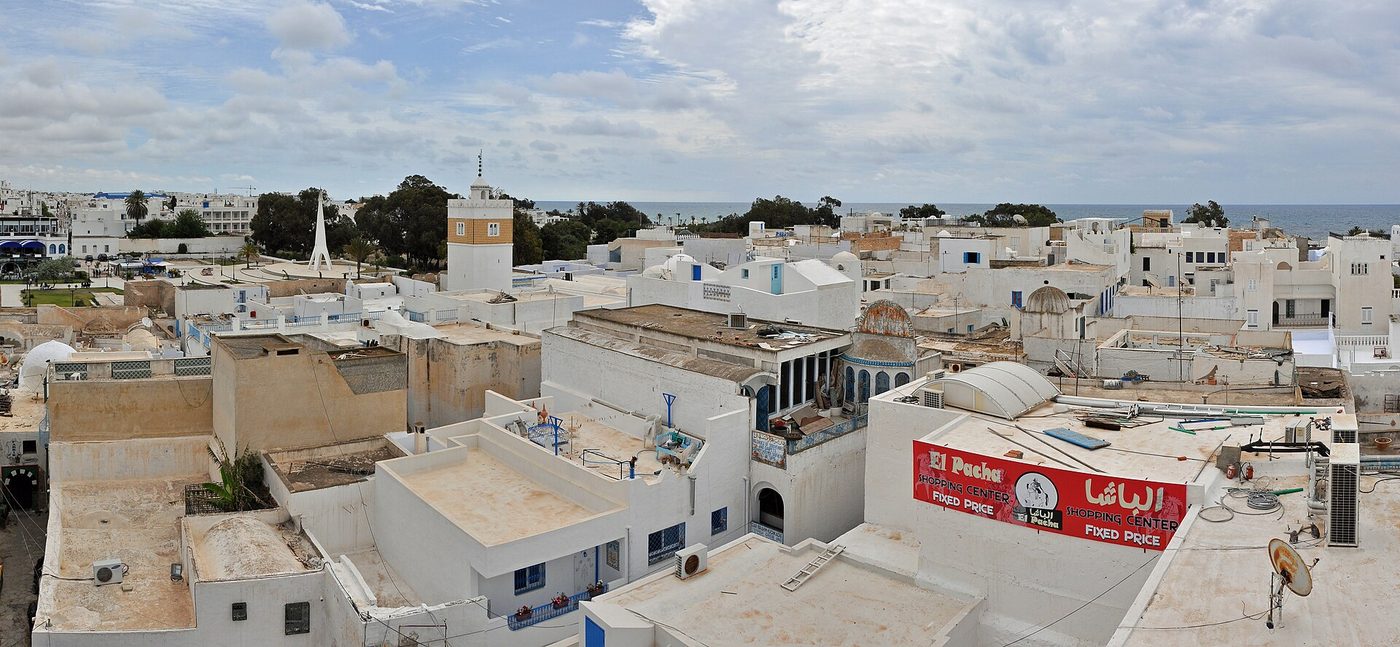
The old town occupies a small point at the southern edge of the modern resort, right by the sea, and its ramparts wrap the whole thing, pierced by three gates. Its walls went up in the 15th century under the Hafsids, and the layout inside follows the classic Arab-Muslim medina pattern: a clear separation of public and private life, with the busy souk lanes near the gates giving way to quiet, whitewashed residential alleys as you head in.
What strikes you first is the white. The lime-washed houses, the painted blue and yellow and green doors, the fort and the foam against the sea wall are all more or less the same colour, and after a while you stop reading the buildings as separate things. It’s a genuinely lovely place to wander, and — this matters — it’s small enough that you cannot really get lost, but big enough to lose an hour without noticing.
That compactness is the whole appeal. If the sheer scale of the medinas in Tunis or Sousse feels like hard work — and for a lot of first-timers it does — Hammamet is the gentle version: all the atmosphere, none of the overwhelm. You can dip in, see the highlights and be back on the beach or in a café inside a couple of hours. It’s one of the reasons the town works so well as a first taste of Tunisian culture; our wider guide to Tunisian culture and etiquette fills in the background if you want it.
The kasbah: climb the walls for the view
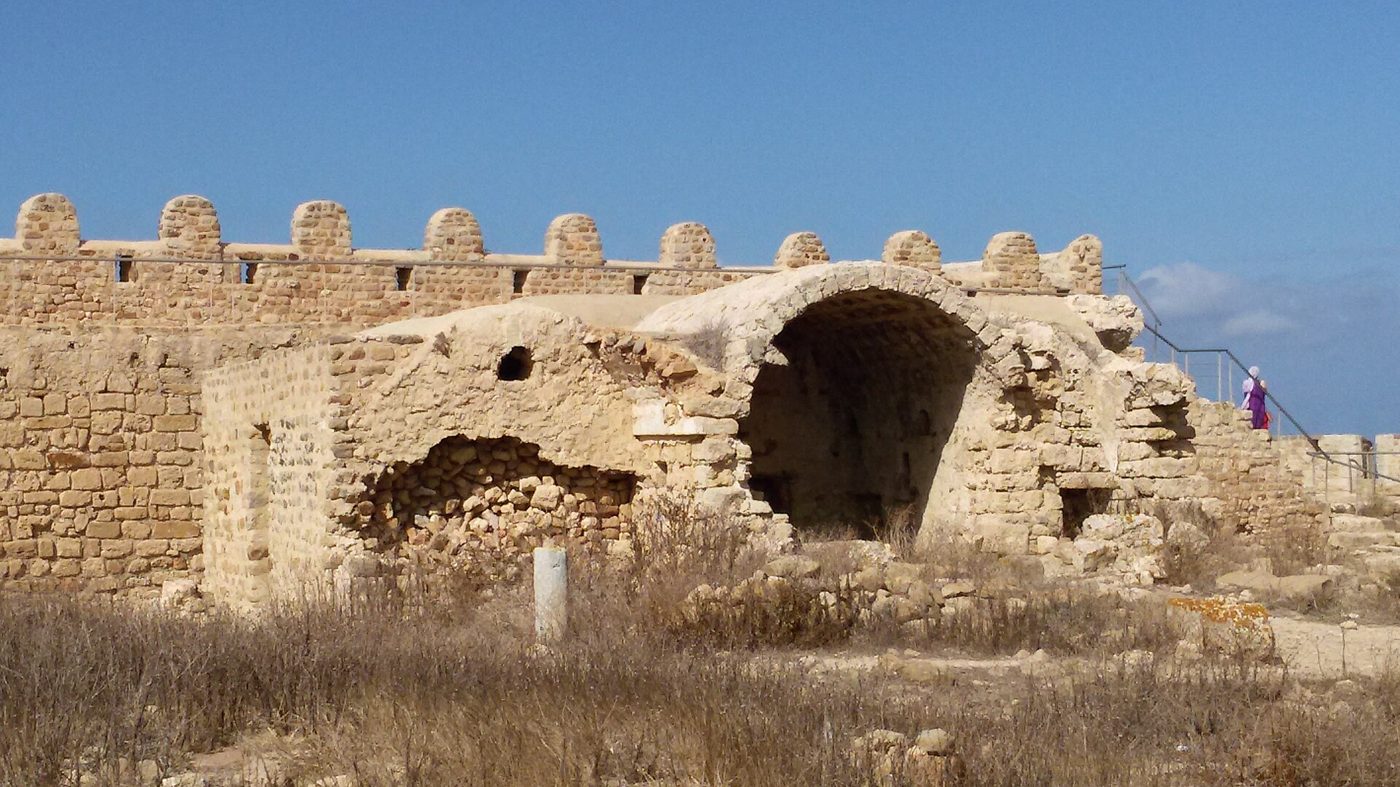
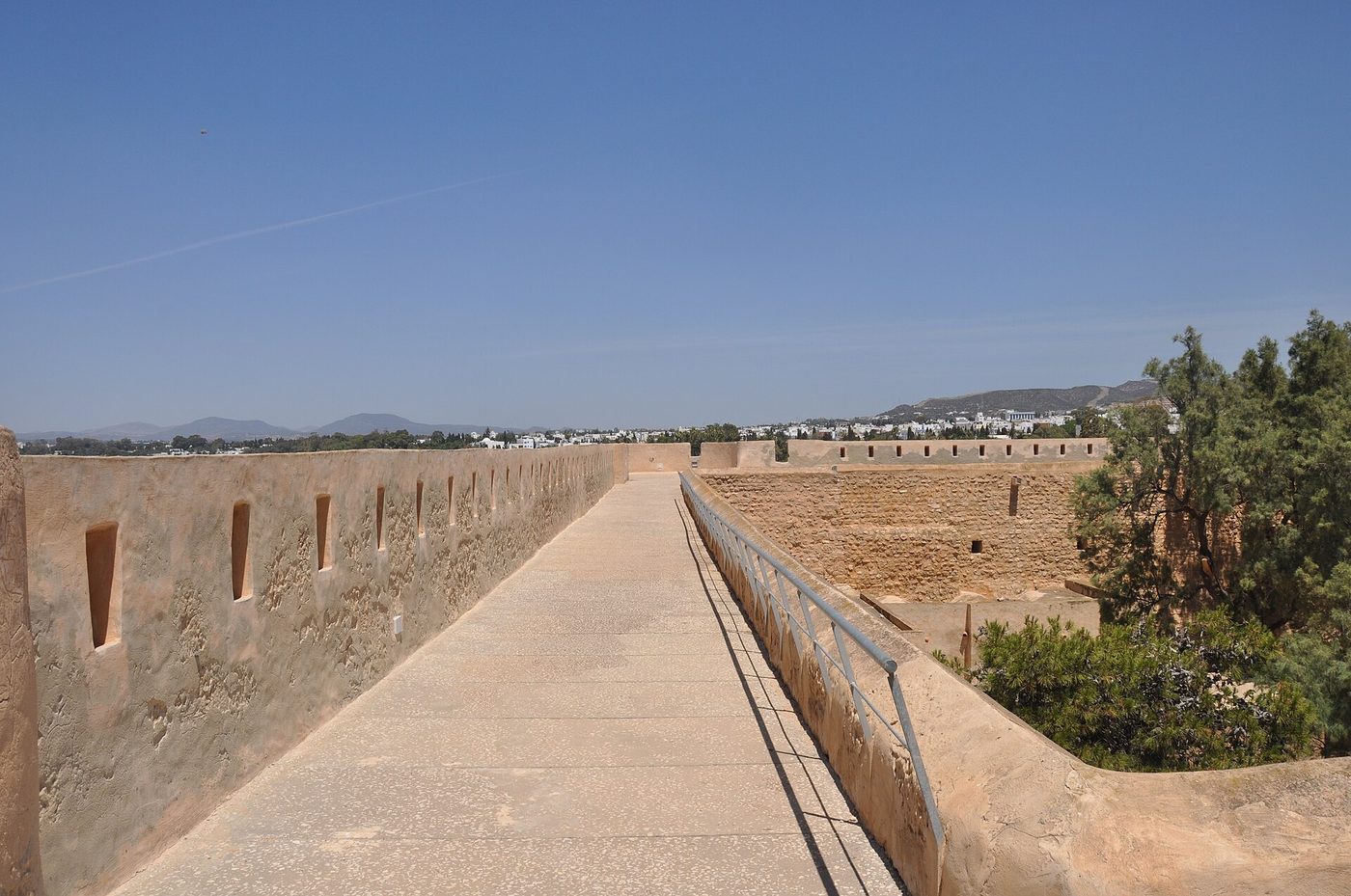
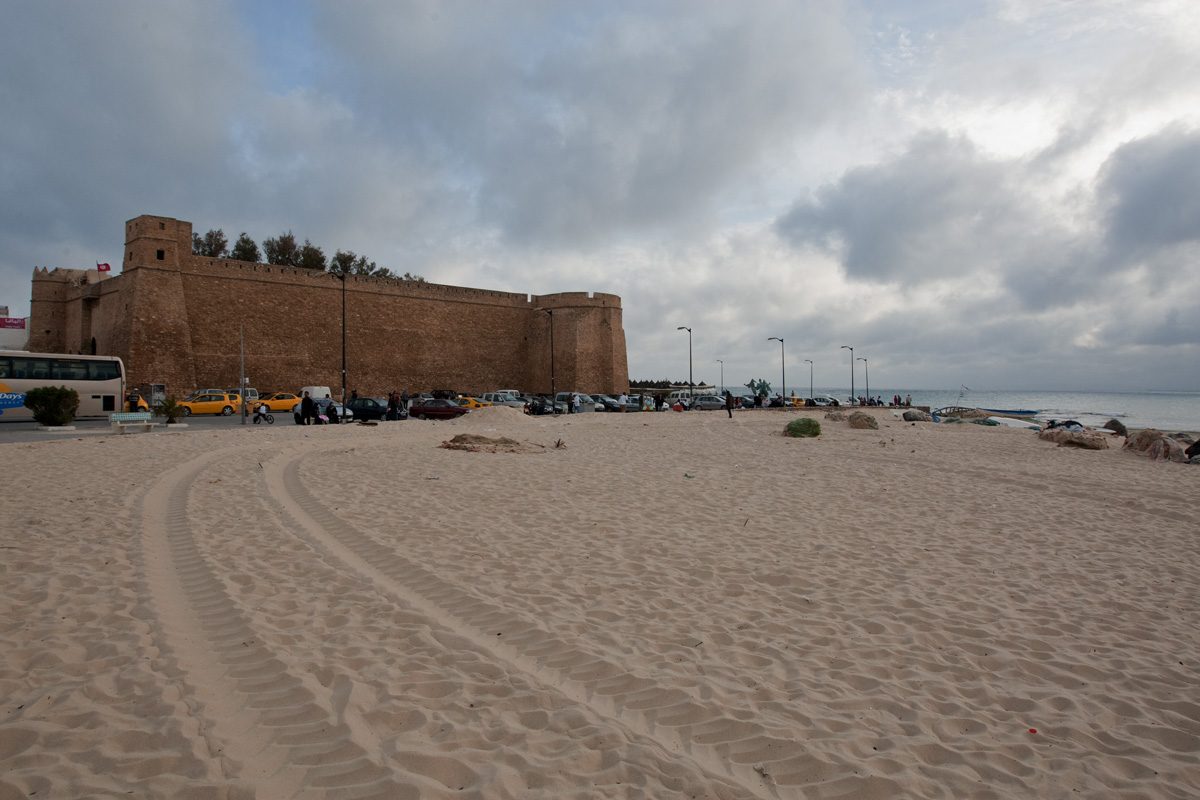
The kasbah anchors the seaward corner of the medina, a squat, honey-coloured fort sharing a wall with the old town. There’s been a stronghold on this spot since the medieval period — sources variously date its origins to the 12th, 13th or 15th century — and it took roughly its present shape under the Hafsids in the 1400s. It was built to keep out the raiding fleets coming across from Sicily and the Spanish coast, and it served as a working military post into the 19th century.
Inside there’s a small museum, but let’s be honest: the point is the rampart walk. You climb up onto the walls and the whole sweep of the Gulf of Hammamet opens out in front of you — the beach curving away to the south, the medina’s white rooftops on one side, the fishing boats drawn up on the sand directly below. It’s the single best view in the old town and one of the more memorable in this part of Tunisia. Don’t rush it.
On the practical detail, and with the usual caveat that prices and hours drift in Tunisia: entry to the kasbah was in the region of 7 to 8 dinars (roughly £2) when we checked, with children less, and it opens through the day — very roughly 8am to around 5.30 or 6pm. Treat those as a guide rather than gospel, and confirm at the gate. Restoration has been an on-and-off saga here for years, so don’t be surprised by the odd scaffold pole or a shortage of interpretive signs — you’re paying for the walls and the view, not a polished museum.
Set into the seaward rampart is Café Sidi Bou Hdid, and it’s worth building your visit around it. White-painted benches, a low parapet, and a long drop to the surf below — order a Tunisian mint tea (watch for the pine nuts at the bottom of the glass) and sit for an hour. Few glasses of tea in Tunisia come with a better view. It’s the sort of unhurried pause the old town is made for, and a natural halfway point on the walk we set out below.
The Great Mosque and the lanes around it
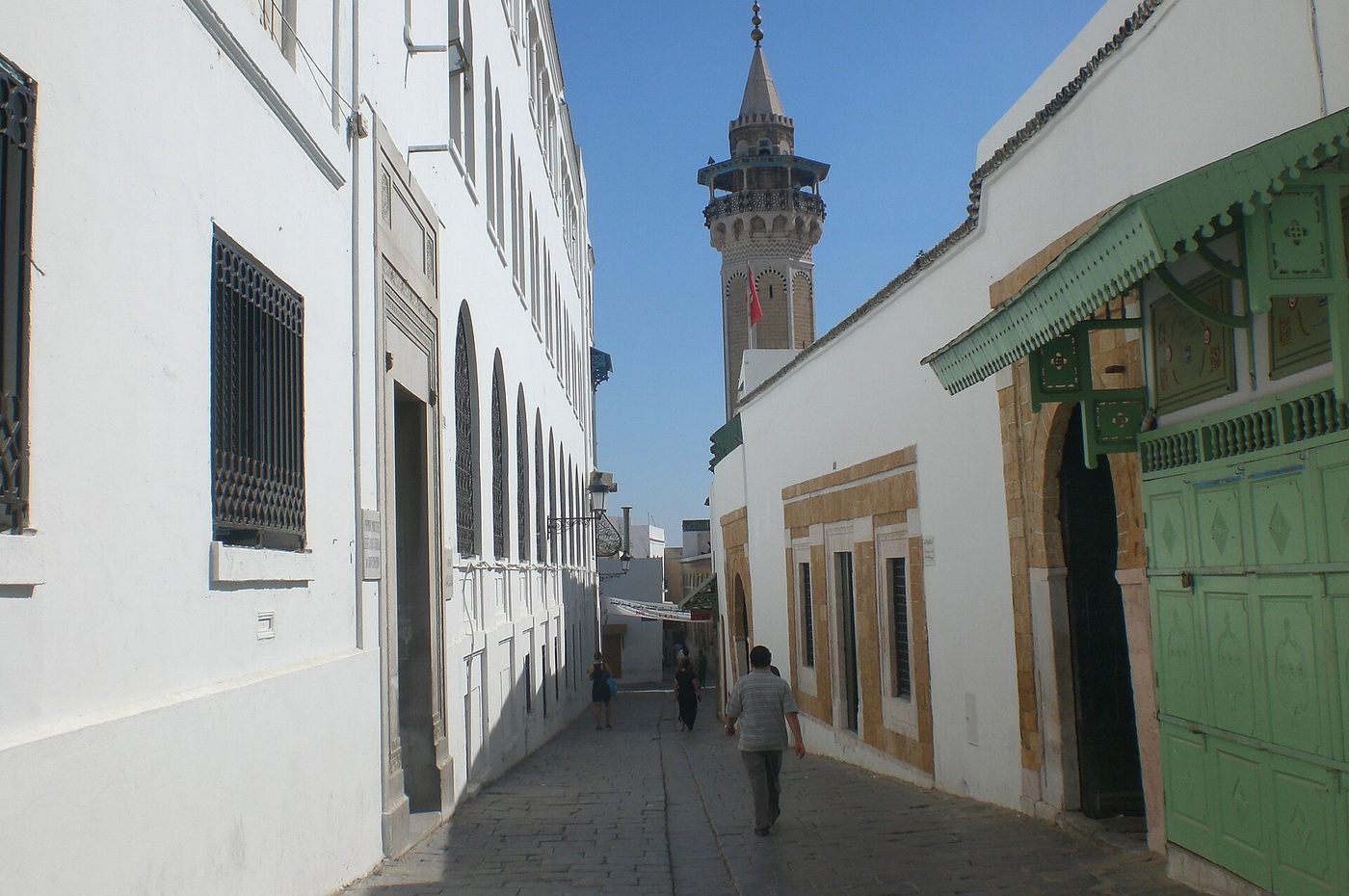
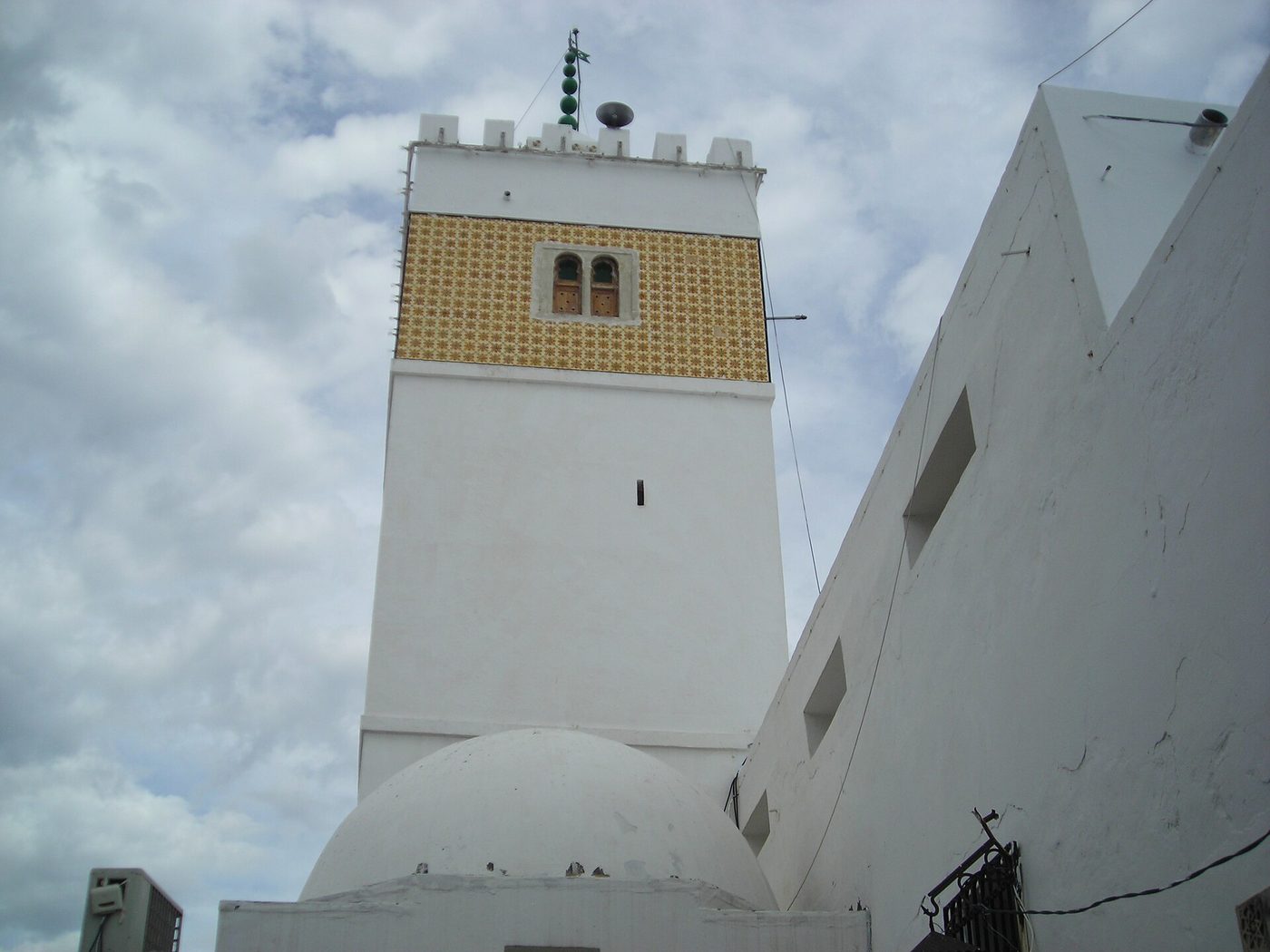
Deep in the medina, the Great Mosque — also 15th-century and still very much in use — rises over the souk lanes, its minaret the tallest thing inside the walls. As a working place of worship it’s closed to non-Muslims, so you can’t go in, but the exterior, the carved doorway and the tangle of whitewashed alleys around it are the old town’s most photogenic corner, especially in the low light of early morning.
Nearby you’ll find the small folklore museum, sometimes called the Dar Khadija, a restored old house laid out over a few floors with traditional costumes and household objects — a quiet, genuinely affecting half-hour if the door’s open. And tucked in the lanes is the tomb of Sidi Bou Ali, the town’s patron saint, where local women still leave little bouquets of jasmine and the odd whispered wish. These aren’t blockbuster sights; they’re the texture of a living old town, and stumbling on them is half the pleasure of wandering with no fixed route.
The souk: what’s sold, and how to haggle
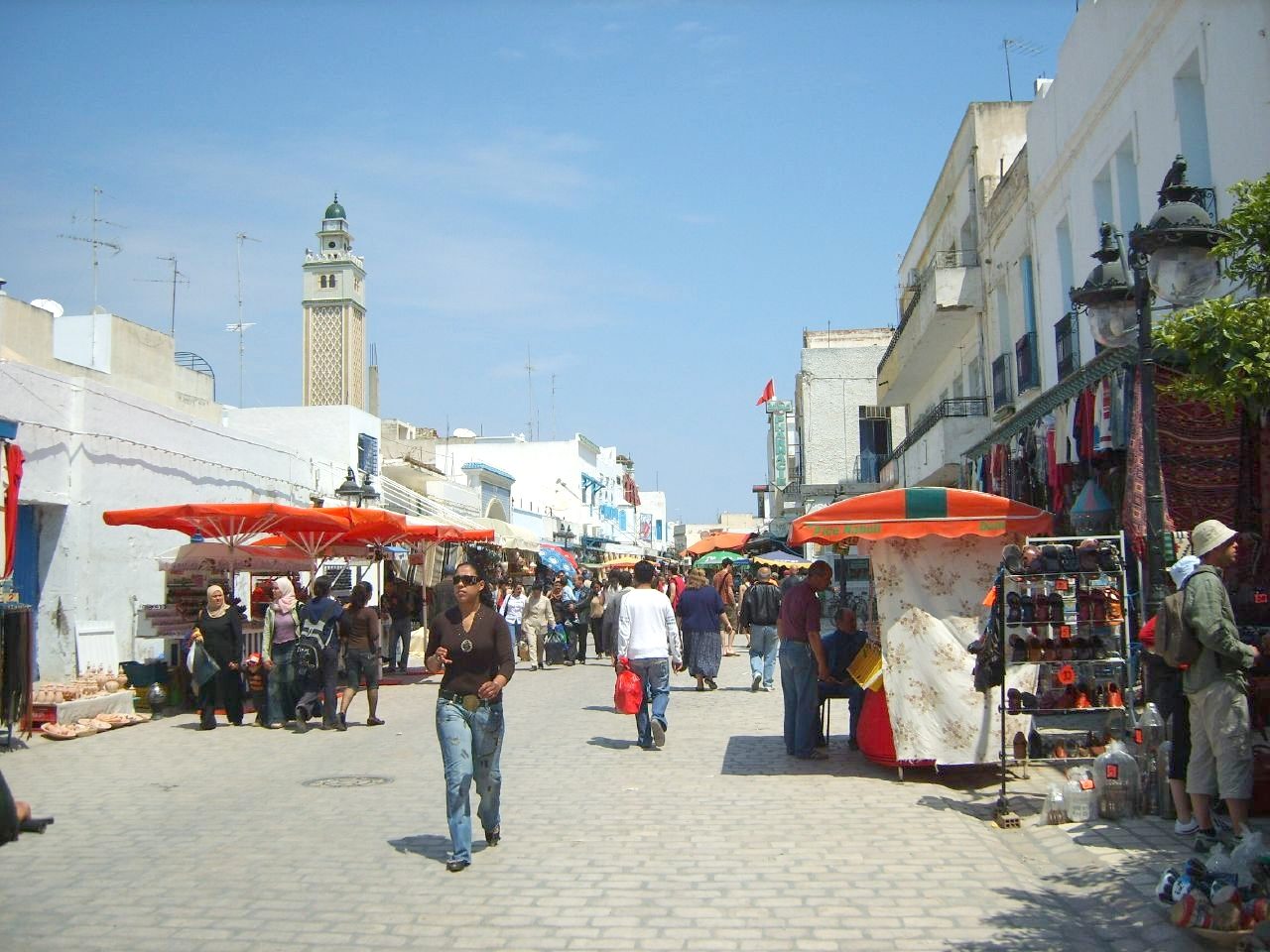
The souk lanes near the gates are where the medina earns its keep. You’ll find embroidery, leather, ceramics (much of it trucked in from the pottery workshops at nearby Nabeul), silver jewellery, perfume and jasmine, spices and sweets — and, inevitably, a great deal of mass-produced souvenir kitsch you’re free to walk straight past. It’s an honest tourist souk rather than a workaday local market, and the sellers know exactly who you are.
Expect the friendly hard-sell. The stallholders are seasoned, charming and armed with an endless supply of patter to get you through the door, and much of what’s on offer is the same across a dozen shops. None of it is intimidating, and a smile and a firm “no thank you” moves you along, but you should go in knowing the routine. Here’s our honest haggling primer:
- Browse before you buy. Walk the length of the souk once with your hands in your pockets. You’ll see the same goods again and again, which tells you nothing is rare and gives you room to bargain.
- Start low and stay friendly. The opening price is theatre. Counter at around a third to a half of it, keep it good-humoured, and be ready to settle somewhere in the middle. If you’re not enjoying it, you’re doing it wrong — so is the seller.
- Be willing to walk. The single most effective tactic. A polite “thanks, I’ll think about it” and a step towards the door does more for the price than any amount of arguing.
- Only haggle for what you actually want. Don’t start bargaining hard over something you won’t buy — agree a price and you’re morally on the hook.
- Watch the “friendly” routines. The “just look, no charge for looking,” the sudden invitation to tea, the “special price, my friend, only for you” — none of it is sinister, but all of it is designed to soften you up. Enjoy it for what it is and keep your budget in your head.
The tea-and-flattery routine tips over into the classic hard-sell often enough that it’s worth reading our guide to common Tunisia scams and hard-sells before you go in — not because Hammamet is dangerous (it very much isn’t), but because knowing the playbook means you’ll pay a fair price and enjoy the game rather than feel cornered. There’s no entrance fee for the souk or the medina, by the way; you only pay to climb the kasbah.
A short walking route
You don’t need a map — the medina’s too small to bother — but here’s the loop we’d walk, and it takes in the best of it in a gentle couple of hours:
- Enter from the seafront gate. Come in off the beach side, where the walls meet the sand and the fishing boats are pulled up. It’s the prettiest approach and puts the kasbah right in front of you.
- Climb the kasbah first. Do the ramparts while you’re fresh and the light is good, and take in the view over the bay before the day heats up.
- Tea at Café Sidi Bou Hdid. Reward yourself on the rampart café before you drop back down into the lanes.
- Wander the souk toward the Great Mosque. Let the lanes pull you inward. Browse, haggle if the mood takes you, and find the mosque and its minaret at the heart of it.
- Loop back through the quiet residential alleys. Head away from the shops into the whitewashed back lanes where people actually live — this is the atmospheric, camera-friendly part most day-trippers skip.
- Out onto the beach. Finish where the walls meet the sand for a swim or a coffee. The town beach sits directly below the medina, so the two make an easy, natural pairing.
When to visit the medina
Timing matters more than you’d think. In July and August the middle of the day inside the walls is hot and the souk is at its pushiest, so we’d steer you to early morning — cool, quiet, with the shopkeepers only just cranking up — or late afternoon, when the heat softens, the light turns gold on the white walls and the local families come out to stroll. Sunset from the kasbah or the town beach below is the reward for the second option.
Season-wise, spring and autumn are ideal for medina wandering: warm enough to be pleasant, not so hot that you wilt between the walls. Our guide to the best time to visit Tunisia has the month-by-month detail. A practical note: the old town is pedestrian-only, so if you’re driving in you’ll park outside the walls (the public lots nearby charge a dinar or two), and if you’re coming from Yasmine or the northern hotels, a cheap taxi or a louage shared cab drops you at the gates — our guide to getting around Tunisia covers how those work.
Culture add-ons nearby: Dar Sebastian and Pupput
The medina alone is a two-hour visit. Two sights just outside the walls turn it into a proper half-day of culture, and both are worth the small effort.
Dar Sebastian and its gardens
A ten-minute walk north of the medina, set back in several hectares of garden, is the most surprising address in town. Dar Sebastian was built in 1927 by George Sebastian, a Romanian aristocrat who decided this stretch of coast was the most beautiful in the Mediterranean and built a low, white, impossibly elegant villa to prove it. The guest list over the following decades reads like a roll-call of the 20th century — Churchill reportedly worked on part of his memoirs here, and the likes of Greta Garbo, André Gide and Paul Klee passed through; during the war, with Sebastian gone, Rommel briefly used the house as a headquarters. Sebastian left the property to the Tunisian state in 1962.
It’s now the International Cultural Centre of Hammamet, and every summer its garden amphitheatre — with the Mediterranean as the backdrop to the stage — hosts the long-running Hammamet International Festival of music, dance and theatre. If your trip falls in July or August, check what’s on; the setting alone justifies a ticket. Even outside festival season, the gardens are open and worth a wander for the villa, the colonnaded pool and the sea views.
Pupput Roman site
A couple of kilometres south, on the edge of the Yasmine zone, lie the ruins of Pupput, the Roman town that occupied this coast from roughly the first to the fifth centuries. It’s modest next to Tunisia’s big Roman sites — some mosaics in the floors of old houses, the bones of a basilica, a large necropolis — but it’s quiet, you can often have it nearly to yourself, and its Roman baths are literally where Hammamet gets its name (from hammam, “baths”). Reports on the entry fee vary — it was around 5 dinars when last widely listed, though a recent guide or two calls it free — so confirm at the gate, which is reached via the café on the site’s inland side. If you like your history, it pairs well with the medina; our roundup of Roman ruins in Tunisia puts it in context alongside the country’s headliners.
Where to eat and drink in and around the medina
You won’t go hungry. Tucked inside and just outside the walls are family-run restaurants doing proper Tunisian food — grilled fish straight off the boats in the little port, brik (the crisp folded pastry with a runny egg inside), couscous and the smoky grilled-pepper salad called slata mechouia. Prices in the medina restaurants are reasonable, and the rule of thumb is simple: look for the places where Tunisians are also eating, not just tourists. Our guide to Tunisian food is a useful primer on what to order and how to eat it.
For a drink with a view, the kasbah café is unbeatable for tea; for something stronger, you’re better off in the hotels or down at the Yasmine marina, as licensed bars are thin on the ground in the old town itself.
How long should you spend in the Hammamet medina?
Honestly? Two hours for the medina proper is plenty — it’s small, and lingering longer means diminishing returns once you’ve walked the walls, browsed the souk and had your tea. Add the kasbah, a mint tea and a slow wander through the back lanes and you’ve had the best of it before lunch.
Stretch it to a half-day and you can fold in Dar Sebastian’s gardens and, if you’re keen, the Pupput ruins — a satisfying culture morning that leaves the afternoon free for the beach. What we wouldn’t do is build a whole day around the old town alone; it’s a lovely, low-effort highlight rather than a full-day attraction, and it’s at its best paired with the sand below or a Cap Bon drive. For ideas on the latter, see our guide to day trips from Hammamet, and if you’re still deciding where to base yourself, where to stay in Hammamet and the national where to stay in Tunisia guide both help. For the bigger question of whether the town earns your week at all, we answer it plainly in is Hammamet worth visiting.
Hammamet medina: your questions answered
Is Hammamet medina worth visiting?
Yes — it’s one of the more enjoyable old towns in Tunisia precisely because it’s small, whitewashed and right on the sea, so it delivers the atmosphere of a Tunisian medina without the overwhelm of the bigger ones in Tunis or Sousse. Climbing the kasbah walls for the view over the bay alone makes it worth the hour or two.
How much does it cost to enter Hammamet medina?
Nothing to wander the lanes and the souk — the medina itself is free and open. You only pay to climb the kasbah, which charged in the region of 7 to 8 dinars (about £2) when we last checked, with children less. Prices drift, so confirm at the gate.
What are the opening hours of the Hammamet kasbah?
The kasbah opens through the day — very roughly 8am to around 5.30 or 6pm — but hours vary by season and aren’t rigidly posted, so treat that as a guide and check on the day. The medina lanes and souk are open all day and into the evening, with the shops liveliest from mid-morning.
How long do you need in Hammamet medina?
About two hours covers the medina, the kasbah ramparts, a mint tea and a browse round the souk. Allow a half-day if you want to add the Dar Sebastian gardens and the Pupput Roman ruins nearby. It’s a highlight to pair with the beach or a day trip, not a full-day attraction on its own.
Can you climb the kasbah in Hammamet?
Yes, and you should — walking the ramparts is the main reason to visit. From the walls you get the whole sweep of Hammamet Bay, the medina rooftops and the fishing boats on the sand below. There’s a small museum inside and the excellent Café Sidi Bou Hdid set into the seaward wall, where you can have tea with the view.
What can you buy in the Hammamet souk?
Embroidery, leather goods, ceramics (much of it from nearby Nabeul), silver jewellery, perfume, jasmine, spices and sweets — alongside a lot of mass-produced souvenirs. It’s a tourist souk, so haggling is expected: browse first, start low, stay friendly and be willing to walk away. Prices come down with patience.
Is haggling expected in Hammamet medina?
Yes. The opening price is a starting point, not the real one, and bargaining is part of the deal. Counter at around a third to a half of the first quote, keep it good-humoured, and be ready to walk — that’s the most effective tactic of all. Only haggle hard for things you genuinely intend to buy.
What’s the difference between Hammamet medina and Yasmine Hammamet medina?
The Hammamet medina is the real 15th-century walled old town on the headland. The “medina” at Yasmine Hammamet is a modern shopping-and-dining complex built in the 1990s to look like an old town — pleasant enough for an evening browse, but not historic. For the genuine article, head to the old town.
What is Dar Sebastian in Hammamet?
Dar Sebastian is an elegant 1927 villa a short walk north of the medina, built by the Romanian aristocrat George Sebastian and once host to the likes of Churchill and Greta Garbo. It’s now the International Cultural Centre, and its garden amphitheatre stages the summer Hammamet International Festival. The gardens are worth a wander in their own right.
Is Pupput worth visiting near Hammamet?
If you like Roman history, yes — it’s a quiet, modest site of mosaics, baths and a large necropolis on the edge of the Yasmine zone, and its Roman baths are what gave Hammamet its name. It’s no El Jem, but you can often have it nearly to yourself, and it pairs well with a morning in the medina.
When is the best time to visit Hammamet medina?
Early morning or late afternoon, when it’s cooler, quieter and the light is soft on the white walls. Midday in high summer is hot and the souk is at its pushiest. Spring and autumn are the most comfortable seasons overall for wandering the old town without wilting.
Is Hammamet medina safe for tourists?
Hammamet is one of Tunisia’s calmer, most established resort towns, and the medina is a relaxed, friendly place to wander. The only real hassle is the friendly hard-sell in the souk, which is easily handled with a smile and a firm no. Keep an eye on your bag in the busier lanes, as you would in any market.
Written by the Tunisia Tourism Guide team — an independent UK-focused guide to travelling in Tunisia. We don’t sell tours or take hotel commissions. Prices and advice were checked at publication; always confirm current details before you book.
Photo credits
All images via Wikimedia Commons, used with thanks: The whitewashed walls of Hammamet’s 15th-century medina meeting the sea © Marc Ryckaert (MJJR) (CC BY 3.0); The honey-coloured kasbah fort of Hammamet © Noomen9 (CC BY-SA 4.0); Hammamet’s kasbah fortress on the edge of the medina © Jerzystrzelecki (CC BY 3.0); The minaret of Hammamet’s 15th-century Great Mosque rising over the © Yamen (CC BY-SA 4.0).