By the Tunisia Tourism Guide team · Last updated 24 July 2026 · We don’t sell tours or take hotel commissions — this is independent advice, written to be useful.
There’s a moment, near the top of the watchtower, when it all clicks. The sea on one side, the golden dome of a president’s tomb on the other, a sea of whitewashed graves below — and the odd, delightful realisation that you’re standing exactly where John Cleese once demanded the crowd “welease Woger”. Few buildings in Tunisia pack this much history, this many views and this much film trivia into one afternoon.
The Ribat of Monastir is one of the oldest and largest fortified monasteries in North Africa, begun in 796. You climb its nador tower for sweeping coastal views, and film fans will recognise it as a location for Monty Python’s Life of Brian and Franco Zeffirelli’s Jesus of Nazareth. Entry is only a few dinars.
This is the single best sight in Monastir, and a highlight of the whole Sousse and Sahel coast. Below we cover what the Ribat actually is, its 1,200-year story, the tower climb, and — the part most guides skate over — the real film history, including one very stubborn myth. Let’s begin with the essentials.
The Ribat of Monastir at a glance
| Detail | What to know |
|---|---|
| Founded | 796 AD — one of the oldest ribats in North Africa |
| Where | On the seafront in Monastir, on its own peninsula |
| Don’t miss | The climb up the nador (watchtower) for the views |
| On screen | Life of Brian (1979) and Jesus of Nazareth (1977) |
| Entry | Around 8 TND for adults (2026 — check current) |
| Opening hours | Roughly 8.30am–5.30pm daily (confirm before visiting) |
| Getting there | Sahel metro from Sousse, about 30 minutes |
Allow an hour to an hour and a half. Now, the story behind those stones.
What is a ribat, and why does Monastir have one?
A ribat is a fortified Islamic monastery — part barracks, part place of worship — built along the frontiers of the early Muslim world. They were manned by murabitun: devout volunteers, sometimes called warrior-monks, who split their time between prayer and guarding the coast against seaborne raiders, chiefly the Byzantine fleet that still contested the Mediterranean in the 8th century. A chain of these forts once studded the Tunisian shore, close enough to pass warning signals between them.

Monastir’s is the grandest survivor. It sits right on the water, exactly where an early-warning fort needed to be, and its high blank walls and single great tower were designed to be seen — and to see — for miles. There was a spiritual pull, too. A well-known tradition held that standing guard at the ribat for three days earned the defender a place in paradise, which did no harm at all to recruitment. That blend of the martial and the holy is what gives the building its strange, watchful atmosphere today.
A short history of the Ribat of Monastir
The Ribat was founded in 796 AD, on the orders of the Abbasid caliph Harun al-Rashid, by his commander Harthama ibn A’yan. That makes it the oldest of the great ribats built during the Arab expansion across the Maghreb — the prototype that others copied. The original was a fairly simple quadrangle; over the following centuries it grew into the layered fortress you see now.
A major enlargement came in 966 under Abu al-Qasim ibn Tammam, and further towers and defences were bolted on between the 11th and 13th centuries, and again from the 17th to the 19th, as the technology of war — and the range of artillery — changed. By the medieval period the Ribat had become as much a symbol and a place of pilgrimage as a working garrison.
The version visitors explore today owes a lot to a sweeping restoration in 1970, which stabilised the walls and made the whole complex safe to wander. Purists sometimes grumble that it’s a touch over-restored, but the bones are genuinely ancient, and the effect — courtyards, cells, stairways and that soaring tower — is tremendously atmospheric. If old stones are your thing, pair this with our guide to the Roman ruins of Tunisia for the country’s other great historical set-pieces.
The town grew up around the fortress and took its name from it: “Monastir” derives from the Latin monasterium, a nod to how this contested shore once sat on the frontier between the Christian Byzantine world and the expanding Islamic one. The Ribat was one link in a chain of such forts strung along the coast — nearby Sousse has one too — built close enough to relay a warning from tower to tower in a single night.
Climbing the nador tower
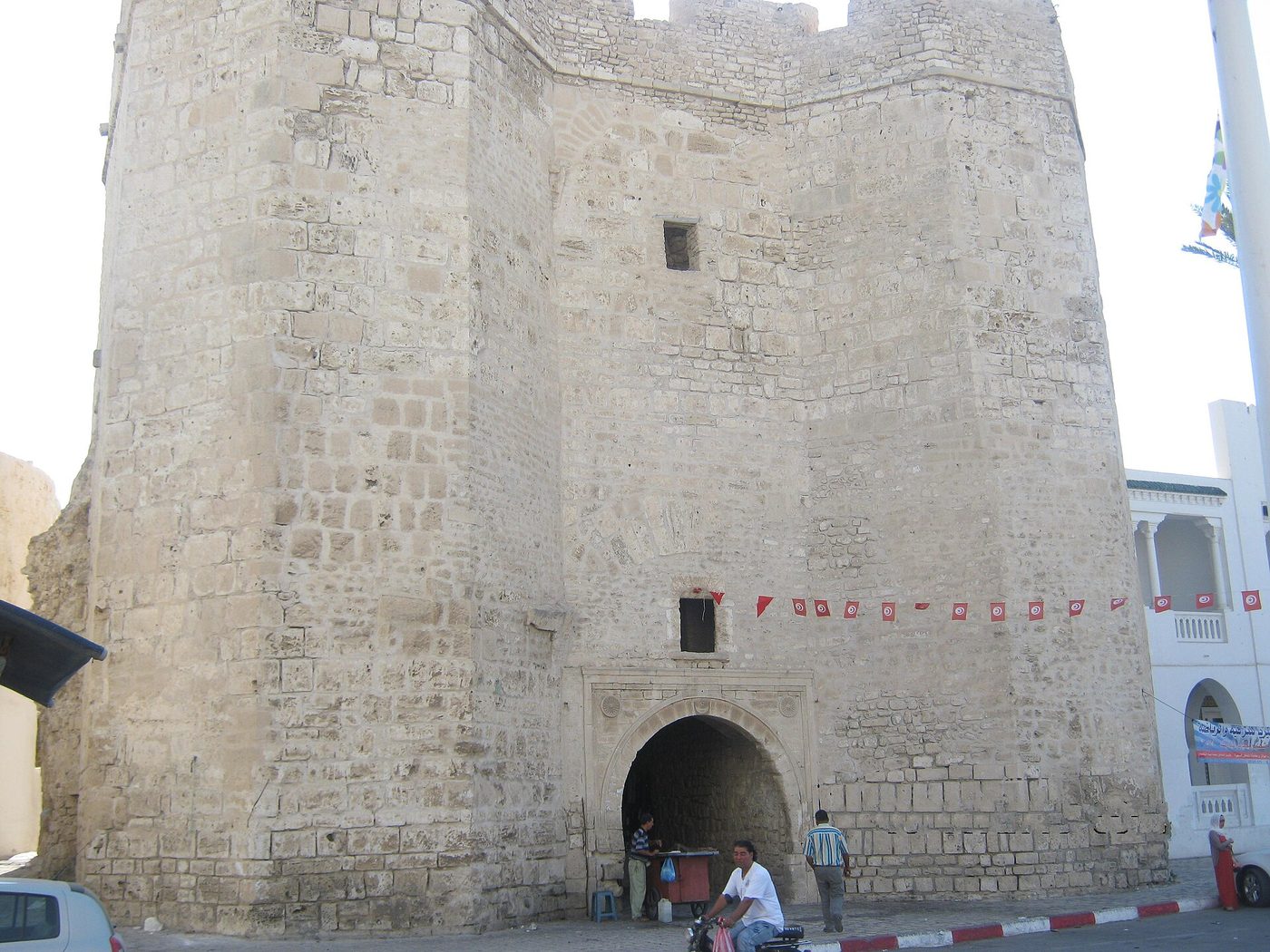
The tall round tower is called the nador, and climbing it is the highlight of any visit. A narrow spiral staircase of roughly a hundred steps corkscrews up through the stone — mind your head and your footing — and delivers you onto a parapet with one of the finest views on the coast.
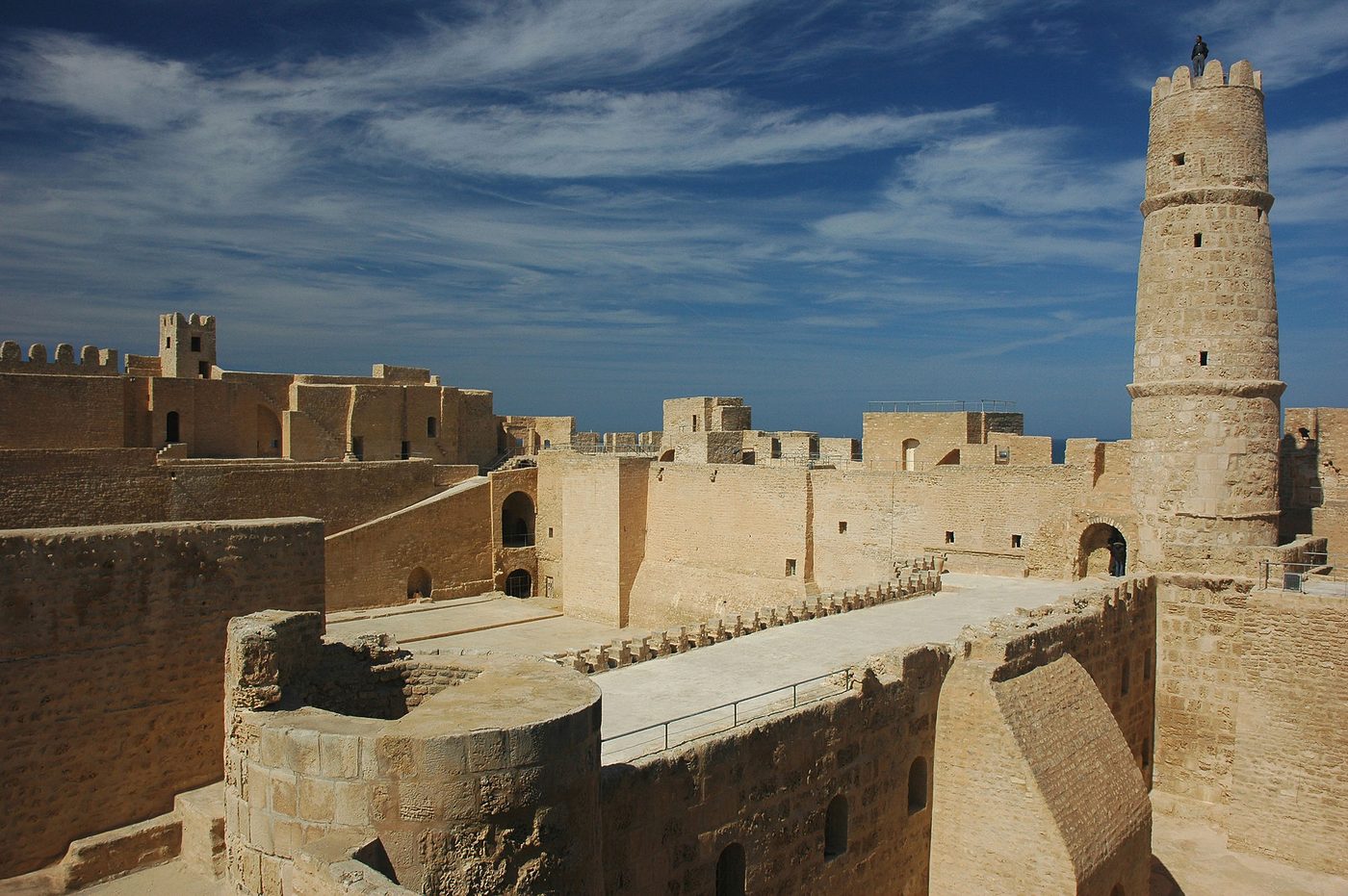
From the top you get the lot: the Mediterranean stretching away, the medina rooftops, the twin minarets and gold dome of the Bourguiba Mausoleum, and the vast whitewashed cemetery that fills the ground between the fort and the tomb. Originally this platform was a signal station — watchmen exchanged light and smoke signals at night with the neighbouring ribats up and down the shore, an early-warning network against raiders. Today it’s simply the best photo spot in Monastir. Go early in the day if you can, both for the light and to beat the heat on the exposed stone.
Inside the fortress: courtyards, prayer hall and museum
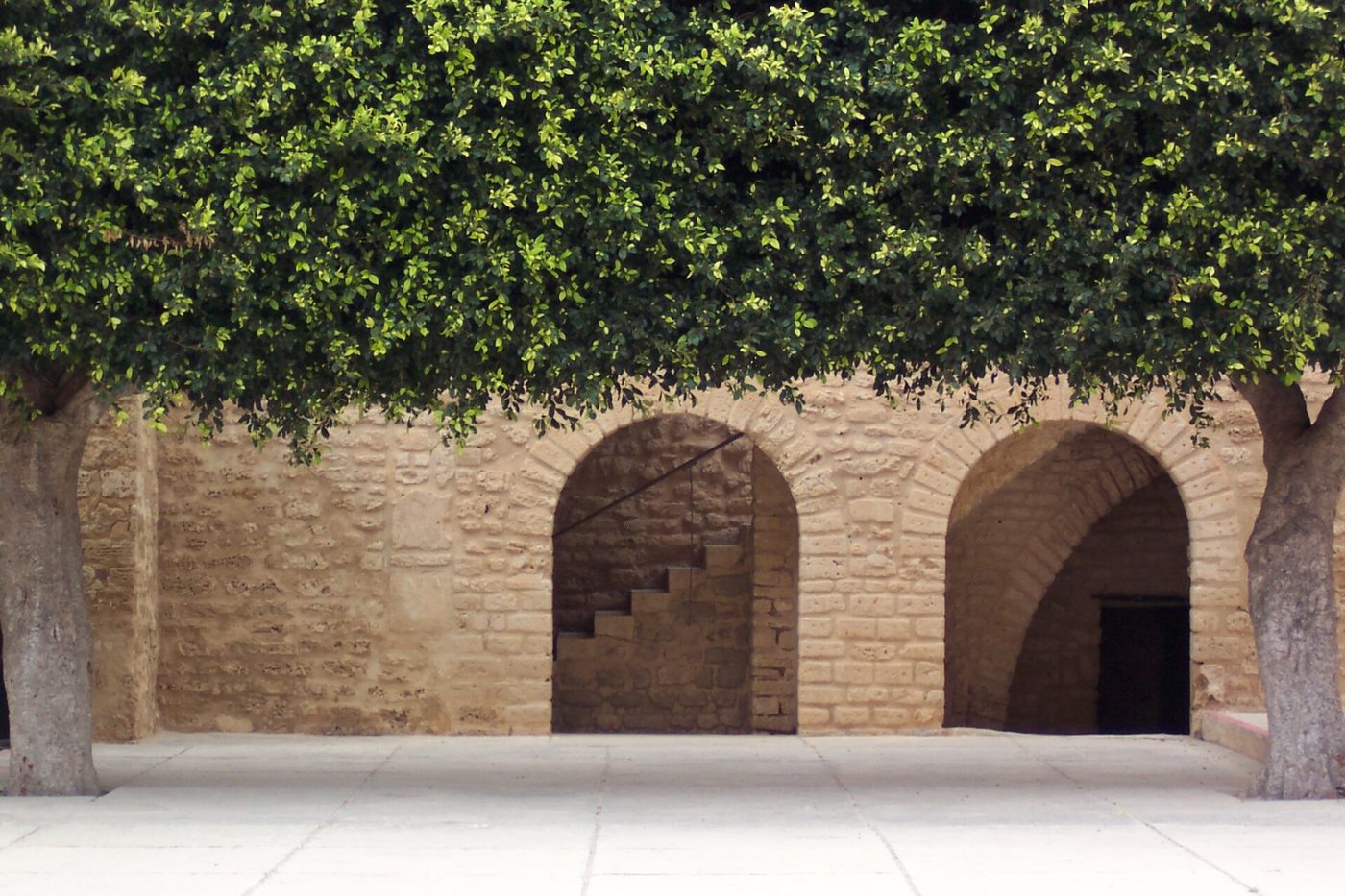
At ground level the Ribat is a satisfying maze. A large central courtyard is ringed by arcades and the small cells where the murabitun once lived and prayed; stairways lead up to walkways along the ramparts. It’s the kind of place that rewards a slow, curious wander rather than a march round a fixed route — every archway seems to frame another view.
Tucked inside is a small Museum of Islamic Art, worth a look for its collection of early ceramics, textiles, coins, glass and manuscripts drawn from the region’s Islamic centuries. It’s not a huge display, but it adds useful context to the walls around you, and it’s a cool retreat if the sun is fierce. Modest dress is appropriate here as at any religious site, and there are basic facilities on site.
The film history: Life of Brian, Jesus of Nazareth and a persistent myth
Here’s the part that makes the Ribat unusual among Tunisia’s monuments: it has a serious screen career. Those maze-like passages and high, featureless walls turn out to be perfect for standing in as the ancient Holy Land — and two very different productions used them.
Jesus of Nazareth (1977) came first
Before the Pythons ever arrived, Franco Zeffirelli shot much of his reverent television epic Jesus of Nazareth here, filming across Tunisia and Morocco in 1975–76. At Monastir, the Ribat’s watchtower doubled as the Antonia Fortress — the Roman garrison overlooking Jerusalem — while the walls were dressed to stand in for the Temple. If the fortress looks biblical, that’s because it has literally played the part.
Life of Brian (1979) made it famous
Two years later, Monty Python arrived to film Life of Brian, directed by Terry Jones, and reused many of the same Tunisian locations — reportedly making good use of sets and know-how left over from Zeffirelli’s production. The Ribat is all over the finished film. Fans point out the outer wall behind the stoning scene, the window from which Brian reluctantly addresses his adoring followers, and the tower itself. It’s the backdrop to Michael Palin’s lisping Pontius Pilate and the immortal command to “welease Woger”. Stand in the courtyard with the film in your head and it snaps instantly into focus.
The El Jem myth — worth clearing up
Now for the myth. You’ll be told — by guides, guidebooks and countless websites — that the film’s big “Jerusalem amphitheatre” scene, where Brian is recruited into the People’s Front of Judea, was shot at the mighty Roman amphitheatre of El Jem. It wasn’t. That scene was actually filmed at the Roman Theatre of Carthage, near Tunis, with set-dressing and a little movie trickery. El Jem is spectacular and absolutely worth a visit — see our day trips from Sousse guide for how to get there — but it does not appear in Life of Brian, however often you’re told otherwise.
A couple of other real locations, while we’re setting the record straight: the “city walls of Jerusalem” were the kasbah in nearby Sousse (now its archaeology museum), and the film’s crucifixion finale was shot on the barren landscapes around Matmata, deep in the south — the same desert country that stood in for Tatooine, as our Star Wars in Tunisia guide explains. But the beating heart of the film’s “Holy Land” is right here at the Ribat.
| Production | Year | How the Ribat was used |
|---|---|---|
| Jesus of Nazareth (Zeffirelli) | 1977 | Tower as the Antonia Fortress; walls dressed as the Temple of Jerusalem |
| Life of Brian (Monty Python) | 1979 | Pilate’s “Welease Woger” address, the stoning wall and Brian’s window |
Spotting the Life of Brian scenes on your visit
Half the fun of a visit is playing spot-the-scene, and the Ribat makes it easy because so little has changed. As you cross the main courtyard, picture the crowd gathered below Brian’s window — the spot where a bleary-eyed mob hails him as the Messiah and he begs them, hopelessly, to think for themselves. The high outer walls are the backdrop to the famous stoning sketch. And the tower you climb for the views is the very one that looms over so many of the film’s wide shots. Bring the film to mind and the fortress quietly rearranges itself into a film set in front of you.
It’s worth remembering that the Pythons filmed here in the autumn of 1978, reportedly settling on the Ribat partly because sets and know-how from Zeffirelli’s production were still close to hand — a happy accident that saved a low-budget comedy a good deal of money. The upshot is that two of the most quoted films in two very different genres share the same Tunisian stones. Not many fortresses can claim that.
Tunisia on screen: why film-makers keep coming
The Ribat’s double life is part of a much bigger story. Tunisia has stood in for the ancient and the imagined world on film for decades, thanks to its Roman monuments, its deserts and its old Islamic architecture — all a short hop from Europe and blessed with reliable light. The barren country around Matmata and Tozeur in the south, where the Life of Brian crucifixion finale was shot, is the same landscape George Lucas turned into Luke Skywalker’s home planet; our Star Wars in Tunisia guide follows that trail. The Roman theatre at Carthage and the amphitheatre at El Jem have both drawn crews too, and you can walk them yourself with our guide to Roman ruins in Tunisia.
What makes the Ribat special is that you don’t need a permit, a tour or any special access to enjoy its screen history. You just buy a ticket, climb the tower and stand where the cameras once stood. For a film fan building a trip around these locations, it’s one of the most satisfying and accessible stops in the whole country.
The Bourguiba Mausoleum next door
Don’t rush off after the Ribat, because its perfect companion is a two-minute walk away across the cemetery. The Bourguiba Mausoleum is the gold-domed, twin-minareted resting place of Habib Bourguiba — born here in Monastir, and independent Tunisia’s first president and “father of independence”.
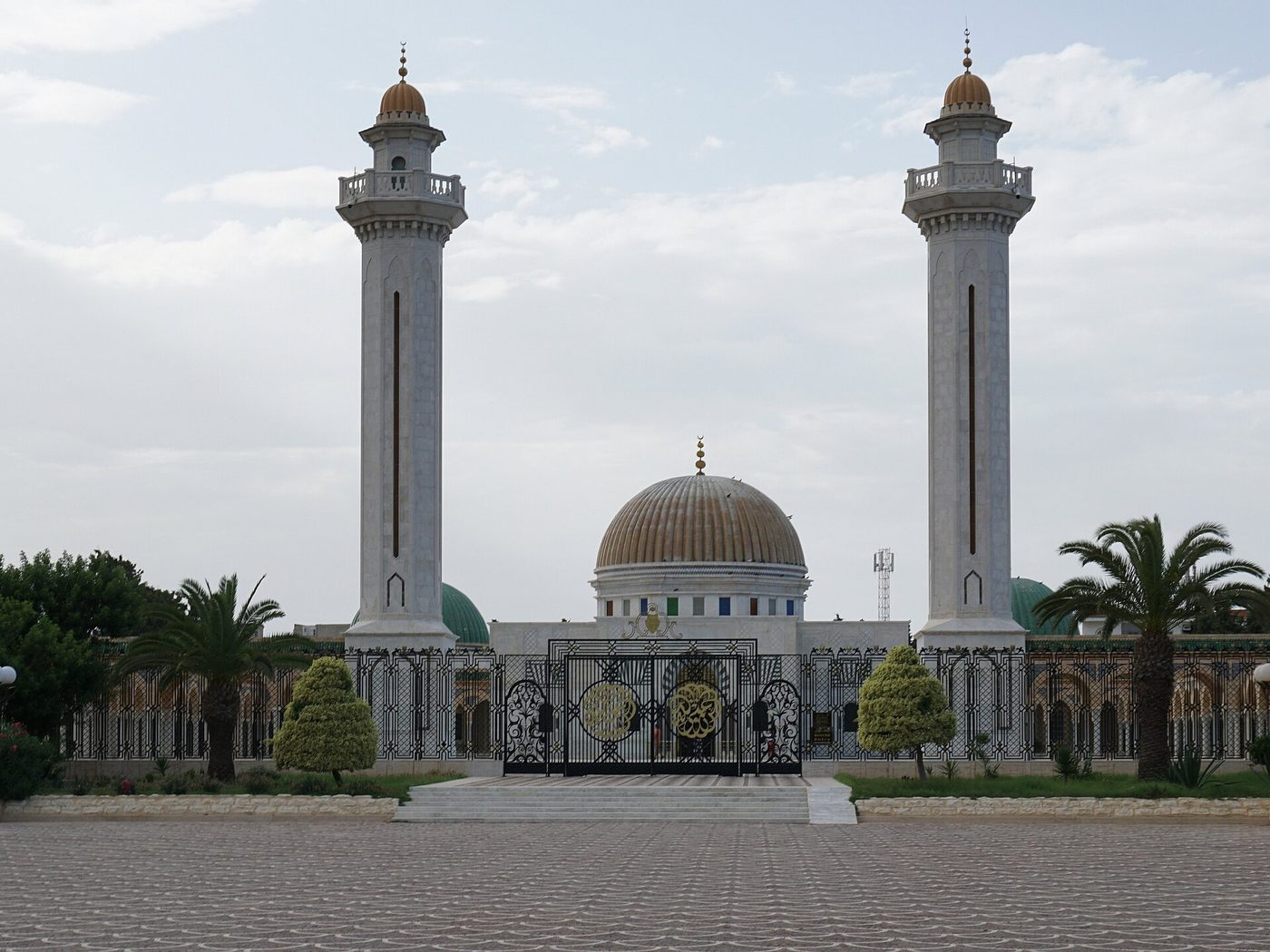
It’s free to enter (there’s a quick security check) and quietly grand inside: marble, gilding, and glass cases of the president’s personal effects, from his reading glasses to old photographs. Together, the ancient fort and the 20th-century tomb bookend more than a thousand years of Tunisian history and culture in a single short stroll — which is exactly why we suggest doing them back to back. Both feature in our wider things to do in Monastir guide, alongside the marina and medina that round out a day in town.
Making a day of it in Monastir
The Ribat and mausoleum are the headline act, but they sit inside a genuinely likeable town worth lingering in. A short walk away, Monastir’s compact medina is refreshingly low on hard-sell touts — good for an unhurried browse of pottery, leather and Berber blankets. The marina is the spot for a coffee or a seafood lunch by the water, and the beaches of the Skanes strip are a short taxi or metro ride away if you fancy a swim to finish the day.
All told, the fortress, the tomb, the old town and a marina lunch make a satisfying full day — or a very easy half-day if you’re over from Sousse. Our complete things to do in Monastir guide covers the rest, and the day trips from Sousse guide explains the 30-minute metro hop that gets you here.
Visiting the Ribat: tickets, hours and practical tips
The Ribat sits on Monastir’s seafront, an easy walk from the town’s medina and train station. Here’s what to know before you go.
- Getting there. The simplest route is the Sahel metro (coastal light rail) from Sousse, which reaches central Monastir in about 30 minutes for a tiny fare; from the station it’s a short walk to the fort. Louages and taxis also work. Our getting around Tunisia guide covers the options.
- Tickets. Entry was around 8 dinars for adults in 2026 (roughly £2 — confirm the current price on arrival). There may be a small extra charge for a camera; carry cash, as the dinar is a closed currency you change on arrival.
- Opening hours. Typically about 8.30am to 5.30pm daily, with shorter hours during Ramadan. Times shift seasonally, so check locally before you set off.
- What to wear. Sensible shoes for the tower’s steep, uneven staircase, and modest clothing as at any religious site. There’s little shade on the upper levels, so bring a hat and water in summer.
- When to go. Early morning gives the best light for photos and the coolest stone underfoot. Spring and autumn are the most comfortable seasons overall — see our best time to visit guide.
- How long. Allow an hour to 90 minutes for the Ribat, plus 30–45 minutes for the mausoleum next door.
Fit the Ribat into a wider loop and it slots neatly into a Sahel day: fortress and mausoleum in the morning, marina lunch, medina in the afternoon. If you’re building a longer trip, our Tunisia itinerary shows where Monastir sits, and the pillar guide to things to do in Tunisia puts it in national context.
The Ribat of Monastir: your questions answered
What is the Ribat of Monastir?
It’s an 8th-century fortified Islamic monastery on the seafront in Monastir — one of the oldest and largest in North Africa. Built to house warrior-monks who guarded the coast and prayed, it’s now a well-preserved historic site you can explore, complete with courtyards, a small Islamic art museum and a watchtower with superb views.
Was Life of Brian filmed at the Ribat of Monastir?
Yes. Monty Python’s Life of Brian (1979) made extensive use of the Ribat, whose high walls and passages stood in for the Holy Land. It’s the setting for Pontius Pilate’s “Welease Woger” scene, among others. Two years earlier, Franco Zeffirelli filmed parts of Jesus of Nazareth here too.
How old is the Ribat of Monastir?
It was founded in 796 AD, making it more than 1,200 years old and the oldest of the great ribats built during the Arab expansion across North Africa. It was enlarged in 966 and again over later centuries, then heavily restored in 1970, so what you see today blends genuinely ancient fabric with modern stabilisation.
How much does it cost to visit the Ribat of Monastir?
Entry was around 8 dinars for adults in 2026 (roughly £2), with a possible small extra fee for cameras. Prices change, so confirm on arrival, and bring cash — the Tunisian dinar is a closed currency you can only obtain once you’re in the country.
What films were shot at the Ribat of Monastir?
The two famous ones are Franco Zeffirelli’s Jesus of Nazareth (1977), which used the tower as the Antonia Fortress, and Monty Python’s Life of Brian (1979), which reused many of the same locations. The fort’s blank walls and maze of passages made it an ideal stand-in for the ancient Holy Land.
Can you climb the tower at the Ribat?
Yes, and you should. A spiral staircase of about a hundred steps leads up the nador (watchtower) to a parapet with panoramic views of the sea, the medina and the Bourguiba Mausoleum. The stairs are narrow and steep, so wear sensible shoes and take care, especially with children.
Was the El Jem amphitheatre in Life of Brian?
No — this is a common myth. The film’s big amphitheatre scene was actually shot at the Roman Theatre of Carthage, not at El Jem. El Jem is a magnificent Roman amphitheatre well worth visiting, but it does not appear in Life of Brian, despite what many guides and websites claim.
What is the Bourguiba Mausoleum next to the Ribat?
It’s the grand, gold-domed tomb of Habib Bourguiba, Tunisia’s first president, who was born in Monastir. A two-minute walk from the Ribat across the cemetery, it’s free to enter and displays his personal effects. Visiting the two together bookends more than a thousand years of Tunisian history in one short stroll.
How long do you need at the Ribat of Monastir?
Allow an hour to 90 minutes to explore the courtyards, museum and tower without rushing. Add 30–45 minutes for the neighbouring Bourguiba Mausoleum. Together they make an easy half-day, leaving time for the marina and medina if you’re spending a full day in Monastir.
Is the Ribat of Monastir worth visiting?
Very much so. It’s one of the most impressive and best-preserved historic buildings on Tunisia’s coast, the views from the tower are the best in town, and the film history adds a fun extra layer. Combined with the mausoleum next door, it’s the standout reason to visit Monastir.
What is a ribat?
A ribat is a fortified Islamic monastery, built along the frontiers of the early Muslim world and manned by devout volunteers who both prayed and defended the coast. Monastir’s is the finest surviving example in Tunisia, and the town’s name itself derives from the same root as “monastery”.
How do you get to the Ribat of Monastir?
The easiest way from Sousse is the Sahel metro, a coastal light-rail line that reaches central Monastir in about 30 minutes for a small fare; the fort is a short walk from the station. Louages and taxis cover the same route. If you’re staying in Monastir, it’s an easy walk from the medina.
Written by the Tunisia Tourism Guide team — an independent UK-focused guide to travelling in Tunisia. We don’t sell tours or take hotel commissions. Prices and advice were checked at publication; always confirm current details before you book.
Photo credits
PHOTO_CREDITS_PLACEHOLDER