By the Tunisia Tourism Guide team · Last updated 24 July 2026 · We don’t sell tours or take hotel commissions — this is independent advice, written to be useful.
Get to Sidi Bou Said before the tour buses and it feels like a small miracle: cobbled lanes climbing between whitewashed walls and cobalt-blue doors, bougainvillea spilling over the parapets, and the Gulf of Tunis glittering far below. Turn up at two on an August afternoon and you’ll shuffle along behind a cruise group instead. Timing is the whole game here — and it’s the first thing we’ll help you get right.
Sidi Bou Said is a small clifftop village about 20km north-east of Tunis, famous for its blue-and-white houses and sweeping views over the Gulf of Tunis. It’s an easy half-day trip from the capital on the TGM train, and it’s at its best before 10am or in the golden hour, when the light is soft and the day-trip crowds have thinned.
The village sits at the seaward edge of greater Tunis, and it slots naturally into a day among the capital’s headline sights — so this guide is part of our wider coverage of things to do in Tunis. Below we untangle why the whole place is painted blue and white (the real story is messier than the postcards let on), walk you up the main street in the right order, compare the famous cafés — including the one everyone gets the name of wrong — and cover the practical side: the train, the best light, the museums worth your time, and how to enjoy it all without feeling herded.
Sidi Bou Said at a glance
| Detail | What to know |
|---|---|
| Where | Clifftop village about 20km north-east of Tunis, above the Gulf of Tunis |
| Getting there | TGM light-rail from Tunis Marine to Sidi Bou Said, about 35–40 minutes |
| Don’t miss | The studded blue doors, Café des Nattes, the clifftop sunset view |
| Best time of day | Before 10am or late afternoon; tour buses dominate 10am–3pm |
| How long | A half-day, or longer if you add the palace museum below the village |
| Signature snack | Bambalouni — hot, sugar-dusted fried dough (around 3 TND) |
| Why blue & white | A 1915 heritage decree, championed by Baron Rodolphe d’Erlanger |
Allow half a day at the very least; the village rewards dawdling far more than dashing. Now, the story behind the colour.
Why is Sidi Bou Said blue and white?
The short answer everyone repeats is “Baron d’Erlanger”. The longer answer is more interesting, and rather more honest.
First, the name. Sidi Bou Said takes it from a thirteenth-century Sufi holy man, Abu Said ibn Khalaf al-Baji, who came from Beja in the north-west and settled on this breezy headland — then called Jbel el-Menar, the Hill of the Lighthouse — where he founded a zaouia, a Sufi lodge and shrine. He died here in 1231 and was buried at the sanctuary, and the village that slowly grew around his tomb took his name. For centuries it was a modest religious settlement; by the eighteenth century, wealthy families from Tunis had cottoned on to the cool sea breeze and the ridiculous quality of the light at the cliff edge, and began building the summer houses you walk past today.
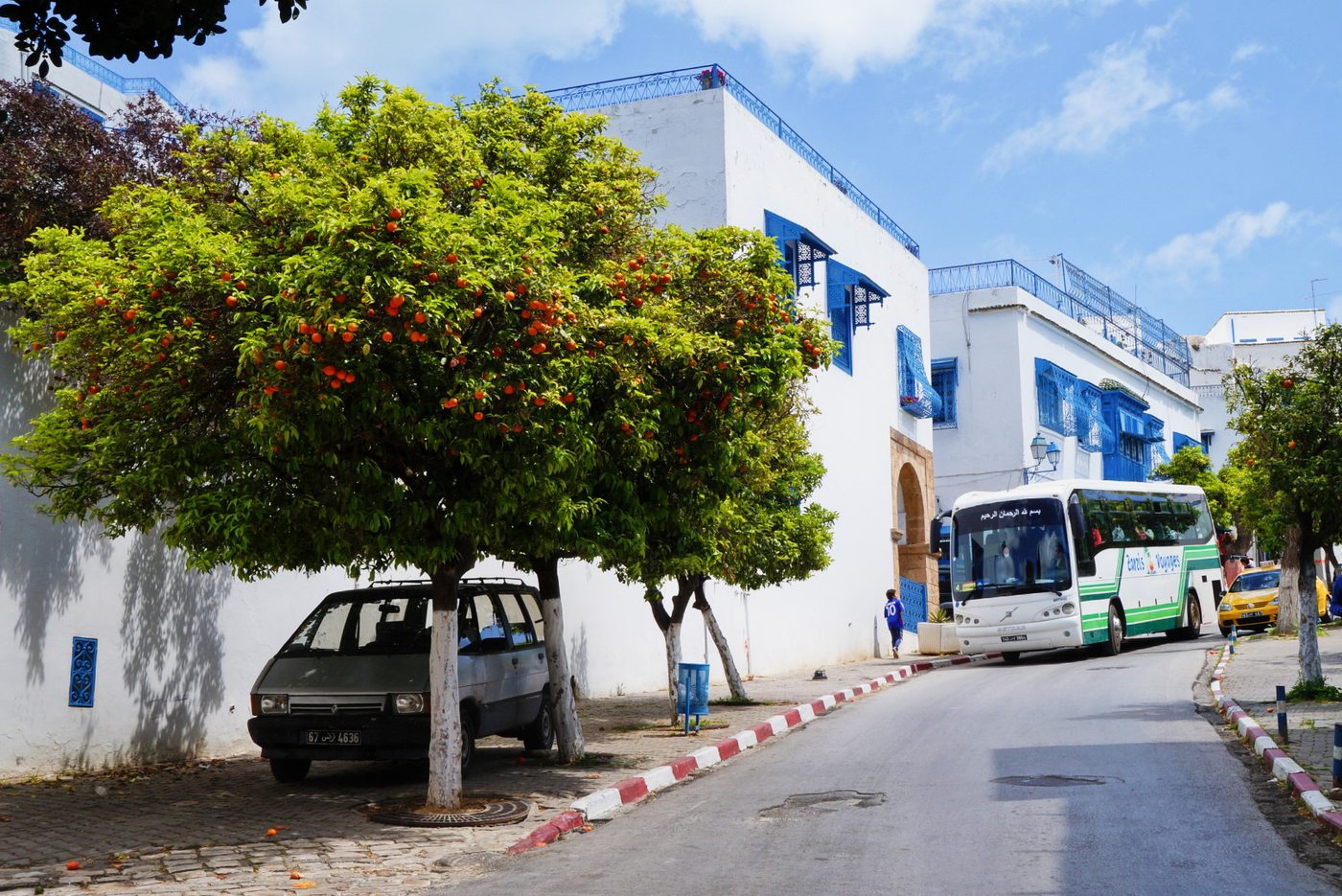
Now the colour. The blue is a specific deep, slightly violet cobalt — locals nod to the French painter and call it bleu Majorelle, though the village was using the shade well before Majorelle made it famous in Marrakech. The white is lime wash, refreshed each spring. And the honest origin of the palette is practical rather than romantic: limewashed walls bounce back the summer heat, and blue shutters and grilles stand up to sea glare and salt air. The look grew out of climate, cheap materials and habit long before anyone thought to protect it.
Where Baron Rodolphe d’Erlanger comes in is the protecting. An Anglo-French musicologist and painter, comfortably off on a Rothschild inheritance, he settled here in 1909 and fell for the place. In 1915, under the French Protectorate, he lobbied the authorities to pass an ordinance that essentially froze the village’s look in place: white walls, blue trim, low rooflines, no unapproved alterations. It’s fair to say he championed and codified the blue-and-white harmony rather than inventing it — a distinction the glossier guides tend to skate over. The rule held, and more than a century on the village still obeys it, which is exactly why it feels like a painting someone refuses to let dry.
That protected look is now recognised well beyond Tunisia: in 2024 the village was added to UNESCO‘s Tentative List, a first step towards possible World Heritage status. It has long drawn artists — Paul Klee and August Macke painted here in 1914, and writers from André Gide to Simone de Beauvoir passed through — which is part of why it looms so large in Tunisia’s cultural imagination. For more on that thread, see our guide to Tunisian culture.
The blue doors, birdcages and bougainvillea
Once you know what to look for, Sidi Bou Said becomes a scavenger hunt of small, photogenic details — and the doors are the headline act.
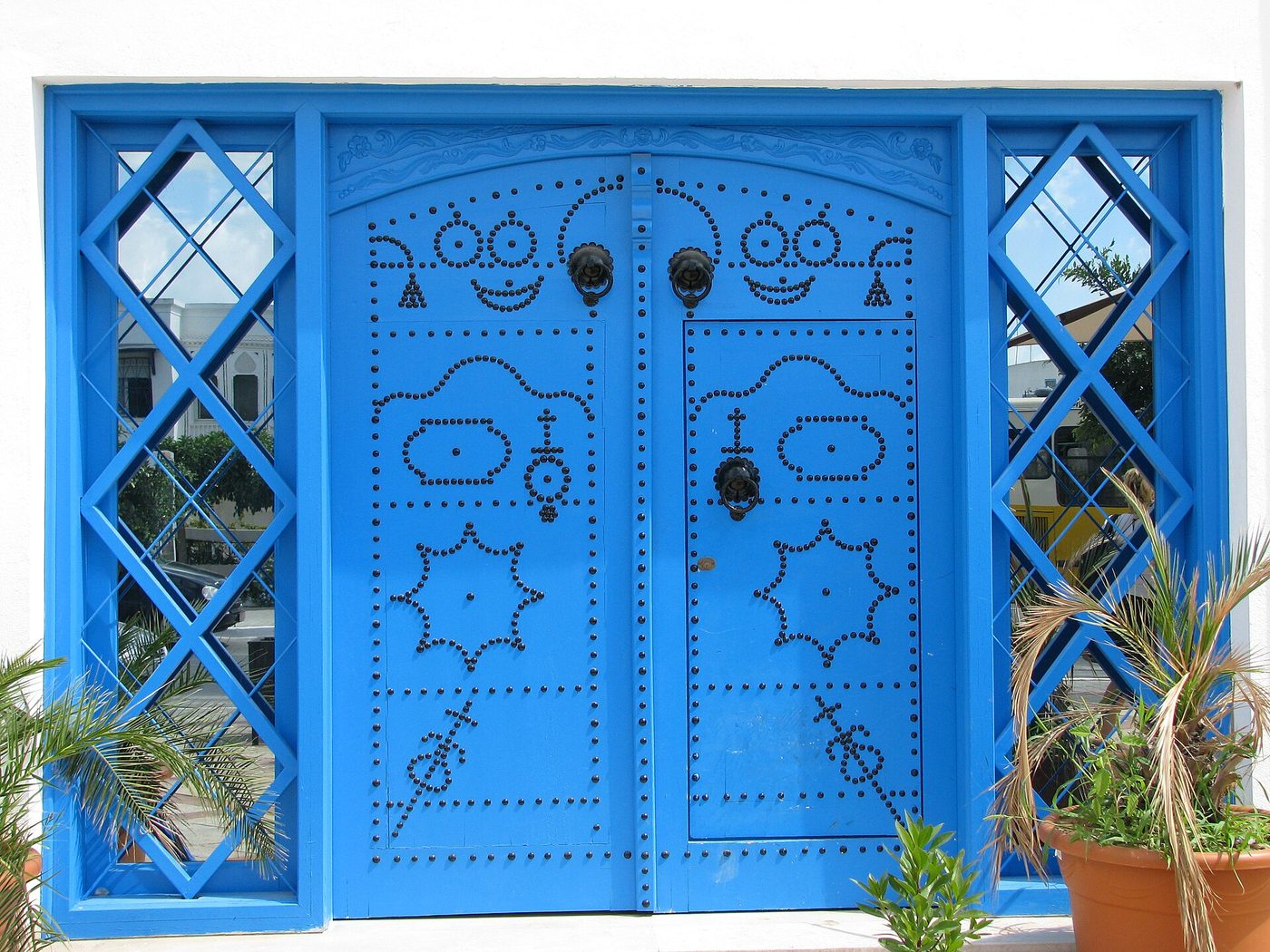
The village’s famous doors are arched, painted the same cobalt as the shutters, and studded with black iron nails hammered into patterns. Look closely and you’ll pick out stars, cypress trees, crescents, flowers and the occasional Hamsa — the protective “hand of Fatima”. No two are quite alike, and half the fun of the climb is clocking the differences from house to house. They aren’t only decoration: historically the studding strengthened the timber, and the patterns carried a quiet language of status and blessing.
Then there are the birdcages. Sidi Bou Said has a long tradition of ornate wood-and-wire cages, built to look like miniature domed mausoleums and often painted — of course — blue and white. The wirework echoes the wrought-iron window grilles you’ll see all over the village. They make one of the more characterful souvenirs in the country, and you’ll spot them hanging outside the little workshops on the main street.
Add bougainvillea tumbling in magenta sheets over white walls, pots of geraniums and sprigs of jasmine on the thresholds, and you have the recipe for the photos that made the village famous. A few tips we’ve learned the hard way:
- Shoot early. Before about 9.30am the streets are quiet and the light is soft — you’ll get clean shots of doorways without a queue of people in them.
- Look up and down, not just ahead. The best compositions are often a blue door framed by bougainvillea, or a slot of sea glimpsed between two white walls.
- Ask before photographing people or the inside of shops; a smile and a quick “min fadlik” (please) go a long way.
- The steepest, most photogenic stretch is the upper part of the main street — walk it first, before the crowds arrive.
Walking the village: the main street, the belvedere and the lighthouse
Sidi Bou Said is tiny — you could march end to end in fifteen minutes — but that would miss the entire point. Here’s the order we’d walk it.
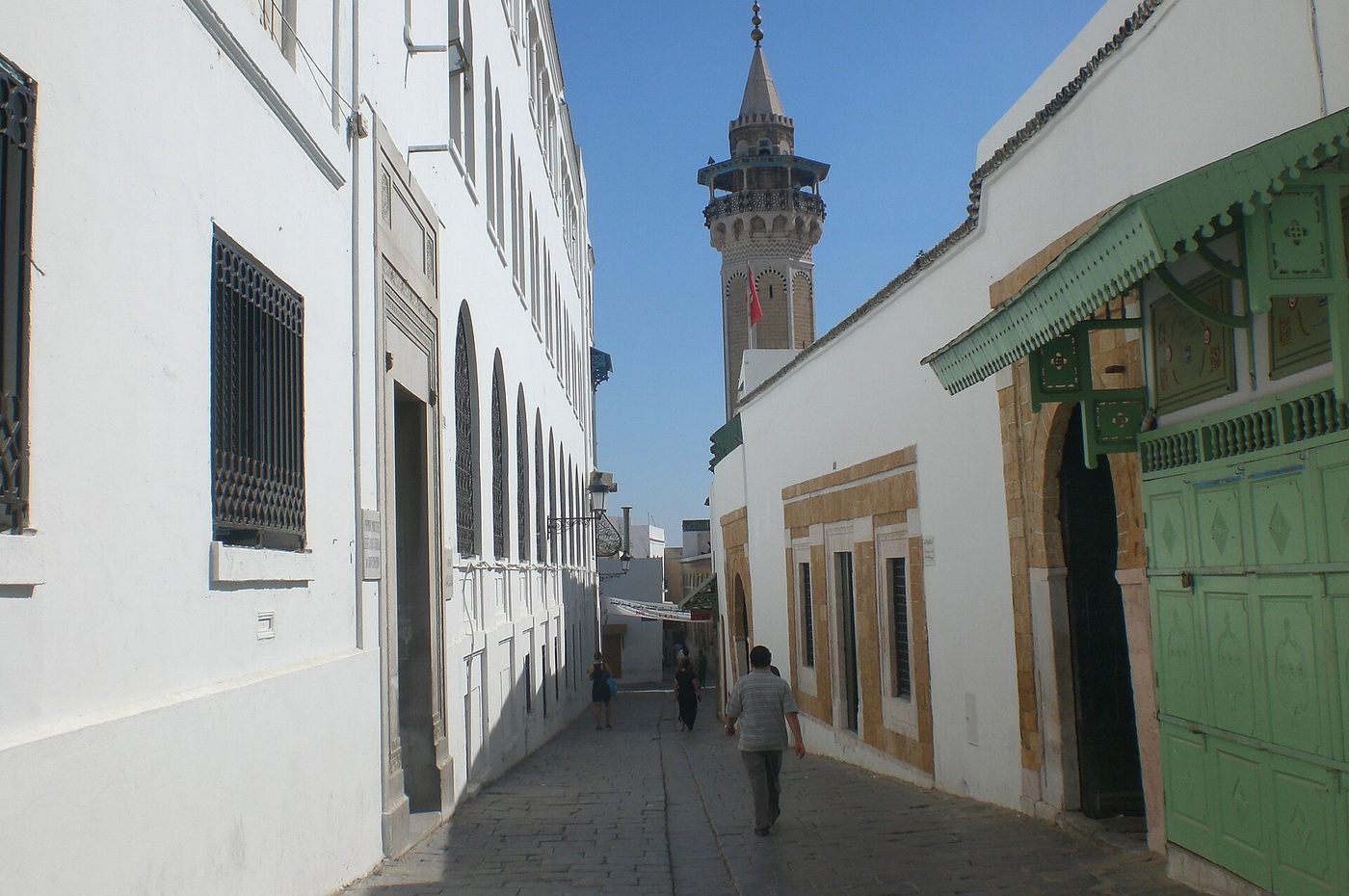
You’ll arrive at the top, at Place 7 Novembre, where the taxis idle and the smell of frying bambalouni hangs in the air. From here the main cobbled street, Rue Habib Thameur, drops down through the heart of the village — narrow, steep, worn smooth underfoot, and lined with the white walls and blue doors that fill every postcard. This is the photogenic spine of the place, and it earns its reputation within the first thirty paces.
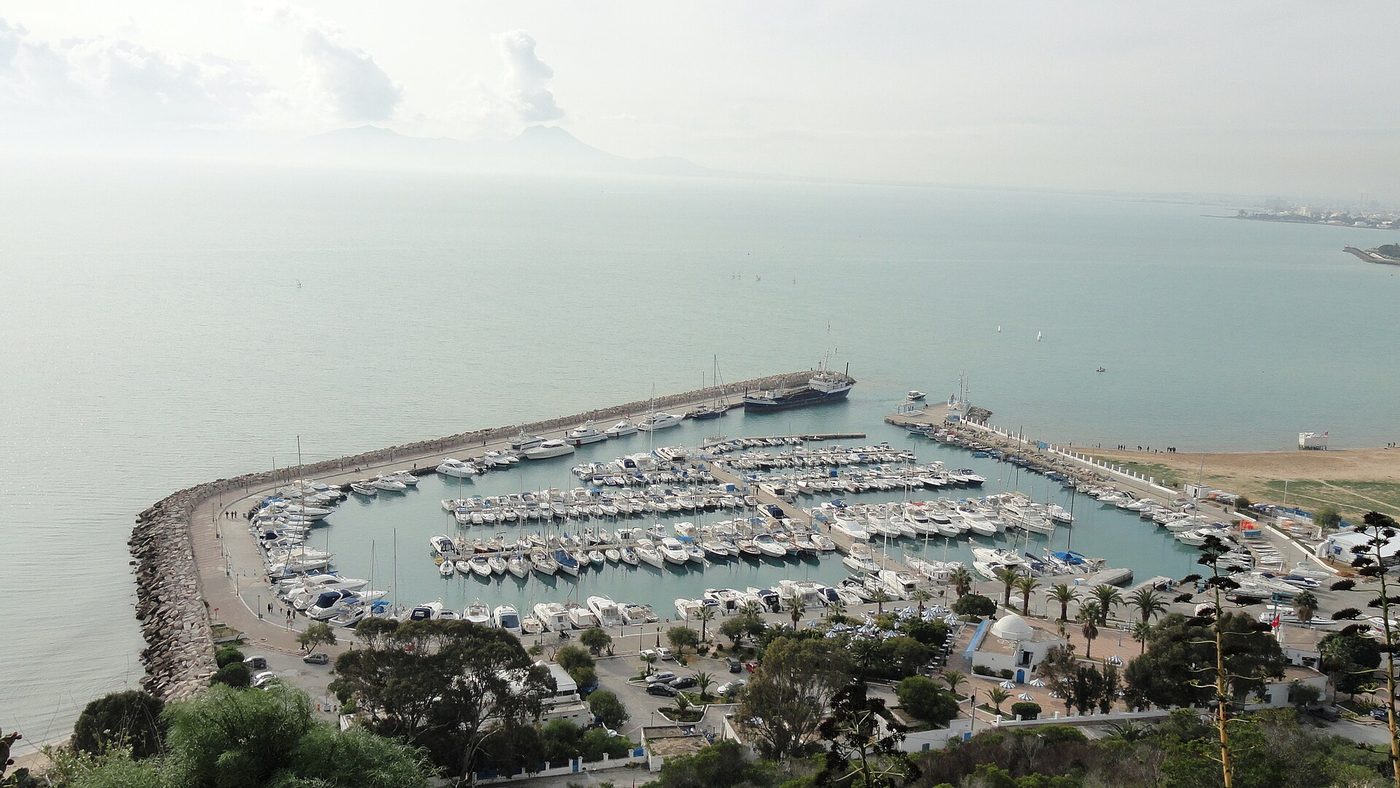
Keep going and the street opens out at a belvedere — a lookout where the village suddenly gives way to the Gulf of Tunis. From here the view is enormous: Carthage off to your right, the long curve of the bay, the headland of Cap Bon closing the horizon on a clear day, and the marina directly below with its pleasure yachts. There is almost always a breeze, which is half the reason the beys built up here in the first place.
Above the village, crowning the summit, sits the lighthouse that gave the hill its old name. The lighthouse itself is a working navigation light and not usually open to visitors, but the ground around it is the highest point in the area and one of the finest viewpoints in the whole of greater Tunis — worth the short extra climb for the panorama over the gulf. If chasing Tunisia’s best views is your thing, we’ve gathered more of them in our guide to the most beautiful places in Tunisia.
The cafés: Café des Nattes vs Café des Délices
Half the pleasure of Sidi Bou Said is sitting down and letting the village happen around you, and two cafés dominate the story — though the naming trips almost everyone up.
Café des Nattes is the historic one, up a short flight of steps near the mosque at the top of the village. It’s named for the woven straw mats (nattes) that still cover the floor, and it has been serving for centuries — Klee sketched here, and generations of writers have propped themselves against its tiled walls. You sit low on cushions, order a kahwa arbi (thick Arabic coffee) or a mint tea, and watch the street through the open arch. The coffee is fine rather than remarkable, and that isn’t really the point.
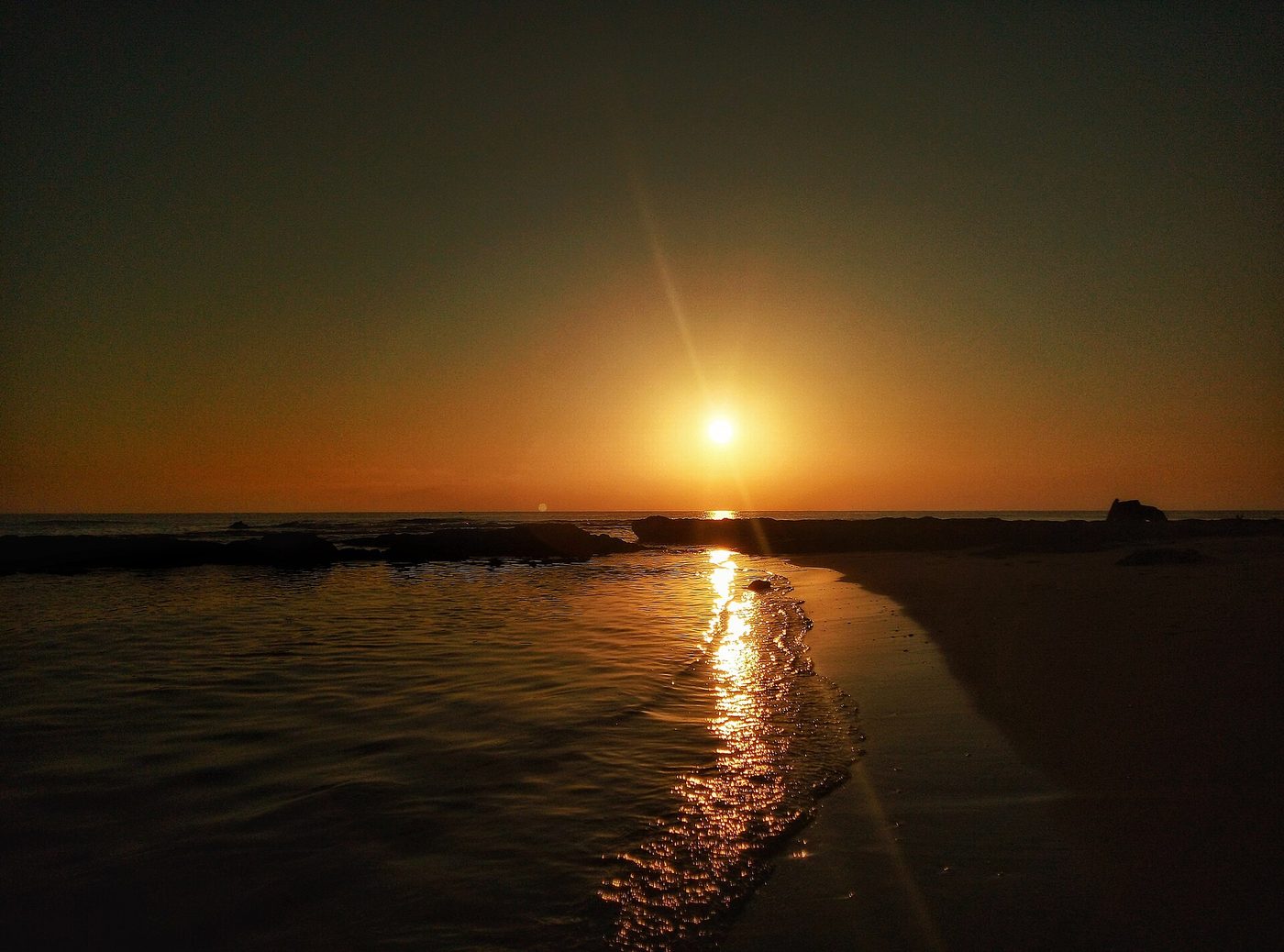
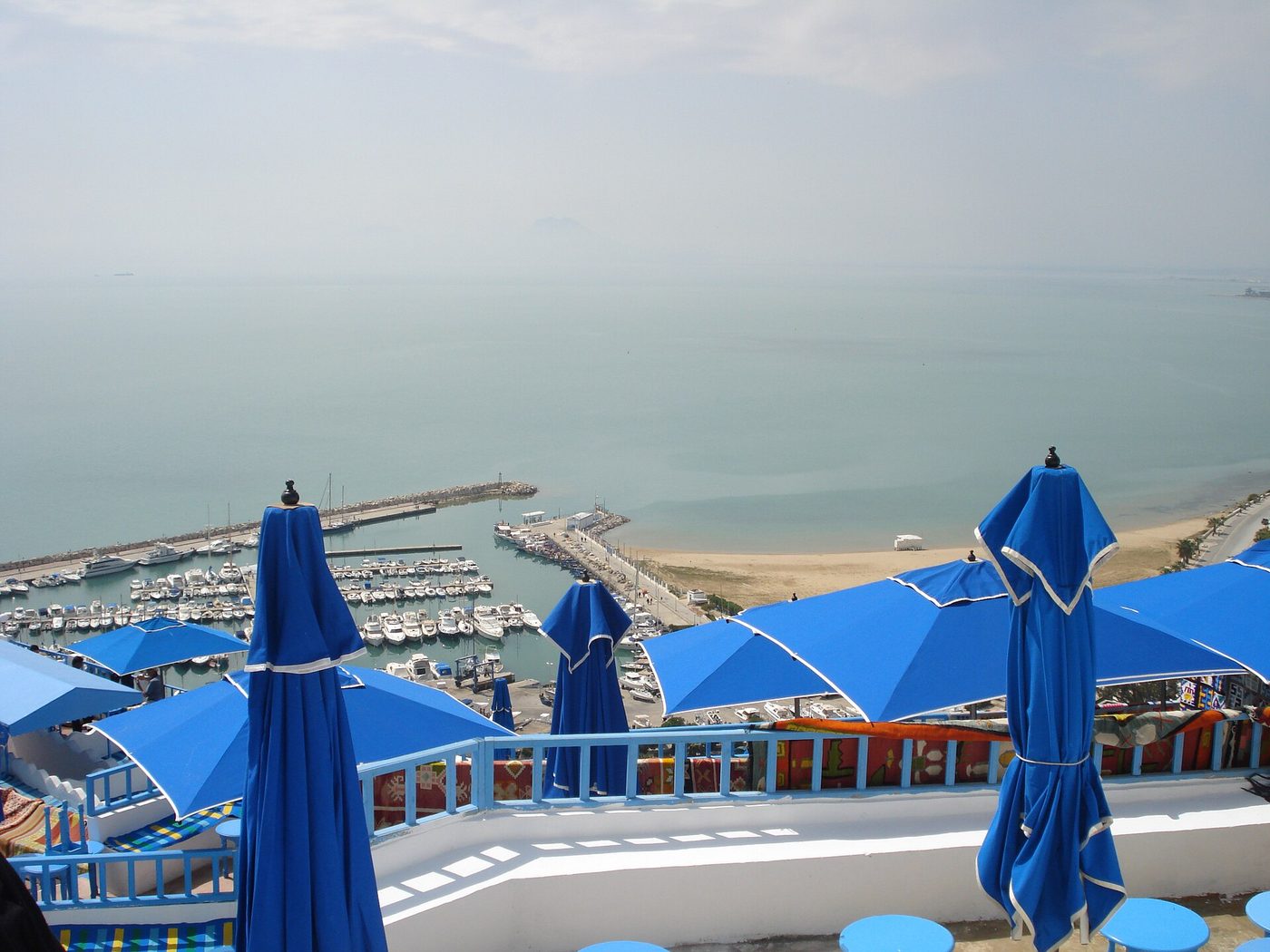
Café des Délices is the other one — the terraced café tumbling down the cliff towards the sea, the one you’ve seen on a thousand posters and heard in a Patrick Bruel song. Here’s the confusion worth clearing up: the celebrated clifftop terrace is properly called Café Sidi Chabaane, and many listings now bundle the two names together. Whatever the sign says, this is the place to arrive about ninety minutes before sunset, claim a table on the terrace, order a mint tea heavy with pine nuts, and simply not move while the gulf turns from gold to pink to dark blue.
A quick comparison to help you choose — or, better, do both:
| Café | What it’s like | Best for |
|---|---|---|
| Café des Nattes | Historic, mat-floored, up steps by the mosque | Atmosphere and a mid-morning coffee stop |
| Café des Délices / Sidi Chabaane | Terraced café spilling down the cliff over the bay | The sunset view and a long, slow mint tea |
| Café Le Chergui | Small, tucked behind the main square | A quieter cup where locals actually go |
One thing to know going in: café prices here are noticeably higher than in ordinary Tunisian towns — you’re paying for the view and the address. A mint tea can cost several times what you’d pay in central Tunis. It’s still a modest sum by UK standards, but don’t expect street prices at a clifftop table. And do seek out the bambalouni — a hot, sugar-dusted ring of fried dough sold from stalls at the top of the village for a few dinars. Eat it walking. It’s one of Tunisia’s great cheap pleasures, and the food chapter of our Tunisian food guide has more where that came from.
The museums: Dar el-Annabi and Ennejma Ezzahra
If you want more than pretty streets, two house-museums turn a stroll into a proper half-day.
Dar el-Annabi is a restored family mansion, parts of it dating to the eighteenth century, opened to the public as a window into traditional Sidi Bou Said life. You wander tiled courtyards and rooms dressed as they would have been lived in — the salon, the kitchen, the marriage room, complete with costumed mannequins — and there’s a rooftop terrace with another fine view. Entry is a few dinars and it takes about 40 minutes; it’s the easiest way to see behind those famous doors.
Ennejma Ezzahra — “Star of Venus” — is Baron d’Erlanger’s own palace, a fifteen-minute walk downhill towards the sea, and it’s arguably the most beautiful private house in the country. Behind white walls sit columns of green marble, Arab-Andalusian gardens cascading towards the Mediterranean, and the grand music room where d’Erlanger composed his six-volume study of Arab music. Fittingly, it now houses the Centre of Arab and Mediterranean Music, and its collection of instruments is a draw in its own right. Allow an hour or more, and check the opening times before you set off, as they can be limited.
Both sit within easy reach of the main street, and together they add real depth to a visit that could otherwise be over in an hour. They’re the kind of stops we’d fold into a considered Tunis itinerary rather than rush past.
The marina, and pairing Sidi Bou Said with Carthage
Below the cliff lies the Sidi Bou Said marina — technically the village’s little port — ringed with seafood restaurants that are honest rather than fancy. A plate of grilled daurade (sea bream) with a view of the boats is a fine way to stretch a visit into a leisurely lunch. Up in the village itself, restaurants like Dar Zarrouk trade on their clifftop terraces; they’re lovely, if priced firmly for the setting.
The single best move, though, is to pair Sidi Bou Said with Carthage, which sits just a few TGM stops back down the line. The classic day runs the ancient ruins of Carthage in the morning — Byrsa Hill, the Antonine Baths, the ports — then rides the train up to Sidi Bou Said for the afternoon and sunset. Add the Bardo Museum and the medina of Tunis and you have two of the most rewarding days in the country. Our guide to day trips from Tunis maps out how to string them together.
Visiting Sidi Bou Said: how to do it well
The village is small, famous and easy to reach, which is both its charm and its problem. A few practical notes to get the best of it:
- Getting there. The simplest route is the TGM (the Tunis–Goulette–Marsa light-rail line) from Tunis Marine station at the foot of Avenue Habib Bourguiba. Trains run every 15 minutes or so, the ride is about 35–40 minutes, and the fare is under 2 dinars — see our guide to getting around Tunisia for how the system works. From the Sidi Bou Said stop it’s a short, steep walk uphill to the village.
- By taxi. A metered taxi from central Tunis costs roughly 15–20 dinars and takes about 30 minutes outside rush hour; insist on the meter (the compteur). From the airport, reckon on 25–35 dinars. Don’t try to drive yourself — parking in the village is genuinely painful in season.
- When to go. Be in the village before 10am or after about 4pm; the tour buses from the coastal resorts dominate the middle of the day. Spring and autumn are far more comfortable than high summer — our best time to visit guide has the seasonal detail.
- How long. A couple of hours covers the streets and a café; half a day lets you add Dar el-Annabi or Ennejma Ezzahra; a full, unhurried day pairs it with Carthage.
- What to wear. Comfortable shoes for the cobbles and the climb, and a hat and water in summer — the streets are steep and there’s little shade at the top.
- Money. Bring cash. The Tunisian dinar is a closed currency you can only get once you’ve arrived, and small cafés and stalls won’t take cards. Reckon on roughly £1 to 3.8–3.9 dinars, but check the current rate.
- Etiquette. This is a residential village and a place of pilgrimage as well as a sight. Keep noise down early in the morning, dress modestly near the shrine and mosque, and ask before pointing a camera at anyone.
Do all that and Sidi Bou Said rewards you handsomely. It slots neatly into a Tunisia itinerary and ranks among the country’s essential things to do — provided you time it right.
Sidi Bou Said: your questions answered
Why is Sidi Bou Said blue and white?
The palette began as practical — limewashed walls reflect the heat and blue shutters resist sea glare — long before anyone protected it. In 1915 Baron Rodolphe d’Erlanger championed an ordinance that fixed the white-and-blue look and low rooflines in place. He codified an existing style rather than inventing it, and the village has kept faithfully to it ever since.
Is Sidi Bou Said worth visiting?
Yes — it’s one of the prettiest and most atmospheric spots in Tunisia, and an easy trip from Tunis. The blue-and-white streets, clifftop café views and photogenic doors are the real thing. The one caveat is crowds: come early morning or late afternoon and you’ll see it at its best, rather than shuffling behind midday tour groups.
How do you get to Sidi Bou Said from Tunis?
The easiest way is the TGM light-rail from Tunis Marine station, which reaches Sidi Bou Said in about 35–40 minutes for under 2 dinars, stopping at Carthage on the way. A metered taxi from central Tunis costs around 15–20 dinars and takes roughly half an hour. From the station, it’s a short uphill walk into the village.
How long do you need in Sidi Bou Said?
A couple of hours is enough to walk the main street, photograph the doors and settle into a café. Add a house-museum such as Dar el-Annabi or Baron d’Erlanger’s palace and you’ll want half a day. Pair it with Carthage down the line and you have a full, and very rewarding, day out from Tunis.
Where is Café des Délices in Sidi Bou Said?
It’s the terraced café spilling down the cliff at the seaward edge of the village, below the main street. Confusingly, the famous clifftop terrace is properly named Café Sidi Chabaane, and the two names are often used interchangeably. Whatever the sign reads, it’s the spot for the sunset view over the Gulf of Tunis with a pine-nut mint tea.
What is Café des Nattes?
Café des Nattes is the village’s historic café, up a short flight of steps by the mosque at the top of the main street. It’s named for the straw mats on its floor and has been serving coffee and mint tea for centuries. Paul Klee sketched here; you sit low on cushions and watch the street go by through an open arch.
When is the best time to visit Sidi Bou Said?
Spring (April to early June) and autumn (mid-September to November) offer the kindest light and temperatures without the peak-summer heat and coach parties. Within any day, aim to arrive before 10am or in the late afternoon and golden hour. High summer at midday is the hottest and most crowded combination — the one to avoid if you can.
Can you visit Sidi Bou Said and Carthage in one day?
Easily — they sit on the same TGM line a few stops apart. The classic plan is Carthage’s Roman ruins in the morning, then the train up to Sidi Bou Said for the afternoon and sunset. It’s one of the best days out in Tunisia and costs little more than a couple of train tickets and some café stops.
Is Sidi Bou Said expensive?
Getting there and wandering the streets costs almost nothing, but the clifftop cafés and restaurants charge a premium for the view — a mint tea can be several times the price of one in central Tunis. It’s still modest by UK standards. Bring cash, as small places don’t take cards and the dinar is a closed currency.
What is bambalouni?
Bambalouni is Sidi Bou Said’s signature street snack: a ring of dough deep-fried to order and dusted with sugar, sold hot from stalls near the top of the village for a few dinars. Eat it straight away, walking. It’s greasy, sweet and completely delicious — one of the simplest and best-value treats in Tunisia.
Is Sidi Bou Said safe?
Yes. It’s one of the calmer, more relaxed spots around Tunis, popular with families and largely free of hard-sell hassle. Take the usual care with your belongings in crowds and use metered taxis, and you’ll have no trouble. For the national picture, see our guide to whether Tunisia is safe.
Do you have to pay to enter Sidi Bou Said?
No — the village itself is free to wander; you only pay for cafés, food and the optional house-museums. Dar el-Annabi and Ennejma Ezzahra each charge a small entry fee. Budget mainly for a café stop, a bambalouni or two, and perhaps lunch by the marina, and you can enjoy the whole place very cheaply.
Written by the Tunisia Tourism Guide team — an independent UK-focused guide to travelling in Tunisia. We don’t sell tours or take hotel commissions. Prices and advice were checked at publication; always confirm current details before you book.
Photo credits
All images via Wikimedia Commons, used with thanks: Whitewashed houses with blue doors and shutters climbing the hillside © Rene Cortin (CC BY-SA 4.0); A traditional arched cobalt-blue door studded with black iron nails © User:SvenZ (CC BY-SA 2.5); View over the Gulf of Tunis and the marina from © OsamaK (CC BY-SA 3.0); A traditional blue-and-white cafe terrace overlooking the sea at Sidi © Cimoi (CC BY-SA 3.0).