By the Tunisia Tourism Guide team · Last updated 24 July 2026 · We don’t sell tours or take hotel commissions — this is independent advice, written to be useful.
Step through the Porte de France and the modern city drops away in a single stride. One moment you’re on a wide French boulevard; the next you’re in a covered lane that smells of jasmine and leather — disorientating in the best way, and far friendlier than its reputation suggests.
The Tunis medina is the walled old city at the heart of the capital — a UNESCO World Heritage maze of covered souks, mosques and palaces founded around 698 AD. You can walk its main spine in half a day, haggle gently in the souks, and, reassuringly, it’s genuinely safe by daylight. Come with a rough route in mind and you’ll get far more out of it.
This walking guide is part of our full guide to things to do in Tunis: a sensible route through the named souks, the monuments worth ducking into, how to haggle without stress, and an honest word on the “guides” who’ll try to adopt you. It pairs naturally with the ancient ruins just up the coast at Carthage. Let’s start with the essentials, then walk.
The Tunis medina at a glance
| Detail | What to know |
|---|---|
| Status | UNESCO World Heritage Site, listed 1979 |
| What it is | The walled medieval old city — some 700 monuments packed into one quarter |
| Founded | Around 698 AD; its golden age was the 12th–16th centuries |
| Don’t miss | Ez-Zitouna mosque, Souk el-Attarine, Souk des Chéchias, Tourbet el-Bey |
| Main gate | Bab Bhar (Porte de France), on Place de la Victoire |
| Time needed | Half a day for the highlights; a full day to linger |
| Still lived-in? | Yes — roughly 20,000 people still live and work here |
| Safety | Calm and safe by day; ordinary city caution after dark |
A quick note before we set off: the medina is a living neighbourhood, not an open-air museum, so shops keep their own hours, some monuments are shut on Fridays or Mondays, and prices are almost never fixed. Treat the times and figures below as a guide and confirm on the day.
Getting your bearings: how the old city is laid out
The medina looks like chaos on a map and feels like it on the ground, but there’s a logic to it. Think of it as a rough oval, with the Great Mosque of Ez-Zitouna at the dead centre and the souks wrapped tightly around it like the rings of an onion. The trades were organised by “purity”, so the perfumers and cloth-sellers sit closest to the mosque, while the noisier, smellier crafts — smiths, tanners, dyers — were pushed to the edges.
You only really need two streets to navigate. The main spine, Rue Jamaa Ez-Zitouna, runs uphill from the Porte de France straight to the Great Mosque; it’s the souvenir-heavy tourist artery, and useful precisely because it’s hard to lose. From near the mosque, Rue Sidi Ben Arous and Rue de la Kasbah carry on up towards the Kasbah and the government quarter. Keep those three in your head and you can always find your way back out.
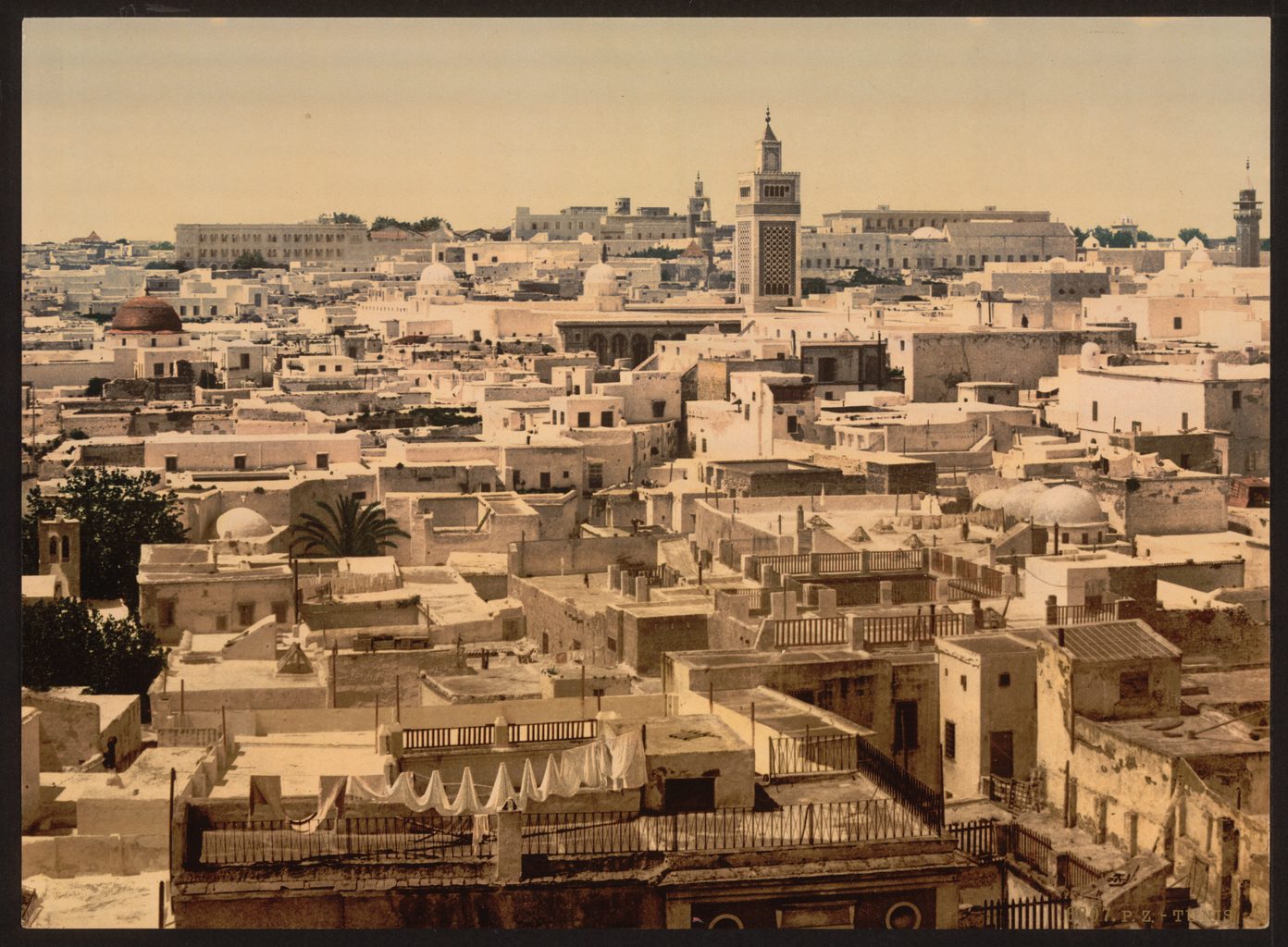
Our honest advice, though, is to get a little lost on purpose. The magic of the medina is in the side alleys — a painted door here, a hammam’s studded gate there, a shaft of light falling through a vaulted souk roof. Phone GPS goes haywire under the covered lanes, so drop a pin on your hotel or the Porte de France before you dive in, and don’t panic if the blue dot starts wandering through walls. If you’d rather not think about any of it, our guide to getting around Tunisia covers taxis and the light metro that drop you at the edge of the old city.
A walking route through the souks
Here’s the route we’d give a friend. Start at the Porte de France and walk up Rue Jamaa Ez-Zitouna towards the Great Mosque — resist the first flood of souvenir stalls, they’re the least interesting part. As you near the mosque, the covered souks open up on either side, and this is where the old city earns its reputation.
Peel off left into Souk el-Attarine, the perfumers’ souk, laid out in the 13th century and still lined with tiny shops selling essential oils, rose water, jasmine and blocks of amber musk. It’s one of the prettiest lanes in the medina and the sales patter is usually good-humoured. From here the souks interlock, so the order below is a suggestion rather than a strict path — follow your nose.
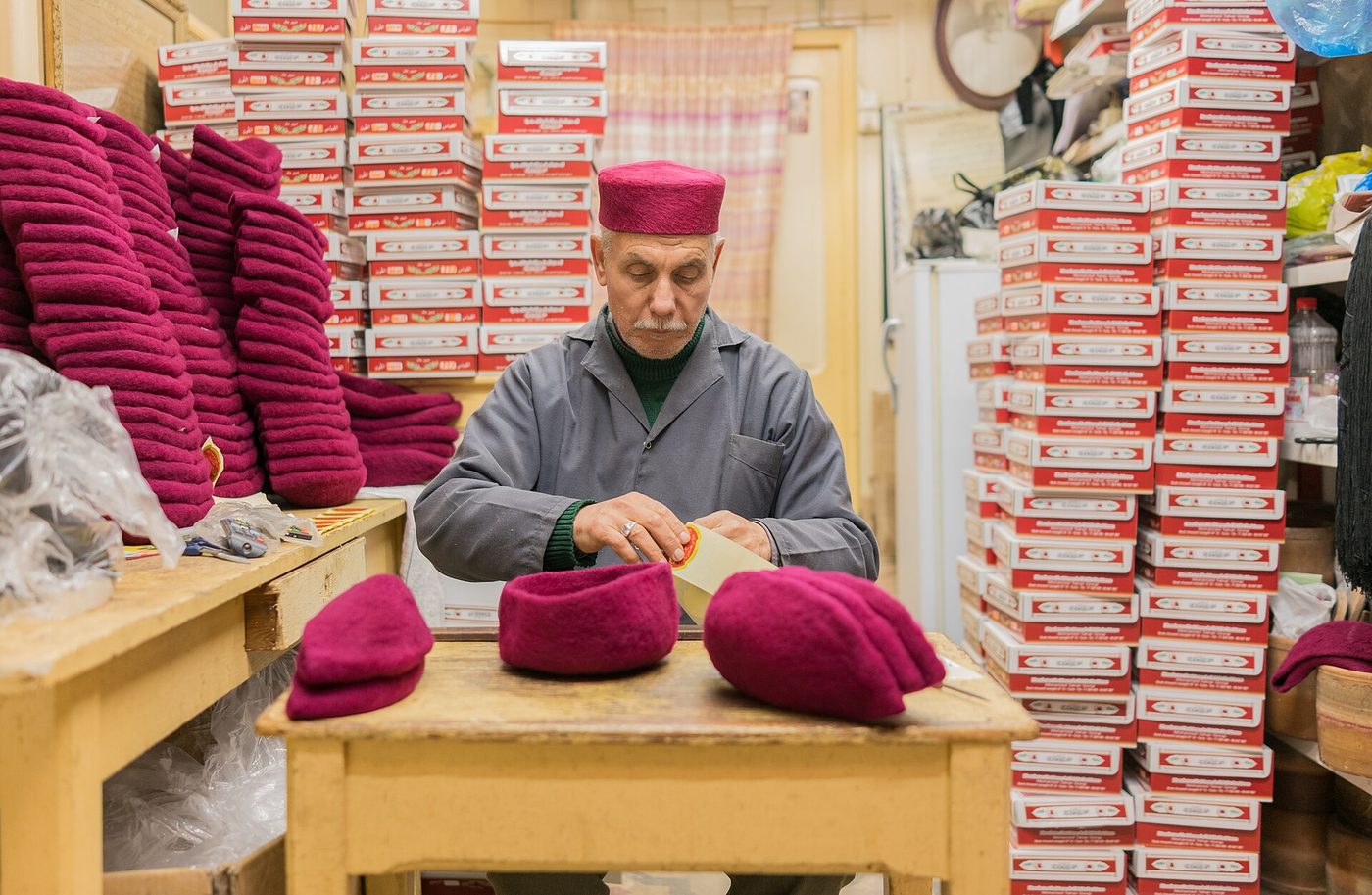
Just north, tucked near the junction of Rue Sidi Ben Arous, is the little Souk des Chéchias, and it’s our favourite corner of the whole quarter. This is where craftsmen have hand-made the chéchia — Tunisia’s soft, blood-red felt cap — since the 1690s, working in jewel-box chambers painted mint green. Many of the families here have made the same hat in the same room for six generations, a craft brought over by Andalusian Muslims expelled from Spain. Even if you don’t buy one, it’s a lovely, low-pressure place to watch real work being done.
Carry on and you’ll hit Souk el-Berka, now a glittering row of gold and jewellery shops set under ornate columns. Its past is much darker: this was the medina’s slave market, where people trafficked across the Sahara were sold until the trade was abolished in 1846. It’s worth pausing to take that in amid the sparkle. Nearby, Souk el-Koumach is the grand drapers’ souk, heaped with fabrics, silks and the elaborate cloth bought for weddings, while Souk el-Blat is the herbalists’ lane — bundles of dried thyme and eucalyptus, henna, and folk charms against the evil eye. For tailoring and embroidery, look for Souk el-Trouk, the “souk of the Turks”, set out in Ottoman times.
| Souk | What they sell | Worth knowing |
|---|---|---|
| Souk el-Attarine | Perfumes, rose water, jasmine, henna | The 13th-century perfumers’ lane beside the Great Mosque |
| Souk des Chéchias | Red felt chéchia caps | Mint-green workshops; six generations of the same families |
| Souk el-Berka | Gold and jewellery | Built on the former slave market; ornate columns |
| Souk el-Koumach | Fabrics, silks, wedding cloth | The grand covered drapers’ souk |
| Souk el-Blat | Herbs and folk remedies | Dried thyme, henna and charms against the evil eye |
| Souk el-Trouk | Tailoring and embroidery | The “souk of the Turks”, laid out under the Ottomans |
Don’t feel you must “do” all of them. Half the pleasure is the overlap — turning a corner from the quiet gleam of the goldsmiths into the sharp herbal fug of the medicine sellers. If you like this sort of sensory deep-dive, our guide to Tunisian culture puts the crafts and customs in context.
The Great Mosque of Ez-Zitouna
Everything in the medina radiates from Ez-Zitouna, the “Mosque of the Olive” and the spiritual heart of the old city. Its core dates to the early 8th century, which makes it one of the oldest and most important mosques in North Africa, and for centuries its attached university was among the leading centres of learning in the Arab world. The great square minaret you’ll glimpse over the rooftops is the landmark to steer by.
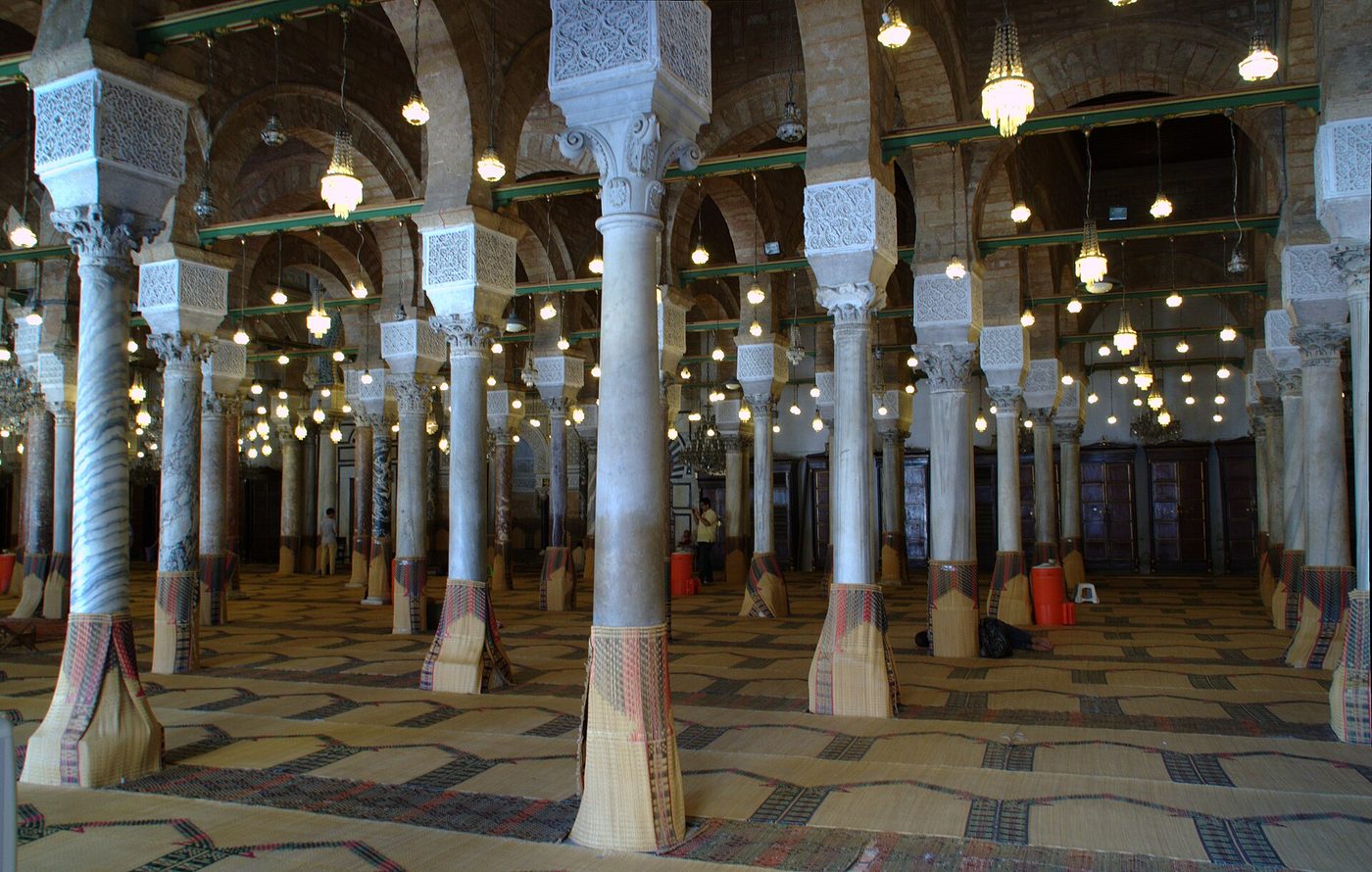
Non-Muslims can’t enter the prayer hall, but you’re usually welcome to look into the vast arcaded courtyard, which is the part most worth seeing — a serene rectangle of pale marble columns, many of them recycled from Roman Carthage. Visiting hours for tourists are generally mornings and early afternoons from Saturday to Thursday, with the mosque closed to visitors on Fridays and during the five daily prayers. Dress modestly (covered shoulders and knees, and a scarf for women), keep your voice down, and expect either a small fee or a request for a donation. Always double-check the day’s hours locally, as they shift with the prayer calendar and Ramadan.
There’s a local legend we rather like: that beneath the mosque lies the tomb of Saint Olivia, a young Christian martyr from Palermo, and that the two faiths are quietly bound together on this spot. True or not, it’s a fitting story for a building raised, in part, from the stones of a vanished Roman city.
Beyond the souks: palaces, a mausoleum and a museum
If you only shop, you’ll miss the medina’s quieter marvels — the palaces and tombs tucked down residential lanes where the touts don’t bother to follow. These are the places we’d steer you towards once the souks start to blur.
Tourbet el-Bey is the grandest: the 18th-century royal mausoleum of the Husainid beys who ruled Tunisia, a series of domed chambers filled with marble catafalques and lined floor-to-ceiling with intricate tilework and carved stucco. Male tombs are topped with a carved marble turban; it’s atmospheric and often nearly empty. A short walk away, Dar Ben Abdallah is a beautiful 1790s courtyard palace that now houses the Museum of the City of Tunis, its rooms staged with costumed mannequins to show how a wealthy Tunisois family lived in the 19th century — the best single place to picture daily life behind these blank street walls.
Keep an eye out, too, for Dar Othman, an early-17th-century palace with a striking striped marble portal and a peaceful garden courtyard, and for the medina’s medersas — the old Quranic colleges such as the Slimania, with their tiled courtyards and student cells. Grandest of all the secular buildings is Dar el-Bey, the former beylical palace up near the Kasbah, now used by the prime minister’s office (so admired from outside only). Together they’re a reminder that this was a capital of real wealth and learning, not just a marketplace. For the full sweep of the city’s sights, including the extraordinary mosaics of the Bardo Museum, see our dedicated guides.
Bab Bhar and the Ville Nouvelle
The obvious start and finish point for any medina walk is Bab Bhar — the “Sea Gate”, better known by its French name, the Porte de France. This stout stone arch once stood in the city walls facing the lake; the French demolished the ramparts around it in the 19th century and left the gate marooned on Place de la Victoire, where it now marks the seam between the old city and the new.
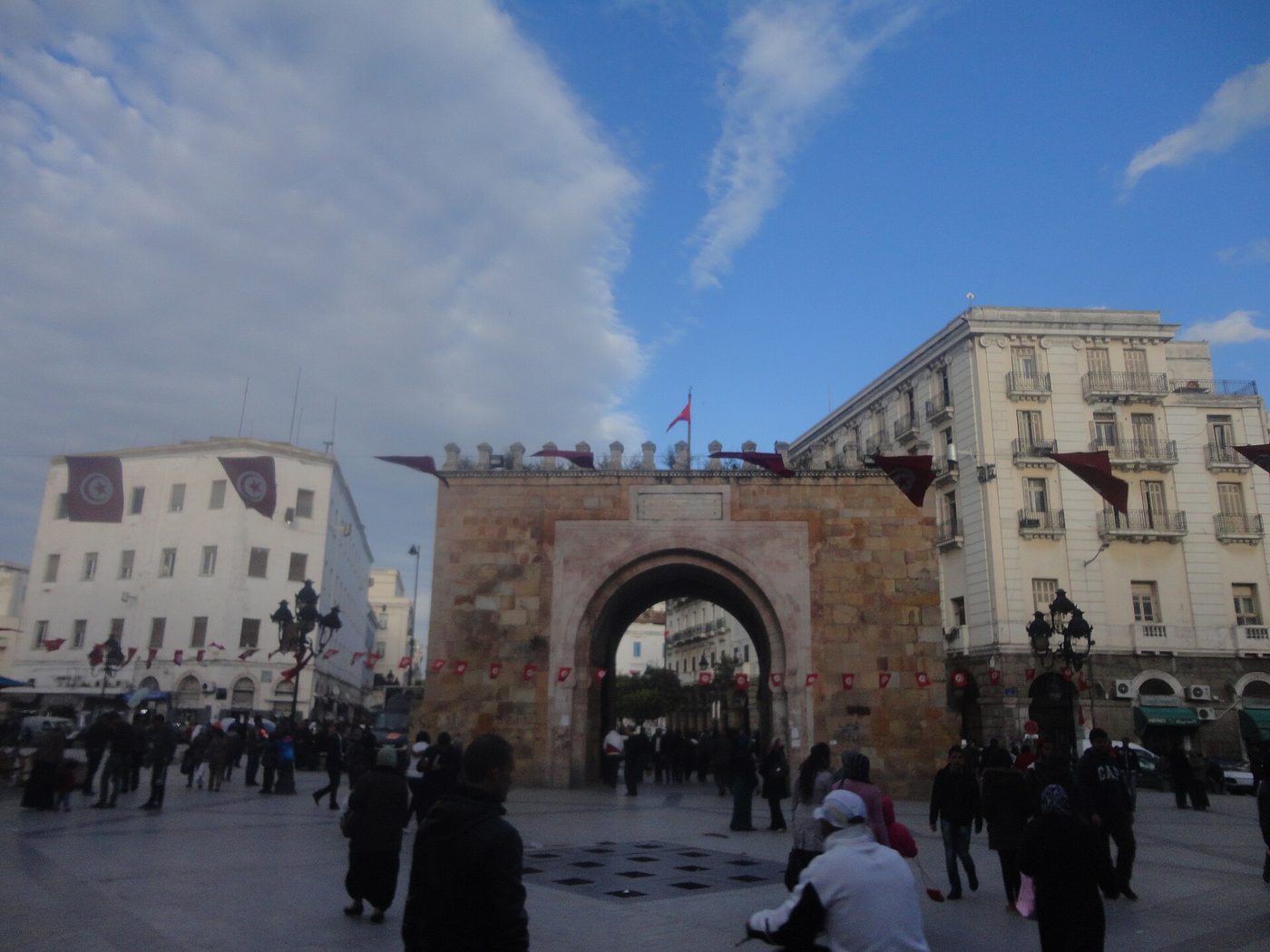
Step through it the other way and you’re on Avenue de France, which becomes the grand, tree-lined Avenue Habib Bourguiba — the “Champs-Élysées of Tunis”, all café terraces, the Art Nouveau theatre and the cathedral. The contrast is the whole point: a 20th-century European boulevard fused directly onto a 1,300-year-old Arab city. Grab a coffee on Place de la Victoire (the handsome building on the corner was once the British embassy) and watch the two worlds mingle before or after your walk. If you’re planning where to base yourself, our guide to where to stay in Tunis weighs up sleeping inside the medina versus the Ville Nouvelle.
Rooftop views and a mint tea
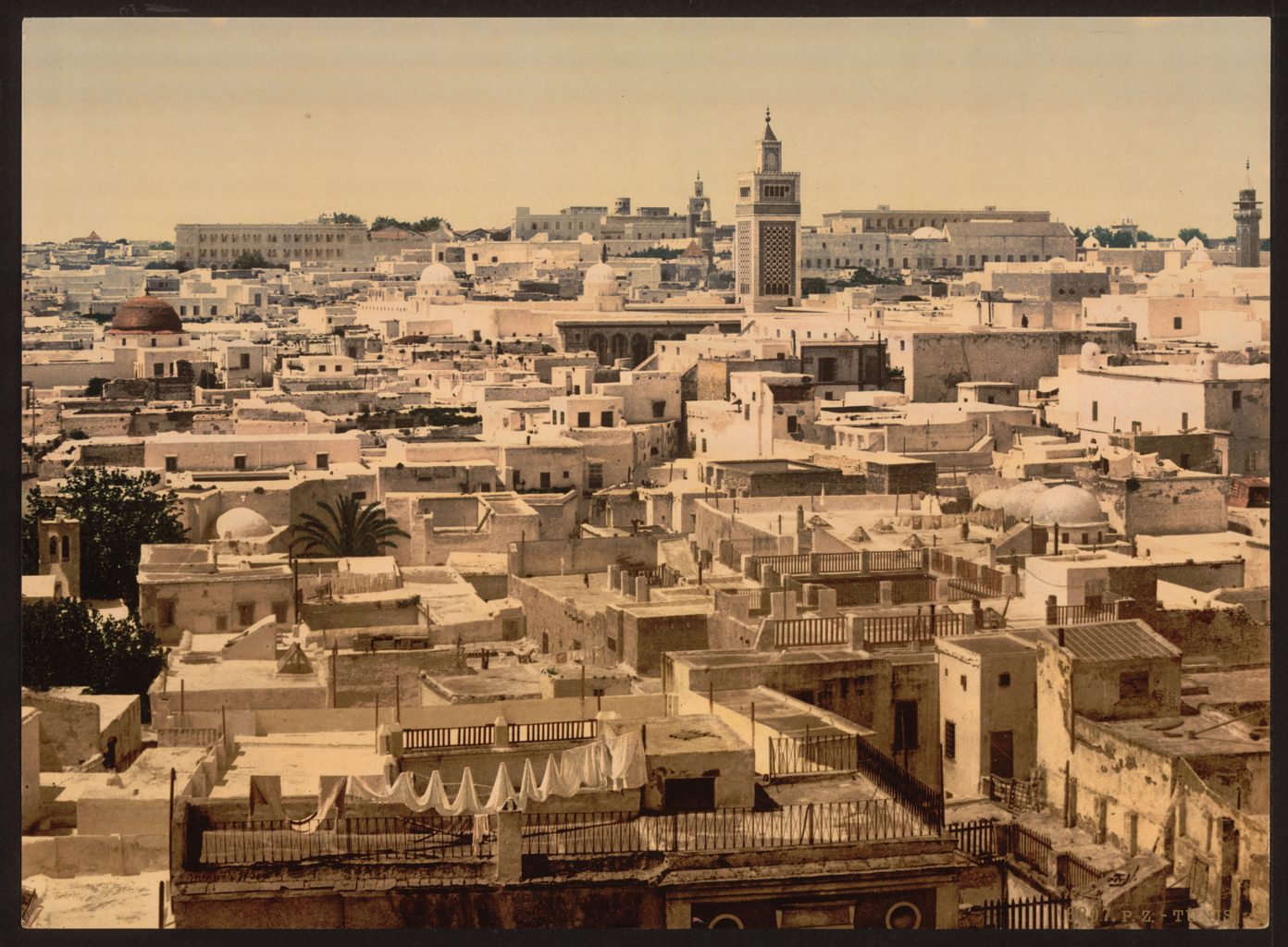
The medina hides its best views on its roofs. Several perfume and carpet shops around Souk el-Attarine will happily walk you up to their terraces for a panorama over the sea of pale rooftops and the Zitouna minaret — lovely, but be aware it usually comes with a friendly expectation that you’ll browse the shop afterwards. There’s no obligation to buy; a genuine thank-you and a small purchase, or a polite decline, are both fine.
For a view with no strings, head to one of the rooftop cafés — Café Panorama is the best known — where a Tunisian mint tea, poured over pine nuts or almonds, buys you a table and one of the finest outlooks in the city. It’s the perfect place to rest your feet, plan the rest of your day, and watch the light go gold over the old city. When hunger strikes, our guide to where to eat in Tunis and our national Tunisian food guide point you to the brik, lablabi and couscous worth crossing town for.
Haggling in the souks without the stress
Prices in the souks are a starting position, not a fact, and the haggling is meant to be a friendly game rather than a battle. If the idea makes you tense, relax — a smile and a bit of patience get you a fair price far more reliably than hard bargaining. Here’s how we go about it.
- Look interested, not desperate. If you fall in love with something visibly, the price only goes one way. Browse a few shops first to learn the going rate.
- Let them open. Ask the price, then counter with roughly a third to a half, and settle somewhere in the middle. The first quote to a tourist can be two or three times the real value.
- Keep it good-natured. This is a social ritual — tea may be offered, jokes made. Stay warm, never rude, and you’ll both enjoy it.
- Be ready to walk. A polite “thank you, I’ll think about it” and a step towards the door is the single most powerful move you have. Often you’ll be called back with a better price.
- Only haggle if you mean it. Don’t push hard on a price and then walk once they’ve met it; that’s considered bad form.
- Carry small notes. The dinar is a closed currency you can only get in Tunisia, so change money on arrival and keep small change handy — “I’ve only got this much” is a fine closing line.
Fixed-price craft shops and the state-backed handicraft centre (the ONAT/SOCOPA store on the edge of the medina) are useful for a no-haggle benchmark before you dive into the souks. And remember the golden rule: something is only “expensive” if you didn’t want it. If you’re weighing up costs across your trip, our Tunisia travel tips cover money and the closed currency in more detail.
The “faux guide” and how to handle it
Now for the thing every guidebook warns about, and the one worth understanding before you go: the faux guide, or unofficial guide. Somewhere near the Porte de France, a friendly, well-dressed young man will fall into step beside you. He may say he works at your hotel (“Do you remember me?”), or that the mosque is “closed today” but he can show you a special view, or simply that he’s a student who loves to practise his English and show visitors around for free.
It’s rarely threatening and often genuinely charming — that’s what makes it work. The pattern is almost always the same: a “free” wander that ends at a particular carpet or perfume shop where he earns commission, followed by an awkward demand for payment for his “tour”. The rooftop view is real; the free-ness is not.
Handling it is simple and doesn’t require rudeness. A firm, friendly “La, shukran” (no, thank you), no eye contact, and keep walking. Don’t accept the offer of a “quick look”, don’t follow anyone down a side street, and if someone attaches themselves regardless, just head into a café or a shop and they’ll melt away. Tucking a hotel wristband out of sight helps, too. We cover the full range of these approaches — and a few cash and taxi tricks — in our guide to common tourist scams in Tunisia. None of this should put you off; it’s background noise you learn to tune out within an hour.
Is the Tunis medina safe?
Yes — and by regional standards it’s remarkably relaxed. Visitors who’ve done the medinas of Morocco often remark that Tunis feels calmer, less crowded and far less aggressively touristy; you’ll share the lanes with locals shopping for cloth and spices rather than tour groups. Violent crime against tourists is rare, and the daytime atmosphere is friendly and workaday.
The honest caveats are the ordinary ones for any busy old city. Petty pickpocketing can happen in the tightest, most crowded souks, so keep bags zipped and to the front and don’t flash valuables. The hassle you’ll meet is commercial, not menacing — persistent sellers and the faux guides above, rather than anything frightening. After dark the medina’s residential lanes empty out and get poorly lit, so it’s best explored by day; in the evening, stick to the well-lit main streets or the Ville Nouvelle. For the fuller picture, including the current Foreign Office position, see our honest assessment of whether Tunis is safe.
Visiting the Tunis medina: know before you go
A handful of practical things that make a medina visit run smoothly:
- Go in the morning. The souks are at their best as they open, before the midday crush and the fiercest heat. Mondays and Fridays can see some monuments and shops closed.
- Wear the right shoes. The lanes are worn, uneven and occasionally slick — trainers over sandals, every time.
- Dress modestly-ish. Tunis is relaxed, but covered shoulders and knees are respectful, and essential if you want to enter the mosque courtyard.
- Carry cash in small notes. Most souk stalls don’t take cards, and small change is your friend when haggling. There are ATMs around Place de la Victoire.
- Don’t over-plan the map. Pin your exit, then wander. Ask a shopkeeper rather than a hovering “guide” if you’re truly lost.
- Allow half a day at least. The highlights fit into three or four unhurried hours; history lovers can easily fill a full day.
- Combine it. The medina, Carthage and the blue-and-white village of Sidi Bou Said make a classic capital-region trio — see our day trips from Tunis for how to string them together.
Slot it all into a wider plan with our first-timer’s Tunis itinerary, or zoom out to the national picture with our guide to things to do in Tunisia. Either way, the medina deserves to be first on the list.
Tunis medina: your questions answered
Is the Tunis medina worth visiting?
Absolutely — it’s the single best thing to do in the capital and one of the finest medieval old cities in North Africa. A UNESCO World Heritage Site of some 700 monuments, it rewards a half-day of wandering with covered souks, historic mosques, palaces and rooftop views, all far less touristy than the medinas of neighbouring Morocco.
How long do you need in the Tunis medina?
Allow at least half a day — around three to four hours — to walk the main spine, dip into the souks, see the Great Mosque courtyard and one or two palaces. History enthusiasts who want to add the Tourbet el-Bey mausoleum, Dar Ben Abdallah museum and a rooftop tea can happily spend a full day here.
Is the Tunis medina safe for tourists?
Yes, it’s safe and relaxed by day, with only ordinary big-city caution needed. Keep bags zipped against occasional pickpockets in crowded souks, and expect persistent sellers and unofficial “guides” rather than any real danger. After dark the residential lanes empty and dim, so it’s best explored in daylight and left for the Ville Nouvelle in the evening.
Can you enter the Zitouna Mosque as a non-Muslim?
Non-Muslims can’t enter the prayer hall but are usually welcome to view the marble courtyard, which is the highlight anyway. Visiting hours are generally mornings and early afternoons from Saturday to Thursday, closed on Fridays and during prayers. Dress modestly, cover shoulders and knees, and expect a small fee or donation. Confirm the day’s times locally.
What are the main souks in the Tunis medina?
The classics are Souk el-Attarine (perfumers), Souk des Chéchias (the red felt-cap makers), Souk el-Berka (gold and jewellery, built on the former slave market), Souk el-Koumach (fabrics) and Souk el-Blat (herbs and remedies). They interlock around the Great Mosque, so you’ll drift between them without really trying.
How do I get to the Tunis medina?
It’s an easy walk from the Ville Nouvelle: head up Avenue Habib Bourguiba and Avenue de France to the Porte de France on Place de la Victoire, the medina’s main gate. The light metro and taxis also stop nearby at Place de la République and Place Barcelone. From there you simply walk in — no ticket needed to enter the quarter.
How do you deal with fake guides in the medina?
Stay friendly but firm. If someone claims to work at your hotel or offers a “free” tour, decline with a polite “no, thank you”, avoid eye contact and keep walking. Don’t follow anyone to a shop or down a side alley. If they persist, step into a café. It’s a commission game, not a threat, and it fades fast.
Is haggling expected in the Tunis medina?
Yes, in the souks haggling is normal and expected — prices are a starting point, not fixed. Counter the first quote with about a third to a half, keep it good-humoured, and be ready to walk away, which often brings a better price. Only bargain hard if you genuinely intend to buy. Fixed-price craft shops offer a useful benchmark.
What should I buy in the Tunis medina?
Good buys include a hand-made chéchia felt cap, perfume oils and rose water from Souk el-Attarine, ceramics and painted plates, leather goods, silver jewellery and woven blankets. Quality varies hugely, so compare a few stalls and check craftsmanship before you commit. The state handicraft shop nearby is handy for gauging fair fixed prices.
Where are the best rooftop views of the medina?
Several perfume and carpet shops near Souk el-Attarine offer terrace views in the hope you’ll browse afterwards, and rooftop cafés such as Café Panorama serve mint tea with one of the finest outlooks over the old city. Either way you’ll get sweeping views across the pale rooftops to the Zitouna minaret and the sea beyond.
Can you visit the Tunis medina and Carthage in one day?
Yes, and many people do. Spend the morning in the medina, then take the TGM light rail out to the Roman ruins of Carthage and the village of Sidi Bou Said in the afternoon. It’s a full but very doable day; our day-trips guide sets out the timing and the train connections that make it work.
Do I need a guide for the Tunis medina?
Not at all — the medina is safe and walkable on your own, and this route covers the highlights. That said, an official, licensed guide (booked through your hotel or a reputable agency, not picked up on the street) can add real depth to the history and lead you into palaces you might otherwise miss. Avoid the unofficial “guides” who approach you.
Written by the Tunisia Tourism Guide team — an independent UK-focused guide to travelling in Tunisia. We don’t sell tours or take hotel commissions. Prices and advice were checked at publication; always confirm current details before you book.
Photo credits
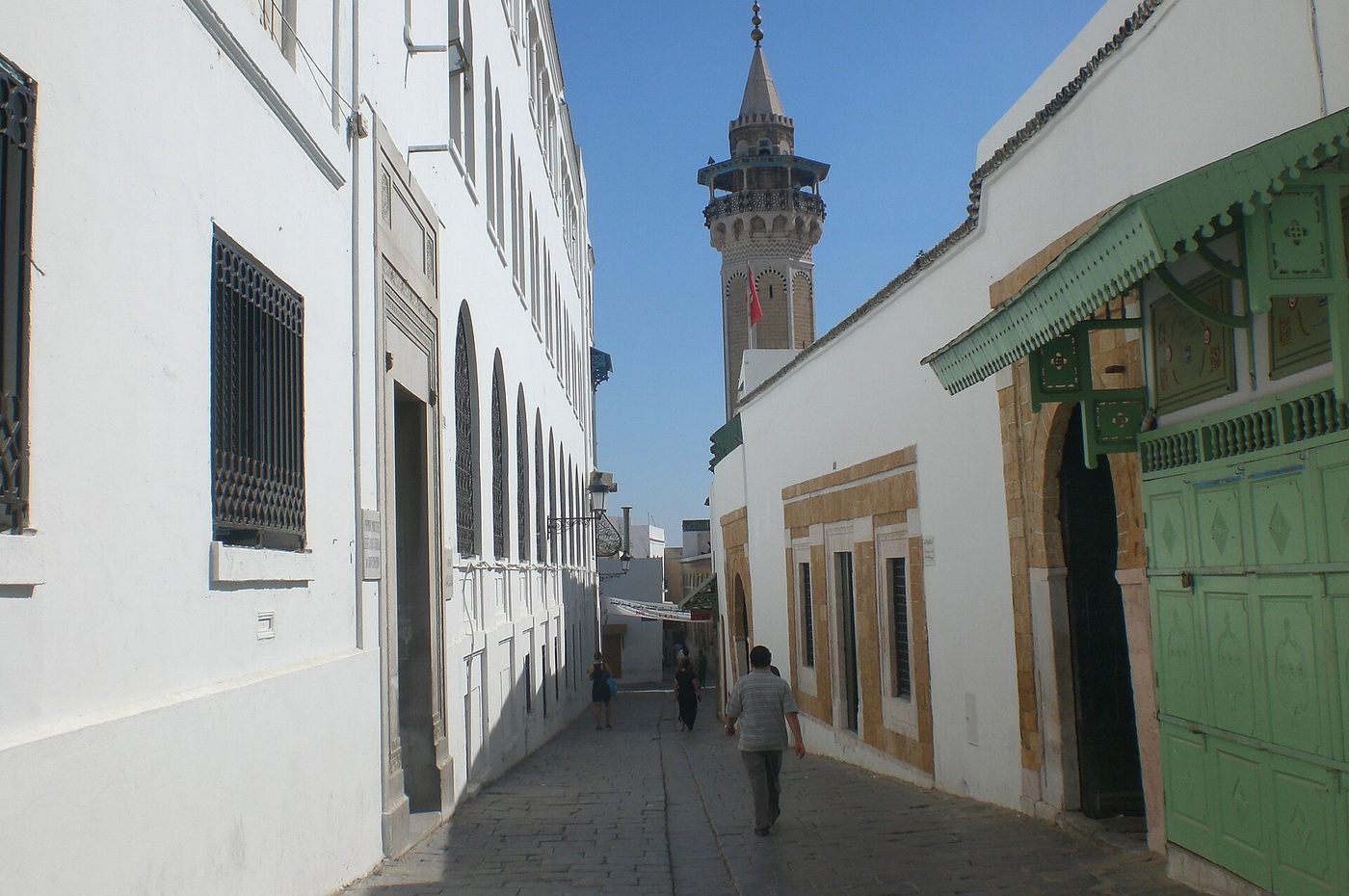
All images via Wikimedia Commons, used with thanks: Rooftops of the Tunis medina with the square minaret of © Wikimedia Commons contributor (Public domain); A chechia (felt-cap) maker at work in his shop in © IssamBarhoumi (CC BY-SA 4.0); Marble courtyard and arcades of the Great Mosque of Ez-Zitouna © Habib M’henni (CC BY-SA 3.0); The Bab Bhar or Porte de France gate at the © Noomen Daoud (CC BY-SA 3.0).
2 responses to “Tunis Medina: A Walking Guide to the Old City”
[…] that stops you doubling back in the heat. It’s the natural companion to a morning in the Tunis medina. Here’s everything you […]
[…] prayer. None of that is a dealbreaker; it’s simply the texture of staying somewhere real. Our Tunis medina guide covers what to see once you’re inside, and the Bardo Museum is an easy […]