By the Tunisia Tourism Guide team · Last updated 2 September 2026 · FCDO advice quoted below was updated 24 July 2026 and re-checked word for word on 2 September 2026 · We don’t sell tours or take hotel commissions — this is independent advice, written to be useful.
There is a point on the road northwest out of Tozeur where the flat world simply stops. The Djebel el Negueb rises off the plain like a reef — ochre, folded, entirely dry-looking. Then a crown of palm fronds appears in a crease of the rock, and you understand what has pulled people up here for two thousand years, which is water.
The Chebika Tamerza Mides circuit takes in three mountain oases an hour northwest of Tozeur: Chebika, a spring-fed palm gorge with a small waterfall; Tamerza, the largest, with a cascade and a ruined old town; and Mides, a village wrapped by a layered canyon. It is a half-day loop.
It is also, unlike anything else in our guide to the Tunisian Sahara, a trip with a live travel-advisory question attached. We are going to deal with that first, plainly, before we tell you how lovely it is — because you cannot make a sensible decision about the second without the first.
Read this before you book: the FCDO position
Chebika, Tamerza and Mides sit in Tozeur Governorate, hard against the frontier with Algeria. Mides in particular is right on it — the border runs along the far lip of the gorge.
The UK Foreign, Commonwealth and Development Office advises against all but essential travel to a list of areas in western Tunisia. Quoted exactly, one of them is:
“within 10km of the rest of the Tunisia-Algeria border south of Kasserine Governorate”
The three mountain oases fall inside that 10km band. FCDO advice, updated 24 July 2026, checked 2 September 2026 — read it yourself at gov.uk’s Tunisia travel advice, because it can change between us writing this and you reading it.
What that means in practice
The FCDO also says this, and it is the sentence that actually bites:
“Your travel insurance could be invalidated if you travel against advice from the Foreign, Commonwealth & Development Office.”
Standard UK travel insurance is written against FCDO advice. Enter an area the FCDO advises against all but essential travel to and, on most policies, your cover simply stops — not just for anything that happens in the zone, but potentially for the trip. That includes medical treatment, which matters here because your GHIC is not valid in Tunisia and private care is paid up front. A handful of specialist insurers will cover travel against FCDO advice for an extra premium and an explicit declaration; a mainstream annual multi-trip policy will not. If you are considering this circuit, ring your insurer and ask the direct question before you go, and get the answer in writing.
And now the other half, honestly
Here is where we part company with articles that either pretend the advisory doesn’t exist or imply the place is a war zone. Neither is true, and you deserve the actual picture.
- Tunisian operators sell this as a routine day trip. Every guesthouse, hotel desk and driver in Tozeur and Nefta offers the mountain-oasis loop. Coaches do it. Families do it. It is one of the most heavily marketed excursions in the south, and the vendors, cafés and guides at each site exist because visitors come every day.
- There is a normal, visible security presence. Expect military and National Guard checkpoints on the road up. That is the border region working as intended, not a sign of trouble — slow right down, wind the window, be polite, carry your passport. Foreign visitors on the standard circuit are routine to them.
- Other governments draw the line differently. Canada’s advisory (updated 26 May 2026) tells travellers to avoid the area within 20km of the Algerian border — but explicitly excepts a short list of tourist towns where it asks only for a high degree of caution, and that list names Aïn Draham, Tabarka, Chebika, Tamerza and Mides. In other words, one Western government carves these three villages out by name; the UK’s wording does not.
- The FCDO’s concern is the frontier itself — cross-border smuggling and militant movement in remote border country, and the practical difficulty of consular help out there — rather than these three villages specifically. That’s context, not reassurance.
So the official line and the on-the-ground reality diverge, and we are not going to pretend to resolve that for you. What we will say plainly is this: the FCDO advises against all but essential travel here, a normal holiday is not essential travel, and going anyway is a decision with a real insurance consequence. Some readers will weigh that up and go. Others will drive out to Chott el Jerid instead and sleep easier. Both are reasonable. It is your call, made with the facts, not ours to make for you.
If you want the full national picture with every zone quoted, our date-stamped Tunisia safety guide and travel advice roundup set it all out. Nothing on the standard coastal or main desert circuit — Tozeur, the chott, Douz, Ksar Ghilane — falls inside any advisory zone.
The three oases at a glance
| Stop | From Tozeur | Time on site | What you’re there for | Effort |
|---|---|---|---|---|
| Chebika | ~60km, 1 hr | 60–90 min | Palm gorge, small waterfall, ruined old village on the slope | A proper walk — loose rock, some steps |
| Tamerza | ~10 min beyond Chebika | 60–90 min | The Grande Cascade, the abandoned old town, canyon views | Easy viewpoints; scramble to the falls |
| Mides | ~6km beyond Tamerza | 45–60 min | The canyon — layered, sheer, wrapped round the old village | Rim walk easy; descending needs a guide |
Total loop from Tozeur and back is roughly 120km on sealed road. Half a day covers it briskly; a full day lets you walk properly at each stop and eat somewhere decent.
Chebika: the Palace of the Sun
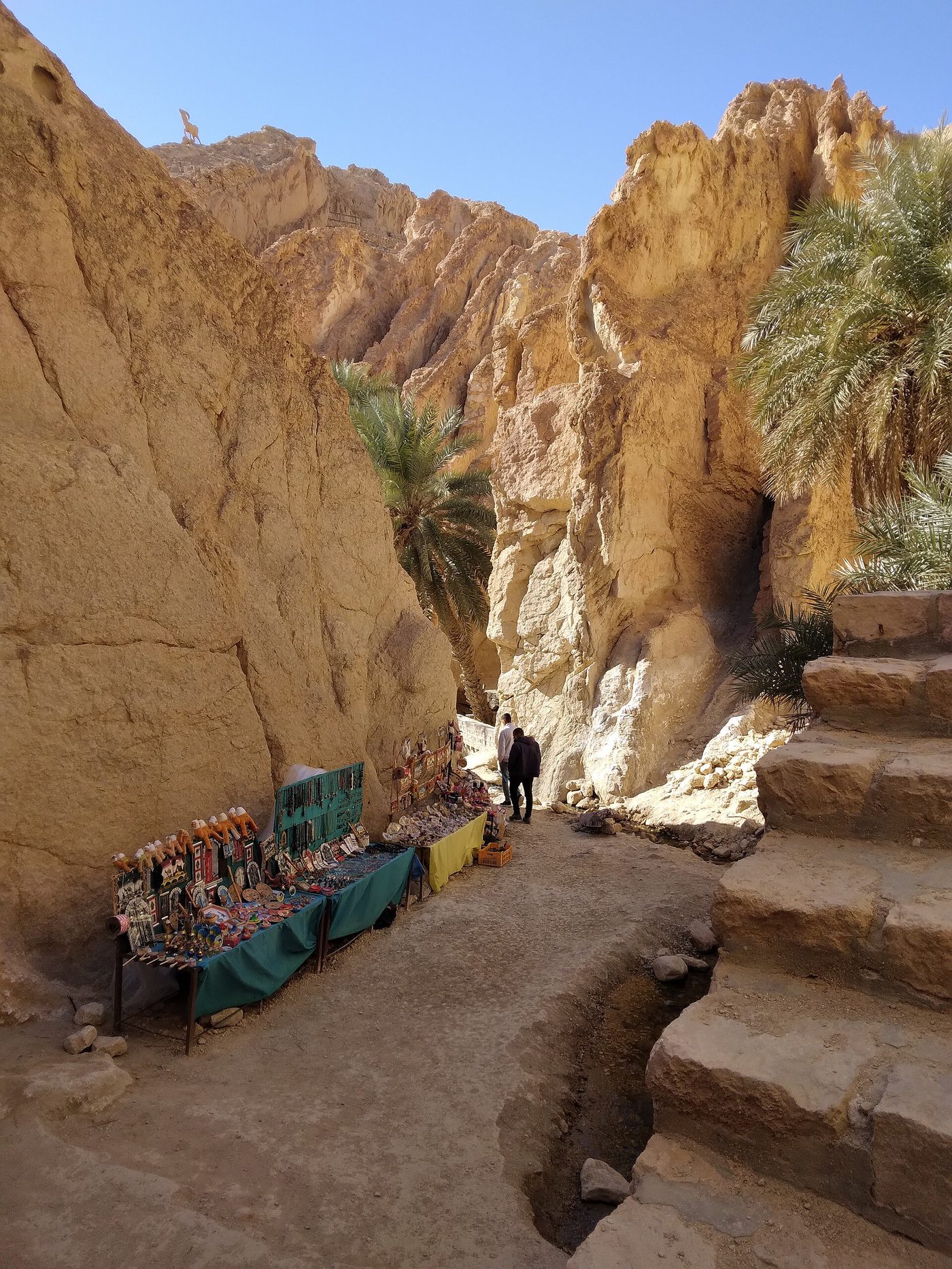
The first and, for most people, the prettiest. Chebika sits at the foot of the Djebel el Negueb where a spring-fed stream drops off the mountain into a narrow palm gorge. The Romans held it as a frontier lookout — Ad Speculum, “at the mirror”, from the signalling post here — and locals still call it Qasr el-Shams, the Palace of the Sun, because the ridge keeps it lit from first light to last.
The set walk is a loop of about an hour: up past the ruins of the old village on the slope, along the rim with the plain opening out below, then down into the canyon itself where the stream runs cool between the palms, frogs sing from the pools, and the waterfall gathers into a small bathing basin. The name is said to come from the Tunisian Arabic for “little net”, after the way the water spreads over the rock.
Do it in that direction, early, and you’ll have the best stretch of the gorge to yourself. By mid-morning the minibuses arrive and the souvenir sellers set up along the path. Informal local guides attach themselves at the entrance; they’re genuinely useful on the route and the expected tip is around 20 TND (2026 — check current). Agree it at the start, not at the end.
Wear real shoes. The ground is loose stone and there are unfenced drops. Flip-flops are how people turn an ankle here.
Tamerza: the cascade and the ghost town
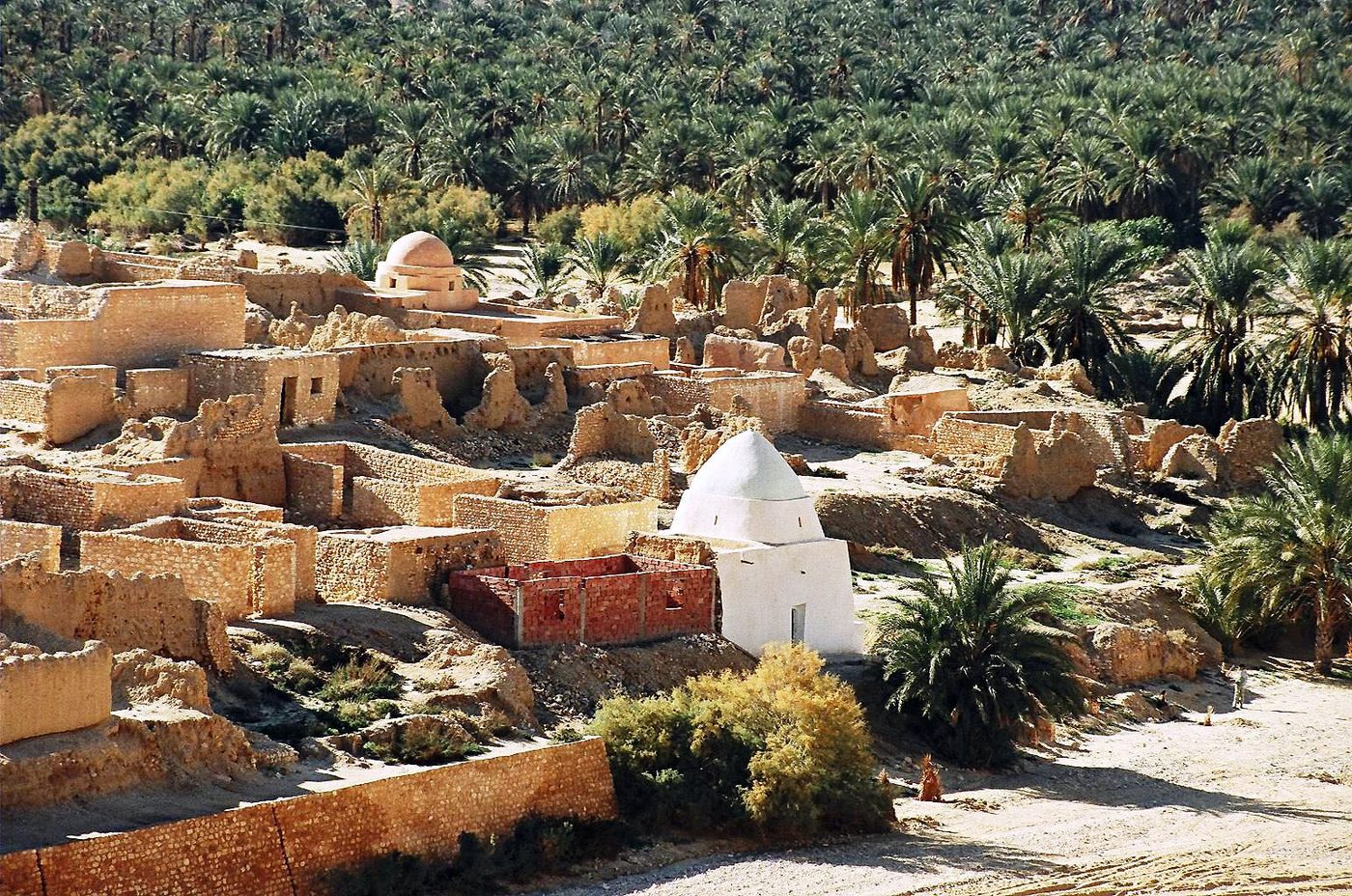
Ten minutes on, Tamerza is the region’s capital and its biggest piece of theatre. The living town faces, across a wide dry riverbed, the roofless shell of Tamerza El Gdima — the old village — a long, low sprawl of ochre walls with a marabout’s white dome still standing amid the collapse. In late light it is one of the great sights of southern Tunisia.
The ruin is there because of what happened in the autumn of 1969, and it’s worth knowing the story. Rain fell across southern Tunisia almost without pause for twenty-two days — a freak in a region that gets sun most of the year — and the floods that followed dissolved the earth-built villages of these mountains and killed hundreds of people across the wider region. The survivors rebuilt in concrete on safer ground nearby and left the old stones where they stood. Half a century later, the villages the water emptied have become, with the water itself, the reason anyone comes.
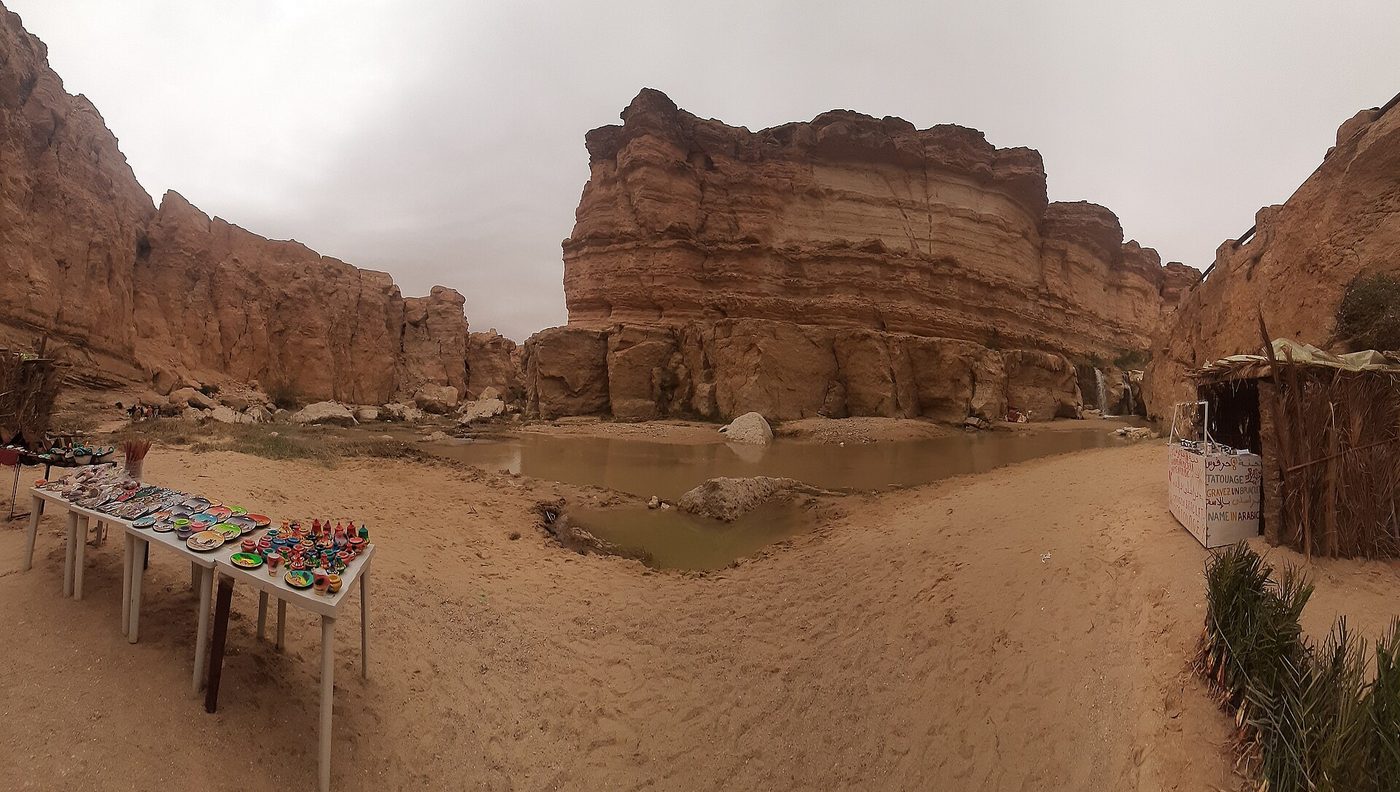
Below the town, the oasis is fed by the Grande Cascade, routinely described as Tunisia’s largest waterfall. Calibrate that word for the edge of a desert: after a wet winter it’s a broad, genuinely lovely veil; in a dry autumn it’s a determined trickle over a rock lip with a small pool and a lot of litter. The canyon it has cut is worth the scramble either way, and there are usually a couple of café shacks and men offering tea.
Above the gorge sits the clifftop hotel that has hosted nearly every film crew to point a camera at these mountains. This is The English Patient country — several of its aerial panoramas were shot over these ruins — and Star Wars productions based themselves here while working the desert locations we cover in our Star Wars in Tunisia guide. A pot of tea on the terrace with the ghost village going gold across the wadi is the natural pause in the circuit.
Mides: the canyon on the line
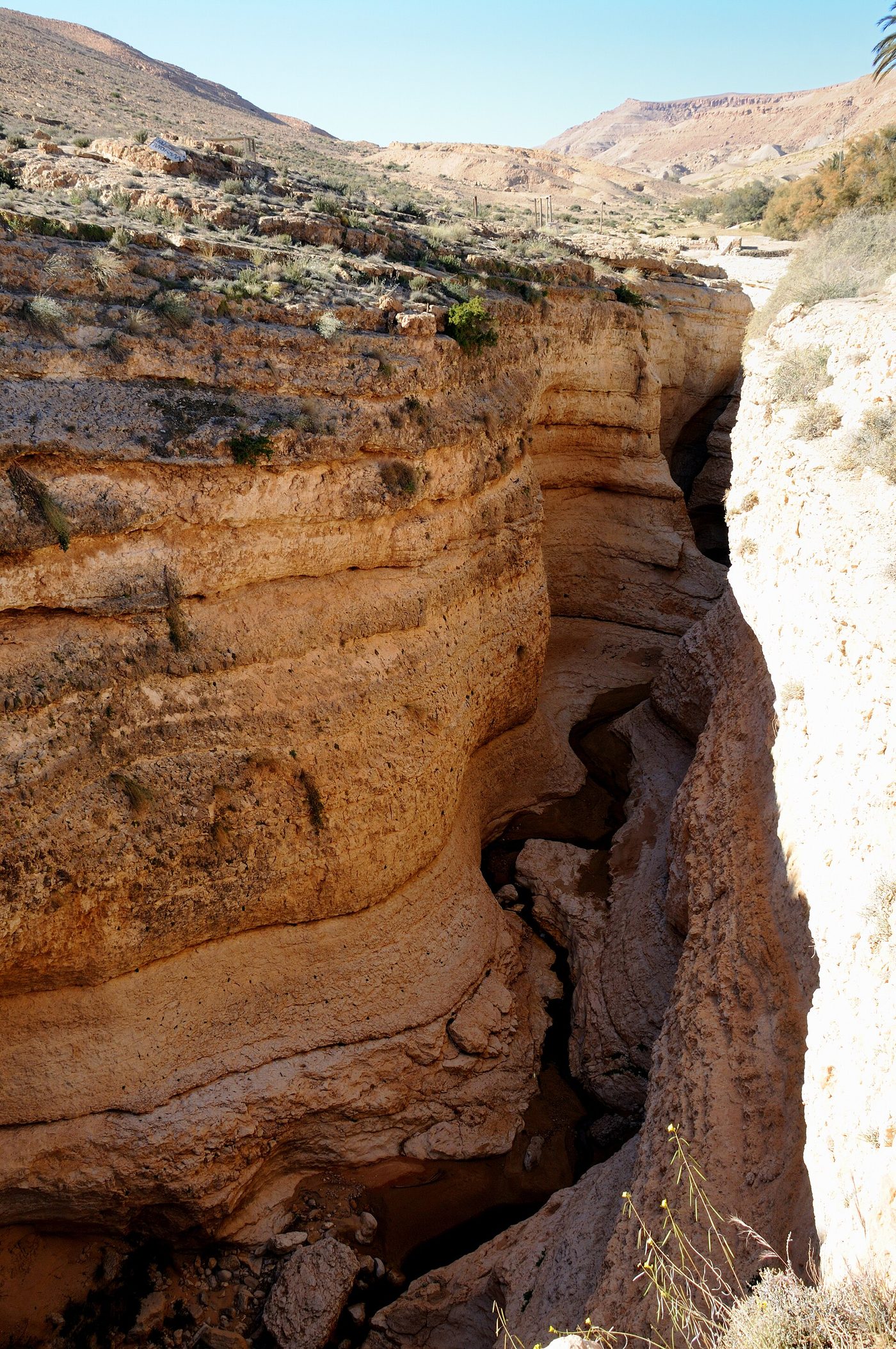
The last stop is the smallest oasis and the biggest landscape. Mides clings to the very edge of Algeria — the frontier runs close enough to see the markers — where its stream has cut a gorge of extraordinary layered, wind-smoothed rock that wraps the old village on three sides like a moat.
The Romans garrisoned this perch because it is almost impossible to attack; Berber communities held it for centuries after; the 1969 floods emptied it like its neighbours. What’s left is geology. You walk the rim, which is easy and unfenced and absolutely not the place to be careless with children or a phone. Sure-footed visitors can go down into the gorge with a local guide; do not attempt the descent alone. Vendors on the rim sell desert roses and, improbably but genuinely, fossilised shark teeth from the marine beds all around here.
Of the three stops, this is the one that silences a vehicle. It is also the one closest to the frontier, and worth being sensible about: stay on the marked paths and the village side, don’t wander toward the border, and don’t photograph military positions or personnel — that is taken seriously across Tunisia and especially here.
How to do the trip
Do you need a 4×4?
No — and this is the single most common misconception, usually encouraged by whoever is trying to sell you a 4×4. The road from Tozeur through Chebika, Tamerza and Mides is sealed and perfectly fine for an ordinary hire car. The only genuine 4×4 terrain in the region is the optional desert extension west to the dune film sets, which is a different trip. If you’re driving yourself, our Tunisia road trip guide covers checkpoints, fuel and the rules of the southern roads.
Private driver, organised tour or self-drive?
| Option | Rough cost (2026 — check current) | Pros | Cons |
|---|---|---|---|
| Private car and driver from Tozeur | ~80–150 TND per vehicle for a half day | Flexible, cheap split between four, local knowledge | Quality varies; circuits get quietly shortened |
| Joined half-day tour | Roughly €30–60 per person | Simple, hotel pickup, English-speaking guide | Fixed timings, group pace, some shopping stops |
| Self-drive hire car | Fuel plus your day rate | Total control of the light and the timing | You handle the checkpoints and the parking touts |
| Add-on to a coach circuit from the coast | Included in tour price | No planning | Rushed; often the first thing dropped |
Whichever you choose, name all three villages out loud before you set off and agree the price for the whole loop. The standing complaint about this circuit is drivers who trim Mides off the end, or who fold in a “carpet workshop” that eats forty minutes. Write the stops down if you need to.
The order and the timing
Leave Tozeur at eight. Chebika first, before the groups; Tamerza by late morning with tea on the terrace; Mides before the heat peaks. Back in Tozeur for a late lunch. If you’d rather have the best light on Mides, run it in reverse and accept that Chebika will be busier.
There is essentially no shade between the palm gorges. Hat, sunglasses, sunscreen, more water than you think, and shoes with grip. In winter add a layer — it’s several degrees cooler up here than on the plain and the wind funnels through the canyons.
When to go
October to April, and spring is the sweet spot. Winter rain gives the waterfalls their best voice, so March and April usually show Tamerza and Chebika at their most convincing. Autumn is warm, dry and lovely but the falls are at their thinnest. Summer is punishing and the walks stop being pleasant well before the thermometer tops out.
| Season | Waterfalls | Crowds | Verdict |
|---|---|---|---|
| March–April | Best — fed by winter rain | Moderate | The pick of the year |
| October–November | Modest to thin | Busiest — peak southern season | Very good weather, weaker water |
| December–February | Variable; improving through winter | Quiet | Cold mornings, superb light, few people |
| May–September | Usually dry | Few | Skip it |
Our best time to visit Tunisia guide has the month-by-month detail for the whole country.
What it’s really like — the honest bits
“Waterfall” is doing some work. These are desert cascades. On a good spring day Tamerza is a proper sheet of falling water; in October it can be a metre-wide trickle. If you’ve come from Iceland or the Lake District, adjust.
There is litter. The pools at Chebika and Tamerza attract picnickers and the clean-up is patchy. It’s noticeably worse in the areas nearest the car parks and better once you walk.
The guides and vendors are persistent but not aggressive. At each site you’ll be met by men offering to show you the path, sell you a desert rose, or mind your car. A tip of a few dinars for the car and 20 TND for a guide who actually walks with you is fair. Agree everything up front; our Tunisia travel tips cover the etiquette.
The old villages are ruins, not museums. No signage, no ticket, no barriers, no restoration. That’s most of the charm and all of the hazard — crumbling walls, open drops, loose footing.
It is genuinely spectacular. With all of the above said, the canyon at Mides and the gorge walk at Chebika are among the finest landscapes in the country, and they belong in any list of the most beautiful places in Tunisia. Nobody comes back saying it wasn’t worth looking at.
Practicalities
- Base: Tozeur, an hour away, with the widest choice of hotels and dars. Nefta works too. There is a clifftop hotel at Tamerza itself if you want to be there for dawn.
- Getting around: no useful public transport on this route — louages serve the towns, not the sites. You need a car or a driver. See getting around Tunisia.
- Money: the dinar is a closed currency, so you cannot buy it before you fly or take it home. Change on arrival, carry small notes for guides, parking and tea. Roughly £1 to 3.8–3.9 TND in mid-2026 — check the rate.
- Health: your GHIC is not valid in Tunisia and treatment is pay-up-front, so travel insurance is essential — see the advisory section above on what that means for this particular trip. The NHS-linked TravelHealthPro page for Tunisia has vaccination and food-and-water advice.
- Documents: carry your passport, not a photocopy, for the checkpoints. If you’re driving, keep the hire agreement and your 1968-convention International Driving Permit to hand.
- Phone signal is patchy in the gorges and non-existent in parts of the canyon. Tell someone your plan.
Combining it with the rest of the south
If you decide to go, the circuit slots naturally into a southern swing. The classic two-day Tozeur pattern is mountain oases in the morning of day one, palm grove and brick medina in the afternoon; salt-lake crossing and the dune film sets on day two. From the coast or the island it’s usually an optional extra on a longer loop — see the Sahara tour from Djerba and our roundup of excursions worth booking. For quieter corners of the country beyond the standard route, our guide to Tunisia’s lesser-known places has more.
Chebika, Tamerza and Mides: your questions answered
Where are Chebika, Tamerza and Mides?
In Tozeur Governorate in southwest Tunisia, strung along one road in the last folds of the Atlas Mountains about 60–75km northwest of Tozeur, and hard against the Algerian border. The three are within roughly 15km of each other and are almost always visited as one loop.
Is it safe to visit Chebika, Tamerza and Mides?
The FCDO advises against all but essential travel to “within 10km of the rest of the Tunisia-Algeria border south of Kasserine Governorate”, which covers these villages (advice updated 24 July 2026, checked 2 September 2026). Tunisian operators nevertheless sell the circuit daily and there is a routine military and police presence. Travelling against FCDO advice can void your insurance — check with your insurer before deciding.
Will my travel insurance cover the mountain oases?
Most standard UK policies will not, because they’re written against FCDO advice and this area carries an “all but essential travel” warning. Some specialist insurers cover travel against FCDO advice for an additional premium and a declaration. Ask the direct question before you travel and get the answer in writing.
Do you need a 4×4 for the mountain oases?
No. The road from Tozeur through all three villages is sealed and fine for an ordinary hire car, whatever a driver trying to upsell you says. A 4×4 is only needed for the separate desert run west to the dune film sets.
How long does the Chebika, Tamerza and Mides trip take?
Half a day at a brisk pace — roughly five hours door to door from Tozeur for the 120km loop. A full day is better: an hour to walk Chebika’s gorge properly, an hour at Tamerza with tea, an hour on the Mides rim, plus lunch.
How much does a mountain-oases tour from Tozeur cost?
Around 80–150 TND for a private car and driver for the half-day loop, split between up to four passengers, or roughly €30–60 per person on a joined tour with hotel pickup (2026 — check current). Agree the price and name all three stops before setting off.
Is there really a waterfall at Tamerza?
Yes, and it’s usually called Tunisia’s largest — but it’s a desert waterfall. After winter rain, in March and April, it’s a broad and genuinely impressive veil. In a dry autumn it can be a trickle. The canyon and the ruined old town are worth the stop regardless of the water.
What happened to the old villages?
Twenty-two days of near-continuous rain in the autumn of 1969 caused catastrophic floods across southern Tunisia. The earth-built villages of these mountains dissolved and hundreds died in the wider region. Survivors rebuilt in concrete nearby and abandoned the old sites, which still stand half-collapsed above each oasis.
Can you walk into Mides gorge?
The rim walk is straightforward and unfenced. Going down into the gorge itself is possible for sure-footed visitors with a local guide, and shouldn’t be attempted alone — the rock is loose in places, there’s no phone signal, and this is a border area where wandering off is a bad idea.
Can you cross into Algeria at Mides?
No. There is no crossing point at Mides; the frontier here is closed border country, not a checkpoint. Stay on the village side and the marked paths, and don’t photograph military positions or personnel anywhere in the area.
When is the best time of year to visit?
March and April, when the winter rain has fed the waterfalls and the walking is comfortable. October to February also works well — drier falls, better light, fewer people in midwinter. Avoid May to September: no shade, punishing heat, and the falls usually dry.
Is the Chebika walk difficult?
Moderate rather than hard: about an hour on loose stone with some steps, a climb up to the ruins and a descent into the gorge, with unfenced drops. Anyone reasonably mobile in proper shoes will manage. It is not suitable in sandals, and not ideal for unsteady walkers or toddlers.
The bottom line
The Chebika Tamerza Mides loop is the day the Sahara shows you the one thing nobody expects of it, which is the sound of running water. Three springs, three ruined villages, one extraordinary canyon, all within an hour of a comfortable base in Tozeur.
It also sits inside an area the FCDO advises against all but essential travel to, with the insurance consequences that carries, while Tunisian operators run it as an everyday half-day excursion and Canada names the same three villages as exceptions to its own border rule. Those two facts are both true at once. We’ve given you the wording, the date, the practical effect and the local reality — check gov.uk yourself the week you travel, ring your insurer, and then decide.
Either way, the rest of the south is open: the Chott el Jerid crossing, the palm groves and brickwork of Tozeur, the dunes at Douz and the hot spring at Ksar Ghilane — all of it outside every advisory zone.
Written by the Tunisia Tourism Guide team — an independent UK-focused guide to travelling in Tunisia. We don’t sell tours or take hotel commissions. We re-check government advisories whenever they change; the FCDO wording above was verified word for word on 2 September 2026 against advice updated 24 July 2026. Prices were checked at publication; always confirm current details before you book.
Photo credits
All images via Wikimedia Commons, used with thanks: The spring-fed oasis at Chebika in Tunisia’s mountain oases © Ridiculopathy (CC BY-SA 4.0); The canyon and pool at Tamerza © Habib M’henni (CC BY-SA 4.0); The narrow sandstone gorge at Mides on the Tunisia-Algeria border © Josep M. Gracia (CC BY-SA 4.0); The abandoned old village of Tamerza © Cyril Romier from French living in Nairobi, Kenya (CC BY 2.0).