By the Tunisia Tourism Guide team · Last updated 12 August 2026 · We don’t sell tours or take hotel commissions — this is independent advice, written to be useful.
Somewhere between the beach resorts and the souks, an ordinary Djerban village had its walls handed over to 150 of the world’s best street artists. The result is one of the most surprising things you can do in Tunisia, and almost nobody books a tour to see it.
Djerbahood is an open-air street-art museum in the village of Erriadh on Djerba, where around 150 artists from some 30 countries painted roughly 250 murals across the walls, doors and archways in 2014, with more added in 2022. It’s free, self-guided and open around the clock — you simply wander the lanes and find them.
It’s the most talked-about cultural day out on the island of Djerba, and one of the easiest — no ticket, no set route, no fuss. This is our honest walking guide: the story behind it, what the murals are actually like a decade on, a suggested loop through the lanes, photography tips, how to fold in the neighbouring El Ghriba synagogue, and how to get there without wasting half your holiday.
Djerbahood essentials
The quick version, before we get into the detail.
| Detail | The short version |
|---|---|
| What it is | An open-air street-art museum spread through a lived-in village |
| Where | Erriadh (also called El Hara Sghira), central Djerba, beside the El Ghriba synagogue |
| Cost | Free — the murals are outdoors on public lanes |
| Opening | Always open; there’s no gate or ticket, so early or late is fine |
| Time needed | Around one to two hours at a gentle wander |
| Best time to go | Early morning or the last hour before sunset — cooler light, fewer people |
| Getting there | Roughly 15–20 minutes’ drive from Houmt Souk; taxi or hire car |
One honest caveat up front, because we’d rather you arrived with the right expectations: this is a real project from 2014, and the art has aged. Some pieces are as vivid as the day they were sprayed; others have faded, flaked or been painted over. More on that below — but it’s the reason a little context makes the visit far more rewarding.
What is Djerbahood? The story behind the murals
In the summer of 2014, the Franco-Tunisian gallerist Mehdi Ben Cheikh — of the Galerie Itinerrance in Paris — brought around 150 street artists from some 30 countries to the quiet village of Erriadh. Over July and August they turned its whitewashed walls, blue doors, domes and archways into a permanent open-air gallery, using something like 4,500 cans of spray paint to create roughly 250 works.
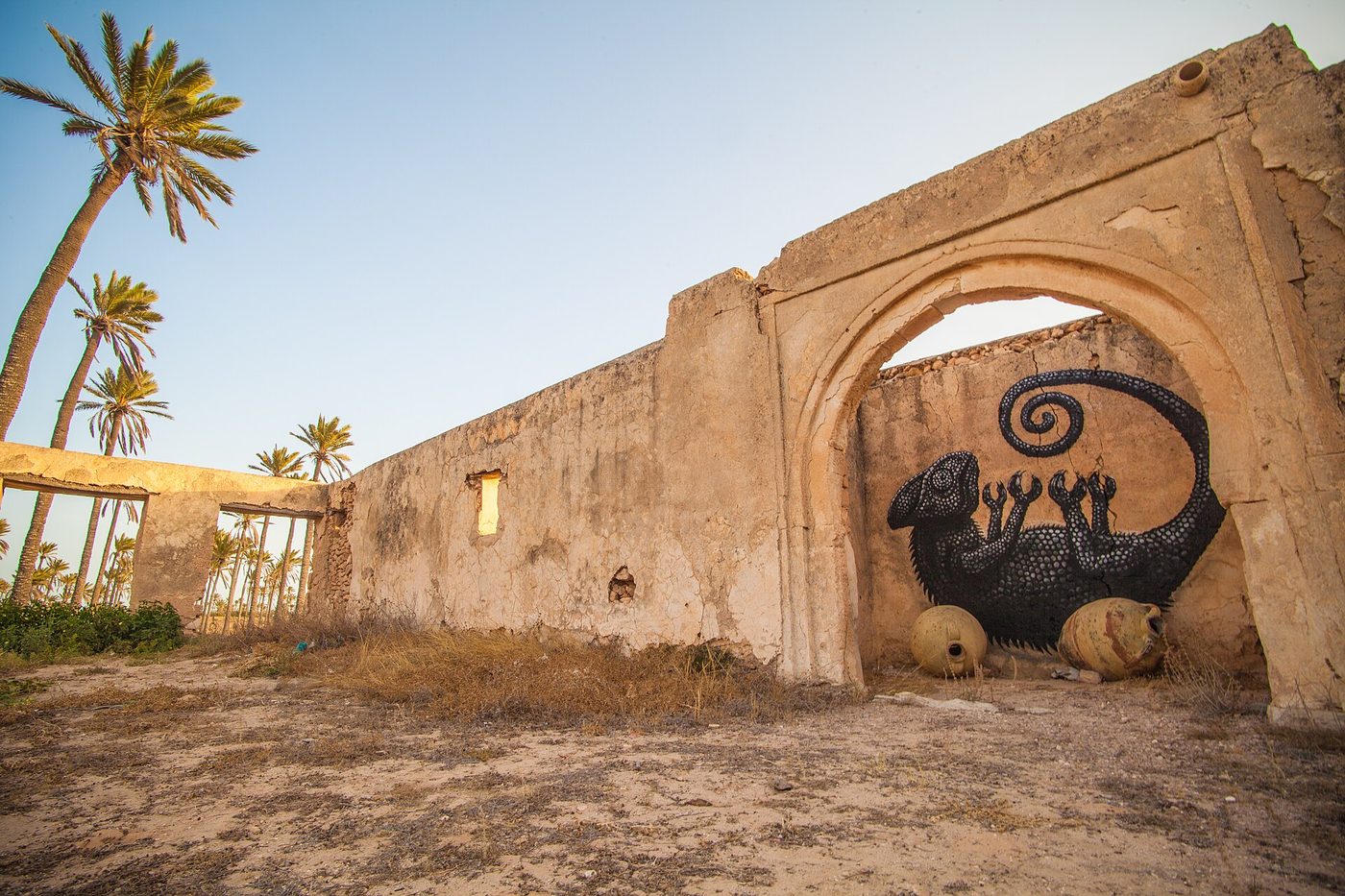
The name stuck almost by accident: the artist Rodolphe Cintorino planted giant letters spelling “THE HOOD” at the village entrance, and Djerbahood was born. The line-up was a genuine who’s-who of the international scene — the Belgian animal-painter ROA, the Tunisian-French calligraffiti star eL Seed, Chile’s INTI, Britain’s Phlegm and dozens more — alongside local Tunisian artists painting their own island.
It was never a cynical tourist stunt. Ben Cheikh had to win over the residents one wall at a time, securing permission from the government and from individual homeowners; some were wary at first, then asked for their own walls to be painted once they saw the results. The project drew coverage from the New York Times to the BBC, and it genuinely put Erriadh on the map. A second wave in 2022 brought in a further group of artists — some returning names — to refresh and expand the collection. It’s a real slice of modern Tunisian culture, and a reminder there’s far more to Djerba than the beach.
What you’ll actually see today: an honest word
Here’s where we part company with the glossy listicles. Djerbahood had its peak moment in 2014–15, and a decade on, the collection is a mix. Plenty of murals are still striking — bold, weird, moving, and set off beautifully against the village architecture. But this is spray paint on old lime-washed walls in a hot, salty, sunlit climate, and it shows. Some works have faded to ghosts, some have flaked away, and a few have simply been lost to repainting or renovation.
So treat any headline figure with caution. Around 250 pieces were created in 2014 and more were added in 2022, but the number you’ll actually find in good condition on any given visit is lower and always changing. We’d rather tell you that than have you counting fruitlessly. The 2022 refresh helped, and you’ll spot works dated across different years as you walk, which is part of the charm — it’s a living, weathering thing, not a frozen museum.
None of this makes it not worth doing. The pleasure is in the hunt and the setting as much as any single wall: turning a corner in a sleepy village and finding a three-storey octopus, or a swirl of Arabic calligraphy across a doorway. Go for the atmosphere and the surprises, not a checklist, and you’ll love it. If you’re still deciding whether the island earns a spot on your trip, our take on whether Djerba is worth visiting makes the case.
Notable artists and murals to look for
Because the collection changes, we’ll flag these as things to look for rather than guarantee — some may have faded since our last check. But the following are among the pieces and names people remember most.
- ROA’s octopus — the Belgian street artist’s giant monochrome sea creature, wrapped across a building, is the single most photographed work and a good one to hunt down first.
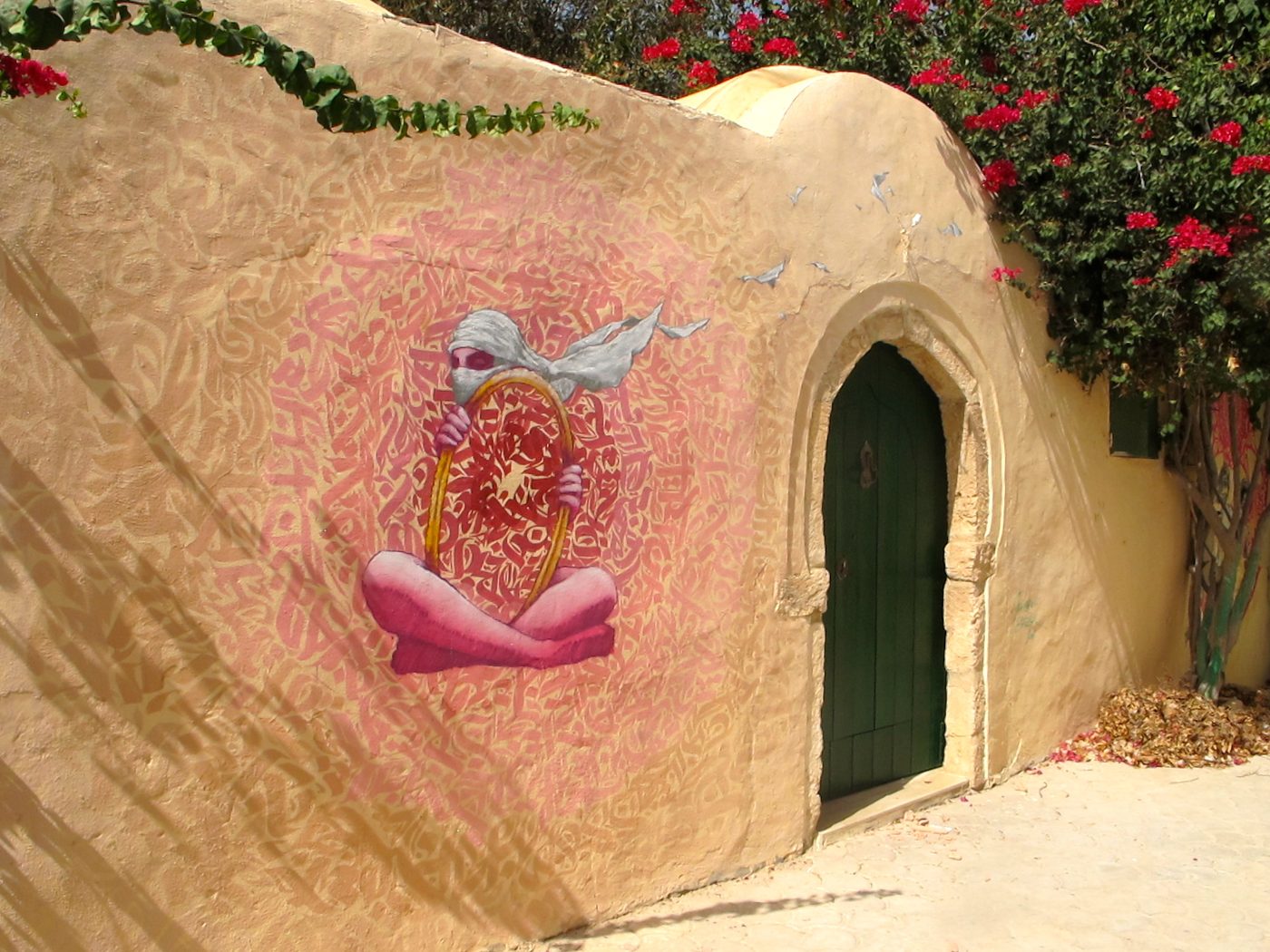
- eL Seed’s calligraffiti — the celebrated Tunisian-French artist’s flowing Arabic-script murals turn poetry into paint, and connect the project to its Tunisian roots.
- INTI, Phlegm and the international names — look for the Chilean muralist INTI’s folkloric figures and the eerie greyscale worlds of Britain’s Phlegm among the bigger walls.
- The painted doors — some of the loveliest pieces are small: individual blue doors and shutters reworked into tiny artworks. Look down and sideways, not just up.
- The Tunisian voices — several local artists used their walls to comment on island life, migration and politics. These are the rawest, most rooted works, and the easiest to walk straight past.
The official Djerbahood website has published a village map pinning many of the works, which is worth a look before you go if you want to track down specific pieces. Otherwise, wandering blind is genuinely the nicer way to do it.
How to visit: a self-guided walking route
There’s no official route, no entrance and no opening hours — the murals are simply out in the lanes of a working village, and you explore on foot. That freedom is the appeal, but a loose plan helps you cover the ground without doubling back in the heat. Here’s how we’d walk it.
- Start at the village entrance and get your bearings on the main street before diving into the side lanes, where most of the art hides.
- Work a rough loop through the residential alleys rather than trying to follow a line — the murals are scattered on walls, corners, doors and rooftops with no logic to them.
- Look up and down. Pieces are painted on domes and upper storeys as well as at street level, and some of the best are on humble doorways you’d otherwise miss.
- Give it an hour or two. The village is small and flat, so this is an easy amble, not a hike — but the more corners you turn, the more you find.
- Detour to the El Ghriba synagogue nearby (see below) to round out the visit.
Wear comfortable shoes, bring water — the interior of the island gets hot and shade is patchy — and don’t rush. Getting mildly lost is the correct way to experience Djerbahood.
El Ghriba synagogue: combine the two
Erriadh isn’t only a canvas. The village is also home to the El Ghriba synagogue, one of the oldest synagogues in the world and the spiritual heart of Djerba’s ancient Jewish community — a reminder of the island’s long history as a place where faiths lived side by side. It sits a short walk or drive from the murals, so the two make a natural pair.
The interior is a jewel of blue-tiled walls, arches and hanging lamps, and each spring it draws a well-known Jewish pilgrimage. Modest dress is expected, heads are usually covered to enter, and there may be security checks or restricted opening around the annual pilgrimage, so it’s worth confirming access locally before you set off. Photography rules inside can change too. Visited together, the synagogue and the street art tell you more about Djerba’s character than a week on the beach ever could. We describe El Ghriba in prose here rather than link it, as it doesn’t yet have its own page on our site.
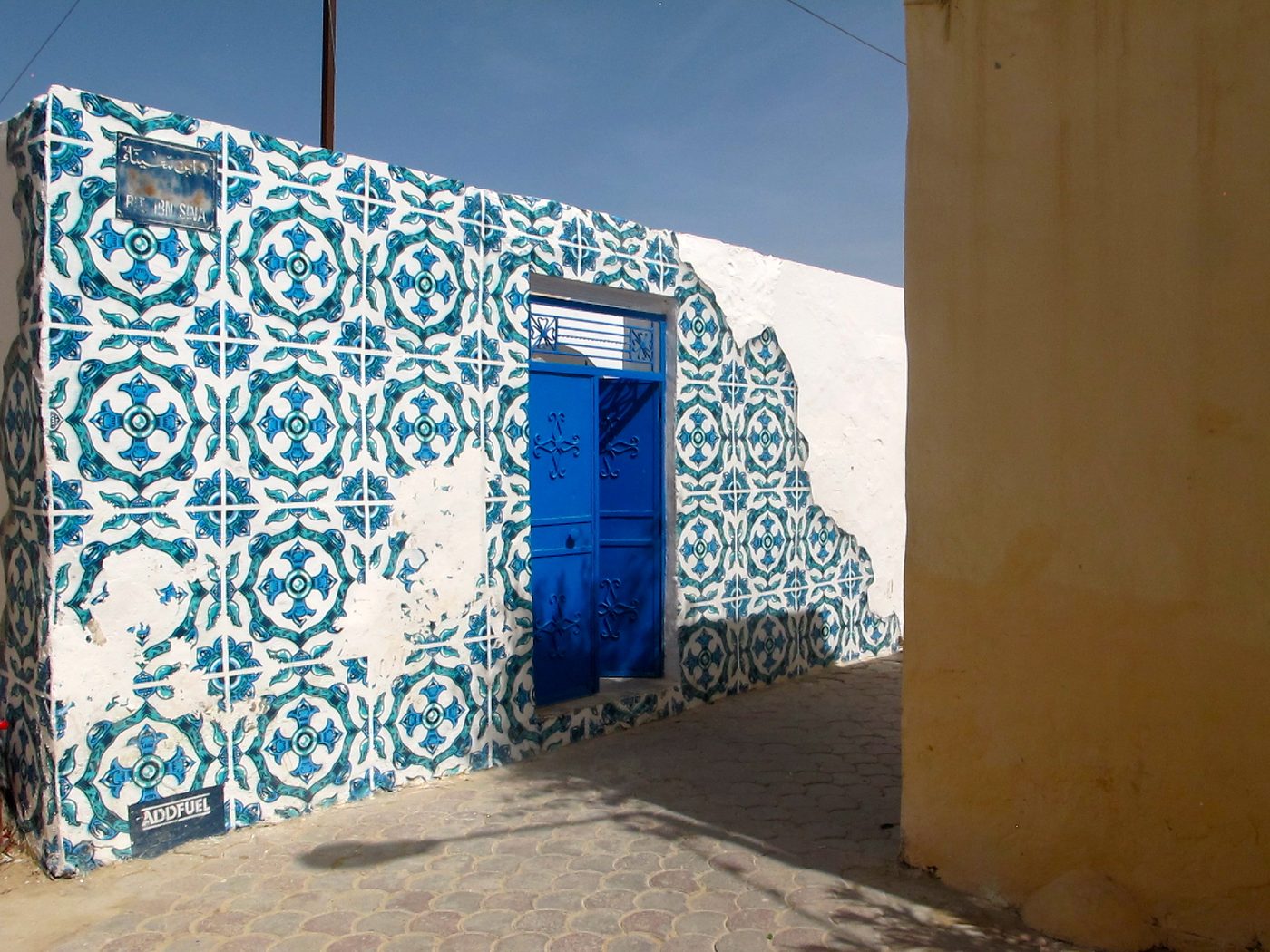
Photography tips
Djerbahood is made for a camera, and even a phone does it justice — the writer of one guide we rate shot the lot on an iPhone. A few things help.
Time it for soft light. The hour after sunrise and the hour before sunset are magic here: low golden light rakes through the vines and archways, the whites glow rather than glare, and the harsh midday contrast that flattens the murals is gone. It’s also far cooler and quieter than the middle of the day, when tour groups and heat both peak.
Work the details. The wide shots of big walls are obvious, but the memorable frames are often the small collisions — a cat asleep under a mural, washing strung across a painted door, a child’s bike against a spray-painted wall. And crucially, remember people live here: don’t photograph residents or into their homes and courtyards without asking, and never move their things for a better shot.
Respecting a living village
This is the bit we wish more visitors took to heart. Erriadh is not a theme park or an abandoned art site — it’s a real village where families live behind those famous doors. The project only exists because residents lent their walls, and the welcome stays warm when visitors are considerate.
Keep your voice down in the lanes, don’t wander into private courtyards, ask before pointing a camera at anyone, and take your litter with you. If a local artisan or a small kiosk is selling drinks or crafts, buying something is a nice way to put a little money back into the community that hosts all this for free. Treat it as someone’s home that happens to be covered in extraordinary art, and everyone has a better time. Our Tunisia travel tips have more on travelling respectfully here.
Getting to Erriadh and practical logistics
Erriadh sits in the middle of Djerba, on the roads between Houmt Souk and Midoun, which makes it easy to reach from wherever you’re based. From Houmt Souk it’s roughly a 15–20 minute drive; from the Sidi Mahres hotel strip, budget a little more, perhaps 25–30 minutes. Every taxi driver on the island knows Djerbahood, so getting there is simple.
You’ve got two sensible options. A taxi is easiest for a quick visit — agree a fare or insist on the meter, and either arrange a pickup time or expect to phone for a return, as cars don’t always wait around in the village. A hire car is better if you’re combining Djerbahood with the beaches, Guellala’s potteries or Midoun’s market in one loop; the island’s flat, quiet roads are among the easier places to drive in Tunisia, and our notes on getting around Tunisia cover the basics.
Set expectations on facilities: this is a village, not a visitor centre. On a quiet day you might find only a small kiosk selling water and snacks, so bring your own and plan to eat back in Houmt Souk or at your hotel. One money note that trips up first-timers — the Tunisian dinar is a closed currency, so you can’t buy it before you fly or take it home; change money on arrival and carry small notes for a taxi or a cold drink. Reckon very roughly on £1 to 3.8–3.9 dinars in mid-2026, but check the current rate.
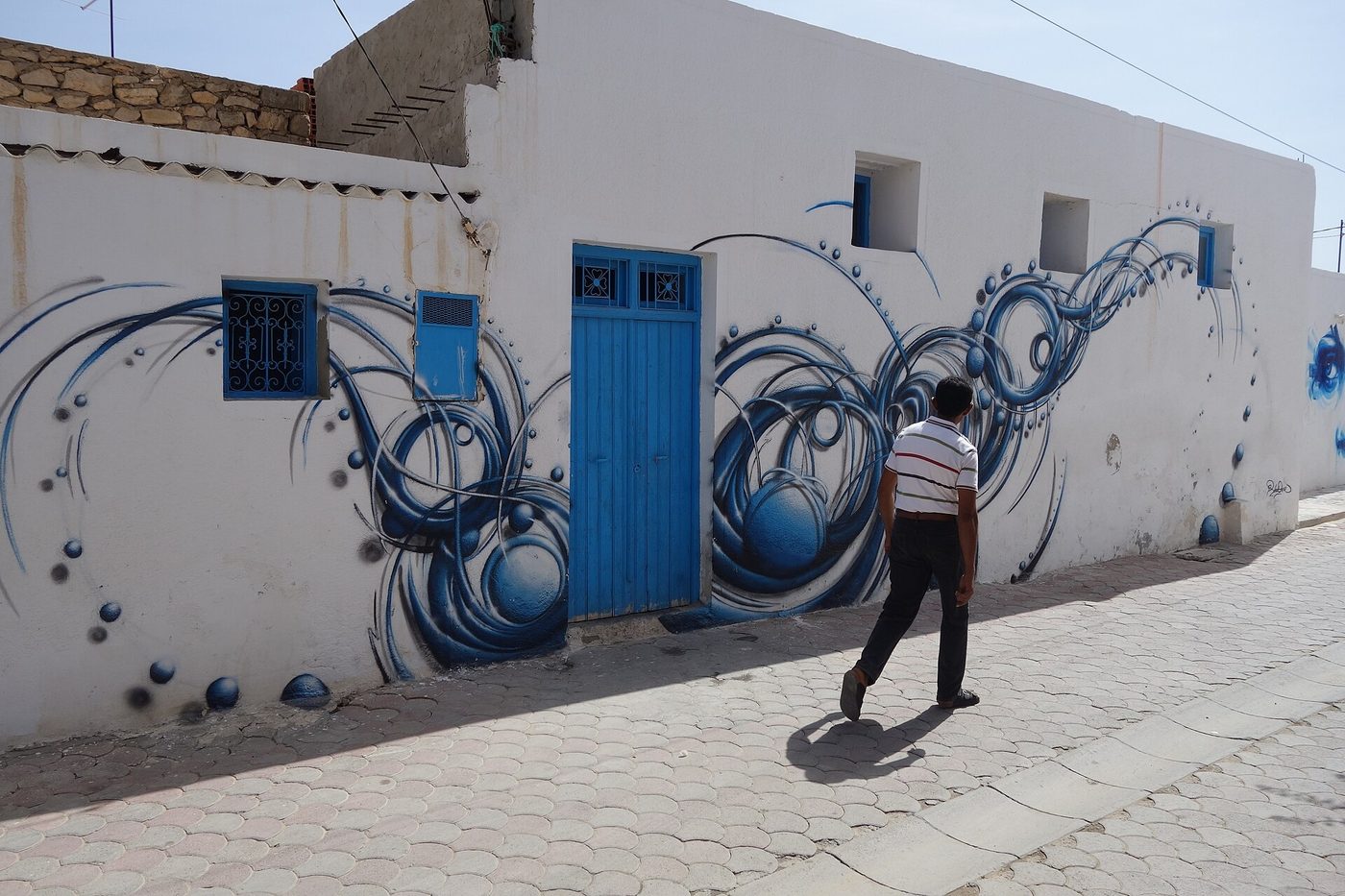
Combine it with the rest of Djerba
Djerbahood takes a morning or an afternoon, not a whole day, so it pairs well with the island’s other sights. The obvious add-on is a swim — our roundup of Djerba’s beaches points you to the best sand — or an hour in the souks and fort of Houmt Souk on the way back.
Film fans can push on to the west of the island, where the fishing village of Ajim doubled as Mos Eisley in the original film; our guide to the Star Wars filming locations in Tunisia maps them out. And because Djerba is one of the closest coastal points to the dunes, it’s a springboard for a trip into the Tunisian Sahara — see our roundup of the best Tunisia excursions for how to slot it in. Djerbahood also earns its place among the country’s most photogenic spots in our guides to the most beautiful places in Tunisia and its quieter hidden corners.
Is Djerbahood worth visiting?
Yes — with realistic expectations. As a pristine, curated art gallery it isn’t; as a free, atmospheric wander through a real village strewn with murals by some of the world’s best street artists, it’s one of the most memorable things you can do on Djerba, and a proper antidote to a week behind resort gates. Go early or late, keep an eye out for the small pieces as well as the show-stoppers, treat the residents as hosts rather than backdrop, and you’ll come away glad you made the trip.
A last reassurance: Erriadh is a calm, welcoming village and Djerba is one of the safest places to travel in Tunisia. If you like to have the full official picture before you go, our Djerba safety guide lays it out. And if you’re still sorting your base, our guide to where to stay in Djerba will help you land close enough to make mornings like this easy.
Djerbahood: your questions answered
What is Djerbahood?
Djerbahood is an open-air street-art museum in the village of Erriadh on the island of Djerba, Tunisia. In 2014, around 150 artists from some 30 countries painted roughly 250 murals across the village’s walls, doors and archways, with more added in a 2022 revival. It’s free and spread through the public lanes.
Where is Djerbahood?
It’s in Erriadh (also known as El Hara Sghira), a village in the centre of Djerba, on the roads between Houmt Souk and Midoun. It’s next to the historic El Ghriba synagogue, which most visitors see on the same trip. Roughly 15–20 minutes’ drive from Houmt Souk.
Is Djerbahood free to visit?
Yes. The murals are outdoors on the public streets and doors of a working village, so there’s no entrance fee, no ticket and no set opening hours. You simply walk the lanes and find the art. Bring some cash only for a taxi, a cold drink or anything you buy from local sellers.
How long do you need at Djerbahood?
Around one to two hours is enough to enjoy it at a relaxed pace. The village is small and flat, so it’s an easy wander rather than a hike. Add time if you’re a keen photographer or want to visit the neighbouring El Ghriba synagogue, which pairs naturally with the street art.
When is the best time to visit Djerbahood?
Early morning or the hour before sunset. The low, golden light flatters the murals and the whitewashed walls, it’s far cooler than the middle of the day, and you’ll share the lanes with fewer people. Djerba’s interior gets hot, so avoid the midday sun if you can.
Are the Djerbahood murals still there?
Many are, but the collection has aged. The project dates from 2014, so some murals have faded, flaked or been painted over, while a 2022 refresh added new ones. Expect a changing mix rather than all 250 original works in perfect condition — the atmosphere and the hunt are the real draw.
How do you get to Djerbahood from the resorts?
From the Sidi Mahres hotel strip it’s roughly a 25–30 minute drive; from Houmt Souk, around 15–20 minutes. Every island taxi driver knows it, so a taxi is easy — agree a fare and arrange your return. A hire car is handy if you’re combining it with the beaches, Midoun or Guellala.
Who created Djerbahood?
The project was conceived by the Franco-Tunisian gallerist Mehdi Ben Cheikh of the Galerie Itinerrance in Paris, who invited around 150 international and Tunisian street artists to Erriadh in 2014. Big names involved included ROA, eL Seed, INTI and Phlegm, alongside many local artists painting their own island.
Can you visit the El Ghriba synagogue too?
Usually, yes, and it’s right by Djerbahood, so most people combine the two. El Ghriba is one of the world’s oldest synagogues and a major pilgrimage site. Dress modestly, expect to cover your head to enter, and confirm access locally, as opening can be restricted around the annual spring pilgrimage or for security.
Is Djerbahood suitable for children?
Yes. It’s a free, open-air, low-key wander that many families enjoy — a mural treasure hunt through village lanes. Keep little ones close near the occasional passing car, bring water and sun cover, and be ready to leave once interest fades, as there’s little in the way of cafés or facilities in the village.
Is it worth visiting Djerbahood in 2026?
For anyone with an interest in art, photography or the real Djerba beyond the beach, yes. Set expectations — it’s a weathered, living project, not a polished gallery — and it’s one of the island’s most rewarding, and cheapest, half-days out. Go early or late, respect the residents, and enjoy the surprises.
Written by the Tunisia Tourism Guide team — an independent UK-focused guide to travelling in Tunisia. We don’t sell tours or take hotel commissions. Prices and advice were checked at publication; always confirm current details before you book.
Photo credits
All images via Wikimedia Commons, used with thanks: A large street-art mural on a whitewashed wall in the © Galerie Itinerrance (CC BY-SA 4.0); A quiet whitewashed lane in Erriadh village on Djerba © Rani777- Baha-Eddine MKD (CC BY-SA 4.0); A traditional blue Djerban door reworked into a small artwork © Rani777- Baha-Eddine MKD (CC BY-SA 4.0); A bold full-wall mural by an international artist in the © Rani777- Baha-Eddine MKD (CC BY-SA 4.0).