By the Tunisia Tourism Guide team · Last updated 11 August 2026 · We don’t sell tours or take hotel commissions — this is independent advice, written to be useful.
Most people who holiday on Djerba never really leave the resort strip, which means they miss the one place on the island that still feels like a working Tunisian town. That place is Houmt Souk, and it deserves a morning of anyone’s week.
Houmt Souk is Djerba’s main town — the island’s market capital, wrapped around a fishing harbour, a Spanish-era fort and a warren of covered souks and old merchant inns. Spend a morning here haggling for pottery and silver, watching the fish auction and drinking mint tea in a fondouk courtyard, and you’ll see the real island behind the resorts.
It’s the cultural heart of the island of Djerba, and the easy antidote to a week of buffet-and-sunlounger sameness. This guide walks you through what’s actually worth your time in town — the markets, the fort, the fondouks, the food — with honest notes on the touts and the timing, plus a half-day walking route you can follow straight off the page.
Houmt Souk at a glance
If you’re short on time, here’s the shape of a visit before we get into the detail.
| What | The short version |
|---|---|
| What it is | Djerba’s main town and administrative centre — the island’s only proper town |
| Best for | Souks and shopping, the morning fish auction, seafood, history, cafés |
| Time needed | A half-day does it; a full day if you shop, eat and linger |
| Best time to go | Morning — cooler, quieter, and when the market and fish auction are liveliest |
| From the hotel zone | Roughly 10–15 minutes by taxi from the Sidi Mahres strip |
| Don’t miss | Borj El Kebir fort, the covered souk, a fondouk café, the harbour |
The single best piece of advice we can give: come in the morning. The light is kind, the temperature is bearable, the fish auction is in full swing and the day-trippers from the resorts haven’t arrived yet. By mid-afternoon in summer the lanes are hot and half-shuttered.
A quick history: the market town that named an island
The name Houmt Souk means, roughly, “the market quarter” — and that’s exactly what it has always been. There was a town on this spot in Roman times, called Girba, which is where the island’s modern name comes from. For centuries this was the island’s trading hub, the point where Djerba’s famous weavers, potters and merchants met the wider Mediterranean.
You still feel that trading DNA in the layout: a knot of covered markets, arcaded squares and old merchant inns, all within a few minutes’ walk of the harbour. In 2023 Djerba as a whole was inscribed as a UNESCO World Heritage Site for its distinctive island settlement pattern, and Houmt Souk’s old core is a big part of what earned it. If you’re weighing up whether the island is for you, our honest take on whether Djerba is worth visiting puts the town in context.
The souks: shopping, pottery and the art of haggling
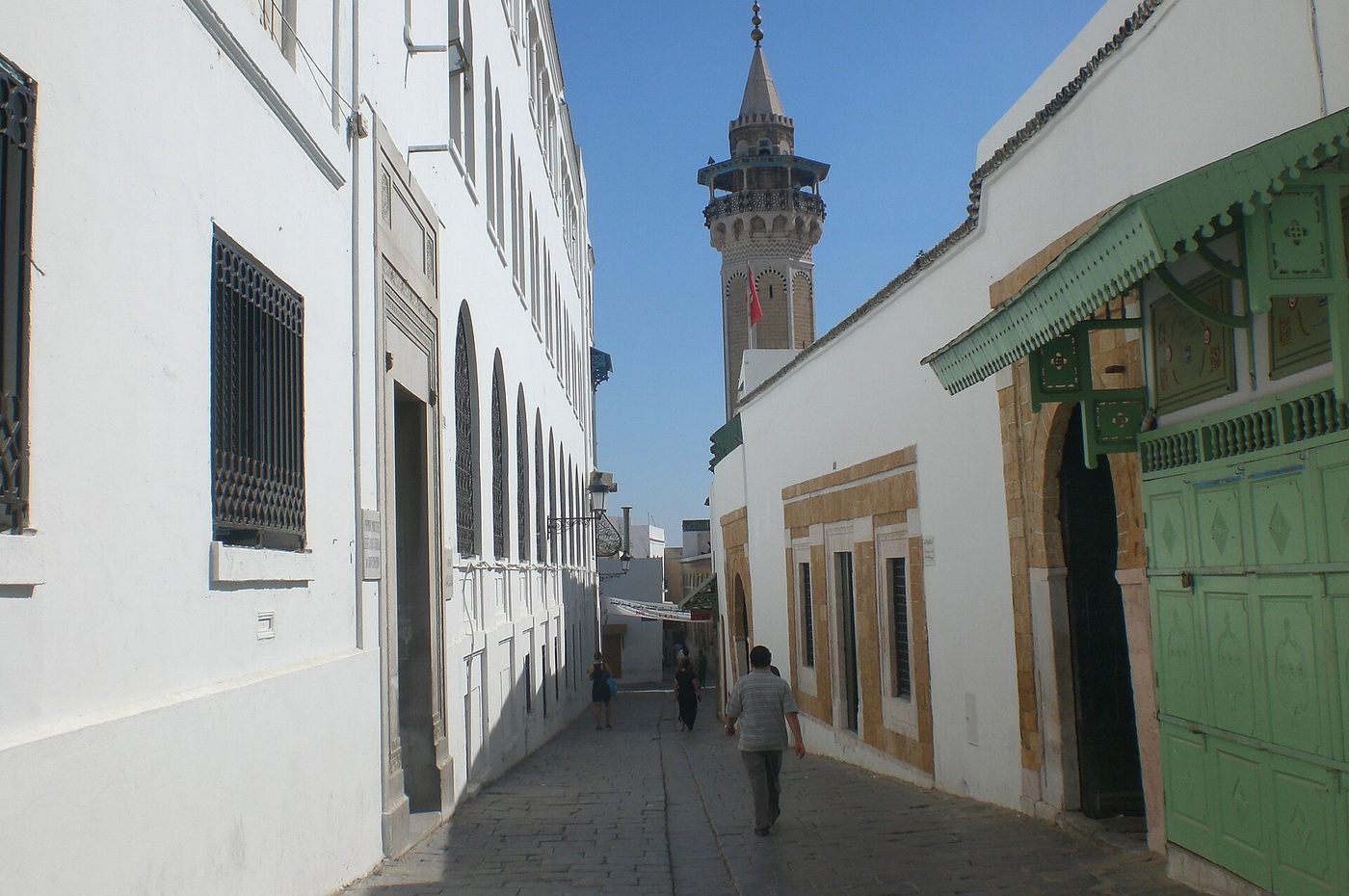
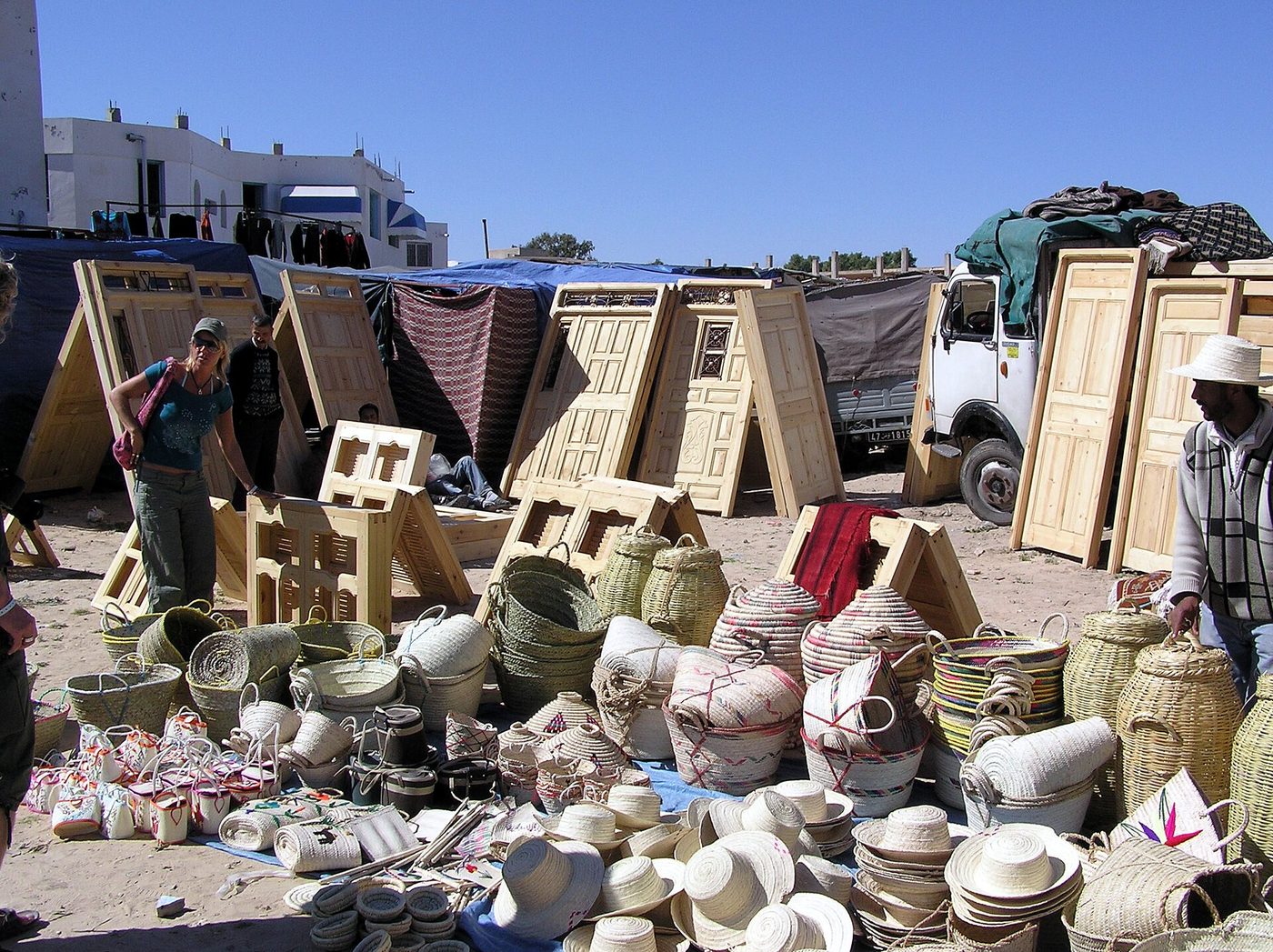
The souks are the reason the town exists and still its main event. A cluster of covered and open markets threads back from the main squares, stalls piled with painted pottery, silver and gold jewellery, carpets, leather, spices, olive-wood bowls and natural sponges. Two mornings a week — traditionally Monday and Thursday — the market swells as traders come in from across the island, though you’ll find plenty open on any day.
Djerba has a genuine craft heritage behind the souvenirs. The island’s potters have worked for generations, above all in the village of Guellala to the south, so ceramics here are a cut above the usual tourist tat. Silver and gold jewellery is another local tradition, with a long Jewish silversmithing history on the island. Here’s a quick steer on what’s worth buying and roughly what to expect.
| What to buy | Worth knowing |
|---|---|
| Painted pottery & ceramics | Djerba’s signature craft; the real stuff comes from Guellala |
| Silver & gold jewellery | A long island tradition; check hallmarks and weigh by gram |
| Carpets & kilims | Handsome but the hardest sell — never buy on the first pitch |
| Spices, olive oil, olive wood | Cheap, genuinely good, and easy to carry home |
| Leather & woven textiles | Quality varies wildly; inspect the stitching before you commit |
Now the honest part. Haggling is expected and part of the fun, but it can tip into pressure. A workable approach: show mild interest, let the seller name a price, then counter at roughly a third and settle somewhere in the middle. Walking away almost always brings the price down, and there’s no obligation to buy just because you’ve been offered mint tea. A few sellers are pushy and a few “guides” will try to steer you to a shop that pays them commission — polite, firm and moving on works every time. Our guide to common Tunisia scams covers the usual routines so none of them catch you cold.
The fish market and the daily auction
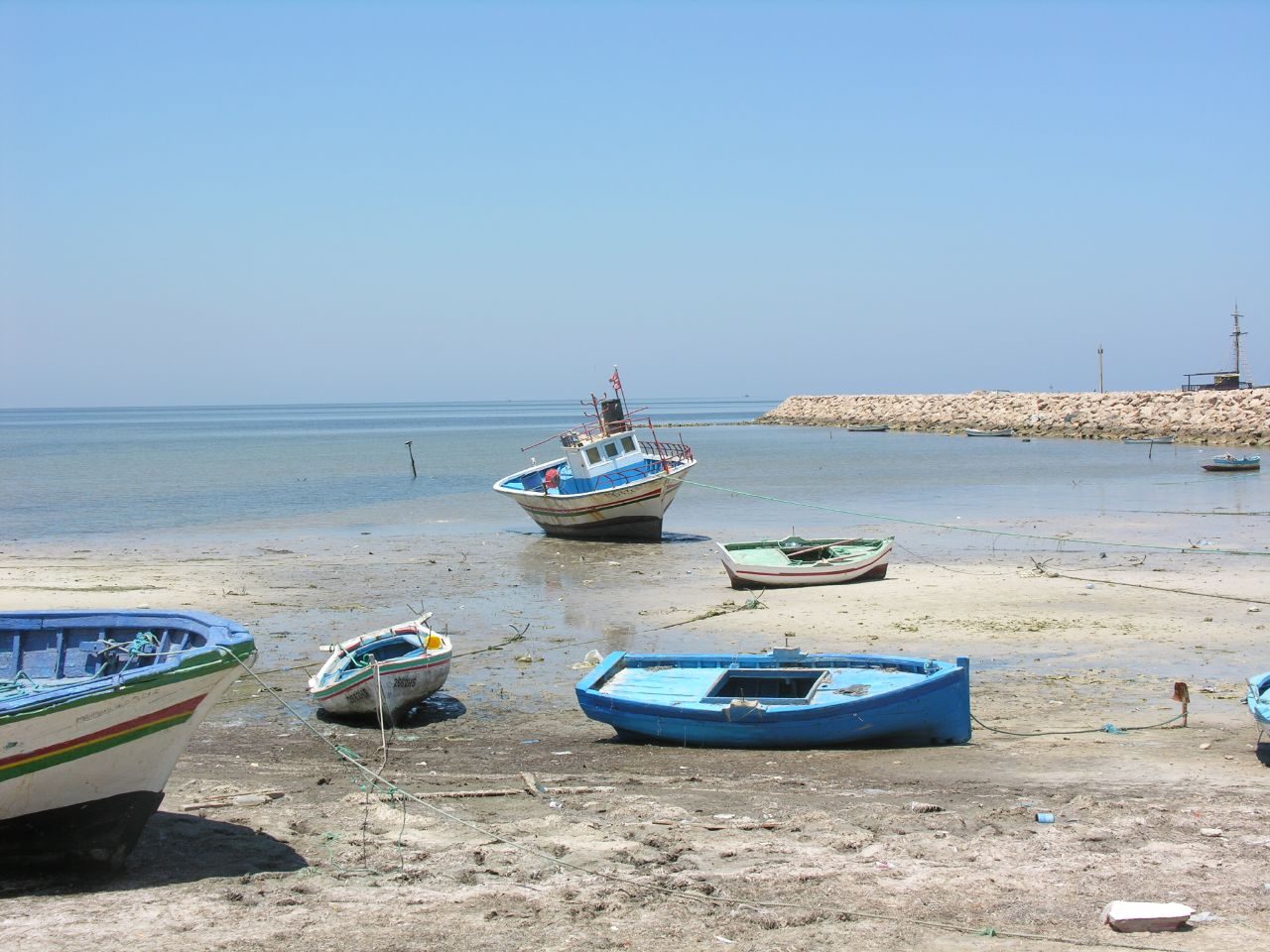
The fish auction is our favourite thing in Houmt Souk, and it costs nothing to watch. Most mornings, in a hall near the harbour, the night’s catch is sold off in a fast, shouted auction — an auctioneer holding up trays of sea bream, bass, mullet, prawns and octopus while local restaurateurs and household cooks bid against each other. It’s loud, quick, completely unstaged, and over well before lunch.
Better still, several restaurants around the market run on a lovely system: you buy your fish fresh, hand it over, and they grill it for you with salad and harissa for a small cooking charge. It’s about the best-value seafood lunch on the island, and a proper local experience. If Tunisian cooking is new to you, our Tunisian food guide explains what to order and how.
Borj El Kebir: the fort by the harbour
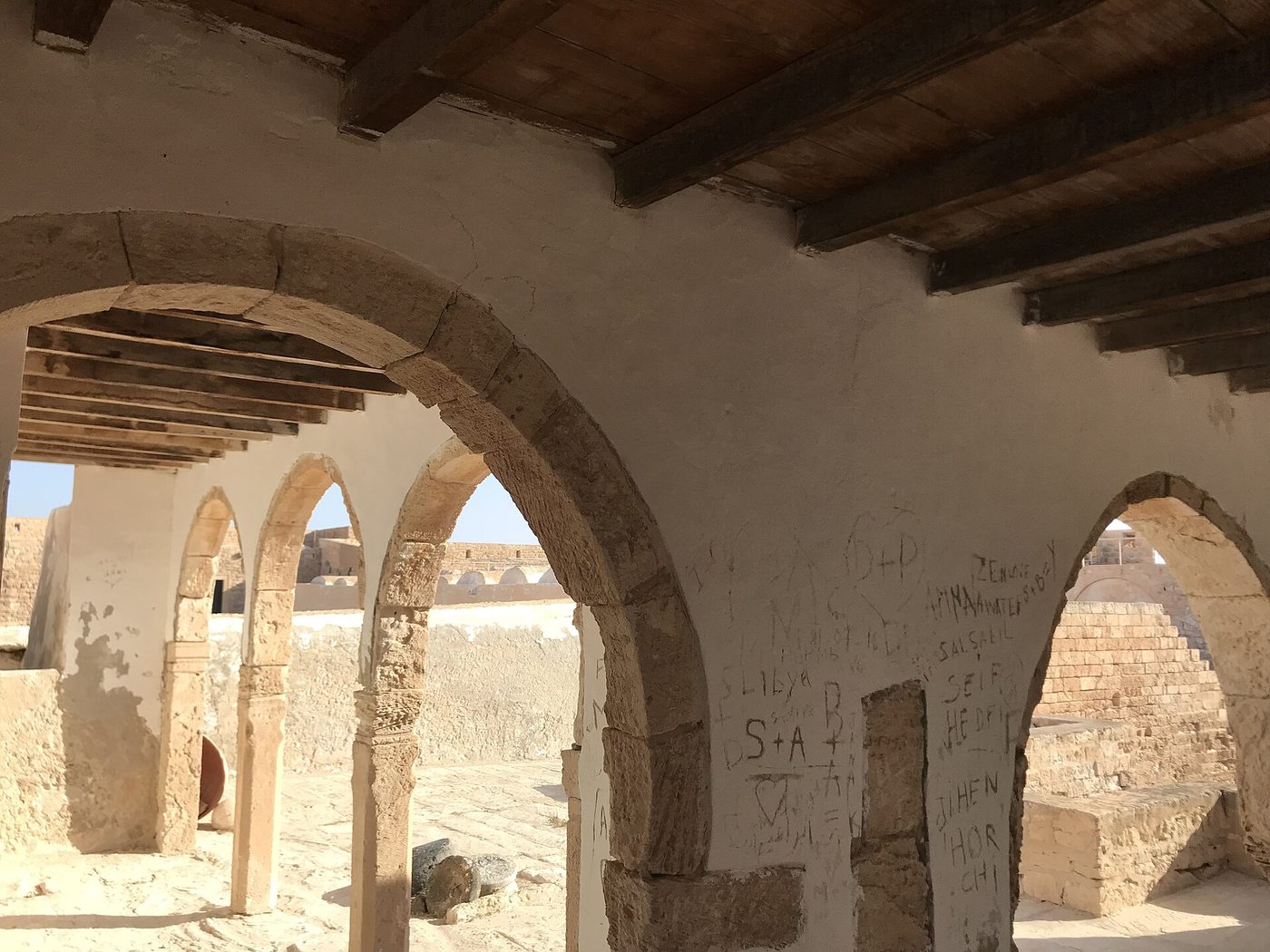
Guarding the north edge of town by the fishing port is Borj El Kebir — “the great fort” — also known as Borj Ghazi Mustapha or Fort Ghazi Mustapha. It’s the largest and best-preserved of Djerba’s forts, and the most rewarding single sight in Houmt Souk.
The bones of it were built at the end of the 14th century, on the ruins of Roman Girba, and it was extended and strengthened over the centuries that followed. It takes its best-known name from Ghazi Mustapha, the Ottoman commander who settled on Djerba in 1559. The walls saw real drama: the fort was central to the Ottoman-Spanish struggle for the island in 1560, and the harbour once carried the grim nickname the “tower of skulls” after the corsair Dragut is said to have piled the bones of the defeated here. It became a national monument in the early 20th century and now houses a small museum.
Climb the ramparts for the best view in town — the harbour, the fishing boats and the flat sweep of the island beyond. Opening hours are usually longer in summer and shorter in winter, and entry is only a few dinars, but hours and prices change, so treat any figure you read online as a guide and confirm on the day. As a rough steer, reckon on somewhere around 7–8 TND to get in (2026 — check current), and note it may close one day a week.
The fondouks: caravanserais turned cafés
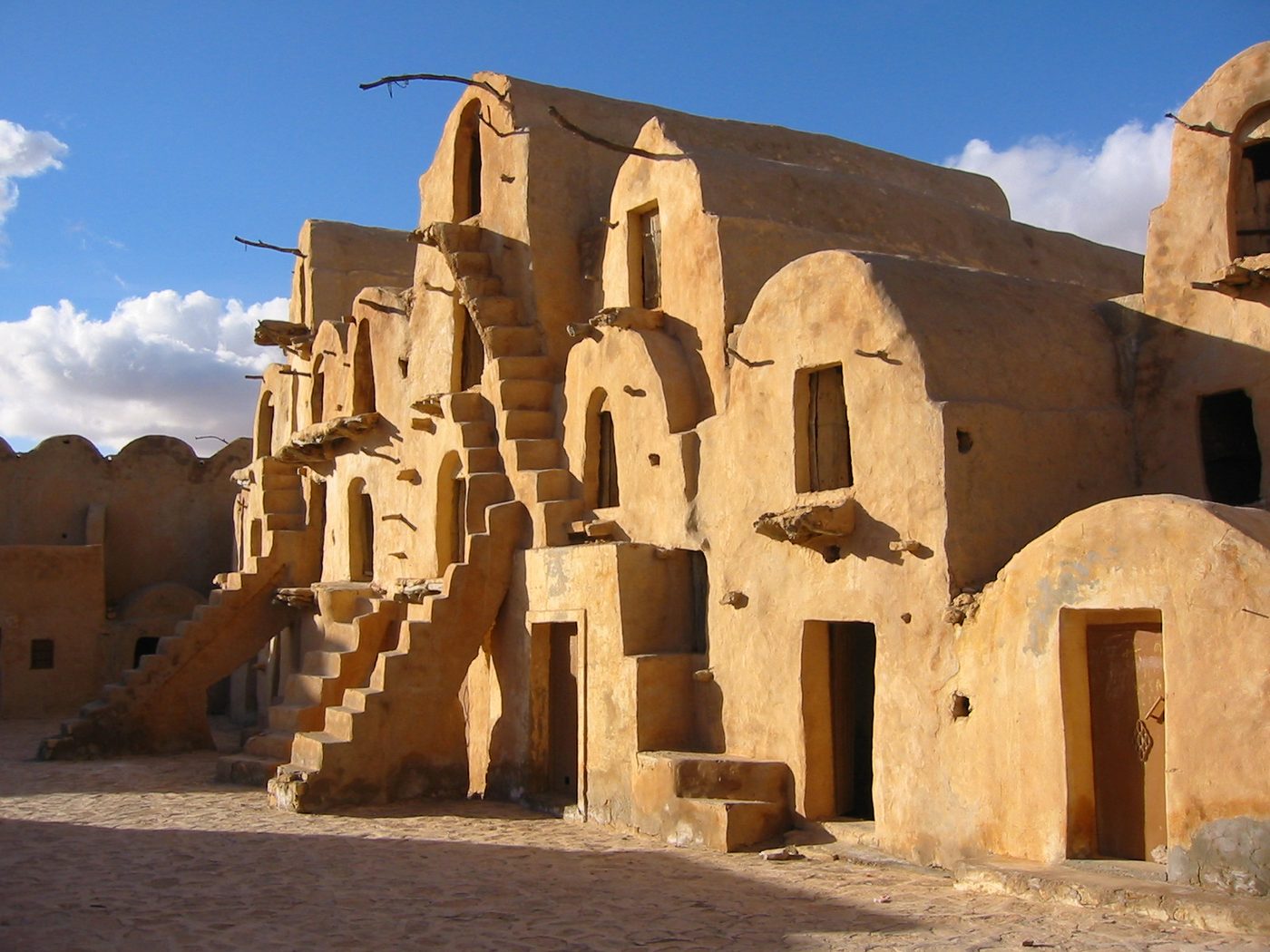
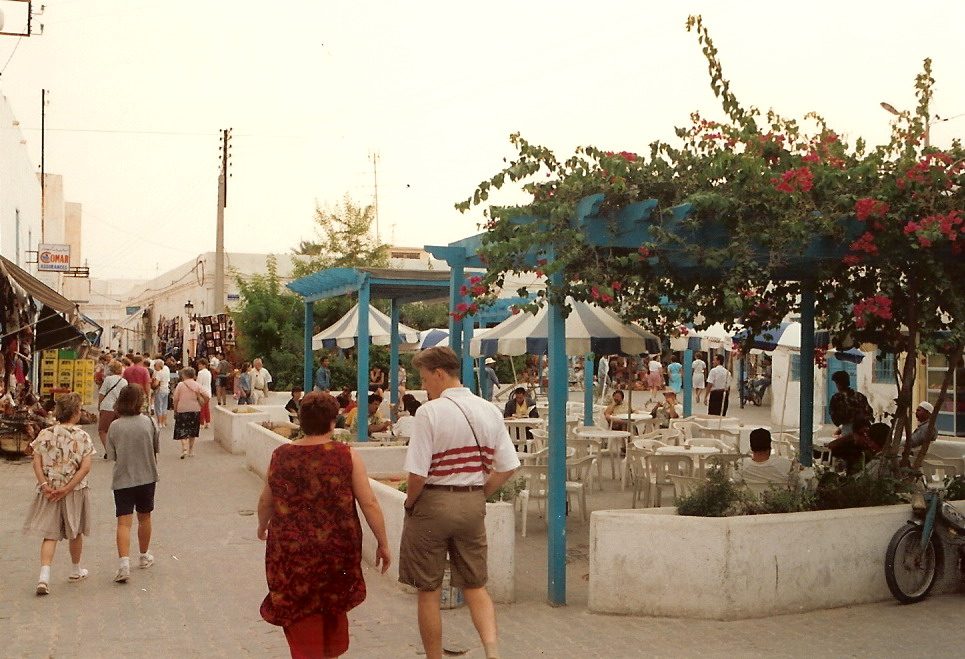
Scattered through the old town are Houmt Souk’s fondouks — former caravanserais, the walled inns where travelling traders once stabled their animals downstairs and slept upstairs around a central courtyard. They’re the town’s architectural signature: cream walls, arched galleries and those photogenic sky-blue doors and shutters.
Several have been given a second life as cafés, small hotels and craft galleries, their courtyards now full of tables rather than camels. Ducking into one for a mint tea and a plate of Tunisian sweets, out of the sun and the sales patter, is one of the quiet pleasures of a morning in town. A few now operate as characterful guesthouses too, which is worth knowing if you’re deciding where to stay in Djerba and fancy the town over the resort strip.
Squares, mosques and the Heritage Museum
The souks open out onto a chain of café-lined squares — Place Hedi Chaker chief among them — where the town does its socialising over coffee and games of cards. It’s the spot to sit, watch and let Houmt Souk come to you for half an hour.
The town is also unusually rich in religious buildings, a mark of Djerba’s long history as a place where different communities lived side by side. Several historic mosques are listed monuments, including a distinctive Turkish-founded one, and there’s even a small Catholic church, St Joseph’s, a relic of the island’s cosmopolitan past. For the fuller cultural picture, the Djerba Traditional Heritage Museum — set in an 18th-century religious complex — lays out island costume, jewellery, pottery and craft, and is a cool, quiet hour if the sun gets too much. It slots neatly into our wider look at Tunisian culture.
Where to eat: seafood, cafés and street snacks
Houmt Souk is the best place on Djerba to eat like a local. The obvious move is fresh fish — either at one of the restaurants that grills your market-bought catch, or off the menu at the seafood places around the squares and harbour. Grilled sea bream, calamari, prawns and the fiery-fresh Tunisian salad mechouia are the things to order.
For something cheaper and faster, hunt down a fricassé (a small fried savoury bun stuffed with tuna, egg, olives and harissa) or a brik (crisp fried pastry with egg inside) from a hole-in-the-wall counter. Wash it down with a mint tea or a thick Tunisian coffee. It’s holiday food at pocket-money prices, and a world away from the resort buffet.
A half-day walking route
Here’s the loop we’d walk with a friend, starting mid-morning and finishing over lunch. It’s flat, short and easy.
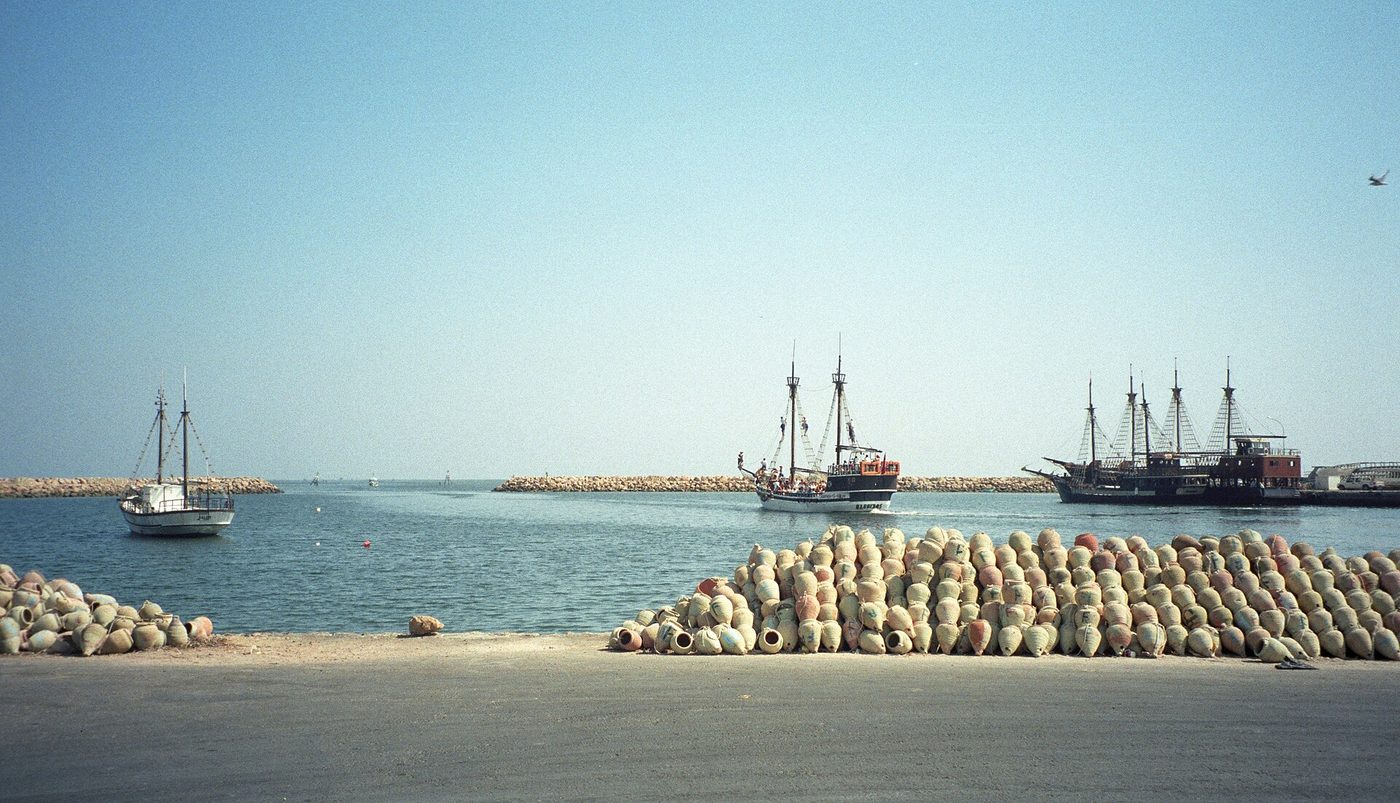
- Start at the harbour — get your bearings by the fishing port and the marina, where the Flamingo Island pirate-ship trips leave.
- Borj El Kebir — walk up to the fort, climb the walls for the view, and take in the little museum.
- The fish market — time this for the morning auction if you can; it’s a short walk back toward the centre.
- The covered souks — lose yourself in the market lanes for pottery, silver and spices, haggling as you go.
- Place Hedi Chaker — pause for a mint tea and watch the town tick over.
- A fondouk courtyard — duck into one of the old inns for photos and shade.
- Lunch — finish with grilled fish at a harbour-side restaurant, ideally your own market catch.
Done at a gentle pace, that’s three or four hours. Add the Heritage Museum and a proper shopping session and it fills a full, unhurried day.
Getting to Houmt Souk and when to go
Houmt Souk sits at the northern tip of Djerba, and it’s easy to reach from anywhere on the island. From the Sidi Mahres hotel strip it’s a short taxi hop of roughly 10–15 minutes; from Djerba-Zarzis airport it’s around 8km. Taxis are cheap — insist on the meter, the compteur, for the in-town fare rather than accepting a flat tourist rate, and remember there’s no Uber or Bolt anywhere in Tunisia.
If you’re exploring the island more widely, hiring a car makes Houmt Souk an easy stop between the beaches, Djerbahood and Guellala; our notes on getting around Tunisia cover the practicalities. One money point that catches first-timers out: the Tunisian dinar is a closed currency, so you can’t buy it before you fly or take it home — change money on arrival and keep some small notes for the souk. Reckon very roughly on £1 to 3.8–3.9 dinars in mid-2026, but check the current rate.
On timing: a half-day is plenty for the highlights, but go in the morning. The market and fish auction are morning affairs, the heat is manageable and the town is at its most genuine before the resort coaches roll in.
Excursions from Houmt Souk
The town also works as a launch pad for the island’s best days out. From the marina, pirate-ship trips run out to Flamingo Island — really a low sandy peninsula — for swimming and grilled fish, with a decent chance of seeing the flamingos themselves between roughly April and October. Inland, the extraordinary street-art village of Djerbahood at Erriadh is a short drive south, and the island’s quieter sands are covered in our guide to Djerba’s beaches.
Djerba is also a springboard for two of Tunisia’s headline experiences. Film fans use it as a base for the island’s Star Wars filming locations — the fishing village of Ajim on Djerba’s west coast doubled as Mos Eisley, and Obi-Wan’s hermit home stands nearby. And the island is one of the closest coastal points to the dunes, so a two-day trip into the Tunisian Sahara is very doable. See our roundup of Tunisia excursions for how to slot them in.
Is Houmt Souk safe for tourists?
Yes. Houmt Souk is a relaxed, welcoming town where the worst you’re likely to face is an over-keen carpet seller or a taxi driver “forgetting” the meter — annoyances, not dangers. Normal city sense (watch your bag in the crowded souk, agree taxi fares up front) is all you need. Djerba as a whole is one of the safest places a UK visitor can holiday in Tunisia.
On the official advice, it’s worth being precise, because the headlines can mislead. The UK Foreign Office “advises against all travel to the Chaambi Mountains National Park and the designated military operations zones of Mount Salloum, Mount Sammamma and Mount Mghila; and against all but essential travel to parts of the interior including Kasserine Governorate (including the town of Sbeitla), and to within 75km of the Tunisia–Libya border, including Remada and El Borma but excluding Zarzis, the C118 road and all areas in Medenine Governorate north of the road.” That was still current at 19 June 2026 (last updated 23 February 2026).
The key point: Djerba — with nearby Zarzis — lies in Medenine Governorate, north of the C118, and is explicitly excluded from that border advisory. In other words, Houmt Souk is well outside the warning zone. We spell all this out, with the current wording and dates, in our guide to whether Djerba is safe. One health note: your UK GHIC card is not valid in Tunisia, so comprehensive travel insurance with medical cover is essential — check the NHS’s TravelHealthPro Tunisia page before you go.
Houmt Souk: your questions answered
What does Houmt Souk mean?
Houmt Souk means roughly “the market quarter” in Arabic, which is exactly what it has always been — Djerba’s main trading town. There was a settlement here in Roman times called Girba, which gave the island its modern name. It’s the island’s administrative centre and its only proper town.
Is Houmt Souk worth visiting?
Very much so. It’s the one place on Djerba that still feels like a working Tunisian town rather than a resort, with covered souks, a fishing harbour, a historic fort and old merchant inns turned into cafés. A morning here is the easiest way to see the real island behind the hotel strip.
What is there to do in Houmt Souk?
Explore the covered souks, watch the morning fish auction, climb Borj El Kebir fort, drink mint tea in a fondouk courtyard, browse for pottery and silver, and eat fresh grilled fish by the harbour. The Djerba Traditional Heritage Museum and the café squares round out an easy half-day.
When is the market in Houmt Souk?
The souks are open daily, but the traditional big market mornings are Monday and Thursday, when traders come in from across the island and the town is at its busiest. Mornings are best whatever the day — cooler, livelier and before the resort day-trippers arrive.
How far is Houmt Souk from the resorts?
It’s close. From the Sidi Mahres hotel strip on the north-east coast it’s roughly a 10–15 minute taxi ride, and about 8km from Djerba-Zarzis airport. Djerba is small and flat, so getting into town from anywhere you’re likely to stay is quick and cheap.
What can you buy in Houmt Souk?
Painted Djerban pottery, silver and gold jewellery, carpets and kilims, spices, olive oil, olive-wood bowls, leather and natural sponges. The ceramics are a genuine local craft, best sourced from the Guellala tradition. Haggle on everything, and inspect quality — especially on carpets and leather — before you commit.
How much should I haggle in the souk?
Expect to. A reasonable approach is to counter the opening price at about a third of it and settle somewhere in the middle. Show only mild interest, be willing to walk away — which usually lowers the price — and don’t feel obliged to buy just because you’ve accepted a glass of tea.
Is the Houmt Souk fish market worth seeing?
Absolutely, and it’s free. Most mornings the night’s catch is sold off in a fast, shouted auction near the harbour — completely unstaged and a genuine slice of island life. Better still, nearby restaurants will grill fish you’ve bought for a small charge, for a superb-value seafood lunch.
How long do you need in Houmt Souk?
A half-day covers the highlights — the fort, the souks, the fish market and a fondouk café. If you want to shop properly, visit the Heritage Museum and linger over lunch, give it a full, unhurried day. It’s compact and flat, so you can see a lot on foot.
Can you visit Borj El Kebir fort?
Yes. Borj El Kebir (Fort Ghazi Mustapha) is open to visitors and houses a small museum, with ramparts you can climb for the best view over the harbour. Opening hours are longer in summer than winter and entry is only a few dinars, but confirm current times and prices locally, as they change.
Is Houmt Souk safe?
Yes. It’s a relaxed town where pushy sellers and taxi overcharging are the main irritations rather than any real risk. Djerba sits north of the C118 in Medenine Governorate and is explicitly excluded from the Foreign Office’s Libya-border advisory. Take normal precautions, agree taxi fares up front, and take out travel insurance, as the UK GHIC isn’t valid.
Written by the Tunisia Tourism Guide team — an independent UK-focused guide to travelling in Tunisia. We don’t sell tours or take hotel commissions. Prices and advice were checked at publication; always confirm current details before you book.
Photo credits
All images via Wikimedia Commons, used with thanks: A covered market street in Houmt Souk © Henning Leweke from Kiel, Germany (CC BY-SA 2.0); The fishing harbour at Houmt Souk © phileole (CC BY 2.0); A traditional fondouk courtyard in Houmt Souk with arched galleries © Tico at Romanian Wikipedia (Public domain); The walls of Borj El Kebir © Mohatatou (CC BY-SA 4.0).