By the Tunisia Tourism Guide team · Last updated 4 September 2026 · We don’t sell tours or take hotel commissions — this is independent advice, written to be useful.
Almost everyone who asks us about Bulla Regia asks the same slightly disbelieving question: can you really walk down a staircase into a complete Roman room, with the original mosaic floor under your feet and a stone ceiling over your head? Yes. That is exactly what happens, and it is why this quiet site in Tunisia’s north-west is worth the two-hour drive from the capital.
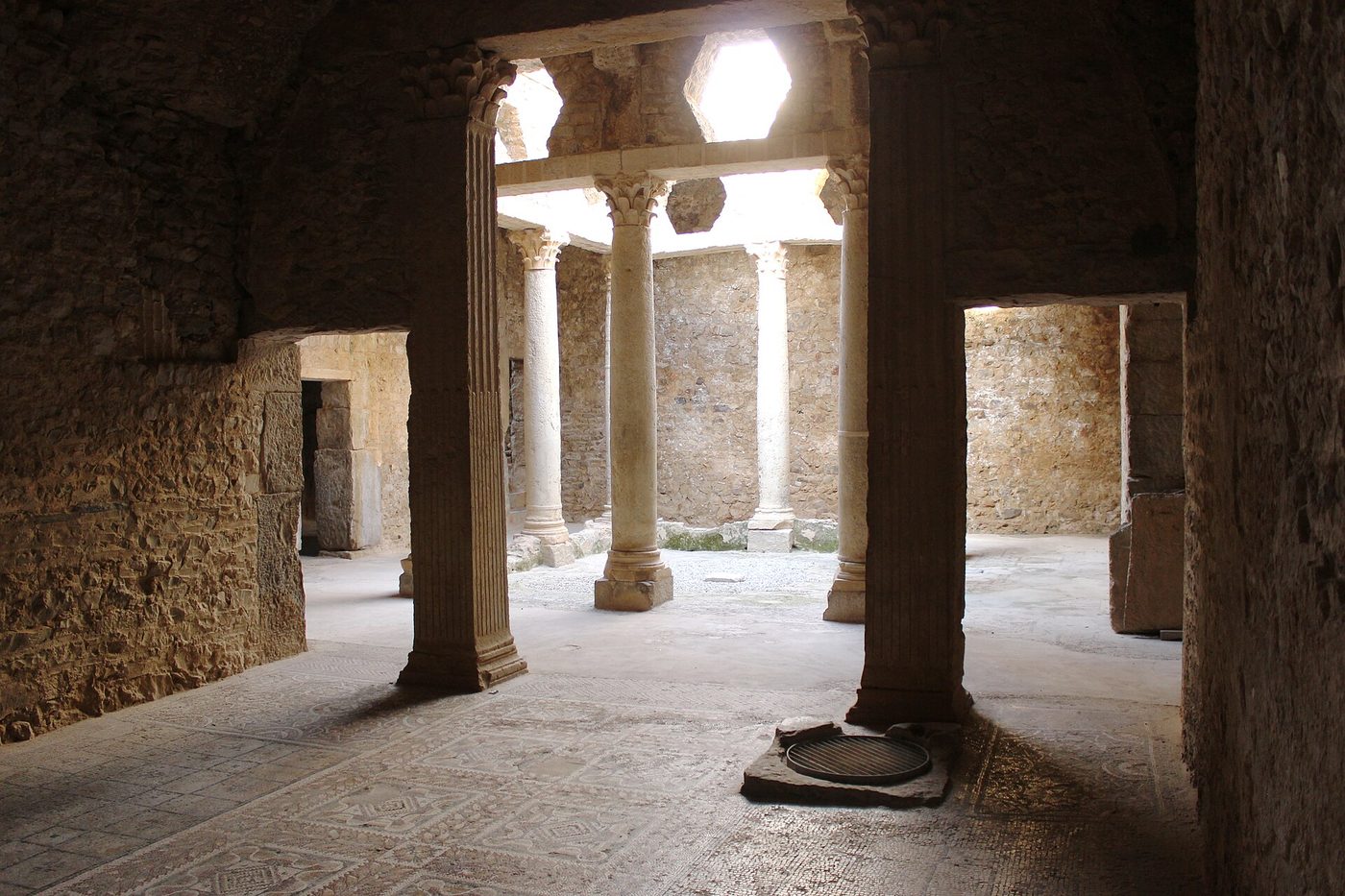
Bulla Regia is a Roman town near Jendouba where wealthy families built a second storey of their houses underground to escape the summer heat. Several of those subterranean rooms survive intact — vaulted, cool and dark — with their mosaic floors still in place. Nowhere else in the Roman world preserved domestic architecture quite like this.
It is the strangest and, we’d argue, the most memorable of the Roman ruins in Tunisia, and it draws a fraction of the visitors Dougga or El Djem pull in. Here’s how to visit properly, what to look for, and the one bit of safety geography you need to get right before you set off.
Bulla Regia at a glance
| Question | Short answer |
|---|---|
| Where is it? | Roughly 6–7km north of the town of Jendouba, in Jendouba Governorate, north-west Tunisia |
| Distance from Tunis | Around 160km by road; reckon on 2 to 2.5 hours each way |
| Why go | Underground Roman houses with mosaics still in situ — unique in the empire |
| Ticket | Single figures in dinars, cash only. Reports in recent years cluster around 7–8 TND (roughly £2). Verify on the day. |
| Photo permit | Many Tunisian sites levy a small separate camera charge. Carry a few extra dinars in coins and small notes. |
| Opening hours | Broadly 8am–7pm in summer and 8.30am–5.30pm in winter, shorter in Ramadan. Hours drift; ask locally. |
| Time to allow | Two hours minimum; two and a half to three if you like reading floors |
| Best time of day | Mid-morning, when the sun drops light down the stairwells |
| What to skip | Nothing on site — but do not treat neighbouring Chemtou as an add-on. See the safety section below. |
To set expectations: from ground level, Bulla Regia does not look like much. Low walls, a big bath complex, a theatre, olive trees. The whole point is downwards. Arrive, glance around and leave after twenty minutes and you will have missed the site entirely.
Why the Romans here built downstairs
The Medjerda valley is Tunisia’s breadbasket and one of its ovens. Jendouba routinely posts some of the highest summer temperatures in the country, and the Romans farming wheat here had no more tolerance for 45°C afternoons than we do.
Their answer was structural rather than seasonal. A wealthy household built a normal ground-floor house — courtyard, colonnade, reception rooms, open to the warming winter sun — then excavated a near-identical suite of rooms directly beneath it for summer. Not a cellar: a full second home, with its own columned courtyard, dining room and mosaic floors, reached by a proper staircase.
How the cooling actually worked
The clever part is that the lower level does not feel like a cave. Each sunken house is arranged around an open court running the full height of both storeys, so daylight and air pour straight down. Stand in one at midday and you get shade, a draught and a temperature drop you can feel on the back of your neck within a few steps of the stairs.
Two further tricks are worth knowing. The vaults were lightened with open-ended terracotta tubes locked into one another — far lighter than solid stone, which is part of why so much roofing survived. And the floors were sprinkled with water, cooling the rooms by evaporation and, as a happy side-effect, making the colours leap. Guides still do it today with a bottle of water, and the shift from dusty grey to deep russet and blue is startling.
Why the basements survived when the houses didn’t
This is the accident of preservation that makes Bulla Regia what it is. An earthquake brought the town down in late antiquity and the ground-floor storeys collapsed — in many cases straight into the rooms below. For the upper floors that was a disaster. But the vaulted basements held, debris packed in above them, and drifting soil sealed the lot.
The site was effectively forgotten until excavations began in 1906. The forum was dug out between 1949 and 1952; the little amphitheatre stayed buried until 1960–61, which is why its steps still look freshly cut. What you walk into today is not a reconstruction — it is a set of rooms buried before they could be robbed out, quarried for stone or weathered away.
The underground houses, one by one
The houses are named after their floors, which is a nice reminder that the mosaics are the point. Not all are open at once — conservation work rotates, and a guardian may unlock one that looks shut — but this is the cast list.
The House of Amphitrite
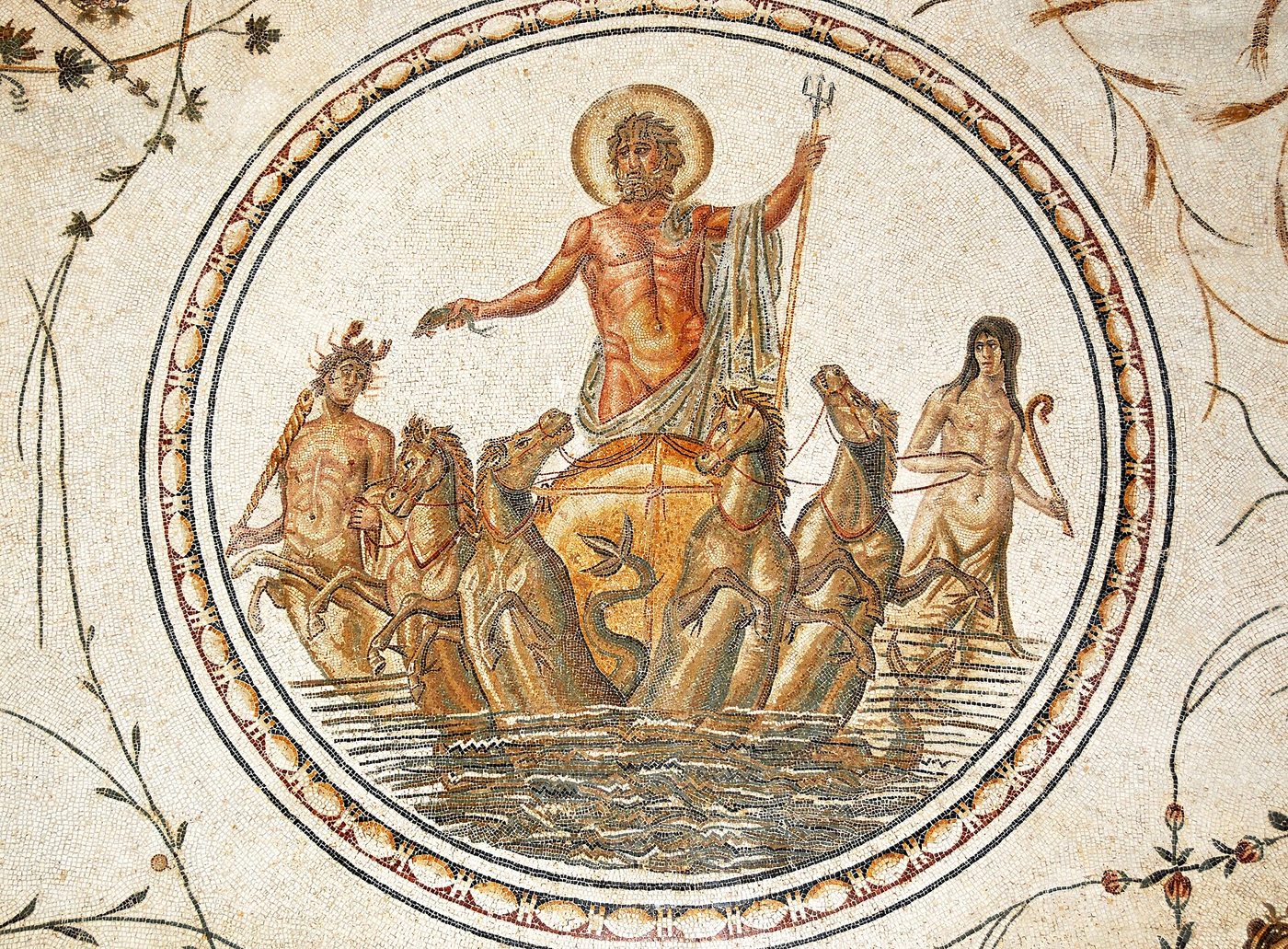
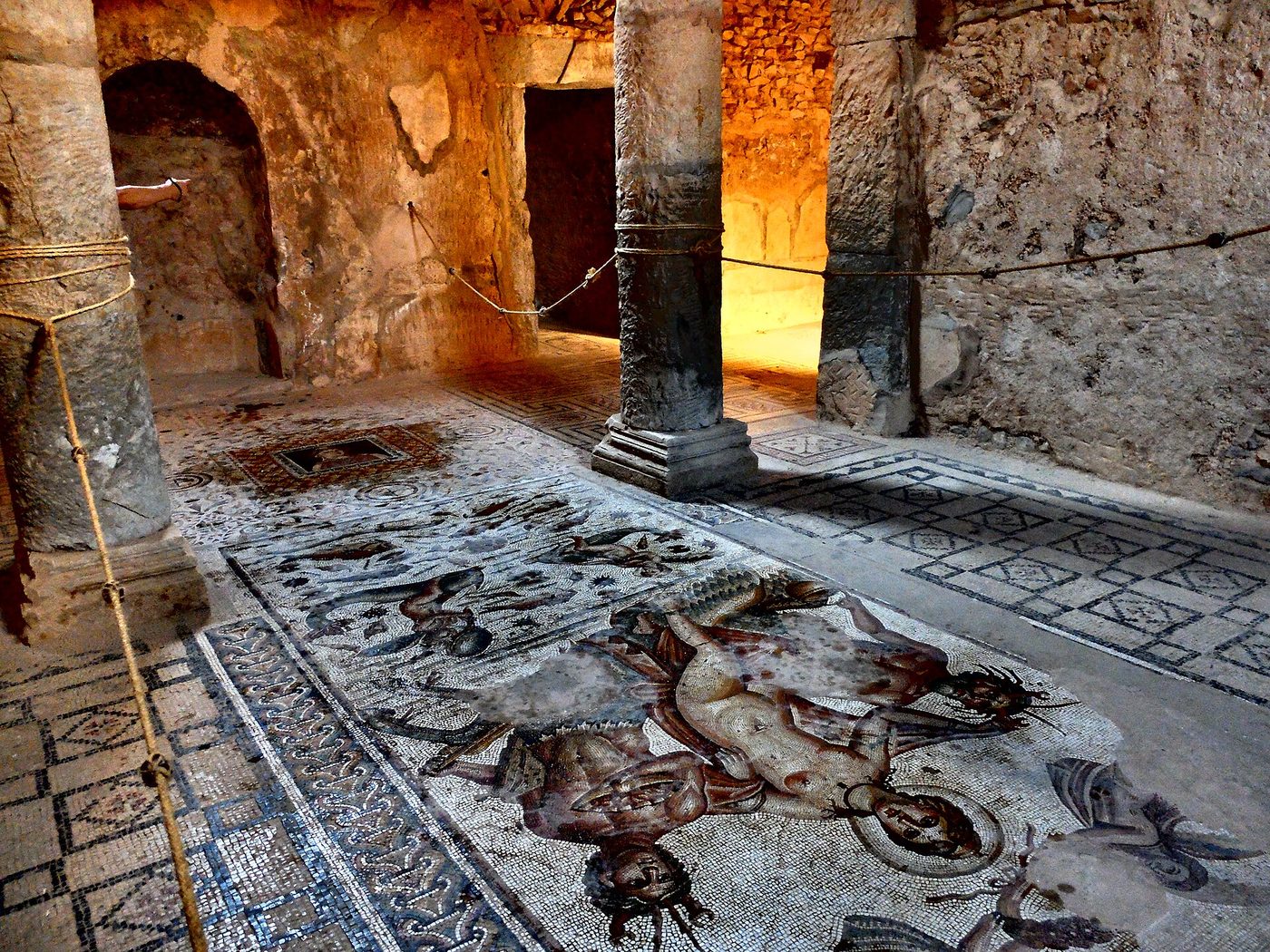
The famous one, and rightly. Down its stairs is a room whose floor carries a marine scene: Venus or Amphitrite, haloed, flanked by centaur-tritons, with cupids riding dolphins around her. It is one of the finest surviving mosaics in Roman North Africa and — this is the bit that matters — it is still where the Romans laid it, in the room they laid it for, lit the way that room has always been lit.
Seeing a mosaic as a floor rather than a framed panel on a museum wall changes it completely. You read it at walking pace, at the scale the owners lived with, columns interrupting the view exactly as they did in the third century. It is usually roped off, and quite right too.
The House of the Hunt
The grandest of the underground houses: a two-storey colonnaded court with capitals still on top of columns, and a lower level you descend into rather than peer at. Parts have carried modern props in recent years while conservators stabilise the vaulting, so don’t be surprised by steel where you expected stone.
Archaeologists like it for another reason: its main hall has an apse and a transept-like arrangement that looks uncannily like the church plans of a century later. It is a standard example of how the reception rooms of the late-Roman rich fed into Christian basilica architecture.
The House of the New Hunt
Less visited, and one of the most complete. Its underground reception rooms survive to close to their original height with the mosaic floors in unusually good condition. If a guardian offers to open it, say yes.
The House of the Peacock
Named for a mosaic that is no longer there — the peacock went to the Bardo in Tunis. The house itself is still worth the descent, and it is a useful lesson in reading the site: several of these buildings are named for floors that have since been lifted.
The House of the Fisherman
A subterranean house with fishing scenes, and a piece of social history built into its walls. In the later empire the owners expanded it across a public street, swallowing the through-route and joining two city blocks into one property — the late-Roman aristocracy quietly annexing public space. You can walk the dead end they created.
What went to the Bardo, and what is still on the floor
Tunisia’s great mosaic collection lives in the Bardo Museum in Tunis, and some of Bulla Regia’s best pieces are there. But a large proportion of the site’s floors were deliberately conserved in place, and that is the whole argument for coming here rather than only visiting the Bardo. Our guide to Tunisian mosaics explains what to look for and which collections hold what.
Our advice: do both, in this order. See the floors here, in the rooms, then go to the Bardo and see what the same craft looks like after a century of conservation. The contrast is the education.
The town above ground
Do not write off the surface. It is a real Roman town, and much of it is in good condition.
The Memmian Baths
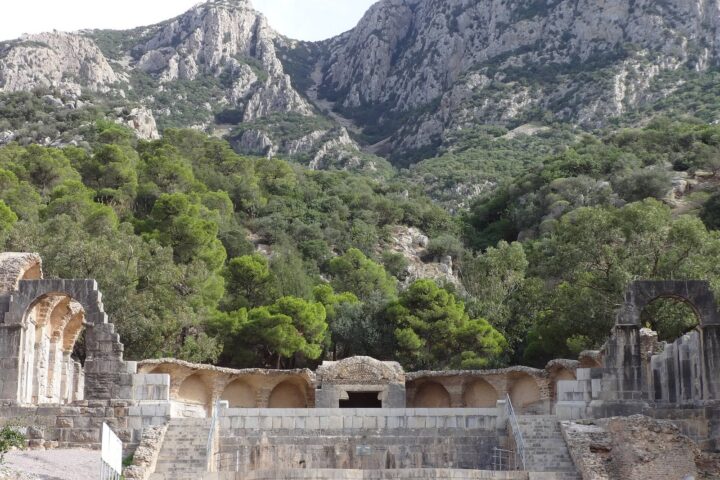
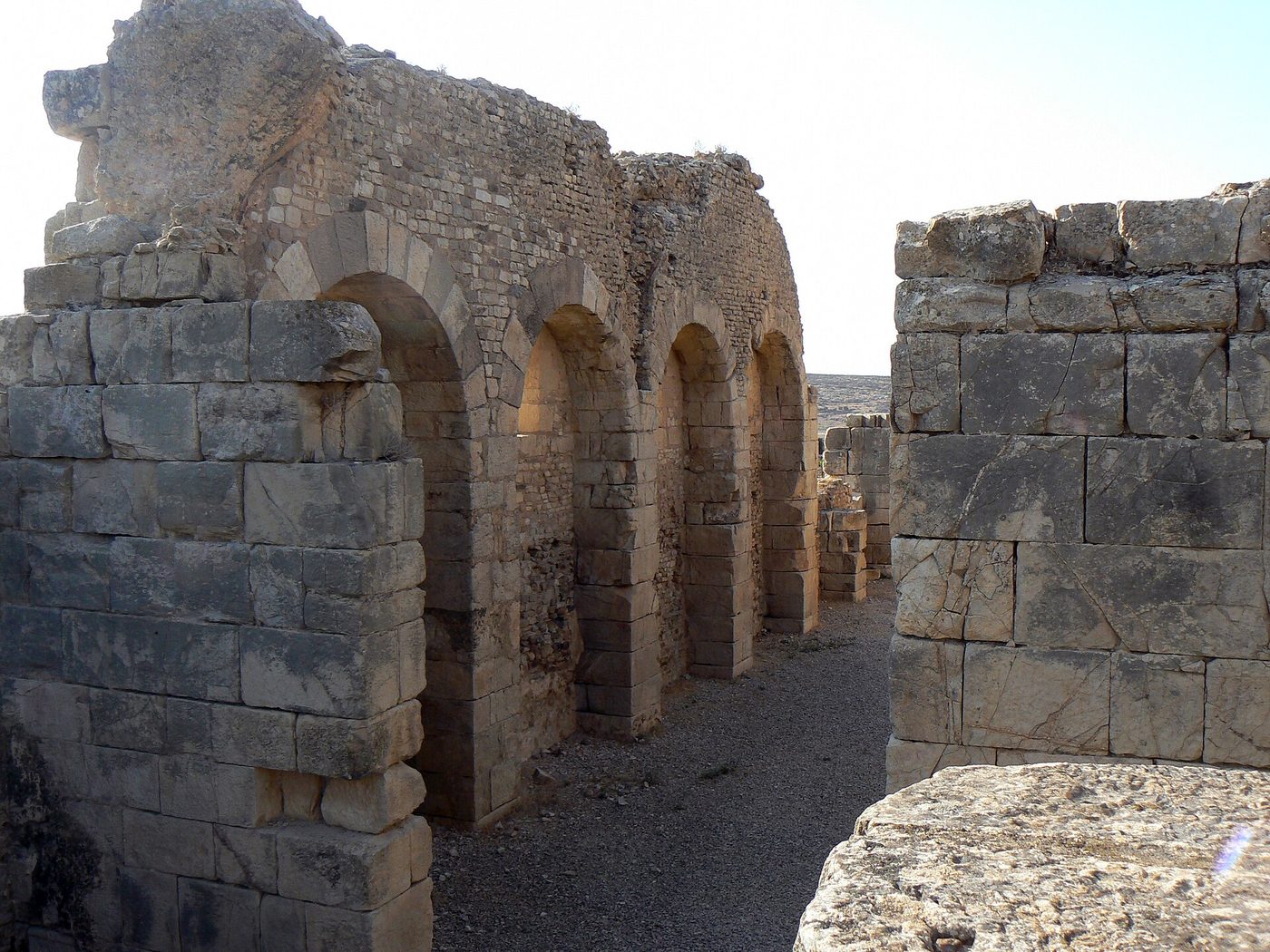
The most imposing thing on site, near the entrance: a large public bath complex named for Julia Memmia, the local benefactor who paid for it. Earthquakes have knocked it about, but enough survives — arches, changing rooms, the frigidarium — to show the scale. For a town this size, it is a statement.
The theatre and the little amphitheatre
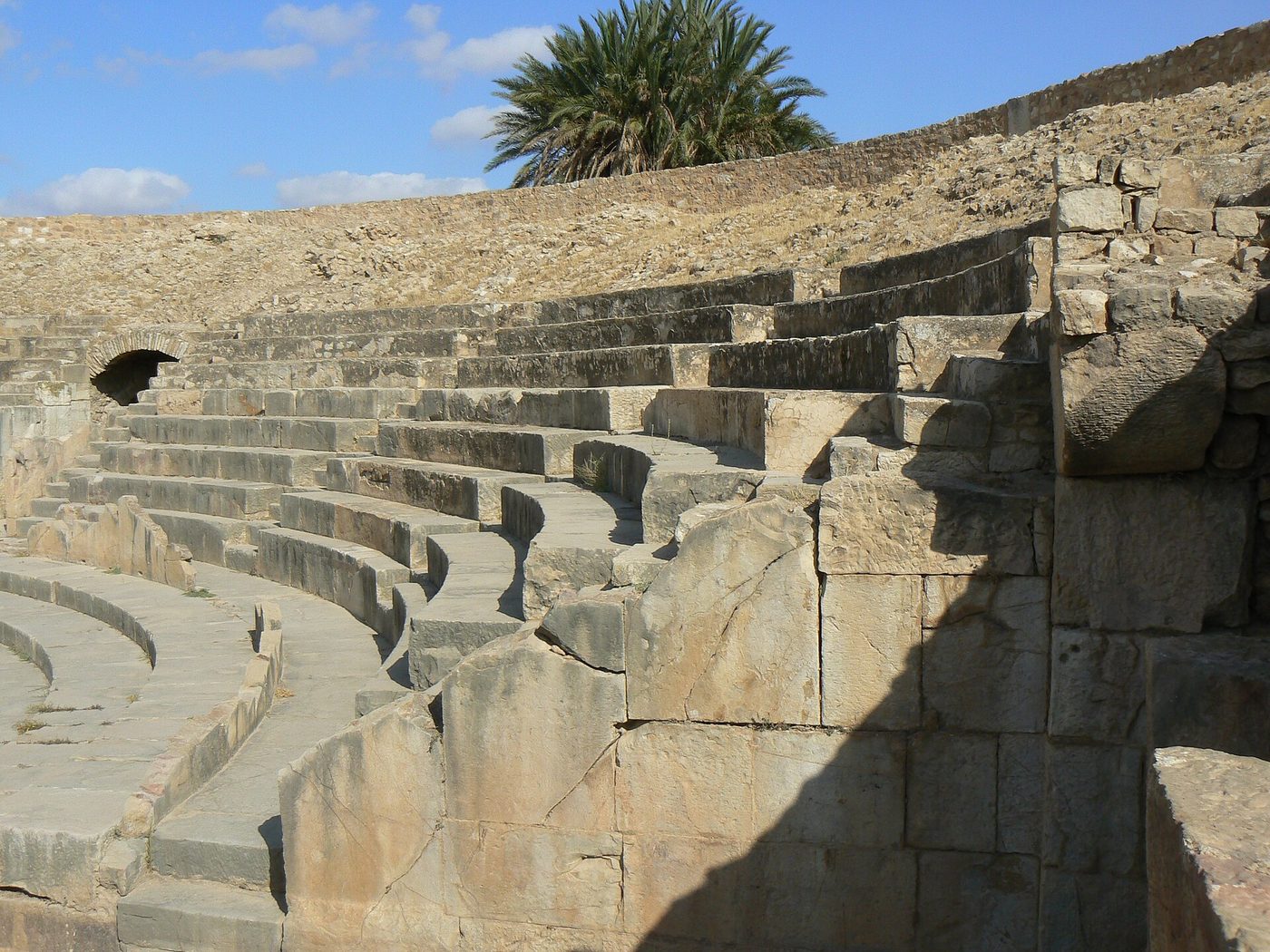
The theatre is small, well preserved and has a bear mosaic set into the floor of its orchestra. The amphitheatre is smaller still and, thanks to staying buried until the early 1960s, unusually crisp. Augustine of Hippo used the entertainments at Bulla Regia as material for a sermon, which tells you how the town was regarded.
The forum, the basilica and the temple of Apollo
The porticoed forum was excavated in the middle of the last century. Its civil basilica, with an apse at each end, was later converted into the town’s cathedral and a cruciform baptismal font inserted into the nave — an odd, memorable arrangement even among Tunisia’s many Byzantine-era conversions.
The temple of Apollo produced one of the site’s more haunting finds. In its courtyard, in the abandonment layers, excavators recovered the remains of a woman wearing a lead slave collar. The tag records that she had fled from Bulla Regia and instructs whoever found her to detain her. Worth holding in your head as you walk the villas: someone had to carry the water that made those mosaics shine.
The site museum
A small museum holds finds including a capital from a temple of the Punic goddess Tanit. It is modest and hours are unpredictable — a bonus rather than a reason to come.
Royal Bulla: the Numidian back-story
The name is a giveaway. Bulla Regia is Latin for “Royal Bulla”, and the “royal” refers to the Numidians, not the Romans. King Masinissa made it one of his royal seats in the middle of the second century BC, and one of his sons kept a palace here. Before that there was a Punic town — its coins carry a name read as a contraction of “House of Baal” — and probably a Berber settlement before that.
Rome took direct control in 46 BC, when Julius Caesar reorganised the province and made Bulla a free city as a reward for its conduct during the civil war. Hadrian later raised it to full colony status, and the underground houses date from that Hadrianic peak and the prosperous century that followed. The layered sequence here — Berber, Punic, Numidian, Roman, Byzantine — is the same one you meet at ancient Carthage, and it makes every site in the country read better.
Getting to Bulla Regia
The site sits just off the main road a few kilometres north of Jendouba town, and there is space to park. Signage on the approach is adequate rather than good, so save the location offline before you lose your mobile signal.
| Option | How it works | Our verdict |
|---|---|---|
| Hire car from Tunis | A3 motorway west, then local roads via Béja and Bou Salem. Around 160km, 2–2.5 hours. | Best option by a distance. Lets you time your arrival and leave when you want. |
| Louage + taxi | Shared minibus from Tunis to Jendouba, then a local taxi for the last few kilometres. | Cheap, doable, slow. Agree the taxi’s return arrangement before you get out. |
| Train to Jendouba | SNCFT runs the Tunis–Ghardimaou line via Béja and Bou Salem; a few services a day, roughly 3.5 hours. | Characterful and very cheap, but the timetable will own your day. Still needs a taxi at the end. |
| Organised day trip | Private drivers and small-group tours run from Tunis, usually paired with Dougga. | The easy answer if you don’t want to drive. Confirm the itinerary in writing. |
Driving yourself
This is what we’d do. The motorway takes you most of the way west and the last stretch is ordinary two-lane road through farmland — rolling green in spring, gold by June. You will pass police and military checkpoints; that is routine in Tunisia, so slow down, be polite and carry your documents. Bring your UK licence, a 1968 International Driving Permit and the hire company’s green card, and avoid these roads after dark. Our guide to getting around Tunisia covers the paperwork in full, and the Tunisia road trip guide sets out the sensible loops.
Without a car
Louages — the shared inter-city minibuses — leave Tunis for Jendouba through the day and cost very little, and a taxi covers the last few kilometres in minutes. The catch is the return: there is essentially nothing at the ruins, so either ask your driver to wait (agree a price first, including the waiting time) or take a number and phone when you’re done. Don’t assume a taxi will simply turn up.
The train is cheap and characterful, but with only a handful of daily services on the Tunis–Ghardimaou line you are building the whole day around the timetable. Check current SNCFT times rather than any schedule you read online, including ours.
Can you combine Bulla Regia and Dougga in one day?
Yes — plenty of tours sell exactly that pairing — but be honest about what the day involves. Something in the region of 300km of driving, plus a couple of hours at each site, plus lunch. Leave Tunis at seven and you’ll be back around seven, tired.
Our view: if you only have one day, do it. The two sites are completely different — Dougga is the great standing town with its capitol and hillside theatre; Bulla Regia is the one you go inside — and the contrast gives you a proper sense of Roman Africa’s range. With two days, split them and sleep in the north-west.
Bulla Regia alone from Tunis is a comfortable day: away by nine, on site by half eleven, home mid-afternoon. Our roundup of day trips from Tunis puts it against the closer options, and the where to stay in Tunis guide will help you pick a base with easy road access.
Tickets, hours and what it’s actually like on the ground
Money
Entry is cheap — single figures in dinars, with recent visitor reports clustering around 7 to 8 TND, roughly a couple of pounds. Bring cash; there is no card machine and no cashpoint at the ruins. Many Tunisian sites also charge a small separate fee for photography, so carry a few extra dinars in small notes rather than turning up with a 50. Prices change without announcement — treat every figure here as an indication.
Remember the dinar is a closed currency: you cannot buy it in the UK before you fly and cannot legally take it home, so you’ll change money on arrival. Reckon on around 3.8–3.9 dinars to the pound as we write, but check the current rate.
Hours and timing
Hours run broadly 8am to 7pm in summer and 8.30am to 5.30pm in winter, with shorter days during Ramadan — which next falls in February 2027. In practice closing times at Tunisian sites are elastic and the guardians go home when they go home, so arrive by mid-afternoon at the latest in winter.
Mid-morning is the sweet spot: the sun is high enough to drop light down the open courts into the underground rooms without turning the surface into glare. Late afternoon flatters the baths and the theatre but leaves the villas gloomy.
How long to allow
Two hours is the working minimum for the main houses and the surface monuments. Two and a half to three is better if you want to sit with the mosaics, and the site is quiet enough that lingering is a pleasure. Anyone doing a Dougga combination will be on the shorter end.
Guides
There is very little interpretation on site — signage is sparse and several of the best houses are easy to walk straight past. Guides tend to find you at the entrance, and for a modest fee one will show you where the staircases are and unlock things. Establish the price first, check the English is up to it, and don’t feel obliged if you’d rather explore alone with a plan.
Underfoot, and accessibility
This needs saying plainly. The whole appeal of Bulla Regia is going down worn ancient staircases into uneven rooms, often in low light, sometimes with a step that isn’t where your foot expects it. Handrails are largely absent and surfaces are gritty. Proper closed shoes with grip, not sandals.
For wheelchair users or anyone with significant mobility limitations, the underground houses are effectively inaccessible and the surface site is rough ground rather than paths. Small children need holding onto near open courtyards and stairwells.
Facilities
Minimal. A ticket kiosk, basic toilets of variable quality, and not much else — no café worth the name, no shop, no shade above ground. Bring water, a hat and something to eat, and plan a proper lunch back in Jendouba. On a hot day the underground rooms are the only real shade on site, which is a pleasing irony given why they were built.
Safety, the FCDO, and getting the geography right
This is the part that trips people up, so we’re going to be precise about it.
Bulla Regia sits roughly 6–7km north of the town of Jendouba, and it is outside every current FCDO advisory zone. The two relevant restrictions in this governorate are these, quoted exactly. The FCDO advises against all but essential travel to:
- “areas north and west of the town of Ghardimaou in Jendouba Governorate, including El Feidja National Park”
- “within 20km of the Tunisia-Algeria border in El Kef and Jendouba governorates, south of the town of Jendouba, including the archaeological site of Chemtou”
FCDO advice was last updated on 24 July 2026 — always check gov.uk/foreign-travel-advice/tunisia before you book.
Read those two lines against a map and the position is clear. Ghardimaou is a separate town roughly 35km further west, up towards the frontier; Bulla Regia is well east of it. The second zone is defined as being south of Jendouba town; Bulla Regia is north of it. The site itself, the road to it from Tunis, and Jendouba town are all outside the restricted areas.
That is the useful service this page can do: the ruins you actually want to see are fine, and the neighbouring site is not. Don’t let a vague memory of “the Algerian border” put you off an ordinary day trip — but don’t extend that reassurance a kilometre further west than the wording allows, either. If your route runs near a boundary, look at the FCDO’s own map rather than relying on our description of it. The full national picture is in is Tunisia safe, with the booking implications in our Tunisia travel advice guide.
On the ordinary stuff: your UK GHIC is not valid in Tunisia, so comprehensive travel insurance with medical cover and repatriation is essential. Check NHS Fit for Travel and TravelHealthPro’s Tunisia page for vaccinations and food-and-water advice before you go.
Chemtou: history, not an itinerary stop
You will see Chemtou — ancient Simitthus — mentioned alongside Bulla Regia in older guidebooks and on tour listings, so it is worth explaining what it is and why it is not in our suggested day.
Chemtou was the source of giallo antico, the yellow-gold marble Rome prized above almost any other stone. It was quarried here on an industrial scale and shipped out to be cut into columns and floor panels across the empire; the site preserves the quarries, a Numidian monument, a bridge and mill complex, an amphitheatre and a museum. It matters enormously to the story of Roman Africa’s economy.
But the FCDO names it. To quote the bullet again, exactly: the FCDO advises against all but essential travel to “within 20km of the Tunisia-Algeria border in El Kef and Jendouba governorates, south of the town of Jendouba, including the archaeological site of Chemtou” — FCDO advice, last updated 24 July 2026.
So we are not going to suggest it as an add-on or a half-hour detour, and we would not go ourselves. The practical consequence matters as much as the principle: most UK travel insurance is void in an area the FCDO advises against all but essential travel to, unless your policy explicitly says otherwise in writing. A twisted ankle on a quarry slope becomes a bill you pay yourself; an evacuation becomes a very large one. If you want Chemtou’s marble, look for it where Rome sent it.
Best time of year to come
Spring is the answer, and it isn’t close. March to May gives you green hills, wildflowers across the site and temperatures you can walk in all day. Late September to November is the second window, warm but no longer punishing.
High summer is hard work: the Medjerda valley in July and August is brutal above ground, and while the underground rooms are a genuine refuge you have to cross a lot of open ground to reach them. Come at opening time or don’t come. Winter is quiet, cool and often lovely, but the north-west is the wettest part of the country and the site turns muddy — see our best time to visit Tunisia guide for the month-by-month picture.
Where Bulla Regia fits in a bigger trip
Few people fly to Tunisia for this site alone. It works best as one stop in a Roman-heavy few days out of the capital, or as the eastern anchor of a north-west loop.
- With Dougga. The classic pairing — one site you look at, one you go inside.
- With Tunis and Carthage. Give a day to Carthage and Sidi Bou Said, a day to the medina and the Bardo, and a day out here. Our Tunis itinerary slots them together, with more on the city in our guide to Tunis.
- With the north coast. The cork forests and the coast at Tabarka are within reach, with Bizerte further east — one of Tunisia’s quieter hidden gems.
- On a wider Roman circuit. Add the amphitheatre at El Djem and, heading south, the holy city of Kairouan, easily reached from Sousse.
Frequently asked questions
Is Bulla Regia worth visiting?
Yes, if you have any interest in the ancient world. The underground houses are unique — nowhere else can you walk into a complete Roman room with its original mosaic floor and roof — and you will often have them to yourself. If you only want photogenic standing ruins, Dougga impresses more from a distance.
Why did the Romans at Bulla Regia build underground?
To escape the heat of the Medjerda valley, one of the hottest parts of northern Tunisia. Wealthy families built a normal ground-floor house for winter and an identical suite of rooms directly beneath it for summer, arranged around open courts that let light and air down. Sprinkling water on the floors added evaporative cooling.
How long do you need at Bulla Regia?
Two hours is a sensible minimum for the main underground houses plus the baths, theatre and forum. Allow two and a half to three if you want to look properly at the mosaics or you’ve hired a guide. Anyone combining it with Dougga should budget nearer two.
How much does it cost to visit Bulla Regia?
Entry is inexpensive — single figures in dinars, with recent reports around 7–8 TND, roughly a couple of pounds. Bring cash: cards are not accepted and there is no cashpoint on site. Budget a little extra for a possible photography fee and a guide. Confirm prices at the kiosk; they change.
Can you visit Bulla Regia and Dougga in the same day?
You can, and many tours sell the pair. Expect roughly 300km of driving from Tunis and a twelve-hour day. The contrast between the two sites is worthwhile, but it is a long push. With two days available, split them and stay overnight in the north-west.
How do you get to Bulla Regia from Tunis without a car?
Take a louage — a shared minibus — from Tunis to Jendouba, then a local taxi for the last few kilometres. There are also a few daily trains on the Tunis–Ghardimaou line, taking around three and a half hours. Arrange your return taxi before you’re dropped off; nothing waits at the ruins.
Are the mosaics at Bulla Regia still in their original places?
Many of them, yes. Some of the finest pieces, including the peacock mosaic, were lifted long ago and are in the Bardo Museum. But a large number of floors — including the celebrated Amphitrite mosaic — were deliberately conserved in situ, which is exactly what makes the site special.
Is Bulla Regia safe to visit?
The site sits about 6–7km north of Jendouba town and lies outside every current FCDO advisory area. The nearby restricted zones are defined as north and west of Ghardimaou, further west, and within 20km of the Algerian border south of Jendouba. Check the current FCDO advice and its map before you travel.
Should I visit Chemtou while I’m there?
We don’t recommend it. The FCDO advises against all but essential travel to “within 20km of the Tunisia-Algeria border in El Kef and Jendouba governorates, south of the town of Jendouba, including the archaeological site of Chemtou” (advice last updated 24 July 2026, still current on 4 September 2026). Most travel insurance is void in such an area unless your policy explicitly covers it.
Is Bulla Regia a UNESCO World Heritage Site?
No. Despite its rarity, Bulla Regia is not inscribed — it has been put forward for Tunisia’s tentative list rather than added to the main one. See our guide to Tunisia’s UNESCO sites for the country’s actual inscriptions and where they sit.
What is the best time of year to visit Bulla Regia?
March to May is ideal: green countryside, wildflowers and comfortable walking temperatures. Late September to November is a close second. July and August are punishingly hot above ground, so go at opening time if you must. Winter is cool and quiet but wet.
Is Bulla Regia suitable for children or visitors with limited mobility?
Older children usually love the staircases and dark rooms, but everything needs supervision — open courts, uneven steps, no handrails. For wheelchair users or anyone with significant mobility limitations, the underground houses are effectively out of reach and the surface site is rough ground.
Written by the Tunisia Tourism Guide team — an independent UK-focused guide to travelling in Tunisia. We don’t sell tours or take hotel commissions. Prices and advice were checked at publication; always confirm current details before you book.
Photo credits
All images via Wikimedia Commons, used with thanks: A sunken colonnaded courtyard in one of the underground Roman © Meryem ATHIMNI (CC BY-SA 4.0); The Amphitrite mosaic still in situ on the floor of © Gigi Sorrentino (CC BY-SA 3.0); The surviving arches of the Memmian Baths at Bulla Regia © Pradigue (CC BY-SA 3.0); The Roman theatre at Bulla Regia © Pradigue (CC BY-SA 3.0).