By the Tunisia Tourism Guide team · Last updated 4 September 2026 · We don’t sell tours or take hotel commissions — this is independent advice, written to be useful.
Almost everyone who walks up Byrsa Hill has the same private thought and never says it out loud: is this it? You have come to see the city that frightened Rome for a hundred years, and what you get is a scatter of low walls, a museum wrapped in scaffolding and a very nice view over the rooftops. The ruins are not the problem. The problem is that nobody has told you the story yet.
Ancient Carthage was a Phoenician colony founded from Tyre in the late ninth century BC that grew into the dominant trading power of the western Mediterranean, fought Rome three times and was burned to the ground in 146 BC. Rome then rebuilt it as the capital of Roman Africa, where it flourished for another 800 years.
This is the story piece, not the site guide — the history behind the finest of the Roman ruins in Tunisia. If you want opening hours, the combined ticket, how to get out there on the TGM line and which of the scattered sites deserve your morning, all of that lives in our practical guide to visiting Carthage. Read this first and the stones start talking.
Carthage at a glance
The short version, before we get into it.
| Founded | Traditionally 814 BC by settlers from Tyre; radiocarbon dates from Byrsa put the earliest material around 835–800 BC |
| Peak | Roughly the 6th to 3rd centuries BC, as the western Mediterranean’s leading trading power |
| Destroyed | 146 BC, at the end of the Third Punic War |
| Refounded | 29 BC as a Roman colony; capital of the province of Africa |
| Finally eclipsed | AD 698, when Arab forces took the city and Tunis rose in its place |
| Where it is now | A wealthy seaside suburb about 15km north-east of central Tunis |
| What survives | Punic houses on Byrsa, the two harbours, the Tophet, the Antonine Baths, a theatre, cisterns, villas and mosaics — spread across roughly a dozen fenced plots |
| Time needed | Half a day for the highlights, a full day if you want all of it plus Sidi Bou Saïd |
| Status | UNESCO World Heritage site since 1979 — one of Tunisia’s World Heritage listings |
Dido, the oxhide, and the parts Virgil made up
Start with the founding legend, because it is the thing most visitors half-remember and almost all of it is literary rather than historical.
What the story says
Elissa — the Greeks and Romans called her Dido — was a princess of Tyre, the great Phoenician port on the coast of modern Lebanon. Her brother Pygmalion murdered her husband for his money. She fled west with a party of loyalists and landed on the North African coast, where the local ruler agreed to sell her as much land as could be covered by a single oxhide. She had the hide cut into strips thin as thread, laid them end to end, and enclosed an entire hill. That hill is Byrsa, and the citadel took its name from the trick.
It is a wonderful story and a suspiciously neat one. The Greek word byrsa does mean oxhide — which is exactly why scholars distrust it. The Punic name was more likely a form of the Semitic root behind words like bosra, meaning fortress or stronghold, which is a thoroughly boring and thoroughly plausible thing to call a citadel. The oxhide, in other words, looks like a Greek folk etymology worked backwards into a legend: someone heard a foreign name that sounded like their own word for hide, and built a tale around it.
What the archaeology actually supports
The colony itself is real enough. The Greek historian Timaeus gave 814 or 813 BC as the founding date, and for a long time archaeologists could not find anything that old in the ground — the earliest pottery kept coming out later than the tradition. That gap has narrowed. Radiocarbon dates on animal bone from stratified deposits on Byrsa, published by Belgian and Tunisian teams working at Bir Massouda, calibrate to roughly 835–800 BC, which sits comfortably around the traditional date. The picture is less “a queen founded a city on a Tuesday” and more a gradual eighth-century urbanisation of a Tyrian trading post — but the tradition turns out to be in the right century, which is more than many foundation legends manage.
Aeneas was never there
Here is the bit worth carrying up the hill with you. The doomed love affair between Dido and the Trojan refugee Aeneas — the one that ends with Dido on a funeral pyre cursing Rome forever — is Virgil’s invention, written into the Aeneid in the late first century BC. Virgil was composing under Augustus, roughly 700 years after Carthage was founded and a century after it was destroyed. Troy, in the Greek tradition, fell somewhere around 1180 BC. Dido’s Carthage begins around 814 BC. The two are separated by well over three centuries. They could not have met.
Virgil knew that. The point was never chronology: it was to give Rome’s hundred-year war with Carthage a mythic origin, a personal wound that explained everything that followed. It worked so well that 2,000 years later it still shapes how Europeans imagine the city — through opera, oil paintings and school Latin rather than through anything a Carthaginian ever wrote.
How a refugee colony became a Mediterranean superpower
Strip away the myth and what you have is a spectacularly well-sited port. Carthage sits on a promontory with sheltered water on one side, a fertile hinterland behind it, and the narrows between Sicily and Africa a short sail away — the pinch point of the whole Mediterranean. Whoever held that stretch of water controlled the traffic between its eastern and western halves.
The harbours
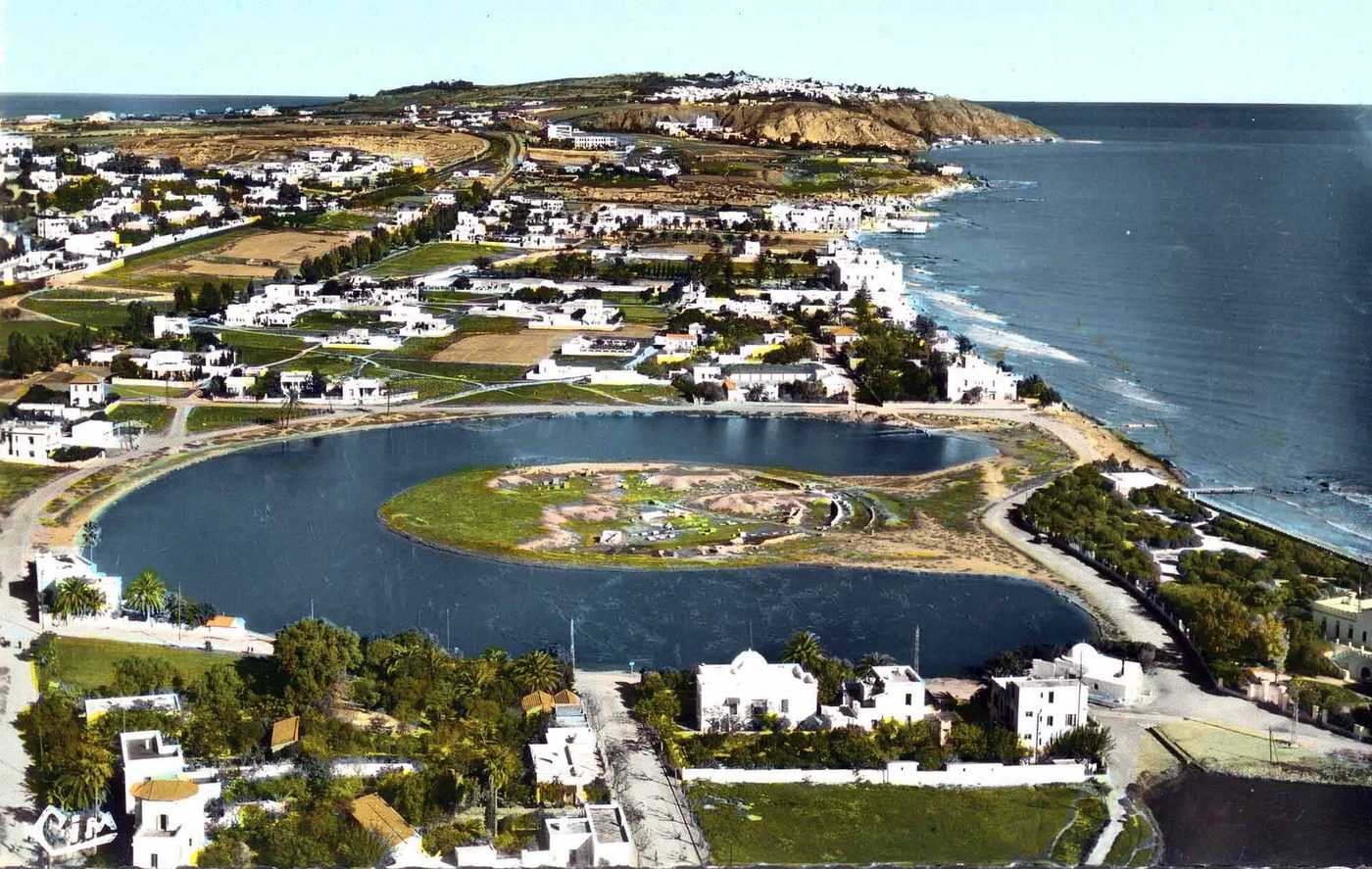
The two lagoons you can walk around today are the remains of the Punic ports, and they are the single most underrated thing at Carthage. There were two basins: a rectangular commercial harbour and, behind it, a circular naval harbour with an artificial island at its centre. Appian describes ship sheds ringing the island with berths for over two hundred warships, hidden from view from the sea and from the merchant harbour. Excavations in the 1970s under Henry Hurst and Lawrence Stager found the sheds, which is a rare and satisfying case of an ancient author being straightforwardly right.
Stand on the little path around the circular basin now and you see fishing boats, ducks and the back walls of villas. Knowing what it was changes the view completely. This was the machine that made Carthage rich — and, later, the thing Rome could not tolerate.
What the Carthaginians were actually good at
Trade, mostly, and the systems that support it. Carthage ran a network of ports and outposts around North Africa, Sardinia, western Sicily and southern Spain, dealing in metals, salt fish, textiles, worked ivory, wine and grain. Its craftsmen produced glass, jewellery and terracotta of real quality — much of what survives is in the Bardo Museum in Tunis, which is the essential companion visit to the site itself.
Carthaginians also wrote things down, and this is where the loss bites. A Carthaginian named Hanno sailed down the Atlantic coast of Africa and left an account of it. Another, Mago, wrote a treatise on agriculture so respected that the Roman Senate had it translated into Latin after the city fell. Both survive only in fragments and quotations. When Rome burned Carthage it burned the libraries too, and the Roman Senate reportedly handed the rest to allied Numidian kings. The result is that we know Carthage almost entirely through the writings of the people who destroyed it — a fact worth holding in mind through everything that follows.
The three Punic Wars, in plain English
“Punic” is just the Latin word for Phoenician. Three wars, spread across 118 years, took Carthage from equal to Rome to erased by it.
First Punic War, 264–241 BC: a land power learns to swim
It started as a squabble over Messina in Sicily and turned into the longest continuous war of the ancient world, fought largely at sea. Rome had no navy worth the name. It built one, copied a captured Carthaginian warship, and bolted on a boarding bridge — the corvus — which let Roman legionaries fight a sea battle as if it were a land battle. Both sides lost fleets to storms on a scale that beggars belief. After 23 years Carthage sued for peace, gave up Sicily and paid a crushing indemnity.
The aftershock mattered more than the war. Unpaid mercenary armies revolted against Carthage in a savage conflict later known as the Mercenary or Truceless War, and Rome used the chaos to seize Sardinia and Corsica as well. That opportunism is what turned defeat into grievance.
Second Punic War, 218–201 BC: Hannibal, elephants and Cannae
This is the one everyone knows. Hannibal Barca, raised in Carthaginian Spain, marched an army overland from Iberia, through southern Gaul, over the Alps in autumn and down into Italy. Polybius gives him 37 war elephants at the start; almost all of them died in the mountains or the first Italian winter, so the mental image of elephants trampling Roman legions is largely wrong. The Alps crossing itself cost him a huge share of his army.
What he did with the remainder is why generals still study him. At the Trebia in 218 BC and Lake Trasimene in 217 BC he destroyed Roman armies through terrain and timing. Then at Cannae in 216 BC he let his centre give way, drew a far larger Roman force into a sagging crescent and closed his cavalry behind them. Ancient casualty figures vary wildly — roughly 48,000 dead in Livy, around 70,000 in Polybius — but by any count it was the worst day in Roman military history, and the manoeuvre is still taught as the model double envelopment.
And it was not enough. Hannibal never had the siege train or the manpower to take Rome itself, and Rome simply refused to accept that it had lost. It rebuilt, avoided pitched battles, and eventually attacked Carthage’s own territory in Africa under Publius Cornelius Scipio. Hannibal was recalled home after 15 years in Italy, and Scipio beat him at Zama in 202 BC — somewhere inland in what is now Tunisia, though the exact battlefield has never been firmly identified. Scipio took the name Africanus. Carthage lost its fleet, its overseas empire and its freedom to go to war.
Third Punic War, 149–146 BC: annihilation
Half a century later Carthage was disarmed, boxed in and still visibly prosperous, which turned out to be the problem. Rome found a pretext in Carthage’s response to raids by its Numidian neighbour, demanded that the population abandon the coast and move inland, and when they refused, laid siege.
The siege lasted three years. Scipio Aemilianus — grandson by adoption of Africanus — took the city street by street in 146 BC. Appian describes days of house-to-house fighting up the slope to Byrsa. The survivors, perhaps 50,000 of them by his account, were sold into slavery. The city burned, the site was formally cursed, and Rome decreed that nobody should live there. Polybius, who was standing beside Scipio, records his commander weeping and saying he feared the same fate would one day come to Rome.
| When | What happened |
|---|---|
| c. 814 BC (traditional) | Settlers from Tyre found Carthage; earliest excavated material dates to roughly 835–800 BC |
| 6th–4th centuries BC | Carthage dominates trade in the western Mediterranean |
| 264–241 BC | First Punic War, fought mainly at sea; Carthage loses Sicily |
| 218 BC | Hannibal crosses the Alps into Italy |
| 216 BC | Cannae — Rome’s heaviest defeat |
| 202 BC | Scipio defeats Hannibal at Zama, in modern Tunisia |
| 149–146 BC | Third Punic War; Carthage besieged, stormed and burned |
| 29 BC | Augustus refounds Carthage as a Roman colony |
| AD 145–162 | The Antonine Baths are built |
| AD 439 | The Vandals take Carthage and make it their capital |
| AD 533–534 | Byzantine reconquest under Belisarius |
| AD 698 | Arab forces take Carthage; Tunis becomes the regional city |
| 1979 | Inscribed on the UNESCO World Heritage list |
The salt myth: Rome did not sow Carthage with salt
If you learned one thing about Carthage at school, it was probably this: the Romans ploughed the ruins and sowed them with salt so that nothing would ever grow there again. It is a brilliant image. It is also, as far as anyone can tell, entirely modern.
No ancient source says it. Polybius was an eyewitness and his account of the final assault survives only in fragments, but nothing in what remains mentions salt. The epitome of Livy describes a siege. Appian, our fullest surviving narrative, describes the burning of the city and the Senate’s decree that whatever was left should be obliterated and nobody allowed to live there — and says nothing about salt. Diodorus, Cicero, Plutarch, Orosius: nothing. Later writers mention a curse and a ceremonial ploughing of the site, both of which are plausible Roman ritual practice, but the salt is simply absent.
Where the story actually comes from
The case was made properly by the Australian historian R. T. Ridley in a 1986 article in Classical Philology with the excellent title “To Be Taken with a Pinch of Salt: The Destruction of Carthage”. Ridley showed that no classical source supports the claim and argued that it is a contamination — the destruction of Carthage fused with genuine ancient accounts of cities being sown with salt, most famously Shechem in the Book of Judges. Follow-up work has traced the claim in print back into the nineteenth century, and it appears in reference works well before it was made respectable by inclusion in the first edition of the Cambridge Ancient History in 1930. From there it entered every school textbook in the English-speaking world.
There is also a simple practical objection. Salting a site of that size would have required a genuinely absurd quantity of a valuable commodity, and it plainly did not work: Rome refounded the city on much the same ground within a century and farmed the surrounding plain for the next 700 years. Roman Africa became the empire’s grain basket. Whatever Rome did to Carthage in 146 BC, it did not sterilise the soil.
And Cato probably never said “Carthago delenda est” either
The other line everyone knows is Cato the Elder ending every Senate speech with Carthago delenda est — “Carthage must be destroyed”. The sentiment is genuine and well attested. The Latin is not. Plutarch records the phrase in Greek, and the polished Latin versions people quote today — Carthago delenda est, Ceterum censeo Carthaginem esse delendam — were shaped by early modern scholars, not Roman ones. No surviving ancient text gives the wording in the form it is always quoted.
Two famous facts about Carthage, then, and both of them modern. That tells you something about how thin the ground is, and it is a decent frame of mind to take to the site.
The Tophet: the argument archaeologists are still having
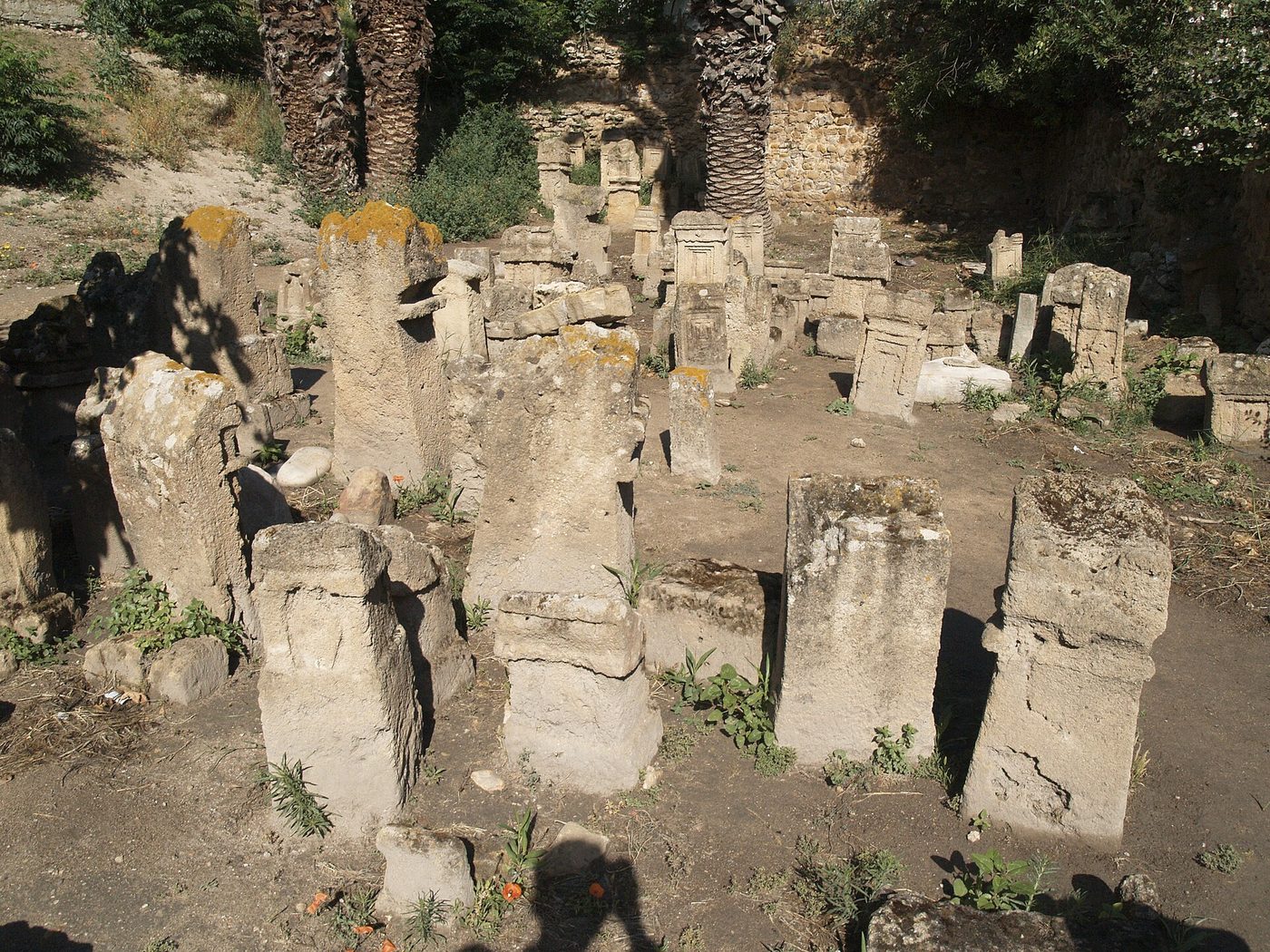
South of the harbours, in the suburb of Salammbô, is a sunken plot of ground crowded with carved stone markers. This is the Tophet — a Punic sanctuary where urns holding the cremated remains of newborn infants and young animals were buried under stelae dedicated to the gods Baal Hammon and Tanit, from roughly the mid-eighth century BC until the city fell in 146 BC. More than 20,000 urns have been recovered. It is one of the strangest places in the Mediterranean and it is often a visitor’s least comfortable half hour.
The question of what happened there is genuinely unresolved, and anyone who tells you flatly that it was child sacrifice — or flatly that it was not — is overselling their side.
The case for sacrifice. Greek and Roman writers accused the Carthaginians of burning children to their gods, and the Hebrew Bible describes comparable rites in the Levant. Physically, the urns hold infants and animals treated the same way, often in the same vessel; the animals are largely lambs and kids burned whole, which looks like offering rather than burial. Studies of tooth and bone development by Patricia Smith, Lawrence Stager, Joseph Greene and colleagues, published in Antiquity in 2011 and 2013, put many of the infants past the newborn stage. Paolo Xella, Josephine Quinn and others argued in the same journal that the inscriptions on the stelae — vows fulfilled to a god — read exactly as you would expect if a child had been promised and given.
The case against. Jeffrey Schwartz and colleagues, in PLOS ONE in 2010 and again in Antiquity in 2017, re-examined the skeletal remains and concluded that a large share were prenatal or died within days of birth — a distribution that matches ordinary perinatal mortality in a pre-modern population rather than selective killing. On that reading the Tophet is a specialised cemetery for babies who died too young for a normal burial, and the ancient accusations are hostile propaganda from Carthage’s enemies, later amplified by nineteenth-century European writers who found the idea irresistible.
Where it stands. Awkwardly. A 2023 volume of new excavation data, reviewed in 2024, made two things clear: the sacrifice reading is currently the majority position among specialists working on the site, and the evidence is far patchier than a century of argument suggests. Astonishingly, not one of the seven excavation campaigns since 1921 has ever been fully published. Recent Tunisian-led digs under Imed Ben Jerbania are the most rigorous work yet done there. Until that is published in full, “we don’t know for certain” is the honest answer — and the more interesting one to stand there holding.
Roman Carthage: the empire’s African capital
Julius Caesar planned a colony on the site; Augustus actually founded it in 29 BC. Rome then did something quietly remarkable to the hill: engineers sheared off the top of Byrsa and built an enormous artificial platform for a forum and basilica. That single act of levelling is why the Punic city is so hard to find — and, by accident, why part of it survived at all. We’ll come back to that.
Roman Carthage grew into the administrative and economic capital of Africa Proconsularis and, by late antiquity, by most estimates the largest city in the Latin-speaking west after Rome. It had a circus modelled on the Circus Maximus, a theatre, an amphitheatre, an odeon, and an aqueduct running over 100km from the hills at Zaghouan to feed the vast Malga cisterns.
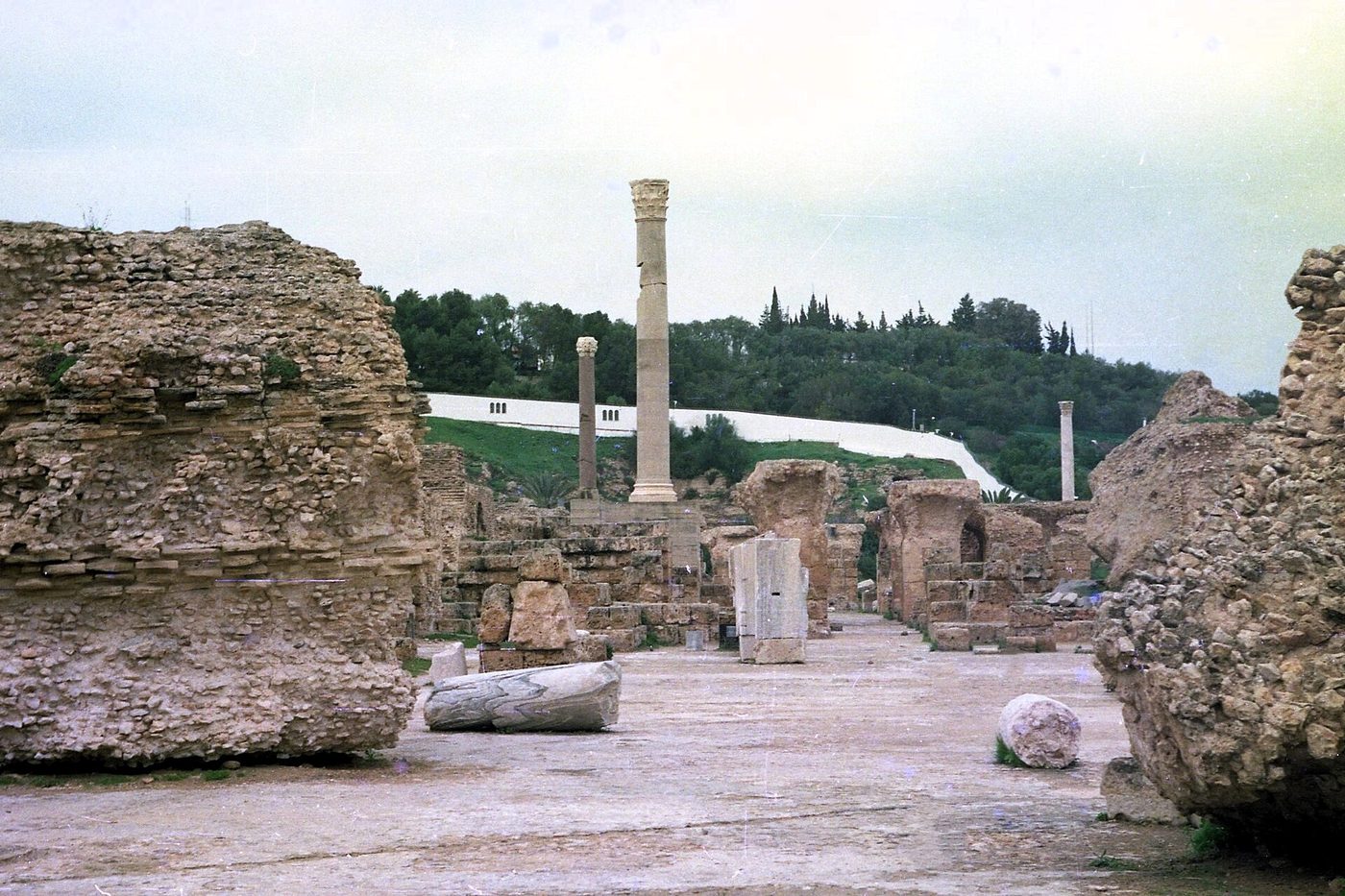
The showpiece is the Antonine Baths, built between roughly AD 145 and 162 under Antoninus Pius: the largest Roman bath complex in Africa and among the largest anywhere in the empire. What you walk through today is mostly the service basement — the vaulted underfloor level — with a single re-erected column standing to full height to show you what has gone. Look at that column, then at the low walls around your feet, and the scale finally lands.
The domestic side is easier to love. The villas of the Roman quarter, with their courtyards and mosaic floors above the Gulf of Tunis, show how a rich Carthaginian household lived, and the mosaic workshops of Roman Africa were the best in the empire. The finest pavements were long ago lifted and taken to the Bardo — our guide to Tunisian mosaics explains what to look for. For the sheer scale of Roman Africa’s building programme, the amphitheatre at El Jem and the hill town of Dougga both preserve far more standing architecture than Carthage does, and the underground villas of Bulla Regia preserve far more mosaic in situ.
Augustine, the Vandals and the long ending
Carthage became one of the great centres of early Christianity in the Latin west. Tertullian wrote here around AD 200. Perpetua and Felicity were martyred in the amphitheatre in 203, and their prison account is one of the earliest surviving texts by a Christian woman. Cyprian was bishop and was executed in 258. Church councils at Carthage helped fix the shape of Western Christianity.
Augustine of Hippo, born in 354 in what is now eastern Algeria, came here as a teenager to study rhetoric and later taught in the city. The Carthage of his student years — theatres, sermons, lawcourts and temptations — is one of the sharpest pictures we have of a late Roman city, precisely because he was so unimpressed by himself in it. He became bishop of Hippo Regius in 395 and died there in 430 while the Vandals were at the gates. Christian Carthage is part of the deep layering that still shapes Tunisian culture.
The Vandals took Carthage in 439 under Geiseric and ruled a kingdom from it for nearly a century, using its harbours to raid across the Mediterranean, Rome included. Byzantine forces under Belisarius retook the city in 533–534 and held it as the seat of the Exarchate of Africa. Then, in 698, Arab armies under Hassan ibn al-Nu’man took Carthage and dismantled what mattered: the walls came down, the water supply was cut, the harbours were disabled. The centre of gravity shifted inland and south — to Kairouan, founded in 670, and to the sheltered lagoon site of Tunis, whose medina became the region’s great city. Carthage’s cut stone went into building it.
Why so little Punic Carthage survives — and why it’s scattered through a suburb
Three things happened to the Punic city, in order.
- Rome burned it, then buried it. The 146 BC destruction was thorough, but the levelling of Byrsa a century later did more archaeological damage — the Roman platform simply removed the top of the Punic hill.
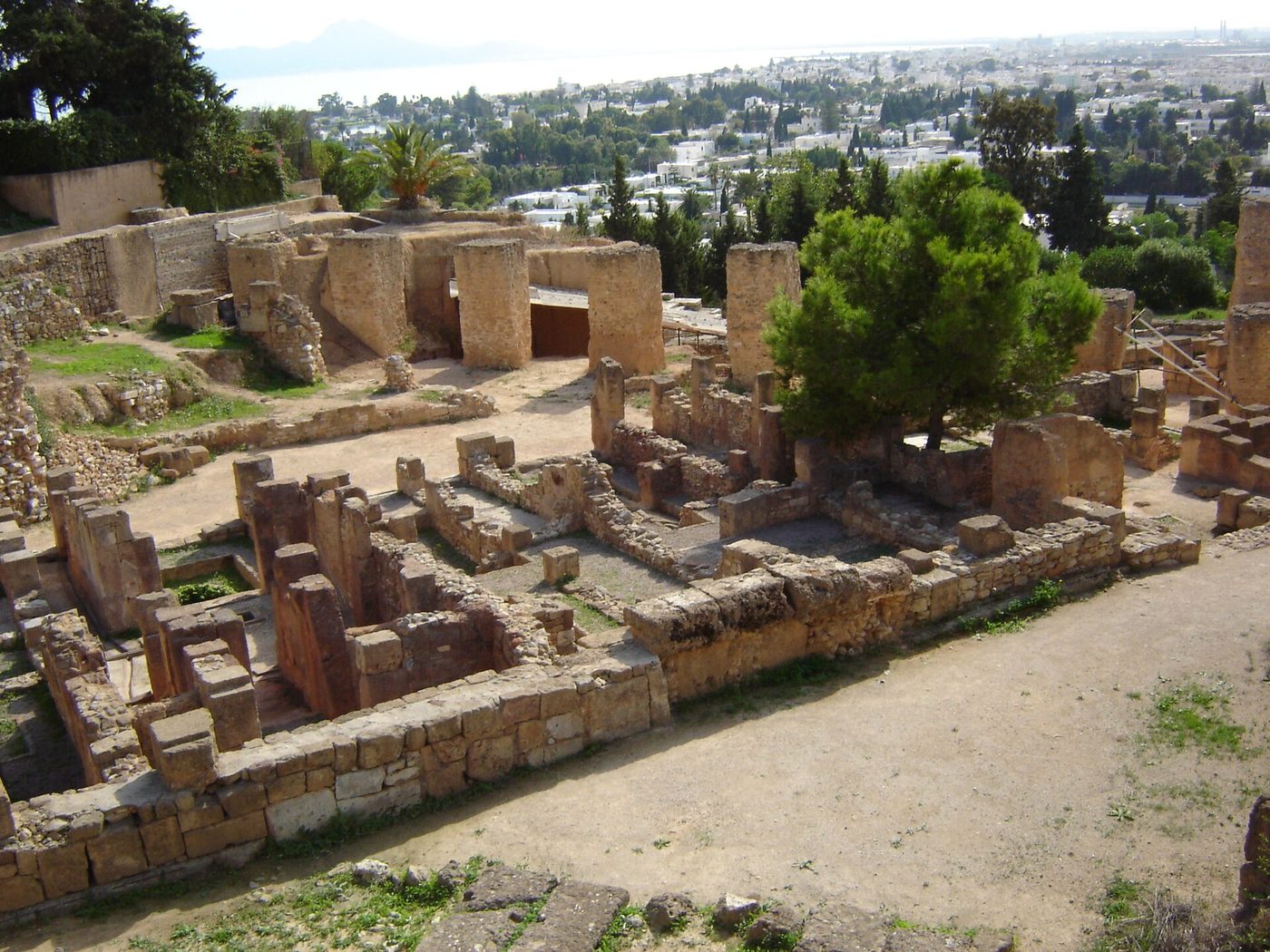
- An accident saved a slice of it. The fill and retaining walls that built that Roman terrace sealed a band of Punic houses on the hillside beneath. Those are the streets and cisterns you can walk through today, often called the Hannibal Quarter: ordinary second-century BC homes, preserved because Rome buried them rather than despite it.
- Everything else was quarried. For a thousand years Carthage was the region’s stone yard. Columns, blocks and marble went into Tunis and beyond. A ruin that convenient does not stay a ruin.
Then came the modern chapter, which explains the layout that confuses visitors. Through the nineteenth and twentieth centuries Carthage became a fashionable seaside suburb, and villas went up across the archaeological zone before anyone could stop them. UNESCO’s own assessment notes that the site’s integrity was partly compromised by uncontrolled urban sprawl in the first half of the twentieth century. So the ancient city is not a park with a fence around it; it is a dozen or so protected plots stranded in a grid of walled houses, embassies and a presidential palace, connected by suburban streets. That is why you can be standing in Roman Carthage and looking at a hedge.
The pressure has not stopped. UNESCO’s state-of-conservation reports through the 2010s and 2020s identify illegal construction on and around the property — worst in the Roman circus district — as the leading threat, with demolition orders issued and only partly carried out, a land-purchase programme launched to buy plots back, and a formal warning in 2019 that the site could be put on the List of World Heritage in Danger. Knowing this changes the visit. You are looking at a place that is still, quietly, being lost.
What to read and watch before you go
Half a day of preparation is worth more here than at almost any other Tunisian site, because so much of Carthage is invisible without it.
- Richard Miles, Carthage Must Be Destroyed (2010). The best single book for a general reader — takes Carthage seriously on its own terms rather than as Rome’s opponent.
- Adrian Goldsworthy, The Fall of Carthage (2000). The three wars, told clearly and without romance. Read this if the campaigns are what interest you.
- Serge Lancel, Carthage: A History. Drier and more archaeological, by the excavator who worked on Byrsa. The one to reach for when you want the evidence rather than the narrative.
- Virgil, Aeneid, Book IV. An hour’s read in any decent translation. Not history — but it is why Dido is famous, and it is the version half your fellow visitors will be carrying.
- Gustave Flaubert, Salammbô (1862). A lurid, obsessively researched and thoroughly unreliable novel about the Mercenary War. Worth knowing because the suburb where the Tophet sits is named after its heroine.
- Channel 4’s Carthage: The Roman Holocaust (2004), presented by Richard Miles. Two 45-minute parts, occasionally overheated in tone, but it walks the ground and it is easy to find.
- Purcell’s Dido and Aeneas (1689) or Berlioz’s Les Troyens. If you want to understand why Carthage lodged itself in the European imagination, listen to Dido’s lament once before you climb Byrsa.
Seeing it for yourself
The full logistics — tickets, timings, transport, which sites to skip — are in our Carthage visiting guide, but here is the order we’d walk it now that you know the story.
- Byrsa first. Stand on the Roman platform, look down at the Punic houses, and you have the whole argument of this article in one view. The National Museum on the hill has been closed for structural work since 2018 with a major reopening long promised — check its status before you build a day around it.
- Then the ports, ten minutes downhill, for the circular naval basin and the admiral’s island.
- Then the Tophet, close by in Salammbô — short, sobering, and the place where knowing the debate really pays.
- Then the Antonine Baths for scale and sea views. Be aware the presidential palace adjoins the site and photographing in that direction is not welcome.
- Finish at Sidi Bou Saïd up the hill for a mint tea, or carry on to the Bardo another day.
A single combined ticket has generally covered the separate Carthage sites for one day, with a small extra charge for a photography permit at some Tunisian sites — around 12 dinars for the ticket at recent report (2026 — check current prices at the first gate you reach). Most people do Carthage as a half-day from the capital; see our day trips from Tunis and Tunis itinerary for how it slots in, and where to stay in Tunis if you’re basing yourself nearby. October is our favourite month for it — warm, clear light, and the site nearly empty; our guide to Tunisia in October explains why. Carthage and the Bardo together are the anchor of any serious Tunisia itinerary, and near the top of our list of things to do in Tunisia. Tunis and its suburbs sit far from any restricted area — our Tunisia safety guide has the current Foreign Office wording if you want it.
Frequently asked questions
Did the Romans really salt the earth at Carthage?
No. No ancient source — Polybius, Livy, Appian, Diodorus, Cicero, Plutarch — mentions salt at Carthage. The claim was demolished by R. T. Ridley in Classical Philology in 1986, who showed it was a modern conflation with biblical accounts of salting cities. It appears in print in the nineteenth century and became standard after the 1930 Cambridge Ancient History. Rome burned and cursed the site; it did not salt it.
Was Dido a real person?
Possibly, in outline. The tradition of a Tyrian princess named Elissa leading a colonising party west is old and predates Virgil, and the archaeological dates for the founding roughly match. But the oxhide trick looks like a Greek folk etymology built on byrsa meaning hide, and the love affair with Aeneas is pure literary invention. Treat Dido as a founder-figure, not a biography.
Where is ancient Carthage today?
In a coastal suburb of the same name about 15km north-east of central Tunis, reachable in half an hour on the TGM light rail. The ancient city is not one enclosure but roughly a dozen separate fenced sites spread through modern streets, which is why first-time visitors often feel they have missed something.
Why was Carthage destroyed?
Because Rome chose to. By 149 BC Carthage was disarmed and no strategic threat, but it was recovering commercially and a faction in the Senate, led by Cato the Elder, wanted it gone. Rome used a border conflict with Numidia as a pretext, demanded the city be abandoned, and besieged it when the Carthaginians refused. The destruction in 146 BC was punitive rather than necessary.
Did Hannibal ever attack Rome itself?
He came close but never assaulted the city. After Cannae in 216 BC he lacked the siege equipment and manpower to storm Rome’s walls, and expected its Italian allies to defect — most did not. He rode up to the walls in 211 BC as a diversion, which gave Rome the phrase Hannibal ad portas, but he never attempted a siege.
How many elephants did Hannibal take over the Alps?
Polybius gives 37 setting out. Almost all died crossing the mountains or in the first Italian winter, and by the major battles the elephants were a marginal factor. The popular image of elephants smashing through legions in Italy is not what the sources describe — the real achievement was moving an army over the Alps at all.
Did the Carthaginians sacrifice children?
Genuinely unresolved. The Tophet holds more than 20,000 urns of cremated infants and young animals. Bone and tooth studies by Smith, Stager and Greene support sacrifice; work by Schwartz and colleagues argues the age profile matches natural perinatal death, making it an infant cemetery. Most specialists currently lean towards sacrifice, but no excavation campaign has been fully published, so certainty isn’t available.
What language did the Carthaginians speak?
Punic, a western dialect of Phoenician and a Semitic language related to Hebrew. It is what you see carved on the Tophet stelae. Remarkably, it outlived the city’s destruction by centuries — Augustine, writing around AD 400, refers to Punic still being spoken in the North African countryside.
Is there anything genuinely Punic left to see?
Yes, though less than people expect. The Punic houses on the flank of Byrsa Hill are the best of it — real streets, cisterns and thresholds from the years before 146 BC, preserved because Roman engineers buried them under a terrace. The Tophet stelae and the shape of the two harbours are the other survivals. Everything monumental you see standing is Roman.
How long do you need at Carthage?
Three to four hours covers Byrsa, the ports, the Tophet and the Antonine Baths at a reasonable pace, including the walking or taxi hops between them. A full day lets you add the theatre, the villas, the cisterns and Sidi Bou Saïd. Under two hours and you will see stones without the story, which is exactly the experience most people complain about.
Is Carthage worth visiting if you’re not a history buff?
Honestly: only if you do a little homework or take a good guide. Carthage rewards knowledge more than almost any site in Tunisia, because so much of what matters is absent rather than present. Go in cold and it can feel like an underwhelming set of foundations. Go in knowing what happened on that hill, and it becomes one of the most affecting places in the Mediterranean.
Written by the Tunisia Tourism Guide team — an independent UK-focused guide to travelling in Tunisia. We don’t sell tours or take hotel commissions. Prices and advice were checked at publication; always confirm current details before you book.
Photo credits
All images via Wikimedia Commons, used with thanks: The surviving frigidarium column towering over the ruined Antonine Baths © Silar (CC BY-SA 4.0); Excavated Punic houses and streets of the Hannibal Quarter on © No machine-readable author provided. BishkekRocks assumed (based on copyright claims). (Public domain); Aerial view of the circular Punic military harbour at Carthage © Unknown authorUnknown author (Public domain); Rows of carved Punic stelae standing in the Tophet of © Institute for the Study of the Ancient World from New York, United States of America (CC BY 2.0).