By the Tunisia Tourism Guide team · Last updated 4 September 2026 · We don’t sell tours or take hotel commissions — this is independent advice, written to be useful.
The question we get asked most about the Tunisian desert isn’t “is it worth it?” It’s “how bad is the camel, really?” People have seen the photographs, they like the idea of a night under the stars, and they are quietly dreading several hours in a wooden saddle on top of a large animal they have no relationship with.
Camel trekking Tunisia — the genuine version, not the ten-minute photo ride — means two to four hours a day in the saddle, walking the rest, and a night camped on the sand. Expect sore inner thighs, colder nights than you can imagine, no phone signal, and one of the best evenings of your holiday.
What follows is the hour-by-hour reality: how the different trips differ, what the camps are actually like, what to pack, how to tell whether the camel you’re about to sit on is being looked after, and what any of it should cost. It sits inside our wider guide to the Tunisian Sahara desert, which covers the region as a whole.
At a glance: what you’re actually booking
| Details | |
|---|---|
| Where it happens | The Grand Erg Oriental, reached from Douz, Ksar Ghilane or Tozeur |
| Shortest version | A 45–60 minute sunset ride from the edge of Douz |
| Most popular version | One night: ride out late afternoon, camp, ride back after sunrise |
| Serious version | 2–4 days with a nomad guide, moving camp each night |
| Time in the saddle | Rarely more than 2–4 hours a day; you walk the rest |
| Typical cost | Roughly 30–60 TND for a short ride; around 120–200 TND per person per day on a multi-day trek including meals and camp (2026 — check current prices) |
| Best months | October–November and February–April. Avoid June to September entirely |
| Night temperatures | Douz averages lows near 17°C in October and around 4°C in January — and the open erg feels colder than the town |
| Phone signal | Patchy at the fixed camps, effectively none an hour into the dunes |
| Loos | En suite at the tented camps; a spade and a dune at a bivouac |
| Insurance | Must explicitly cover animal riding and 4×4 or quad excursions. Your GHIC is not valid in Tunisia |
| Who it suits | Anyone reasonably mobile. Not for bad backs, late pregnancy or nervous first-time riders on a long trek |
Three completely different trips, all called “camel trekking”
This is where most disappointment comes from. The word “trek” is doing an enormous amount of work in Tunisian tourism, and the three things it describes have almost nothing in common except the animal.
1. The sunset photo ride (45–60 minutes)
Sold from every hotel in Douz, from the camel stand at the edge of the dune field, and as a bolt-on to almost every coach excursion in the south. A handler leads a string of four to eight camels out to a photogenic dune, everyone takes the same three photographs, and you come back. Expect somewhere around 30–60 TND per person, more if a coach tour is taking a cut (2026 — check before you go).
We’re not sneering at it. If you have one afternoon and want the sensation of being on a camel with sand in every direction, it does the job, and an hour is genuinely long enough to know whether you’d enjoy more. But it is a ride, not a trek. You never leave sight of the town, you’ll pass other groups, and you’ll be back in time for the hotel buffet.
2. The overnight (one night, and the sweet spot for most people)
Ride out in the late afternoon for an hour and a half to two and a half hours, arrive at a camp as the light goes, eat, sleep, and ride or drive back after sunrise. This is what most people mean when they book “a night in the Sahara”, and for a normal two-week holiday it’s the right call. You get the silence, the stars, the sunrise and the sore legs, without committing three days to it.
The catch is that “overnight” covers everything from a permanent tented camp with a swimming pool to a canvas sheet and a fire in the open erg. Those are wildly different nights. We break the camps down further below, and it’s the single most important question to ask before you pay.
3. The real thing (2–4 days with a guide)
Two to four days walking and riding south and east into the Grand Erg Oriental, camping at a different spot each night, water and food carried on the baggage camels. Operators in Douz typically charge in the region of 120–200 TND per person per day including meals and camp, moving with group size and season (2026 — always confirm).
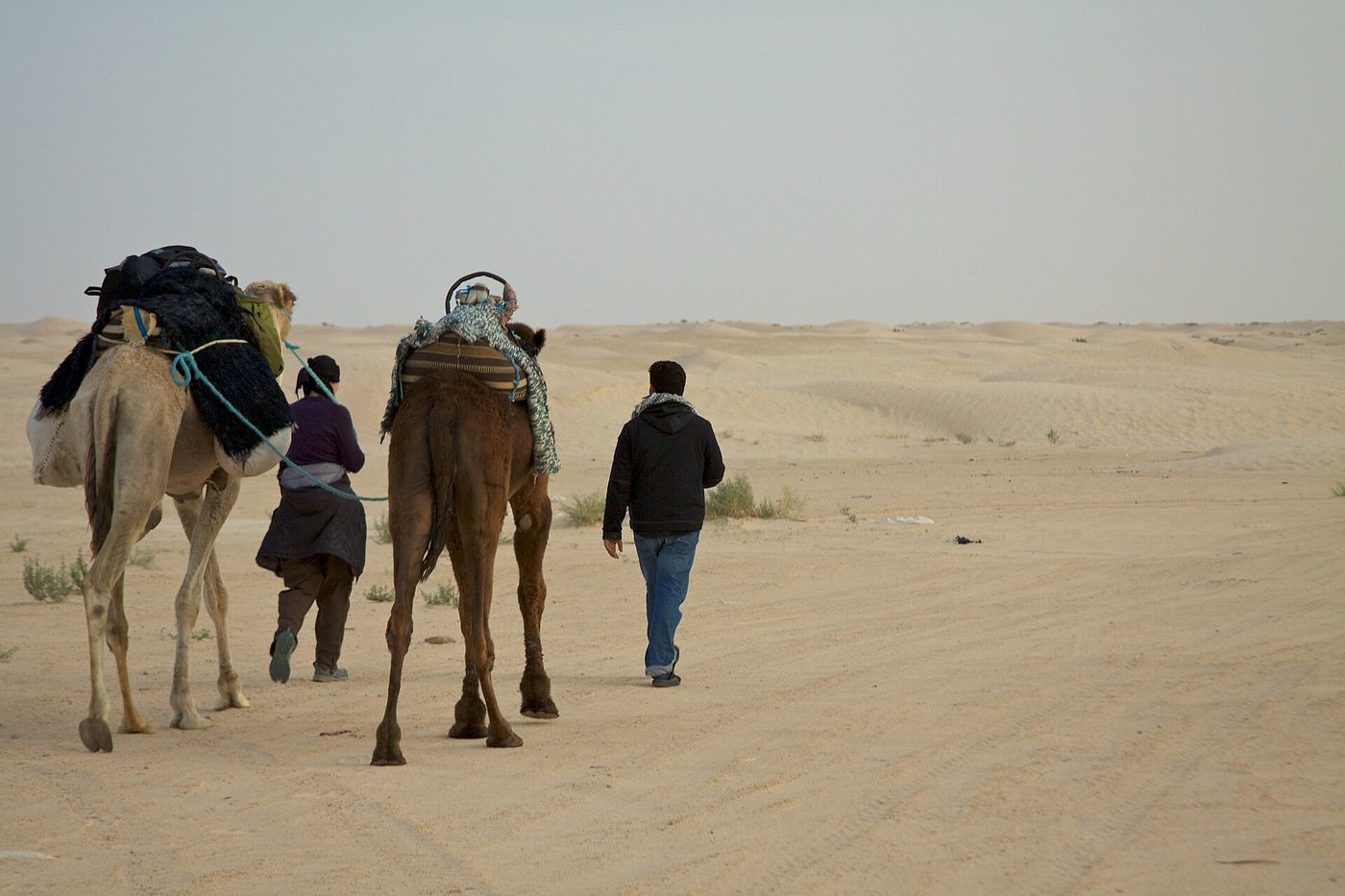
The honest surprise here is how much you walk. Nobody sits on a camel for eight hours; the animals do about 4–5 km/h and the humans get down and walk beside them for long stretches, partly out of kindness to the camel and mostly because the saddle stops being fun after ninety minutes. A day is typically two sessions of two hours or so, with a long lunch stop in whatever shade exists.
What you’re buying on a multi-day trek isn’t scenery — the dunes look much the same on day three as on day one. It’s the absence of everything. No road noise, no aircraft, no lights, no signal, no schedule. Several of us have found that the second night is the one that lands, once the novelty has worn off and you stop reaching for your phone.
Where to start: Douz, Ksar Ghilane, Tozeur or a package from the coast
The departure point matters more than the operator’s brochure suggests, because it decides how much of your day is spent in a minibus.
| Departure point | What the desert is like | Getting there | Best for | Honest downside |
|---|---|---|---|---|
| Douz | Genuine erg dunes starting at the end of a residential street; the deepest routes in the country | About 250–270km from Djerba (roughly 4¼ hours); around 130km from Tozeur | Multi-day treks, serious bivouacs, anyone who wants the real thing | The town itself is dusty and plain; short rides near town are busy at sunset |
| Ksar Ghilane | Big accessible dunes around an oasis with a warm spring of about 32–35°C and a Roman fort 4km away | About 3½ hours by road from Djerba; day trips leave around 06:30 | Comfort-first camping, families, nervous first-timers | Busy in season; the “wilderness” has a car park and a café |
| Tozeur | Oases, canyons, salt lake and film sets rather than deep sand; camel rides in the palm groves and at Ong Jemel | Its own airport with domestic and some seasonal flights; 130km from Douz | Combining desert with the mountain oases and Star Wars sets | The camel bit is scenery, not a trek — the dunes here are thin |
| Packaged from Djerba | Whatever the itinerary reaches — usually Ksar Ghilane or Douz | Long road days; 2-day tours with a camp night are common | People on a Djerba beach holiday with two spare days | Half the trip is a minibus window |
| Packaged from Sousse or Hammamet | Same destinations, much further away | Around 390km Sousse to Douz, roughly 5 hours each way; sold as 2-day or 3-day loops | Anyone who accepts the driving as the price of admission | Brutal schedules, 5am starts, lots of stops you didn’t ask for |
If you are starting from the coast, read our honest breakdowns of the Sahara tour from Djerba and the Sahara tour from Sousse before you book anything at the hotel desk — the two-day versions are far better value than the crushing one-day ones, and our guide to Tunisia excursions explains where the mark-ups sit.
The overnight, hour by hour
Here’s what a standard one-night trip out of Douz actually looks like. Times shift by an hour or two with the season, but the shape holds.
15:30 — meeting the camels
You’ll be driven or walked to a staging area at the edge of the sand. There’s usually a certain amount of standing around while saddles are adjusted and someone hands out a chèche — the long cotton scarf everyone wraps into a turban. Take it, and let them show you how to wind it. It isn’t fancy dress; it keeps sun off your neck and sand out of your mouth, and by hour two you’ll understand why.
16:00 — getting on, which is the alarming bit
The camel is already couched — folded down on its knees. You swing a leg over and hold the front pommel hard, because the camel stands back legs first and pitches you violently forward, then rocks back as the front legs straighten. Nobody warns people about this properly. Lean back on the rise, forward on the descent, and don’t grab the handler.
16:10–18:00 — the ride out
The gait is a slow rolling sway, side to side, like a very small boat. It is oddly hypnotic for about twenty minutes. Then your inner thighs start to complain about being held apart, your lower back gets involved, and you become extremely aware that the wooden saddle frame has corners. Ask to get down and walk — every decent guide expects it and it costs you nothing in face.
18:00–19:00 — arrival, sunset and the temperature drop
You’ll reach camp with enough light to find your tent, and then the sun goes and the temperature falls off a cliff. This is the thing people are least prepared for. The fleece you packed as an afterthought comes out within ten minutes.
19:30–21:30 — dinner and the fire
Dinner is usually a vegetable and meat stew or couscous, cooked over wood, with flatbread baked in the sand under the embers — a genuinely impressive trick, and better bread than most of what you’ll eat in a resort. Then mint tea, some drumming, and a certain amount of good-natured performance. It’s touristy and it’s also fun; the guides are largely from the Mrazig families who were semi-nomadic within living memory, and if you ask real questions you’ll get real answers.
21:30 onwards — the stars, which are the point
Walk five minutes from the fire, let your eyes adjust for a full ten minutes, and lie down. There is essentially no light pollution in the erg. On a moonless night the Milky Way is a solid band and you can see satellites crossing. Check the moon phase before you book: a full moon is beautiful but washes the stars out completely.
05:30–07:00 — dawn, and the ride back
Get up for sunrise even though you’ll have slept badly. It’s colder than the night felt, the light on the dune faces is better than at sunset, and the camp is quiet. Breakfast is bread, jam, olive oil, dates and coffee. Then either the camels again or, on many trips, a 4×4 back, which your legs will thank you for.
The saddle: how uncomfortable is it, honestly?
More than you expect, less than you fear, and in a place you didn’t anticipate.
Tunisian riding saddles sit forward on the hump with a tall wooden pommel, and your legs are pushed wider apart than on a horse. The pain isn’t in your backside — it’s the adductors, the muscles on the inside of the thigh, plus a general grumble in the lower back from constantly correcting the sway. Two hours is fine for most people. Four hours on day one, without a break, will leave you walking oddly for a day or two.
Practical things that genuinely help:
- Long trousers, no seams on the inner thigh. Leggings under loose trousers work well. Shorts are a mistake; so are jeans with a chunky inside seam.
- Get off and walk every forty minutes or so on a long day. The sand is easy going and you’ll feel better for it.
- Take the offered blanket or cushion. Most operators have folded blankets over the saddle. If yours doesn’t, ask.
- Don’t grip with your knees. Let your legs hang and move with the sway rather than bracing against it.
- Sit tall. Slumping puts the whole thing through your lumbar spine.
If you have an existing back or hip problem, be honest with yourself. A one-hour ride is usually manageable; a two-day trek is not the place to find out. Nobody will think less of you for doing the camp by 4×4 and the camel for an hour.
The cold at night — the single most underestimated thing
We keep coming back to this because people keep getting it wrong. The Sahara is a desert, and deserts lose heat spectacularly fast once the sun goes: dry air holds almost nothing, and there’s no cloud to keep it in.
The climate averages for Douz give October daytime highs around 29°C with overnight lows near 17°C, and January highs around 17°C with lows around 4°C. Those are town figures. Out on open sand, with a breeze, in a tent with no heating, it feels considerably colder than the number suggests — and the drop happens within an hour of sunset, while you’re still in the T-shirt you wore all afternoon.
What that means in practice: even in October, when the coast is still beach weather, you want a fleece, a hat and something over your legs after dark. In December and January you want a proper jacket, thermals and a hat you’d wear on a British winter walk. Camps supply thick blankets and they are heavy for a reason. The March shoulder is similar: warm afternoons, genuinely cold nights, and windier than the autumn.
Our best time to visit guide has the month-by-month picture. The short version: October, November, March and April are the sweet spot for a desert night. July and August are dangerous rather than merely unpleasant, and the reputable operators mostly stop running treks.
The camps: from swimming pools to a blanket on the sand
Three broad tiers, and the photographs on booking sites do not reliably tell you which one you’re getting.
Permanent tented camps (Ksar Ghilane and the Douz fringe)
At Ksar Ghilane in particular, several fixed camps sit around the oasis with air-conditioned Berber-style tents, en suite bathrooms, restaurants and — at the larger ones — a swimming pool, plus the natural warm spring at around 32–35°C that everyone ends up sitting in. These are hotels with canvas walls. They’re comfortable, sociable, and if your travelling companion is unconvinced by the whole idea, this is the version that wins the argument. Day trips from Djerba start from around €80 / 270 TND, with two-day versions including a camp night from roughly €128 / 430 TND (2026 — check current pricing).
The trade-off is honest: you are camping next to a car park. Generators hum, there are other groups, and the desert starts about two hundred metres away.
Fixed bivouac sites in the erg
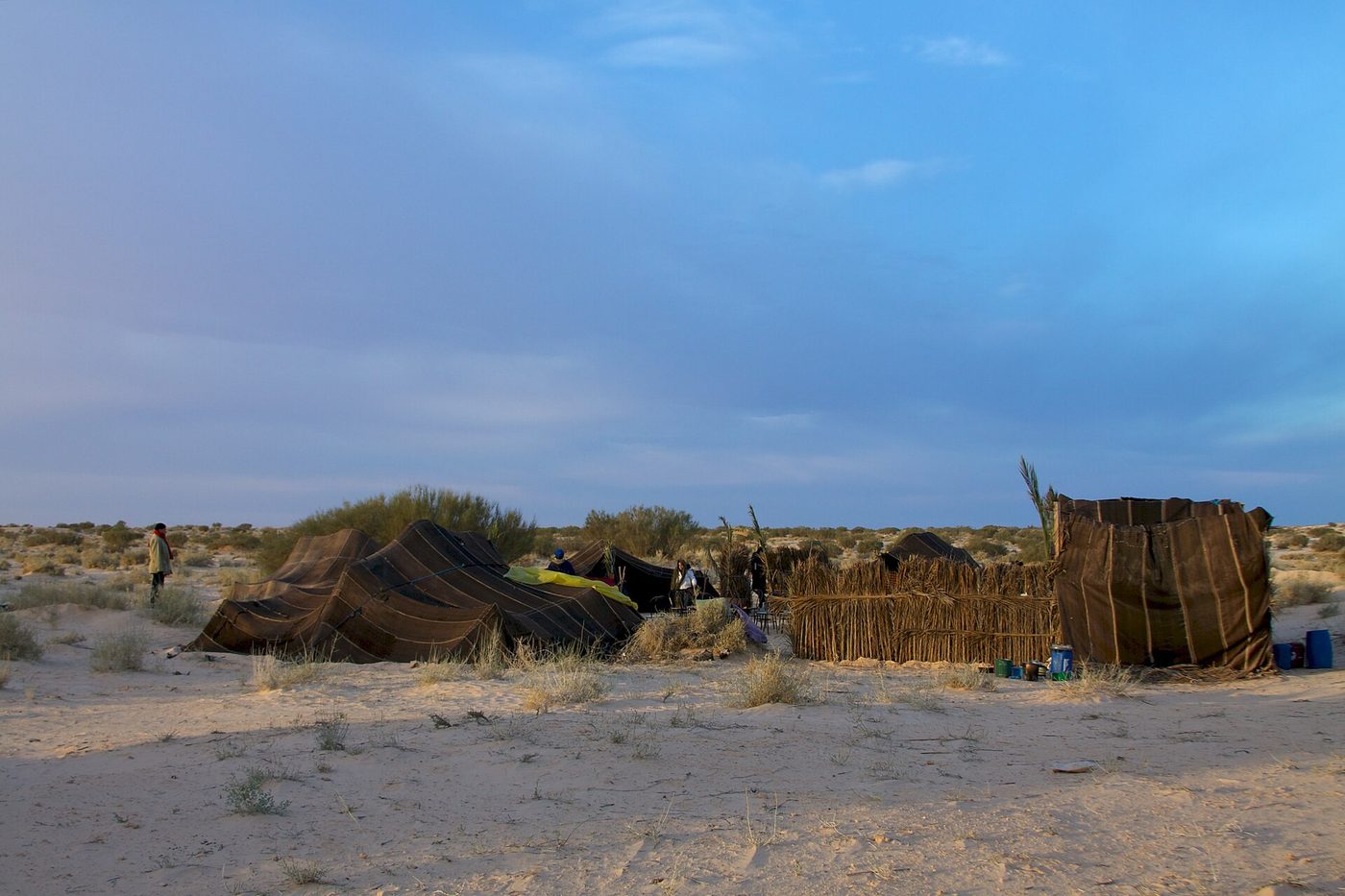
The middle option, and where most one-night camel trips out of Douz end up. A cluster of goat-hair tents or reed windbreaks at a spot the operator uses all season, an hour or two into the sand. No electricity beyond a solar lamp or two, a chemical loo or a screened pit, water carried in. Mattresses on rugs, thick blankets, dinner on a fire. This is our preference for a first desert night: it feels like the desert, and it isn’t actually hard.
Wild bivouacs
No structures at all. The guides unroll mattresses in the lee of a dune, cook on a fire, and you sleep either in a low tent or under the open sky. There is no bathroom — there is a spade. From Djerba these are sold at around €193 / 650 TND for a two-day trip (2026 — hedge that figure hard, it moves with group size).
It’s the purest version and it is not for everyone. Wind is the variable: a still night is magical, and a blowy one means sand in your hair, your ears and your dinner.
Whichever tier you’re booking, ask these four questions before you pay, because the price does not reliably tell you the answer:
- Is the tent private, or shared with strangers?
- Is there a bathroom, and is it en suite, a shared block, or a spade?
- Is there any electricity for charging a phone or a CPAP machine?
- How far from the road or car park is the camp, actually?
Food, water and the loo question
Food on treks is better than it has any right to be. The standard is a vegetable stew or couscous with lamb or chicken, salad, bread baked in the embers, dates, oranges and endless sweet mint tea. Vegetarians are catered for easily if you say so at booking; vegans should be specific, because “no meat” often still means eggs and butter. Coeliacs will struggle — bread is the backbone of every meal out there.
Water is carried for you, but carry your own bottle too and drink more than you think you need. The air is so dry that you sweat without noticing it; the classic desert mistake is arriving at camp with a headache and blaming the sun when it’s simple dehydration. Rehydration sachets weigh nothing. Our Tunisia travel tips cover the water and stomach-bug side of a Tunisian trip generally.
On loos: at the fixed camps there’s plumbing. At a bivouac, there’s a screened chemical toilet if you’re lucky and a walk over the dune with a spade and a lighter if you’re not. Bring your own loo roll, a small bag for waste, and hand gel. Burying paper is not good enough in sand that moves — take it out with you. This is the point at which some people quietly decide on the tented camp, and that’s a perfectly sensible decision.
Phone signal, power and what happens if something goes wrong
At the fixed camps around Ksar Ghilane and on the near fringe of Douz, you’ll often get a bar or two of 3G or 4G — enough for a message, not for streaming. An hour into the erg it disappears entirely and does not come back until you do.
Assume no charging. Bring a power bank, and remember that cold nights flatten phone batteries fast — sleep with the phone inside your sleeping bag or blanket if you want it working at dawn for photographs.
Reputable operators on multi-day treks carry a satellite phone or a VHF radio and file a route. Ask. On a one-night trip within a couple of hours of a road, a 4×4 can reach you; deeper in, it can’t, quickly. Give your hotel or a family member the operator’s name and phone number and a rough return time. This is basic, and almost nobody does it.
Rain, wind and sandstorms
It does rain in the Tunisian south — rarely, briefly and hard. When it does, the sand takes it instantly, but the oueds (dry watercourses) between the dunes and along the desert pistes can run within minutes and cut tracks. Most operators simply won’t set out, and if you’re already in camp you’ll sit it out under canvas. Trips are more often postponed than cancelled outright, so ask at booking what the refund policy is if the weather turns.
Wind is the more common problem. A stiff blow lifts a haze of sand to head height, which is unpleasant rather than dangerous: eyes, teeth, camera lenses. This is what the chèche is for — wrap it across your nose and mouth. Anything with a lens or a sensor should live in a zip bag when it isn’t being used, and changing a camera lens outdoors in the erg is a good way to ruin a camera.
A genuine sandstorm — a wall of dust that drops visibility to a few metres — is uncommon but does happen, most often in spring. In that case the guides stop, sit the camels down, and wait. Follow their lead entirely and don’t wander off; people have become disoriented within fifty metres of a camp.
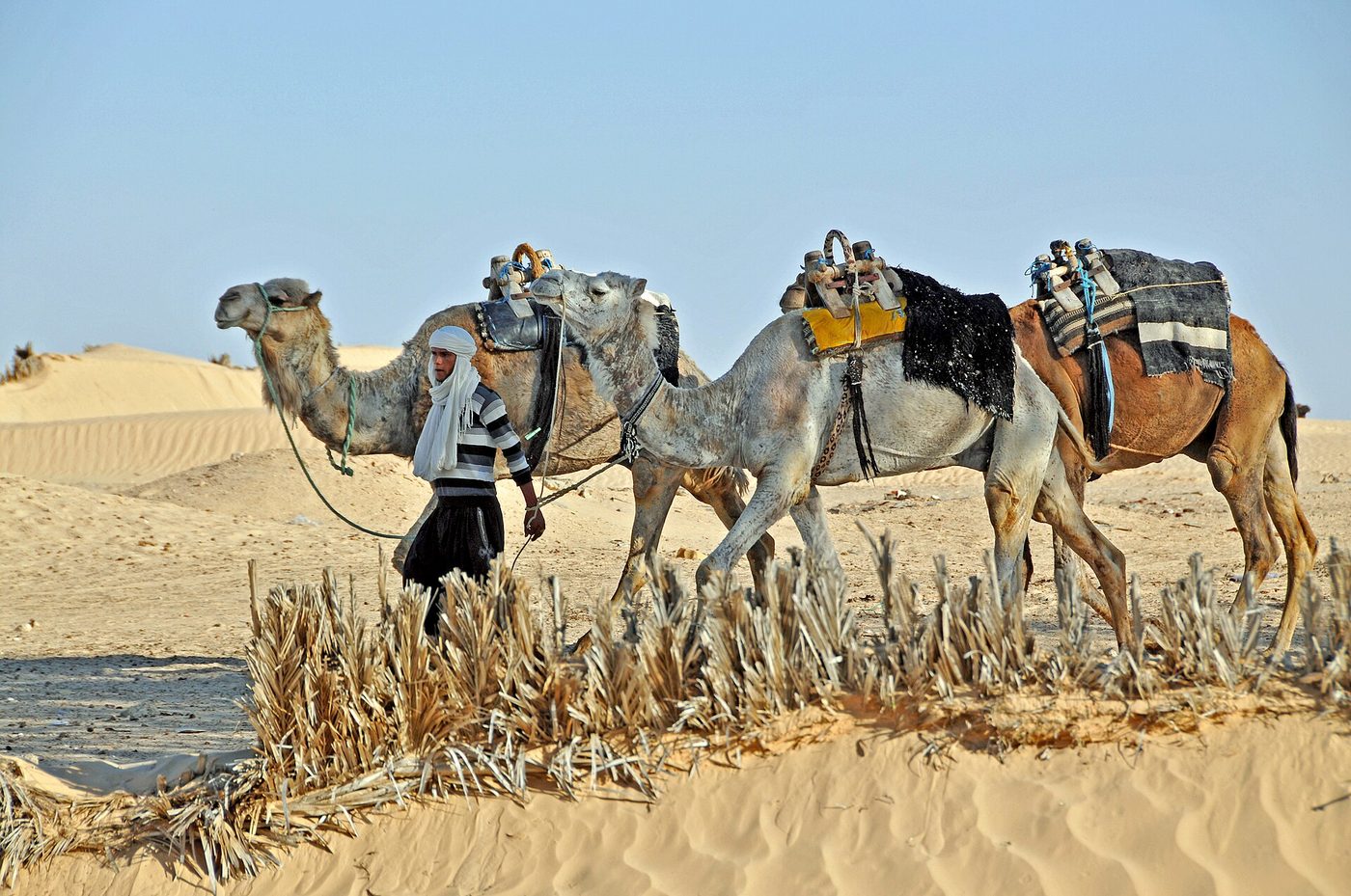
Animal welfare: how to judge the camel in front of you
This is the part of the trip most people feel uneasy about and few know how to assess. We’re not going to tell you that riding camels is fine, or that it’s cruel. Working dromedaries have been part of Saharan life for centuries and a well-kept trekking camel has a considerably better existence than a neglected one tied up outside a hotel — but standards in Tunisia vary enormously between operators, and the difference is visible in about ninety seconds if you know what you’re looking at.
Here’s what we check before we get on.
Body condition
Look at the hump first. A healthy, well-fed camel has a firm, upright hump; the hump is a fat store, so a small, floppy hump that lolls to one side means the animal has been living off it. Then look at the ribs, hips and shoulders — you shouldn’t be able to count ribs from ten paces. Eyes should be clear and open, not weeping or crusted. A relaxed camel chews its cud, exactly like a cow. A camel standing rigid with its head high and eyes wide is stressed.
The saddle area and any sores
This is the one nobody thinks to look at, and it’s the most telling. Ask to look under the saddle blanket, or watch while they’re being tacked up in the morning. You are looking for: bare patches where hair has been rubbed off, thickened grey callus, weeping sores, or fresh scabs on the hump, the girth line and behind the front legs. Saddle sores are the classic welfare failure on overworked trekking camels, and a padded, well-fitted saddle over a clean folded blanket is a good sign about everything else the operator does.
Also check the feet. A camel’s foot is a soft pad, not a hoof; cracks, limping or an animal shifting its weight repeatedly are red flags, and lameness is common where camels are worked on stony ground rather than sand.
Nose pegs, headropes and muzzles
Some Tunisian handlers lead camels by a rope attached to a peg through the nasal septum. It’s a traditional method across North Africa and the Middle East, and it works by pain: a tug on the peg hurts, so the animal complies. Animal-welfare bodies including the RSPCA hold that nose pegs are not justified given that humane alternatives — a headcollar or halter — exist.
You will not change this on the spot, and refusing a ride from a peg-using handler in Douz will simply mean the next tourist takes it. But it is a fair thing to ask about when you book, and it’s a meaningful differentiator: operators who use halters rather than pegs have generally thought about the rest too. If a peg is in use, look at it. Fresh blood, torn skin, or a rope being yanked hard is a walk-away.
Muzzles are more ambiguous. A camel may be muzzled during a ride to stop it grazing or biting, and a loose basket-style muzzle isn’t cruel in itself. A tight strap holding the mouth shut for hours in the heat is a different matter, because a camel can’t pant properly with its mouth bound.
How the handler behaves
Watch for thirty seconds before you commit. Are the camels being spoken to, or hit? Is there a stick, and is it used to touch and direct or to strike? Are the animals allowed to graze and drink between groups, or tied in the sun all afternoon in a row for photographs? Are the same camels going out again and again with no rest, and is anyone paying attention to how heavy the riders are?
Good operators do a handful of visible things: they work camels in rotation rather than continuously, they stop the ride to adjust a slipping saddle, they let the animals drink, and they have a weight limit and will actually apply it. If a handler tells you a camel is too tired or too small for you, that is a good sign about the operation, not an insult.
What a good operator looks like
- Owns its own camels rather than hiring whichever animals are cheapest that morning — ask directly.
- Uses halters rather than nose pegs, and can tell you so without getting defensive.
- Has a stated weight limit (usually somewhere around 90–100kg) and applies it.
- Builds walking into the itinerary rather than keeping everyone mounted all day.
- Doesn’t work camels through the hottest months or the hottest hours.
- Employs local guides from the desert communities and pays them properly.
- Will answer welfare questions in detail rather than with a shrug and a laugh.
When to walk away
Open sores under the saddle, visible ribs and a collapsed hump, a camel bleeding at the nose, obvious lameness, animals tied with no shade or water, or a handler hitting an animal to make it stand. You have lost nothing but a deposit, and the fifteen seconds it takes to say “no thank you, not this one” is the only leverage a visitor genuinely has. Say why, politely, and book with someone else.
And a straightforward alternative worth saying out loud: you do not have to ride at all. Walking into the dunes with a guide, camping, and letting the baggage camels carry the kit gives you the same night, the same stars and none of the welfare worry. Ask for a walking trek — several Douz operators run them and almost nobody requests them.
What to pack for a desert night
Assume nothing is provided beyond blankets, water and food. This list is the result of several cold, sandy nights.
- A proper warm layer. Fleece or down jacket, even in October. In winter, add thermals and a woolly hat — most body heat goes out of your head while you sleep.
- Long, loose trousers with no thick inner seam, plus something to sleep in that you haven’t ridden in.
- Closed shoes, not sandals. Trainers or light boots. Sand gets everywhere anyway, but there are thorns, and the sand is scorching at midday and freezing at dawn.
- A chèche or large scarf — usually provided, but bring your own if you’re fussy about hygiene.
- Sunglasses, high-factor suncream and lip balm. The reflection off pale sand burns the underside of your nose and chin.
- A head torch, hands-free. Camps are dark and uneven.
- Power bank, and a zip bag for every electronic item.
- Wet wipes, hand gel and your own loo roll. There is no washing at a bivouac.
- Any medication in your day bag, not the main luggage, plus rehydration sachets and paracetamol.
- A small amount of cash in dinars for tips. Guides and camel handlers are not well paid and a tip is normal and appreciated.
- Earplugs. Camels are loud at night, drumming goes on late, and canvas flaps.
Leave behind: hard suitcases, anything white, a hairdryer, and unrealistic ideas about hair. One small rucksack per person is plenty — the rest stays at your hotel.
Insurance, health and safety — the bit people skip
Two things to get right before you book, and both cost you almost nothing to sort out.
Insurance that actually covers what you’re doing
Standard travel policies frequently exclude animal riding, and almost all of them treat quad biking and off-road 4×4 excursions as hazardous activities requiring an add-on. Read your policy wording and look for camel or animal riding by name; if it isn’t there, ring the insurer and get it added in writing. Also check that remote-area search, rescue and repatriation are covered, because a medical evacuation from the erg is not a taxi ride.
Your UK GHIC is not valid in Tunisia — there’s no reciprocal healthcare agreement — so comprehensive medical cover with repatriation isn’t optional. Private clinics in the south will expect payment up front. Check the NHS TravelHealthPro Tunisia page for vaccination and food-and-water advice before you travel, and note that healthcare in the deep south is thin on the ground.
Quad bikes, if you’re adding one
Most camps and oases sell quad-bike hire alongside camel rides, and it’s the activity most likely to end a holiday badly. The FCDO’s wording is worth reading exactly as written: “Quad bikes are popular in desert resorts. Take the same precautions as you would in the UK. Safety standards can vary considerably. Always wear a crash helmet.” If the operator’s safety briefing is a shrug and there is no helmet, walk away. Ride with a guide rather than alone — orientation in an erg is genuinely difficult and the sand is far softer than it looks.
The FCDO position on the desert routes
The reassuring bit: Douz, Ksar Ghilane, Tozeur and the standard Grand Erg circuits sit outside every FCDO advisory zone. FCDO advice, last updated 24 July 2026 and still current when we checked on 4 September 2026 — always check gov.uk/foreign-travel-advice/tunisia before you book. The restricted areas are the far western border zones and a belt along the Libyan frontier, none of which any legitimate camel trek goes near. Our full, date-stamped write-up is in is Tunisia safe.
One money note while we’re here: the Tunisian dinar is a closed currency. You can’t buy it in the UK and you can’t legally take it home, so change money on arrival, keep the receipts, and carry cash into the desert — there are no ATMs out there and card payment is a fantasy.
How it fits into a wider trip
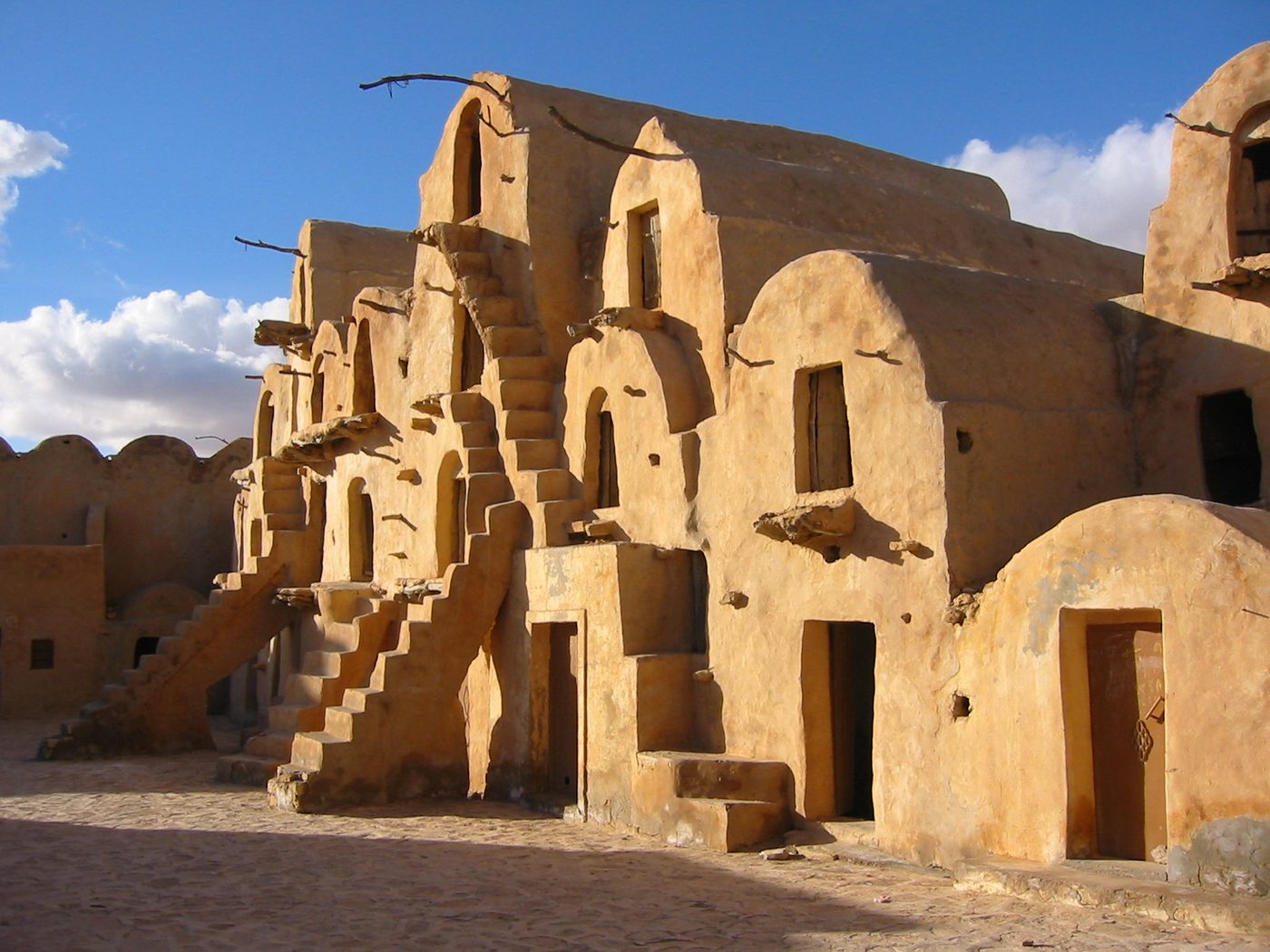
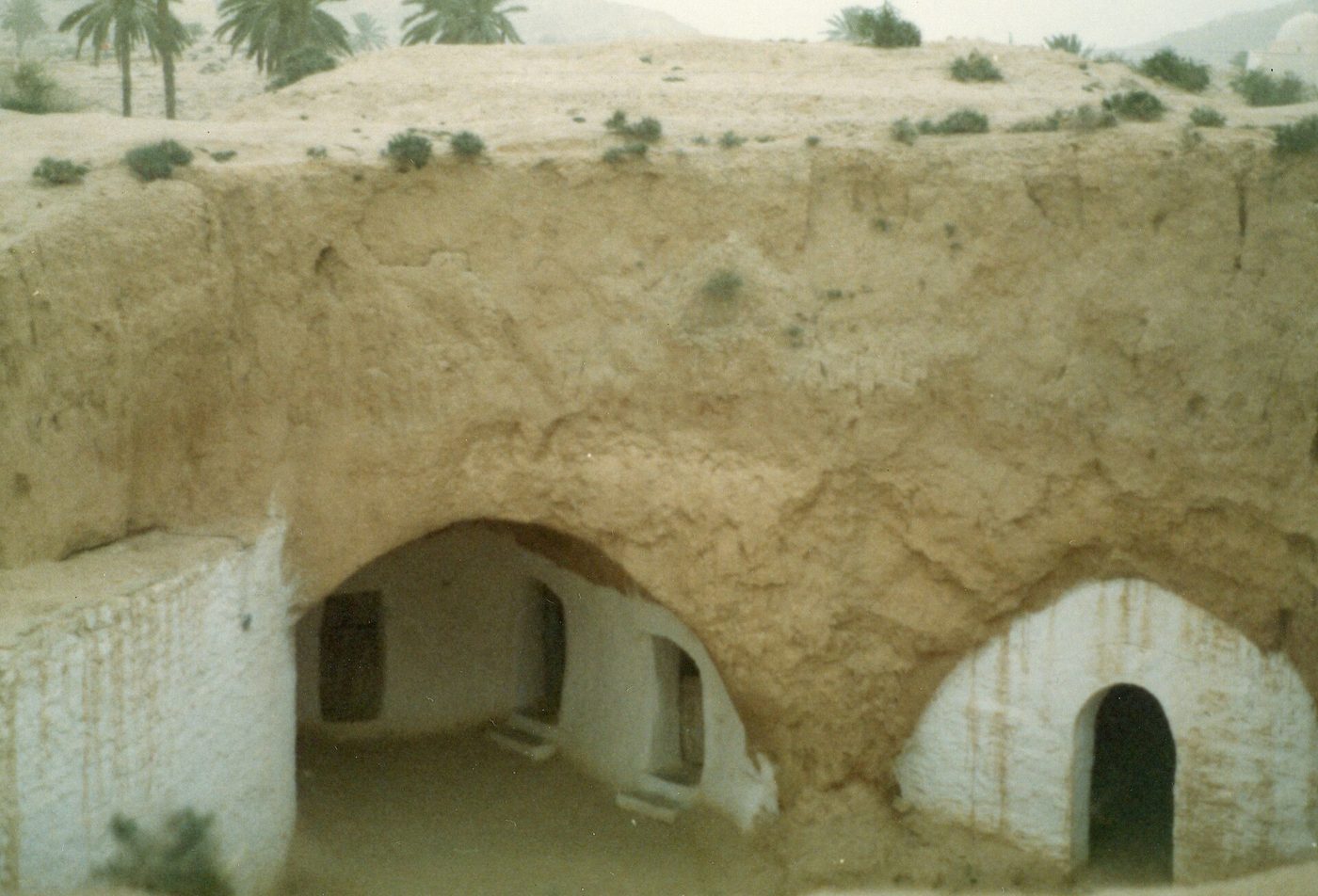
A desert night is the best thing most visitors do in Tunisia, and it slots neatly into a southern loop. The natural pairings are the troglodyte houses at Matmata, the hilltop ksour around Tataouine, the white glare of Chott el Jerid on the way to Tozeur, and the surviving film locations covered in our Star Wars Tunisia guide.
Three days gets you a camp night and two of those. Our Tunisia itinerary pages sketch out how to string them together without spending your whole holiday in a minibus, and the wider list of things to do in Tunisia puts the desert in context against the coast and the Roman sites.
Frequently asked questions
Is camel trekking in Tunisia cruel?
It depends entirely on the operator. Camels are working animals across the Sahara and a well-kept trekking camel is fit, fed and rested. Poorly run outfits produce saddle sores, lameness and exhausted animals worked all day for photographs. Check the hump, the ribs, under the saddle and the feet, ask about nose pegs and weight limits, and be prepared to walk away — or book a walking trek with baggage camels instead.
How long is a typical camel ride in Douz?
The standard sunset ride from the edge of Douz is 45–60 minutes, which is long enough for most people. Half-day options run three to four hours. Genuine treks last two to four days with two to four hours in the saddle daily, split into morning and afternoon sessions, and a lot of walking beside the animals in between.
How cold does it get in the Sahara at night?
Colder than almost anyone expects. Douz averages overnight lows around 17°C in October and around 4°C in January, and the open desert feels colder still because there’s no cloud to hold heat and often a breeze. The drop starts within an hour of sunset. Pack a fleece even in autumn, and thermals plus a hat between December and February.
Is there a toilet at a desert camp?
At the permanent tented camps around Ksar Ghilane, yes — en suite bathrooms with running water. At a fixed bivouac you’ll usually find a screened chemical toilet. At a wild bivouac there is a spade and a dune, and nothing else. Bring your own loo roll, a bag to carry paper out, and hand gel regardless of which you book.
Will I have phone signal in the Tunisian desert?
Sometimes at the fixed camps, where a bar or two of mobile data is common. An hour into the erg, no. Assume no signal and no charging: bring a power bank, tell someone at your hotel where you’re going and when you’ll be back, and ask multi-day operators whether they carry a satellite phone or radio.
How much should a night in the Sahara cost?
Prices move constantly, so treat these as orientation rather than quotes. A short sunset ride from Douz runs around 30–60 TND. Multi-day treks are typically 120–200 TND per person per day including food and camp. Two-day packages from Djerba including a camp night start somewhere around €128 / 430 TND, with wild bivouac versions higher. Always confirm current prices directly.
Can children do a camel trek?
Short rides, yes — most children love them, and a one-hour sunset ride from Douz or Ksar Ghilane works well from about six or seven upwards. A multi-day trek is a different proposition: the cold, the loos and the sheer boredom of a long day defeat most under-tens. A fixed camp with a pool and a warm spring is the family-friendly compromise. Our guide to Tunisia with kids has more.
What happens if it rains or a sandstorm blows in?
Rain in the south is rare, brief and heavy; the sand absorbs it fast but desert tracks can flood, so operators usually postpone rather than set out. Wind is the commoner nuisance — a sand haze at head height, uncomfortable but not dangerous, which is what the scarf is for. In a serious dust storm the guides stop and wait it out. Follow them exactly and never wander from the group.
Do I need to be fit to do a camel trek?
Not especially fit, but reasonably mobile. You need to be able to get on and off a couched camel, tolerate an hour or two of sway, and walk on soft sand. The people who struggle are those with existing back, hip or knee problems, and anyone who can’t get up off the floor easily — camp life happens at ground level. Late pregnancy is a no.
Is one night in the desert enough?
For most holidaymakers, yes. One night gets you the sunset, the fire, the stars and the sunrise, which is 90% of the experience. The case for a second or third night is different: it’s about the silence settling in once the novelty has passed. If you have the days and you’re comfortable with basic conditions, two nights is noticeably better than one.
Which is better for a desert night, Douz or Ksar Ghilane?
Douz for authenticity and depth — the erg starts at the edge of town and the multi-day routes are the real thing. Ksar Ghilane for comfort — big accessible dunes, a warm spring at around 32–35°C, tented camps with plumbing and a Roman fort nearby. If you want the desert to feel wild, choose Douz. If someone in your party needs convincing, choose Ksar Ghilane.
Can I do a Sahara camp trip from a beach resort?
Yes, and thousands of people do — but mind the distances. Djerba to Ksar Ghilane is around 3½ hours each way; Sousse to Douz is roughly 390km and about five hours. One-day versions from the northern resorts are punishing and we’d avoid them. A two- or three-day trip with a camp night is far better value for the same driving.
The bottom line
Go, but book the right version. If you have one afternoon, take the hour-long ride at sunset from Douz and enjoy it for what it is. If you have a spare night, spend it in the sand — that’s where the trip becomes a memory rather than a photograph. And if you have three days and a tolerance for discomfort, the multi-day trek out of Douz is the best thing in southern Tunisia.
Whatever you choose, spend two minutes looking at the animal before you get on it. Check the hump, look under the saddle, ask about the nose peg and the weight limit. Operators respond to what customers notice, and it is the one bit of influence a visitor genuinely has.
Written by the Tunisia Tourism Guide team — an independent UK-focused guide to travelling in Tunisia. We don’t sell tours or take hotel commissions. Prices and advice were checked at publication; always confirm current details before you book.
Photo credits
All images via Wikimedia Commons, used with thanks: Loaded baggage camels and walkers on a camel trek in © McKay Savage from London, UK (CC BY 2.0); Simple desert bivouac with a goat-hair tent and reed windbreak © McKay Savage from London, UK (CC BY 2.0); Handler leading a string of loaded trekking camels across the © Dennis G. Jarvis (CC BY-SA 2.0); Rippled sand dune of the Grand Erg Oriental at Ksar © Jérôme Prax jeromeprax (CC0).