By the Tunisia Tourism Guide team · Last updated 4 September 2026 · We don’t sell tours or take hotel commissions — this is independent advice, written to be useful.
The coach parks on the edge of the old walls, the guide says “ninety minutes, please”, and roughly forty of those minutes vanish inside a carpet showroom with a glass of mint tea in your hand. That is how most British visitors meet Kairouan, and it’s a waste of one of the most important cities in the Islamic world.
Kairouan, Tunisia’s holy city, lies inland from Sousse and was founded in 670 AD. Its Great Mosque of Uqba is the oldest major mosque in the Maghreb; non-Muslims are generally allowed into the courtyard but not the prayer hall. Allow half a day, cover shoulders and knees, and avoid Friday midday.
Kairouan isn’t a Roman town, but it is built out of one — its columns were quarried from the ruins of Roman Africa — which is why it slots naturally into any trip built around the Roman ruins in Tunisia. The Kairouan Tunisia sells to coach parties is a shopping stop with a mosque attached; the real one deserves a day. This guide is what the ninety-minute stop leaves out: what to see, what it costs, the real access rules for the Great Mosque, how the carpet pitch works, and how to get here under your own steam.
Kairouan at a glance
| Question | Short answer |
|---|---|
| Where is it? | Central Tunisia, inland from Sousse, about 155–160km south of Tunis |
| Why go? | The Great Mosque of Uqba, a walled UNESCO medina, the Aghlabid basins and the country’s carpet trade |
| Time needed | Half a day for the highlights; a full day to do it properly; one night for the medina at dawn |
| Typical cost | 20 TND a head for non-residents in 2026, rising to 30 TND on 1 January 2027; personal photography is included |
| Best time of day | Early morning, before the coaches; late afternoon once they’ve gone |
| Worst time | Friday around midday prayers, when the Great Mosque closes to visitors |
| What to skip | Bir Barouta, if the working camel bothers you — and it bothers a lot of people |
| Dress code | Shoulders and knees covered for everyone; women are usually asked to cover their hair at the mosque |
Why Kairouan matters
Founded in 670, and the first of its kind
The Arab general Uqba ibn Nafi established a garrison here in 670 AD, on a plain at almost equal distance from the sea and the mountains — deliberately inland, out of reach of Byzantine ships. It became an early Arab-Muslim base in the Maghreb and a major political and religious centre, for long periods the capital of Ifriqiya, the province covering roughly modern Tunisia and its neighbours. Under the Aghlabid dynasty in the ninth century it was a city of scholars, jurists and hydraulic engineers.
Then it lost. The political capital shifted to Tunis, the Banu Hilal tribes wrecked the city in 1057, and Kairouan settled into the long, quiet second act it has been living ever since. Today it’s a working provincial city of about 187,000 people (2014 census) that happens to contain a seventh-century mosque.
The “fourth holiest city” line — handle with care
You will hear, from guides and brochures and probably from the man selling you a carpet, that Kairouan is the fourth holiest city in Islam and that seven pilgrimages here equal one to Mecca. Both are folk tradition rather than doctrine. Even UNESCO’s own citation puts it in the past tense — that in the past, seven pilgrimages to Kairouan could take the place of the one prescribed pilgrimage to Mecca — and Muslim readers regularly, and politely, point out that mainstream teaching gives special standing to three mosques only: Mecca, Medina and Jerusalem.
Kairouan’s importance is historical and spiritual rather than doctrinal: it is where Islam in the Maghreb began, and where one of the Prophet’s companions is buried. That’s a better story anyway. Say “one of the most important cities in Islamic history” and you’re on solid ground.
What UNESCO actually inscribed
Kairouan joined the World Heritage List in 1988, with a minor boundary change in 2010. It’s a serial property rather than a single monument: the medina and its suburbs, the Aghlabid basins and the Zaouia of Sidi Sahbi are all listed together. The medina alone covers around 54 hectares, ringed by more than three kilometres of walls. Our guide to Tunisia’s UNESCO World Heritage Sites puts it in context alongside the rest.
The Great Mosque of Uqba, in detail
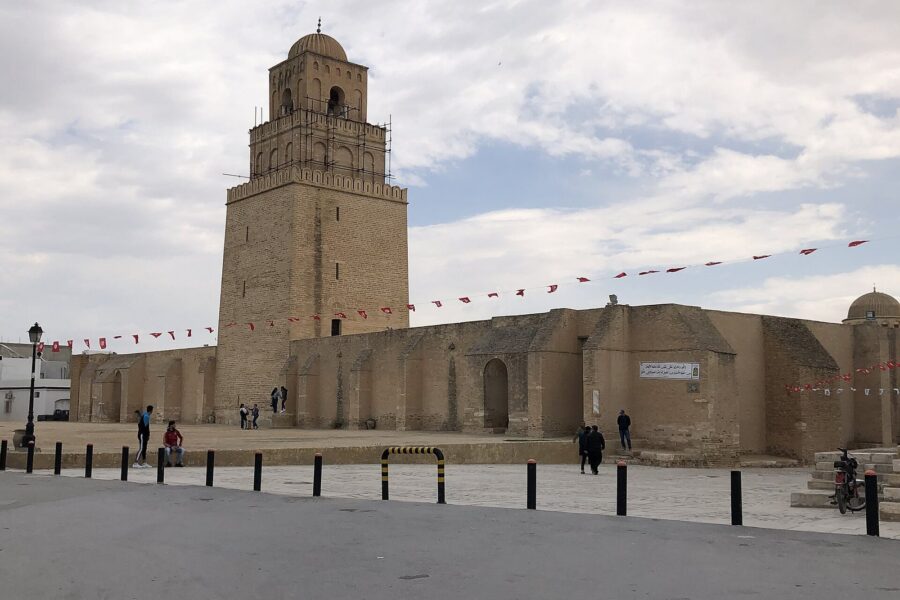
This is why you came. Founded in 670, comprehensively rebuilt in the ninth century under the Aghlabids, and largely unchanged in plan since. It is a fortress from the outside — buttressed, windowless, the colour of the ground it stands on — and it gives nothing away until you walk through the gate.
The courtyard, and the clever bit under your feet
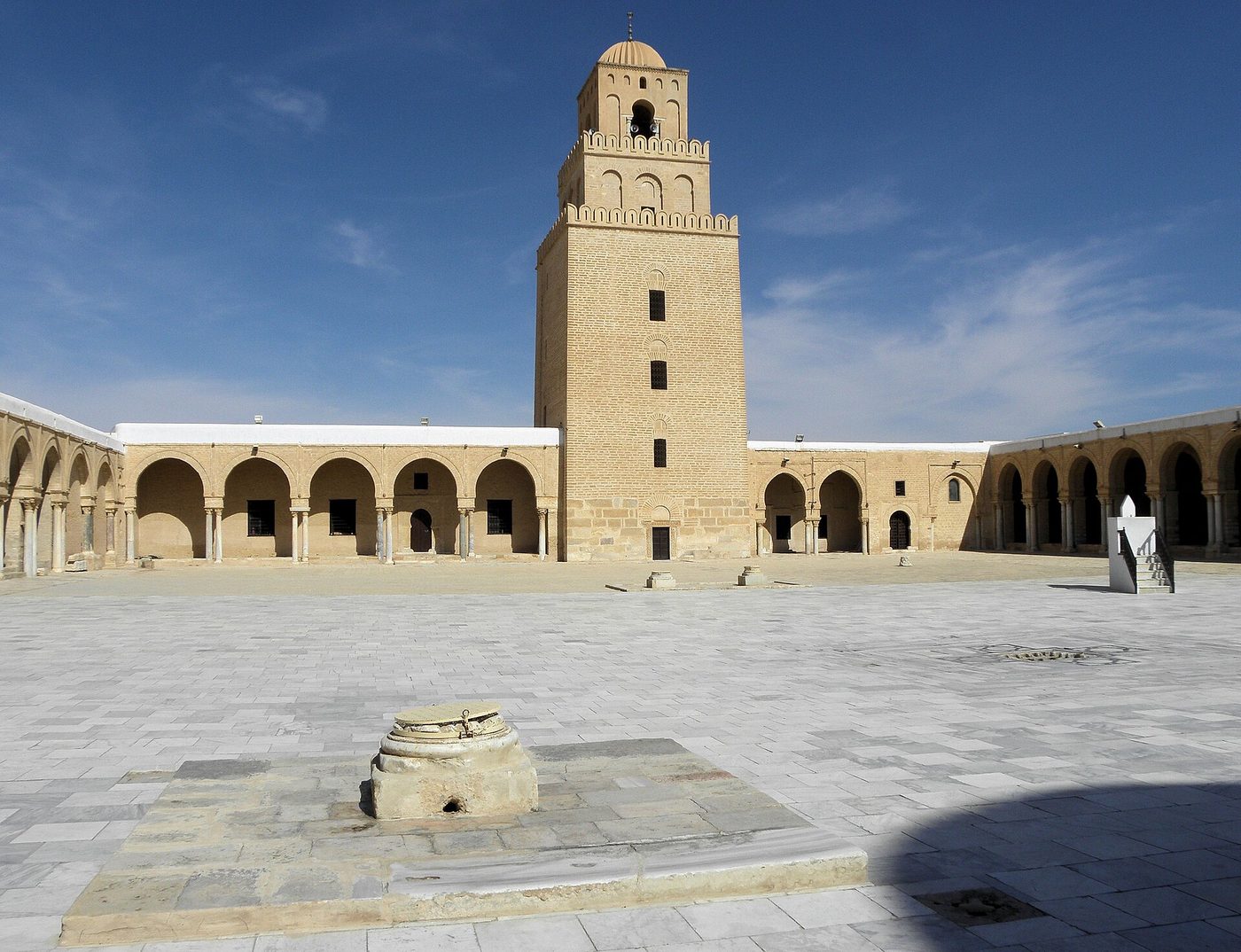
The courtyard is enormous: the mosque forms a quadrilateral of roughly 135m by 80m, and the open court takes up most of the northern half. Walk into the middle of it on a hot afternoon and the scale lands properly.
Then look down. The paving isn’t flat — it slopes very gently towards a marble collector at the lowest point, so rain falling on the courtyard is funnelled inwards. The stone is cut with horseshoe curves that slow the water and drop the sand out of it before it reaches the vaulted cistern beneath the courtyard. In a city with no river and no reliable spring, that isn’t decoration; it’s the water supply. The wellheads dotted around are reused Roman column bases, several worn into deep grooves by centuries of rope. Look for the sundials too — there’s a horizontal one with four gnomons on a raised platform, inscribed with a nineteenth-century date, used to fix the prayer times. Most groups walk straight past it.
The minaret
The squat, square, three-tiered tower on the north side is usually described as the oldest standing minaret in the Islamic world, its lower stage dated to around 836 AD. We’d hedge that slightly — “oldest” claims in architectural history are always contested at the margins — but it is widely accepted, and the influence is not in doubt. Every square minaret you’ve seen in Morocco, Algeria or Andalusia descends from this one. It’s built partly of stone robbed from Roman buildings, and at the base you can spot recycled masonry with Latin lettering still on it. You cannot normally climb it, so don’t pay anyone who says otherwise.
The prayer hall and its forest of columns
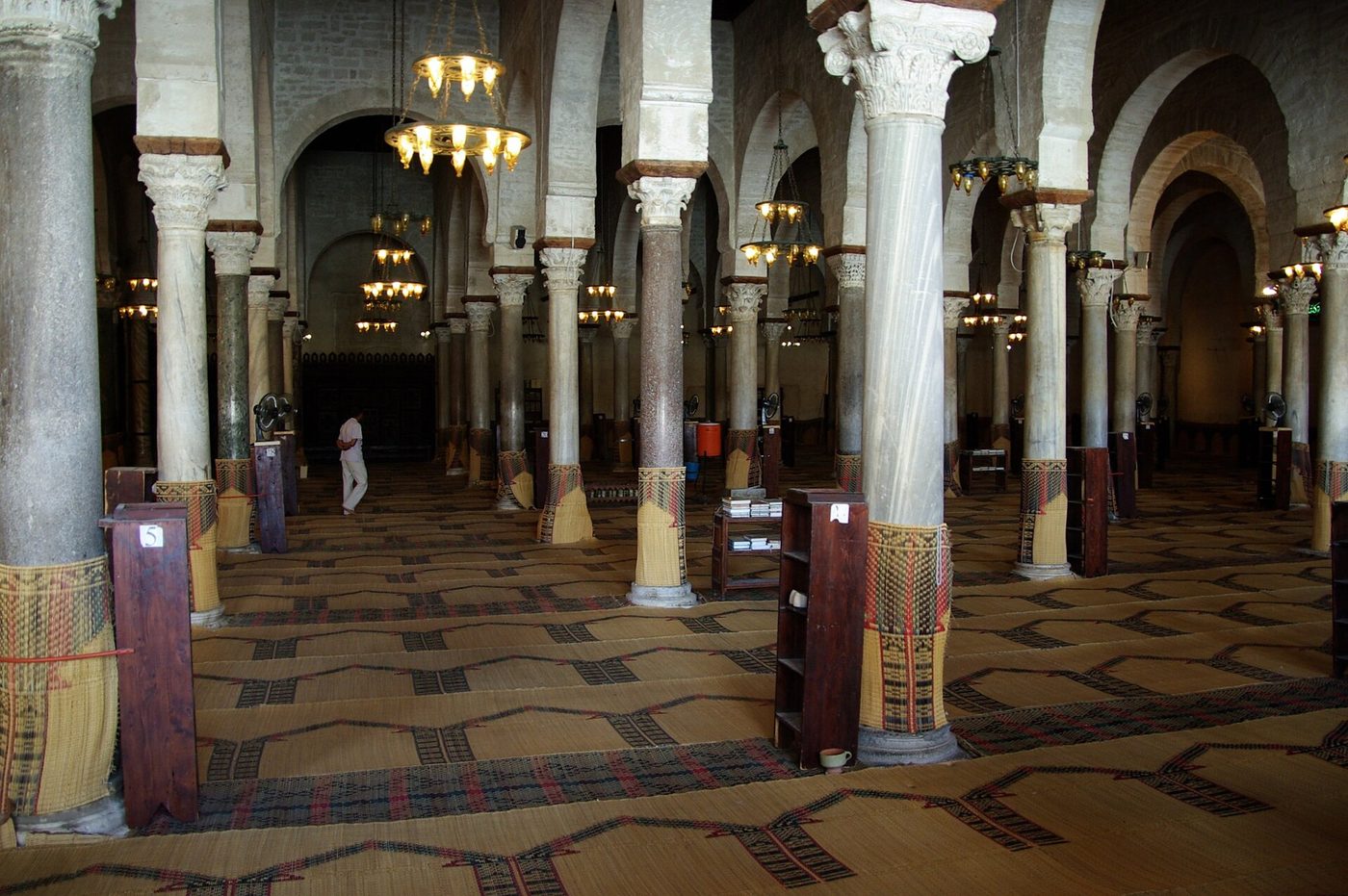
Through the arcade on the south side is the hypostyle prayer hall: seventeen naves running back from the courtyard on hundreds of columns in marble, granite and porphyry. Almost none were made for this building. They were lifted from Roman and Byzantine structures across the old province — Carthage among them — which is why the capitals don’t match, the shafts are different heights, and some are propped on stacked bases to make up the difference. It’s one of the great acts of architectural recycling anywhere, and oddly moving: the Roman world dismantled and reassembled into something entirely new. If you’ve been to ancient Carthage and wondered where all the marble went, some of it is here. The mihrab, carved wooden minbar and lustre tiles are ninth-century and among the oldest surviving of their kind — though you’ll be looking at them from a distance.
Can non-Muslims visit? The rules as we understand them
This is the single most-searched question about Kairouan, so here’s the honest position as of 2026, with the caveat that it can and does change.
- The courtyard: yes, normally. Non-Muslim visitors are generally admitted to the great courtyard and the porticoes around it. That’s not a token look — it’s the best part.
- The prayer hall: no. Entry is reserved for Muslims. In practice the doors along the south arcade are usually left open so visitors can look in from the threshold and photograph the columns. That is what the picture above is.
- Hours are restricted and seasonal. Visiting is only permitted outside prayer times, and because prayer times follow the sun, the windows move through the year. Ask at your hotel or the ticket office for the day’s visiting hours before you set out.
- Friday is shorter. The mosque typically closes to visitors around the Friday congregational prayer and often for the whole of Friday afternoon; some sources give Friday morning only.
- Religious holidays close it. Expect no visitor access around Eid al-Fitr and Eid al-Adha, and heavy restrictions around Mawlid, the Prophet’s birthday, celebrated in Kairouan on a scale you won’t see elsewhere in Tunisia.
- Dress properly. Shoulders and knees covered for everyone; women are routinely asked to cover their hair. Robes and scarves are usually available to borrow or hire at the entrance, but they’re worn, shared and in August thoroughly unpleasant — bring your own long sleeves and a scarf and skip the whole business.
Two more notes. Take your cue from the staff at the gate rather than a self-appointed guide outside it. And don’t treat any of the above as a guarantee: access arrangements at Tunisian religious sites are decided locally and have tightened and loosened repeatedly over the years. Ask at your hotel the day before if you’re making a special journey.
The rest of the city
The mosque is roughly forty-five minutes of your day. Here’s what fills the rest.
The Aghlabid basins
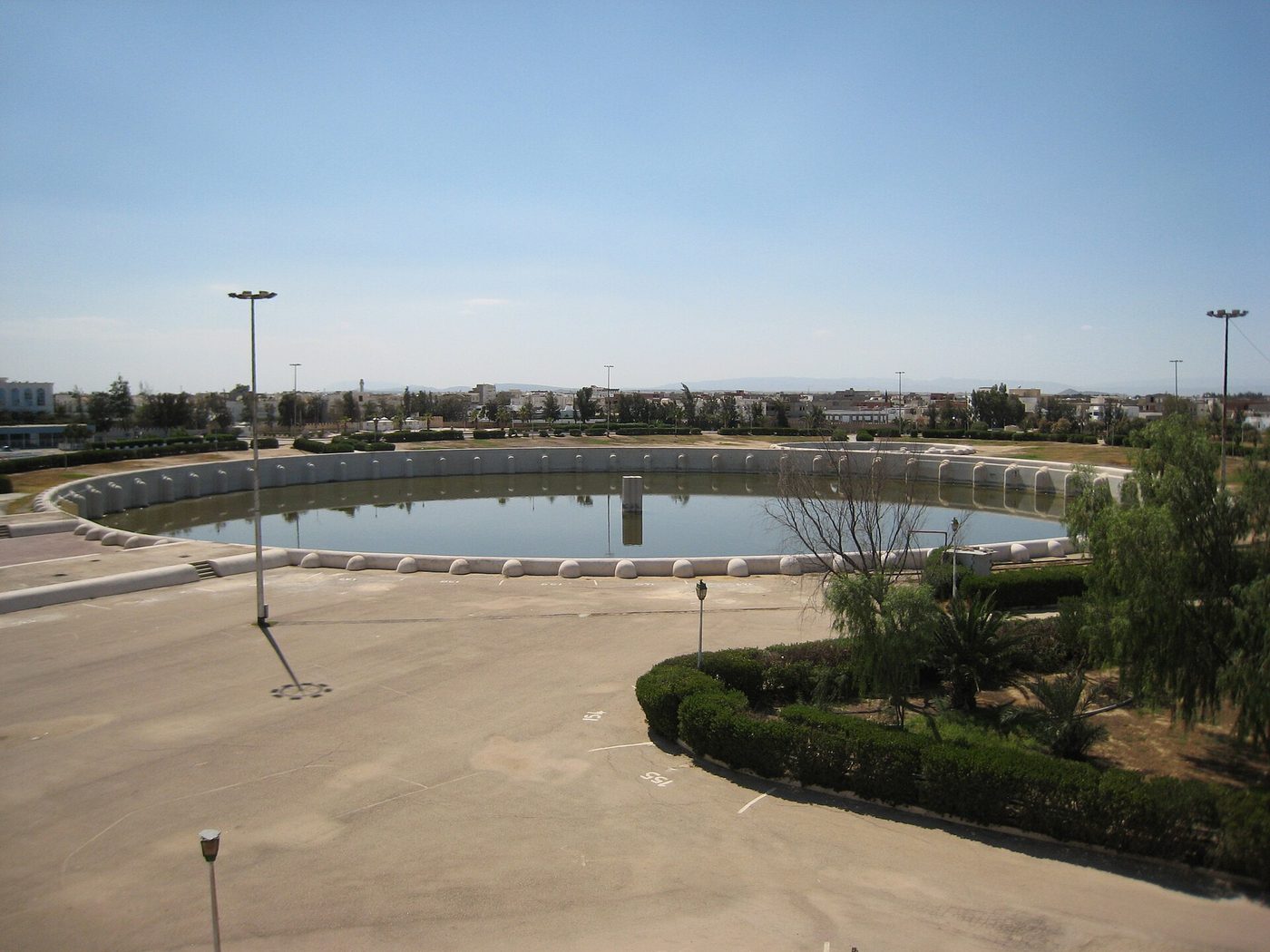
On the northern edge of the city, outside the medina and a short taxi ride from it, sit two vast open reservoirs built in the ninth century. Water arrived by aqueduct from the hills, dropped into a smaller settling basin so the silt fell out, then fed into the huge main basin.
Be warned: most visitors’ first reaction is “it’s a big pond next to a car park”, because that is exactly what it looks like. Climb the terrace by the ticket office and the geometry snaps into focus, and if you think about a ninth-century city solving its water problem at that scale, it earns its place. Ten minutes, not an hour.
The Zaouia of Sidi Sahbi — the Mosque of the Barber
Our favourite building in Kairouan, and it isn’t close. The seventeenth-century complex stands over the seventh-century tomb of Abu Zama al-Balawi, a companion of the Prophet who, tradition says, carried three hairs from the Prophet’s beard and was buried with them — hence the nickname, the Barber’s Mosque.
It’s a sequence of courtyards you pass through one at a time, each more elaborate than the last: glazed faience tiles and carved stucco on the walls, and painted coffered ceilings. Non-Muslim visitors are admitted to the courtyards and vestibules rather than the tomb chamber. It’s a working place of pilgrimage — you’ll likely be sharing it with families bringing newborns, a long-standing local tradition — so keep your voice down and your camera pointed at the tiles rather than at people.
Bir Barouta, and an honest word about the camel
Up a flight of stairs in the middle of the medina is a seventeenth-century well building where a blindfolded camel walks in circles to turn a wooden wheel that draws water. The legend is lovely: that the well connects underground to the Zamzam spring in Mecca, and that Kairouan’s founders sited the city here after a cup lost in Mecca surfaced in this water.
The reality is a large animal in a small, hot room walking in circles all day for tourists. A good number of British visitors come out upset, and we’d rather tell you now than have you find out at the top of the stairs. If that will spoil your afternoon, skip it — you lose nothing from the rest of Kairouan.
The medina, its walls and its souks
Kairouan’s medina is smaller and calmer than the coastal ones, and that’s the point. There are souvenir stalls on the main axis between Bab ech Chouhada and the Great Mosque, but step one lane off it and you’re in an ordinary residential quarter: whitewashed walls, blue doors, arches bracing one house against another across the alley, and almost nobody selling you anything. Next to Sousse’s medina it’s noticeably gentler on the nerves.
Two things inside worth finding. The Mosque of the Three Doors, built in 866, has a carved and inscribed façade generally reckoned the oldest decorated mosque frontage in the Islamic world — a small neighbourhood mosque on an unremarkable lane, exterior only, but a genuine first. And the Zaouia of Sidi Abid el-Ghariani, which brings together teaching rooms, student lodgings and a mausoleum, is worth seeking out on the way.
The Raqqada museum — check before you drive out
The National Museum of Islamic Art at Raqqada sits about 9km from the city in a former presidential palace, and it holds the good stuff: early Islamic ceramics, gold coins, and Qur’an manuscripts, including folios of the famous Blue Qur’an. Ask at the ticket office in town whether it’s open before committing to a taxi. Lovers of early decorative art will find the Roman half of the same story in our guide to Tunisian mosaics.
Tickets: the combined ticket and what it covers
Kairouan works on a single multi-site ticket rather than an entry fee at each door — genuinely good value, and slightly confusing the first time.
The ticket has traditionally been sold from the tourist office beside the Aghlabid basins on the northern edge of town, covering the Great Mosque, the basins, the Zaouia of Sidi Sahbi, Bir Barouta, the Zaouia of Sidi Abid el-Ghariani, the Zaouia of Sidi Amor Abbada and the Raqqada museum. In recent years tickets have also been sold at or near the Great Mosque itself, which saves the trip out to the basins first.
New national tariffs came in on 1 April 2026. Non-residents now pay 20 TND for Kairouan’s monuments, and that rises to 30 TND on 1 January 2027. Carry small notes, and don’t pay anyone extra to take pictures: personal photography on a phone or camera is included in the ticket. Only professional photography or filming needs separate authorisation, from the heritage agency AMVPPC.
Keep the ticket — it’s checked at every site, and losing it means buying another. Remember the dinar is a closed currency, so you can’t bring dinars from home; you’ll change money after you land, and our Tunisia travel tips cover how that works. And if a “guide” attaches himself to you at the mosque gate offering to sort your ticket, decline — the office is easy to use, and our guide to scams in Tunisia explains where that favour usually ends up.
Kairouan carpets: zerbia, mergoum and the sales pitch
Kairouan has been the centre of the Tunisian carpet trade for centuries, and if you buy one anywhere in the country it probably came from here. It’s also where the hardest sell in Tunisia happens, and the two facts are related.
What you’re actually being shown
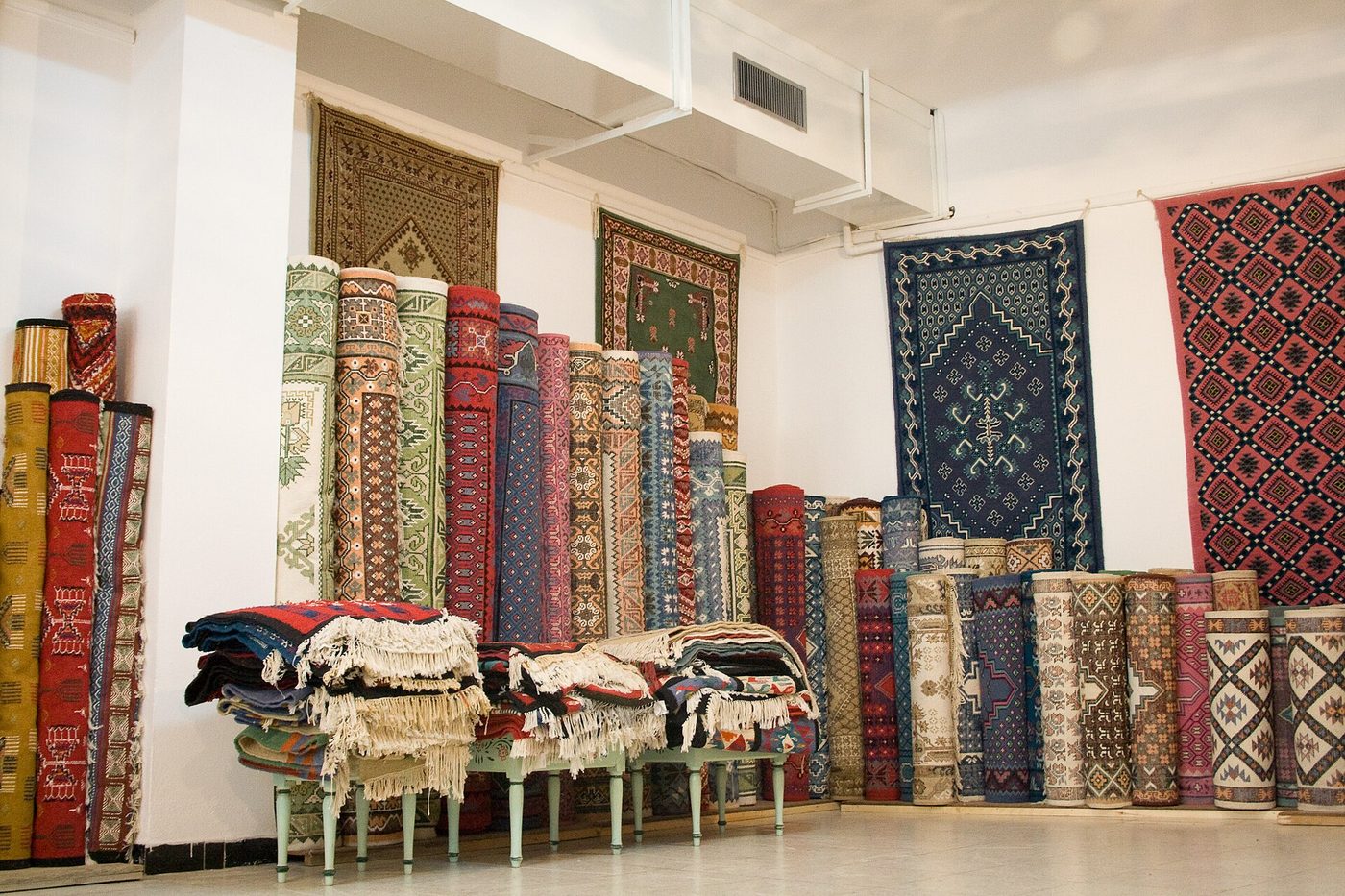
- Zerbia (or zarbia) — the hand-knotted pile carpet, wool or wool and silk, knotted row by row onto a warp. These are the expensive ones. Quality is graded by knot density and the seller will quote you a figure; higher counts mean finer detail and far more hours at the loom. Ask which grade you’re looking at, and get the answer written down.
- Mergoum (or margoum) — flat-woven, sitting between a kilim and a knotted rug: a woven ground with the pattern worked in, usually sheep’s wool on a cotton warp. Thinner, lighter, bolder in its geometry, a fraction of the price, and it packs into a suitcase. For most UK houses it’s the more practical buy.
- Klim — the plain flat weave, cheapest of the three, often the most modern-looking.
The ONAT seal
The Office National de l’Artisanat Tunisien (ONAT), the state handicrafts body under the tourism ministry, runs a certification scheme for Tunisian crafts, carpets included. A carpet that has passed inspection carries an official stamp or seal. It isn’t a price guarantee and doesn’t mean you aren’t being overcharged — but it does tell you the thing is what the seller says it is, and it matters if you ever want to resell or insure it. Turn the carpet over and ask to see the seal. A seller with nothing to hide shows you immediately.
How the pitch works — and how to handle it
None of this is sinister, but all of it is designed, and it helps to see the shape of it coming.
It usually starts outside the mosque or in the medina with someone friendly who isn’t selling anything — he’s showing you the way, or he works at your hotel, or he wants you to see the best view of the minaret. That view is real: several carpet houses near the Great Mosque have terraces looking straight down onto the courtyard, and it is genuinely the best photograph in Kairouan. The terrace is free. The route back down goes through the showroom.
There you’ll get mint tea, a tour of a beautiful old merchant’s house, several men unrolling carpet after carpet, a great deal of information about knots, and an opening price that is typically a large multiple of what the carpet will eventually sell for. The tea and the hospitality do real psychological work — you’ll feel obliged. You aren’t. It’s a shop.
- Decide before you go in if you are buying. If not, say so at the door, cheerfully — “we’re only here for the view, we’re not buying today” — then hold that line without apologising for it.
- Set a ceiling in pounds before the tea arrives, and don’t move it. Being handed a calculator isn’t a trap, but do the sums in your own currency.
- Expect a long negotiation. A realistic landing price is often well under half the opening ask, sometimes far less. Nobody is offended by haggling; it’s the expected form.
- Walking out is completely acceptable. If you’re followed to the door with a better price, that price was always available.
- Get a receipt with the size, materials and grade on it, and check the seal. If they’re shipping, establish who pays UK import VAT and duty — it will be you.
- Don’t buy in your first hour in Tunisia. Look in Kairouan, price it, buy on the way home if you still want it.
Be firm, be friendly, don’t be rude — the hard sell is a trade practice, not an insult, and the same men will happily give you directions afterwards. How commissions and “friends” work across the country is covered in our guide to Tunisian culture and etiquette.
Makroudh — the reason to arrive hungry
Kairouan’s other famous export is edible. Makroudh is a diamond of semolina dough wrapped around spiced date paste, fried, then soaked in honey or syrup. It’s dense, sticky, faintly gritty from the semolina in a way that’s part of the point, and sold everywhere from pastry shops with queues outside to trays on the pavement.
Buy from a shop on the main medina street between Bab ech Chouhada and the Great Mosque, where turnover is high and it’ll be fresh; a box of assorted pieces costs very little and travels home perfectly well. Ask for a couple of warm ones to eat there too — makroudh straight out of the fryer is a different food from makroudh out of a box, and two is plenty. Our wider Tunisian food guide has the rest of the sweet counter.
Getting to Kairouan
Kairouan has no airport and no passenger rail service, so it’s road transport whatever you choose.
| From | Distance | Rough journey time | Options |
|---|---|---|---|
| Sousse | – | About 1 hour | Louage, bus, taxi, organised trip |
| Hammamet | Shorter than from Tunis | Under 2 hours by car | Organised trip, taxi, louage via Sousse |
| Tunis | The longest run here | About 2 hours by car | Louage, bus, taxi, organised trip |
| El Jem | ~71km | About 1h15 by car | Taxi or hire car; pairs into one long day |
The louage — a shared minibus that leaves when it’s full rather than at a set time — is the cheap option. Fares have been reported at roughly 6–8 TND a seat from Sousse and around 10–14 TND from Tunis, though rates move; buy at the kiosk before boarding. See getting around Tunisia for how the system works.
A private taxi with waiting time is the low-stress choice for a family or four friends. Operators quote in the region of 40–55 TND return from Sousse and 90–110 TND return from Tunis, but those are advertised rates rather than a fixed tariff — agree the price and the waiting time before you set off, not after. If you’re driving yourself you’ll want a 1968-convention international driving permit alongside your UK licence; avoid driving between towns after dark, and expect routine police checkpoints — slow right down, be polite, keep documents to hand. Parking near Bab ech Chouhada or by the basins is straightforward.
Organised trips, and what to check
Every resort sells Kairouan, usually bundled with El Jem. It’s the easy choice and much the most common, particularly on day trips from Sousse and day trips from Hammamet. Check two things before booking: how long you actually get in Kairouan itself, and whether the itinerary includes a “craft centre” or carpet showroom. If the answer to the first is under two hours and the second is yes, you’re buying a shopping trip with monuments attached. Our overview of Tunisia excursions covers how to read an excursion sheet.
Pairing Kairouan with El Jem
This is the classic central-Tunisia day and it’s a good one: Kairouan in the morning while it’s cool, an hour east to El Jem for the amphitheatre in the afternoon, then back to the coast. Reckon on twelve hours door to door from Tunis, less from Sousse. It’s two very different things in one go: the Roman empire at its most theatrical, then the civilisation that replaced it. If you’re building a bigger loop, Dougga and Bulla Regia sit north-west and pair better with Tunis — see our day trips from Tunis.
How long to stay, and is it worth a night?
Half a day covers the Great Mosque, the medina and the basins at a brisk pace. A full day lets you add Sidi Sahbi, the Mosque of the Three Doors, lunch in a restored merchant’s house and an hour of aimless wandering, which is when the medina is at its best.
Should you stay over? For most people on a beach holiday in Hammamet or Sousse, no — it’s an easy day trip and the coast has better hotels. But there’s a real argument for one night if you care about photography or atmosphere: a night here gives you the medina in the evening and again first thing in the morning, the hours a day trip never reaches. There’s a small but improving set of restored guesthouses inside and near the walls, plus a few functional mid-range hotels; rates are modest by UK standards, but check current prices rather than trusting any figure you read, including ours.
Dress, Fridays, Ramadan and manners
Kairouan is more conservative than the coastal resorts, and visitors who dress as if they’re still by the pool stand out badly. Shoulders and knees covered is the baseline at the religious sites, and simply better manners in the medina too. Women should carry a scarf. Nobody will be rude to you if you get it wrong; you’ll just be the person everyone is politely not looking at.
On timing: Friday is the congregational prayer day, so plan around it — early Friday morning, or a different day entirely. During Ramadan, which next begins in February 2027, opening hours contract, cafés and restaurants in a religious city like this largely close during daylight, and mosque access can be restricted further. It’s a fascinating time to be in Tunisia and a difficult time to sightsee in Kairouan specifically; our guide to Ramadan in Tunisia explains what changes. Mawlid, the Prophet’s birthday, is Kairouan’s great annual celebration and moves roughly eleven days earlier each year — worth checking the date, and worth avoiding if you want quiet monuments rather than crowds.
One more thing. Kairouan is not a security concern — it’s a normal, well-policed provincial city far from any advisory area, and the honest national picture is in our is Tunisia safe guide. The only thing anyone here is going to do to you is try to sell you a rug.
Our verdict, and how we’d spend the day
Kairouan is the most historically significant place you can visit in Tunisia, and one of the few where the country’s own story — rather than the Roman one imported on top of it — is front and centre. It also has the highest ratio in Tunisia of “extraordinary thing” to “time the average visitor is given to look at it”.
Given a free day from the coast, we’d arrive by 9am, do the Great Mosque first while it’s cool and empty, walk to Sidi Sahbi, taxi to the basins for ten minutes and a photograph, come back for a slow lunch in the medina, buy makroudh, look at carpets from a rooftop with no intention of buying, and be on the road east to El Jem by half two. That’s a day that costs very little and stays with you for years — and it’s roughly four times as much Kairouan as the coach tour gives you.
Planning the rest of the trip? Start with things to do in Tunisia, and check the best time to visit Tunisia — Kairouan in August is punishing, and spring or autumn is a different city.
Frequently asked questions
Can non-Muslims enter the Great Mosque of Kairouan?
Generally yes, to the courtyard and its porticoes, but not the prayer hall, which is reserved for Muslims. The prayer hall doors are usually left open so you can look and photograph from the threshold. Shoulders and knees must be covered and women are normally asked to cover their hair. Access closes during prayers and around religious holidays, and arrangements can change.
How much does it cost to visit Kairouan?
Kairouan uses a single multi-site ticket covering the Great Mosque, the Aghlabid basins, the Zaouia of Sidi Sahbi, Bir Barouta and several other monuments. Non-residents pay 20 TND in 2026 and 30 TND from 1 January 2027, and taking your own photographs costs nothing extra.
How far is Kairouan from Sousse?
It’s a short way inland, about an hour by car or taxi. Shared louages run from Sousse’s louage station at a few dinars a seat. It’s the easiest and cheapest starting point for anyone based on the coast.
Is Kairouan worth visiting?
Yes, if you have any interest in history or architecture. The Great Mosque is one of the most important buildings in the Islamic world and the medina is calmer and more genuine than the coastal ones. If your holiday is purely beach-based and you dislike being sold things, it will feel like hard work — go early, go with a plan, and it’s excellent.
Why is Kairouan called Tunisia’s holy city?
Because it was the first great Islamic city in the Maghreb, founded in 670 AD, for much of its early history the capital of Ifriqiya, and the burial place of a companion of the Prophet. You’ll hear it called the fourth holiest city in Islam and hear that seven pilgrimages here equal one to Mecca — both are popular tradition rather than doctrine, so treat them as folklore.
How long do you need in Kairouan?
Half a day covers the Great Mosque, the medina and the Aghlabid basins at pace. A full day is much better and adds the Zaouia of Sidi Sahbi, the Mosque of the Three Doors and a proper lunch. An overnight stay is only worth it if you want the medina at dawn or after the coaches leave — but it is genuinely lovely then.
What should I wear in Kairouan?
Cover shoulders and knees, men and women alike. Women should carry a scarf for the Great Mosque and the Zaouia of Sidi Sahbi. Robes are usually available to borrow at the mosque entrance but they’re shared and hot. Loose long sleeves and light trousers or a long skirt are comfortable, respectful, and save you the queue for a robe.
Should I buy a carpet in Kairouan?
Only if you actually want one. Kairouan is the centre of the trade and the quality is real: hand-knotted zerbia at the top end, flat-woven mergoum for less. Check for the ONAT certification seal on the reverse, get size, materials and grade on a receipt, expect a long negotiation from a very high opening price, and remember walking away is normal and inoffensive.
Can you do Kairouan and El Jem in one day?
Yes, and it’s the classic central-Tunisia circuit. The two are about 71km apart by road, roughly an hour and a quarter’s drive. Do Kairouan in the morning while it’s cool and El Jem’s amphitheatre in the afternoon. It’s a long day from Tunis — twelve hours or so door to door — and more comfortable from Sousse or Monastir.
Is the Raqqada Museum of Islamic Art open?
It sits about 9km from Kairouan and is normally included in the multi-site ticket. Before paying for a taxi out there, check at the ticket office in town that it’s open that day. When open, it holds the finest early Islamic collection in Tunisia, including pages from the Kairouan Qur’an manuscripts.
Written by the Tunisia Tourism Guide team — an independent UK-focused guide to travelling in Tunisia. We don’t sell tours or take hotel commissions. Prices and advice were checked at publication; always confirm current details before you book.
Photo credits
All images via Wikimedia Commons, used with thanks: The vast paved courtyard and three-tier square minaret of the © Keith Roper (CC BY 2.0); Reused marble and porphyry columns in the hypostyle prayer hall © Alan Lew (CC BY-SA 2.0); The 9th-century Aghlabid basins at Kairouan © Alan Lew (CC BY-SA 2.0); Stacked hand-knotted zerbia and woven mergoum carpets in a Kairouan © Lluis Satorre Gonzalez (CC BY 2.0).