By the Tunisia Tourism Guide team · Last updated 24 July 2026 · We don’t sell tours or take hotel commissions — this is independent advice, written to be useful.
Most people give Tunis an afternoon on the way to the beach, and most people are wrong. Give the capital two proper days and it becomes one of the most rewarding short breaks in the Mediterranean — a thousand-year-old walled city, a palace full of Roman mosaics, the ruins of Carthage and a blue-and-white village on a clifftop, all within a 20-minute train ride of one another.
The ideal 2-day Tunis itinerary spends day one in the walled medina and the Bardo Museum, then day two on the coast at ancient Carthage and clifftop Sidi Bou Said. Both areas link by cheap light rail and the TGM train, so you barely need a taxi all weekend.
Our complete guide to Tunis covers the city top to bottom; think of this as the practical weekend version — a walkable, time-of-day-aware plan you can follow step by step. It puts the heavy sightseeing in the cool of the morning, saves the coast for golden hour, and barely touches a taxi. This is the route we hand friends who have a spare weekend, a cruise stop or a couple of days at the start of a longer trip. Below you’ll find the full two-day plan, a compressed one-day version, and a separate route for cruise passengers arriving at La Goulette with only a few hours ashore.
The 2-day Tunis itinerary at a glance
Here’s the whole weekend on one screen. The detail — timings, tickets, trains and where to slot meals — follows underneath.
| When | Day 1 — old Tunis | Day 2 — the coast |
|---|---|---|
| Morning | The medina: Porte de France, Zitouna Mosque, the souks | TGM train to Carthage: Antonine Baths & Byrsa Hill |
| Lunch | Grilled fish in the medina or a rooftop café terrace | Seafood by the water in Sidi Bou Said or La Marsa |
| Afternoon | Métro léger out to the Bardo Museum (shut Mondays) | Sidi Bou Said: the blue-and-white lanes and clifftop |
| Evening | Dinner on or near Avenue Habib Bourguiba | Sunset mint tea, then the TGM back into town |
One scheduling trick decides the whole weekend: the Bardo Museum closes on Mondays, and much of the medina winds down around Friday midday prayers. Line your two days up so the Bardo falls on any day but Monday, and you’ll avoid the single most common Tunis planning mistake.
Day 1: the medina, a long lunch and the Bardo
Day one stays on foot in the old city and finishes with the greatest collection of Roman mosaics on earth. It’s a lot of walking on uneven ground — reckon on 12,000 steps and comfortable shoes — but almost none of it needs a vehicle.
Morning: into the medina
Start where the two cities meet. Avenue Habib Bourguiba, the palm-lined French-built boulevard, runs west from the lake to a grand old archway: the Porte de France, or Bab El Bhar, the “sea gate”. Step through it and 130 years of European town planning drop away in a single stride — you’re in the medina, a UNESCO-listed maze founded in the 7th century.
Aim straight up Rue Jamaa Zitouna, the main artery, climbing gently through the souvenir stalls towards the minaret at the top. This is the Tunis medina at its most touristy, so expect a bit of “come and look, no charge” patter; a friendly, firm “la, shukran” (no, thanks) and a steady pace handle it fine.
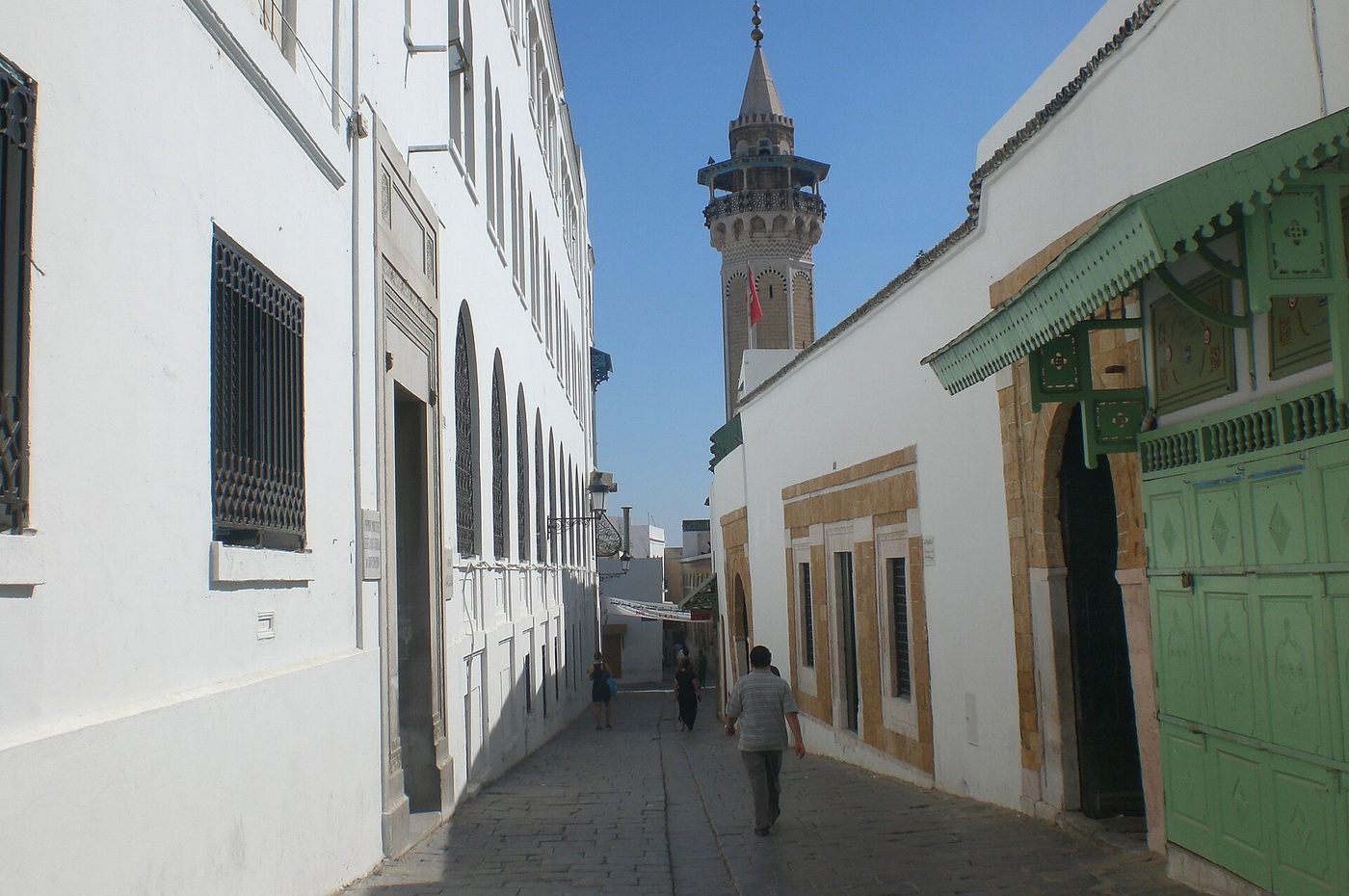
At the top stands the Zitouna Mosque — the “Mosque of the Olive” — founded in the 8th century and the spiritual heart of the old city. Non-Muslims usually can’t go into the prayer hall, and access to the courtyard comes and goes depending on the day, so don’t build your morning around getting inside. The classic view is from above anyway: the carpet shops ringing the mosque will happily walk you up to their rooftop terraces for a photo, on the polite understanding that you’ll glance at the rugs on the way down. There’s no obligation to buy.
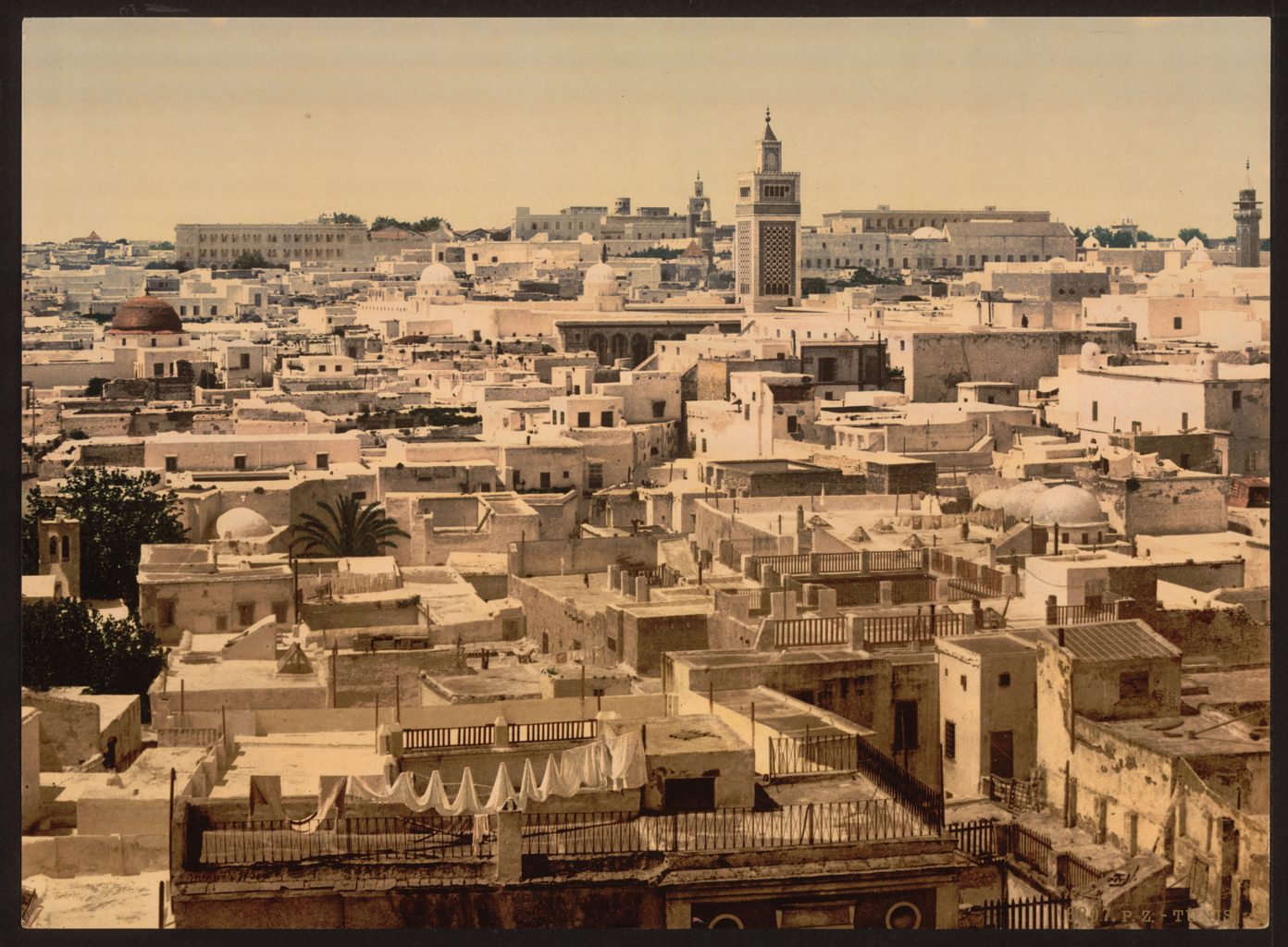
From here, get pleasantly lost. The covered souks fan out from the mosque, each one historically dedicated to a single trade: Souk El Attarine for perfumers, all orange-blossom water and musk; Souk Ech-Chaouachine for the makers of the red felt chechia hats. Duck into a couple, watch the artisans, and don’t panic about your bearings — the medina is small, and any downhill lane eventually spills you back towards Bourguiba. This slow, curious wandering is the whole point; our guide to Tunisian culture explains what you’re looking at.
Lunch and a rooftop
By around one o’clock you’ll want to sit down. The medina has two good options. For a proper meal, several restored merchant houses and old caravanserais have become atmospheric restaurants — grand traditional dining rooms and café-terraces tucked behind plain doors. For something lighter and cheaper, follow the office workers to a hole-in-the-wall serving lablabi, the garlicky chickpea soup that is Tunis in a bowl. Either way, our full rundown of where to eat in Tunis names the places we’d actually pick, and the Tunisian food guide decodes the menu.
A tip worth its weight: several medina cafés and restaurants have rooftop terraces with a view over the tiled roofs to the minarets beyond. A mint tea up there, with pine nuts floating on top, is the best-value hour in the city and a proper rest for tired feet before the afternoon.
Afternoon: the Bardo Museum
The afternoon belongs to the Bardo — and this is the part to plan carefully. The Bardo National Museum, housed in a 19th-century Ottoman palace on the western edge of town, holds what is widely called the finest collection of Roman mosaics anywhere in the world: room after room of floors lifted from villas across ancient Tunisia, still impossibly vivid.
A word of honesty first. The museum was closed for a long spell after 2021 and only reopened to the public in September 2023; as of 2026 a few galleries were still being reworked. It is open and very much worth your time, but it has a history of unexpected closures, so check it’s open the day before you go and remember it shuts every Monday. Recent opening hours ran roughly 9am to 5pm in summer and 9.30am to 4.30pm the rest of the year, with shorter hours during Ramadan — but treat those as a guide and confirm.
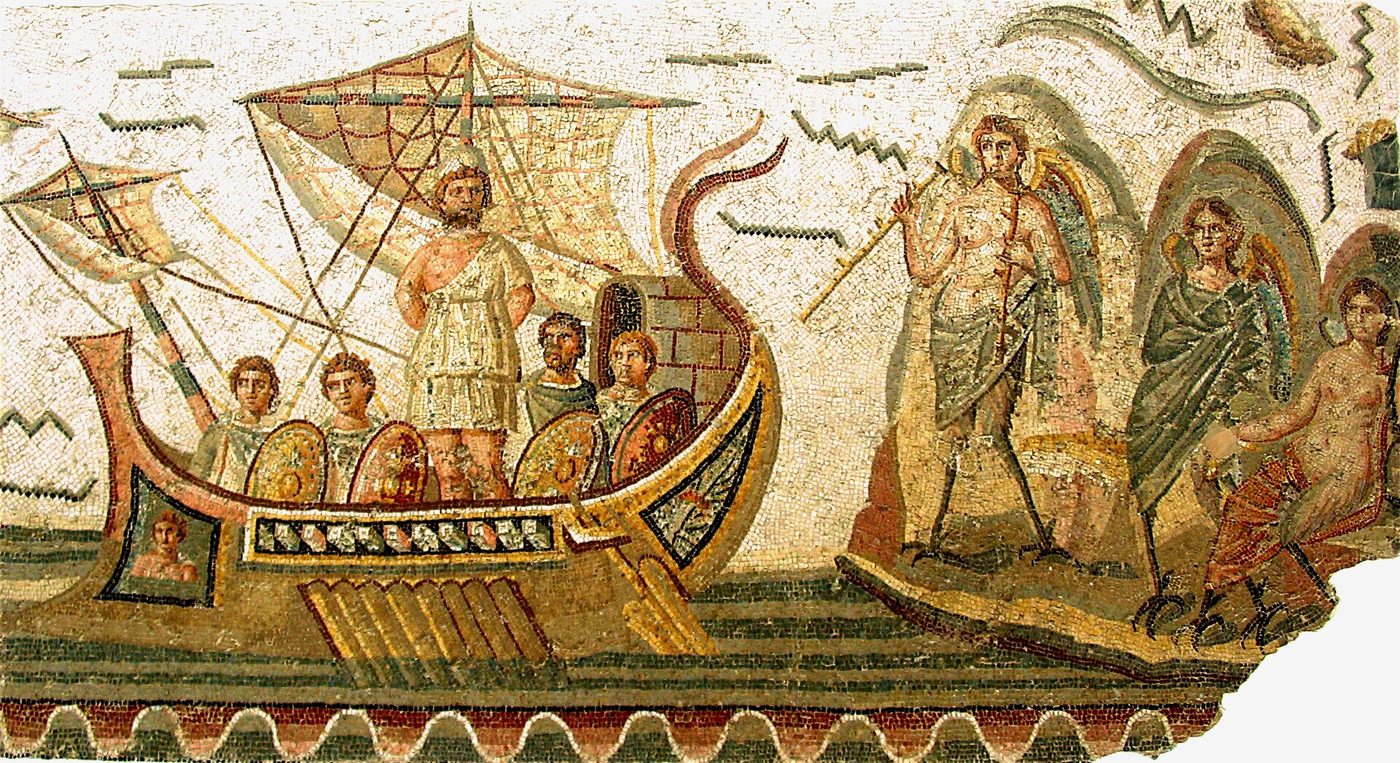
Getting there is half the fun and costs almost nothing. Rather than a taxi, take the métro léger — Tunis’s tram-style light rail — out to the Bardo stop; line 4 runs west from the centre and the museum is a short signed walk from the platform. The fare is a fraction of a dinar. If you’d rather not puzzle out the network, a metered taxi from the centre is only around 10 TND and takes about 20 minutes; our guide to getting around Tunisia covers both. Allow a good two hours inside; the mosaics reward slow looking, and there’s a café for when your neck gives out.
Evening: back in the ville nouvelle
Ride the tram back and spend the evening in the ville nouvelle, the elegant grid of the new town around Avenue Habib Bourguiba. It’s made for an aimless stroll — the cathedral, the old theatre, the flower sellers on the central island, café tables spilling onto the pavement. Dinner options here range from cheap-and-cheerful to smart bistros; if you want a drink with it, this is where the licensed restaurants cluster, since not every place in Tunis serves alcohol. For where to lay your head at the end of it all, see our guide to where to stay in Tunis.
Day 2: Carthage by TGM, then Sidi Bou Said for sunset
Day two swaps the crowded lanes for the sea. Everything today strings along a single train line, so this is genuinely the easy day — you just hop on and off as you go north up the coast.
Getting there: the TGM line
The TGM (Tunis–Goulette–Marsa) is a scruffy, characterful little railway that has shuttled between the capital and its seaside suburbs for well over a century. It leaves from Tunis Marine station, at the lake end of Avenue Bourguiba, and runs every 15 minutes or so, taking under half an hour to reach the far end at La Marsa. Buy a ticket at the window for a dinar or two, keep it for the barriers, and ride second class with everyone else — it’s fine.
Here are the stops that matter for a day of sightseeing:
| Get off at… | For… |
|---|---|
| Carthage Hannibal or Carthage Dermech | The Antonine Baths and the seafront Carthage sites |
| Carthage Byrsa | Byrsa Hill, the National Museum and the cathedral |
| Sidi Bou Saïd | The blue-and-white village (a steep walk up from the station) |
| La Marsa (Marsa Plage) | The seafront promenade, cafés and seafood restaurants |
Morning: the ruins of Carthage
Get an early train and start at Carthage while it’s cool. Once Rome’s great rival, Carthage today is a green, wealthy suburb with its ancient bones scattered across several sites over a few square kilometres — you can’t see all of it on foot in a morning, so pick the highlights. A single combined ticket, around 12 TND in 2026 (check the current price), covers the lot and is sold at the main entrances.
The two we’d never skip are the Antonine Baths — a colossal Roman bath complex tumbling down to the sea, with columns you can walk among — and Byrsa Hill, the acropolis crowned by the National Museum of Carthage and the old cathedral, with a long view back over the Gulf of Tunis. Between them you’ll get the scale of the place and its best photographs. Purists can add the Punic ports, the theatre and the Tophet; two to three hours covers the essentials comfortably. Our full guide to Carthage has the site-by-site detail.
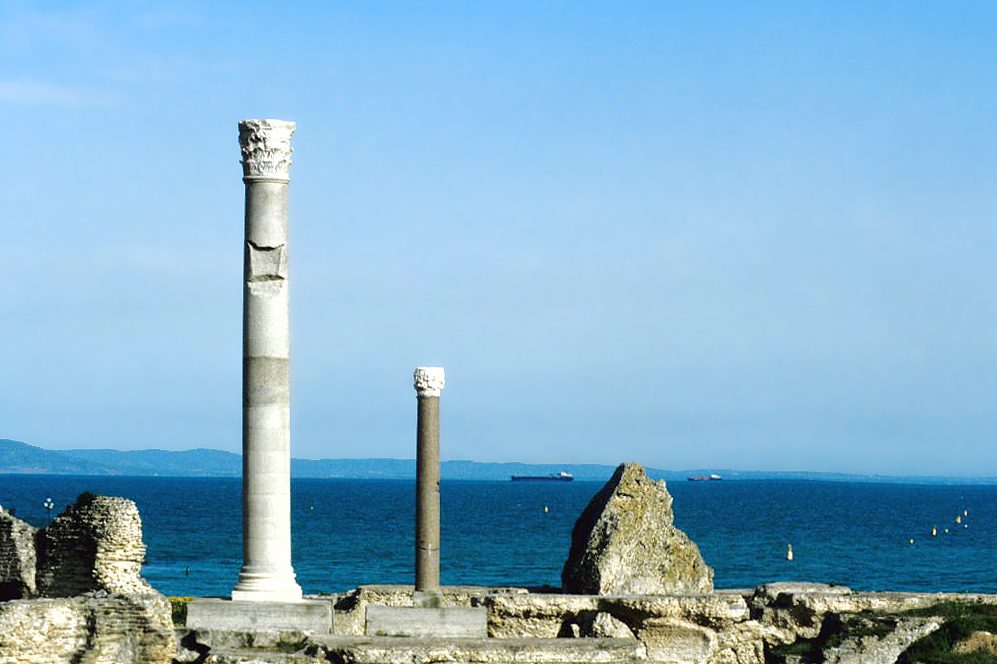
The sites open around 8.30am and close at 5pm in winter, later in summer; there’s little shade, so a hat and water are non-negotiable in the warmer months. When you’ve had your fill, walk back to the nearest TGM halt and ride two stops north.
Lunch by the sea
Time your morning so you reach the coast hungry. You’ve two good lunch calls. Ride on to La Marsa, the breezy suburb at the end of the line, where seafront restaurants grill the day’s catch and the promenade is made for a post-lunch amble. Or hold out for Sidi Bou Said itself, which has plenty of terraces looking out to sea — pricier and more touristy, but hard to beat for the setting. Fresh fish, a Tunisian salad and a soft drink is the order of the day.
Afternoon and sunset: Sidi Bou Said
Save the best for last. Sidi Bou Said is the blue-and-white village on the clifftop that launches a thousand postcards — cobbled lanes, studded doors in that famous cornflower blue, bougainvillaea, and the Gulf glittering below. It’s a stiff climb up from the TGM station, so take it slowly, then simply wander. The single main street is lined with craft shops and cafés; the joy is in ducking down the quieter side lanes where the day-trippers thin out. Our full Sidi Bou Said guide maps the best of them.
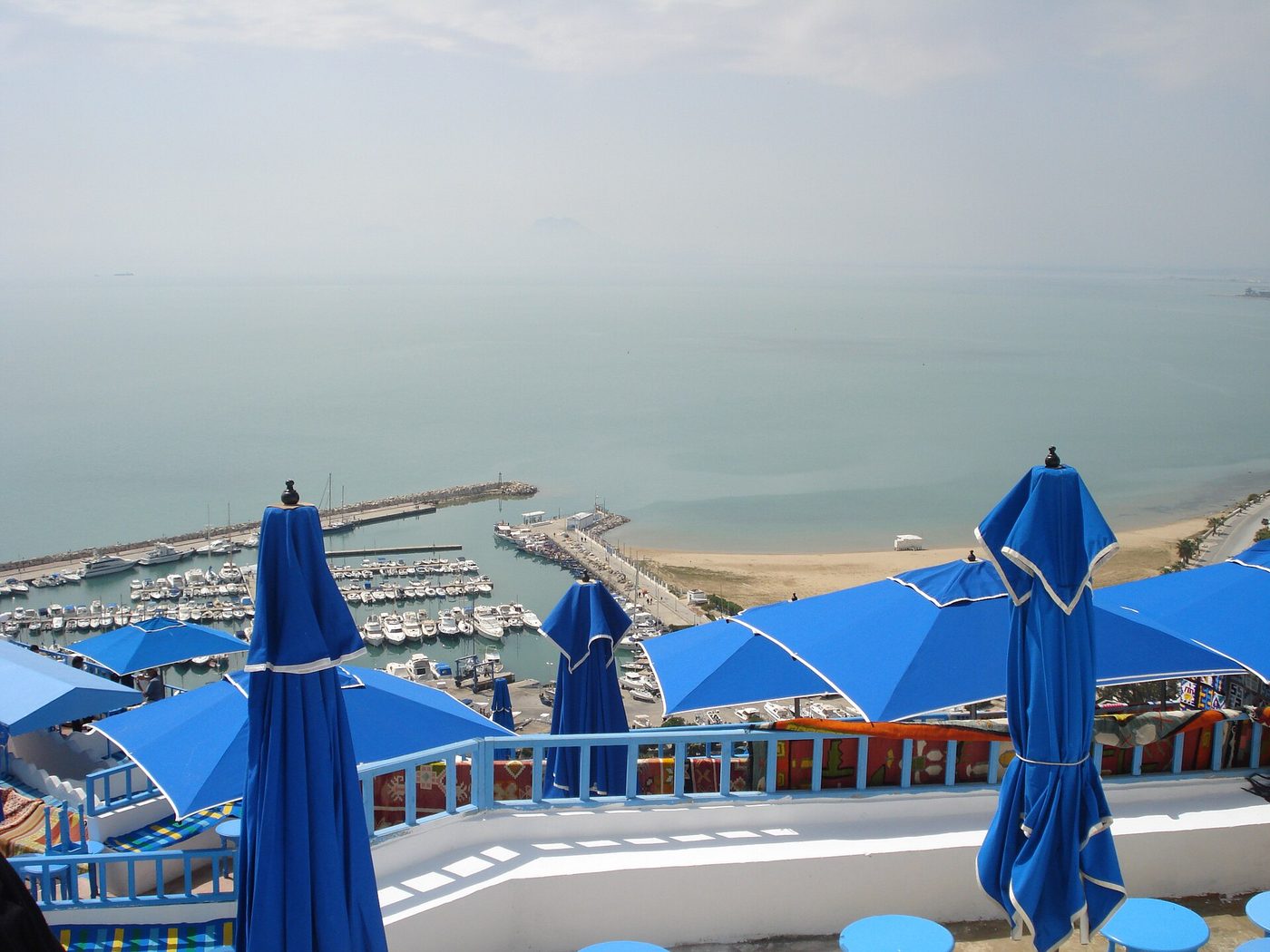
Two cafés are institutions. Café des Nattes, at the top of the main street, has served mint tea on straw mats since the 17th century and drew artists like Paul Klee. Café Sidi Chabaane, terraced down the cliff, has arguably the finer view and a little more calm. Grab a table at either, order tea with pine nuts, and time it for sunset — the white walls turn gold and the crowds finally ebb. Then it’s back down to the station and a gentle TGM ride into town, ideally in time for a late dinner. That’s a near-perfect Tunis weekend.
One day in Tunis: the compressed version
Only got a single day — a long layover, or a night either side of a beach week? Tunis in one day is tight but doable if you’re ruthless and start early. Here’s how we’d spend it:
- Early morning: the medina from the Porte de France up to the Zitouna, then a fast loop of the souks (about 90 minutes).
- Late morning: jump on the TGM to Carthage and see the Antonine Baths and Byrsa Hill (two hours, ticket included).
- Lunch: a quick seafood lunch in Sidi Bou Said or from a café on the main street.
- Afternoon: the blue-and-white lanes of Sidi Bou Said and a mint tea with a view.
- Trade-off: you’ll have to drop either the Bardo Museum or a slow medina — you can’t fairly do both plus the coast in a day. We’d sacrifice the Bardo and save it for a return trip, because the coast in the afternoon light is the memory you’ll keep.
If a single day leaves you wanting more — and it will — our two-day plan above and our list of day trips from Tunis show where to take it next.
The cruise-stop version: Tunis from La Goulette
Cruise ships dock at La Goulette, the port about 12 km from central Tunis, and you’ll typically have something like six to eight hours ashore — enough for a real taste of the area, but not the full two days. The clock is the enemy here, so plan tightly and don’t try to cram in the medina, the Bardo and Carthage all at once.
Our honest advice for a cruise day:
- Do the coast, not the city. The single best half-day from the port is Carthage plus Sidi Bou Said — both are close to La Goulette (Carthage is only 15–25 minutes away by car), photogenic, and easy to combine. Save the medina and Bardo for a land trip another time.
- Sort transport before you’re swept up in the sales pitch. Taxis wait right outside the terminal; agree the fare in advance, because the meters are conveniently “broken” on cruise days. A half-day taxi hired to wait for you, or a small-group tour booked ahead, both work well. The ship’s own excursion is the priciest but the most foolproof.
- Mind the ship’s timings. Build in a big buffer — traffic between the port and Carthage is unpredictable, and no captain waits. Aim to be back at the gangway a clear hour before all-aboard.
- The port itself. La Goulette has a purpose-built terminal village of shops and cafés if you’d rather not venture far, plus a long seafood-restaurant strip in the town for a quick fried-fish lunch before you sail.
In short: treat a La Goulette call as a Carthage-and-Sidi-Bou-Said sampler and you’ll go home delighted rather than frazzled. Come back for the medina and mosaics when you can give Tunis its two full days.
Know before you go: practical tips for your Tunis itinerary
A handful of things quietly make or break a Tunis weekend:
- Beat the heat. From June to September the middle of the day is brutal on exposed ruins and treeless lanes. Do your walking and sightseeing before noon, take a long lunch in the shade, and come back out after four. Our best time to visit guide has the month-by-month picture.
- Watch the calendar. The Bardo shuts Mondays; the medina quietens sharply around Friday midday prayers; and public holidays close museums without much warning. During Ramadan, hours shorten and daytime cafés thin out, though the evenings come alive.
- Carry small cash. The dinar is a closed currency — you can’t get it before you fly and can’t take it home, so change money on arrival and keep coins for train tickets, tea and the odd tip. Reckon on roughly £1 to 3.8–3.9 TND, but check the current rate.
- Use the trains. The TGM and the métro léger are cheap, frequent and take you almost everywhere on this itinerary. Keep valuables zipped away at rush hour, as you would on any city network.
- Dress for mosques and modesty. Covered shoulders and knees make the religious sites and conservative medina lanes easier; sensible shoes save your ankles on the cobbles.
- Tip lightly and in cash. Around 10% in restaurants and a dinar or two in cafés is normal and appreciated; hand it over directly.
- Stay street-smart, not scared. Tunis is a safe, well-visited capital; the usual big-city common sense is all you need. Our guide to whether Tunis is safe gives the honest, up-to-date picture.
Fold this weekend into a bigger loop and it slots neatly at the start or end of a longer trip — our full Tunisia itinerary shows where the capital fits, and the pillar guide to things to do in Tunisia puts it all in national context.
Tunis itinerary: your questions answered
Is 2 days enough for Tunis?
Two days is the sweet spot for Tunis and its coast. It gives you a full day in the medina and at the Bardo Museum, and a second day for Carthage and Sidi Bou Said, without rushing. Three days lets you add a day trip; one day means choosing between the old city and the coast.
What is the best order for a 2-day Tunis itinerary?
Do the medina and Bardo on day one while your legs are fresh, then the coast on day two so you finish with sunset at Sidi Bou Said. Just make sure day one isn’t a Monday, when the Bardo is closed, and check the museum is open before you set out.
How do you get from Tunis to Carthage and Sidi Bou Said?
Take the TGM light-rail line from Tunis Marine station. It runs every 15 minutes or so, costs a dinar or two, and stops right at Carthage and Sidi Bou Said within about 20–30 minutes. It’s far cheaper and easier than a taxi and the same train links both sites in a single day.
Is the Bardo Museum open in 2026?
Yes. The Bardo reopened in September 2023 after a long closure and is open again, though a few galleries were still being reworked into 2026 and it has a history of sudden closures. It shuts on Mondays. Always check it’s open the day before you plan to visit.
How much time do you need at the Bardo Museum?
Allow around two hours. The collection of Roman mosaics is vast and rewards slow looking rather than a quick march-through. Add travel time from the centre — about 20 minutes by tram or taxi each way — so block out half an afternoon for the whole outing.
Can you do Tunis in one day?
Yes, but you’ll have to choose. A single day realistically covers either the medina or the Bardo, plus Carthage and Sidi Bou Said by train. We’d skip the Bardo, do a fast medina in the morning and the coast in the afternoon, saving the museum for a return visit.
What can cruise passengers do from La Goulette in a day?
The best cruise-day plan is Carthage and Sidi Bou Said, both close to the port and easy to combine in six to eight hours. Agree a taxi fare in advance or book a small-group tour, and leave a generous buffer to get back before the ship sails. Skip the medina and Bardo this time.
Is Tunis walkable?
The medina and the new town are very walkable, and you’ll cover a lot on foot on day one — expect uneven cobbles and some hills. The coastal sites are spread out, so you’ll pair walking with short train hops. Comfortable shoes matter more here than almost anything else you pack.
How do you avoid the heat and crowds in Tunis?
Sightsee early and late, and take a long shaded lunch through the hottest hours from roughly noon to four. Spring and autumn are far kinder than high summer. At Sidi Bou Said, arrive late afternoon as the day-trip coaches leave and stay for a much quieter sunset.
Do you need a guide for Tunis?
Not for this itinerary. The medina, Carthage and Sidi Bou Said are all straightforward to do independently with the trains and a map. A guide can add depth in the medina if you want the history, but it’s entirely optional and easy to arrange for a half-day only.
Where should you eat on a Tunis weekend?
Grab a cheap lunch of lablabi or grilled fish in the medina, splash out on a restored merchant-house restaurant one evening, and eat seafood by the water at La Marsa or Sidi Bou Said on day two. Our full guide to where to eat in Tunis has the specifics.
Is Tunis worth visiting for a short break?
Very much so. Few Mediterranean capitals pack a UNESCO medina, the world’s best Roman mosaics, an ancient rival to Rome and a clifftop blue-and-white village into two easy, cheap days. As a weekend break or a bolt-on to a beach holiday, Tunis punches well above its weight.
Written by the Tunisia Tourism Guide team — an independent UK-focused guide to travelling in Tunisia. We don’t sell tours or take hotel commissions. Prices and advice were checked at publication; always confirm current details before you book.
Photo credits
All images via Wikimedia Commons, used with thanks: Rooftops of the Tunis medina with the Zitouna minaret © Wikimedia Commons contributor (Public domain); The Ulysses and the Sirens mosaic at the Bardo Museum © Giorces derivative work: Habib M’henni (Public domain); The Antonine Baths at Carthage above the Gulf of Tunis © LBM1948 (CC BY-SA 4.0); The clifftop cafe terraces of Sidi Bou Said overlooking the © Cimoi (CC BY-SA 3.0).