By the Tunisia Tourism Guide team · Last updated 4 September 2026 · We don’t sell tours or take hotel commissions — this is independent advice, written to be useful.
Type Matmata Tunisia into a search box and you get the same photograph fifty times over: a sandy crater with white-rimmed doorways cut into its walls. What you don’t get is an answer to the two questions people actually arrive with. Are the underground houses real, or is the whole thing a performance laid on for the coaches? And is it worth the hours in a minibus to find out?
Here’s the honest answer. Matmata in Tunisia is a genuine Berber village of pit houses dug down into the hillside, and several dozen families still live in them. But the version most day trippers see is a staged demonstration home with a tip expected at the door. Go with that in mind and it’s a fascinating 1–2 hour stop, not a full day.
Matmata sits inland from Gabès, on the edge of the hill country that drops away towards the sand seas, and it’s the single most-visited stop on the standard southern circuit. If you’re piecing together a wider trip, start with our main guide to the Tunisian Sahara desert, which explains how Matmata slots in between the coast and the dunes. This page is the detail: what the houses actually are, what happens on a coach stop, whether the Star Wars hotel is still going, and whether the “tourist trap” complaints you’ve read online are fair.
Matmata at a glance
The practicalities, in the order people usually ask for them.
| Question | Short answer |
|---|---|
| Where is it? | Gabès Governorate, southern Tunisia — roughly 40km inland (south-west) of Gabès, about 45 minutes by road |
| How long do you need? | 1–2 hours for the village itself; half a day if you add Toujane or Tamezret |
| What does it cost? | A few dinars to look round a demonstration house, plus a tip — figures vary and are negotiable (2026, check on the day) |
| Best time of day | Before 10am or after 4pm, when the coach convoys aren’t in town |
| Best time of year | March–May and October–November; midsummer above ground is brutal |
| Worth an overnight? | Only for the novelty of sleeping in a cave room — the village goes very quiet after the coaches leave |
| What to skip | Any stop where you’re hurried through a courtyard, photographed with a camel and moved on in ten minutes |
| Don’t miss | The drive in or out over the Toujane road — for us, the best part of the whole trip |
What a troglodyte pit house actually is
“Troglodyte” simply means cave-dweller, from the Greek. It’s a slightly unfortunate word — it makes the houses sound primitive, when in fact they’re one of the smartest pieces of low-tech engineering you’ll see anywhere in North Africa.
How they’re dug
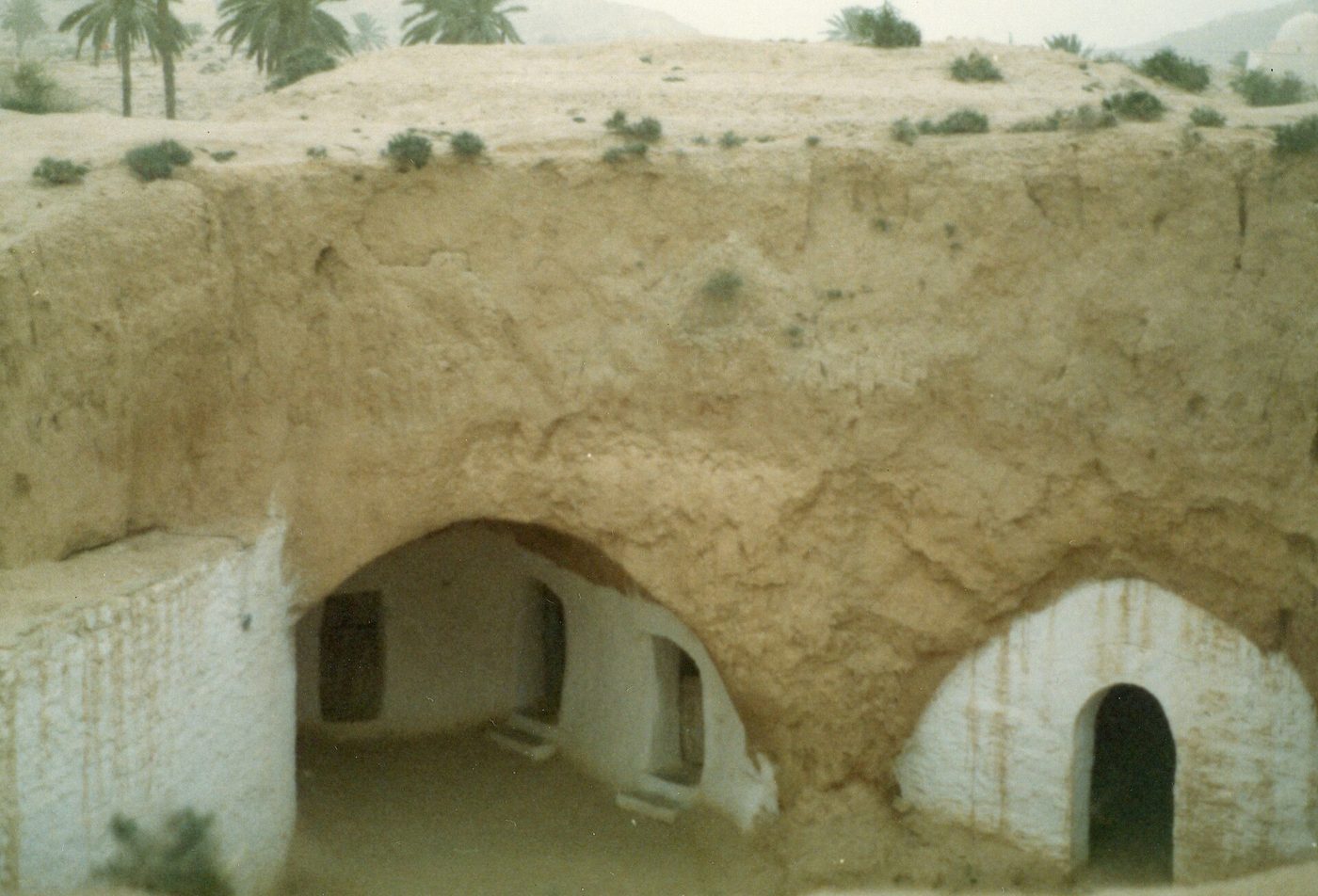
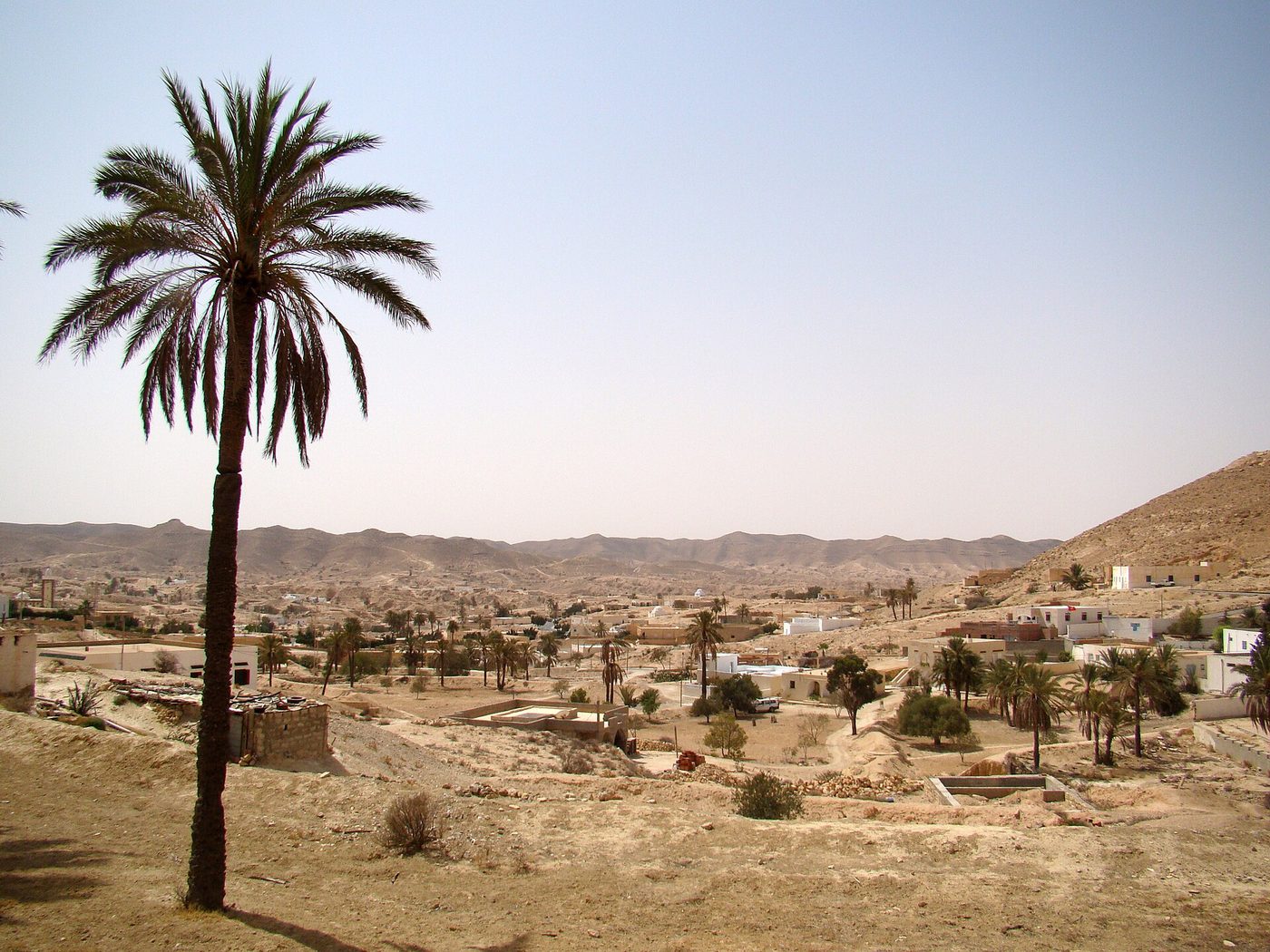
The method is the same across the Matmata hills. You find a patch of soft, gypsum-rich ground, and you dig a large circular or rectangular pit straight down — commonly somewhere around 5 to 10 metres deep and a similar distance across. That hole becomes the open courtyard. Then you tunnel horizontally into the walls of the pit to create rooms: sleeping chambers, a kitchen, a store for grain and olive oil, sometimes a stable. Each room is a barrel-vaulted cave, whitewashed inside, with a low doorway.
You reach the courtyard through a sloping tunnel driven in from ground level, often long enough to bend round a corner so that nobody outside can see straight in. Bigger family compounds have two, three or more pits linked underground by these passageways, so the household expands sideways as sons marry, rather than upwards. From the surface you see almost nothing — a rim of raised earth, a scatter of TV aerials, and what looks like a crater.
How they work thermally — and what they don’t do
This is the part guides tend to oversell, so here’s the sober version. Several metres of earth act as a thermal buffer. Southern Tunisia routinely swings from well above 40°C in the afternoon to something you’d want a blanket for at night; underground, that swing gets flattened out. The rooms stay noticeably cooler than the surface in summer and noticeably warmer in winter, and — crucially — they stay roughly the same temperature all day, so there’s no scorching afternoon peak.
What they are not is air conditioning. Step into one in August and it will feel cool by comparison, not cold. The other advantages are less glamorous but just as real: the excavated material was free, the gypsum-rich soil cuts easily when damp and hardens as it dries, and a house dug into the ground is invisible from a distance — which mattered a great deal in a region with a long history of raiding.
Who still lives in them
Fewer people than the tour commentary implies, and more than the cynics online claim. Matmata’s old village recorded a population in the low thousands at the last census figures we can find, spread across hundreds of pit dwellings, and a meaningful minority of those are still lived in year-round. Others are used for storage, some have been converted into hotels and cafés, and a fair number are simply abandoned — you’ll see collapsed rims and half-filled courtyards as you drive in. Several households make most of their income from showing visitors round, which is exactly the tension at the heart of a Matmata visit.
Old Matmata, New Matmata, and the flood that split them
People get confused between the two, and it matters if you’re buying bus or louage tickets.
Matmata Ancienne (Old Matmata) is the one you want: the hill village with the pit houses, the cave hotels and the junction of the Gabès, Toujane and Tamezret roads. Matmata Nouvelle (New Matmata) is a modern, above-ground settlement roughly 15km away on the Gabès side, with concrete houses and no reason to stop unless you’re changing transport there.
The reason New Matmata exists is one of the better stories in southern Tunisia. In 1969 the region was hit by weeks of extraordinary rain — accounts describe around three weeks of it — and the pit houses, designed for a climate where serious rainfall is rare, filled with water and began to collapse. A delegation walked out to Gabès to ask the authorities for help, which is how the wider country properly discovered that thousands of people were living underground out here in the first place. The state’s answer was to build a new town on the surface. Most families, having patched up their pits, declined to move.
That refusal is the thing to hold on to when you’re deciding how you feel about Matmata. Nobody was forced to stay underground. Plenty of people had the option of a concrete house with a front door and chose the courtyard instead.
The staged “family home” — what really happens
Let’s be blunt about the standard coach experience, because this is where the disappointment comes from.
What you’re actually shown
Most organised trips stop at one of a handful of houses that operate more or less as a business. You walk down the entry tunnel into the courtyard. There’s a woman grinding grain or working a loom, a display of jars and blankets, perhaps a plate of dates or a shot glass of fig spirit. You’re invited to look into two or three rooms — a bedroom with a low bed and a camel-hair blanket, a kitchen corner with a clay oven. Someone offers to dress you in a headscarf for a photo. Then you’re steered towards a table of desert roses, carpets and fossil-set trinkets, and at the exit there’s a plate for tips.
None of this is fake, exactly. The house is real, the family is real, the objects are the right objects. But it’s a demonstration, not a window into somebody’s Tuesday. And when four coaches arrive within twenty minutes of each other, it is very obviously a production line. If your entire Matmata visit is fifteen minutes in that courtyard, of course it feels hollow.
The tip, and how not to get stung
There is almost always money expected — either a small entry fee, a tip at the door, or both. Historically the going rate for a look around a private house was a very modest few dinars a head, and that’s still the right order of magnitude, but we’re not going to print a figure and pretend it’s fixed, because it isn’t. Ask your guide what’s normal before you walk in, have small notes ready, and give what you think the visit was worth.
Where it goes wrong is when nothing is agreed in advance and a much larger sum is requested at the exit, in front of the group, which is an uncomfortable position to be put in. It’s the same dynamic you’ll meet elsewhere in the country — our guide to common Tunisia scams and pressure tactics covers how to head it off politely. Agreeing the amount at the entrance, not the exit, solves nearly all of it.
How to visit respectfully
- Ask before photographing anyone. A courtyard full of strangers pointing phones at a woman working a loom is the single grimmest thing about the coach stops. If you wouldn’t do it in someone’s kitchen at home, don’t do it here.
- Buy something small rather than tipping nothing. A bag of dates or a woven bracelet costs little and feels less like paying an entrance fee to look at a person.
- Go early or late. Arrive before the convoys and the same house is a completely different, unhurried experience.
- Walk the village. Matmata is small enough to explore on foot. Wandering the lanes between the pits, saying hello, and looking at homes from the outside costs nothing and shows you far more than the demonstration house does.
- Don’t peer into occupied courtyards. Standing on the rim looking down into a family’s open-air living room is exactly as intrusive as it sounds.
Hotel Sidi Driss and the Star Wars question
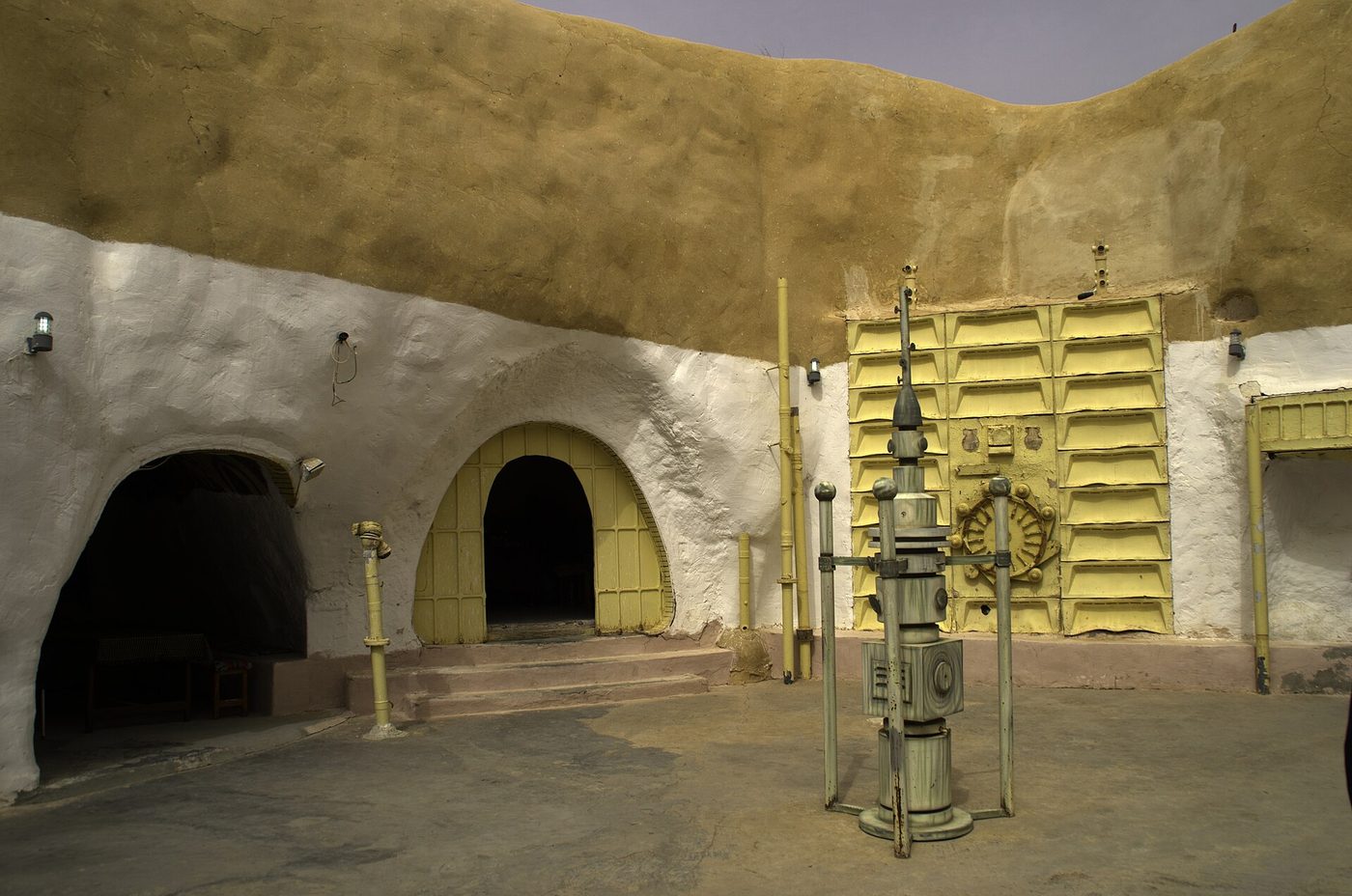
The other reason people come. In 1976 the interiors of the Lars homestead — Luke Skywalker’s childhood home on Tatooine — were filmed inside a Matmata cave hotel usually written as Hotel Sidi Driss (you’ll also see Sidi Idriss). The domed exterior everyone pictures wasn’t here at all: that was built out on the salt flats of Chott el Jerid, roughly 300km west near Nefta, and Matmata provided the underground rooms and courtyard the family lived in. The set was dressed again around 2000 for the second prequel, and a fair amount of that later decoration was left behind.
What’s actually there
The hotel is a complex of five pits linked by tunnels, of which one — the largest — is the Star Wars pit, now used as the dining room. It’s the real thing: the sculpted yellow panelling on the walls, the moisture-vaporator prop standing in the courtyard, the painted door surrounds, the steps Luke climbs. Ceiling frescoes in the dining chamber were uncovered and restored under the whitewash years ago, though these are as likely to be traditional local decoration as film dressing.
What surprises people is the tone of the place. The entrance has been painted up with lightsabers, helmets and a large STAR WARS sign, and the effect is closer to a themed café than to a Berber house. If you came for architecture you may wince. If you came because you were nine when you first saw the film, you probably won’t care at all. Our wider guide to Star Wars filming locations in Tunisia sets it alongside the sets at Tozeur, Nefta and the ksour further south.
Is it still open?
Yes, as far as we can establish. Sidi Driss has been trading and taking bookings through 2025 and into 2026, and recent visitor reports describe the Star Wars pit as accessible and the set dressing intact. But treat that as a snapshot, not a guarantee: this is a small, ageing, family-run place that has closed and reopened before, and the pit is sometimes shut off when the adjoining kitchen and bar aren’t operating. If seeing it is the whole point of your journey, phone ahead or have your driver ring on the morning — don’t drive three hours on our say-so.
Note too that you don’t have to be a guest. Walking in to look, or stopping for a drink or lunch in the pit, has traditionally been possible for a token amount or the price of a coffee.
Should you sleep in a cave hotel?
Only if you know what you’re signing up for. The rooms at Sidi Driss are hollowed-out caves with a bed and not much else, bathrooms are shared, and reviews have complained for years about upkeep — the place takes a very high volume of day visitors and reinvests little. Cleanliness reports are mixed at best. Other cave hotels in the village, including Les Berbères and Marhala, are generally described as simpler but better kept, and there are part-cave places out along the Tamezret road with pools and more conventional comforts.
Our view: one night is a genuinely good story and a genuinely poor night’s sleep. If you want a memorable desert overnight, we’d spend it at Ksar Ghilane or in a proper dune camp instead, and treat Matmata as a daytime stop.
The Toujane road — the best bit most people miss
If you take one thing from this page, take this. The approach to Matmata from the Medenine side runs through the Matmata hills via the Berber village of Toujane, and it is one of the most striking drives in Tunisia.
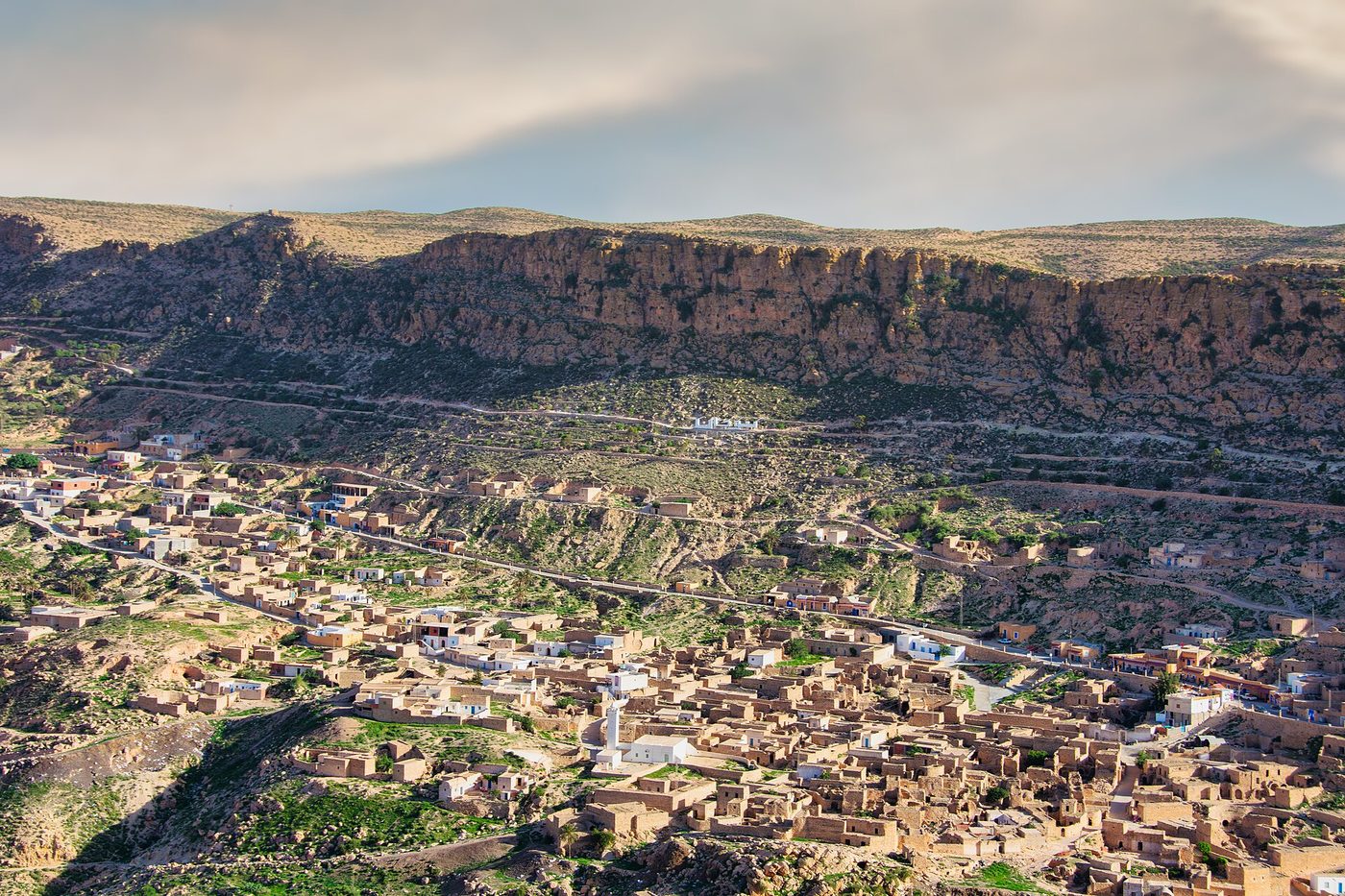
Toujane sits about 23km from Matmata and about 27km from Medenine, draped across two slopes either side of a gorge. Its houses are stone-built and above ground, terraced up the hillside in a way that looks, from a distance, like part of the rock — the exact opposite architectural answer to the same problem Matmata solved by digging down. The village was an old staging post on the caravan road between Gabès and Medenine, with a pair of ruined forts facing each other across the pass.
There’s a café-restaurant on the upper slope with a terrace and a viewing deck that looks straight down over the rooftops to the plain beyond. Order a coffee, climb up, take twenty minutes. Reports on the food are lukewarm, so treat it as a viewpoint with a drinks licence rather than a lunch stop. The souvenir cases are heaped with desert roses — gypsum crystals that grow in rosette clusters and are the regional keepsake.
Ten kilometres west of Matmata on the Douz road is Tamezret, another Berber-speaking stone village with a small museum-café and long views, and far fewer coaches. Between them, Toujane and Tamezret are what turn Matmata from an underwhelming photo stop into a properly good half-day. Add them to a wider loop and you’re into the territory covered in our roundup of the most beautiful places in Tunisia.
Getting to Matmata
Matmata is not somewhere you stumble across. Here’s how the main approaches work.
| From | Rough distance | How most people do it |
|---|---|---|
| Gabès | ~40km, about 45 min | Bus (several a day) or louage; the only easy public-transport route |
| Djerba | ~150km, 2.5–3 hours | Organised day trip or hire car, usually via Medenine and Toujane |
| Douz | ~120km, around 1.5–2 hours | Hire car or a leg of a multi-day desert tour |
| Tozeur | 250km-plus, half a day | Almost always part of a wider southern circuit, not a day trip |
| Sousse or Hammamet | 350km-plus | Two- or three-day organised tour only; a day trip isn’t realistic |
On an organised day trip
By far the commonest way. From the island, Matmata is the anchor of a standard full-day loop that usually also takes in the Mareth war museum and Toujane, or pairs Matmata with a desert run — see our guide to day trips from Djerba for how these are packaged and priced. Longer Sahara tours from Djerba and multi-day Sahara tours from Sousse nearly all pass through. The trade-off is time: you’ll get perhaps an hour in the village, at the worst hour of the day, in a convoy.
By hire car
Our preferred option, and the one that unlocks Toujane and Tamezret. The roads are sealed and reasonable, though the mountain sections are narrow, unlit and occasionally rough at the edges, so don’t plan to drive them after dark. You’ll need a 1968-convention international driving permit alongside your UK licence, and you should expect routine police and national guard checkpoints — slow right down, be friendly, have documents to hand. The general rules of the road are in our guide to getting around Tunisia.
By louage and bus, independently
Entirely doable, and cheap, if you’re flexible. Get yourself to Gabès first — it’s on the main north-south road and rail corridor — and go to the louage station. Shared taxis and local buses run to Matmata through the day, and the fares are small change by UK standards; travellers have reported paying a couple of dinars for the Gabès leg and a further dinar or so for the final hop, with the option of chartering a whole louage for a modest sum if you don’t want to wait.
The one thing to get right: say Matmata Ancienne, clearly and repeatedly. Some services terminate at New Matmata, 15km short, and you’ll be stuck waiting for an onward connection that thins out badly in the afternoon. Louages leave when they’re full, not to a timetable, so mornings are much better than afternoons, and you want to be heading back to Gabès well before the light goes.
How long is Matmata really worth?
Our honest reckoning:
- 1 hour: a demonstration house, a look down into a couple of courtyards, photos. This is the coach-stop experience and it’s the one that generates the disappointed reviews.
- 2–3 hours: add a walk through the village lanes, the small museum behind Sidi Driss (tiny, barely labelled, worth a few dinars for the objects rather than the interpretation) and a coffee or lunch in a cave dining room. This is the sweet spot.
- Half a day: the above plus Toujane, or Tamezret, or both. Now it’s a proper excursion and the landscape does as much work as the houses.
- Overnight: for the novelty and for photographers who want the hills at dawn. Be realistic about the accommodation.
- Two days: hard to justify unless you’re using Matmata as a base for slower exploring, which very few people do.
Is Matmata a tourist trap? Our verdict
The criticism you’ll find on Reddit and in the one-star reviews is broadly this: it’s staged, it’s rushed, you get hassled for money, the “cave house” is a shop, and it’s a long way to go for a hole in the ground. Every one of those complaints is describing something real.
But look at what they have in common — they’re all descriptions of the coach stop, not of Matmata. Turn up at eleven in the morning in a convoy of minibuses, spend forty minutes in a house that has hosted three hundred people before lunch, and you will indeed feel processed. That’s a problem with the format, and it’s fixable.
Do it differently and it’s a good half-day. Drive yourself, arrive early or late, walk the lanes, stop at Toujane, look at the hillside properly — pit houses read as craters until you learn to spot them, and then you realise the whole valley is full of them. What you’re looking at is a genuine, still-inhabited answer to an unforgiving climate, worked out long before anyone had a word for passive cooling. That’s worth two hours of anyone’s time.
Would we cross the country for it alone? No. As part of a southern loop that also takes in Douz, the ksour around Tataouine and a night in the dunes — absolutely yes. Our sample routes in the Tunisia itinerary guide show how it fits.
Practicalities: money, weather and safety
Money
Bring cash in small denominations. There is very little card acceptance in the village, tips and entry fees are cash-only, and the nearest reliable ATMs are in Gabès or New Matmata. Remember that the Tunisian dinar is a closed currency — you can’t buy it before you fly and you can’t legally take it home, so change money after you land and keep the receipts. More of this sort of thing in our Tunisia travel tips.
When to go
Spring and autumn, comfortably. March to May and October to November give you walkable temperatures and decent light on the hills. July and August above ground in southern Tunisia are genuinely punishing, and while the caves are cool, the walking between them isn’t. Winter days are pleasant and clear but the nights get properly cold — worth knowing if you’re staying over. Our best time to visit Tunisia guide breaks the year down month by month.
Safety and insurance
Matmata is in Gabès Governorate, well away from Tunisia’s frontier regions, and it sits outside every area covered by British government travel restrictions. FCDO advice, last updated 24 July 2026 and still current when we checked on 4 September 2026 — always check gov.uk/foreign-travel-advice/tunisia before you book. We go through the exact wording, zone by zone, in our guide to whether Tunisia is safe.
Practical risks here are the ordinary ones: heat, dehydration, an unlit mountain road, and stone steps with no handrails. Take water, wear something with grip on the soles, and note that your UK GHIC is not valid in Tunisia — comprehensive travel insurance with medical cover and repatriation is essential. Check TravelHealthPro’s Tunisia page (country 226) and the NHS Fit for Travel site before you go.
Frequently asked questions
Is Matmata worth visiting?
Yes, with the right expectations and enough time. As a fifteen-minute coach stop it’s underwhelming; as a two-hour wander with a stop at Toujane on the way, it’s one of the more interesting things you can do in southern Tunisia. The engineering is genuinely clever and the landscape is unlike anywhere else in the country.
How long do you need in Matmata?
Most people find one to two hours is right for the village itself — long enough to see a pit house properly, walk a few lanes and have a coffee underground. Add Toujane or Tamezret and you have a satisfying half-day. Two full days is difficult to fill unless you’re using it as a walking base.
Do people still live in the underground houses?
Yes. Several dozen households in and around Old Matmata still live in pit dwellings year-round, alongside many that are now used for storage, tourism or nothing at all. The 1969 floods prompted the government to build a modern town nearby, but most families repaired their pits and stayed put rather than move.
Is Hotel Sidi Driss still open?
It has been operating and taking bookings through 2025 and into 2026, with the Star Wars set dressing still in place in the largest pit. That said, it’s a small family-run place that has opened and closed before, and the pit is occasionally shut when the kitchen isn’t running. Ring ahead or have your driver check on the day.
Was Luke Skywalker’s house filmed in Matmata?
The interiors were. Hotel Sidi Driss stood in for the inside of the Lars homestead in the 1977 film and was re-dressed for the 2002 prequel. The famous white dome exterior was a separate build out on the salt flats of Chott el Jerid, several hundred kilometres to the west, so the two halves of that “house” are nowhere near each other.
How do you get to Matmata from Djerba?
It’s roughly 150km and two and a half to three hours each way, so almost everyone goes on an organised day trip or by hire car, usually routed via Medenine and the Toujane mountain road. There’s no useful direct public transport from the island; independent travellers change at Gabès. If you’re basing yourself on Djerba, budget a full day.
Can you reach Matmata by public transport?
Yes, via Gabès. Local buses and shared louages run from Gabès through the day for a few dinars, taking around 45 minutes. Ask specifically for Matmata Ancienne, because some services stop at New Matmata about 15km short. Louages go when they’re full rather than to a timetable, so travel in the morning and start back early.
How much should you tip at a Matmata family home?
A modest few dinars a head has long been the norm for looking round a private house, but there’s no fixed rate and it varies by house and by group. Agree the amount before you go down the entrance tunnel rather than at the exit, carry small notes, and consider buying a small item instead of, or as well as, tipping.
What’s the difference between Old and New Matmata?
Old Matmata (Matmata Ancienne) is the hill village with the pit houses, cave hotels and everything you came to see. New Matmata (Matmata Nouvelle) is the surface town built after the 1969 floods, about 15km away towards Gabès, with conventional housing and no sights. Make sure your transport is going to the old village.
Can you sleep in a cave hotel in Matmata?
You can, at Sidi Driss and a handful of others including Les Berbères and Marhala. Rooms are simple hollowed-out caves, bathrooms are usually shared, and standards of upkeep draw regular complaints. It’s a memorable night rather than a comfortable one — for a genuinely good desert overnight, we’d point you at a dune camp instead.
Is Matmata safe to visit?
Yes. It’s in Gabès Governorate, far from Tunisia’s border areas and outside every zone the British government advises against travelling to, and it has been a mainstream tourist stop for decades. The realistic hazards are heat, uneven ground and driving mountain roads after dark. Read our date-stamped safety guide for the current FCDO wording.
What else can you combine with Matmata?
Toujane and Tamezret are the obvious add-ons. Further afield, Matmata pairs naturally with camel trekking in the dunes, the oasis of Ksar Ghilane, the ksour circuit, or a run west towards Tozeur and the mountain oases at Chebika, Tamerza and Mides. Our list of Tunisia excursions and our roundup of the country’s quieter hidden gems have more ideas.
Written by the Tunisia Tourism Guide team — an independent UK-focused guide to travelling in Tunisia. We don’t sell tours or take hotel commissions. Prices and advice were checked at publication; always confirm current details before you book.
Photo credits
All images via Wikimedia Commons, used with thanks: A troglodyte pit house in Matmata © Robert Linsdell from St. Andrews, Canada (CC BY 2.0); The bare hills around Matmata in southern Tunisia © Ahmedhamouda (CC BY-SA 3.0); Star Wars set decoration in the courtyard pit at Hotel © Habib M’henni (CC BY-SA 4.0); The stone terraces of Toujane village on the Matmata mountain © Bill.pix (CC BY-SA 4.0).