By the Tunisia Tourism Guide team · Last updated 4 September 2026 · We don’t sell tours or take hotel commissions — this is independent advice, written to be useful.
The question we get about Dougga is almost never “is it any good?” — everyone already knows the answer to that. It’s “how on earth do I actually get there without booking a £90 tour?” Every guidebook tells you it’s the best Roman site in the country and then, in the next breath, tells you there’s no public transport. Both statements are half true, and the gap between them is where people give up.
Here is the honest answer. You can reach Dougga independently for a few pounds: take a louage (shared minibus) from Bab Saadoun in Tunis towards Téboursouk, then a local taxi up to the gate, and check the day’s departures at the station. The catch is the return — there is almost no passing traffic at the site, so you must agree a wait-and-return fare with the same driver before you set off.
That single sentence is the thing nobody writes down, and it’s why so many people end up on a coach. This guide is the version we wish we’d had: the transport worked out properly, plus a walking route round the site in an order that makes sense. It sits inside our wider guide to Roman ruins in Tunisia, which ranks the country’s ancient sites and tells you which ones deserve a whole day.
Dougga at a glance
| Question | Short answer |
|---|---|
| Where is it? | Hilltop above Téboursouk, Béja Governorate, north-west Tunisia — about 110km from Tunis |
| What is it? | Ancient Thugga: a complete Roman town of roughly 70 hectares, UNESCO-inscribed in 1997 |
| Entry | Around 8 dinars for non-residents, about 5 for residents (2026 — check current prices at the booth) |
| Hours | Roughly 08:30–17:30 in winter, 08:00–19:00 in summer; open every day (confirm before you travel) |
| Time needed | 2–3 hours to walk it properly; half a day if you like inscriptions |
| Best time of day | First thing, or after about 16:00. There is essentially no shade |
| Cheapest way there | Louage Tunis → Téboursouk, then a return taxi with waiting time agreed up front |
| What to skip | Nothing, honestly — but don’t bother hunting for the best mosaics, they’re in the Bardo |
Why Dougga is different from every other Roman site in Tunisia
Most ancient sites give you one great thing surrounded by rubble. At El Jem it’s the amphitheatre. At Carthage it’s a scatter of separate parks with a motorway-ish suburb draped over the top. Dougga is the opposite: it’s the whole town.
A complete town, not a single monument
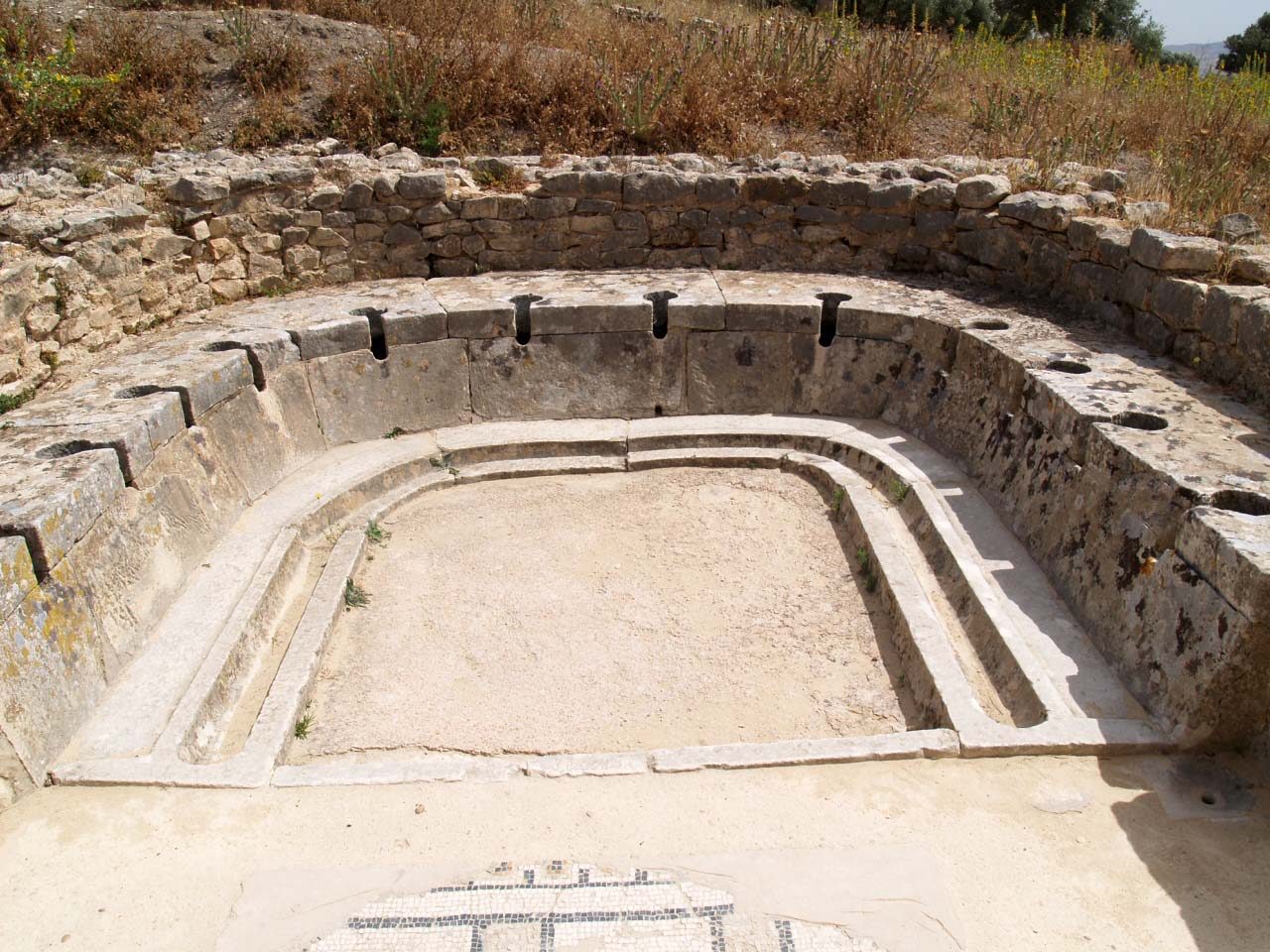
You walk on the actual streets, rutted by cart wheels. You can see where the market was, where people lived, where they washed, where they went to the loo — an intact twelve-seat public latrine that is, we’d argue, more memorable than half the temples. Cisterns, an aqueduct, house plans you can read at ankle height, a theatre, a forum, a mausoleum older than the Romans, and inscriptions everywhere.
UNESCO puts the inscribed area at about 75 hectares; Tunisia’s own heritage agency describes roughly 70. Either way it’s a proper walk over a hillside at around 571m, looking down over the fertile Khalled valley — olive groves, wheat, sheep, the odd tractor. Dougga is one of the few ruins where the view from the top row of the theatre is as good as the theatre. And it’s quiet: it has never had the visitor numbers its quality deserves, and midweek out of season you can go twenty minutes without seeing another person. One of the genuinely most beautiful places in Tunisia, and usually empty.
Numidian first, Roman second
This matters for what you’ll actually be looking at. Thugga existed for centuries before Rome arrived — founded by the end of the 6th century BC at the latest, and possibly the first capital of the Numidian kingdom. The Greek writer Diodorus of Sicily described it in the early 4th century BC as a town of “a fair size”. There’s a temple here built in 139 BC for the Numidian king Massinissa.
When Rome took over in 46 BC it didn’t flatten the place, as it had done at ancient Carthage. Roman settlers moved in alongside the existing population, and for around two and a half centuries two legally separate communities shared one hillside. The street plan stayed stubbornly local; the monuments went up in Roman marble-and-column style. That collision is exactly why UNESCO listed it.
The site has also produced one of the great epigraphic collections of the Roman world — well over 2,000 inscriptions in Libyan, Punic, Greek and Latin, including bilingual ones. One of those is the reason a chunk of Dougga now sits in Bloomsbury, which we’ll come to.
Getting to Dougga: the logistics nobody explains
Here’s the part that actually decides whether you go. We’ll give you four options, with honest timings — including the dead time you never see quoted.
Option 1: louage from Tunis, then a taxi (the cheap one that works)
Louages are Tunisia’s shared long-distance minibuses: no timetable, they leave when full, and they are the backbone of getting around outside the cities. If you’ve not used one, read our guide to getting around Tunisia first — the system is simple once you’ve done it once and baffling until then.
The route is:
- Bab Saadoun louage station in Tunis (the northern station, sometimes signed Gare Routière Nord) to Téboursouk. Reckon on about 80–100 minutes on the road, and expect to pay a single-figure sum in dinars — travellers have reported roughly 6–8 TND recently (2026 — check current fares). Ask for “Téboursouk”, not Dougga; the touts will find you before you find the van.
- Téboursouk to the site is an uphill run by local taxi. There’s a taxi rank right beside where the louage drops you. Expect to be quoted somewhere in the 15–30 TND region for the round trip including waiting time (2026 — negotiate).
The critical bit: agree the return before you get in. Dougga sits on a hill above a farming village. There is no rank at the gate and very little passing traffic. If you take a one-way taxi up, your options for getting back are a long hot walk, hitching, or hoping a tour minibus takes pity on you. Agree a price for “there, wait two and a half hours, back to Téboursouk”, say the time out loud, and pay at the end rather than up front. Some drivers will genuinely park and wait; others disappear and send a cousin at the agreed hour. Both work.
Be aware there is an informal alliance between louage and taxi drivers — the louage driver will often ring ahead so a taxi is waiting for the foreigner. It’s not a scam so much as a referral network, but it does mean your first quote will be the high one. Smile, halve it, settle in the middle.
Option 2: the Le Kef and Nouvelle Dougga variations
Two useful variations. Ask at the station whether any louages from Tunis go to Nouvelle Dougga, the modern village on the main road below the site — the one built for the families who were living inside the ruins until the mid-20th century. From there it’s still a taxi up the hill, so the advantage is marginal unless one is leaving as you arrive.
More usefully, if you’re coming from or heading on to Le Kef, there are louages between Le Kef and Téboursouk taking roughly an hour. That makes Dougga a stop on a north-west loop rather than a there-and-back from the capital. It’s the route we’d take if we were spending more than a day in the region.
Option 3: drive yourself
By far the most flexible option, and the one we’d pick. It’s roughly 110km from Tunis — the A3 motorway towards Béja, then local roads via Téboursouk. One Tunis taxi firm puts the trip at about 1h30 from the city centre, so allow more than that for traffic leaving Tunis and the narrow rural road at the end.
Parking is free at the entrance. Note there are two ways in: the main gate near the theatre at the top, and a lower entrance near the restaurant on the far side. Both have ticket booths and a car park. Follow the brown archaeological signs on the road rather than your satnav — GPS has a habit of routing people down a farm track into the village and leaving them there.
If you’re hiring a car you’ll want the 1968-style International Driving Permit alongside your UK licence, and you should expect police and military checkpoints on rural roads: slow right down, wind the window down, have documents to hand, and they’ll almost always wave you through. Our Tunisia road trip guide covers the paperwork and driving norms; our general travel tips cover money and the closed-currency dinar, which you’ll need in cash here.
Option 4: an organised day trip
Perfectly reasonable if you’d rather not spend the day negotiating. From Tunis, full-day guided trips are widely sold, usually combining Dougga with Testour or with Bulla Regia, and they typically include hotel pick-up and lunch. Prices move constantly, so we won’t quote one, but expect a meaningful multiple of what the DIY route costs. Browse what’s realistic on our day trips from Tunis page.
From Hammamet or the Sousse coast it’s a different proposition. Dougga is well inland and north-west; from a beach resort you’re looking at three hours each way and a very long day for two and a half hours on site. Operators do sell it — see our honest assessment of day trips from Hammamet and of the wider Tunisia excursions market. If Roman ruins are your priority and you’re based on the coast, Sousse is much better placed for El Jem. Dougga is a Tunis trip.
The four options, honestly compared
| Option | Realistic door-to-door time from Tunis | Rough cost | Best for |
|---|---|---|---|
| Louage + return taxi | Depends on louage departures and taxi waiting | Louage fare plus a taxi | Confident independent travellers with a full day |
| Louage via Le Kef | Similar, but doesn’t backtrack | Cheap | Anyone touring the north-west |
| Self-drive | About 1½ hrs from central Tunis on a taxi firm’s estimate, more in traffic | Car hire + fuel | Combining Dougga with Testour or Bulla Regia |
| Organised tour | Full day, 08:00–18:00-ish | Highest | Anyone who wants a guide and no hassle |
A walking route round Dougga that actually works
Signage on site is thin and mostly in French and Arabic. Most people wander, miss half of it, and leave puzzled. Here’s the order we’d walk it, starting at the upper entrance by the theatre and working downhill — which is the sane direction on a hot day.
1. The theatre
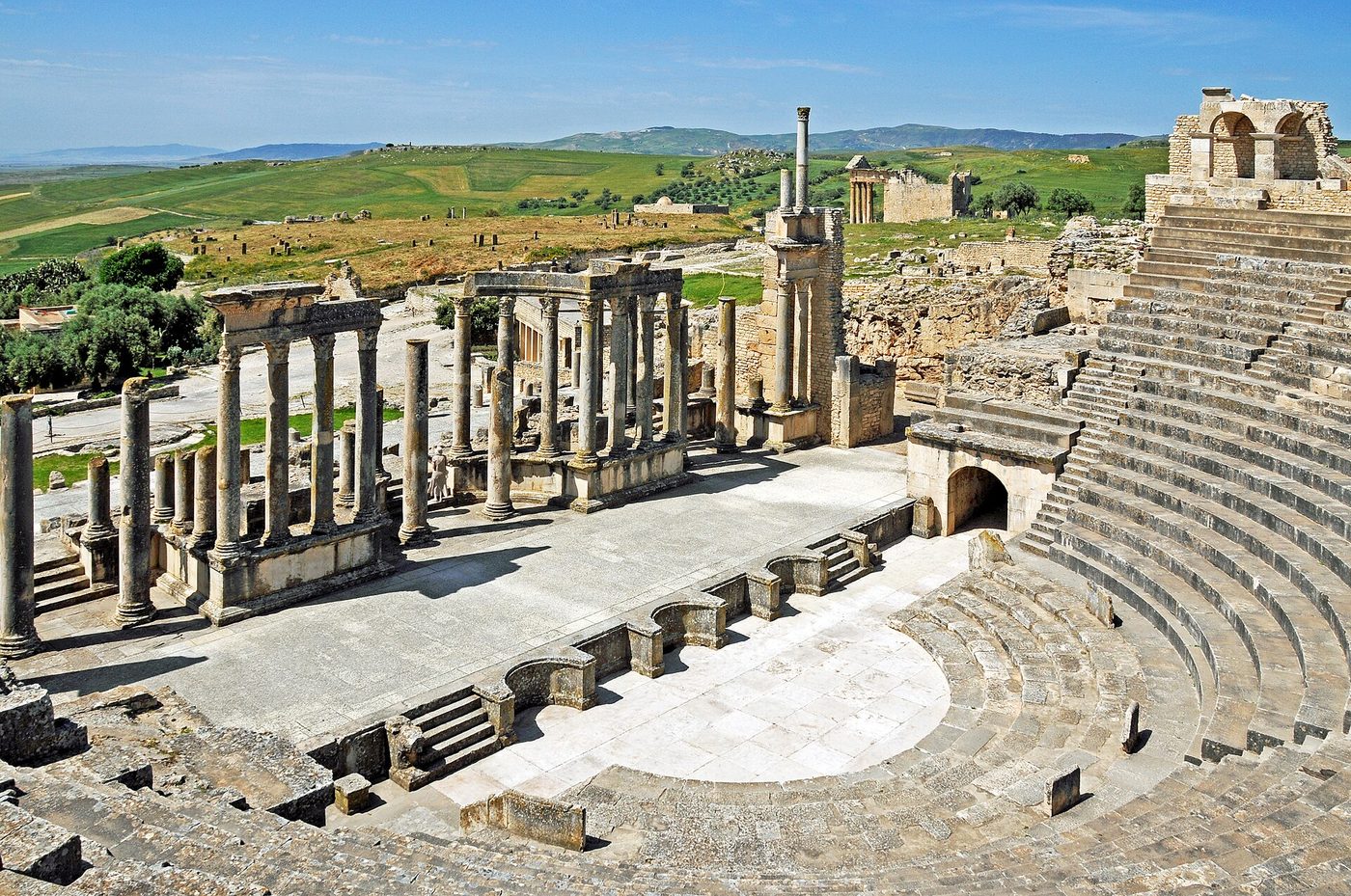
It’s the first thing you see and it’s a good one: built in AD 168 or 169, seating around 3,500 people in a town of perhaps 5,000. Do the maths on that and you understand something about Roman provincial vanity. The dedication records that a local grandee, P. Marcius Quadratus, paid for it himself, and celebrated the opening with shows, a festival and athletic games.
Climb to the very top row before you do anything else. The valley opens up below, the whole site lies in front of you, and you get your bearings for the walk. It’s still used for performances during the Dougga festival in summer, though programme information is famously hard to find in advance — ask locally if you’re there in July or August.
2. The Capitol
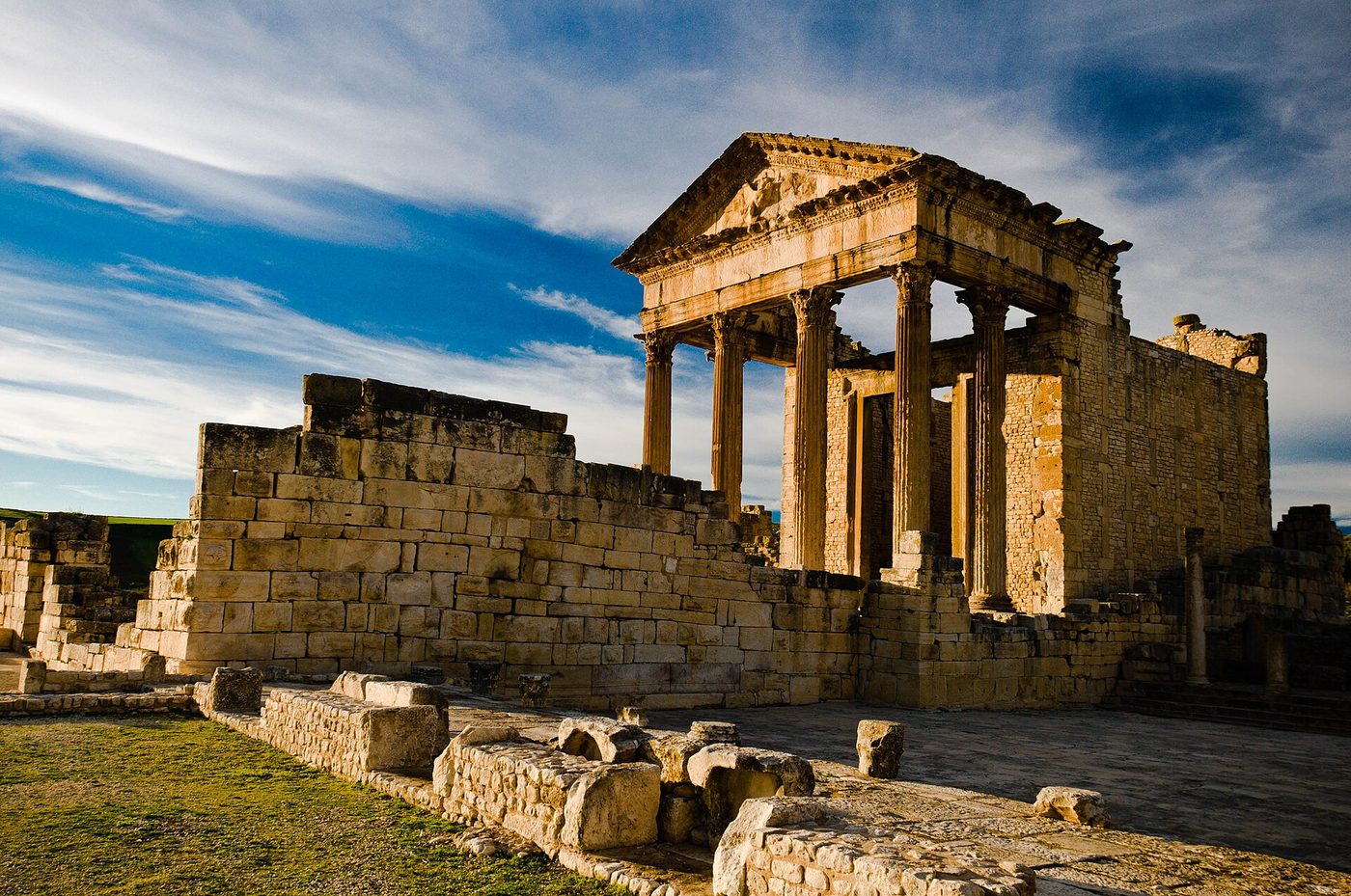
Downhill from the theatre, and the reason most people come. Dougga’s Capitol is exceptionally well preserved, as you’ll see standing in front of it: the pediment is complete, the six Corinthian columns are around 8m tall, and much of the cella wall behind is still up.
It was finished around AD 166–167 — dated by its secondary dedication to the emperors Marcus Aurelius and Lucius Verus, alongside the main dedication to Jupiter, Juno and Minerva. Look up at the pediment: the carving shows the emperor Antoninus Pius being carried up to the gods by an eagle. Inside, the base of the cella still has the three alcoves for the cult statues; the colossal Jupiter that stood in the middle is long gone, and fragments ended up in the Bardo Museum in Tunis.
Here’s the lovely irony: it survives so well because the Byzantines built a fort round it in the 6th century and swallowed the temple whole. Preservation by fortification.
3. The Square of the Winds
Immediately beside the Capitol, and the single most overlooked thing on the site. Look down at the paving. Carved into the stone is a compass rose naming the twelve winds the Romans recognised, each with its Latin name radiating outwards from the centre.
It’s worn, and if the light is flat you can walk straight across it without noticing — which is exactly what most visitors do. Early or late sun rakes across the letters and makes them readable. It’s a two-thousand-year-old weather chart underfoot. The square itself worked more as an esplanade leading up to the Temple of Mercury on its north side than as open public space, and the masonry around you is the remains of that Byzantine citadel. The small mosque nearby was built by the villagers who lived here for centuries after the Romans left.
4. The Licinian Baths
Follow the street downhill. The Licinian Baths (sometimes called the Antonine Baths, and dated variously to the reigns of Caracalla or Gallienus in the 3rd century) are the big set-piece bath complex, with much of the walls still standing over several levels.
Two things to do here. First, the frigidarium has triple arcades at each end and large windows framing the valley — Roman bathers had a better view from the cold plunge than most modern spas manage. Second, find the service tunnel: a long, dark passage used by the enslaved workers who kept the furnaces going, with hollow flue tubes still visible in the wall. There’s no lighting. Get your phone torch out. It’s the most atmospheric thirty seconds on the site and almost everyone walks straight past the entrance.
5. The Cyclops Baths and the twelve-seat latrine
A short way on is the smaller Cyclops bath complex, named for a mosaic of one-eyed giants forging Jupiter’s thunderbolts that was lifted from here and is now — along with so much else — in the Bardo. If you want to understand how much of Dougga’s decoration has been relocated, read our guide to Tunisian mosaics before you come; it makes the empty floors here far more legible.
What is still here is the latrine, and it’s magnificent. Twelve stone seats in a horseshoe, footrests intact, a channel of running water in front for rinsing the sponge-on-a-stick, and a drain beneath that fed into the town’s main sewer. Romans did this side by side, in company, chatting. Nothing else at Dougga collapses the distance between then and now quite so effectively. It is also, invariably, the photo everyone sends home.
6. The Trifolium House and the residential streets
In the southern part of the site, some distance from the Cyclops Baths, stands the Trifolium House, the largest private house yet excavated at Dougga. It’s named after a clover-shaped room that was almost certainly the dining room, and it originally had two storeys, though nothing meaningful survives of the upper one. The entrance hall slopes down into a courtyard with the rooms arranged around it — a house designed around the gradient rather than fighting it.
Your guide may tell you confidently that this was the town brothel. It’s a well-worn story, disputed by archaeologists, and nobody can prove it either way — enjoy it as folklore rather than fact. Around it, wander the residential lanes. This is the part that makes Dougga worth the journey: you can read the floor plans of ordinary houses, follow the drainage, see thresholds worn by doors.
7. The mausoleum of Ateban — and the piece that’s in London
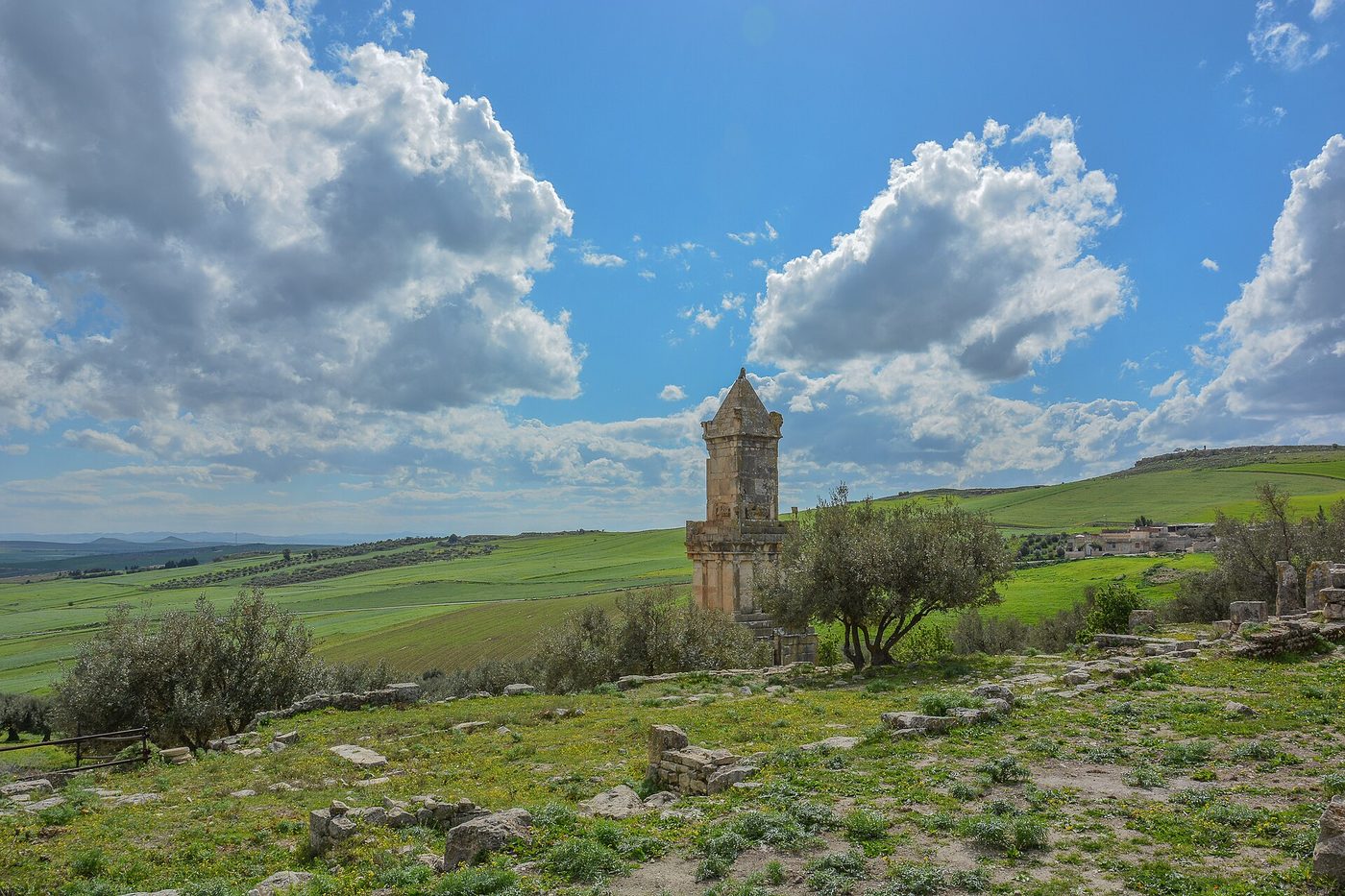
Keep going downhill to the edge of the site and you reach a 21m Libyco-Punic tower tomb from the 2nd century BC, three tiers on a five-step podium, capped with a pyramid, with griffins at the corners and a chariot carved on the upper level. It is one of only a handful of surviving examples of Numidian royal architecture, and it predates every Roman stone above it.
Now the story. The tomb carried a bilingual inscription in Punic and Libyan. In 1842 Sir Thomas Reade, the British consul in Tunis, decided he wanted it — and in prising it out he brought a substantial part of the monument down. The inscription went to the British Museum, where it remains, and where it proved genuinely important: it was the key that allowed scholars to decipher the Libyan alphabet, the ancestor of Tifinagh. The text itself, once translated, turned out to be a list of the craftsmen who built the thing — the stonemasons, carpenters and metalworkers, named individually.
What you’re looking at today is a reconstruction. The French archaeologist Louis Poinssot reassembled the scattered blocks between 1908 and 1910, working from earlier drawings. That makes one of the site’s icons, in part, an early twentieth-century rebuild. We think that makes it more interesting, not less.
8. The Temple of Caelestis and the far end
On the western edge, past a ceremonial arch, sits the Temple of Juno Caelestis — the Roman face of the old Punic goddess Tanit, and the most architecturally odd building on the site. The temple stands inside a vast semicircular colonnaded precinct whose curve is usually read as a deliberate echo of a crescent moon, Caelestis’s symbol. Several Corinthian columns are still standing and the sweep of the enclosing wall is unmistakable.
It’s a fair walk out from the main cluster, into open ground with no shade at all, and a lot of visitors look at it from a distance and give up. Don’t. Late-afternoon light on that curve is the best photograph at Dougga.
9. Cisterns, aqueduct and the things people walk past
If you’ve got energy left, seek out the Aïn Mizeb cisterns: seven adjoining domed reservoirs and an eighth compartment where the aqueduct arrives, holding something like 9,000 cubic metres between them, fed by a spring a couple of hundred metres away, and remarkably intact. A second network at Aïn El Hammam was supplied by an aqueduct from a spring around 12km distant. Water is the unglamorous story of every Roman town, and Dougga’s plumbing is better preserved than most of its temples.
Also worth a glance: the small market square, the compact forum, the Temple of Saturn on its rise, and the dolmens on the lower slopes — burials that predate everything else here by a very long way. Dougga is listed precisely because it stacks all these layers on one hillside; our roundup of Tunisia’s UNESCO sites puts it in context.
Tickets, hours and the photography question
What it costs
Tunisia’s heritage agency lists Dougga at around 8 dinars for non-residents and about 5 for residents (2026 — check current prices). That’s a couple of pounds. Tickets are sold at the booth at either entrance, cash only, and there is no online booking. Bring small notes: nobody at a rural ticket window wants to break a 50.
On top of that, several Tunisian archaeological sites levy a separate small charge for photography — usually a dinar or two, sometimes only enforced for tripods or obvious professional kit, and it doesn’t appear on the official tariff for Dougga. Assume you may be asked, carry a few coins, and don’t be surprised either way. If you’re planning anything commercial, that’s a different conversation and needs prior permission.
Opening hours
The official listing gives winter hours of roughly 08:30–17:30, summer hours of about 08:00–19:00, and Ramadan hours of around 08:00–17:00, open every day (2026 — confirm before you travel, and note that Ramadan next falls in February 2027). Last admission tends to be an hour or so before closing in practice, and staff start shepherding people towards the gate before the official time. Don’t roll up at 16:45 in December expecting a full visit.
Do you need a guide?
Interpretation on site is minimal, so a guide adds a lot — particularly for the inscriptions, which are the site’s real speciality and completely opaque without help. Guides can sometimes be found at the main entrance at weekends in season, but availability is unpredictable; arranging one through your hotel in Tunis in advance is more reliable. Expect a three-figure dinar sum for a couple of hours, agreed before you start, in cash. If you’d rather go it alone, download an offline map before you leave the city — mobile signal on the hill is patchy.
What it’s actually like on the ground
- There is no shade. None. This is the single most important practical fact about Dougga. It’s an exposed hilltop with a few olive trees at the margins. In summer the stone radiates heat back at you, and midday is unpleasant. Go at opening or from about 16:00.
- Footwear matters. You’re walking on original Roman paving, uneven kerbs, loose scree on the slopes and grass in spring. Trainers minimum; proper walking shoes if your ankles are temperamental. Sandals are a bad idea.
- Carry more water than you think. There is a cafeteria and a shop listed at the site, and a well-regarded restaurant just outside the lower entrance, but opening is not guaranteed and neither is finding them when you’re forty minutes’ walk away at the Temple of Caelestis. Two litres per person in summer.
- Loos exist — sanitary facilities are listed at the entrance — but they are basic and there’s nothing out in the site. Use them before you set off, and carry tissues.
- Hat, sunglasses, high-factor sun cream. Non-negotiable from May to September.
- Cash only, for everything: tickets, taxi, guide, lunch. The dinar is a closed currency — you can’t buy it before you fly and can’t take it out — so change money in Tunis before you go.
- Mobility: Dougga is a steep, rough hillside with no smooth routes. It is difficult for anyone with limited mobility, and impractical with a pushchair. Baby carriers work; wheels don’t.
How long to allow, and what to pair it with
Two to three hours is the honest answer for a proper look at the theatre, Capitol, Square of the Winds, both bath complexes, the houses and the mausoleum. Push it to four if you want the cisterns, the far temples and time to sit. Under ninety minutes and you’re doing a highlights sprint.
For pairings, be realistic about the geography:
- Testour — a town with Andalusian heritage and a famous mosque clock whose numbers run backwards. This is the easy, sensible pairing and it doesn’t wreck your day.
- Bulla Regia — further north-west, and the perfect contrast: at Dougga the Romans built up a hillside, at Bulla Regia they built down, giving their houses underground storeys that still hold their mosaic floors. Doing both in one day from Tunis is possible with your own car and an early start, but it’s a big day and you’ll rush one of them. We’d give each half a day if you can.
- Thuburbo Majus — often mentioned in the same breath, but it lies south-west of Tunis on a different road, so it pairs badly with Dougga on the same trip. Do it separately.
- Carthage and Sidi Bou Said — a completely different day, right on the capital’s doorstep. See our guides to visiting Carthage and to planning a Tunis itinerary.
If Dougga is the main reason you’re heading inland, base yourself in the capital rather than a beach resort — our guide to where to stay in Tunis covers the medina guesthouses and the Ville Nouvelle hotels that put you within a short taxi ride of Bab Saadoun.
Safety and timing
Briefly, because it comes up: Dougga sits in Béja Governorate, in the agricultural north-west, well outside every area covered by UK Foreign Office travel advice. FCDO advice, last updated 24 July 2026, concerns the Algerian and Libyan frontier regions and specific mountain zones — always check gov.uk/foreign-travel-advice/tunisia before you book, and see our fuller, date-stamped guide to whether Tunisia is safe. The practical risks at Dougga are sunstroke and a twisted ankle, in that order.
On timing: spring (roughly April and May) and autumn (September and October) are the sweet spot — mild, and in spring the valley is startlingly green with wildflowers between the stones. Summer is brutal on an unshaded hilltop; winter is cold, windy and prone to rain that turns the slopes greasy. Our best time to visit Tunisia guide breaks the seasons down month by month, and Dougga is on our list of the best things to do in Tunisia.
Frequently asked questions
How do you get to Dougga from Tunis without a car?
Take a louage from Bab Saadoun station towards Téboursouk (a single-figure fare in dinars), then take a taxi up to the site. Crucially, negotiate a return fare with waiting time included before you leave Téboursouk, because there is no reliable transport back from the gate.
How much does it cost to enter Dougga?
Tunisia’s heritage agency lists roughly 8 dinars for non-residents and about 5 for residents (2026 — check current prices). Payment is cash at the entrance booth; there’s no online ticketing. Budget a little extra in coins in case a separate photography charge is asked for, as happens at some Tunisian sites.
How long do you need at Dougga?
Allow two to three hours to walk the site properly — theatre, Capitol, Square of the Winds, both bath complexes, the houses and the mausoleum. Enthusiasts happily spend half a day, particularly if they’re reading inscriptions. Ninety minutes gets you the headline monuments and not much else.
Is Dougga better than El Jem or Carthage?
Different, and for our money more rewarding. El Jem gives you one colossal amphitheatre; Carthage gives you fragments across a modern suburb. Dougga gives you a whole town you can walk around, with streets, houses and drains as well as temples. If you can only do one Roman site inland, make it this one.
Is there any shade at Dougga?
Essentially none. It’s an open hilltop with a few olive trees at the edges and no cover across the main site. In summer the stone amplifies the heat and midday visits are genuinely uncomfortable. Go at opening time or from late afternoon, wear a hat, and carry at least two litres of water per person.
Can you visit Dougga and Bulla Regia in one day?
With your own car and an early start, yes — they’re roughly an hour apart. But it makes for a long day and you’ll end up rushing whichever you visit second. If you have the time, split them, or pair Dougga with the much closer Andalusian town of Testour instead.
Are there toilets and a café at Dougga?
The official site listing includes sanitary facilities, a shop and a cafeteria at the entrance, and there’s a well-liked traditional restaurant just outside the lower gate. Don’t count on any of it being open when you want it, though — use the loo before you set off into the ruins and bring your own water.
Do I need a guide at Dougga?
Not to enjoy it, but a good one transforms it. On-site interpretation is sparse and mostly not in English, and the inscriptions — the site’s real distinction — are meaningless without translation. Arrange a guide through your hotel in Tunis rather than hoping to find one at the gate, and agree the fee in cash up front.
What happened to Dougga’s mosaics?
Most of the finest ones were lifted long ago and are now displayed in the Bardo Museum in Tunis, including the Cyclopes forging Jupiter’s thunderbolts from the Cyclops Baths. Fragments of plainer paving survive in place. Visiting the Bardo either before or after Dougga makes both far more rewarding.
Why is part of the Dougga mausoleum in the British Museum?
In 1842 Thomas Reade, then British consul in Tunis, removed the tomb’s bilingual Punic-Libyan inscription and badly damaged the monument doing it. The inscription went to London, where it helped scholars decipher the Libyan alphabet. The mausoleum you see was reassembled from the scattered blocks by French archaeologists between 1908 and 1910.
When is the best time of year to visit Dougga?
April–May and September–October. Spring is the pick: mild temperatures, wildflowers across the site and the Khalled valley at its greenest. Summer is punishingly hot on an unshaded hill, and winter brings cold wind, rain and slippery slopes — though a crisp December morning with the site to yourself has its own appeal. And yes, it’s safe: Béja Governorate is far from any area covered by FCDO advice, and travel insurance is essential because the UK GHIC is not valid in Tunisia.
Written by the Tunisia Tourism Guide team — an independent UK-focused guide to travelling in Tunisia. We don’t sell tours or take hotel commissions. Prices and advice were checked at publication; always confirm current details before you book.
Photo credits
All images via Wikimedia Commons, used with thanks: The Capitol at Dougga © Mohamed Amine ABASSI (CC BY 2.0); The Roman theatre at Dougga seen from the top tier © Dennis G. Jarvis (CC BY-SA 2.0); The twelve-seat communal Roman latrine in the Cyclops Baths at © Profburp (Public domain); The Libyco-Punic mausoleum of Ateban at Dougga standing above the © IssamBarhoumi (CC BY-SA 4.0).