Yes — Tunisia has some of the finest Roman ruins on Earth, and you can usually have them almost to yourself. El Jem’s amphitheatre rivals the Colosseum, Dougga is the best-preserved Roman small town in North Africa, and Carthage sprawls right along the Tunis coast. This guide ranks the 12 best, with honest verdicts, the 2026 prices and the practical ways to reach them.
The Roman ruins in Tunisia can fill whole days: a quiet forum at Dougga, the vertiginous top tier of the El Jem amphitheatre, an underground Roman room at Bulla Regia with its mosaic floor still in place. This is, for my money, the single best of all the things to do in Tunisia, and it’s the thing UK holidaymakers most often miss while they’re sitting by the pool. So this is the guide I wish I’d had: every site worth your time, grouped by who it suits, with the logistics nobody else bothers to spell out.
A quick word on what this guide does differently. Most “best Roman ruins” lists are written from Tunis and stop at inspiration. This one is written for the way people actually travel here — from a resort in Hammamet, Sousse or Djerba, or on a short touring trip — with real drive times, the new 2026 ticket prices in dinars, and an honest line on the handful of interior sites I won’t send you to. Last updated: June 2026.
Why the Roman ruins in Tunisia are world-class
For roughly six centuries this was one of the richest corners of the Roman world. After Rome finally destroyed Carthage in 146 BC at the end of the Third Punic War, the territory became the province of Africa, and by the second century AD it had become a major supplier of grain to Italy, with farming and olive oil underpinning its prosperity. That wealth built cities, and those cities built theatres, baths, triumphal arches, capitols and amphitheatres on a scale you’d expect in Italy, not on the edge of the Sahara.
Two things make the ruins here special for a visitor. First, preservation: sites like Dougga and Bulla Regia survive as extensive street plans you can walk through, not a few columns marooned in a modern city. Second, space. At Italy’s big sites you shuffle behind a rope in a crowd; here you can often walk straight into the arena, down into a Roman cellar, or across a forum with barely another tourist in sight. Tunisia has ten UNESCO World Heritage Sites in all, and four of them — Carthage, El Jem, Dougga and Punic Kerkouane — are on this trail.
Punic, Numidian, Roman or Byzantine? A quick guide to who built what
You’ll see these words on every information board, and it helps to keep them straight, because Tunisia’s “Roman” ruins are usually layered.
- Punic (or Phoenician-Punic) — the civilisation of Carthage itself, founded by Phoenician settlers from modern Lebanon around 814 BC. This is the world of Hannibal and his elephants. Genuine Punic remains are rare because Rome flattened Carthage; the great exception is Kerkouane on Cap Bon, a Punic town that was never rebuilt.
- Numidian — the indigenous Berber/Amazigh kingdoms that ruled the interior before and alongside Rome. Their masterpiece is the elegant Libyco-Punic Mausoleum at Dougga, which predates the Roman town around it.
- Roman — the bulk of what you’ll see, mostly 1st–3rd century AD: forums, capitols, theatres, baths and El Jem’s amphitheatre.
- Byzantine (Eastern Roman) — after the Vandals and then Justinian’s reconquest in the 6th century, the Byzantines fortified many towns. Those blunt, recycled-stone forts you see plonked on top of elegant Roman fora — at Dougga and elsewhere — are theirs.
So “is Carthage Roman or Punic?” The honest answer is both: a Punic superpower that Rome destroyed and then rebuilt as its own provincial capital. That layering is half the fascination.
Tunisia’s Roman ruins at a glance
Here’s the whole trail in one table — what each site is, the nearest sensible base, roughly how long you need, and the 2026 entry price. I’ll explain the new pricing and the resort transfers further down; treat this as your shortlist.
| Site | What it is | Nearest base (drive) | Time needed | 2026 ticket | My verdict |
|---|---|---|---|---|---|
| El Jem | Giant amphitheatre | Sousse/Monastir (~1 hr) | 1.5–2 hrs | 20 TND | Unmissable |
| Dougga | Best-preserved Roman small town | Tunis (~2 hrs) | 2–3 hrs | 8 TND | Unmissable |
| Carthage | Punic & Roman capital | Tunis (by TGM train) | Half day | 20 TND | Unmissable |
| Bulla Regia | Underground Roman villas | Tunis (~2.5 hrs) | 1.5–2 hrs | ~8 TND | A genuine one-off |
| Bardo Museum | World-class Roman mosaics | Tunis (city) | 2–3 hrs | 30 TND | Unmissable (indoor) |
| Thuburbo Majus | Hilltop Roman colony | Tunis (~1 hr) | 1–1.5 hrs | ~8 TND | Worth it if driving |
| Uthina (Oudhna) | Amphitheatre & cisterns | Tunis | 1.5 hrs | 8 TND | Underrated, quiet |
| Utica | Early Phoenician settlement | Tunis/Bizerte | Varies | 8 TND | For enthusiasts |
| Zaghouan | Roman Temple of Waters | Tunis | Varies | Ask on site | Lovely detour |
| Maktar | High-plains Roman town | Tunis (~2.5 hrs) | 1.5 hrs | ~8 TND | Deep-cut |
| Kerkouane | Punic town the Romans never rebuilt | Hammamet (~1.5 hrs) | 1.5 hrs | ~8 TND | Special, remote |
| Kairouan | Islamic holy city & monuments | Sousse (~1 hr) | Half day | ~20 TND | Unmissable (not Roman) |
Prices are the 2026 figures under Tunisia’s new national heritage tariff (more on that below). At roughly 3.9 dinars to the pound in June 2026, a 20 TND ticket is about £5 and an 8 TND ticket barely £2 — these are some of the cheapest world-class sights you’ll ever pay to enter.
The big five: ruins you shouldn’t miss
If you only have a day or two for history, these are the five. Three are an easy day out for the coastal resorts; all five are world-class.
1. El Jem (Thysdrus): Africa’s colosseum

Nothing prepares you for the moment you turn a corner in a dusty little market town and a honey-coloured Roman amphitheatre the size of a stadium rears up over the rooftops. El Jem — Roman Thysdrus, built around 238 AD — is one of the largest amphitheatres in the Roman world, built to hold up to 35,000 spectators. It’s been a UNESCO World Heritage Site since 1979, and it is the single most jaw-dropping ancient sight in the country.
What makes it beat the Colosseum as an experience is access. There’s no crowd and no rope. You can climb to the top tiers for the view down the bowl, then descend into the hypogeum — the underground passages where gladiators and animals waited beneath the arena floor — and walk its full length. Bring a hat; the upper levels are pure sun.

Tickets & hours: 20 TND (about £5) in 2026, and the ticket is generally valid the same day for the excellent El Jem Archaeological Museum about 600m away, which has some of the finest in-situ mosaics in the country. The amphitheatre’s hours change with the season, so check them on the heritage agency’s site (patrimoinedetunisie.com.tn) before you travel. Getting there: El Jem sits on the main railway line, so it’s an easy train hop — roughly an hour from Sousse or Monastir and about three hours from Tunis. Most Sousse and Mahdia resorts run half-day coach excursions. Verdict: unmissable. If you do one thing on this list, do this. In July and August the amphitheatre hosts the International Festival of Symphonic Music, with orchestras playing in the arena under the stars — a remarkable setting if your dates line up.
2. Dougga (Thugga): the best-preserved Roman small town in North Africa

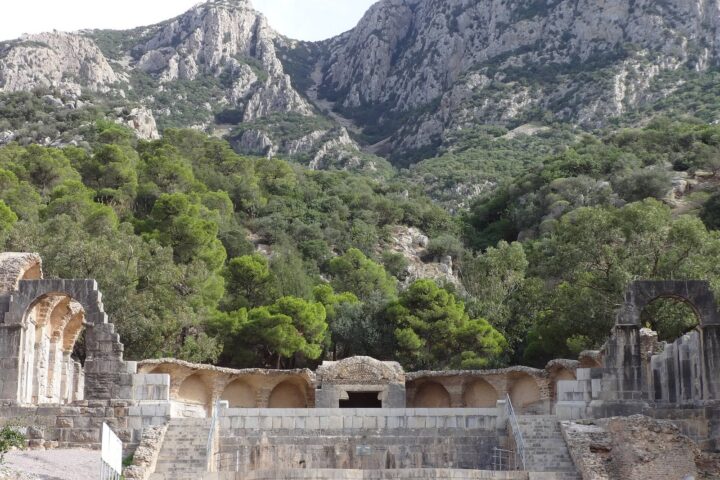
If El Jem is the showstopper, Dougga is the one that gets under your skin. UNESCO calls it the best-preserved Roman small town in North Africa, and that’s exactly what it is — not a handful of monuments but an entire hillside town, with paved streets, a theatre, temples, baths, a house sometimes identified as a brothel, communal latrines (sit down for the photo, everyone does) and the magnificent Capitol, its columns still holding up a pediment after 1,800 years. The views over the patchwork of the Téboursouk valley are sublime, especially in spring when the site is green and starred with wildflowers.
Don’t miss the Libyco-Punic Mausoleum at the bottom of the site — a slender, three-tiered tower that predates the Romans and is one of the only significant pieces of Numidian royal architecture left standing. Dougga rewards slow wandering; give it two to three hours.
Tickets & hours: 8 TND (about £2), open roughly 8am to late afternoon. Getting there: this is the one that needs planning. Dougga is in Béja governorate, about two hours west of Tunis and well outside any restricted area. Without a car, the DIY approach is through the town of Téboursouk, below the site: ask at the Tunis louage (shared taxi) station about services, and agree any taxi fare up to the ruins, and a wait, before you set off. Honestly, for most visitors a hire car or a private driver for the day makes far more sense, and you can pair Dougga with Thuburbo Majus or Bulla Regia. Verdict: unmissable, and the highlight of any touring Tunisia itinerary.
3. Carthage: from Punic superpower to Roman capital

Carthage is a state of mind as much as a site. This was the great Phoenician sea power that produced Hannibal and fought Rome to a standstill for over a century, until Rome erased it in 146 BC — then rebuilt it as the capital of Roman Africa, the empire’s second city in the west. Today it’s a leafy, upmarket suburb strung along the coast north of Tunis, and the ruins are scattered through it: the seaside Baths of Antoninus (the largest Roman baths in Africa, with that famous lone column against the blue Gulf of Tunis), the Roman theatre, the hilltop Byrsa with its Punic house foundations, the eerie Tophet sanctuary, the villas and the ancient ports.
Manage your expectations: this is not a single dramatic ruin but a half-day archaeological treasure hunt across a living suburb. Go for the layered history and the sea views rather than for one knockout monument. One thing to know — the Carthage National Museum on Byrsa Hill has been closed for a major renovation since 2018, and I’d not count on it being open; check before you go. The separate Roman and Paleo-Christian Museum reopened in December 2025.
Tickets & hours: Carthage sells a grouped ticket, 20 TND (about £5) in 2026 — ask at the ticket office which sites it covers and how long it stays valid, and keep it with you. Open roughly 8am–6pm in summer. Getting there: the easiest thing in Tunisian tourism. Hop on the TGM light railway from Tunis Marine station; it trundles out along the coast to Carthage, and you can combine it with the blue-and-white village of Sidi Bou Said on the same line. It’s all covered in our Tunis travel guide. Verdict: unmissable for the history; pace yourself and wear good shoes.
4. Bulla Regia: the underground Roman villas

This is the strangest and most wonderful site in Tunisia, and the one even keen travellers haven’t heard of. To beat the ferocious interior heat, the wealthy of Bulla Regia built their finest rooms underground, and you can walk down a Roman staircase into cool rooms with the original mosaics still on the floor. The House of the Hunt and the House of Venus are the stars. Walking down into rooms where Romans lived moves you in a way no roped-off museum can match.
Tickets & hours: around 8 TND (about £2), open roughly 8am to late afternoon. Getting there: Bulla Regia sits near the town of Jendouba, around two and a half hours from Tunis, and is best combined with Dougga on a touring day or a private-driver trip. A note on geography: the site lies north of Jendouba town and east of Ghardimaou, which places it outside the FCDO’s advisory zones (those cover areas to the west and south, nearer the Algerian border) — but because it’s in that general region, do check the current FCDO travel advice before you go, as I explain in the safety section below. Verdict: if you have a third day for ruins, spend it here. There’s nothing else like it.
5. The Bardo National Museum: where the mosaics live

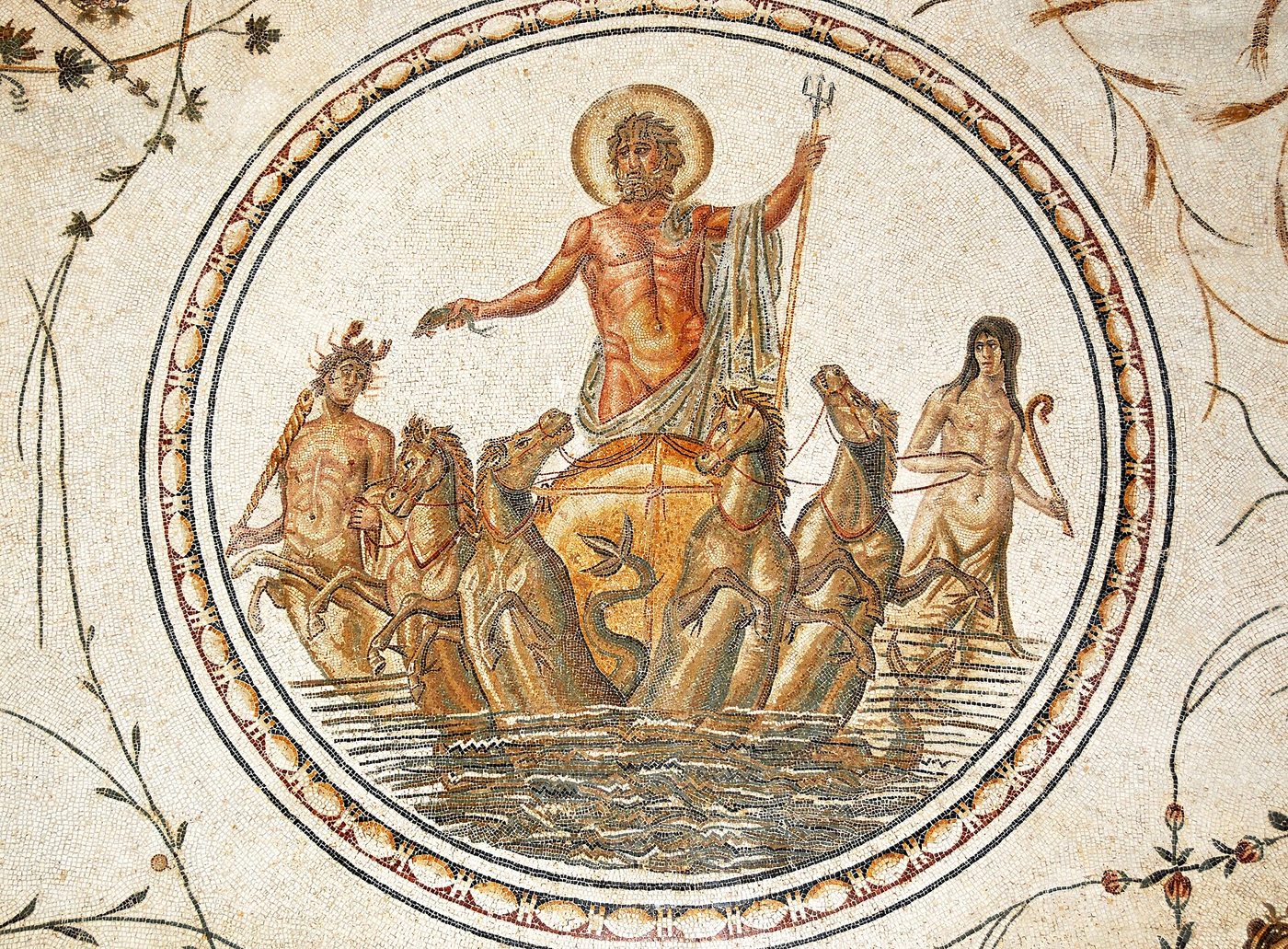
Strictly a museum rather than a ruin, but no Roman-Tunisia trail is complete without it, because this is where the mosaics went. The Bardo, housed in a former Ottoman palace on the edge of Tunis, holds one of the finest and largest collections of Roman mosaics in the world — room after room of astonishing floors lifted from El Jem, Dougga, Sousse and a hundred other sites: Virgil writing the Aeneid between two muses, Neptune riding the waves, Odysseus lashed to his mast as the Sirens sing. After a day clambering over the places these came from, seeing them whole and at eye level ties the whole story together.
Tickets & hours: 30 TND (about £7.70) in 2026; closed on Mondays, otherwise open 9am–5pm in summer and 9.30am–4.30pm in winter and during Ramadan. A combined Bardo-plus-Carthage ticket is available for 45 TND if you’re doing both. The museum reopened in September 2023 after a long closure. You’ll see it referenced in the context of the March 2015 attack here; I cover that honestly in the safety section. Verdict: unmissable, and a perfect rainy-day or too-hot-to-be-outside option. Give it half a day.
Six more sites worth the detour
These won’t all fit a one-week resort holiday, but each is a reward for the keen, and several pair neatly with the big five if you’re driving or on a private tour.
6. Thuburbo Majus

An easy hour southwest of Tunis near El Fahs, Thuburbo Majus was an Augustan colony settled by Roman army veterans, and it’s a satisfying, compact site: a fine Capitol with re-erected columns, a forum, temples to Mercury and Caelestis, and good mosaics (the best are now in the Bardo). It catches beautiful low light in the late afternoon and you’ll likely share it with nobody. Around 8 TND. With a car, it combines well with Zaghouan on a loop from Tunis or even from Hammamet.
7. Uthina (Oudhna)

A substantial Roman site about 30km south-west of Tunis, near Mornag, and weirdly overlooked. Uthina has a partly restored amphitheatre that once seated around 15,000, built into a low hill, plus huge cisterns and a capitol. It’s quiet, photogenic and cheap at 8 TND. There’s no public transport to the gate, so you’ll need a hire car or a chartered taxi, but as a short, easy add-on to a Tunis trip it punches above its weight.
8. Utica (Utique)
Ancient tradition makes Utica older than Carthage itself, the first Phoenician foothold in the region, and in 146 BC it became the capital of the new Roman province of Africa, before Carthage was rebuilt. The sea has since retreated and left it stranded inland near Bizerte, but the House of the Cascade preserves lovely mosaics, and Utica has a small national museum, opened in 1990. It’s around 8 TND. This one is for the genuinely keen — if you’re already heading north to Bizerte it’s an easy stop; otherwise it’s a long way for a subtle site. Confirm opening locally, as hours here are unreliable.
9. Zaghouan: the Temple of Waters & the great aqueduct

At the foot of Mount Zaghouan, the Romans built an elegant semicircular nymphaeum — the Temple of Waters (Temple des Eaux) — around the spring that fed their capital. From here, water ran about 90km to Carthage along one of the longest aqueducts in the Roman empire (some 132km counting its branch channels), and you can still see its great arches striding across the plain south of Tunis (the photo above shows a surviving stretch). The mountain air at the temple is cool, and the drive up through Zaghouan town is pretty. A lovely, low-key detour, ideally twinned with Thuburbo Majus.
10. Maktar (Mactaris)
High on the cool central plains at around 900m, Maktar is a deep-cut for ruin enthusiasts: a Numidian town that became Roman, with a triumphal Arch of Trajan, large baths, a forum and the famous Schola Juvenum (a young men’s college). It’s about two and a half hours from Tunis in Siliana governorate — well outside any restricted zone — and you’ll have it to yourself. Around 8 TND. Realistically one for a touring trip rather than a resort day out.
11. Kerkouane: a Punic town the Romans never rebuilt

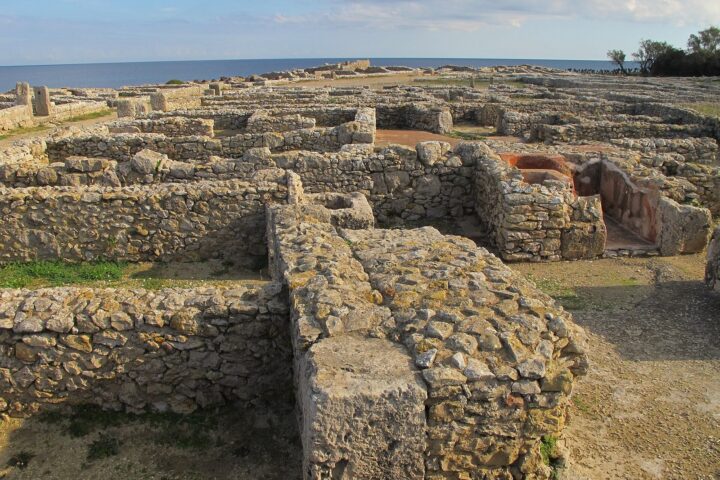
Out on the tip of Cap Bon near Kelibia, Kerkouane is, in UNESCO’s words, the only example of a Phoenicio-Punic city to have survived: the town was abandoned around 250 BC, during the First Punic War, and the Romans never rebuilt it. There are no grand temples — the magic is in the domestic detail. You walk pink-plastered streets of Punic houses, many with their own bath tubs still in place, complete with a little seat, looking out over a turquoise sea. It’s a UNESCO World Heritage Site (inscribed 1985, extended 1986) and a beautiful, peaceful spot. Around 8 TND, with a small museum (closed Mondays). It lies north-east of Hammamet, beyond Nabeul and Kelibia, and pairs well with a Cap Bon beach day.
Beyond the Romans: Kairouan and Tunisia’s ancient layers
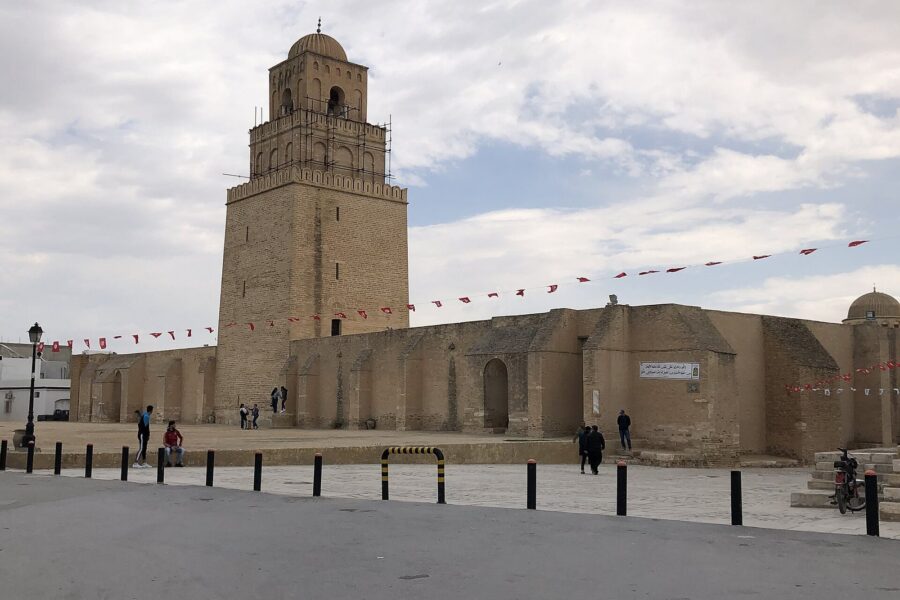
Tunisia’s “ancient sites” don’t stop with Rome, and the greatest of the rest is Kairouan — the holy city founded in 670 AD that became the cradle of Islam in North Africa, and a UNESCO World Heritage Site since 1988. Its Great Mosque of Uqba is one of the oldest and most important in the Muslim world; non-Muslims can’t enter the prayer hall but may admire it from the doorway and walk the vast marble courtyard. Add the 9th-century Aghlabid Basins — enormous open reservoirs that supplied the medieval city — and the warren of the old medina, and Kairouan is a genuine half-day highlight. A combined monuments ticket runs around 20 TND in 2026. It’s often described, particularly in North African tradition, as the fourth holiest city in Islam; dress modestly. Kairouan is an easy hour inland from Sousse and a classic pairing with El Jem on a single touring day.
The sites I don’t send people to (and why): Sbeitla, Chemtou & Haïdra
Here’s where this guide parts company with most of page one. Several “best Roman ruins in Tunisia” lists cheerfully include Sbeitla (ancient Sufetula), with its beautiful trio of forum temples, and a few mention Chemtou and Haïdra (Ammaedara). They are real and they are impressive. But Sbeitla and Chemtou sit inside areas where the UK government advises against all but essential travel, and Haïdra, also in Kasserine Governorate, is covered by the same advice — and I’m not going to point you toward a possible problem just to pad a list.
The UK Foreign, Commonwealth & Development Office (FCDO) is specific. As of its advice last updated 24 July 2026 (still current at 28 October 2026; always check the live page before you travel), it states:
“FCDO advises against all travel to: the Chaambi Mountains National Park; the designated military operations zones: Mount Salloum; Mount Sammamma; Mount Mghila.
In addition, FCDO advises against all but essential travel to: areas north and west of the town of Ghardimaou in Jendouba Governorate, including El Feidja National Park; within 20km of the Tunisia-Algeria border in El Kef and Jendouba governorates, south of the town of Jendouba, including the archaeological site of Chemtou; Kasserine Governorate, including the town of Sbeitla; within 10km of the rest of the Tunisia-Algeria border south of Kasserine Governorate; within 10km of Mount Mghila; Mount Orbata.”
For southern Tunisia it adds: “FCDO advises against all travel to: the militarised zone south of the towns of El Borma and Dhehiba; within 20km of the rest of the Tunisia-Libya border area north of Dhehiba; the town of Ben Guerdane and immediate surrounding area. In addition, FCDO advises against all but essential travel to within 75km of the Tunisia-Libya border, including Remada and El Borma but excluding Zarzis, the C118 road and all areas in Medenine Governorate north of the road.”
Read that carefully and the picture is clear. Chemtou is named outright as inside the 20km border zone. Sbeitla is named outright, because the whole of Kasserine governorate is covered. Haïdra/Ammaedara sits in the same Kasserine border country. Travelling against FCDO advice can also invalidate your travel insurance, which is reason enough on its own. So I leave all three off the trail. None of the 12 sites above is named in that advice, and nor are the coastal resorts, but check the FCDO’s regional-risks map against your own route; I cover the whole safety picture in our dedicated is Tunisia safe guide.
See this instead: if it’s the great forum-temples of Sbeitla you’re after, Dougga and Thuburbo Majus give you that same Capitol-and-forum drama in safe, accessible country. If you want a remote, lump-in-the-throat ancient town, Bulla Regia or Kerkouane deliver it without the worry. You lose nothing essential.
Tickets, prices and opening hours in 2026
Tunisia overhauled its museum and heritage pricing on 1 April 2026, so any older guide quoting “El Jem, 12 dinars” is now out of date. A national decree set a five-band tariff for non-resident visitors. Here’s how it works and where the big sites fall.
| Band | 2026 price (non-resident) | Roughly (£) | Example sites |
|---|---|---|---|
| A | 30 TND | ~£7.70 | Bardo National Museum |
| B | 20 TND | ~£5.10 | Carthage, El Jem, Kairouan |
| C | 10 TND | ~£2.60 | Mid-tier sites & museums |
| D | 8 TND | ~£2.05 | Dougga, Bulla Regia, Thuburbo Majus, Uthina, Utica, Kerkouane, Maktar |
| E | Check at the ticket office | – | Smaller sites |
A few things worth knowing about the 2026 rules:
- The flat 2 TND concession (about 50p) covers resident pupils, students and vocational trainees, accompanied children under 12, and foreign students visiting independently with an international student card. It isn’t a blanket discount for every child or student.
- Photography for personal use is now included in your ticket. You no longer buy a separate camera permit (professional photography and filming still need authorisation from the heritage agency, AMVPPC).
- Tunisians and foreign residents get free entry on the first Sunday of each month, on public holidays and on 18 April and 18 May; the free days don’t cover non-resident visitors.
- A combined Bardo + Carthage ticket costs 45 TND (about £11.50) if you’re doing both in Tunis.
- Heads-up for later trips: Carthage, El Jem and Kairouan are due to rise to 30 TND from 2027 and move up a band again in 2028, so 2026 is a good year to visit.
Opening hours aren’t fixed by the decree and vary by site and season, so check each one. The Bardo opens 9am to 5pm in summer and 9.30am to 4.30pm in winter, and is closed on Mondays; the El Jem museum keeps 8am to 6.30pm in summer and 8am to 5.30pm in winter. During Ramadan, hours are shorter and often end mid-afternoon. Times can change, so for a long drive to somewhere like Dougga or Maktar, it’s worth confirming on the day.
Getting to the ruins from your resort
This is the question no one answers, so here’s the honest version, resort by resort. The single most important thing to grasp is that Tunisia’s Roman sites cluster in two areas: the far north around Tunis (Carthage, Dougga, Bulla Regia, Thuburbo Majus, Uthina, Utica, Zaghouan) and the Sahel near Sousse (El Jem, Kairouan). Where you’re staying decides what’s realistic.
From Tunis
You’re in the best possible base. Carthage is on the TGM line; Uthina, Thuburbo Majus and Zaghouan are within reach by car; Dougga and Bulla Regia make long day trips, easiest with a car or driver. If ruins are your priority, stay a couple of nights in Tunis or Sidi Bou Said — our Tunis guide and our where-to-stay guide cover the options.
From Hammamet & Yasmine Hammamet
A good central base. El Jem lies to the south, beyond Sousse; Carthage and the Bardo are north, around Tunis (very doable as a self-drive or private-driver day); Kerkouane is out on Cap Bon, north-east of Hammamet; Thuburbo Majus and Zaghouan are inland to the west. Dougga is a committed full-day push but possible with an early start. See our Hammamet guide for excursion desks and transport.
From Sousse, Port El Kantaoui & Monastir
The Sahel resorts are perfectly placed for the two Sahel giants: El Jem is about an hour by train or car, and Kairouan about an hour inland — you can do both in one big day, which is exactly the classic excursion every operator here sells. The northern sites (Carthage, Dougga) are much further, around and beyond Tunis, so they’re a long day or an overnight in Tunis rather than a casual outing. Full detail in our Sousse & Sahel guide.
From Enfidha
If you flew into Enfidha–Hammamet airport and are staying nearby, you’re roughly midway between the two clusters — El Jem and Kairouan to the south, Carthage and Zaghouan to the north — all within day-trip reach with a car or driver.
From Djerba — the honest truth
I’ll be straight with you: if you’re on a package in Djerba, the mainland sites on this trail are a long way off for a day trip. El Jem is around four hours’ drive each way; Dougga is the far end of the country. Djerba’s brilliant for beaches, its own island culture and a Sahara excursion, but for Roman ruins you’d need to build a touring trip rather than expect a day out. Don’t book a Djerba beach week expecting to “pop to Carthage.”
Tour, hire car or louage? How to actually get around
There are three honest ways to reach these sites, and the right one depends on how much you value comfort versus adventure versus money.
- Organised excursion (resort coach or private driver-guide). The path of least resistance. Resort excursion desks sell El Jem + Kairouan day trips and, from the north, Carthage + Sidi Bou Said + Bardo combinations. For the harder-to-reach interior — Dougga, Bulla Regia — a private driver-guide for the day is the sweet spot: expect somewhere in the region of £60–110 for the car and driver depending on distance and your bargaining, split between up to three or four of you. No checkpoints to navigate, no parking, and a guide who can read the site.
- Hire car. The most freedom, and Tunisian roads to the main sites are fine — the A1 motorway runs down the Sahel, and the roads to Dougga and Bulla Regia are decent. Budget around £25–40 a day. Be ready for police checkpoints (routine, polite, have your papers and an International Driving Permit), assertive city driving in Tunis, and livestock on rural roads. Our itinerary guide maps out road-trip routes.
- Louage + taxi (the DIY adventure). Tunisia’s shared long-distance taxis are cheap, frequent and a genuine slice of local life — a louage from Tunis to Téboursouk costs a few dinars. The catch is the last mile: sites like Dougga, Bulla Regia and Uthina lie outside the nearest town, so work out how you’ll cover the final stretch to each one before you set off. Brilliant if you have time and patience; frustrating if you’re on a tight schedule.
My rule of thumb: train to El Jem, TGM to Carthage, private driver for Dougga and Bulla Regia, hire car if you want to tour the lot.
Sample itineraries for Roman Tunisia
However much time you have, here’s how I’d spend it.
Half a day (from a Sahel resort): the El Jem run. Train or coach to the amphitheatre, an hour and a half on site plus the museum, back for the afternoon by the pool. The most ruin-per-effort on this whole list.
One full day (from Sousse/Hammamet): the classic double — El Jem + Kairouan. Amphitheatre in the morning, the holy city and Aghlabid Basins after lunch. Long but hugely rewarding, and the standard operator excursion.
One full day (from Tunis): Carthage + Sidi Bou Said by TGM, finishing at the Bardo if your legs hold out. A perfect first-timer’s day that mixes ruins, a gorgeous clifftop village and the world’s best mosaics.
Two to three days (touring): base in Tunis. Day one, Carthage and the Bardo. Day two, a private driver west to Dougga and Bulla Regia (the great pairing). Day three, south to Thuburbo Majus, Zaghouan and Uthina, or onward to El Jem and Kairouan. This is the heart of a proper Tunisia touring itinerary, and it’s the trip the country deserves.
Follow the mosaics: Tunisia’s Roman mosaic trail
One thread ties this whole story together, and it’s worth chasing on its own: mosaics. Roman Africa produced the richest mosaic art in the empire, and Tunisia has the lion’s share of what survives. If floors of tiny coloured stone are your thing, follow them like this:
- The Bardo, Tunis — the mothership, where the masterpieces from every site ended up.
- The El Jem Archaeological Museum — superb mosaics displayed in a reconstructed Roman villa, included with your amphitheatre ticket.
- The Sousse Archaeological Museum — the second-finest mosaic collection in the country after the Bardo, including the famous Triumph of Bacchus, and easy to combine with a Sahel beach stay.
- In situ at Bulla Regia — mosaic floors still in the underground rooms where the Romans laid them; admire them without stepping on them.
Do all four and you’ve seen the best Roman mosaic art anywhere on the planet, full stop.
When to go, what to wear and accessibility
When to go. Spring (March–May) and autumn (September–November) are ideal: warm, clear and, at the inland sites, mercifully bearable. The interior sites — Dougga on its sloping plateau, Maktar up on the high plains, Kairouan — get fiercely hot in July and August. If you’re here in the heat, go at opening time, take more water than you think you need, and be off the site by late morning. Spring has the bonus of wildflowers carpeting the ruins. For the full picture, see our best time to visit Tunisia guide.
What to wear. Proper shoes — these are uneven, ankle-turning sites of 2,000-year-old stone, not paved museums. A hat, high-factor sun cream and a refillable water bottle are non-negotiable outdoors. For Kairouan’s Great Mosque and other religious sites, dress modestly: shoulders and knees covered for everyone, and women may be asked to cover their hair at mosque entrances.
Accessibility. Be realistic: most of these sites are challenging for anyone with limited mobility. Expect rough ground, loose stone, steep theatre steps and, at Bulla Regia, staircases down into the villas. El Jem has the most even main concourse but still involves steps to the upper tiers and down into the hypogeum. The Bardo, as an indoor modern museum, is by far the most accessible option and the one I’d point anyone with mobility needs toward first. There’s little in the way of ramps, lifts or accessible toilets at the open-air sites, so plan accordingly.
Frequently asked questions
Does Tunisia really have Roman ruins?
It has some of the best in the world. For roughly six centuries this was Roman Africa, the empire’s grain and oil powerhouse, and it’s left an extraordinary density of amphitheatres, temples, baths and whole towns. Carthage, Dougga and El Jem are UNESCO World Heritage Sites, and so is the Punic town of Kerkouane. Many are better preserved, and far less crowded, than comparable sites in Italy.
What is the best-preserved Roman town in Tunisia?
Dougga, without much argument — UNESCO itself calls it the best-preserved Roman small town in North Africa. You walk a near-complete hillside town with its streets, theatre, temples and Capitol largely intact. Bulla Regia runs it close for sheer uniqueness, thanks to those underground villas.
Is El Jem bigger than the Colosseum?
Not quite — El Jem is one of the largest amphitheatres the Romans built, holding up to 35,000 people. But it’s far better preserved in places than people expect, and because there are no crowds and no ropes, it often feels like the more thrilling visit.
Can you visit Carthage from Tunis?
Yes, and it’s effortless. The TGM light railway from Tunis Marine runs to Carthage and continues to the village of Sidi Bou Said. Carthage’s grouped ticket costs 20 TND; check at the ticket office which sites it includes and how long it’s valid.
How much does it cost to see Tunisia’s Roman ruins?
Very little. Under the 2026 national tariff, El Jem and Carthage are 20 TND each (about £5), the Bardo is 30 TND, and sites like Dougga, Bulla Regia and Kerkouane are around 8 TND (roughly £2). Resident pupils and students, accompanied under-12s and foreign students visiting independently with an international student card pay a flat 2 TND, and personal photography is included.
Is it better to visit on a tour or self-drive?
For the easy sites — El Jem by train, Carthage by TGM — go independently. For the harder interior sites like Dougga and Bulla Regia, a private driver for the day (around £60–110 for the car) is the best balance of comfort and freedom. Hire a car only if you’re happy with checkpoints and Tunisian city driving.
When is the best time to visit the ruins?
Spring (March–May) or autumn (September–November). Many inland sites are exposed to the summer heat, so if you visit in July or August, go at opening time and carry plenty of water.
Is it safe to visit Tunisia’s archaeological sites?
None of the 12 sites in this guide, or the coastal resorts, is named in the UK FCDO’s regional advice (updated 24 July 2026), but that advice lists only the areas it warns against, so check it against your own plans. The only Roman sites I’d avoid are Sbeitla, Chemtou and Haïdra, which sit in or beside the FCDO’s advisory zones near the Algerian border. Always check the current FCDO advice before you travel.
Where can I see the famous Tunisian mosaics?
Chiefly the Bardo National Museum in Tunis, which holds one of the world’s greatest collections, plus the El Jem and Sousse museums, and — uniquely — in situ on the floors at Bulla Regia.
Site by site: our history & heritage guides
- Ancient Carthage: a traveller’s history
- El Jem: visiting Africa’s Colosseum
- Dougga: the best-preserved Roman small town in North Africa
- Bulla Regia: Tunisia’s underground Roman villas
- Kairouan: Tunisia’s holy city
- Tunisia’s UNESCO World Heritage sites
- The mosaics of Tunisia & where to see them
- Kerkouane: the Punic town on Cap Bon
- Zaghouan & the Roman Aqueduct of Carthage
Photo credits
All images are used under their respective licences. Thank you to the photographers who share their work:
- El Jem amphitheatre — photo by Agnieszka Wolska, CC BY-SA 3.0, via Wikimedia Commons.
- Inside the El Jem arena — photo by Diego Delso, CC BY-SA 4.0, via Wikimedia Commons.
- The Capitol at Dougga — photo by Dennis G. Jarvis, CC BY-SA 2.0, via Wikimedia Commons.
- The Antonine Baths, Carthage — photo by Tamerlan Dulaev, CC BY-SA 4.0, via Wikimedia Commons.
- Bulla Regia — photo by Verity Cridland, CC BY 2.0, via Wikimedia Commons.
- The Virgil mosaic (Bardo National Museum) — photo by David Stanley from Nanaimo, Canada, CC BY 2.0, via Wikimedia Commons.
- Thuburbo Majus — photo by Skander zarrad, CC BY-SA 4.0, via Wikimedia Commons.
- The amphitheatre at Uthina (Oudhna) — photo by M.Rais, CC BY-SA 3.0, via Wikimedia Commons.
- A surviving stretch of the Zaghouan–Carthage aqueduct — photo by Maison Méditerranéenne Des Sciences de l’Homme Phonothèque, André Raymond, Licence Ouverte, via Wikimedia Commons.
- Punic Kerkouane on Cap Bon — photo by Christian Manhart, CC BY-SA 3.0 igo, via Wikimedia Commons.
About this guide. Written by the tunisiatourism.org editorial team, with UNESCO, Tunisia’s heritage authority and current UK FCDO travel advice as sources. Prices reflect Tunisia’s national heritage tariff effective 1 April 2026; exchange rates and opening hours change, so treat figures as a guide and confirm locally. Last updated: June 2026.
If the ruins are your reason for coming, round out the picture with Tunisia’s living culture — the souks and hammams the Romans would recognise — the food guide, the Star Wars sets (Tunisia’s other film-set history), and the travel tips for site-day logistics.
5 responses to “Roman Ruins in Tunisia: The 12 Best Ancient Sites (2026 Guide)”
[…] being hoisted up through trap doors into the arena. It is one of the finest of Tunisia’s Roman ruins, and for our money the single most impressive thing you can see from Sousse in a […]
[…] — is tremendously atmospheric. If old stones are your thing, pair this with our guide to the Roman ruins of Tunisia for the country’s other great historical […]
[…] the finest collection of Roman mosaics anywhere — entire floors lifted from villas at Sousse, El Jem, Dougga and Carthage and hung like paintings up the palace walls. The star is the 3rd-century […]
[…] you travel. With 5 days, pair the coast with a single desert overnight. Seven days adds Kairouan, El Jem and a proper southern loop. Ten to fourteen days lets you circle Tunis, the Sahara and Djerba […]
[…] palace was the obvious home. To see where they came from, pair the museum with our guide to Roman ruins in Tunisia — the Bardo makes far more sense once you’ve stood in the villas these floors were cut […]